
Training Science
TRANSFER OF STRENGTH: WHAT CAN STRONGMAN LEARN FROM OTHER SPORTS? | Episode 5: Athletics Throwing Events: Impulse, Acceleration and Coordination of Explosive Movements
October 28, 2026
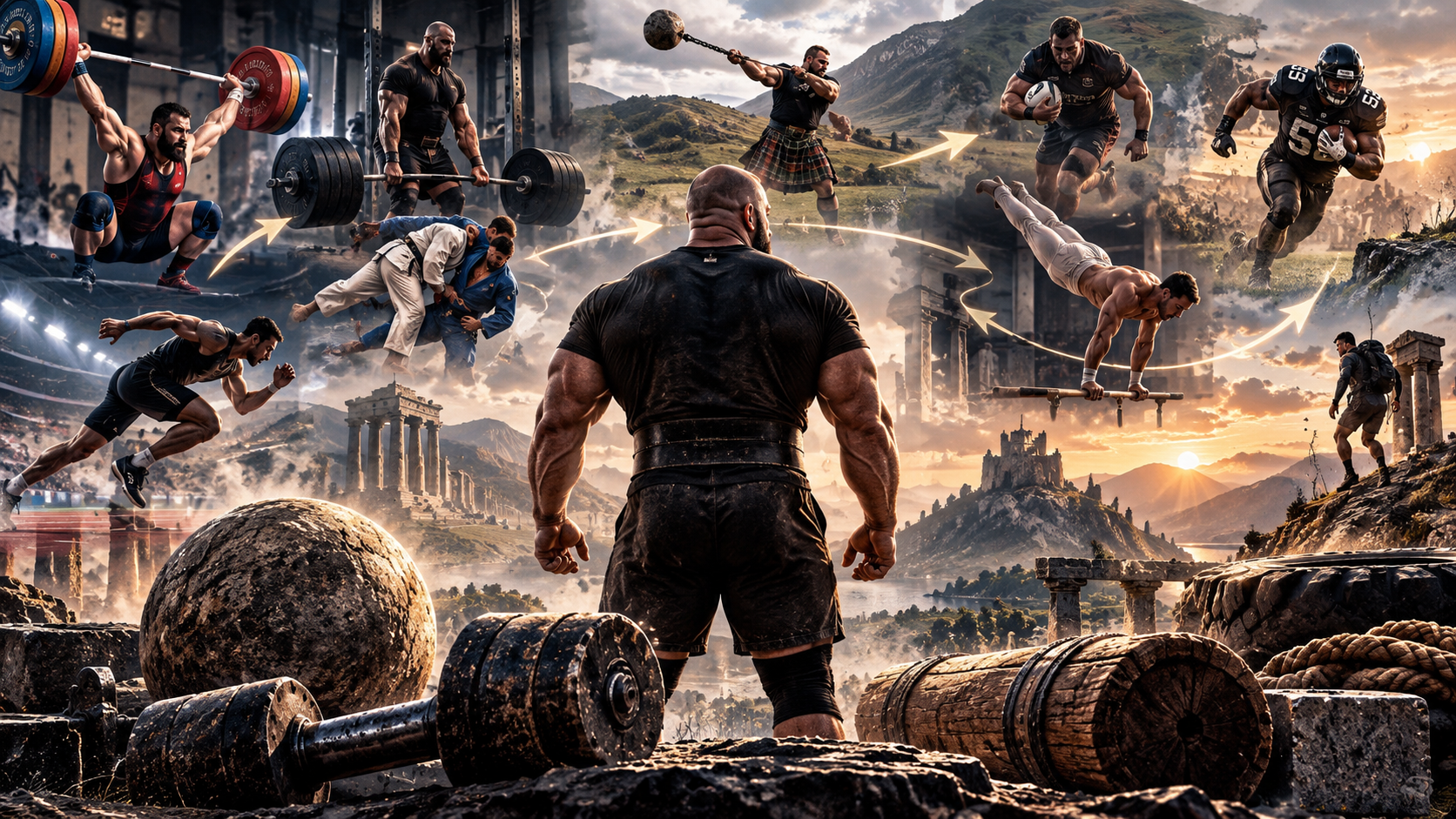
Athletics Throwing Events: Impulse, Acceleration and Coordination of Explosive Movements
Why track-and-field throwing is a distinct resource for strongman science
Athletics contains four principal Olympic throwing disciplines: shot put, discus, hammer and javelin. All require an implement to be accelerated and released under competition rules, yet they differ dramatically in mass, geometry, trajectory and interaction with the environment. Shot put uses a push from near the neck; discus relies partly on aerodynamics and distinctive rotation; hammer throwing uses a mass connected through a wire; javelin combines a run-up with an elongated aerodynamic object. Strongman may include partially related throws, but its implements are often heavier and less standardized. Transfer cannot be inferred simply because each event is called throwing [1–3].
Compared with the Highland Games addressed previously, Olympic throwing has a more extensive instrumentation literature, including three-dimensional motion analysis, force-platform measurement and biomechanical energy-flow modeling. This allows closer examination of mechanisms without itself proving that they transfer to strongman. A study of discus release speed describes that event and can motivate a hypothesis about accelerating external objects. To establish that an athletics-inspired intervention improves a strongman event, the target result must be measured.
Meron and Saint-Phard's 2017 review described the kinetic-chain demands of throwing, emphasizing coordination across the legs, pelvis, trunk, shoulder and arm and discussing associated injury mechanisms [3]. The kinetic-chain concept must not be interpreted as a simple rigid sequence in which each segment passes all its energy directly to the next. Joints may produce or absorb energy at different moments, and transmission depends on body position, contact and timing.
Potential value for strongman includes learning to generate impulse and coordinate body segments while accelerating an object. During Bag Toss, release timing and the vertical component of velocity matter greatly. During a heavy sled or vehicle push, force must be applied in an effective direction and time interval but the object stays in contact with the athlete. Some physical capacities overlap, while projectile release and continuous contact remain mechanically distinct.
Throwing performance also reflects more than general maximal strength. A high-level thrower may achieve great distance through a combination of muscular capacity, long practice, release mechanics and precise coordination. A strongman may have immense strength but limited experience with rapid implement release. Comparing the two without accounting for technique may attribute too much of the difference to one physiological variable.
This episode focuses on modern competition rules, projectile mechanics, linear and rotational approaches, impulse, energy transfer between body segments and limits of cross-sport application. It does not repeat the catalogue of Highland traditions. Numerical examples are explicitly idealized physical calculations rather than invented records of real athletes.
2026 rules and why standardized implements matter
World Athletics competition rules for 2026 specify implements for recognized throwing events. At senior level, the men's and women's shots are 7.260 kg and 4 kg respectively, the discuses 2 kg and 1 kg, the hammers 7.260 kg and 4 kg, and the javelins 800 g and 600 g. Younger age categories use other specifications. These values matter because mass affects how much energy is needed to reach a given velocity and which acceleration strategies are feasible. They must not be conflated with the loads used in traditional Highland Games or strongman throws [1].
Shot put is performed from a 2.135 m circle and has a front stop board, with the implement put from the neck or chin rather than thrown like a freely swung ball. Discus uses a 2.5 m circle. Hammer throwing has circle, cage and landing-sector requirements, while javelin uses an approach runway and specific landing rules. Such standardization enables clearer comparisons than events using widely variable implements, though technique and environmental conditions still affect performance [1,4].
Rules help define efficient movement. A shot putter cannot choose any release action, since the implement must maintain prescribed position and contact during the put. Javelin orientation and landing influence validity, while its aerodynamic flight means release speed alone cannot completely explain range. In discus, high release speed combined with unfavorable implement orientation can produce a disappointing result. Competition rules are therefore not a decorative addition to biomechanics; they define the performance task.
Standardized implements reduce one source of variation in research. When athletes use identical official objects, measured differences may more plausibly reflect movement characteristics after controlling relevant conditions. But not all confounding disappears: athlete size, release height, approach speed, weather and measurement methods still matter. Standardization is useful without turning ordinary competition into a controlled laboratory experiment.
Strongman implements can be standardized within one event but differ between organizers. A better regulation-shot performance cannot be converted through a simple equation into higher clearance with a 20 kg sandbag or more repetitions at a log. Different mass and movement constraints change the relevant motor problem. The actual strongman task must be tested separately.
Terminology also matters. Shot put is a put, modern Olympic hammer uses a wire and handle, and traditional Scottish hammer employs a rigid shaft and different footwork constraints. Treating these as identical techniques risks misleading exercise recommendations. Mechanical specificity provides the starting point for useful cross-sport comparisons.
Projectile physics: impulse, acceleration and release velocity
In Newtonian mechanics, momentum change equals net impulse: J = ∫F_net dt = m(v_f − v_i) for an implement of constant mass. Release velocity depends on the net force applied over the acceleration interval, not merely on the peak force recorded at one instant. An athlete may produce a very large force briefly yet fail to supply sufficient useful impulse. Another may coordinate force magnitude, direction and duration more efficiently. This is a physical relationship rather than a complete account of neural activation or muscular contraction.
For an illustrative calculation, accelerating a 7.26 kg shot from rest to 12 m/s gives a momentum change of about 87.1 kg·m/s, corresponding to 87.1 N·s of net impulse in the idealized model. If acceleration lasts 0.30 seconds, the mean net force component along the velocity change is roughly 290 N. That is not a measured hand force because gravity and changing contact conditions also act on the implement. The distinction prevents a correct mechanical identity from being misrepresented as a direct biomechanical measurement.
Translational kinetic energy at release is E = mv²/2. For the same 7.26 kg shot, 12 m/s corresponds to approximately 523 J, while 13 m/s gives about 613 J. This increase of roughly 90 J does not describe the athlete's full internal work or any rotational energy. The equation clarifies why release velocity strongly influences performance without explaining the adaptation required to increase it.
For an ideal projectile released and landing at the same height without air resistance, R = v² sin(2θ)/g. An angle of 45 degrees maximizes range only in this restrictive case. Real shot, discus and javelin releases can begin above landing height, and aerodynamic effects, technique-dependent speed and competition rules alter the optimal angle. Recommending exactly 45 degrees to every thrower is a misuse of an elementary model.
Strongman Bag Toss shares the relationship between vertical release velocity and attainable height, but sandbag mass, shape, rotation and contact change technique. A heavier sandbag will not necessarily leave the same athlete's hands at the same speed. Transfer of impulse-production skill from athletics remains a hypothesis requiring event testing. In Truck Pull or Vehicle Push, impulse changes the velocity of a continuously contacted object, while friction and traction become central.
Measurements must match the chosen system. A sensor attached to one body segment does not automatically measure impulse transmitted to the implement. A single camera may not reconstruct the complete three-dimensional trajectory. Force platforms describe ground reactions under specific conditions, but implement force requires accounting for other interactions. Numerical calculations can be dimensionally correct and still biomechanically misleading if the measured object and model assumptions are not clearly identified.
Shot put: glide and rotation solve the same objective differently
Shot put is a useful case of technical specialization because athletes must achieve high release speed while keeping the implement close to the neck before the final put. Two major technical families are the glide and rotational styles. In the glide, the athlete moves largely from the rear toward the front of the circle, organizing a power position and final delivery. In the rotational style, the athlete develops and manages angular momentum over several phases. Both methods have supported high performance, but their balance, timing and segment sequencing requirements differ [4,5].
A Sports Biomechanics review covering twenty studies analyzed the six phases of rotational shot put and emphasized angular momentum, implement path and timing. Movements in earlier phases influence final acceleration, making coaching focused solely on the last arm action potentially incomplete. This does not identify one universal kinematic sequence for every thrower; it shows that performance is a coordinated system in which phases interact [5].
A preliminary comparison of technique variability among elite and sub-elite athletes examined how glide and rotation performance depends on technique and individual characteristics. It should not be transformed into a universal declaration that one method is always superior. A glide may be a useful learning pathway for one athlete, while another has previous rotational skill. Both require specific practice under the restrictions of the throwing circle [6].
For a strongman, the main lesson may not be copying the entire rotation but learning to coordinate body acceleration with a powerful final push. Selected medicine-ball throws or other ballistic pushing tasks may be useful candidates. A log push press, however, operates with different loading and requires overhead stabilization, while a pushed vehicle remains in contact with the athlete. Shared lower-body involvement is not direct evidence of identical transfer.
Biomechanical analysis can separate phases, but those phases are interdependent. Changing foot placement can change trunk rotation and the onset of arm acceleration. Demonstrating the effect of a technical change requires comparable attempts, not merely attractive photographs. A visually graceful path does not necessarily maximize release speed for every athlete.
Strongman athletes who struggle to coordinate a ballistic push may reasonably test shot-put-inspired exercises. If their actual target is a vertical bag toss, however, release direction and implement handling are different. The auxiliary method needs a defined physical aim and target-event evaluation rather than a promise that shot put automatically improves all presses and throws.
A controlled study could assign strongmen practicing the same target event to different auxiliary programs, including throwing drills inspired by shot put. The main outcome should be a strongman performance measure, not solely medicine-ball distance. Positive findings would need uncertainty intervals, while null findings could be useful for improving exercise selection.
Discus: release speed interacts with aerodynamic orientation
Discus throwing illustrates why a simple projectile model cannot explain every event. The flattened implement rotates through the air, generating aerodynamic forces dependent on orientation. A high-speed launch can yield modest range if the discus is badly aligned relative to the airflow. Conversely, favorable orientation can improve flight without equivalent increases in release velocity. This differs substantially from a strongman sandbag, which has another shape, mass distribution and aerodynamic behavior.
Bartlett's 1992 review examined discus biomechanics through the launch and flight phases, emphasizing the complex relationship between athlete movement and aerodynamic implement behavior. Although the publication is older, its fundamental physical distinctions remain relevant while later research can refine measurements and models. Two separate questions need study: how the athlete produces release conditions and how the discus behaves once released [7].
Lift and drag depend on the implement's angle of attack and its velocity relative to the air. An ideal projectile formula predicting maximum distance at 45 degrees is therefore inappropriate for explaining an actual discus throw. Maximum release speed alone also does not guarantee maximum range when orientation is unfavorable. This provides a broader lesson for strongman: success depends on how the object behaves after release as well as on the energy supplied to it.
A sandbag is not aerodynamically equivalent to a discus, and its relatively heavy mass may make some aerodynamic effects less dominant. Yet orientation and tumbling can affect whether the entire bag passes a horizontal bar. The useful transfer may therefore concern attention to release conditions rather than copying rotational discus technique. Coaches can borrow a measurement principle without importing an entire movement pattern.
Segmenting discus technique into support, rotation and delivery phases may help describe acceleration, but should not be treated as a mechanically rigid energy sequence. A lower-limb change may alter trunk timing and release, and athletes may trade rotation speed against control of the throwing sector. Similar constraints occur when a strongman accelerates a bag but loses the direction needed for clearance. In both sports, valid performance matters more than an isolated mechanical metric.
A transfer experiment should select a common measurable capacity, such as rotational coordination under load or release speed in a related throw, then demonstrate an effect on the strongman target event. Specific practice time must be controlled. Without this, better discus performance remains an athletics accomplishment rather than proof of improved strongman competition results.
The discus offers an important methodological lesson: once an object is airborne, body force cannot be analyzed independently of object geometry and the environment. Aerodynamic effects may be minor for some strongman implements, whereas orientation and rotation can decide clearance for others. Exercise selection should follow the actual physical constraint, not superficial visual resemblance.
Olympic hammer: rotation, cable tension and the Scottish-hammer distinction
Track-and-field hammer throwing uses a metal ball connected by a wire to a handle, with athletes typically performing multiple turns inside a circle. Unlike the rigid-shaft Scottish hammer and its traditional support methods, the Olympic event is organized around the interaction of body rotation, cable tension, trajectory radius and release timing. Turn count and technique vary, while scoring rewards the greatest valid range in the throwing sector [1,3].
Cable tension contributes to changing the direction of implement velocity, while tangential acceleration contributes to increasing its magnitude. For a given radius, the required radial acceleration scales with speed squared. Yet high cable force is not equivalent to useful energy transfer into launch speed: a predominantly radial force can redirect velocity without proportionately increasing tangential speed. Complete performance depends on how acceleration and control develop throughout the throw.
Consider an illustrative 7.26 kg implement moving at 25 m/s on an idealized radius of 1.8 m. The corresponding radial acceleration is approximately 347 m/s², and mass times acceleration is around 2,520 N. This is not a measurement from an actual throw and does not represent internal shoulder or spinal force. Radius, velocity and tension vary during authentic competition. The calculation merely illustrates substantial radial demands during high-speed curved motion.
Hammer throwing requires controlled support changes, balance and coordination between body movement and implement trajectory. Increasing body rotation speed without maintaining effective implement interaction can harm the final delivery. This explains why technical experience matters and why enormous maximal strength does not automatically produce an elite hammer thrower. Years of practice can shape the specific movement solution.
Direct transfer to strongman is most plausible in tasks involving swinging or rotational acceleration. Many heavy carries and lifts have different mechanics. General adaptability in controlling changing force direction or segment timing remains an unverified hypothesis rather than a quantified benefit. A two-handed sandbag toss does not reproduce the orbit of a wire-connected hammer.
Safety requires an appropriate throwing cage and sector, verified equipment, restricted access and competent supervision. A strongman should not attempt Olympic hammer technique in an ordinary gym or an area with bystanders. Other controlled exercises may train related general capabilities at lower logistical cost without claiming an identical mechanical stimulus.
The transfer outcome is ultimately the target event. Improvement in Olympic hammer establishes progress in athletics; a strongman benefit requires a separate competitive result measured with suitable controls. Shared use of heavy moving objects is insufficient to prove shared bottlenecks or a predictable transfer coefficient.
Javelin: converting approach speed into aerodynamic release
Javelin differs from other throwing events through its run-up and the need to transfer motion into a relatively light, elongated aerodynamic implement. The movement includes acceleration, transition, crossover steps, controlled blocking of the lower body and final delivery. A strongman Bag Toss may involve a swing or limited approach, but the implement is much heavier and does not behave aerodynamically like a javelin. Direct technical transfer is therefore restricted even though both require coordination of impulse and release.
The classic javelin biomechanics review examined release speed, height, angle, implement pitch, angle of attack, wind, grip, run-up and final strides. Its central mechanical distinction is that an aerodynamic object does not obey the full range predictions of a projectile model without air. Release angle and angle of attack are not the same quantity. The first describes velocity direction; the second the implement's orientation relative to the surrounding air. Confusing them leads to poor technical interpretation [8].
The approach gives the athlete horizontal center-of-mass velocity, but success depends on redirecting useful movement into the javelin. Faster running does not guarantee longer throws if the athlete cannot coordinate the final phase. Ineffective blocking can impair release trajectory, while too little approach momentum may limit the available movement resource. The solution requires coordination rather than maximizing one isolated indicator.
The final delivery involves rapid changes in segment position and velocity. The throwing arm may move very fast, but contributions from the lower body and torso cannot be quantified correctly from a frontal video alone. Appropriate instrumentation is needed for estimates of internal mechanics and energy flows. Observing a blocking action does not prove that all energy from earlier segments enters the javelin. Some may be absorbed or redirected.
For strongman, the useful concept is coordination of approach and impulse before object release. Many Bag Toss formats offer limited space and much heavier loads, altering how much running speed can be used. An approach-assisted medicine-ball throw might be a reasonable coordination exercise, but its value must be tested on the bag itself. Javelin velocity or range cannot be assumed to predict strongman performance.
Safety distinctions are substantial. A javelin is sharp and requires an appropriate throwing sector, restricted access and careful implement retrieval. It should not be used casually in unsuited training areas for auxiliary purposes. Strongmen interested only in general acceleration capabilities may select safer alternatives, while acknowledging that they do not replicate the Olympic event.
The lesson is that useful interdisciplinary training need not copy the entire movement. Javelin provides insights about the interaction among run-up, blocking and release without requiring a strongman to become a competitive javelin thrower. Transfer is established only when training those mechanisms changes a relevant result with the target strongman implement.
Segmental energy flow in elite throwing: what instrumented studies reveal
A 2019 biomechanics study investigated mechanical energy flows among body segments in shot put, discus and javelin among elite Polish national-team throwers. The researchers used Vicon motion capture and Kistler force platforms, calculating power and energy behavior during final acceleration. The aim was to evaluate mechanical energy transfer within throwing rather than show that any particular training program improves strongman performance [9].
The authors reported discipline-dependent patterns and correlations with individual best performances. Part of the analysis described an average energy loss from shoulder to wrist expressed relative to body mass, around 1.63 J/kg. This is not a universal percentage of energy wasted by throwers. Interpretation depends on the model, selected segments and definitions of mechanical energy. The supported conclusion is that energy flow can be investigated, not that every observed negative value is a technical error that can simply be eliminated.
Relationships between mechanical variables and personal records differed in sign and magnitude across events. Correlations do not show that changing a specific mechanical indicator will necessarily cause a better throw. Athletes of different performance levels may use different techniques, and unmeasured variables may influence both the mechanical estimate and the final result.
For readers unfamiliar with laboratory mechanics, the body is not one rigid lever throwing an object. Its segments can generate, absorb and transfer mechanical energy as their movement changes. One part may accumulate kinetic energy and subsequently decelerate while another accelerates. This coordination contributes to a rapid release without requiring an identical sequence in every individual.
Transfer to strongman needs caution. Energy-flow analysis of an Olympic throw can inspire questions about coordination of the hips, trunk and arms during Bag Toss. Its reported numerical values cannot be copied into models of sandbags or giant dumbbells because implements, populations, directions, time windows and measurement methods differ. The study supports mechanistic reasoning, not strongman effect-size predictions.
A relevant strongman experiment could use three-dimensional motion analysis and ground reactions during standardized manageable implement tasks, with competitive outcomes measured before and after intervention. Internal energy estimates would remain model-dependent rather than direct measurements of every muscle. Event success, such as valid height, would remain the performance criterion, while the model provides possible explanation.
The study's real value is showing that segmental acceleration and energy transmission can be examined with established tools. Translating those methods to strongman is a promising research direction, but not evidence that Olympic throwing should replace implement-specific training. Distinguishing measurement capability from proved training transfer prevents overstating the findings.
Release speed, angle and height form an interacting optimization problem
Throwing distance is often explained almost entirely through object velocity. Speed matters greatly, but release angle, height, aerodynamics and movement constraints also contribute. Changing angle to create a higher trajectory may reduce the speed an athlete can actually generate in that direction. The best angle is not solely an equation from ideal projectile physics; it interacts with the movement capabilities of the person.
In the ideal no-air, equal-height projectile model, increasing initial velocity by 10% increases range by roughly 21% when angle is unchanged. A real thrower may not be able to produce that extra speed without changing release direction or body position. An aerodynamic discus can also respond differently to orientation from a compact shot. The mathematical percentage does not represent a demonstrated effect of any training method.
For an object released from initial height y0, the ideal vertical position is y(t) = y0 + v_y t − gt²/2. Without air resistance, time to maximum height is v_y/g, and additional rise is v_y²/(2g). These equations clarify the vertical velocity requirements of Bag Toss, but crossing a bar depends on orientation and horizontal location when the object's path intersects the obstacle.
A hypothetical release at 2.0 m with vertical velocity 6.5 m/s reaches a maximum center-of-mass height around 4.15 m in the simple model. This does not mean a bar placed at 4.15 m will be cleared, because a sandbag has finite dimensions and may strike it. Nor does the result reveal the athlete's required hand force; that would require mass, acceleration duration and pre-release dynamics.
In shot put, release height depends on stature and delivery technique. In javelin, orientation and aerodynamic effects make optimal conditions differ markedly from a simple projectile. In discus, rotation and wind add further complexity. Physics remains indispensable, but the correct model must match the dominant features of the event. A calculation can be arithmetically impeccable and still omit the decisive variable.
For transfer to strongman, first identify the limiting factor. Insufficient vertical velocity might justify training impulse production. Adequate velocity with poor trajectory suggests release practice. Losing sandbag contact before final acceleration suggests grip or implement-handling work. Scientific programming begins with this task diagnosis rather than selecting exercises solely for a presumed universal power benefit.
There is no valid universal release-angle recommendation for every strongman throw. Implements and rules vary among distance, height and platform tasks. Even the same event may require different solutions under different equipment conditions. Repeatable measurements and individual adjustments are more useful than a supposedly magical angle.
Biological determinants: lean mass, neural drive and fast fibers
A 2021 review of biological determinants of track-and-field throwing summarized reported associations involving lean body mass, neural activation and the cross-sectional area of type II fibers. Its authors acknowledged that available evidence was insufficient for strong statistical claims about every mechanism [10]. For strongman this limitation is essential: biological resources may support power without determining a specific bag-toss height or log-lift record.
An athlete with substantial muscular mass may produce great force but fail to coordinate release of a heavy sandbag. A highly skilled thrower may achieve remarkable release speed with somewhat different maximal-strength resources. This is not an opposition between strength and technique. Competitive performance requires several conditions to function together.
Electromyography cannot be used as a simplistic proof of exercise effectiveness. Signal amplitude is affected by electrode placement, normalization and tissue geometry. A larger electrical signal does not establish greater external force. Research should connect muscle measurements to implement kinematics and the actual outcome rather than treating activation as a performance ranking.
Fiber composition can influence rapid force production, but it is not sufficient to explain throwing. Fascicle architecture, tendons, coordination and practice also contribute. Coaches cannot infer an athlete's fiber distribution from appearance. Programming based on imagined internal physiology is less defensible than identifying observable bottlenecks such as inadequate release velocity, poor trajectory or insecure contact.
For strongman the useful starting point is the specific limitation. If the bag cannot be accelerated, developing strength and power may be rational. If speed is adequate but the object misses the bar, release timing and angle may be the priority. No single biological feature deserves to be presented as a universal explanation for all events.
The review therefore supports systematic physical development while discouraging invented individualized predictions about fiber types and performance. In both athletics and strongman, physiology and learned movement interact under the requirements of a particular implement.
Rate of force development is not the same quantity as mechanical power
Rate of force development, or RFD, is the speed of force increase during a contraction. Its reported value depends on how onset is identified, the interval selected and the testing condition. The final acceleration phase of a throw may provide little time for useful impulse. A strongman carry can last tens of seconds and requires sustained posture, repeated support and fatigue tolerance. One RFD test cannot predict all these performances.
RFD is measured in units such as N/s, whereas mechanical power combines force and velocity and is measured in watts. Both can be relevant to explosive movement, but they cannot be substituted for each other. Faster force rise in an isometric condition does not automatically yield a longer throw, because throwing includes complex motion and release.
For an illustrative calculation, a force increase from 100 N to 1,300 N over 0.20 seconds produces a mean rate of 6,000 N/s. The same force change over 0.30 seconds gives 4,000 N/s. This does not describe how long force can be sustained or what happens outside the interval. Signal processing and contraction-onset detection can further change published estimates.
Research on neural adaptations to resistance training shows that force-time characteristics can respond to training, but effects depend on protocols and participants. Improvement in an isometric test cannot be translated into a guaranteed percentage gain for bag tossing or vehicle pushing. Direction, movement duration and implement contact differ.
A coach may monitor a standardized submaximal exercise to observe movement speed, but should not automatically label that number RFD. Indirect measurement requires appropriately cautious conclusions. An auxiliary indicator demonstrates competitive transfer only when the target event also improves under comparable conditions.
For strongman, additional RFD development may have little immediate relevance if the bag already has sufficient speed but misses the bar through poor release direction. If object acceleration is truly limiting, methods stimulating rapid force production can be reasonable to test. Assessment should precede exercise selection.
Sports medicine: fast throwing is not universal injury prevention
Throwing events require rapid acceleration and deceleration of body segments, creating demands on shoulders, elbows, trunk and lower limbs. Meron and Saint-Phard described relevant injury mechanisms and musculoskeletal concerns in 2017 [3]. Their review does not demonstrate that every technical variation inevitably causes injury or that ideal technique eliminates all risk.
Javelin involves rapid arm acceleration and deceleration. Shot put combines pushing and torso rotation, while hammer requires control of a fast-moving object under high tension. These demands differ from a strongman log press or giant dumbbell even when some anatomical structures are shared.
Strongmen already performing heavy overhead work, deadlifts and carries may accumulate additional fatigue through ballistic throwing. Loading and volume should progress according to experience and recovery, with suitable instruction. No universal weekly number of throws has been demonstrated to prevent injury.
Safety also involves the environment. Javelin requires a controlled sector, while discus and hammer need proper throwing facilities and equipment. They should not be introduced into a crowded gym merely to obtain a power stimulus. When conditions are unsuitable, simpler alternatives may be more appropriate without pretending to create identical mechanics.
Persistent pain, functional deterioration or unusual neurological or cardiopulmonary symptoms warrant stopping and qualified evaluation. Ignoring significant symptoms is not effective training. A method proposed for performance should not automatically be advertised as proven protection against strongman injuries.
Responsible programming distinguishes mechanical interest from practical feasibility and risk. Technical quality, supervision, suitable space and recovery enable consistent long-term development. Spectacular appearance is insufficient reason to include a hazardous exercise.
Medicine-ball drills: what can be standardized and what remains specific
Medicine-ball exercises are widely used in preparation for sports involving rapid force production. They permit throws in different directions, with manageable mass adjustments and less complete technical demand than discus or javelin. A medicine ball nevertheless does not automatically reproduce a 20 kg strongman sandbag, a hammer or an irregular stone. Size, grip, center of mass and release mechanics change the task. Selection must be justified by the desired adaptation rather than by the shared label throw.
A chest pass can emphasize ballistic pushing, while an overhead backward throw may involve coordinated lower-limb extension, trunk action and arm movement. When the target is Strongman Bag Toss, the latter may resemble some parts of the action more closely. The heavy bag still has different geometry and can require different swing and release strategies. Improvement with a medicine ball alone does not demonstrate transfer.
Load choice should preserve acceleration intent and manageable trajectories. A very light object permits high speed without reproducing heavy-bag force demands; an excessively heavy object can turn a fast throw into slow lifting. There is no universal percentage conversion between medicine-ball mass and all strongman implements. Progression should reflect movement quality and target-task performance.
Standardize medicine-ball tests by recording mass, surface, starting position, footwork and measurement procedure. Different balls or techniques may produce distances that are not directly comparable. The test can be useful for monitoring a capacity without being equivalent to an official Bag Toss attempt.
A controlled intervention could compare throwing drills against an alternative auxiliary program while both groups maintain comparable bag-toss practice. Superior target-event improvement would support transfer within the studied conditions. Progress confined to medicine-ball distance would show auxiliary skill development without demonstrating the stated strongman benefit.
Some medicine-ball drills are easier to arrange safely than Olympic hammer or javelin throwing, but any projectile requires a clear landing area and suitable supervision. Familiar equipment is not a reason to throw toward people or inside an unsuitable shared training space.
Objective assessment: video, sensors and false precision
Modern biomechanics may combine video, inertial sensors and force platforms, but their usefulness depends on the question being asked. A lateral camera can estimate movement in its image plane yet cannot reconstruct full three-dimensional rotation alone. A sensor attached to the wrist measures that point's motion rather than the center-of-mass velocity of the sandbag. Equipment does not replace correct definition of the observed system.
Release timing is central in throwing. A high sensor velocity just before release can be informative, but the analyst must identify whether the value belongs to the implement or to a body segment. When the object rotates, different points may have different velocities. Serious technical reports explain reconstruction, filtering and computational methods rather than simply presenting an impressive number.
Force platforms measure ground reaction but do not directly identify individual muscle forces. During rotational throws, support shifts between feet and forces act in several directions. One vertical component cannot explain the complete release velocity. Inverse dynamics and segmental models may help, but they introduce assumptions about mass distribution and joint geometry.
A manageable strongman bag-toss test needs no extraordinary laboratory: use the same bar height, verified bag mass, stable camera positions, fixed attempt count and official success criteria. If velocity is estimated, calibration and error need consideration. A phone recording does not become laboratory-grade merely because the software displays several decimal places.
Physical adaptation and technical strategy should be distinguished. An athlete may clear a higher bar through a better release angle without increasing squat maximum. Another may accelerate the bag faster yet lose attempts because it strikes the obstacle. Both changes are real, but only valid clearance directly measures the competitive objective.
Good reports make limitations visible. Small samples, one implement and no comparison group can provide useful preliminary observations without supporting a universal rule. A modest reproducible measure is more useful than numerical explanation that looks sophisticated but is mechanically wrong.
From releasing a projectile to pushing a vehicle: only partial transfer
Throwing an implement and pushing a vehicle both obey mechanics, but their external conditions differ. In a throw, the athlete supplies impulse until release, after which the object follows a trajectory influenced by gravity and air. During Vehicle Push, contact continues and applied force must overcome resistance while controlling acceleration over a course. Classifying both as simple tests of explosiveness obscures the mechanical contrast.
For a wheeled vehicle, total mass is not equal to the horizontal force required at the hands. Rolling resistance, slope, friction, ground conditions and acceleration alter the task. An athlete may have exceptional shot-put release velocity yet be limited during vehicle pushing by traction or trunk position. Throwing adaptations may support initial impulse without guaranteeing speed throughout the course.
In a simplified model, net impulse determines velocity change for a constant-mass system. During continuous pushing, however, the athlete and vehicle interact dynamically through repeated contacts. Impulse generated while throwing a 7.26 kg shot cannot be converted into a precise acceleration prediction for a multi-ton truck. Geometry and resisting forces differ fundamentally.
Auxiliary work may target rapid force production, but vehicle performance should be assessed through early-course speed, sustained pace and positional stability. Improvement confined to the start represents partial transfer rather than better performance in every phase. If locomotion under resistance remains limiting, specific practice may deserve priority.
Separating initial acceleration from maintaining motion is a mature application of mechanics. A program may combine ballistic movements for some capacities with continuous-resistance tasks for others. Its value must be checked through event time and distance rather than the claim that all forms of power are identical.
Transfer from athletics can therefore support general capabilities without replacing learning of continuous contact and loaded locomotion. Recognizing the projectile-versus-vehicle distinction helps select better justified exercises and avoids unsupported performance promises.
Programming throwing-derived work within a strongman season
A strongman program already includes maximal strength development, overhead work, pulling, carries and sometimes dedicated throws. Introducing athletics-inspired movements is a resource-allocation decision, not a requirement. If Bag Toss appears in the next contest, throwing drills with manageable objects may have a clear rationale. If the competition emphasizes maximum lifts and long carries, the same investment may provide a more indirect benefit.
During general preparation, the goal might involve developing rapid force production and coordination of ballistic movement. As competition approaches, actual implement practice may deserve more emphasis. This does not establish a rigid periodization scheme, only that training methods should follow the target task. Shot-put research cannot supply a universal number of weeks needed for an elite strongman to improve sandbag clearance.
A small amount of auxiliary throwing early in a session may permit higher movement quality under lower fatigue, but this is a possible programming arrangement rather than a guarantee of transfer. When the athlete already trains numerous heavy lifts, additional trunk and shoulder exposure needs consideration. High throwing volume is not inherently required for power development, and degraded trajectories may mean the intended stimulus is no longer being delivered.
The coach can retain two outcome categories: improvement in the auxiliary exercise and improvement in the actual strongman event. A longer medicine-ball throw with unchanged bag-toss height demonstrates progress in the source task rather than confirmed transfer. If both improve, changes in specific practice and recovery remain possible explanations. Temporal coincidence alone does not establish causality.
Near competition, reducing fatigue may be more useful than attempting to develop every physical quality simultaneously. The athlete should be able to express capacities already acquired. An Olympic thrower and a strongman competing in six events on one day cannot automatically be assigned identical taper prescriptions. Individual history and event demands matter.
A rational program can remove exercises that consume recovery without contributing measurably to current goals. This does not imply that a method is ineffective for other athletes or other contests. Elite preparation requires ongoing selection rather than symbolic accumulation of every possible sports discipline.
Session order should also account for technical complexity. A difficult rotational throw executed after exhausting deadlifts may reveal little about the athlete's learned ability, because fatigue changes posture and timing. If the coach intends to measure technical progress, testing should be scheduled under comparable recovery conditions.
Equipment access can alter the decision. A club with qualified throwing coaches and a safe field can introduce a wider range of techniques than one operating in a compact gym. When facilities are unsuitable, a simpler controlled movement may target a related capacity more appropriately. Selecting a theoretically ideal exercise that cannot be performed safely or consistently is rarely a practical solution.
Training records should include not only load and repetitions but also event-specific outcomes, perceived fatigue, surfaces and any substantial technique changes. When improvement stalls, those records can reveal whether the problem is insufficient stimulus, excessive cost or a target task that was never adequately practiced. This is evidence-informed coaching without pretending that a logbook is a randomized trial.
The priority is overall competition performance. An auxiliary throwing method may improve one capacity while interfering with critical carries or overhead sessions. In that case the complete program deserves reconsideration. The physical adaptation can be genuine and the programming choice still be poor for the athlete's current goal.
Equal gym strength, different throwing outcomes
Imagine two athletes with similar maximal barbell strength. One has years of competitive throwing experience, while the other primarily practices powerlifting and strongman without ballistic release events. At initial testing, the experienced thrower may achieve higher release velocity through better coordination. That does not mean strength training is irrelevant; it means skill changes how the available force reserve can be expressed.
In another scenario, a strongman may possess such great absolute strength that a heavy bag can be accelerated despite imperfect technique. Improving the motor solution could then enhance performance without a large change in one-repetition maximum. There is no simple linear relationship between squat or deadlift results and the height attained by an object. Conclusions require target-task measurements rather than comparison of unrelated records.
Individual differences can include segment proportions, release height, mobility and previous implement experience. A taller athlete may release from a higher point but achieve a different velocity. A heavier athlete may have substantial maximal strength but little throwing practice. Those factors interact, and the training history of one exceptional champion cannot be generalized to everyone.
Comparative studies should characterize participants by experience, body mass, performance level and prior target-task exposure. Otherwise, an apparent intervention advantage may reflect initial skill differences. Randomization improves study design but does not guarantee identical baseline characteristics in small elite samples.
For coaches, individualization means addressing the bottleneck. Sufficient speed with poor release suggests technical practice. Stable technique with inadequate speed may indicate a physical capacity limitation. When both are deficient, programming must distribute time while accounting for recovery.
The final purpose is not constructing an ideal physiological profile but solving a competition problem. Exceptional ability in one sport can provide useful resources without certifying competence in another. Transfer has to be demonstrated rather than assumed.
Even within a single athlete, different throwing objects may expose different constraints. A competitor could excel at a light medicine-ball pass yet struggle with a heavy sandbag because the grip and acceleration window differ. Such observations can help identify where a physical resource ceases to be usable under new mechanics.
Changes in technique can also mask physical progress. If a newly learned movement alters the release point or angle, the final distance may change despite stable peak strength. Conversely, increased force capacity may be hidden by an unfavorable new technique. Monitoring intermediate variables can help disentangle these possibilities without pretending that the mechanism is perfectly known.
The athlete's training calendar introduces another dimension. Two performances recorded with different fatigue histories cannot be interpreted as equivalent measures of stable ability. A strongman may perform a throw after several taxing events, whereas a track-and-field specialist often competes in one throwing discipline with multiple attempts. Transfer under rested conditions does not guarantee identical transfer in a multi-event contest.
An evidence-informed decision therefore combines the specific event result, the athlete's technical background, available coaching and the costs of the proposed auxiliary training. No universal conversion of gym strength into throwing distance is scientifically defensible across such varied conditions.
An experiment that could actually test transfer to Bag Toss
To evaluate transfer from athletics throwing to strongman, research needs a clearly defined target such as clearing a fixed bar with a verified-mass sandbag. Before intervention, participants should receive comparable familiarization with the actual object to reduce differences from initial learning. They can then receive different auxiliary programs while maintaining similar amounts of specific bag-toss practice.
One group might perform medicine-ball throws inspired by shot put or related disciplines, while another uses a different explosive-training method. The important comparison is not simply a group training extensively against one doing almost nothing if the real question concerns relative exercise selection. Duration, workload and recovery costs should be documented.
The primary outcome could be the greatest valid clearance or success proportion across predetermined heights and attempt counts. Secondary measures might include release velocity, angle and height. Better target-event improvement in the athletics-inspired group would support a benefit under the studied conditions. Progress confined to auxiliary throwing would not establish transfer to Bag Toss.
Participant count, experience, individual variation and implement details should be reported. Findings from an eight-week intervention with one bag cannot automatically be generalized to every athlete and object. Effect estimates need uncertainty intervals rather than dramatic percentages alone.
A well-designed study should permit unfavorable findings. If the intervention provides no additional benefit, that may indicate the adaptation was not relevant, the dose was insufficient or another constraint dominated the event. These alternatives should be considered without retrospectively changing the primary outcome.
When controlled trials are unavailable, an individual log using repeatable measurements can still guide decisions, but offers weaker causal inference. A coach may act pragmatically while distinguishing a plausible hypothesis from experimentally demonstrated transfer. This is evidence-informed practice rather than false certainty.
Equipment consistency is especially important. Two sandbags of equal nominal mass can differ in dimensions, firmness and available grip. Such variation affects pre-release technique and may obscure changes caused by training. A rigorous experiment should record implement dimensions, material and the exact rules of release and bar clearance.
Test scheduling also matters. Measuring one group immediately after heavy lifting and another after rest would introduce a major confounder. Recovery, warm-up, nutrition and prior strenuous activity should be made reasonably comparable. Complete equivalence is difficult, but documenting differences makes the findings more credible.
Individual results should accompany group averages where privacy and design permit. An intervention may help athletes lacking throwing experience while offering little additional benefit to specialists. That does not make the average useless, but it warns against universal prescriptions for elite competitors with highly different backgrounds.
The final study report should state what the data do not establish. A successful bag-toss intervention would not prove that the same method improves yoke speed, truck pushing or maximal log strength. Each new target remains a new transfer question requiring appropriate evidence.
Motor learning at release: why performance can improve without obvious muscle growth
During a throw, the instant of release marks the end of direct contact between athlete and implement. Before release, the thrower must perceive object position, coordinate multiple segments and direct acceleration toward a useful trajectory. This ability is learned through practice and feedback. Early progress can be rapid without measurable muscle growth because the athlete reduces timing errors and becomes familiar with the task.
In Bag Toss, a small difference in release timing can alter the vertical component of velocity. Releasing too early may produce a trajectory that is too flat; releasing from a poor position may cause the bag to strike the bar despite sufficient overall energy. Coaches can address such issues through observation and controlled repetitions without assuming that the athlete must increase maximal strength that week.
Discus and javelin require perception and control of aerodynamic object orientation. Shot put includes specific hand contact and release position. These skills do not transfer unchanged to a sandbag or log. Nevertheless, experience correcting trajectories and coordinating rapid acceleration may support learning of related tasks when mechanical constraints overlap.
Repetition of one gesture can improve consistency in the practiced condition, while controlled variation may develop adaptability to unfamiliar objects. Yet not all variability automatically improves transfer. Changing bag shape, mass and bar height continuously can prevent stable learning and make progress difficult to interpret. Variation should have a clear purpose rather than being introduced randomly.
Motor learning can be evaluated through trial-to-trial consistency: success at a fixed height, approximate release direction and frequency of grip errors. More reproducible performance suggests better control even when maximum height is unchanged. Demonstrating transfer to a new implement still requires separate testing under those new conditions.
Adaptability to unfamiliar objects is valuable in strongman, but cannot be measured solely through progress in a basic gym exercise. It requires tasks similar enough to share meaningful constraints while differing sufficiently to test generalization. Research can thus distinguish skill with one specific object from broader learning capacity.
Feedback choice also matters. Constant technical correction can help when an athlete is learning basic positions, but too much simultaneous information may interfere with consistent execution. A practical approach identifies one or two measurable constraints, such as release direction or stable contact, and reassesses after repeated practice. The most elaborate cue is not necessarily the most useful.
Success should not be interpreted only through a personal record. An athlete who clears the same height reliably in eight of ten attempts rather than three of ten has improved consistency, even if the highest successful bar remains the same. Depending on contest rules, consistency can be competitively valuable. The result needs reliable attempt counts and comparable equipment to be meaningful.
Different feedback sources answer different questions. Video may show release timing; external distance or height reveals the competitive result; an inertial sensor may characterize a selected point's movement. Combining them can improve coaching if each measure is interpreted correctly. No single display can identify every cause of a missed throw.
Skill acquisition and muscular adaptation also occur on different time scales. Early improvement in a complex throw may be heavily technique-driven, while physical capacity changes often require a longer process. A study that measures only the first two sessions may overestimate the general transfer of an intervention by confusing familiarization with new physical resources.
Finally, strongman equipment variability makes adaptable skill especially relevant. Competition bags can differ in firmness, straps or available grip, and logs may have unfamiliar handle geometry. Practicing controlled variation can be a reasonable hypothesis, but direct evidence is needed before claiming a universal advantage over more specific practice.
The scientific aim is to distinguish what has been learned about a particular object from what can be applied to a new one. Both types of learning may benefit competition. Neither is captured by a generic statement that an athlete has become more explosive.
Environmental effects and reliable interpretation of throwing performance
Throwing outcomes are sensitive to the environment. Discus and javelin flights respond to aerodynamic conditions and wind, while shot put technique can be affected by surface and circle traction. In strongman, an outdoor sandbag throw may differ with implement texture and local conditions, although its aerodynamics are not those of a discus. Performance comparisons should document relevant changes instead of treating every attempt as mechanically identical.
Reliability concerns how consistently an outcome can be reproduced under similar conditions. If an athlete clears a height once in ten attempts and another clears it eight times, their best valid heights may match while their success probabilities differ greatly. Progress testing can include both the maximum result and the proportion of valid attempts under a predetermined protocol.
Warm-up, recovery and preceding effort also affect interpretation. A throw performed after a demanding yoke event may be worse than a rested throw without indicating permanent loss of force-producing capacity. Transfer demonstrated in a laboratory session does not guarantee identical expression after several strongman events. Evaluation should distinguish rested capability from performance under competition fatigue.
Day-to-day variation should not be mistaken automatically for training adaptation. A small improvement may lie within normal attempt variability, while one exceptional performance may not be reproducible. Repeated observations provide more information than a single maximal trial. Complex statistics are not required to recognize the need for consistent conditions.
Scientific reports should describe implements and uncertainty. If groups are tested on different surfaces or with different object masses, the comparison no longer isolates the intervention. Standardization can be challenging with awkward implements, making transparent reporting especially important.
Well-designed evaluation may reveal progress even when the maximum result does not increase immediately. The athlete may become more consistent, miss fewer attempts and improve release coordination. These changes can be useful, but they should be reported separately from gains in maximum speed or force.
Outdoor conditions can also influence athlete behavior before release. Wind may cause changes in implement orientation during discus or javelin delivery; a slippery surface can alter foot placement and acceleration. These changes may be adaptive responses rather than technical failures. A study should avoid assuming that exactly the same visible movement is optimal in different environments.
Competition scoring affects the practical meaning of reliability. A format with limited attempts rewards the ability to deliver a successful result consistently, not only the highest performance an athlete can produce in unlimited training trials. Coaches can therefore monitor success rate as well as peak capacity. Whether this translates to overall ranking depends on the event's rules and the competitor field.
Fatigue may alter both physical capacity and skill. In a heavy-object throw, losing secure grip or trunk position may produce a poor release even when the athlete remains capable of generating substantial leg force. A result described simply as insufficient explosiveness can hide this interaction. Segment-level observations help identify which part of the task deteriorates.
Measurement error can arise from manual timing, camera perspective, inconsistent release definitions and object movement. A large number of decimal places does not make an uncalibrated estimate precise. Researchers and coaches should prefer consistent methods and report the actual measurement limitations rather than creating confidence through numerical formatting.
The principle generalizes beyond throwing. Strongman results frequently combine equipment, technique, fatigue and environmental constraints. Recognizing these contributors improves both research and coaching, preventing apparent transfer from being manufactured by favorable testing conditions.
A three-level application model: capacity, skill and competition outcome
A useful model separates three analytical levels when bringing athletics throwing into strongman preparation. The first is physical capacity, such as maximal force or the ability to generate impulse rapidly. The second is motor skill, meaning how that capacity is organized around a particular object. The third is validated competitive performance: height, distance, repetitions or time. A method may improve the first level without automatically improving the other two.
Suppose medicine-ball throwing improves after several weeks but Bag Toss height remains unchanged. This shows progress in the auxiliary movement rather than complete transfer. If video suggests greater bag acceleration but the object still strikes the bar because of trajectory, partial improvement may coexist with a technical bottleneck. If valid height increases under comparable conditions, competitive progress has occurred, though attribution still requires considering the whole program.
This model prevents an artificial choice between strength and technique. When force capacity is inadequate, technique cannot create unlimited mechanical energy. When substantial force is available but poorly directed, more general strength may produce small immediate returns. Programming aims to identify the current limiting level and select auxiliary exercises accordingly.
Research should evaluate the three levels separately. Strength tests can describe a general adaptation, kinematic analysis may document skill changes, and strongman events define athletic usefulness. Transfer claims become stronger when these measurements converge, but divergent outcomes must remain visible. Faster shot putting does not automatically make an athlete a faster loaded carrier.
A coach can begin with one defined competition task and identify where failure occurs. An athletics-inspired exercise is then introduced with a specific purpose, manageable volume and a prespecified evaluation. If the outcome does not improve after a reasonable period, revise the method or diagnosis. An exercise need not remain in a program forever merely because an Olympic champion performs it.
The science of transfer therefore supplies a decision process rather than one universal exercise. Capacity, skill and outcome are connected but distinct. Preserving that distinction permits creative interdisciplinary training without turning plausible biomechanical analogy into false certainty.
An additional practical advantage is accountability. When an exercise has a clearly stated target, its value can be reconsidered using observed results. A method lacking a target cannot be meaningfully evaluated and may persist because of reputation alone. Explicit hypotheses make both successful and unsuccessful interventions useful for future decisions.
Strongman is particularly well suited to this approach because events differ substantially. A throw requires release; a carry requires ongoing contact; a truck pull adds traction and vehicle resistance. Some resources span all three, while other capacities are event-specific. The coach's task is to identify which shared resource actually constrains the performance under discussion.
Future research: a shared measurement language for throwers and strongmen
Interdisciplinary research requires a shared measurement language. Athletics provides detailed specifications for its implements, while strongman reports often need additional information about dimensions, contact geometry, bar height and course conditions. Without such data, a numerical comparison can appear precise while analyzing different tasks. A common research protocol should identify a minimum set of compatible variables.
Useful studies would follow release velocity under standardized submaximal conditions, strength in defined tests and actual strongman performance. Participants could receive different auxiliary programs while retaining comparable target-event practice. Interventions should last long enough for meaningful adaptation, and changes in technical familiarization must be reported rather than hidden within a generic training description.
Individual response is another important research goal. Athletes with exceptional maximal strength but little throwing experience might respond differently from former athletics specialists. This is a hypothesis requiring study, not a confirmed rule. Research should avoid stereotypes by reporting baseline experience, training history, load and variation among participants.
Null results deserve publication alongside positive findings. If medicine-ball training fails to improve a particular event, that information helps define transfer limits and prevents exaggerated promises. It does not establish that the exercise has no value in other conditions. The precision of the research question determines how broadly the result may be applied.
Safety belongs inside experimental design. Standardized manageable tests and ordinary competition records can provide information without artificially imposing repeated maximal attempts. A credible study respects athlete recovery and health instead of treating extraordinary loading as proof of scientific importance.
Collaboration between biomechanists, coaches and competitors can yield research grounded in actual performance. Laboratory methods explain mechanisms, while competition experience identifies outcomes worth measuring. Neither perspective is sufficient alone. Their integration can make cross-sport transfer a more rigorous field of inquiry.
A useful future database might store implement dimensions, starting positions, release conditions, athlete characteristics, timing methods and validated outcomes. Such a database would permit comparisons across clubs while identifying unavoidable equipment differences. Without common definitions, large volumes of results can be less informative than a small carefully measured series.
Longitudinal designs should also consider how technical skill changes over time. If both groups improve through familiarization with the strongman implement, an auxiliary exercise must deliver additional benefit beyond that shared learning to support a strong transfer claim. This comparison is more meaningful than simply observing that participants improved after training.
Research should distinguish peak performance from consistency and from success under multi-event fatigue. A method may improve maximum release velocity under rested conditions while providing little advantage during a contest following demanding carries. That does not invalidate the source study, but it restricts generalization to another performance environment.
Finally, the results should be communicated in plain language with uncertainty intact. Descriptive association, mechanical plausibility and controlled intervention findings are different levels of evidence. Clear labels help practitioners decide which methods are established, which are promising and which remain speculative. This is the foundation of responsible translation from sports science to coaching.
Conclusion: impulse becomes performance through task-specific coordination
Track-and-field throws show that projectile performance depends on both an athlete's physical resources and the ability to organize acceleration, orientation and release timing. Shot put provides ballistic pushing models, discus reveals the importance of aerodynamic orientation, hammer highlights curved-path force demands, and javelin combines approach speed with aerodynamic delivery. None is mechanically identical to a strongman event, so transfer of a complete technique cannot simply be presumed.
Scientific evidence offers real mechanisms and important limits. Mechanical models describe impulse and kinetic energy; kinetic-chain research examines segmental coordination; biological reviews explore lean mass and neural activation. These findings do not provide a formula by which a specific shot-put improvement automatically becomes a higher Bag Toss or faster Truck Pull.
For strongman, athletics-inspired throwing should be selected conditionally. Inadequate bag acceleration can justify testing ballistic training. Poor release timing may prioritize skill practice. A prolonged carry depends on sustained contact and locomotion, so throwing transfer may be more indirect than implement-specific training. No single method is compulsory for every event.
The final recommendation is to measure the outcome that matters, document the equipment and rules, manage recovery and distinguish a plausible mechanism from a demonstrated effect. An intervention can be interesting without being proven superior. Strength-sport progress is judged by what an athlete can actually do under competition constraints, not by the reputation of a borrowed exercise.
Subsequent episodes will examine different sporting disciplines and mechanisms without repeating the same general comparison. The editorial standard remains verifiable research, mechanically correct explanation, clearly hypothetical numerical illustrations and conclusions proportional to the evidence. Strength transfer is a research question, not a promise made before measuring the result.
The key scientific distinction remains between developing a resource and expressing it in another task. Greater force, faster movement and improved technique are all meaningful, but they may not change the same outcome. Coaches can borrow intelligently when they identify a specific limitation and retain an independent competitive measurement.
Such an approach also respects both sports. Athletics specialists develop extraordinary movement solutions for standardized implements, while strongmen solve demanding problems involving varied, often awkward objects. Neither group needs to be portrayed as superior in general. Their knowledge can complement one another without erasing the differences that make each discipline distinctive.
Where direct transfer research is absent, mechanistic reasoning can guide cautious experimentation, but claims must remain provisional. When a method improves a defined strongman event reproducibly, the case for its practical value becomes stronger. When it does not, the result is useful information about the boundary of the proposed transfer rather than a failure of the athlete.
Scientific bibliography and verified competition rules
[1] World Athletics. Competition and Technical Rules, 2026 Edition; official equipment, validity, circle and throwing sector specifications. Source
[2] World Athletics. Discus Throw: official discipline overview, implement mass and throwing circle. Source
[3] Meron A, Saint-Phard D. Track and Field Throwing Sports: Injuries and Prevention. Current Sports Medicine Reports. 2017;16(6):391–396. DOI: 10.1249/JSR.0000000000000416. Source
[4] World Athletics. Shot Put: official rules, implement specifications and judging of valid puts. Source
[5] Rotational Shot Put: A Phase Analysis of Current Kinematic Knowledge. Sports Biomechanics. 2022;21(3):278–296. DOI: 10.1080/14763141.2019.1636130. Source
[6] Mastalerz A, Sadowski J. Variability of Performance and Kinematics of Different Shot Put Techniques in Elite and Sub-Elite Athletes: A Preliminary Study. International Journal of Environmental Research and Public Health. 2022;19(3):1751. DOI: 10.3390/ijerph19031751. Source
[7] Bartlett RM. The Biomechanics of the Discus Throw: A Review. Journal of Sports Sciences. 1992;10(5):467–510. DOI: 10.1080/02640419208729944. Source
[8] Bartlett RM, Best RJ. The Biomechanics of Javelin Throwing: A Review. Journal of Sports Sciences. 1988;6(1):1–38. DOI: 10.1080/02640418808729791. Source
[9] Błażkiewicz M, Łysoń B, Wit A. Mechanical Energy Flows Between Body Segments in Ballistic Track-and-Field Movements (Shot Put, Discus, Javelin) as a Performance Evaluation Method. Acta of Bioengineering and Biomechanics. 2019;21(1):31–36. PMID: 31197282. Source
[10] Zaras N, Stasinaki AN, Terzis G. Biological Determinants of Track and Field Throwing Performance. Journal of Functional Morphology and Kinesiology. 2021;6(2):40. DOI: 10.3390/jfmk6020040. Source
[11] Hindle BR, Lorimer A, Winwood P, Keogh JWL. The Biomechanics and Applications of Strongman Exercises: A Systematic Review. Sports Medicine - Open. 2019;5:49. DOI: 10.1186/s40798-019-0222-z. Source
[12] Currier BS, D'Souza AC, Fiatarone Singh MA, et al. American College of Sports Medicine Position Stand on Resistance Training Prescription. Medicine & Science in Sports & Exercise. 2026;58:851–872. DOI: 10.1249/MSS.0000000000003897. Source
[13] Linthorne NP. Optimum Release Angle in the Shot Put. Journal of Sports Sciences. 2001;19:359–372. DOI: 10.1080/02640410152006135. Source
[14] Aagaard P, Simonsen EB, Andersen JL, Magnusson P, Dyhre-Poulsen P. Increased Rate of Force Development and Neural Drive of Human Skeletal Muscle Following Resistance Training. Journal of Applied Physiology. 2002;93:1318–1326. DOI: 10.1152/japplphysiol.00283.2002. Source
More From The Journal
Training Science
TRANSFER OF STRENGTH: WHAT CAN STRONGMAN LEARN FROM OTHER SPORTS? | Episode 10: Interdisciplinary Synthesis, Method Selection and Validation of Competition Performance
Evidence-based synthesis of transfer from other sports to strongman: biomechanical criteria, individual diagnosis, programming, testing and limits of the evidence.
Training Science
TRANSFER OF STRENGTH: WHAT CAN STRONGMAN LEARN FROM OTHER SPORTS? | Episode 6: Wrestling and Judo: Unstable-Object Control, Balance and Force Production from Disadvantageous Positions
Scientific analysis of grips, off-balancing, center-of-mass control, isometric force, awkward positions and evidence limits for transfer into Strongman.