
Training Science
TRANSFER OF STRENGTH: WHAT CAN STRONGMAN LEARN FROM OTHER SPORTS? | Episode 10: Interdisciplinary Synthesis, Method Selection and Validation of Competition Performance
October 28, 2026
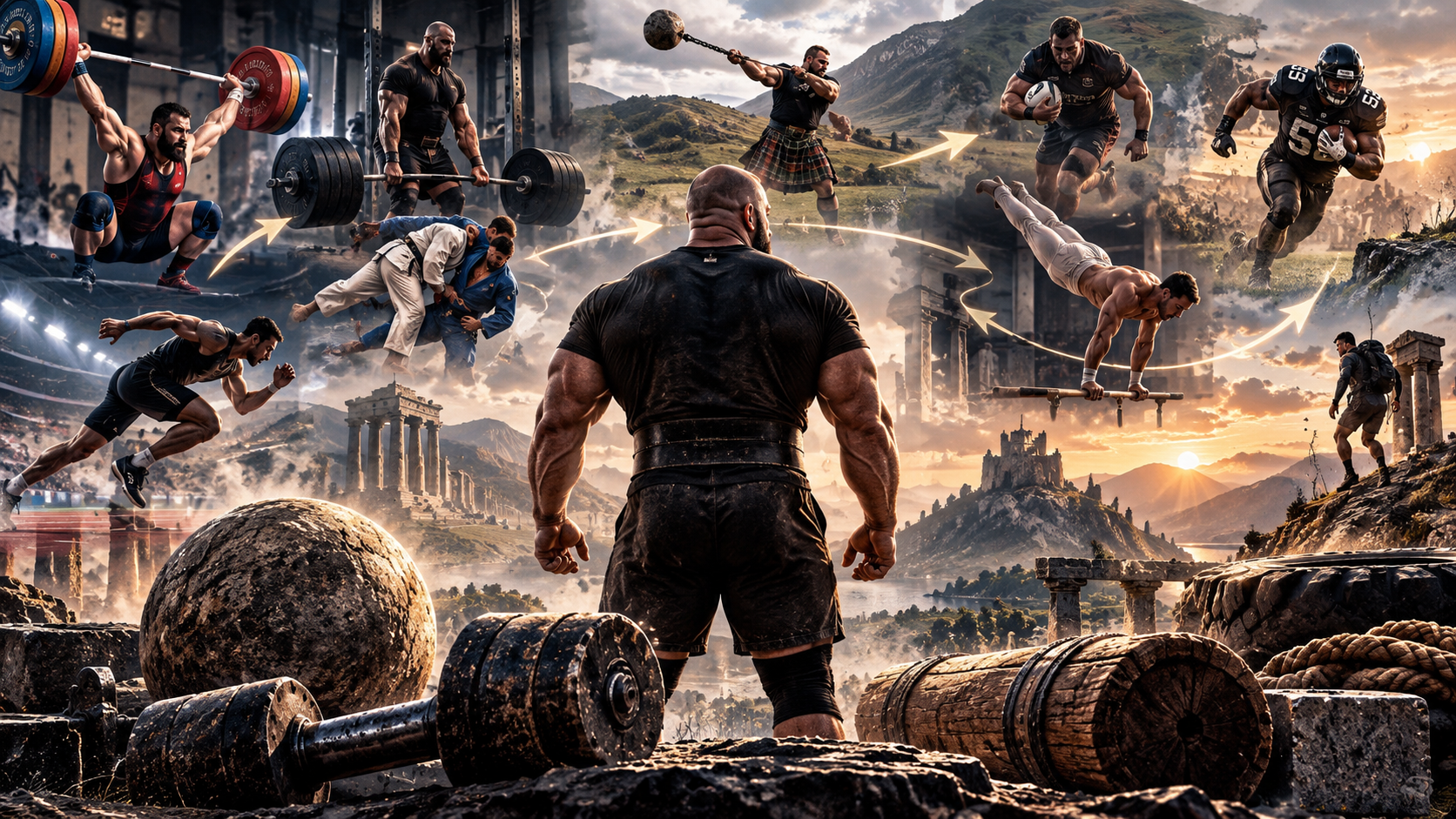
Final synthesis: do not import exercises, build verifiable transfer
After examining Olympic weightlifting, powerlifting, Highland Games, track-and-field throws, wrestling and judo, rugby and American football, sprinting and plyometrics, and finally gymnastics and calisthenics, one conclusion emerges. Sports are not libraries of methods that can be transferred intact through imitation. Each discipline develops specialized responses to particular mechanical, neuromuscular, and perceptual problems. A strongman athlete can learn from these solutions only by identifying a specific limitation in a specific event. A snatch, sled pull, throw, or stability exercise does not become useful simply because its sport of origin is respected. It becomes a training hypothesis that must be judged against the implement, the athlete's background, available recovery, and measurable event performance.
The final episode changes the direction of inquiry. Instead of beginning with a sport and asking what we can borrow, we begin with the strongman event and work backwards toward its demands. A slow start in a yoke carry might reflect insufficient initial force, poor first-step mechanics, implement oscillation, trunk positioning, or difficulties with the pickup itself. Identical stopwatch results can arise from different causes. One auxiliary exercise cannot be assumed to solve all of them. Valuable interdisciplinary training consists of generating competing explanations for a performance limitation and choosing interventions that can distinguish those explanations. The goal is not to assemble an impressive menu of movements.
The statement that an exercise "transfers" contains several separate claims. What changes in the auxiliary task? Is there a plausible mechanism linking that change to the target event? Has the effect been demonstrated in populations comparable to the athlete being coached? Does the probable benefit justify the time, fatigue, complexity, and risk? Research on strongman biomechanics can reveal similarities and differences between tasks, but direct longitudinal studies of every transfer pathway from other sports to strongman events are scarce [1,2]. This evidence gap does not forbid thoughtful experimentation. It requires clear descriptions of uncertainty and careful testing instead of invented numerical promises.
Immediate transfer must also be distinguished from longitudinal training transfer. An athlete with prior expertise in another discipline may perform a new strongman task surprisingly well on the first attempt. That observation may reflect shared capacities, athlete selection, body dimensions, previous exposure, or rapid familiarization. It does not demonstrate that a period of training in the old discipline would improve a strongman specialist's event. A weightlifter learning a log clean quickly does not establish that snatch training increases log press performance. A rugby player pushing a vehicle efficiently, a judoka handling a sandbag smoothly, or a gymnast displaying shoulder control raises interesting questions but cannot, on its own, answer the intervention question.
Competition performance is produced through interacting capacities. Absolute force may be essential for moving a heavy load, yet technique determines how effectively that force reaches the implement. The timing of force production may matter in a brief acceleration phase, while the ability to control a moving load under fatigue may determine the final meters of a carry. These components do not simply add together. Severe technical inefficiency can conceal a modest improvement in strength; better implement positioning can improve performance without an identifiable change in maximal force. Each intervention therefore requires a primary target outcome. Supporting tests may help explain an effect, but they should not replace the competition outcome they were intended to improve.
The biomechanical matrix: five questions before exercise selection
The first dimension is force direction and configuration. A deadlift chiefly involves overcoming a vertical external load in a particular relationship with the ground; vehicle pushing depends strongly on horizontal force and traction; throwing requires accelerating an object to release; carrying means supporting and controlling a load during locomotion. All involve muscular force, but their external vectors, contact points, and movement sequences differ. The shared use of hip extension does not guarantee an identical adaptation. A defensible comparison specifies force direction, the objects in contact with the body, and the position of the combined center of mass relative to the base of support. Without these details, descriptions of exercises as "functional" are too vague to guide decisions.
The second dimension is the time available to generate force. Mechanical impulse, expressed as the integral of force over time, explains why increasing maximal force may not fully address a movement constrained to a short interval. A slow maximal pull can allow more time for force development before visible movement than an explosive throw. Olympic lifts, ballistic exercises, and plyometrics can provide ways to challenge the ability to express force rapidly, but adaptations remain task-dependent. The scientific literature on maximal neuromuscular power clarifies the underlying factors without providing a valid conversion from a higher jump or clean to a specific number of extra kilograms or centimeters in a strongman bag toss [3–5].
The third dimension is implement geometry. Object size, handle position, grip surface, center of mass, tendency to roll, inertia, and oscillation can fundamentally change movement. A barbell is relatively predictable. An Atlas stone, sandbag, shield, or yoke imposes contact and stabilization demands that may evolve from one instant to the next. Similarities between a barbell clean and a sandbag load should therefore be stated with caution. A sandbag may require repositioning against the body and managing a changing shape, while a barbell follows another set of constraints. If the dominant problem is losing contact or grip, an explosive exercise that does not address that limitation may be a poor first priority despite its genuine training value.
The fourth dimension concerns muscle action, joint range, and velocity. Concentric, eccentric, and isometric demands interact differently across front holds, presses, carries, and jumps. A heavy vehicle push is not equivalent to absorbing force during a fast landing, even when both challenge the lower limbs. Likewise, a static rings position and an overhead strongman lift can involve shoulder stabilization without imposing the same external torques. Whenever "stability" is offered as the reason for a method, the responsible explanation should specify the joints, positions, and loading conditions. New exercises can also expose tendons and other tissues to unfamiliar mechanical demands, especially when athletes attempt advanced skills without a progression.
The fifth dimension is event duration and the evolution of fatigue. One maximal attempt of a few seconds differs from a sequence of loads and carries lasting much longer. A medley requires transitions, pacing, repeated contact with implements, and decisions made under time pressure. General work capacity may support training tolerance, but improvement in an aerobic test is not direct proof that an athlete will complete a particular medley faster. Conditioning and maximal strength training can coexist, although scheduling and recovery must be considered. An auxiliary method that is sensible in isolation may become costly inside a week already containing demanding event sessions, heavy pulls, and substantial accessory work.
The five-dimensional matrix is a teaching tool, not a validated scoring system. Two exercises may look alike on four dimensions and differ decisively on the fifth. Conversely, an exercise that does not imitate an event closely may still develop a limiting general capacity. We should avoid arbitrary percentages of "specificity" unless a defined, validated measurement supports them. A good exercise selection decision combines mechanical plausibility, empirical evidence, individual constraints, and observed event outcomes. Where the relationship remains uncertain, the result should be labeled a hypothesis worthy of testing rather than a settled fact.
Competition outcomes before training methods: define what success means
In strongman, "progress" is an incomplete description unless the event and conditions are specified. Log press progress may mean a heavier valid lift, more repetitions at a fixed load, or faster completion of a defined series. Yoke progress may mean a faster time over an identical distance with the same implement and turns. Stone performance may depend on load height, the order of the stones, success with a defined stone, or completion time. A higher vertical jump is progress in a jump test. It becomes evidence about transfer only when a suitable evaluation establishes a relationship with the strongman target outcome. This separation is essential for avoiding false success claims.
Good measurements attempt to standardize implement mass, surface, distance, footwear and equipment rules, grip conditions, residual fatigue, and prior exposure to the test. A two-second improvement in farmers walk may be meaningful or misleading depending on typical within-athlete variability and the quality of the comparison. A test performed after several hard sessions should not casually be compared with a fresh attempt in ideal conditions and attributed to one new exercise. Repeated measurements help estimate how much ordinary variation is present. The sports-science literature on interpreting changes emphasizes estimation, uncertainty, and the magnitude of differences rather than a simplistic binary distinction between success and failure [6].
Breaking an event into observable phases can make the diagnosis more useful. A truck pull may be divided for analysis into initiating movement, accelerating once motion begins, and maintaining speed. A log press can be examined through the clean, rack transition, leg drive, and final lockout. Loading a sandbag can involve separation from the floor, lap position, control against the torso, and final extension onto a platform. These phases should not become rigid categories that erase individual technique. Their value is practical: they identify where performance is being lost and help avoid prescribing more maximal strength as the reflexive answer to every unsuccessful repetition.
Secondary tests can include a one-repetition maximum, a loaded jump, a short sprint, a timed isometric hold, or a standardized grip task. Such tests can be useful when linked to a coherent hypothesis about the event. Yet improvement in a secondary test must be described as secondary improvement until the target changes. This point also applies to biomechanics data: a different movement pattern can be informative, but not every visible difference demonstrates better performance or lower injury risk. An athlete may find a technique easier because it is familiar, not because it produces more valid repetitions. The choice of a measurement should follow the question, not the availability of a device.
It is equally important to know what a test cannot tell us. A smartphone clip can suggest more fluent movement but cannot accurately quantify forces without appropriate methods. Lower perceived effort can reflect improved efficiency, better recovery, or a favorable day. Estimated exercise calories do not measure the capacity to move a massive implement. A dashboard with dozens of attractive numbers may provide less guidance than a simple record of event performance, a relevant supporting measure, training exposure, and recovery context. These indicators should be read together. Compressing them into an unsupported overall readiness or transfer score would merely replace one vague claim with another.
What to retain from each sport and what not to copy
Olympic weightlifting demonstrates how athletes can organize and express force rapidly against an external load. It offers lessons in coordinated lower-limb extension, implement acceleration, and transitions under load. That does not mean every strongman must become proficient at the full snatch or clean and jerk regardless of mobility, previous injury, or time available. A clean pull, high pull, or simpler acceleration task might provide a more compatible stimulus when the goal is not competitive weightlifting proficiency. The method should preserve the intended quality without imposing an unnecessary learning burden. If the principal obstacle in a log or sandbag clean is positioning and contact, deliberate practice with the actual object may be more useful than a technically complex weightlifting cycle.
Powerlifting provides well-developed ways to build and quantify maximal force in standardized movements. Squat, bench press, and deadlift can establish important strength reserves for many strongman events. However, records in these lifts do not equal a universal measure of ability to transport, load, or stabilize irregular objects. An athlete can deadlift exceptionally well and still struggle with the initial contact phase of a stone or the grip requirements of farmers walk. General strength should be developed when it is limiting, and maintained when it is already sufficient for the next objective, without automatically consuming the entire program. Strongman demands a balance between the capacity to produce force and the task-specific ability to express that capacity.
Highland Games and track-and-field throws make acceleration, release timing, and intersegmental coordination especially visible. The caber toss, weight for height, shot put, discus, and hammer each present unique mechanical and regulatory demands; none is identical to a strongman bag toss. Coaches can borrow principles about producing a useful launch trajectory and, where appropriate, select low-cost medicine-ball throws or other ballistic tasks. They cannot assume that the technique of an entire sport carries over unchanged. If the bag already clears the required height but repeatedly misses because of release direction, the most direct opportunity may be more precise practice of the competitive throw rather than a larger maximal-strength program.
Wrestling and judo emphasize control of contact, grips, balance disturbances, and force production from changing body positions. These ideas are relevant to handling objects that shift or tend to escape the athlete's grasp. The analogy is limited, however: a live opponent actively chooses and changes actions, while a sandbag or stone is an inert object governed by mechanical constraints. Experience in grappling may help someone learn particular transitions, but that possibility must be checked at the actual implement. Full contact-sport training is not a mandatory route to stronger sandbag loading, especially if it adds injury exposure and fatigue that the strongman athlete does not need. Select the underlying ability rather than importing the entire sport.
Rugby and American football emphasize the production of force during movement, body alignment under contact, and the influence of traction on acceleration. These insights can inform the analysis of vehicle push, truck pull, and some loaded carries. Yet a rugby scrum and a truck harness involve different force vectors, contact arrangements, opposing forces, and fatigue patterns. Sprinting and plyometrics add a perspective on how rapidly force must be expressed; gymnastics and calisthenics add insight into relative strength, leverage, and positional control. Their role remains selective. Borrowing a method is not proof of sophistication. A borrowed method is an intervention with a probable mechanism, an opportunity cost, and a result that must ultimately be assessed in the target event.
Athlete diagnosis: the same event can fail for different reasons
Good diagnosis begins with repeated observations rather than a quick label. Two athletes moving slowly under identical yokes may have completely different limitations. One may lose most of the time during the pickup and first step, while the other starts efficiently but slows because of oscillation and inconsistent pacing. The first needs examination of the pickup configuration, initial force capacity, and transition to locomotion. The second may benefit more from specific rhythm and load-control practice. Their squat records alone do not identify these problems. Comparable trials under stable conditions are necessary before proposing an auxiliary exercise. The coach's job is to identify the dominant changeable limitation, not to assign a fashionable training quality to every slow stopwatch result.
Overhead events offer a particularly clear illustration. A failed repetition can arise in the clean, rack, dip, drive, or lockout. Difficulty getting the log to the chest is not automatically solved by increasing strict press volume. Instability overhead cannot be explained solely by an assumed lack of triceps strength. Limb proportions, usable mobility, coordination between the lower body and trunk, experience with the exact implement, and pain may all matter. Techniques from weightlifting, powerlifting, or positional training can supply useful options, but only after the unsuccessful phase has been identified. An exercise chosen without diagnosis can consume substantial training time while leaving the actual performance bottleneck unchanged.
An Atlas stone can produce another misleading picture. One athlete may generate ample force during final extension but fail to retain the stone against the torso. Another may lift the stone from the floor easily and then struggle at the loading platform. These are not identical problems, even when both count as failed attempts. Potential explanations include grip and friction conditions, contact geometry, body positioning, the sequence of movement, and strength in the relevant range. Adding the same general deadlift progression to both athletes is not necessarily the best option. Sometimes shortening the distance between the object and the body through better positioning changes the task more than a small increase in maximal strength.
A missed bag toss may involve insufficient release velocity, an unfavorable release angle, poor timing, or the combination of these. Under ideal projectile mechanics, the flight path depends on initial velocity, angle, and release height; the shape and aerodynamics of a real bag complicate this model. It is not possible to infer one exact cause from the fact that the bag fails to clear the bar. Standardized video and repeated observations may help show whether the principal weakness lies in speed or trajectory. If the bag reaches sufficient height but travels into the bar, more maximal force should not automatically be prescribed as the single answer. Technique and the intended trajectory deserve investigation.
Diagnosis must also include less visible influences: accumulated fatigue, sleep, pain, preparation quality, tolerable volume, scheduling, and access to the real implement. A new technique may initially reduce performance because it requires learning. This does not prove that the technique is wrong, but the time spent learning needs a plausible justification. A method suitable for a general training block may be unwise immediately before competition. Distinguishing between insufficient capacity, insufficient skill, accumulated fatigue, and equipment-specific constraints makes the program more responsive to actual needs. The intervention should address the limiting mechanism, not the athlete's reputation or a generic description such as "needs more explosiveness".
From hypothesis to exercise: a practical decision process without invented scores
A sensible process starts by selecting one target event and defining one or two primary outcomes. The athlete then completes comparable trials that reveal where performance deteriorates. The coach formulates a hypothesis that could be disproved. If the problem seems to be the first steps under a yoke, progressive start drills can be compared against the athlete's existing practice. If maximal strength appears to be the dominant limitation, a general strength progression may be more appropriate. Before the intervention, the plan should specify what change would count as useful and when the outcome will be checked. Otherwise almost any later improvement can be interpreted after the fact as evidence for the coach's favored method.
Mechanical plausibility is considered next. Force direction, time constraints, joint positions, the object itself, and event duration are compared without assuming that similarity guarantees transfer. A sled push resembles vehicle pushing in its horizontal movement, but total mass, friction, handle height, traction, and acceleration can produce very different demands. The resemblance should be described precisely. A general force-capacity exercise does not need to reproduce every part of the event, whereas technical practice depends much more strongly on the specific implement and rules. Complementary methods work best when their roles are explicit, rather than when every exercise is claimed to be a perfect simulation.
Evidence quality is another filter. A biomechanics review can describe measured mechanics; a controlled training intervention can test an effect on defined outcomes; observational data can reveal associations; and case reports can suggest promising hypotheses. These sources do not justify identical causal claims. When direct evidence in advanced strongman competitors is lacking, certainty should be reduced, especially when the available intervention studies involve recreational athletes or other sports. General reviews of strength and power provide a reliable foundation for understanding possible mechanisms [3–5,10]. They do not justify invented percentages of improvement in event results, and they cannot determine the single best accessory for all competitors.
Practical cost must be examined alongside expected benefit. An exercise might require specialized coaching, expensive equipment, unfamiliar impact exposure, or substantial recovery time. These factors matter for a competitor with limited weekly sessions and several priority events. An intervention that works well in a tightly controlled study may have little marginal value in a crowded strongman schedule. In some circumstances, refining an existing exercise and its progression is more efficient than adding another movement. A good program uses the athlete's available resources intelligently. It does not maximize the number of sports represented in a training diary.
Finally, the method receives a realistic test period and appropriate stopping criteria. Exercise selection, frequency, repetitions, intensity, and placement within the week should be recorded. Changing many variables simultaneously weakens causal interpretation. Complete experimental control is not always possible in performance sport, but consistency and transparency still improve coaching decisions. If the target improves in repeatable conditions without compromising other priorities, the method may be retained. If only an accessory test improves, the athlete should not claim unproven transfer. If the method creates large recovery costs without useful outcomes, it can be reduced or removed. This logic is more defensible than a universal list of mandatory exercises.
Competing stimuli and periodization: when interdisciplinarity becomes overload
Programming begins by protecting what must remain productive: practice of competition implements, development of a limiting general capacity, and sufficient recovery for meaningful adaptation. Adding sprint sessions, Olympic pull variants, and gymnastics practice does not automatically improve a plan. Each session brings mechanical demands, metabolic demands, and an opportunity cost. Heavy strongman events can produce substantial local fatigue even when they occupy little clock time. Before adding a method, the coach should decide which qualities deserve priority and how much exposure the athlete can tolerate without reducing the quality of essential work. The relevant question is not whether an exercise is good in isolation, but whether it makes the overall preparation better.
Periodization models, including block approaches, help organize emphasis across training qualities, yet they are not infallible formulas. Reviews of planning concepts identify potential benefits as well as limitations in how broadly specific models can be applied [7,8]. An athlete who needs greater deadlift and log capacity may devote a period to strength development while retaining technical exposure to implements. Another athlete with adequate force reserves but poor loaded movement speed may prioritize timed carries and conserve strength with smaller doses. The correct emphasis is determined by performance constraints and responses, not by rigid loyalty to a named periodization system. Plans should change when the evidence obtained from training changes.
During general preparation, borrowed exercises can occupy a larger share of training because the athlete may be developing missing capacities, exploring efficient movement options, or building tolerance to workloads. As a competition approaches, the relevance of the event's actual implements and rules typically increases. This shift need not eliminate every accessory. A ballistic drill with a clear purpose and low fatigue cost may remain useful, while learning an advanced technical skill shortly before an event may have little value. The trade-off depends on the importance of the skill, the cost of mastering it, and the time left. The stage of preparation is a context for decision-making, not a command to perform a fixed menu of exercises.
Fatigue can be task-specific and cumulative at the same time. A heavy deadlift session may reduce the quality of a subsequent carry. High volumes of jumping may be inappropriate for an athlete unaccustomed to fast landings. The fact that two exercises can each produce beneficial adaptations does not demonstrate that any combination of their doses is recoverable. When sessions are grouped, order should reflect the primary objective. Complex technique practiced in severe fatigue may become inconsistent, although exposure to tasks under fatigue can be deliberately useful when competition requires it. What matters is the intended stimulus and the control of its cost rather than a simplistic rule that fatigue must always be avoided.
Approaching competition often requires a reduction in training volume to dissipate fatigue while retaining enough intensity and specificity. A meta-analysis by Bosquet and colleagues examined tapering in competitive athletes and identified favorable strategies in the populations studied [9]. This evidence does not establish a single optimal taper duration or volume reduction for every strongman competitor or every event. An athlete exposed to repeated heavy implements and long travel demands may need a different strategy from a competitor focused on one short event. A taper aims to reveal existing capacity; it cannot substitute for months of skill acquisition or justify learning many new methods immediately before competition.
Effective programming also includes a rule for subtraction. If a new exercise does not produce a useful target change and undermines the quality of primary sessions, it should be reconsidered. If transfer is uncertain but the fatigue cost is low and the mechanism plausible, it may be continued cautiously until an appropriate reassessment. There is no universal deadline after which every adaptation must have appeared; learning, strength development, work capacity, and tissue tolerance evolve at different rates. The coach should set a test window consistent with the expected adaptation rather than judging the entire program after every workout.
Three broad event families and different preparation strategies
Events centered on lifting, such as deadlift, log press, and certain stone loads, require sufficient capacity to move the implement through the required path. Yet the meaning of "sufficient" depends on technique, leverage, and competition rules. An athlete whose maximal force is genuinely limiting may benefit from structured general strength work. An athlete who fails the rack transition of a log may need a more targeted technical intervention. Powerlifting and weightlifting methods need not compete for exclusive status. The former can contribute to force reserves, while selected methods from the latter can challenge acceleration and coordination. The final criterion is not superiority in an accessory lift but better execution of the target event.
Loaded carries, including yoke, farmers walk, duck walk, and Husafell-style events, combine an initial lift, moving balance, oscillation control, step rhythm, grip or contact management, and sustained locomotion. Exercise selection cannot therefore depend solely on how much an athlete can lift once from the floor. Breaking down pickup time, travel time, and stops can reveal different limitations. An athlete with an excellent deadlift but poor handle control may need practice with the particular carry. Sprinting can offer a useful conceptual model of force orientation, but the ground-contact times, body positions, and speeds of running without a massive implement differ from loaded walking. Similarity at one level does not erase those differences.
Pulling and pushing events, such as truck pull, arm-over-arm pull, and vehicle push, are sensitive to initial resistance, friction, harness or rope geometry, and terrain. Rugby and resisted sprinting can suggest ways to think about horizontal force and body alignment, but neither reproduces all the mechanics of a heavy vehicle. Tire pressure, surface conditions, and the design of the equipment can make comparisons between testing and competition difficult. A standardized training substitute may still be valuable, provided its limitations are understood. Categories such as lifting, carrying, and pushing are practical organizational tools rather than claims that the body's physiological systems become completely separate.
Medleys cut across these event families. Multiple implements performed in sequence introduce transitions, pacing, changes in grip, and repeated attempts under fatigue. The athlete with the highest isolated strength score in every component does not necessarily win a medley if transitions are slow or the final implement is reached in an exhausted state. Increasing one-repetition maxima alone may therefore have limited effect once a necessary strength threshold has been reached. Some training should reproduce the succession, duration, and rules of the event, while recognizing the recovery cost of frequent maximal simulations. Technical efficiency and force capacity must be assessed together.
These event families also expose the possibility of little transfer or a costly transfer strategy. An excessive emphasis on maximal strength can consume recovery capacity without solving a locomotion bottleneck. Too much sprint or plyometric work may reduce time available for critical heavy implements. Static positional drills may help one limitation while doing little for a dynamic event. These are practical trade-offs, not claims of universal biological incompatibility between training types. The right comparison is between alternative interventions for the same target, evaluated within the athlete's actual schedule rather than an imaginary program with unlimited time and recovery.
A useful event map can contain four fields: target outcome, observed limitation, proposed mechanism, and evidence of change. For example: twenty-meter yoke time, large oscillations after the initial step, controlled-start practice with progressive loads, and a repeated reduction in time under standardized conditions. This formulation cannot guarantee success, but it makes decisions auditable. If the target does not improve, the initial diagnosis, dose, or measurement method can be reconsidered. A rational process does not require an invented numerical transfer coefficient or an exhaustive catalog of exercises.
General adaptations, technical quality, and possible interference
Strength performance depends on morphological, neural, and coordinative factors whose influence changes with the task [4,10]. Muscle growth may increase the potential to produce force without guaranteeing that force will be used efficiently against an awkward implement. Better performance in one joint position does not imply identical improvements across every range of motion and speed. General preparation is consequently a foundation rather than a miniature reproduction of competition. Athletes entering strongman from powerlifting may possess substantial strength reserves but need new implement skills. Athletes entering from contact sports may have experience with movement under perturbation yet need progressive adaptation to extremely heavy loads.
Interference may be practical rather than a universal biological conflict. Learning a complex new skill uses time and attention that could have been spent on the main event. Unfamiliar eccentric demands can create muscle soreness that compromises a later session. Excessive variation can make progress hard to measure because no task is repeated often enough under comparable conditions. A competitor can appear to be doing everything while giving no important quality sufficient exposure. The objective is not to choose general or specific training as rival ideologies. It is to establish proportions appropriate to the present limitation and the athlete's tolerance.
Mechanical redundancy is a useful concept. Several exercises can burden many of the same tissues or capacities without offering meaningful additional adaptation. A week already containing heavy deadlifts, Romanian deadlifts, and repeated sandbag loading may not benefit from another demanding Olympic pull variation unless it has a defined purpose. If the new exercise primarily trains an already well-developed resource, marginal benefit may be small relative to fatigue. A simpler technical drill could be a better choice if it addresses a precise transition at a lower cost. Exercise quality has to be judged in the context of the entire week rather than through a demonstration of one exercise alone.
Body mass creates another set of interacting constraints. High body mass can contribute to certain mechanical advantages and absolute-force potential, while increasing the cost of moving and supporting one's own body. Advanced calisthenics may impose unexpectedly high loads on a large athlete, and sprinting or jump exercises should not be prescribed by copying the exposures used by much lighter populations. Gradual progression and tissue tolerance matter. A lower bodyweight athlete and a heavier competitor may excel in different kinds of strength tasks without either being universally superior. What matters is the relationship between the athlete's capacities and the specific event rather than aesthetic assumptions about movement.
Energy systems should not be described as independent tanks that activate one at a time. Energy contributions overlap, with their relative importance affected by intensity and duration. Heavy-repetition events and medleys require both repeated force production and an ability to sustain performance under accumulating fatigue. Improving aerobic fitness alone does not show that a competitor can load more stones within a minute, but appropriate conditioning may support tolerance to training and recovery between bouts. The competitive value of conditioning must be judged in events that resemble the relevant duration and work-rest pattern. Training categories are helpful, but physiological responses are integrated rather than neatly isolated.
Even a plausible program can produce results that do not identify the mechanism. A competitor might improve both deadlift and yoke during the same block because of general strength gains, more efficient technique, better familiarization, or some mixture of these. This does not invalidate the training. It limits causal certainty. A mature interpretation accepts that uncertainty and continues to observe whether progress can be repeated and whether the intervention remains worthwhile. The critical question is whether the target has improved under comparable conditions and whether the program can sustain those gains without undermining other events.
Monitoring: useful signals and imperfect measurements
Monitoring is not the collection of every available metric. It is the selection of information likely to change a decision. External loads, perceived exertion, standardized performance tests, and subjective recovery measures can all help explain an athlete's response. None provides a complete picture. Buchheit's review of heart-rate monitoring emphasizes that interpretation depends on context, measurement error, and the intended use [11]. Measures developed largely in aerobic sports should not be treated as automatic predictors of log press or stone loading. In heavy strength events, implement performance and the individual's response to the actual loading remain essential.
A training diary should describe each exercise precisely enough to make later tests comparable. Yoke records can include load, distance, surface, turn configuration, and stops. Log records can specify the implement variant, repetition rules, set structure, and perceived effort. Sandbag records may require load, platform height, and grip conditions. Two sessions labeled farmers walk can be mechanically different if handles, distance, or direction changes differ. Standardization does not require laboratory perfection, but the important constraints must be recorded. The value of a diary comes from comparisons it makes possible, not from the number of cells it fills.
Ratings of perceived exertion can describe subjective difficulty but should not be treated as medical diagnoses or independent truth. Higher difficulty on one day may be intentional, reflect residual fatigue, or simply accompany an unfamiliar task. Persistent deterioration across comparable sessions warrants investigation, whereas one low test does not establish overtraining. Every measure has variability and interpretation limits. Combining event outcomes with sleep, perceived recovery, and training exposure is usually more sensible than assigning readiness from a single number. The goal is to decide what to modify, not to produce a dramatic dashboard.
Injury-related claims require similar care. A method can impose unfamiliar tissue loads, but one injury does not prove that a movement is dangerous for every athlete. Conversely, the absence of injuries in a small series does not demonstrate universal safety. Introducing fast landings, advanced ring positions, or contact-sport drills requires appropriate progression and a reason to accept their specific exposures. Visible technique differences are not automatic evidence of imminent damage. Persistent pain and unusual symptoms deserve individualized professional assessment. In an interdisciplinary program, the decision to borrow an exercise should include the athlete's prior exposure to its distinctive demands.
Monitoring may reveal hidden costs. An accessory can improve a secondary test while coinciding with poorer sleep, increased soreness, or declining quality in the main event sessions. These observations alone do not prove causation, but they justify review of the intervention. Changing several variables simultaneously makes interpretation harder. A practical system can establish review points and conditions under which an auxiliary method is reduced or removed. If the athlete's priority is a medley, the medley outcome remains central; recovery measures support scheduling rather than replacing direct evidence of event performance.
A workable monitoring system can have three layers. The first consists of event results and exercise records. The second adds repeatable information about fatigue, sleep, and perceived exertion. The third uses standardized video or specialist tests when the resulting information can genuinely alter coaching decisions. A consistent and interpretable basic system is better than an impressive but unmanageable database. The purpose is to explain why a method was retained, modified, or abandoned and to make those decisions understandable to the athlete rather than mysterious products of a proprietary score.
Testing transfer in one athlete: building a credible applied experiment
The greatest obstacle in applied sports science is often not a lack of training ideas but difficulty distinguishing adaptation from ordinary fluctuation. An athlete may complete a carry faster at the end of a month, yet the change could reflect improved familiarity, better rest, a different implement, or favorable test conditions. Introducing an auxiliary exercise from another sport therefore creates an attribution problem. Did the intervention actually contribute to the competitive improvement? A single-athlete experiment cannot provide the certainty of a large randomized trial, but repeated and structured observations can provide substantially stronger evidence than the claim that a new exercise was followed by a personal record. Careful interpretation of change magnitude and uncertainty is crucial [6].
Before intervention, the athlete can establish a reference range through repeated tests under comparable conditions. For a yoke carry, several timed trials with the same load, distance, and recovery conditions may be more informative than a single baseline. There is no universal number of seconds that establishes meaningful improvement across all athletes and implements. The typical variability of the specific test must be considered, and practical importance should be defined in advance. If baseline results vary wildly, standardization and familiarization should come before experimentation. Otherwise, a favorable final attempt may be mistaken for an intervention effect simply because it is compared with an unusually poor first day.
The intervention must be described in enough detail to be repeated: exercise selection, frequency, load progression, repetitions, placement within the week, and other program changes. If the athlete simultaneously changes sprint training, nutrition, sleep, and event practice, attributing an outcome to the sprint drills is unjustified. A pragmatic approach may change one principal element while keeping other exposures reasonably stable. Complete control is rarely realistic in a competitive athlete's life, and research design must not become an excuse for unnecessary load or compromising important competition preparation. Better measurement supports coaching, not the other way around.
A credible evaluation includes the auxiliary task and the event it is intended to improve. If resisted sprinting leads to faster acceleration in a sprint test but yoke performance remains unchanged, the appropriate claim concerns sprint performance. If yoke performance also improves, transfer becomes a more plausible hypothesis, but technical practice and other factors may still explain part of the result. A sequence of baseline observations, intervention, and later reassessments can build an individual evidence record. Repeated effects under planned conditions offer more confidence than one surprising personal best. The results should also document costs and any deterioration in other priority tasks.
An absence of immediate improvement does not necessarily demonstrate harmful transfer. Skill acquisition can be slow, and a new stimulus can temporarily increase fatigue. Yet indefinitely extending an ineffective method wastes resources. The coach can define in advance a principal review date and conditions for dose reduction when tolerance is poor. A practical decision rule might be: retain the exercise when the target improves reproducibly without compromising higher priorities; modify it when local adaptation occurs without observable competition transfer; remove it when costs are substantial and the intended outcome does not improve. This is a framework for judgment rather than a validated universal protocol.
Reporting must distinguish an individual observation from a general causal law. "My farmers walk time improved after a four-week grip-training block" is a personal description, although attribution still requires caution. "Grip training will reduce farmers walk time for every strongman" is a broad intervention claim that needs much stronger evidence. Elite athletes have valuable experience, but their examples are subject to selection effects and numerous uncontrolled influences. Sharing context, measurement conditions, uncertainty, and failed attempts makes case reports more useful. The community benefits from transparent reasoning rather than polished anecdotes that omit every unsuccessful experiment.
Hypothetical athlete profiles: the same literature, different decisions
Consider athlete A, who has strong maximal lifts but repeatedly fails to clear a height with a throwing bag. The immediate temptation may be to prescribe heavy pulls from weightlifting. Diagnosis should first separate inadequate release speed from an unfavorable trajectory. If standardized video suggests the object reaches sufficient height but misses the bar, a block of specific throwing practice is a more direct hypothesis. Ballistic drills inspired by athletics or Highland Games may remain useful supplements, but their success is assessed at the competition bar. This is an illustrative case, not an experimental finding or a promise of a numerical performance increase.
Athlete B has a powerful deadlift but loses time during farmers walk because the handles slip or the walking rhythm breaks down. Developing even more hip-extension strength may have a lower immediate return than grip-specific exposure and implement practice. Biomechanical analysis of farmers walk has documented meaningful differences relative to unloaded walking and deadlifting [14]. That study does not establish an ideal training program for every athlete, but it shows why a barbell record alone is an incomplete predictor of loaded-carry performance. Selection of grip, gait, and load-control exercises should reflect the particular implement, with enough recovery for the upper limbs and connective tissues.
Athlete C comes from a team sport and accelerates well but lacks the absolute strength reserve needed for maximal strongman loading. Rugby experience may provide useful familiarity with body positioning and force production in movement. It does not replace progressive exposure to heavy objects. For this athlete, a structured general-strength program combined with gradual implement training may be more useful than another sprint session. Sprint performance without load and movement with a massive external implement are distinct tasks. Reviews on muscular strength support its foundational role in many athletic performances [4,10], but the way this resource is developed must still reflect the individual athlete's needs.
Athlete D is exceptionally heavy and strong in absolute terms but poorly tolerates high-volume running or demanding gymnastics progressions. This athlete does not need to copy a sprinter's or gymnast's routine in order to learn from those sports. Scalable exercises can develop useful qualities of acceleration or positional control with fewer unfamiliar impacts and less technical complexity. Gradual exposure matters to tendons, joints, and the broader locomotor system, not just the main muscle groups. If a new movement causes persistent discomfort or worsens recovery for log and yoke training, its place in the program should be reconsidered. The goal is competition performance, not proof that the athlete can train every imaginable discipline.
A fifth illustrative athlete faces frequent competitions and travel with limited uninterrupted training blocks. Such a schedule may require preservation of existing strength and implement skills more than the introduction of a major new training method. Short, targeted exposures and reliable monitoring can be preferable to an ambitious program of unfamiliar techniques. This does not make cross-disciplinary training invalid. It recognizes the opportunity cost of time and recovery. An auxiliary exercise that is attractive during a long off-season can be unsuitable when the athlete is repeatedly competing. Calendar structure and individual tolerance alter what constitutes a rational choice.
These profiles are hypothetical teaching examples, not disguised clinical reports or actual data from named athletes. Their purpose is to illustrate how the same research base can justify different decisions depending on the starting point. A responsible coach cannot promise that Olympic pulls, judo drills, sprinting, or calisthenics will automatically increase a log press by a particular amount. The coach can formulate a conditional prediction, expose the athlete to a recoverable dose, measure the outcome, and revise the plan. This is the practical transformation of interdisciplinary curiosity into problem-solving.
An illustrative eight-week block integrating general and specific preparation
An eight-week example can show how general methods and event practice might be combined without claiming that the design is a validated universal protocol. Suppose an experienced athlete prioritizes a timed yoke carry and a log press for repetitions. Observations suggest that the yoke problem lies in controlling the first steps and that the log problem lies in the transition from the rack position to leg drive. Before the block, both events are tested under standardized conditions, with relevant secondary strength and recovery measures recorded. The plan intentionally includes only a small number of supplemental methods: progressively controlled yoke starts, focused log practice, and a recoverable general strength stimulus.
The first two weeks emphasize standardized execution and enough technical volume for reliable practice without repeated maximal attempts. Yoke training can use short efforts that allow attention to pickup position and initial steps at loads appropriate to the athlete. Log sessions can involve complete repetitions or selected phases with an emphasis on repeatable positions. A borrowed auxiliary exercise is chosen only if it targets an observed limitation. We do not prescribe universal percentages or exact loads, because those decisions depend on the athlete, the implements, previous tolerance, and the type of competition. A useful example should explain its logic, not conceal arbitrary prescriptions behind a scientific tone.
Weeks three and four can gradually progress load, movement complexity, or task duration while retaining comparable testing conditions. If yoke starts become more consistent, the coach might increase distance or loading rather than both at once. As log transitions become more reliable, the athlete can resume progression toward the required repetition performance. The auxiliary method remains a supporting stimulus, not a separate competition within the plan. Records at the accessory are useful for monitoring local adaptation but do not replace the target event result. Poor tolerance may justify reducing the dose without implying that the overall training process has failed.
Week five can provide an intermediate assessment. The same yoke conditions and log rules are used, and outcomes are considered alongside fatigue and usual test variability. A small change should not be interpreted as certain causation when the measurement is noisy. A clear and reproducible change can justify continuing the plan, while stagnation should prompt a review of the initial diagnosis. Perhaps force increased but implement positioning remains inefficient. Perhaps the auxiliary stimulus is competing with specific practice. Reassessment does not need to become another maximal testing competition; its purpose is to inform programming.
During weeks six and seven, the program may move toward the competition's actual implements and rules when an event date is approaching. Methods with little immediate relevance can be reduced, while enough general loading remains to preserve required capacities. Transitions and distances can more closely resemble the event. Total volume is adjusted to the athlete's recovery response. If competition is not approaching, the same weeks might instead continue general development. The calendar and training objective govern the emphasis, not the numerical label attached to a particular week. Progression must remain responsive to observation.
Week eight can provide a final assessment after managing fatigue appropriately. Results are compared with the baseline together with the testing conditions, not only with the most favorable number. If both events improve, the block is associated with competitive progress, but the exact contribution of each auxiliary exercise remains uncertain without a stronger experimental design. If only the secondary tests improve, transfer to the target has not been demonstrated. The value of the example is its explicit goals, monitoring, and decision rules. It shows how to evaluate interdisciplinary methods without pretending that every strongman requires the same schedule or will obtain the same results.
Interpretation errors: correlation, prestige, and apparent specificity
The first error is transfer by association. If a successful strongman previously competed in powerlifting, it does not follow that powerlifting is the single optimal route into strongman. Athlete selection, body size, exposure, available coaching, and many other variables may explain the association. The same error occurs when a former rugby player performs well in a pushing event or a weightlifter learns a log clean quickly. These observations may inspire testable hypotheses, but they cannot establish the efficacy or required dose of a training intervention. Training methods should be judged by their effects on target outcomes, not by selective biographies of famous competitors.
The second error is equating muscle activation with improved competition performance. High electromyographic activity during an exercise does not make that exercise automatically superior for chronic adaptation or for moving an implement. Surface EMG depends on several biological and measurement factors and is not a direct measure of internal muscle force. An exercise may challenge a muscle strongly in one range while the competition task requires different joint angles, timing, or interactions between segments. EMG is informative when it answers a defined question in an appropriate design. It cannot independently justify a claim that a particular accessory will improve a given strongman record.
The third error is confusing visual resemblance with mechanical identity. Hip extension may look similar in weightlifting, throwing, and sandbag loading, yet movement speed, joint configuration, contact, and implement behavior can differ sharply. A photograph cannot reveal mechanical impulse, and an uncalibrated video cannot fully measure force. Biomechanical comparisons are valuable when they use appropriate instruments and variables; otherwise, their conclusions should be modest. Research reviewing biomechanical methods in strongman has emphasized both the promise of careful analysis and the limitations of available measurement approaches [2].
The fourth error is substituting a convenient supporting test for the desired outcome. Higher jump performance indicates improvement in a jump. Faster yoke performance indicates improvement in yoke. Shared use of the lower limbs does not make the first result a valid replacement for the second. More pull-ups do not prove that an athlete can load heavier stones, and a longer gymnastics hold does not guarantee a better Giant Dumbbell lockout. Supporting tests may help explain or sometimes predict performance, but predictive value must be demonstrated rather than inferred from the appearance of an exercise.
The fifth error is assigning a causal share of a personal record to every simultaneous training method. A new record after six weeks of mixed training does not reveal exactly how much improvement came from sprinting, squatting, technical practice, or improved recovery. Acknowledging this does not diminish athletic achievement. It makes the explanation more accurate. Well-described case reports are valuable when they include context, uncertainty, and failures alongside successes. If only successful interventions are discussed publicly, the effectiveness of fashionable methods can appear much greater than it actually is. An evidence-oriented community has room for hypotheses that did not work.
The sixth error is assuming that a more varied program must be more complete. Completeness is not measured by the number of disciplines represented. It is measured by how well necessary capacities are developed relative to their costs and to competing training demands. One carefully selected auxiliary exercise may be more valuable than five redundant additions. The science of training does not prescribe maximal variety. It asks for an intelligible relationship among target, stimulus, response, and outcome. Learning from other sports includes learning what not to borrow.
Research priorities: what remains to be demonstrated in strongman
The largest evidence gap is the shortage of longitudinal research directly comparing training methods from other sports against strongman competition outcomes. Reviews of strength, power, and selected strongman biomechanics offer substantial scientific foundations [1–5,10], but they cannot identify the best imported intervention for every yoke, stone, log, or bag event. A suitable study would clearly define participants, training history, target task, intervention, duration, recovery, and analysis. The primary outcome should be actual performance with a relevant implement rather than only a convenient laboratory variable. Whenever possible, individual responses should be reported alongside group averages.
One useful question is whether resisted acceleration training adds more to yoke speed than an equivalent additional volume of specific yoke practice in athletes with comparable general strength. Answering it requires standardized implements, distances, total training exposure, and test conditions. Another is whether supplementary ballistic throwing improves bag toss beyond what can be obtained through similar amounts of deliberate bag practice. Without such comparisons, separating general transfer from familiarization is difficult. Investigators should avoid selecting only the outcomes that support the favored hypothesis. A failed primary outcome remains scientifically informative when it was defined before data collection.
Log press research could compare the relationships of strict press, push press, and selected Olympic pull adaptations with distinct phases of log lifting. However, correlations between maximal lifts may be confounded by body size, general strength, and experience. Intervention designs and careful description of athlete characteristics are necessary. Log diameter, handle position, implement balance, and judging rules should be reported in enough detail to make experiments interpretable. Two studies using different implements may otherwise appear comparable while testing significantly different tasks. Better reporting standards are a realistic near-term improvement for the sport.
Loaded carries would benefit from study of pickup time, acceleration, step variability, implement oscillation, and grip conditions. Existing biomechanical work on the farmer's walk offers a starting point [14], but data from extreme loads and diverse competition configurations remain limited. Some measurements may require sophisticated laboratories. Others may eventually be made more practical using validated field sensors and calibrated video. The key word is validated. An inexpensive device that generates numerous numbers is not automatically measuring the intended property accurately enough to guide training.
Another research priority is how transfer differs by experience. Beginners can improve in many tasks through general strength development and rapid learning. Advanced athletes may require more targeted stimuli, while still benefiting from general exercises that address newly identified weaknesses. Extrapolating directly from recreational participants to elite strongman competitors is methodologically hazardous. Studies should report training age, body mass, sex, competition category, event experience, and previous exposure to the chosen exercises. These factors do not solve every methodological problem, but they make findings more useful for coaches evaluating real athletes.
Research should also measure costs, not only gains. An intervention might improve one event slightly while increasing soreness, recovery requirements, or difficulties in training for other events. A method that maximizes one isolated lift may be less useful for a five-event competition. Future work should describe adherence, adverse events with consistent definitions, training tolerance, and longer-term outcomes. This would move the field closer to identifying methods that are not only effective in narrow experimental circumstances but also worthwhile in a complete competitive season.
The series conclusion: measure what matters and borrow only what helps
The series began with a deceptively simple question: what can strongman learn from other sports? The answer is neither a fixed list of mandatory exercises nor a ranking of disciplines. Weightlifting illuminates acceleration under load. Powerlifting shows how force reserves can be developed systematically. Highland Games and athletics illuminate ballistic coordination and release mechanics. Judo and wrestling emphasize contact and balance disturbances. Rugby highlights force application while moving. Sprinting and plyometrics focus attention on the time available to generate force. Gymnastics and calisthenics reveal how leverage and body control change muscular demands. Each contribution is real within its own context. None guarantees universal transfer to strongman.
A strongman event is a problem defined by the athlete, the implement, the environment, and the rules. Force direction, time constraints, object geometry, muscle-action demands, and event duration provide useful criteria for deciding whether an auxiliary method is relevant. Even a persuasive biomechanical argument remains a hypothesis until there is evidence of improved target performance. A sound program therefore begins with diagnosis and repeatable measurement. It defines the desired outcome, the capacity likely to be limiting, the intervention proposed to change it, and the moment when the result will be evaluated.
Transfer is conditional. It depends on existing force capacity, implement experience, tolerance to additional workload, the competition calendar, and individual constraints. An exercise that helps a beginner may offer little additional benefit to an advanced athlete. A method that is useful in general preparation can become redundant during a taper. A mature interdisciplinary program does not endlessly accumulate techniques. It ranks them by probable value, cost, and compatibility with specific event practice. The actual competition implement remains indispensable because it supplies information that no general exercise can reproduce completely.
Scientific thinking does not require coaches and athletes to disregard experience. It requires them to make experience inspectable. Experience identifies problems and suggests responses. Mechanical reasoning explains why an intervention might work. Research identifies probable effects and important limitations. Field measurements show what happened in a particular athlete's preparation. When these perspectives are combined, decisions become clearer. When a personal anecdote, a biomechanical resemblance, or a laboratory result is treated as proof of everything else, confidence outruns evidence. The answer is not less curiosity, but greater precision.
The final principle is one of intellectual and sporting economy. We do not need to train every possible quality in every possible way. We need to develop the capacities that currently limit competition performance. If a method borrowed from another sport helps, it deserves a place together with a clear description of when and for whom it helped. If it produces no observable transfer, its role can be revised without denying the value of its original discipline. Strongman is diverse enough to benefit from ideas developed across sport and specific enough to demand that those ideas be validated against its own tasks.
This final episode should leave the reader with a decision tool rather than a universal prescription. Before altering the program, ask: what exact problem are we attempting to solve, through what proposed mechanism, at what cost, and by which outcome will we judge success? A defensible answer makes the training decision understandable, revisable, and open to evidence. Strength does not transfer through slogans. It transfers, when it does, through adaptations and skills expressed under particular constraints. That principle applies to the athlete preparing for a first local contest and to the experienced competitor building an international season.
Verifiable scientific bibliography
[1] Hindle BR, Lorimer A, Winwood P, Keogh JWL. The Biomechanics and Applications of Strongman Exercises: A Systematic Review. Sports Medicine - Open. 2019;5:49. Read the publication
[2] Hindle BR, Lorimer A, Winwood P, Keogh JWL. A Systematic Review of the Biomechanical Research Methods Used in Strongman Studies. Sports Biomechanics. 2020;19:90–119. Read the publication
[3] Cormie P, McGuigan MR, Newton RU. Developing Maximal Neuromuscular Power: Part 1, Biological Basis of Maximal Power Production. Sports Medicine. 2011;41:17–38. Read the publication
[4] Suchomel TJ, Nimphius S, Bellon CR, Stone MH. The Importance of Muscular Strength: Training Considerations. Sports Medicine. 2018;48:765–785. Read the publication
[5] Cormie P, McGuigan MR, Newton RU. Developing Maximal Neuromuscular Power: Part 2, Training Considerations for Improving Maximal Power Production. Sports Medicine. 2011;41:125–146. Read the publication
[6] Hopkins WG, Marshall SW, Batterham AM, Hanin J. Progressive Statistics for Studies in Sports Medicine and Exercise Science. Medicine & Science in Sports & Exercise. 2009;41:3–13. Read the publication
[7] Kiely J. Periodization Paradigms in the 21st Century: Evidence-Led or Tradition-Driven? International Journal of Sports Physiology and Performance. 2012;7:242–250. Read the publication
[8] Issurin VB. Benefits and Limitations of Block Periodized Training Approaches to Athletes’ Preparation: A Review. Sports Medicine. 2016;46:329–338. Read the publication
[9] Bosquet L, Montpetit J, Arvisais D, Mujika I. Effects of Tapering on Performance: A Meta-Analysis. Medicine & Science in Sports & Exercise. 2007;39:1358–1365. Read the publication
[10] Suchomel TJ, Nimphius S, Stone MH. The Importance of Muscular Strength in Athletic Performance. Sports Medicine. 2016;46:1419–1449. Read the publication
[11] Buchheit M. Monitoring Training Status with HR Measures: Do All Roads Lead to Rome? Frontiers in Physiology. 2014;5:73. Read the publication
[12] Aagaard P, Simonsen EB, Andersen JL, Magnusson P, Dyhre-Poulsen P. Increased Rate of Force Development and Neural Drive Following Resistance Training. Journal of Applied Physiology. 2002;93:1318–1326. Read the publication
[13] Rutherford OM, Jones DA. The Role of Learning and Coordination in Strength Training. European Journal of Applied Physiology. 1986;55:100–105. Read the publication
[14] Winwood PW, Cronin JB, Brown SR, Keogh JWL. A Biomechanical Analysis of the Farmer's Walk, and Comparison with the Deadlift and Unloaded Walk. International Journal of Sports Science & Coaching. 2014;9:1127–1143. Read the publication
[15] Morin JB, Edouard P, Samozino P. Technical Ability of Force Application as a Determinant Factor of Sprint Performance. Medicine & Science in Sports & Exercise. 2011;43:1680–1688. Read the publication
More From The Journal
Training Science
TRANSFER OF STRENGTH: WHAT CAN STRONGMAN LEARN FROM OTHER SPORTS? | Episode 6: Wrestling and Judo: Unstable-Object Control, Balance and Force Production from Disadvantageous Positions
Scientific analysis of grips, off-balancing, center-of-mass control, isometric force, awkward positions and evidence limits for transfer into Strongman.
Training Science
TRANSFER OF STRENGTH: WHAT CAN STRONGMAN LEARN FROM OTHER SPORTS? | Episode 7: Rugby and American Football: Acceleration Under Contact and Force Production While Moving
Biomechanics of acceleration, contact pushing, traction, scrummaging, football blocking and limits of transfer to Strongman truck and loaded carries.