
Training Science
TRANSFER OF STRENGTH: WHAT CAN STRONGMAN LEARN FROM OTHER SPORTS? | Episode 6: Wrestling and Judo: Unstable-Object Control, Balance and Force Production from Disadvantageous Positions
October 28, 2026
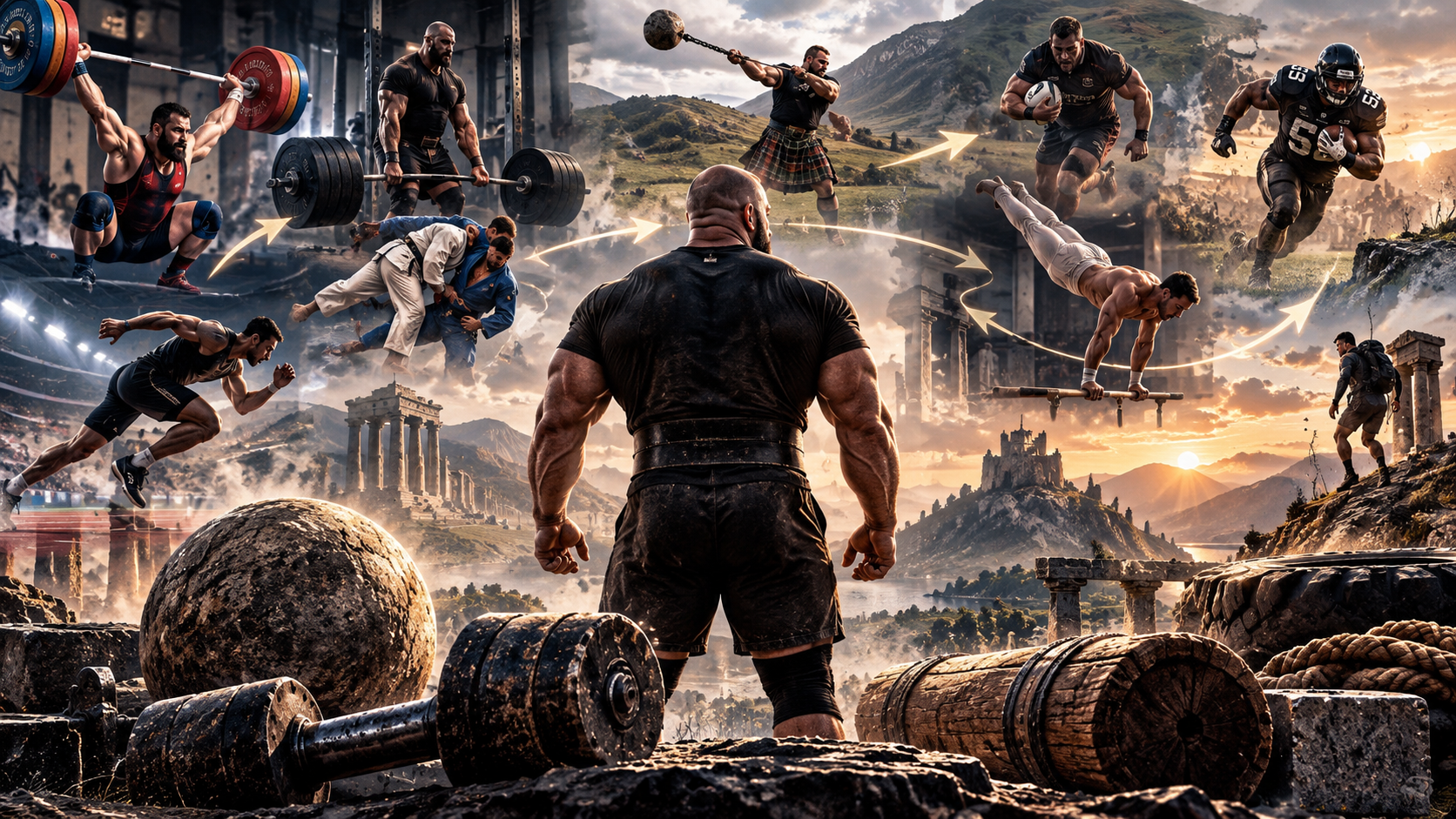
Wrestling and Judo: Unstable-Object Control, Balance and Force Production from Disadvantageous Positions
Why a moving opponent is not mechanically identical to an awkward implement
Judo and wrestling require athletes to generate force while in contact with an opponent who reacts, moves and deliberately disrupts balance. Strongman typically involves objects without agency: stones, bags, logs, vehicles and loaded frames. The sports overlap in external-mass control and continual postural adjustment, but an opponent actively produces force, changes the base of support and anticipates actions. A sandbag can oscillate or redistribute its contents, but it cannot strategically resist a throw. Transfer analysis must begin with this difference instead of a vague claim that both sports build functional strength [1,2].
A judoka can perform an effective throw by redirecting an opponent's momentum and destabilizing the opponent's support. Lifting the full body mass through a deadlift-like action is not always necessary; lever mechanics and rotation can do much of the work. A strongman lifting a stone cannot exploit voluntary reactions from the object and must create the external forces necessary for pickup. An elite wrestler is not automatically an elite stone lifter, even if contact-control abilities could be relevant.
Ren and colleagues' 2023 review characterizes judo as high-intensity intermittent activity involving grip dominance, technical throws and dynamic and isometric contractions during opponent control [1]. Those characteristics provide a rationale for investigating strongman applications, but the review is not an intervention showing that judo practice improves Atlas Stones or Húsafell Carry. Evidence must be interpreted within the sport, population and outcomes actually studied.
The analysis below separates grip mechanics from off-balancing, coordination from maximal force capacity and contact maintenance from throwing an adversary. General mechanics, experimental findings and proposed transfer hypotheses will be distinguished explicitly. The purpose is to identify plausible complementary methods, not to replace contest-implement practice with combat-sport training.
Kuzushi, tsukuri and kake: useful concepts rather than a magic formula
Traditional judo teaching describes kuzushi as disturbing balance, tsukuri as entering and organizing the position, and kake as executing the throw. These terms help divide a complex action pedagogically, but the phases overlap during real movement. A judoka does not necessarily complete all off-balancing, freeze, then enter and finally apply force. Body position, velocity and an opponent's response change continuously; the mechanics are inherently dynamic.
A pedagogical strongman analogy could distinguish securing contact with a stone, organizing the pickup position and performing the lift. Yet the stone has no nervous system and cannot be off-balanced in the intentional sense used in judo. It can be rotated, rolled or repositioned, thereby changing contact points and external moments. The analogy is useful for diagnosing phases, not evidence that a particular judo throw solves competitive stone loading.
A 2026 biomechanical study of elite seoi-nage used three-dimensional capture and force platforms to examine center-of-mass control, propulsion and angular momentum in a specific throwing technique. Its small sample and narrow task limit broad generalization [3]. It nevertheless supports the observation that throw performance is more complex than a single maximal gym-strength number.
Strongman coaches can borrow the diagnostic question: at which phase does performance fail? If the hands slip on a sandbag before final extension, additional back strength may not solve the immediate problem. If the object is secure but cannot leave the ground, force capacity and lifting geometry deserve attention. Phase analysis is a potentially transferable way of reasoning without claiming that complete combat-sport techniques transfer automatically.
Center of mass, support boundaries and loss of balance
In a simplified static model, balance depends partly on the projection of the center of mass relative to the support area and on the available ground reactions balancing external moments. As the projection approaches the support boundary, geometric margin for correction may decrease. Dynamic balance is more complex: center-of-mass velocity, angular momentum and the ability to create new contacts determine whether an athlete can recover without falling.
A judoka may exploit a position in which an opponent cannot easily establish new support. Wrestling exchanges often involve shifts in body level and force direction that alter both athletes' available bases. A strongman carrying a front-loaded sandbag has no strategic opponent, but movement of the bag changes the combined athlete-object center of mass. Effective stability can require steps and repositioning rather than absolute trunk immobility.
An idealized mechanical example illustrates external moments. A 500 N force acting at a perpendicular distance of 0.20 m produces a moment of 100 N·m about the chosen axis. At 0.30 m the moment becomes 150 N·m if force remains unchanged. These values are not direct estimates of spinal loading or muscle force, because the human system includes many forces and joints. They show why holding a heavy object closer can reduce certain external moment demands.
A Húsafell carry may fail when the stone moves away from the torso despite a substantial general strength reserve. Strategies for contact adjustment and corrective stepping can be informed by postural-control concepts from combat sports, but must be tested on the actual stone. A judoka's balance score on a mat cannot directly predict strongman carry distance.
Cloth gripping, mechanical leverage and irregular-object contact
Judo gripping commonly involves the opponent's judogi, a resilient textile that can be grasped, twisted and loaded in tension. Wrestling may involve direct body contact without an intermediate uniform, depending on the ruleset. Strongman grip tasks involve stone, metal, wood, fabric, and handles of varying diameter. Finger flexors and forearm muscles may be involved across these situations, but contact geometry determines which type of force is useful.
Ren and colleagues describe grip dominance and a mixture of dynamic and isometric muscle actions in elite judo [1]. In a study of 406 judoka, Franchini and colleagues documented differences in absolute and body-mass-relative maximal isometric grip strength across weight categories: heavier categories generally produced higher absolute values, while relative patterns favored lighter categories [4]. This describes one testing method and population, not the distance a strongman can carry a stone.
A pinch grip, closed-hand handle grasp, twisted cloth grip and friction-based stone hold are mechanically distinct. Flexible material folds to produce contact surfaces and changes tension directions, whereas a relatively smooth stone requires different contact mechanics. Maximal handgrip dynamometer scores are therefore not universal predictors of awkward-object performance. An athlete might grip strongly on a dynamometer yet struggle to secure a large sandbag because of geometry rather than generalized weakness.
Towel and cloth-based gripping drills may offer complementary stimulus for some strongman tasks, but replacing practice of actual implements is not supported by direct transfer evidence. Selection should compare contact geometry, duration, force direction and performance rules, followed by testing whether the auxiliary method changes the targeted competition result.
Isometric force is not merely the absence of movement
An isometric effort means a defined muscle-tendon system or joint angle remains approximately unchanged while force is produced, even though other body segments may move. A judoka maintaining a judogi grip can perform largely isometric finger work while the whole body travels. A strongman holding a front-loaded object against the chest may likewise maintain some joint positions while walking. The tasks still differ in angles, force directions, contact and duration.
In a judo bout, hands alternate sustained holding with powerful pulling and repeated grip adjustment. A study of 34 competitors measured maximal handgrip strength after successive official matches and reported a significant decline from the third match; perceived exertion increased during the tournament [5]. These are observations in a particular judo sample, not a quantified prediction of grip decline after three strongman carrying events.
In a frontal carry, the central problem is to maintain useful contact while the legs repeatedly move the body and implement. Failure in the last meters could involve local arm fatigue, object migration, trunk position or difficulty breathing. Improvement in a handgrip test does not prove that these constraints are solved. The actual carry needs phase-specific observation.
Isometric drills can target posture or contact endurance, but load, duration and joint angle should follow the intended task. Towel hangs, static barbell holds and front-loaded sandbag holds provide different stimuli. Their benefits are hypotheses until a relevant competition outcome improves while fatigue cost remains acceptable.
A study could measure maximum isometric force, hold duration and loaded carry performance separately. If the first two improve and carrying does not, adaptation occurred without demonstrated transfer. If the carry improves but a simple handgrip test does not, improved contact organization or locomotion could explain the outcome. Both possibilities support multidimensional evaluation rather than one universal grip metric.
Wrestling level changes and strength in awkward postures
Wrestling involves rapid level changes, lower-limb attacks, body control and pushing or pulling from deeply flexed hip and knee positions. Strongman stone pickups, sandbag loading and low-platform objects also require force from positions less standardized than conventional barbell training. Their shared challenge may concern posture and force production under awkward geometry, but a wrestling takedown is not mechanically equivalent to an Atlas Stone pickup.
An unfavorable position can mean a long external lever arm, altered muscle length, narrow support or poor contact with the object. These should be distinguished. A 900 N external force acting with a 0.15 m perpendicular lever arm creates a 135 N·m moment about the selected axis; at 0.25 m it creates 225 N·m. This simple model does not calculate individual muscle force, but illustrates how apparently small geometric changes can modify demands.
A wrestler experienced in rapidly changing support positions may show valuable motor adaptability, yet contact forces in wrestling are not the same as carrying a 200 kg Zercher implement. An opponent's active resistance may be redirected, while gravity and inertia cannot be persuaded to cooperate. Tactical skills should not be converted into guaranteed strength records.
Auxiliary work can target controlled adaptation to variable positions through sandbag pickups, posture transitions and shifts of support without recreating live combat. For an advanced strongman, the additional risk and fatigue of hard sparring are not automatically justified by unproven transfer. Controlled, progressive implement drills may offer more favorable conditions for assessing a specific objective.
Testing should identify the phase where the task fails. If a stone reaches knee level but cannot be repositioned against the chest, the contact transition may be limiting. If it cannot leave the floor, force in the pickup position may matter. If attempts improve quickly through familiarization, motor learning is a plausible explanation. These are different problems requiring different interventions.
Trunk stability is not continuous maximal rigidity
Judo postural control does not require the torso to remain rigid in every direction. The athlete must resist unwanted perturbations while allowing rotation, flexion and directional changes needed for a throw. A strongman carrying a front-loaded bag must limit movements that threaten contact while permitting pelvis and torso adjustments during walking. Stability is controlled motion relative to a goal, not the absence of motion.
A 2026 systematic review of core training in judo included seven studies and found indications that trunk training may support balance and neuromuscular control [6]. Protocol differences and the small evidence base limit universal conclusions. The review does not show that every abdominal drill prevents injury or that a judo core routine directly improves a very heavy Húsafell carry.
During strongman carries, breathing and intra-abdominal pressure strategies interact with stabilization, but a maneuver tolerable for one maximal lift may be impractical during prolonged locomotion. A large anterior object can compress the torso while each step changes weight distribution. Athletes need to maintain contact and breathe appropriately. Dizziness or unusual breathing difficulty should not be reframed as proof of effective bracing.
Stability work should follow a defined target such as controlling rotation during pickup or resisting lateral deviation in unilateral carrying. A drill performed on an unstable surface is not automatically more transferable than a stable-ground exercise. When instability greatly reduces usable load, competitive benefit must be evaluated rather than assumed.
Instead of giving the trunk an abstract score, coaches can record object sway, time to secure a pickup, changes in posture and carry distance. If an auxiliary balance score improves but the strongman event remains unchanged, transfer has not been demonstrated. Exercise selection or the assumed mechanism should be reconsidered.
Fatigue, regripping and the decision to continue under load
Combat sports alternate high-intensity actions, relative pauses, explosive movement and sustained contractions. A judoka may lose and reestablish a grip while changing strategy. Strongman events may forbid dropping an object or impose significant time loss for regripping. Fatigue tolerance and the ability to continue are therefore not necessarily transferable in the same form. Event duration and opportunities for rest matter.
The 2018 judo study of 34 competitors documented declining maximal handgrip after several matches [5]. Its results cannot be used to assign an identical percentage loss to a strongman after three events. A short Farmer's Walk and repeated bouts against active opponents have different contact patterns, duration and fatigue demands.
Regripping a front-loaded stone may help preserve control but cost time and energy. The athlete may need to slow down before the object is lost completely. That is a technical and strategic decision, not simply a measurement of isometric force. Training may target both local holding capacity and efficient grip reorganization.
Research should separately record regrip count, time under contact, distance and perceived effort. Better handgrip force can coexist with unchanged regripping if implement geometry or technique remains limiting. Conversely, regrips may decrease through motor learning without a large increase in dynamometer strength. These reflect different mechanisms.
Effective preparation need not convert every contact drill into an exhaustion contest. Fatigue that repeatedly destroys technique can compromise learning and expose the athlete to avoidable errors. Grip work should be integrated with existing demands from stones, sandbags, farmers and deadlifts. The final criterion is improvement in the complete competition profile, not maximum time spent tolerating discomfort.
What the systematic review of 20 combat-sport strength interventions can actually show
A 2023 systematic review of strength-training interventions in Olympic combat sports included 20 studies and 504 participants, 428 male and 76 female [7]. The researchers assessed interventions with before-and-after fitness measurements and reported improvements in different settings in dynamic and isometric strength, power, flexibility and balance. Those findings do not show that combat-sport practice is superior to strongman training or causes a fixed improvement in competitive stone lifting.
The review primarily asks what resistance training contributes to combat athletes, not what combat sport contributes to advanced strength athletes. The direction of the question matters. If adding resistance work helps a judoka, it does not logically follow that adding judo to an experienced strongman's program produces the same effect. Participants, baseline skill and additional workload differ. Reversing the inference would require different studies.
Intervention quality and design varied. Programs differed in duration, load, supervision and measured outcomes; grouping them as strength training does not make their mechanical exposure identical. Small athletic samples can conceal heterogeneous individual responses. A program useful for judoka with limited weight-room experience may offer smaller marginal returns to a strongman already handling extreme resistance.
The findings remain conceptually important. Combat athletes benefit from physical resources as well as technique, and strength, balance and power can be trained and evaluated. Strongman application should therefore identify particular resources and contact challenges rather than declare that every combat drill is indispensable. A borrowed method deserves testing against an actual competition limitation.
Direct transfer research might compare strongmen practicing the same stone event, with one group receiving additional judo-inspired grip and postural-control work. The main outcome should be valid implement performance, with fatigue and technique changes documented. Without such a comparison, useful transfer remains plausible rather than established.
Unexpected perturbations and learning to respond to external forces
Training partners can apply variable forces that prompt athletes to adjust foot and trunk position to avoid losing balance. Wrestling and judo include strategic external actions requiring anticipation and recovery. A strongman implement has no intention, but yoke oscillation or shifting sandbag contents can require fast postural corrections. This shared challenge motivates transfer research without making the tasks equivalent.
Controlled perturbation drills may help develop responses when force magnitude and direction are manageable. Randomly applying extreme pushes to an athlete already carrying an enormous load could increase risk without a defined training goal. Learning balance recovery in a safe environment does not require creating uncontrollable situations. Failure with massive implements can have serious consequences.
Research on judoka core control suggests selected training may improve some balance and neuromotor indicators [6], but those tests are not the same as competitive yoke oscillation. Relevant strongman assessment might record lateral frame movement and step variability rather than relying on a static balance score. If perturbation training does not improve the target outcome, competitive transfer remains unverified.
Progressive work with modestly changing implement mass distribution or controlled direction changes may offer an alternative to partner contact, provided loads match available skill. Strongman preparation should prioritize implement control, a safe course and the ability to set down the load. Aggressive sparring is not required to create a perturbation stimulus.
A practical decision balances improved control against additional fatigue. Motor variation can be interesting but not valuable if it compromises important stone or carry sessions. Transfer must be assessed in the specific event rather than by counting the unexpected pushes an athlete resisted.
Local pressure, contact area and the limits of analogies to stones
Judo throws may redistribute contact across the hands, forearms, hips, shoulders and trunk as movement progresses. A strongman stone can load the forearms, chest and abdomen in a very different pattern. Local pressure depends on force distribution across the actual contact area; surface texture and implement shape also affect friction. Equal-mass objects can therefore impose distinct skin and grip demands.
For a simplified average normal pressure, p = F/A. A 600 N normal force distributed uniformly over 0.03 m² yields 20 kPa; over 0.015 m² it yields 40 kPa. These are arithmetic illustrations, not measurements of actual tissue pressure under a sandbag, where loading is nonuniform and forces have multiple components.
Changing a judo grip alters where force reaches an opponent. Adjusting forearm position around a stone changes contact security and potentially the object's distance from the torso. The change can influence both pressure and external moment. Maximizing squeezing force is not always the best strategy if the resulting position is mechanically unfavorable or difficult to maintain.
Combat-inspired drills may help an athlete practice finding and maintaining contact during small changes in object configuration, but a training partner does not reproduce the geometry of granite or cylindrical metal. Specific implement handling remains necessary. General contact-control learning may complement, but cannot substitute for, adaptation to the actual surface.
Monitoring should include sliding, regripping, local discomfort and safe release as well as mass lifted. Skin injury or persistent symptoms are not evidence of effective adaptation. Good object handling should support repeatable performance and manageable recovery.
Why live combat is not a compulsory strongman training method
Judo and wrestling are complete sports with complex rules, opponents and techniques. Strongman preparation for a multi-event season can already impose substantial workloads. Adding hard sparring may generate fatigue, injury exposure and lost time for the very implements that determine competition success. None of the evidence discussed establishes that a strongman must engage in live combat to improve awkward-object lifting or carrying.
Principles can be borrowed without copying the complete sport. From judo, coaches may take ideas about center-of-mass control, repositioning and grip mechanics. Wrestling suggests attention to level changes and lateral-force responses. Controlled sandbag and implement drills can target comparable problems while retaining the actual contest task as the measurement standard.
Opportunity cost differs by athlete. An experienced judoka entering strongman may retain some technical drills with little additional learning burden. A strongman new to contact sports may require lengthy instruction merely to practice safely. In the latter case, a simpler sandbag exercise may be more efficient for a near-term goal. This is a pragmatic choice rather than a judgment on combat sports.
Combat training also involves partner-contact and landing hazards that are not necessary for every strength program. Throwing partners or hard sparring without qualified supervision and facilities is not justified as auxiliary training. A strongman intervention must be safe, recoverable and measurable.
The proposed transfer concerns selected physical resources and motor-control principles, not an obligation to reproduce the source sport. Analogies can inspire exercises, but progress in the target event determines whether the added work was useful for the competition goal.
Task ecology: why a shifting sandbag is not a resisting opponent
An opponent in judo or wrestling moves through decisions and muscular actions that can be unpredictable to the other athlete. Strongman implements do not possess this active energy source. A sandbag with mobile contents may change its center of mass and pressure distribution, while a stone may slip, but these variations follow the mechanics of the object and contact. This difference sets a fundamental limit on transferring whole strategies between the sports.
Anticipating an opponent involves perception, experience and tactics. Anticipating yoke oscillation depends more on system mechanics, step rhythm and observed implement response. Postural control and adaptability overlap, but the cognitive processes are not identical. Elite judo performance does not automatically provide familiarity with every loaded frame.
Gradual variation in awkward-object training can test adaptability. Coaches can use bags of different firmness or slightly altered pickup positions while retaining a consistent benchmark implement. However, changing every variable continuously makes it hard to separate adaptation from changes in the test itself. At least one stable event measure should be preserved.
Comparing tasks requires describing environment, contact surfaces, rules and outcome. Front carrying may reward distance, sandbag loading may require platform clearance, and judo throws follow their own judging criteria. An effective motor process in one task need not have identical structure in another. This is not a reason to reject complementary methods, but a reason to frame precise hypotheses.
Potential transfer may lie in a broader ability to find stable positions and effective contacts. Demonstrating that adaptation would require tests with comparable unfamiliar objects, rather than impressions that the athlete has learned to feel the object better after a few judo sessions.
A hypothetical eight-week assessment, not a universal prescription
For an athlete losing time during sandbag pickup, a hypothetical eight-week individual experiment might target the interval from initial contact to stable securing of the load. Eight weeks is not claimed as a universally optimal duration; it is simply a manageable assessment period. Begin with several comparable baseline measurements after appropriate familiarization with the same sandbag.
The intervention might add manageable textile grip work, controlled object repositioning and transitions from low pickup to loading posture. Keep other major training variables reasonably stable and record ongoing event practice. If the athlete simultaneously changes deadlift training, bag geometry and recovery routine, any later improvement cannot be attributed confidently to the judo-inspired work.
Useful outcomes include time to stable contact, regrip count, proportion of valid attempts, total event time and perceived effort. Standardized video can show changes in forearm position, but ordinary footage does not directly measure muscle force or permit precise estimates of internal joint loading.
Different results tell different stories. A longer towel hold with unchanged bag handling indicates local improvement without demonstrated event transfer. Faster stabilization with unchanged total time suggests partial progress constrained elsewhere. Better total event performance on repeated comparable attempts is competitively meaningful, but a single-athlete study without controls remains limited for causal attribution.
Costs matter. Persistent pain, forearm fatigue compromising Farmer's Walk sessions or substantial recovery disruption may justify modifying the intervention even if an auxiliary measurement improves. The aim is not to validate a favored idea at all costs, but to find useful and manageable training for the actual athlete.
Conclusion: positional control can inspire training, but an opponent cannot be copied
Judo and wrestling illustrate how strength, balance, grip and coordination become effective actions under changing constraints. Performance depends on contact, timing, direction and the ability to reorganize body position, not solely maximal gym strength. Yet an opponent actively resists, whereas a strongman implement passively responds to external forces. This difference prevents automatic transfer of complete tactics or techniques.
Judo research documents the relevance of physical strength, gripping and balance, and some interventions improve fitness measures in combat athletes. These results do not directly establish that judo training increases Húsafell carry distance or the maximum stone loaded by a strongman. Such claims require studies with strongman participants, standardized implements and defined competitive outcomes.
The most defensible borrowing involves selected principles and exercises: organizing contact, producing force from varying positions, recovering balance after manageable perturbations and controlling grip under effort. These methods can be adapted without compulsory hard sparring and without replacing specific implement practice. Value is determined by target-event improvement and recovery costs.
The next article examines rugby and American football, shifting attention from grappling and throwing an opponent toward acceleration, traction and force production during locomotion and contact. Each source sport offers a different testable mechanism rather than the same explanation with a new name.
Static and dynamic balance can diverge in one athlete
A static balance test assesses posture under constrained conditions, perhaps maintaining single-leg stance or reducing sway on a platform. In judo and wrestling, balance is dynamic and involves active perturbation by an opponent. Strongman carrying repeatedly changes support while external mass is distributed differently. A good static-platform result does not guarantee stable locomotion with an extremely heavy object.
Sterkowicz and colleagues compared competitive judoka with untrained participants after acute anaerobic effort, examining grip force and balance [9]. The study is useful for understanding sport-specific responses to fatigue, but its sample and methods cannot support universal predictions for strongman. Recognizing the limit of generalization matters as much as interpreting positive findings.
During Yoke Carry, an athlete with good static control can still lose balance when the frame oscillates. Shifting contents in a front-loaded bag may change mass distribution during each step. Relevant dynamic assessment can examine speed variation, lateral implement movement and corrective stepping, always considering actual equipment mass and geometry.
To test a possible benefit from judo-inspired drills, a coach could retain one standardized carry while gradually adding controlled positional challenges. Improvement on a static balance test without better carrying would not demonstrate transfer. Reduced implement sway could be encouraging, but simultaneous changes in specific practice or recovery still need consideration.
This prevents exaggerated advice that every unstable-surface exercise develops strongman stability. Instability type, posture and loading all matter. A very light control exercise can have pedagogical value without reproducing the mechanical exposure of a competition stone.
Grip is a contact system rather than one dynamometer number
A handgrip dynamometer measures maximal force in the instrument's specified configuration. Gripping a stone, sandbag or thick handle uses different finger positions, surfaces and time demands. Franchini's study of 406 judoka provides useful distributions of isometric handgrip by category [4], but did not test Húsafell stones or Farmer's Walk. Treating its values as strongman norms would be unjustified.
Sandbag cloth can be folded, twisted and placed under tension. Stone may be smooth or rough, and secure contact may depend on forearm geometry and friction against the torso. A thick metal handle changes finger opening. These configurations can limit performance despite high general forearm strength.
Coaches can use several complementary tests: maximum dynamometer force, duration of a hold, time until regripping and actual event performance. Each answers a different question. Kilograms, seconds and meters should not be combined into one invented score without validation. For Farmer's Walk, time and distance with the competition handles remain the most directly relevant outcome.
Judogi-inspired gripping drills may be useful for flexible material, but transfer to stone or metal remains uncertain. A strongman handling textile bags may have a closer mechanical rationale for such work than one whose contests emphasize metal handles. The source sport should not dictate exercise choice when the target event has different geometry.
Under fatigue, the ability to restore secure contact may matter as much as peak squeezing force. An athlete who repositions a bag efficiently can improve time without a meaningful handgrip change. That reflects specific skill acquisition and should not automatically be attributed to muscle hypertrophy or fiber composition.
General strength and skillful object lifting remain distinct
Judo can benefit from physical strength, but the most effective throw does not always involve vertically lifting the opponent through a maximal action. Many techniques use lever mechanics, shifts in center of mass and the opponent's reaction. Strongman can require fully lifting a heavy stone or sustaining an external load over distance. The comparison is meaningful only when shared physical resources and mechanical constraints are specified.
A maximal squat or deadlift provides information about strength capacity but cannot alone predict how quickly an athlete learns a judo throw or carries a bag securely. Contact experience may improve hand placement without altering maximal force. Strongman preparation combines physical capacity and implement familiarity without needing to imitate complete judo movements.
Performance may be limited by several small technical errors. A bag is picked up far from the body, forearm contact is ineffective and the athlete loses seconds repositioning it. A ten-kilogram deadlift increase might leave sandbag time unchanged because the intervention did not address the limiting mechanism. This is not paradoxical.
Video can reveal initial contact, position changes and the time required for stable control. These observations inform whether technical repetition or additional strength work is appropriate. Without validated instrumentation, internal joint forces cannot be claimed as directly measured. Accurate qualitative diagnosis is preferable to false numerical precision.
Transfer is ultimately a decision between developing a missing resource and improving expression of an existing one. Judo illustrates how movement solutions can matter, but cannot prescribe one optimal method for every strongman object. The athlete's actual tests and competitive outcomes provide the relevant answer.
Reporting transfer limitations without dismissing combat-sport expertise
Scientific writing needs to distinguish a direct observation, a theoretical mechanism and an applied recommendation. Studies in judoka directly document the relevance of grip, strength and balance within their populations. Mechanics explains why object position and support geometry change external moments. Whether a specific judo program produces a measurable Húsafell carry improvement among strongmen remains an untested intervention hypothesis.
A practical recommendation can be reasonable without a perfect trial for every exercise. A coach may observe a concrete contact limitation and introduce progressive textile gripping work. The benefit should be described as possible and tested, rather than assigned an invented transfer percentage based on muscular overlap. Positive and negative findings deserve equal attention.
Bilingual scientific writing should preserve the strength of claims across languages. A Romanian statement that an exercise may help should not become a guaranteed English effect. Terms concerning off-balancing, impulse, center of mass and isometric force must remain precise, without converting teaching concepts into universal physical laws.
The value of judo and wrestling does not depend on a promise that combat athletes can carry the heaviest stones. Each sport has its own objectives and standards. Strongman may learn from their handling of contact, instability and transitions while retaining actual implement practice as the priority. A tested analogy is useful; an exaggerated one leads to inefficient training decisions.
Research reporting should also acknowledge uncertainty in individual response. An athlete with previous judo experience may require little time to use certain grip strategies, while a newcomer may need substantial instruction. Different opportunity costs alter the practical choice even when the intended physical adaptation is similar.
Finally, training methods should be judged against the complete contest profile. A drill that improves sandbag grip while exhausting the hands before farmers training may reduce overall value. Recording both target improvements and interference prevents the source sport from becoming an end in itself.
The defensible conclusion is conditional: use combat-inspired methods when their mechanics address an observed limitation, their execution is safe and their benefit appears on the actual implement. Otherwise, preserve the method as an interesting training option rather than claiming universal necessity.
Weight classes, absolute grip and relative grip: three different comparisons
Combat sports commonly organize competitors into body-mass divisions, which changes how absolute and relative strength are interpreted. A heavyweight judoka may produce greater absolute squeezing force than a lighter athlete without demonstrating a greater force-to-body-mass ratio. Franchini and colleagues' study of 406 competitors showed that comparisons change when relative rather than absolute values are considered [4]. Strongman often uses open categories or different mass divisions, so importing judo norms requires caution.
A handgrip dynamometer measures force under specified grasp conditions. Dividing this number by body mass can produce a relative index, but it does not reveal the maximum mass of a stone an athlete can carry. In a very heavy object event, absolute force and contact geometry may dominate; in another task body mass must be accelerated repeatedly. These create different trade-offs between physical resources and locomotor cost. No single index describes all strongman events.
For an illustrative comparison, hypothetical athlete A generates 600 N of grip force at 100 kg body mass, while athlete B produces 700 N at 140 kg. Their crude force-to-mass ratios are 6.0 and 5.0 N/kg, but B possesses the higher absolute reading. Neither figure directly predicts Farmer's Walk distance. Handle diameter, hold duration, local fatigue and whole-body movement remain relevant. Raw and normalized data should be retained separately.
When using judo-derived gripping methods, the strongman athlete should measure performance on the actual target object rather than pursue an invented universal dynamometer threshold. Cloth-handling ability may matter for sandbags, but the specific material still requires familiarization. A giant dumbbell has another handle and additional unilateral stabilization requirements. Laboratory squeezing does not replace implement analysis.
Sex, age, experience and training history may influence comparisons, yet they should not be treated as deterministic explanations. A scientifically defensible recommendation states the studied population, equipment and outcome. This prevents valid normative data from becoming unsupported promises for a completely different sport.
Even among athletes of identical body mass, finger length, hand span and grip technique can affect contact with a particular implement. A dynamometer standardizes one interface, not every possible interface. Thus a score may be highly reproducible while its predictive value for a large sandbag remains weak. The measurement is not wrong; it answers a narrower question.
Longitudinal monitoring within one athlete can be more informative than cross-sport ranking. If gripping force improves while bag handling stays stable, the new capacity may not be the limiting factor. If bag handling improves without a large force change, learning and object placement deserve investigation. Keeping both measurements visible prevents exaggerated conclusions about transfer.
Some strongman contests permit straps or other aids for particular events, which can change the importance of unaided finger force. Equipment rules must therefore be checked before borrowing judo methods. A grip intervention that is useful for a bare-handed carry may have less relevance when the target event removes the same constraint through permitted equipment.
Rotational inertia makes large implements unlike human opponents
A large implement may rotate around the hands or another contact point. Resistance to changes in rotation depends on mass distribution relative to the axis, not merely total mass. Equal-mass objects can respond differently to a corrective movement when they differ in dimensions and internal distribution. A cylindrical bag, spherical stone and rectangular block can therefore require different control strategies even when their scale readings match.
The ideal relation between torque and angular acceleration is τ = Iα for a simplified rigid-body model, where I denotes moment of inertia. Greater I means the same torque produces less angular acceleration, all else equal. Real pickup involves shifting contacts and sometimes deformable objects, so this equation is an explanatory relation rather than a direct calculator for forearm force.
A judo opponent can voluntarily move the limbs, changing mass distribution and actively influencing the movement. A sandbag deforms passively, and a rigid block may hardly deform at all. Experience controlling an opponent's rotation cannot transfer completely because the two physical systems behave differently. Nevertheless, recognizing rotational movement and adjusting contact points may represent a potentially useful general skill.
Coaches can initially select manageable implement geometry and add controlled variation as an athlete becomes competent. There is no reason to assume that implement progression must follow the learning order of judo techniques. For performance evaluation, mass and shape should remain constant; otherwise, better results may simply reflect an easier object.
Useful outcomes could include the time required to reduce object oscillation after pickup or the percentage of attempts completed without contact loss. These should accompany the competitive endpoint. An athlete may become better at rotational control yet remain unable to lift the competition mass. Technical progress does not replace adequate strength, and stronger muscles do not guarantee rotational control.
The choice of contact surface also matters. A block with sharp edges, a smooth stone and a textile bag distribute local pressure differently. Unfamiliar pressure may change an athlete's willingness or ability to maintain a particular grip, independently of maximal strength. Research should describe these interfaces rather than treating object geometry as a minor detail.
An experiment investigating general control could expose athletes to one familiar object and one novel object after training. Improvement limited to the practiced item would show specific learning; better handling of the novel object would suggest broader adaptability. Even that result would not establish automatic transfer to every object because the mechanical similarities remain limited.
Finally, training should permit safe release. Rotating a massive stone to recover grip is not equivalent to practicing with a light partner, and a failed movement can create serious contact hazards. Controlled progression, clear surroundings and appropriate supervision are part of the method rather than optional accessories.
Partner feedback and object feedback: distinct information sources
Combat-sport feedback comes from an actively responding partner, the coach and the outcome of the technique. A judoka feels whether an opponent retains balance, breaks a grip or blocks an entry. Strongman feedback comes from how an implement moves: a stone slips, a bag shifts, a frame oscillates or event time changes. Athletes must interpret information rapidly, but the underlying information is not identical.
Coaches can give specific external cues such as holding the bag closer to the torso or securing contact before full extension. The cue only helps when it targets the real problem. Numerous simultaneous corrections can disrupt organization of a complex action. Selecting one measurable constraint, observing several attempts and reassessing is preferable to modifying every technical detail after each repetition.
Judo learning may progress from cooperative partners to active resistance, but strongman does not need to copy that structure. Object training can vary pickup position, bag firmness or platform height. These changes can test adaptability without the hazards of intense combat.
A training log may document grip position, regripping, time and perceived difficulty. Better results with the same object after a few sessions may represent specific motor learning. Success with an unfamiliar object suggests broader generalization, although the neural mechanism need not match judo. Internal explanations should not be invented without measurement.
Visual feedback can identify external positions, but ordinary video does not directly measure contact force or internal muscle tension. Instrumented biomechanics can clarify some mechanisms, yet external competitive outcome remains the decisive test. A technique is useful for strongman when it improves a valid result, not merely when it looks closer to an idealized photograph.
Athletes may respond differently to the same cue. One might improve immediately through a small adjustment; another may require repeated practice before performance stabilizes. The difference can reflect prior learning and current movement solution, not necessarily motivation or willpower. Feedback should therefore be individualized rather than treated as a universal command.
Consistency is also a meaningful outcome. A competitor who successfully loads the same bag on eight of ten attempts rather than four has improved reliability, even if the best single attempt is unchanged. This may matter greatly in an event with limited opportunities or penalties for drops. Recording success rate complements maximal load and total time.
Finally, a study comparing training approaches should standardize how feedback is given. If one group receives extensive coaching and the other is left to practice without instruction, differences cannot be assigned solely to the exercise modality. The learning environment is part of the intervention.
Friction and grip control: normal force and texture
When an athlete holds an object through friction, resistance to slipping depends on how strongly the surfaces are pressed together and on their material properties. An idealized static-friction relationship is F_f ≤ μN, where μ is an effective coefficient and N normal force. This simple model does not completely describe hand contact with skin, stone or cloth because the surfaces deform, vary in moisture and exhibit irregular texture. It nevertheless explains why equal squeezing force may produce different holding outcomes on different materials.
Judo clothing can fold and bunch in the hand, allowing contact to rely partly on textile shape and tension. No-gi wrestling grips use direct body surfaces and can be affected by movement or sweat. Strongman stone contact is different again, especially on a smooth object whose support depends on forearm position and friction against the torso. No universal percentage conversion exists between a strong judogi grip and stone-carry performance.
Consider an ideal contact with a normal force of 400 N. With an effective friction coefficient of 0.4, the model predicts a maximum resisting force of 160 N; at 0.7, the figure becomes 280 N. These are hypothetical calculations, not athlete measurements, and they are not recommendations concerning any particular gripping substance or equipment. Competition rules and safety must always govern the permitted interface. The numbers simply illustrate that contact material can alter support independent of muscular capability.
When an implement slips, the coach should consider local endurance, hand placement, surface condition and the distribution of normal force. Squeezing harder can sometimes help, but may also accelerate forearm fatigue if the geometry remains poor. When the object sits too far from the torso, slipping can reflect an unfavorable external moment rather than an isolated weak hand. An intervention should follow the likely limiting mechanism instead of the reputation of a grip exercise.
A sound evaluation retains the same bag or stone, measures contact duration and regripping, and documents surface condition. If material texture changes simultaneously with training, later improvement cannot be attributed solely to adaptation. The athlete-implement interface must be controlled as far as practical.
Force measurements are also sensitive to where the sensor is placed. A load cell measuring tension at a handle cannot describe all forces against the chest or forearms. Pressure sensors may identify selected local contact regions, but interpretation requires calibration and an awareness of unmeasured contacts. A measurement is not a complete mechanical explanation merely because it contains a precise numerical value.
Dynamic movement further complicates friction. During a carry, vertical and horizontal acceleration change the forces transmitted through the object, and a formerly secure hold can begin to slip when step rhythm changes. The relevant question is not only whether the athlete can hold a mass while stationary, but whether contact remains secure during the actual locomotor task.
These factors suggest a useful experimental distinction between static grip strength and dynamic implement security. A study could test both and report whether changes are correlated. Even a strong correlation would not establish that increasing handgrip alone caused better carries, because technique and surface familiarity may influence both. Controlled interventions would provide stronger causal evidence.
An auxiliary drill must justify its place in a crowded competition calendar
Strongman athletes may already train heavy squats, deadlifts, overhead lifts, carries, grip events and specific endurance within the same week. Adding a full judo or wrestling block can raise total stress without proportional benefit. Mechanical plausibility does not prove that the method belongs in every calendar. Learning time and recovery capacity are finite.
When a competition emphasizes front-loaded objects, modest technical contact drills with bags may be more relevant than complex combat practice. If the athlete already secures the object effectively but cannot lift it from the floor, more gripping work may be the wrong priority. Diagnosis should change as performance evolves, and a method useful in one block need not remain permanent.
Coaches can declare a success criterion in advance: fewer regrips on the same sandbag or shorter time to stable positioning, for example. Reassess after an appropriate interval under comparable conditions. If improvement is absent, examine intervention dose and actual adherence. Persistent null effects can justify replacing the exercise without declaring combat sports valueless.
Near competition, the teaching cost of a completely new technique may exceed realistic benefit. Familiarization with the official implement and maintenance of strength resources can take priority. Further from competition, controlled exposure to new motor problems may be worthwhile if the added stress remains recoverable. Neither approach is universally correct; it depends on the athlete and event calendar.
A training log can record session duration, perceived fatigue, auxiliary performance and actual event outcomes. These observations do not provide experimental proof of causality, but they can prevent automatic accumulation of time-consuming exercises. The purpose is better total performance rather than collecting as many sports as possible in one schedule.
An important complication is interference between sessions. Forearm fatigue from a novel gripping block could make the following Farmer's Walk session worse, even if the new drill offers some local adaptation. Conversely, placing the drill after priority work might reduce learning quality. The program needs to balance exercise order and intended stimulus.
Recovery should be judged through function rather than a universal number of hours. Athletes differ in training history, sleep, recent workloads and the tissues stressed by the method. Repeated deterioration in a key event suggests revising dose or placement. Such adjustments reflect responsible programming rather than abandonment of the intended physical quality.
Training satisfaction and variety can also be legitimate reasons to include an exercise, but they should be distinguished from verified competitive transfer. A judoka entering strongman may value continued technical practice for personal reasons. That preference is compatible with scientific honesty, as long as its contribution to contest performance is not exaggerated.
Unilateral force and asymmetry: two hands can perform different jobs
In judo one hand may control the opponent's lapel while the other manages a sleeve, producing different force directions and objectives. Wrestling grips likewise allow one arm to fix position while the other pulls or pushes. Strongman giant dumbbell events require unilateral overhead stabilization, while frontal stone carrying may involve asymmetric forearm contacts. The similarity is uneven force distribution, not identical technique.
An athlete with high bilateral strength can still struggle to control a unilateral load. The implement's position may create lateral bending or rotational moments, and the free arm may contribute to balance. Judo drills may expose the athlete to asymmetrical contacts but do not reproduce the mass or stabilization requirements of a giant dumbbell. Correlation between grip tests cannot substitute for practice with the actual implement.
In an idealized external model, a 700 N load acting 0.25 m laterally from a selected axis creates approximately 175 N·m of moment. Reducing the distance to 0.15 m reduces the simple moment estimate to 105 N·m, all else equal. These are not measures of internal spinal loading. In real movement, body center of mass and ground reactions must also be considered.
Coaches can monitor right- and left-side contact security, movement trajectory and control without imposing perfect symmetry when the competitive task is itself unilateral. Asymmetrical positions can be functional. Loss of control or persistent pain deserves reassessment rather than being celebrated as proof of toughness.
A transfer study would compare unilateral event performance before and after a controlled intervention with the same implement and rules. Improvement in one-handed judogi gripping is a real source-task adaptation but does not demonstrate an increased giant dumbbell maximum. Both outcomes must remain distinct.
An important complication is that visual symmetry is not synonymous with mechanical symmetry. Athletes with different limb proportions may use distinct arm positions while producing equally valid outcomes. Judging one posture as superior from appearance alone can hide the actual distribution of external forces.
Similarly, an exercise targeting one-sided control should not be prescribed simply because a strongman has a visible left-right difference. The coach first needs evidence that the difference impairs the target event. Training a measurable asymmetry that does not limit performance may have low priority relative to grip security or implement familiarization.
Finally, the time structure differs. Holding a dumbbell overhead for a judged lockout is not the same as maintaining opposing grips through a long wrestling exchange. Even if some stabilization resources overlap, the required joint angles and duration must be documented before the method is selected.
Stability arises from anticipation and correction, not force alone
During interaction with an opponent, athletes anticipate perturbations through body position, grip direction and experience of movement. In strongman, anticipation is more directly related to the athlete's rhythm and the implement's passive mechanics. When a yoke begins to oscillate, the athlete may alter cadence and trunk position to reduce movement. A maximal-strength test does not fully describe this control, although physical force capacity can support correction.
A simple pendulum model can illustrate suspended-mass oscillation, but a yoke is not an ideal pendulum. It includes rigid connections, athlete contact and three-dimensional motion, while each step changes boundary conditions. One observed oscillation frequency cannot by itself determine internal joint forces. Mechanical models are valuable when their assumptions are explicit and their limitations recognized.
An athlete may learn to avoid excessive perturbations at each step through appropriate rhythm, yet the same cadence may be unsuitable for another mass or bar height. Loading progression and technique must therefore be monitored together. A single universal cadence prescription based on combat-sport experience would be unjustified.
Partner drills can provide useful feedback about reacting to external forces but require controlled intensity and competent supervision. Carefully varying implement loads and stepping patterns may be more direct and safer for strongman. Previous judo experience could aid perception of changing contact, but that possibility requires measurement.
Coaches can record the proportion of attempts with balance loss, completed distance and average speed without inventing one general stability score. When auxiliary training reduces oscillation during a controlled test but competitive performance stays unchanged, the benefit may be partial or insufficient. Research should report these outcomes honestly.
Control may also involve reducing the perturbation before it appears, not just responding after the object sways. A small change in pickup posture can alter how the yoke moves during the first steps. Thus the boundary between technique and balance is not always sharp. An effective intervention could target initial setup rather than reactive exercises.
Studies designed to investigate this issue would need synchronized implement and body-motion data, not simply a balance-platform score. Outcomes should separate initial oscillation, corrective responses and eventual event time. Without these distinctions, a claim that balance improved may conceal several different processes.
Finally, a skilled athlete can use compensations that are effective for one equipment configuration and poor for another. Transfer to a new implement should therefore be tested explicitly. This is particularly important when competition equipment differs from the training setup in height, width or mass distribution.
A research protocol for awkward-object control with clear primary outcomes
Testing transfer from combat sport to strongman requires a precisely defined event, such as frontal sandbag carrying or repeated loading of a standardized object. Before intervention, participants should receive comparable familiarization so that initial performance is not dominated by novelty. They could then receive judo-inspired contact drills or alternative training with roughly comparable time and recovery cost.
The primary outcome might be total valid time or number of successful loads, declared before the study begins. Secondary outcomes could include pickup duration, regrips, implement-position variability and perceived effort. If only secondary indicators improve, researchers should not retrospectively redefine the study as a complete competitive success. Partial effects are informative without being equivalent to overall event gains.
Specific implement practice needs documentation. If the judo-inspired group also practices bags more frequently, any difference can reflect the extra exposure. Prior combat experience, baseline strength and body mass may affect learning. Randomization can reduce some bias, but small elite samples require transparent reporting of individual characteristics.
Repeated maximal attempts may be impractical among elite competitors. Standardized manageable loads can be supplemented by ordinary competition records, while acknowledging that these outcomes are not identical. Safety, supervision and controlled object release belong in the research design itself.
Report raw values, individual variation and statistical uncertainty. A favorable mean can hide very different athlete responses, and a null result does not prove that the method lacks value for every implement. Conclusions should remain specific to the population, object and conditions studied.
The research should also distinguish source-task adaptation from target-task transfer. Improvement in a towel grip or partner-balance drill is useful evidence that the intervention changed something, but it cannot replace the primary strongman outcome. If the target event remains unchanged, the proposed bridge between sports has not been demonstrated.
A longer follow-up would show whether an effect persists after the auxiliary exercise is reduced. Short-term performance can be influenced by familiarization, acute readiness and fatigue. Durable changes observed under comparable conditions provide stronger practical evidence, although even that does not prove one mechanism without further controls.
Coaches participating in research should document deviations from the prescribed program. A new injury, an unusually demanding competition week or substantial changes in recovery can alter interpretation. Concealing such events would create false confidence in the treatment effect.
The final objective is not to prove in advance that combat sports transfer to strongman. It is to identify precisely when, for which athletes and tasks, the borrowed methods create additional useful performance. Negative as well as positive findings help define that boundary.
When the object will not move: distinguishing posture, contact and force capacity
One frustrating strongman situation is an attempt in which the object remains on the ground despite maximal perceived effort. Insufficient force in the starting posture is one explanation, but ineffective contact, slipping, excessive distance from the torso or inability to reach the required position may also contribute. A failed judo entry can likewise involve unfavorable geometry even when the athlete is strong. The analogy helps organize diagnosis without equating the movements.
Changing forearm placement around a sandbag can alter force direction. Bringing an object closer may reduce some external moments while leaving the athlete better able to establish useful ground reactions. These changes do not create energy but may allow a better expression of existing physical capacity. The mechanical principle can be explained without pretending to know the activation of every individual muscle.
Coaches can examine initial contact, trunk position and movement before pickup. If the bag slips before rising, contact deserves testing. If it remains secure but does not leave the floor, force capacity in that configuration becomes a more plausible limitation. Both scenarios require controlled attempts rather than unnecessary repeated maximal failures.
Combat-sport principles may inspire effective transitions and repositioning rather than a literal throw of an implement. For example, a strongman might practice moving a manageable bag from pickup to chest support, then examine whether the official loading time improves. If it does not, the drill may still train a local skill but has not demonstrated competitive transfer.
Daily variation complicates interpretation. Previous-session fatigue, implement surface and readiness can change results. One unsuccessful maximal attempt is weak evidence for a permanent muscular deficit. Repeated comparable observations are more informative than rapid labels such as inadequate explosiveness or a weak core.
A useful intervention remains open to revision. When strength is adequate but contact unstable, technique may deserve priority. When contact is stable but the object does not move, specific force development may matter more. Exercise order should follow evidence from the target task rather than the novelty of a judo-inspired movement.
Force production from disadvantageous positions is therefore not a mysterious universal trait. It reflects joint angles, contact geometry, support and the available time for action. Combat athletes learn to manage such constraints within their sports, but any benefit to stones and sandbags requires separate assessment.
This framework can also improve communication between athlete and coach. Instead of saying a pickup was simply too heavy, they can identify whether the hands slipped, the object moved away, the feet lost support or extension stalled. Each observation suggests a more specific hypothesis and reduces the risk of unnecessary exercise changes.
The same approach applies after a successful attempt. A strongman may complete a lift by compensating with extra steps or regrips, but the method may be slow under competition rules. Efficiency can be evaluated through time and repeatability rather than a judgment based on aesthetics.
Finally, real improvement can come from several mechanisms at once. Strength, contact and motor learning often develop together, especially early in practice. A coach does not need to identify every causal contribution to make a useful decision, but should avoid declaring one mechanism proven when the data do not isolate it.
Such cautious interpretation is a practical strength of interdisciplinary training. Combat sports provide a rich collection of examples about controlling forces under changing geometry. Strongman provides a different laboratory, where those concepts can be tested against defined objects and results. The connection is credible when treated as a question for measurement rather than a guaranteed effect.
Precision of the conclusion: from grip control to competition result
The meaning of control must be specified. In judo, it may mean preventing an opponent from recovering balance, maintaining a grip or directing a throw. In strongman, it may mean keeping a stone from slipping, limiting load oscillation or maintaining the implement along a valid competition path. These outcomes are not interchangeable and should not be compressed into an invented universal control index. Transfer measurement requires a definition that fits the target task.
An athlete may learn to grip a sandbag more securely without improving deadlift maximum. Another may gain maximal force without reducing the time needed to organize contact. Both adaptations can be meaningful while solving different problems. Before adding a new method, describe the observable failure: slipping, balance loss, slow pickup or insufficient force. This directs exercise selection more effectively than stating that an athlete needs to become more functional.
Competition rules also change the value of skill. An event allowing the athlete to set a bag down and resume differs from one where any drop ends the attempt. Improving regripping may be particularly useful in the first and insufficient in the second. Judo offers examples of continuous adaptation to changing contact, but any application must be evaluated through the rules of the strongman task.
Scientific reporting should separate local improvement, near transfer and far transfer. Better holding of the same training towel is local progress. Improved handling of a new textile bag could indicate relatively near transfer. Better Húsafell carrying or competitive stone loading is a more distant outcome. As the target becomes mechanically less similar, stronger direct evidence is needed before claiming a connection.
Combat-inspired preparation can be rigorous, creative and useful without promising universal effects. Identify a plausible mechanism, choose a recoverable dose and retest with comparable implements. These steps turn an analogy into a practical testable hypothesis. Strongman performance remains defined by success in the sport's own events, not by the number of source sports represented in training.
An athlete's background can further influence the training decision. Former judoka may have well-practiced contact strategies, while strongmen without combat experience may need extensive teaching time. A technique with low additional cost for one athlete can be inefficient for another. This variability should not be dismissed as a lack of determination; it reflects different prior learning.
Evidence also evolves. A method that helps an inexperienced athlete secure bags may provide little new benefit once technique becomes stable. Periodic reassessment can reveal that maximal strength, endurance or another factor is now limiting. Transfer is therefore a changing relationship between the athlete and the task, not a permanent property of an exercise.
Clear uncertainty statements improve trust. Phrases such as may improve contact control and has not been directly tested in strongman convey the actual state of evidence without preventing practical experimentation. Claims of guaranteed benefits or exact transfer percentages would require studies not presently available for many of these uncommon implementations.
The broader scientific contribution is the method of asking better questions. Judo and wrestling show the importance of controlling external forces in variable configurations; strongman tests how those ideas apply to heavy, nonreactive objects. A defensible training plan preserves the distinction and measures what matters.
Scientific references and methodological notes
[1] Ren M, Tian Y, McNeill C, Lenetsky S. The Role and Development of Strength for Elite Judo Athletes. Strength & Conditioning Journal. 2023;45(6):663–673. DOI: 10.1519/SSC.0000000000000778. Publication
[2] Hindle BR, Lorimer A, Winwood P, Keogh JWL. The Biomechanics and Applications of Strongman Exercises: a Systematic Review. Sports Medicine - Open. 2019;5:49. DOI: 10.1186/s40798-019-0222-z. Publication
[3] Ishii T, Koshida S. Elite seoi-nage biomechanics: integration of centre-of-mass control, propulsion and rotation. Sports Biomechanics. 2026, online ahead of print. DOI: 10.1080/14763141.2026.2723212. Publication
[4] Franchini E et al. Maximal isometric handgrip strength: comparison between weight categories and classificatory table for adult judo athletes. Journal of Exercise Rehabilitation. 2018. PMID: 30656156. Publication
[5] Effect of official judo matches on handgrip strength and perceptual responses. PMID: 29511658. Study of 34 male judo athletes during official matches. Publication
[6] Role of Core Training in Judo Athletes: A Systematic Review. Journal of Clinical Medicine. 2026;15(5):1897. DOI: 10.3390/jcm15051897. Publication
[7] Effects of Strength Training on Physical Fitness of Olympic Combat Sports Athletes: A Systematic Review. International Journal of Environmental Research and Public Health. 2023;20(4):3516. DOI: 10.3390/ijerph20043516. Publication
[8] Hindle BR, Lorimer A, Winwood P, Keogh JWL. A systematic review of the biomechanical research methods used in strongman studies. Sports Biomechanics. 2020;19(1):90–119. DOI: 10.1080/14763141.2019.1598480. Publication
[9] Sterkowicz S et al. Effect of Acute Effort on Isometric Strength and Body Balance: Trained vs. Untrained Paradigm. PLOS ONE. 2016. DOI: 10.1371/journal.pone.0155985. Publication
More From The Journal
Training Science
TRANSFER OF STRENGTH: WHAT CAN STRONGMAN LEARN FROM OTHER SPORTS? | Episode 10: Interdisciplinary Synthesis, Method Selection and Validation of Competition Performance
Evidence-based synthesis of transfer from other sports to strongman: biomechanical criteria, individual diagnosis, programming, testing and limits of the evidence.
Training Science
TRANSFER OF STRENGTH: WHAT CAN STRONGMAN LEARN FROM OTHER SPORTS? | Episode 7: Rugby and American Football: Acceleration Under Contact and Force Production While Moving
Biomechanics of acceleration, contact pushing, traction, scrummaging, football blocking and limits of transfer to Strongman truck and loaded carries.