
Training Science
TRANSFER OF STRENGTH: WHAT CAN STRONGMAN LEARN FROM OTHER SPORTS? | Episode 4: Highland Games: traditional throws and whole-body power development
October 28, 2026
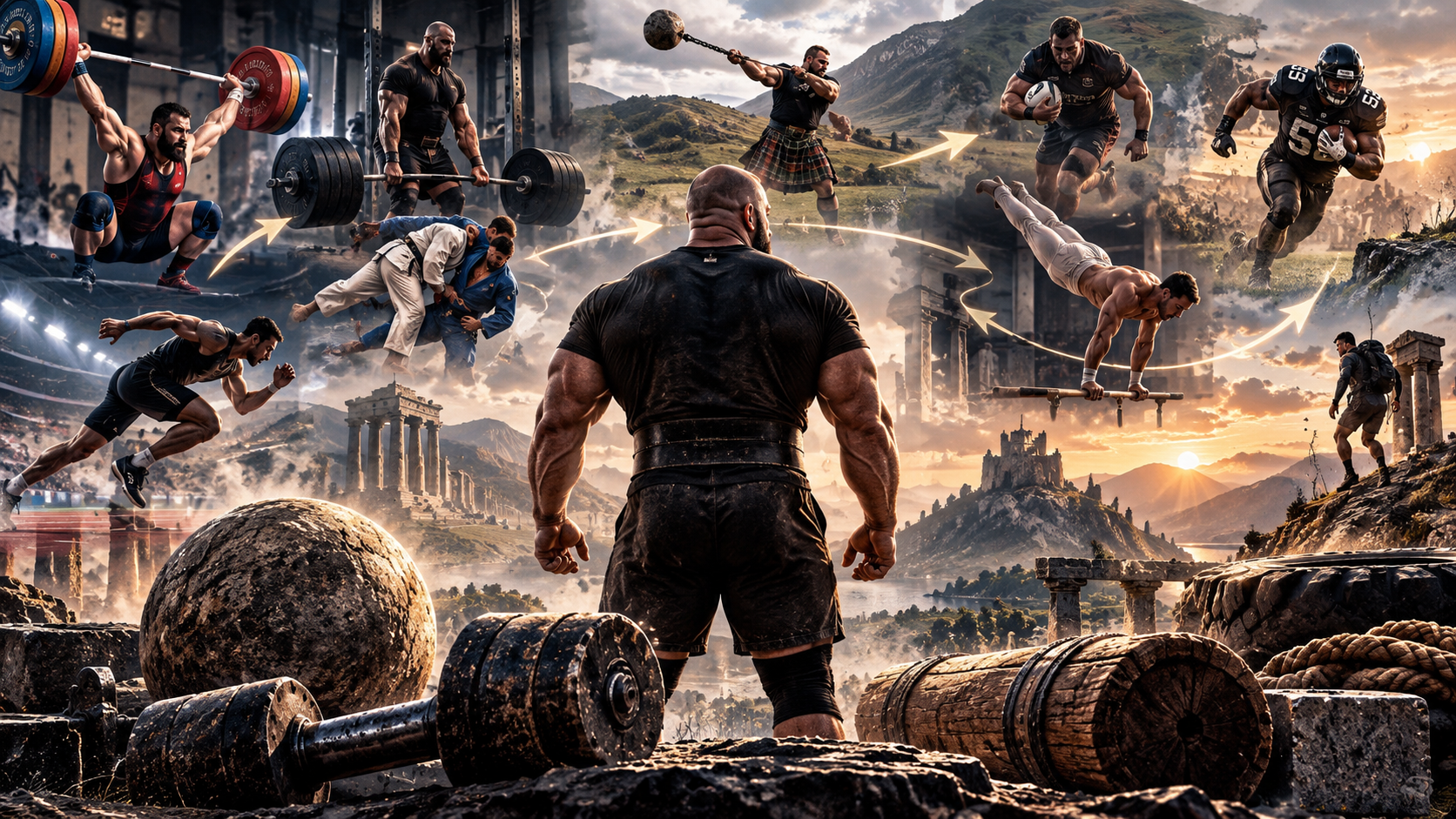
Highland Games: traditional throws and whole-body power development
Highland Games as a field laboratory for unusual-object strength
Highland Games combine traditional Scottish heavy events involving stones, metal weights, rigid-handled hammers, sheaves and long timber poles. Their distinguishing feature is not simply implement mass. Success may be defined by horizontal distance, vertical clearance or the final orientation of a timber after a full turn. Strongman also uses unusual objects, but its objectives frequently involve lifting, carrying or pushing under different rules. Potentially shared capacities include handling unfamiliar implements, generating impulse and coordinating whole-body force. Cultural and visual similarities are not experimental evidence that a training method necessarily improves a particular strongman event [1–3].
A scientific account should not collapse these disciplines into one generic category of heavy throwing. Caber toss rewards turning a long timber and achieving a favorable direction, not maximizing its flight distance. Weight for distance requires releasing a handled mass for horizontal travel. Weight for height rewards passing an obstacle. The Scottish hammer uses a rigid shaft rather than the standard wire-and-handle construction of track-and-field hammer throwing. Stone putting involves a controlled one-handed put. Each task requires a different combination of speed, force direction, release and stability.
Rules and implement categories vary across local, novice and professional competitions. Organizers provide examples of stones around 16 or 22 pounds, weights of 28 or 56 pounds and sheaves of 16 pounds, but these numbers are not universal requirements at every gathering [2,3]. Research and coaching comparisons should document verified mass, geometry and rules of the actual contest rather than memorizing one organization's equipment list.
Highland Games preparation may appear close to strongman because both involve substantial resistance training and variable objects. Yet throwing is ballistic: release speed and direction can decisively determine performance after the athlete lets go. Heavy carrying in strongman requires the athlete to remain in contact with the implement and sustain speed through repeated steps. Overhead lifting can be decided by stabilization rather than projectile distance. Transfer analysis must distinguish potentially shared adaptations from skills that remain specific to the event.
The internal diversity of Highland Games provides opportunities for interesting comparison. The same athlete may be tested on distance, height and caber turning, and different results may reveal distinct limitations. Excellence at weight for height and difficulty with the caber do not establish a general lack of power. Caber performance also depends on balancing, pickup, release timing and the object's rotation. Useful assessment describes the task before assigning an underlying physiological capacity.
The direct research literature on Highland Games is comparatively limited. This article therefore distinguishes event rules and descriptions, observational evidence about athletes' actual practices, and general biomechanical principles applied as explanatory models. Models remain valuable, but they are not disguised as intervention studies proving exact transfer to strongman. This separation is a necessary condition for accessible scientific writing without invented claims.
Distance, height and orientation are three different outcomes
Throwing distance, vertical clearance and the final orientation of an object are fundamentally different outcomes even when all require acceleration of a heavy mass. Distance throwing depends on release speed, direction, height and implement properties. Height throwing requires sufficient vertical travel to clear a bar, with horizontal range generally secondary. Caber toss largely concerns successful rotation and alignment. Peak mechanical power alone cannot explain these different results without considering trajectory and control [2,3].
For an ideal particle released and landing at equal heights without aerodynamic resistance, horizontal range is R = v² sin(2θ)/g, where v is release speed and θ the release angle. Under these restrictive assumptions, range scales with the square of speed. A 10% increase in release speed would increase idealized distance by approximately 21% if angle remained unchanged because 1.1 squared equals 1.21. This is not a demonstrated training-transfer percentage for weight for distance. Training cannot be assumed to increase release speed by a fixed amount, and speed can interact with angle in actual technique.
For an idealized vertical release, additional peak height of the object's center of mass is h = v_y²/(2g). A vertical release velocity of 7 m/s would produce approximately 2.50 m of rise above the release point in the simplified model. Released at 1.7 m, the object would reach a peak near 4.2 m. Whether it passes a horizontal bar still depends on its size, orientation, horizontal position and obstacle geometry. A velocity number alone cannot determine success in a weight-for-height event.
Caber toss requires a different mathematical description. A long rigid object has a substantial moment of inertia and experiences changing ground contact. Its center-of-mass projectile path is insufficient to characterize whether it turns successfully. Torque about a reference point produces angular acceleration, while final orientation depends on release state and contact dynamics. A caber may travel comparatively far without turning, or turn successfully with modest horizontal movement. Distance measurement cannot substitute for event scoring.
Strongman contains some related but distinct objectives. Bag Toss and Weight Over Bar share a vertical target but their implements and movement paths differ. Loading events may involve reaching a platform height without requiring the same airborne trajectory. Carries depend on continuous loaded locomotion rather than free flight. Transfer should be based on the relevant common mechanical requirement, not on the observation that all tasks involve heavy objects.
This classification also prevents simplistic athlete labeling. A powerful stone putter may have high release velocity in a short unilateral effort without being equally proficient at caber turning. An athlete clearing a high bar may generate excellent vertical impulse but lack rotational speed in hammer throwing or stabilization in a long carry. A defensible performance profile preserves distinct outcomes, records implement characteristics and tests relationships rather than assuming them.
Caber toss: turning a timber rather than maximizing flight distance
The caber is a Highland Games emblem partly because its scoring contradicts the intuition that the best throw must travel farthest. Athletes raise a long timber, balance it with one end near the hands, advance while controlling it and attempt to flip it end over end. The judge evaluates the final direction using a clock-face analogy: twelve o'clock is an ideal alignment. Individual competitions can vary details of scoring, and caber dimensions are not identical across events [2,3].
The key mechanical feature is control of a long object whose mass is distributed along its length. Moment of inertia depends on the distribution of mass relative to the axis of rotation, not mass alone. Equal-mass cabers of different length or density do not necessarily have equal turning difficulty. For an ideal uniform thin rod rotating about one end, I = mL²/3. A real caber is not uniform, ground contact shifts and the movement is more complex, but the equation illustrates how strongly length affects rotational inertia.
Consider a hypothetical 80 kg, 5 m uniform rod rotating about one end. The formula gives a moment of inertia near 667 kg·m². With unchanged mass but length increased to 6 m, the estimate becomes 960 kg·m², roughly 44% larger. That does not mean a six-meter caber requires exactly 44% more human force for a valid toss. Angular acceleration, contact and technique all change. The calculation simply shows why nominal mass alone can misrepresent mechanical difficulty.
The athlete must first bring the timber into a balanced position. Pickup may require lower-body extension and torso control, capacities with broad relationships to heavy strongman implements. But balancing a nearly vertical timber introduces instability unlike cleaning a horizontal log with fixed internal handles. During the approach, foot placement must be coordinated with the timber's movement. A maximal-strength reserve cannot compensate indefinitely for a badly timed step.
Release requires a useful combination of translation and angular impulse. Insufficient rotation may leave the timber short of a completed turn, while poor direction reduces the alignment score. Changes in body lean or release timing can substantially alter the result. A larger deadlift could make the initial pickup easier without guaranteeing a successful caber turn. This is a clear example of strength contributing to a task without explaining its final performance.
For strongman, possible lessons concern control of unfamiliar mass distribution, the transition from lifting to moving, balance corrections and safe release. These are plausible shared challenges, not a quantified training effect on yoke or log lifting. Controlled longitudinal evidence is insufficient to assign a percentage transfer between caber practice and those events. Any complementary use should be judged against time, fatigue and actual contest requirements.
Safety is critical because a long timber can fall in unpredictable directions after an unsuccessful manipulation. The front and side sectors must be kept clear, and pickup and controlled release should be learned under experienced supervision. Repeated maximal failures for dramatic footage do not necessarily deliver useful adaptation. A responsible program begins with an implement suited to the athlete's proficiency and with an understanding of its likely path.
Weight for distance: transmitting impulse through rotation
Weight for distance illustrates the distinction between producing force and directing it effectively. A metal weight is connected to a handle by a chain or another link and accelerated through rotating or swinging actions allowed by the competition. The result is measured horizontal range rather than the greatest weight lifted vertically. A competitor with exceptional squat or deadlift strength can still be limited by the coordination of circular acceleration, torso rotation and release timing. General strength matters, but its transmission into implement speed depends on technique [2,3].
During curved movement, acceleration includes a radial component that changes velocity direction and a tangential component that changes speed. In a simplified circular model, radial acceleration is a_r = v²/r. An object moving at 10 m/s on a radius of 1.2 m has radial acceleration of approximately 83.3 m/s². This is a geometric example, not a measurement of handle tension or shoulder loading. Real throws involve changing radius, speed, body movement and contacts, so the athlete's mechanics cannot be inferred from that value alone.
The position of the body influences how leg action and pelvis rotation contribute to the object. Rotating quickly without coordinating the implement can waste useful speed at release, whereas well-timed ground contacts may support progressive acceleration. This does not identify one universal number of turns or one ideal technique for every athlete. Rules, throwing space and experience influence the options available. Coaches should assess the actual throw rather than infer success from rotation speed in isolation.
Potential strongman transfer concerns coordination of the body while accelerating a heavy external object, a feature relevant to certain bag throws. A two-handed sandbag swung behind the body is nevertheless mechanically different from a chain-connected weight, particularly in radius and contact. No direct evidence establishes weight for distance as superior training for every bag-toss event. A reasonable hypothesis is that experience producing and releasing impulse may facilitate learning of a related task when its constraints are sufficiently similar.
An assessment can use calibrated video to describe acceleration duration, implement position and approximate release speed. Uncalibrated footage cannot identify precise muscle forces or internal tissue loading, but it may expose large trajectory changes. Results should be recorded in meters with mass, chain length and rules documented. After a weight-for-distance training period, a standardized strongman throw can be retested to examine whether useful performance transfer occurred. The result still needs careful interpretation because event practice and other training may also have changed.
Teaching and safety costs are important. Accelerating a heavy weight through rotation in an inadequate space places bystanders at risk. The landing sector should be empty and equipment checked before use. Technical control should precede maximal intensity, while lighter implements can assist learning without being assumed to reproduce the exact technique of a heavier competition weight. Under appropriate conditions, the event provides a useful way to study rotation, impulse and release speed, not a guarantee of cross-sport transfer.
Scottish hammer is mechanically distinct from Olympic hammer
The Scottish hammer is commonly constructed as a metal head attached to a rigid shaft, and athletes typically accelerate it through swings with comparatively fixed foot positions rather than performing the full-body turns characteristic of Olympic hammer throwing. Some traditional events allow or employ blade-equipped footwear to anchor the feet against the generated forces. The Olympic implement uses a wire and handle, and the athlete rotates inside a throwing circle. Sharing the word hammer does not make the movement patterns identical [3].
Accelerating the heavy head in an arc requires forces transmitted from the ground through the legs, pelvis, torso and arms. The athlete must resist destabilizing moments while orienting the swing plane and managing the trajectory. Fixed-foot techniques restrict the full-body rotation available in the Olympic version, potentially changing how the release speed is produced. It would be methodologically unsound to import velocity figures or coaching conclusions from one event into the other without accounting for implements and rules.
A simple geometric relationship is v = ωr: tangential speed equals angular speed multiplied by radius. At a given angular speed, a larger radius yields higher linear speed, but it also alters mechanical demands. In actual throwing, angular speed cannot be assumed constant when radius changes. Available torque, geometry and control may constrain acceleration, so a longer handle is not automatically better.
Potential strongman lessons concern trunk rotation and the ability to manage force that changes direction rapidly. These capabilities may assist certain throwing patterns or management of oscillating loads. Yet many strongman movements require force predominantly in a sagittal plane or over less circular paths. There is no adequate body of direct intervention studies assigning a transfer coefficient from Scottish hammer to bag toss or loaded carrying.
Stability must not be equated with maximum stiffness in every direction. The thrower needs to resist unwanted displacement while allowing productive body rotation and object acceleration. A completely immobilized trunk would prevent useful movement. This distinction is also relevant to carrying or lifting irregular strongman implements, where control has to coexist with motion rather than suppress it entirely.
Evaluation can record throwing distance, consistent release patterns and reliably measured speed when suitable technology is available. Better Scottish hammer performance is a gain in that event, not automatically in strongman. Safety requires a clear throwing sector, sound shaft, secure anchoring arrangements and experienced supervision. High object velocity magnifies the consequences of equipment failure or poor control.
Stone put: traditional putting and the limits of resemblance to shot put
Highland stone putting involves propelling a stone or stone-like implement under local event rules. Some competitions use natural stones, while others use more standardized objects or varying categories of mass. It resembles track-and-field shot put through the one-handed putting objective and scoring by distance, but implement shape and contact can differ. A natural stone may have texture and mass distribution unlike a regulation metal shot. The athlete must manage the actual interface rather than merely generate pushing force.
Projectile mechanics involve release speed, height and direction together with gravity and aerodynamic properties. A simplified model is useful for introductory calculations with compact dense objects, but not all irregular stones behave identically. More importantly, the speed achievable at release depends on mass, available movement range, body starting position and how efficiently whole-body movement contributes. General coordination may transfer between stone put and shot put more readily than every technical detail.
Stone putting involves substantial lower-body and torso contribution even though the implement ultimately leaves one hand. Attempting to create all release speed through isolated arm extension can limit use of the rest of the body. Yet describing a kinetic chain does not imply that energy always follows one simple, identical sequence in every athlete. Coordination depends on technique, and shot-put research should not be assigned directly to differently shaped stones without qualification.
Strongman may benefit from practicing rapid impulse transmission in one-handed pushing or related medicine-ball work, but these tasks are not interchangeable. Carrying a large stone against the torso requires sustained contact and locomotion rather than a fast ballistic release. Stone put cannot replace practice of frontal stone carrying simply because both involve stones.
Assessment should specify whether the target is stone-put distance, release speed or a different strongman event. Improved stone-put distance might reflect technique, force capacity, velocity or more secure contact. Without additional measurements, the mechanism cannot be attributed solely to muscle adaptation. If a sandbag throw later improves, that is an interesting association, but concurrent sandbag practice and recovery must be documented for causal interpretation.
The pedagogical advantage of a natural stone is that it forces attention onto the object's physical characteristics rather than only the number on a plate. The downside for research is variability: equal-mass stones can differ in available grip, surface and flight behavior. Where possible, use the same object when testing progress. Without that standardization, experience may remain valuable as general preparation, but claims about measured improvement become less secure.
Weight for height and sheaf toss: vertical clearance is a distinct skill
Weight for height, often called weight over bar, requires throwing a relatively heavy implement above a horizontal obstacle, commonly through a unilateral swing. Sheaf toss also involves bar clearance, but the traditional implement is a sack or bundle commonly launched using a fork. Both score the greatest valid clearance, yet implement mass, shape, grip and release technique differ. They are not interchangeable versions of one throw and cannot automatically be equated with Strongman Bag Toss [2,3].
In an ideal vertical throw, release velocity's vertical component governs height gained after release through a square relationship. But athletes do not necessarily release at the same height, and taller athletes may enjoy a geometric advantage without guaranteeing higher clearance. A handled weight and a sheaf have different mass distributions and contact points. Their center-of-mass trajectories can be accompanied by rotation that influences whether the entire object clears the bar.
Consider two hypothetical releases from the same point with vertical velocities of 6 and 7 m/s. With air resistance ignored, additional maximum height changes from approximately 1.83 m to 2.50 m, a difference near 0.67 m. This does not imply that gaining one meter per second is easy through training or that all implements respond identically. A large object may strike the obstacle despite its center of mass reaching sufficient height, and a misdirected path may miss the bar.
The athlete must coordinate implement swing, body extension and release timing. When released too early or too late, a substantial component of velocity may be directed horizontally when the task primarily rewards vertical clearance. Sheaf tossing adds fork interaction: the sack must separate from its launcher at the proper time. Maximal pulling strength can offer physical resources without teaching this release mechanics.
Transfer to strongman seems intuitively closest to Bag Toss, but the comparison needs precision. A sandbag thrown over a bar has a related clearance objective, yet its release path may differ from a fork-launched sheaf or a chain-connected weight. A gain in Highland weight-for-height cannot be converted to a guaranteed Bag Toss height because implement mass, swing length and release control differ.
A simple testing protocol may use predetermined heights and the same number of attempts at each. Record success rates, best valid height and equipment. Single attempts can be unreliable during motor learning, while excessive repeated maximal attempts increase fatigue and mechanical exposure. A manageable standardized condition may be more informative for long-term progress than rare spectacular successes.
Ultimately, these events distinguish release speed from successful clearance. An athlete may generate sufficient vertical velocity but strike the obstacle because of release position. Similar situations occur in strongman throws where the bag travels fast but fails to clear the bar. In such cases improving technique may have greater immediate value than adding maximal-strength volume.
The 2024 Highland Games athlete survey: evidence and boundaries
One of the most relevant direct studies is the 2024 research by Winwood, Keogh, Travis, Grieve and Pritchard in the Journal of Strength and Conditioning Research. The researchers surveyed 169 Highland Games heavy-event athletes about training and tapering practices. Participants averaged about 40.8 years of age, 181.2 cm in height and 107.2 kg, with roughly 18.8 years of resistance-training experience and 8.1 years of Highland Games competition experience. This was a self-report observational study, not an experiment demonstrating that one method was superior [1].
The investigators found that 78% of respondents, or 132 athletes, reported tapering before competition. Their mean stated taper duration was 5.2 days with a standard deviation of 3.5 days. Training volume decreased by about 34%, while Highland Games event practice became comparatively more prominent as some traditional training was reduced. These are observations about athlete choices. They do not establish that 5.2 days or a 34% reduction is physiologically optimal for every individual.
Reported peak training volume occurred about 5.5 weeks before competition and peak intensity around 3.8 weeks beforehand. Participants reported stopping training on average 2.4 days before competition. This pattern shows deliberate temporal planning but does not prove that the identical sequence is most effective for a strongman who may compete frequently across a very different combination of events.
Strength and muscular power were common training emphases. According to respondents, caber toss, weight for height and heavy weight throw tended to be practiced further from competition than certain other events. This may relate to mechanical fatigue, logistics or other constraints, but the survey did not experimentally isolate the reasons. It would be inappropriate to invent a single causal explanation for a reported behavior.
Retrospective surveys have limitations. Respondents can interpret training volume and intensity differently, approximate past behavior or differ systematically from athletes who did not participate. No randomized intervention compared the described taper against an alternative. The figures are therefore best used as descriptions and sources of testable hypotheses rather than universal prescriptions.
For transfer, the study demonstrates an approach to combining general strength work with event practice in a multi-event sport. It does not answer how much a strongman's bag throw would improve by replacing one session with weight for distance, or whether caber practice would increase a log maximum. Such questions need longitudinal interventions with actual strongman outcomes under comparable conditions.
The distinction between descriptive and prescriptive evidence is essential. The proposition that most surveyed athletes used a taper is supported by the data. The proposition that the same taper guarantees optimal performance is not. Coaches can learn from experienced Highland Games practices while acknowledging that common behavior does not automatically establish causal superiority [1].
Whole-body power must be defined before it can be measured
Whole-body power is often used to describe the ability to coordinate several joints so that an external object receives substantial impulse within a short interval. It is not one universally measurable physical quantity. Mechanical power can be assessed at the object, at selected segments or at a model of the whole system, producing different values. The fact that a throw involves legs, trunk and arms does not mean that every segment contributes equal positive power to the release.
Instantaneous mechanical power is the scalar product of applied force and velocity at its application point. Part of the work performed within the athlete-object system appears as kinetic energy of the implement. If object mass and release speed are known, translational kinetic energy is E_k = mv²/2. A 12 kg implement released at 8 m/s carries about 384 J of translational kinetic energy; at 9 m/s it carries about 486 J. The difference does not measure total metabolic energy expenditure or identify the muscles responsible.
Rotating objects may also carry relevant rotational kinetic energy, given in an idealized rigid-body model by E_rot = Iω²/2. A caber can distribute kinetic energy between movement of its center of mass and rotation, both relevant to its performance. For other objects, rotation can alter stability or aerodynamic behavior. Reducing every Highland Games throw to translational energy alone ignores these distinctions.
Watching movement start at the legs and finish near the hand is not sufficient evidence for a complete segment-by-segment energy-flow model. Some joints may absorb mechanical energy in one phase while others generate it. Trunk stiffness can enable force transmission with little visible displacement. A detailed analysis requires three-dimensional kinematics, external forces and a dynamic model, each with limitations. Such instrumented research is currently less abundant in Highland Games than in Olympic track-and-field throwing.
For strongman the relevant principle is that general strength and power resources must be expressed in the direction and time window that changes the event result. A method can improve release speed in a throw without improving a long carry limited by grip and sustained stability. Better supporting strength may improve a carry while leaving projectile speed unchanged. Related capacities are not fully interchangeable.
The term whole-body becomes scientifically useful when linked to specific joint actions, a defined time interval and an observable effect on an implement. For weight throwing, release velocity may be measured. For caber, pickup control and final orientation may be assessed. For alleged transfer to strongman, the target event itself must be tested. This sequence separates a useful coaching metaphor from a defensible empirical claim.
Ground reaction and force transmission without laboratory mythology
Every heavy throw involves forces applied to the ground, with resulting ground reactions contributing to the acceleration of the athlete and implement. During a stone put, the athlete can push against the surface before transmitting motion through the trunk and arm. Weight for distance depends on contacts that permit changes in angular momentum and balance during turns. Scottish hammer techniques rely on support and anchoring as the implement accelerates. The shared theme is multi-segment force transmission, but the actual process differs across movements and cannot be deduced simply by listing muscle groups.
Force platforms measure components of ground reaction under their installation conditions, while three-dimensional motion systems estimate segment and implement trajectories. A large vertical force does not automatically indicate greater distance in a predominantly horizontal throw. Force direction, application time and movement sequence matter. Some techniques alternate support between legs, making a measurement from only one platform incomplete. Instrument choice should follow the question rather than dictate the explanation.
Without sophisticated equipment, coaches can still observe approach speed, implement position, release direction and post-throw balance. Two well-positioned cameras can assist, although uncalibrated angles remain approximate. High-frame-rate footage helps with timing but does not convert pictures into internal muscle forces. Accurate qualitative observation is preferable to numerical estimates that imply unrealistic precision.
For strongman, the lesson is not necessarily to copy rotational technique. Throwing work might help an athlete coordinate lower-body extension with object acceleration, but a slow heavy carry limited by grip and sustained stability may receive little direct benefit. Exercise selection must follow a defined target outcome. The fact that two tasks recruit much of the body does not by itself establish training transfer.
Contact surface and footwear can greatly change performance. Wet grass or a slippery circle may alter throwing strategy, especially at outdoor Highland Games. Longitudinal comparison therefore requires more than identical implement mass. Improvements on dry ground should not automatically be interpreted as physiological adaptation when an earlier test occurred on a less secure surface.
A coach might test whether Highland-inspired training improves strongman bag-toss height, initial implement acceleration or stability during a related movement. If the target does not improve, other limitations or interventions deserve consideration. The link between sports must ultimately be the measurable result, not a shared vocabulary about explosive effort.
Neuromuscular adaptation and the limits of cross-sport inference
Highland Games athletes commonly report resistance training, power work and event practice, as documented in the 2024 observational survey. Such preparation can plausibly produce muscular and neural adaptations, but differences in training dose and participant experience prevent attributing all results to one method. We cannot claim participation in Highland Games necessarily increases type II fiber proportion by a known percentage or produces a unique neural adaptation absent from other strength training [1].
Maximal strength, rapid force production and coordination are related but distinct qualities. A maximal deadlift measures capacity under one slow high-resistance condition. A light throw emphasizes release speed. A caber rewards control of a large rotating object. An athlete may improve differently on each measure, and no single test provides a complete performance profile. Labeling everything explosiveness obscures those differences.
A longitudinal study might measure standardized one-repetition maximum, jump performance, weight release velocity and caber scoring. Improvements across all tests would demonstrate a multidimensional training response but not automatically identify which adaptation caused each outcome. Specific practice, total workload and recovery would need to be controlled. Improvement confined to caber might suggest technical learning, although that too requires further assessment.
Training stimulus and skill complexity interact. Distance throws demand brief acceleration, while caber manipulation requires balance and coordinated release. A program capable of increasing maximal force may not teach timing. Conversely, extensive technical practice with light implements may improve coordination without substantially raising the force ceiling needed for a heavier object. Both directions can matter, with their relative priority determined by the actual performance limitation.
Neural transfer might plausibly contribute to learning a strongman sandbag throw after experience with another ballistic implement. Nevertheless, shared muscle recruitment or larger electromyographic signals do not demonstrate a competitive transfer effect. Electrical muscle activity depends on position, velocity and measurement methodology. It must be interpreted alongside external mechanics and outcome rather than as direct proof of program effectiveness.
For strongman competitors, Highland Games experience can be valuable for implement variety, control of awkward masses and familiarity with powerful throws. Its competitive value depends on the event calendar. If bag toss and related throws are prominent, Highland-style work may be more relevant. If the season emphasizes maximal lifts and long carries, the same time investment may be less productive. This is a conditional training decision, not a judgment that one sport is inherently superior.
Local rules, surfaces and the interpretation of historical performances
Highland Games preserve local traditions in equipment and judging. That diversity is culturally important but complicates scientific comparison. Caber competitions may use timbers differing in mass, length and density, while scores depend on successful turns and orientation. A result from one festival cannot automatically be treated as mechanically equivalent to another result using a different caber.
For weight for distance, chain length, grip and throwing area can alter movement. Scottish hammer depends on rigid-shaft characteristics and permitted foot technique. Stone put can vary in object texture and contour. Even equal nominal mass does not ensure equivalent movement demands. These differences do not invalidate official results; they determine the conditions under which comparisons are meaningful.
A study should record verified implement mass, dimensions, surface, relevant weather conditions and scoring procedures. Not every variable will be equally influential in every event, but systematic omission makes it difficult to separate athlete improvement from environmental changes. A controlled experiment on a standardized implement may offer valuable findings without justifying unlimited generalization to all traditional events.
Strongman shares the issue of variable equipment across organizers. The methodological lesson of Highland Games may therefore be as valuable as a borrowed exercise. A coach recording implement geometry and rules can interpret progression more accurately than one preserving only total mass. Time, distance and height belong to a specific task with specific constraints.
Personal records should distinguish official contest performances from standardized training tests. Variety is part of competition, whereas repeatability in training can help detect adaptation. Both forms of measurement have value but answer different questions. An official record shows what the athlete achieved in that contest; a controlled test can provide better information about whether a particular capacity changed.
The distinction also protects historical interpretation. Performances achieved decades ago may be extraordinary, but direct comparison requires knowledge of implement construction and measurement method. Respect for the tradition is compatible with scientific rigor. Careful documentation preserves the achievements without imposing mechanically unjustified equivalence across periods and venues.
Programming: borrowing principles without copying the Highland Games calendar
A Highland-inspired preparation strategy can combine general strength, power-oriented exercise and implement practice, but the balance depends on the athlete's actual goal. For a Highland competitor, the traditional throws are direct competition events. For a strongman borrowing them, they are auxiliary work whose time cost needs justification through target-event performance. Reproducing a full Highland Games training week alongside an already demanding strongman schedule may create overlapping fatigue without clear additional benefit [1].
Exercise selection begins with the limiting requirement. Does the athlete lack release speed during a bag toss, have difficulty coordinating rotation, struggle with oscillating implements or require more lower-body extension force? When the problem is release timing, technically specific practice with manageable loads may deserve greater attention than adding a complete weight-for-distance workout. If the bag already has sufficient vertical velocity but misses the obstacle, trajectory correction may offer more immediate benefit than another maximal-strength block. These remain programming hypotheses, not universally proven prescriptions.
Highland Games exercises can offer variety and controlled exposure to unusual ballistic objects during general preparation. As a specific strongman contest approaches, sufficient practice with the actual competition implements remains necessary. If additional throws degrade the quality of priority sessions, auxiliary volume should be revised. Recovery is finite, and potential transfer must be evaluated alongside its cost.
The 2024 survey shows that many Highland Games competitors taper and place increasing relative emphasis on event-specific work before competition. It does not establish that the same duration or volume reduction is optimal for strongman. A strongman calendar may contain two consecutive competition days and tasks unlike traditional throwing. Managing fatigue before an event is a reasonable general principle; the exact prescription must account for the individual and the contest [1].
A simple strategy is selecting one Highland method for one precisely defined goal, at a dose that does not disrupt essential event training. The log records implement mass, throw count, surface, perceived difficulty and the strongman outcome being tested. If the expected benefit is not observed after an appropriate period, revise the method without declaring it universally ineffective. An individual testable approach is more informative than accumulating exercises merely for variety.
Ballistic coordination can deteriorate under fatigue even when the athlete remains physically able to complete attempts. As release speed or trajectory changes, the intended stimulus may no longer be the same. Modifying or stopping a session before substantial control loss can be rational, although no universal velocity-loss threshold has been validated for every traditional Highland implement.
A responsible integration rule is simple: the target sport determines the usefulness of the borrowed method. If an auxiliary exercise develops a genuine capacity but consumes recovery without benefiting relevant competition tasks, its place should be reconsidered. If a traditional throw reproducibly improves a strongman event, it may merit inclusion even though it looks unlike conventional gym work. The criterion is demonstrated performance rather than prestige.
Safety: throwing sectors, rotational energy and unpredictable objects
Heavy throwing brings hazards not solved merely by reducing total weight. A metal implement on a chain or rigid shaft can travel on a broad path, and an accidental release threatens people standing at considerable distance. A caber can fall sideways or backward, and a stone may roll or rebound after landing. Sheaf tossing involves a launching fork that also requires controlled handling. Each implement needs an appropriate designated area and a practiced release procedure rather than simply some space around the athlete.
Rotational tasks can create substantial acceleration. In a simplified circular model, radial acceleration scales with the square of tangential speed. This helps explain why a moderate speed increase can magnify external mechanical demands. It cannot alone predict individual injury risk or joint forces. Position, radius, duration, load history and changing external moments all matter.
Session organization should allow one active thrower in the sector, checks of implement and handle integrity, a clearly marked throwing direction and no access to the landing area during attempts. Visibility and ground condition require assessment. An accidentally released implement may follow a trajectory different from the planned throw. Observers should therefore be outside the danger zone rather than simply a few steps to the side.
Progressive practice can begin with manageable implements and controlled movement amplitude, but no single percentage-based progression is suitable for all athletes. Demonstrated control of stance and release should precede simultaneous increases in speed and mass. Extremely strong novices may generate dangerous forces before mastering the technique, making competent supervision more important rather than less.
Persistent pain, dizziness, unusual instability or other concerning symptoms warrant stopping and appropriate assessment. Tradition and competitive culture do not justify ignoring medical warning signs. Throwing practice should not be treated as a test of tolerance to any symptom. Inadequate recovery can also impair coordination, further complicating control of fast-moving objects.
A Highland Games method should be added to strongman preparation only when adequate space, equipment and instruction are available. When these conditions are absent, a simpler intervention targeting a related general capacity may be more appropriate, while acknowledging that its mechanical stimulus is not identical. Safety enables consistent long-term practice rather than obstructing performance.
Testing one transfer hypothesis without imaginary statistics
Suppose a strongman repeatedly fails a bag toss at one height and introduces a method inspired by Highland weight for height. Begin by standardizing the target: identical bag mass and dimensions, bar height, number of attempts, surface and warm-up. Record not only success but approximate trajectory and release timing. Without repeatable baseline conditions, it is difficult to separate adaptation from environmental variation.
Introduce the auxiliary exercise while keeping other major training components reasonably stable. If the athlete simultaneously increases bag practice, changes technique and reduces body mass, any later improvement cannot be attributed solely to the Highland method. Individual before-and-after observation has causal limitations, but careful documentation makes it more informative. Evidence should be interpreted to answer the initial question rather than protect the preferred hypothesis.
Three outcomes are possible. First, only weight for height improves, demonstrating adaptation to the source task but not verified strongman transfer. Second, both events improve, making transfer plausible while learning and recovery remain alternative explanations. Third, bag toss improves without a change in the source exercise, potentially reflecting more specific technique or normal testing variation. None of these observations yields a universal mathematical transfer efficiency.
Stronger research could compare groups practicing the same strongman event while receiving different auxiliary interventions of approximately comparable training cost. Standardized bag-toss outcomes would be measured before and after with uncertainty intervals and individual responses reported. The program must allow adequate adaptation without forcing unnecessary repeated maximal attempts. A relatively simple design can be valuable when based on a clear question.
Negative findings are useful. If the borrowed exercise does not improve the strongman outcome, the athlete can avoid further investment in an unproductive direction. If reproducible improvement occurs, the method can remain as long as its benefit justifies time and fatigue. Evidence-informed programming is willing to revise an initially plausible idea rather than insisting that all traditional throws automatically improve every kind of power.
Practical importance differs from statistical significance. A small height increase can decide a contest when it clears a bar competitors cannot pass. Nevertheless, the change must be shown to exceed ordinary attempt-to-attempt variation. A single favorable throw cannot establish adaptation. Useful evidence emerges from repeatable observations and honest comparisons.
Even when the same object is used, environmental context can alter the apparent outcome. Outdoor surfaces, humidity, footwear and wind may influence technique. Recording these conditions helps distinguish genuine progress from a more favorable environment. No coach needs a full scientific laboratory for each session, but basic consistency dramatically improves the quality of inference.
Finally, training transfer is not always the sole reason to use a movement. An athlete might enjoy Highland Games practice or use it as a controlled form of variation. Those are legitimate preferences. They should simply be distinguished from a claim that the method has been shown to improve a specific strongman event. Clear language allows creative programming without sacrificing scientific accuracy.
Individual differences: body mass, experience and implement category
Highland Games performance is influenced by athlete characteristics, but neither body mass nor experience explains every event in isolation. A heavier athlete may possess greater absolute strength and useful stability while handling certain implements, yet throwing still requires acceleration within a short interval and an effective release. Body mass is not a direct multiplier of throwing range. During caber toss, proportions may affect how a timber is balanced, while caber length and mass distribution remain independent mechanical factors. A credible predictive model needs more than athlete weight.
The 2024 study included athletes of both sexes and different competitive standards, but the overall descriptive statistics should not be applied unchanged to every subgroup. Implement categories differ across competitions, sometimes substantially. Distance or clearance cannot be compared properly without object mass and geometry. A result achieved with a lighter official implement does not demonstrate low strength, while a larger implement does not automatically demonstrate superior coordination.
Experience can improve pacing and control at the object interface. During weight for distance, a practiced athlete may coordinate a chain-connected mass more effectively than someone performing the movement for the first time. Such an advantage can exist without a dramatic difference in maximal barbell strength. Conversely, good technique cannot fully replace the force needed to accelerate a very heavy object. Successful performance depends on the compatibility of physical resources and the movement solution.
For strongman, the usefulness of a Highland exercise may depend on the athlete's background. Someone with years of powerlifting experience may bring substantial maximal strength but little throwing skill. Ballistic implement practice could mainly provide familiarization with impulse and release. A former track-and-field thrower may have well-developed throwing coordination but require new learning with heavier or irregular implements. These are plausible patterns rather than stereotypes that apply to every athlete in either sport.
Hand dominance, available movement range and comfort with rotation also deserve attention. Unilateral tasks may reveal different strategies between sides. Complex rotational movements can demand extended learning time even in a strong athlete. Perfect symmetry is not a necessary criterion for every throw, but instability or discomfort should inform progression. The athlete needs adequate control before very heavy loads are introduced.
Research reports should present individual variation and subgroup characteristics when possible. An intervention effective among experienced athletes is not guaranteed to work identically for novices, and findings for one implement category need not generalize to others. Strongman adds another layer of task differences, making transfer still more conditional. The best recommendation states which population, event and conditions support the proposed benefit.
Trying to identify one ideal thrower from one number would therefore be counterproductive. Performance is multidimensional, and Highland implements reveal different capacities. Beyond athlete mass and gym strength, useful observation includes release behavior, technique, stability and the actual outcome with each relevant implement. This approach preserves the mechanics of each event without abandoning shared physical principles.
Interindividual variability also means that training cost differs. One athlete may learn a caber technique rapidly, while another requires substantial practice before it can even be performed safely. A program that works for the first athlete may have a very different opportunity cost for the second. Transfer cannot be evaluated independently of the work required to create and maintain the adaptation.
Even within the same athlete, priorities can change over time. Once basic throwing technique is reliable, general power may become a more important limitation. After power improves, release precision may again dominate. Reassessment is therefore part of individualization. One initial diagnosis should not be treated as permanent.
This athlete-centered reasoning allows coaches to borrow methods without importing an entire Highland training identity. The purpose is not to turn every strongman into a caber thrower, but to discover whether a particular unfamiliar-object challenge develops something useful for the athlete's own contest goals. The answer must come from measured outcomes under appropriate conditions.
Conclusion: Highland-to-strongman transfer is plausible but selective
Highland Games present a rich family of challenges that require athletes to accelerate, stabilize and release implements with very different geometry. Stone put emphasizes ballistic pushing, weight for distance coordinated rotation and release, Scottish hammer control of a circular path, height events precise vertical projection, and caber toss the handling of a long object with substantial rotational inertia. They share a cultural identity as heavy events without having identical mechanical requirements. That is why transfer has to be evaluated separately for each task.
The strongest strongman hypotheses concern throwing skills, coordination of body extension with object acceleration and adaptation to unusual implements. Improvement in bag toss after Highland-style practice is plausible, but not established without testing. Transfer to a maximal deadlift or long-distance carry may be more indirect when the real limitation is maximum force, grip or locomotor endurance. Neither visual resemblance nor overlapping muscles supplies a credible numerical transfer percentage.
Direct scientific evidence remains limited. The 2024 survey of 169 Highland Games athletes describes real training and tapering practices but does not establish that these methods are superior interventions for strongman competition. Biomechanics supports plausible mechanisms and the design of meaningful tests, but theoretical explanations require external performance data. Acknowledging evidential limits is a condition of rigor rather than a declaration that the methods are ineffective.
The practical process is straightforward. Define the target strongman event, observe the constraint, select a traditional exercise with the best mechanical rationale, regulate fatigue cost and retest performance under comparable conditions. When transfer is reproducible, the method may deserve a place in training. When it is not, the exercise can still provide valuable sporting experience without becoming a compulsory element of preparation.
The next episode turns to standardized track-and-field throws: shot put, discus, Olympic hammer and javelin. These disciplines offer a more extensive biomechanics literature and clearer implement specifications. We will examine impulse, acceleration, segmental coordination and release mechanics while keeping the Scottish hammer distinct from its Olympic namesake and avoiding repetition of Highland traditions.
The overarching scientific lesson is that a successful exercise method is not defined by how ancient, difficult or visually impressive it appears. Its value for another sport depends on a testable effect. An athlete may become better at caber handling without improving a strongman carry, or develop faster vertical release that helps a specific bag toss. Both outcomes are possible because the tasks share some resources while retaining important differences.
Good applied research should report those distinctions rather than conceal them behind one broad term such as power. The combination of careful mechanics, well-documented training and repeatable event results allows coaches to benefit from Highland Games heritage without overstating what the evidence can prove. That is the practical bridge between tradition and modern strength science.
Skill variability: repeat the same object or practice different implements?
In a sport where implements vary across events, coaches face a recurring dilemma. Repeating an identical object allows precise technical learning, yet can produce very specific familiarity. Constantly changing equipment develops exposure to diversity but may reduce the stability of learning and make progression difficult to interpret. Highland Games makes the dilemma tangible through varying cabers, stones and handled weights. Strongman faces comparable questions when logs, bags and stones differ in geometry despite equal mass. There is insufficient direct evidence for one universally optimal ratio between constant and variable practice.
A program may begin with one stable implement to reduce testing noise and help the athlete recognize how technical changes affect results. After the movement becomes reliable, controlled variation in size, handle position or mass distribution can be introduced. If performance remains good only with the first object, the athlete may be highly competent within a narrow condition without displaying equal adaptability to a competition implement. This does not demonstrate lack of physiological transfer; it suggests the learned motor solution may be context dependent.
For a caber, variations in length and mass distribution change balancing mechanics. For stone put, contour and texture alter contact. For weight for distance, chain length changes the swing radius. Useful variation should therefore be deliberate and recorded rather than the uncontrolled consequence of using whichever object happens to be available on a given day. Researchers could compare one group practicing a single standard object with another exposed to controlled variations and later assess both groups on an unfamiliar implement.
Such research could separate transfer to a familiar implement from transfer to a family of related challenges. If an athlete becomes faster with the training sandbag but shows no improvement with a similarly loaded unfamiliar bag, progress is real but restricted. If performance also improves with the novel bag, broader adaptability becomes plausible. Even then, it cannot be assumed that the same benefit would appear with a stone or log of another geometry.
Competition preparation changes the decision. When the actual event implement is known, specific familiarization may deserve high priority. When exact equipment details are uncertain, a controlled range of nearby variations may be reasonable. Yet variety must not undermine safety or execution quality. An athlete repeatedly losing control is not guaranteed to benefit from a larger set of unfamiliar, more difficult objects.
The principle also affects exercise evaluation. Frequent equipment changes can conceal adaptation, making it appear that an athlete is inconsistent when the test itself varies. Coaches should retain at least one standardized benchmark even while exposing athletes to multiple implements. One stable measurement can help distinguish improved physical capacity from the effects of novelty.
Skill learning also has stages. Early practice may be dominated by becoming comfortable with the object and reducing obvious errors. Later practice may emphasize smaller improvements in timing, rhythm and release position. These phases cannot be assigned identical training doses from general theory. Athletes differ in prior experience and the costs of learning a novel movement.
Highland Games therefore offers a potential lesson about adaptation to uncertainty rather than only heavy-object force production. A strongman might become more capable of devising motor solutions for unfamiliar implements, but demonstrating that benefit requires tests using objects not included in the practice program. Better performance on an already familiar caber alone would not answer the broader adaptability question.
A careful experiment would control overall practice time and fatigue across groups. If the variable-practice group receives much more total work, any advantage cannot confidently be assigned to variability. Equalizing exposure does not solve every bias, but it substantially improves interpretability. The outcome should include both practiced and unpracticed objects to separate specific learning from generalization.
Finally, an exercise does not need to improve every possible object to be worthwhile. If an athlete knows the exact competition implement and achieves a substantial reliable gain on it, narrow specificity may be perfectly appropriate. General adaptability becomes more important when the future task is uncertain. The training choice follows the competitive goal rather than a universal preference for variability.
What research is needed before transfer can be called demonstrated?
Research on Highland-to-strongman transfer needs to specify a source exercise, target event and proposed adaptation. Weight for height and Bag Toss share the requirement for sufficient vertical release velocity, offering a plausible hypothesis: adding Highland-inspired practice might improve strongman clearance beyond the benefit of event practice alone. This hypothesis does not assign an effect size in advance. Groups need comparable exposure to the target event, while auxiliary interventions should be reasonably similar in time and recovery cost.
Measurements might include release speed, angle, release height, implement mass and dimensions, number of attempts and successful clearance at a standardized bar. Statistical reports should provide raw values, individual responses and uncertainty intervals rather than just mean percentage gains. If the borrowed method improves a physical indicator but not the target competition result, that outcome must be reported without redefining the research question after seeing the data.
Caber research could investigate adaptation to different mass distributions and lengths, using turn-success rate and directional consistency. Transfer to strongman might be assessed through an unfamiliar-object manipulation task, while explicitly acknowledging that the target is not identical to a caber. Such work would investigate object-control learning more directly than a mere increase in barbell one-repetition maximum. Outcome selection determines which type of transfer the study can support.
Recruitment is a practical challenge because highly experienced athletes are comparatively few. Multicenter collaboration may increase sample size, but consistent implements and test procedures become essential. A large sample with uncontrolled equipment may yield ambiguous estimates, while a smaller carefully documented experiment can provide useful mechanistic evidence without justifying sweeping population-wide claims.
Study duration also matters. Some technical improvements can occur during initial familiarization while muscular adaptations take longer. Testing immediately after only a few exposures risks conflating learning the implement with gaining a transferable physical resource. Researchers should plan familiarization procedures and intervention durations appropriate to the proposed mechanism rather than selecting an arbitrary number of sessions.
A key methodological distinction is between source-task and target-task performance. It is possible for the intervention to improve Highland weight throwing without affecting strongman bag toss, or vice versa. Reporting both avoids claiming transfer merely because the exercise used for training improved. Ideally, the control group should practice the same target event to isolate the added value of the auxiliary method.
Individual characteristics are relevant covariates. Training history, body mass, experience with unilateral throwing, and baseline event skill may influence response. The analysis should avoid classifying every difference as genetic potential without adequate evidence. Different movement strategies and practice exposure can explain a substantial part of observed variation.
Researchers should monitor the intervention as it is actually performed, including number of throws, loads, rest intervals and technique changes. A prescribed plan does not guarantee identical physical exposure across athletes. Without adherence and workload records, a null result might reflect inadequate implementation rather than ineffectiveness of the proposed method.
Ethics matter because repeated maximal caber attempts or fast heavy-object throws can add substantial risk. Manageable tests, proper familiarization, supervision and controlled release procedures can provide informative data without unnecessary exposure. Study quality is defined by a clear question and honest reporting, not by extraordinary object mass.
Until more direct evidence becomes available, Highland Games remains a valuable source of training hypotheses and complementary exercises. Mechanically plausible methods can be recommended cautiously, but guaranteed transfer cannot be promised. Athletes documenting repeatable progress in their actual target events contribute to better practice, even though individual observations remain less causally robust than controlled trials.
Evidence levels and why conclusions must remain proportional
Highland Games offers an excellent setting for examining technical variability and power applied to unusually heavy implements, but direct controlled comparisons with strongman remain uncommon. Observing an athlete who excels in both sports does not demonstrate that training in one caused success in the other. Previous experience, body mass, baseline physical capacities and shared general training can all explain an association. Establishing a causal effect requires an intervention and appropriate measurements, not a collection of spectacular examples.
A scientific interpretation distinguishes descriptive, mechanistic and intervention evidence. An organizer's description can establish how an event is performed and scored. A mechanical model can explain why release speed, object inertia or body position might matter. An observational survey can show which practices experienced athletes report using. None of these alone proves that a particular method increases a strongman result by a stated percentage. Controlled longitudinal work is needed to answer that question.
For the reader this distinction is useful rather than restrictive. We can use mechanics to explain why a traditional height throw shares features with Bag Toss and recommend testing an appropriate auxiliary method. We cannot promise a fixed improvement or declare Highland training universally superior without direct outcome measurements. Careful uncertainty language preserves the creativity of programming while protecting the athlete from unsupported expectations.
It is also possible that an intervention provides benefits not captured by the chosen test. A technique-focused block may improve implement control while maximal throwing height remains unchanged. That observation should prompt examination of intermediate outcomes without retroactively changing the original primary endpoint. Clear separation of intended and exploratory outcomes reduces the risk of exaggerated conclusions.
Conversely, a positive result does not identify its complete mechanism. Better Bag Toss performance could arise from improved release trajectory, greater initial velocity, more effective contact or reduced fatigue. Even when Highland-inspired training contributes causally, the exact physiological pathway may remain uncertain. Mechanistic studies and practical tests answer related but distinct questions.
Coaches should avoid assigning every unexpected result to athlete motivation or an unspecified lack of explosiveness. Such explanations are difficult to test and can obscure mechanical problems. A better approach asks whether the target event improved under comparable conditions and, if not, which measurable constraint remained. This transforms an unsuccessful hypothesis into useful programming information.
The genuine athletic value of Highland Games does not depend on universal transfer claims. Its events possess their own scoring rules, technical skills and remarkable mechanical demands. Strongman can learn from this tradition by respecting those differences, selecting the relevant shared challenge and verifying outcomes with the actual competition implements.
Scientific maturity also requires openness about negative transfer or absent effects. A method might consume recovery and reduce quality of strongman training despite improving Highland performance. The correct conclusion would concern the whole preparation context rather than moralizing about the athlete's effort. A method can be excellent for its source sport and poorly suited to an individual's current target.
The final recommendation is to preserve a small number of clearly justified exercises, measure them consistently and retain them only while their benefit exceeds their cost. That is a principle of accountable coaching, not a universal Highland prescription. The combination of tradition, physics and careful measurement offers far more value than an unsupported claim that every heavy throw transfers to every heavy lift.
Individual performance and overall placing are different outcomes
One further distinction concerns how performance is evaluated when a competition combines several very different events. Overall ranking depends on the scoring format, not merely on an athlete's average physiological capacity. Better weight-for-height performance may produce a decisive placing improvement in one contest but a modest effect elsewhere when competitors are widely separated. For a strongman considering Highland-inspired training, the auxiliary exercise should therefore be evaluated against the structure of the actual upcoming event. A genuine physical adaptation can improve one discipline without significantly affecting total standings.
Individual progress and competitive ranking are not identical outcomes. An athlete may throw higher and remain in the same position because opponents also improve, or advance in ranking without a personal record if others fail their attempts. These scenarios are compatible with meaningful preparation. Transfer should first be assessed as a reproducible individual performance change and then interpreted within the competition format, rather than using placing alone as evidence of adaptation.
This also helps distinguish an athlete's weak event from the event with the greatest strategic opportunity. A small improvement can be especially valuable when it crosses a scoring threshold or moves an athlete past several closely grouped opponents. Yet those thresholds depend on the particular field. Training cannot responsibly be reduced to predictions of rank without knowing the competitors, equipment and scoring rules.
An honest evaluation can therefore report two results separately: the athlete's own measurable performance change and its impact on the contest. The first is the stronger indicator for assessing physical training transfer, while the second informs short-term strategic priorities. Neither should be used to conceal unfavorable evidence in the other. A scientifically grounded program develops capacities and then selects among them according to actual competitive demands.
Scientific bibliography and official event documentation
[1] Winwood PW, Keogh JWL, Travis SK, Grieve I, Pritchard HJ. The Training and Tapering Practices of Highland Games Heavy Event Athletes. Journal of Strength and Conditioning Research. 2024;38(3):e116–e124. DOI: 10.1519/JSC.0000000000004638 Source
[2] Highland Games. Heavy Athletics: descriptions of caber toss, weight for height, weight for distance, Scottish hammer and stone put; rules vary across events. Source
[3] Highland Games in the Highlands. Heavyweight Events: local event and implement descriptions (stone, weight for height, sheaf and caber). Source
[4] Hindle BR, Lorimer A, Winwood P, Keogh JWL. The Biomechanics and Applications of Strongman Exercises: a Systematic Review. Sports Medicine - Open. 2019;5:49. DOI: 10.1186/s40798-019-0222-z. Source
[5] Currier BS, D'Souza AC, Fiatarone Singh MA, et al. American College of Sports Medicine Position Stand: Resistance Training Prescription for Muscle Function, Hypertrophy, and Physical Performance in Healthy Adults. Medicine & Science in Sports & Exercise. 2026;58:851–872. DOI: 10.1249/MSS.0000000000003897. Source
[6] Suchomel TJ, Nimphius S, Stone MH. The Importance of Muscular Strength in Athletic Performance. Sports Medicine. 2016;46:1419–1449. DOI: 10.1007/s40279-016-0486-0. Source
[7] New Brunswick Highland Games Festival. Heavy Events: local caber, weights, hammer and height-throw descriptions. Source
[8] Highland Games, Arisaig. Heavyweight event specifications and local performance examples. Source
More From The Journal
Training Science
TRANSFER OF STRENGTH: WHAT CAN STRONGMAN LEARN FROM OTHER SPORTS? | Episode 10: Interdisciplinary Synthesis, Method Selection and Validation of Competition Performance
Evidence-based synthesis of transfer from other sports to strongman: biomechanical criteria, individual diagnosis, programming, testing and limits of the evidence.
Training Science
TRANSFER OF STRENGTH: WHAT CAN STRONGMAN LEARN FROM OTHER SPORTS? | Episode 6: Wrestling and Judo: Unstable-Object Control, Balance and Force Production from Disadvantageous Positions
Scientific analysis of grips, off-balancing, center-of-mass control, isometric force, awkward positions and evidence limits for transfer into Strongman.