
Training Science
TRANSFER OF STRENGTH: WHAT CAN STRONGMAN LEARN FROM OTHER SPORTS? | Episode 2: Olympic Weightlifting and Strongman, How Explosive Lifts Develop Power
October 28, 2026
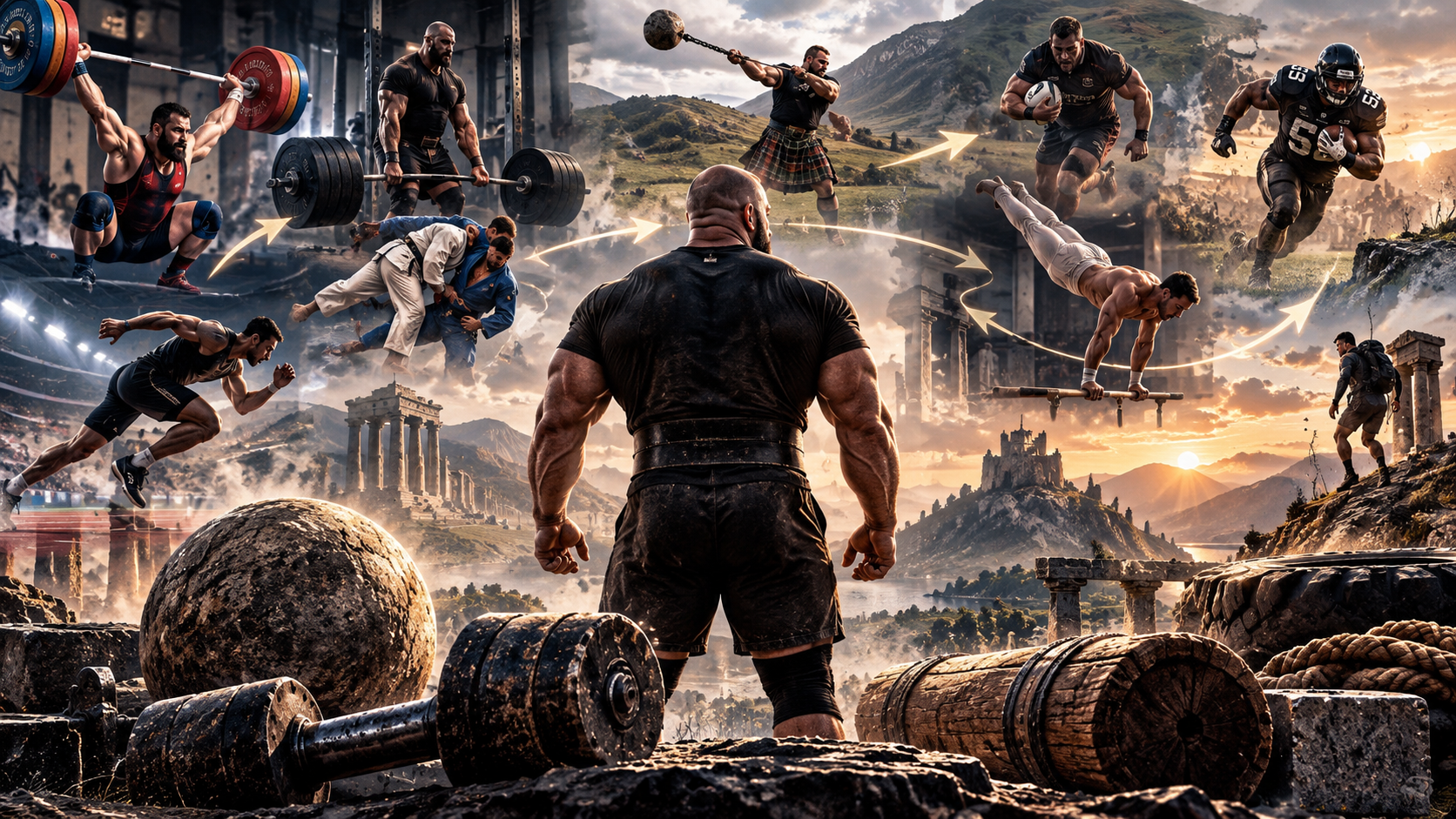
Olympic weightlifting and Strongman: explosive lifts as a tool for developing power
What exactly can Strongman borrow from Olympic weightlifting?
Olympic weightlifting comprises two competition lifts, the snatch and clean and jerk, which require athletes to accelerate a standardized implement while coordinating multiple segments and receiving or stabilizing the load. Strongman contains movements with some mechanical overlap, particularly overhead lifting and lifting objects from the floor, but resemblance does not establish automatic training transfer. A competitor capable of a highly skilled barbell clean may struggle with a log's diameter, while someone proficient in pressing an axle may find snatch coordination unfamiliar. The scientific question is when weightlifting-type training develops a quality that measurably improves a strongman event, not whether both sports share the broad concept of lifting [1,2].
Competitive weightlifting demands strength, power, mobility, anticipation and trajectory control in distinctive combinations. In the snatch, the bar moves from the floor to overhead within a single continuous movement; in the clean and jerk, the bar is received on the shoulders before the overhead phase. Strongman implements may differ in diameter, center of mass, handles, start position and whether the athlete performs one maximal attempt or repeated lifts. A log clean is not mechanically identical to a barbell clean, and an event push press need not resemble the receiving strategy of a competition jerk.
An important distinction is the difference between practicing a particular lift and targeting a broader adaptation. Weightlifting derivatives may develop rapid force production, implement acceleration, coordination of hip-knee-ankle extension, torso control during transitions and economical object trajectories. Whether each component transfers depends on its relevance to the target event and on measurement. Greater bar speed in a hang pull does not itself demonstrate better giant dumbbell performance, but it can provide a reason to test a hypothesis about power.
The National Strength and Conditioning Association's 2023 position statement reviews weightlifting movements and derivatives as tools for athletic performance, emphasizing opportunities to train varied force and velocity characteristics. The evidence concerns more than strongman and does not supply a universal conversion between kilograms lifted in the clean and points earned in a log-lift event. It provides mechanical and methodological rationale to be complemented by event-specific outcome assessment [1].
What comparative studies actually show
A 2022 Sports Medicine meta-analysis compared weightlifting-based training with traditional resistance training and plyometric programs. Sixteen studies involving 427 participants were included. Relative to traditional training, weightlifting produced greater gains in weightlifting-task performance and countermovement-jump height in the reported comparisons. Estimates for linear sprint speed and change-of-direction speed were uncertain and did not establish statistically significant superiority. Weightlifting and plyometric programs produced broadly similar improvements on several outcomes. The authors highlighted substantial heterogeneity and potential risk of bias [2].
This finding rules out a simplistic marketing claim. Olympic-style lifting is not definitively superior to all other methods for acceleration or every strongman outcome. It is an evidence-informed option for developing certain power-related qualities, with effects that differ by assessment. A vertical jump does not reproduce a heavy sandbag toss: ground contacts, implement release and the direction of useful impulse are different. Jump improvement may justify a throwing hypothesis, but it cannot establish throwing improvement without measurement.
The 2026 ACSM position stand synthesized 137 systematic reviews representing more than 30,000 healthy adult participants. It reported that muscular power can benefit from moderate loads, fast concentric actions and Olympic-style weightlifting. Those recommendations cannot be transformed into exact prescriptions for elite athletes using nonstandard implements. An effective loading range averaged across heterogeneous healthy adults does not ensure the same best training dose for highly specialized strongmen [3].
Hindle and colleagues' systematic review of strongman biomechanics documented distinctive features of competitive movements and limitations of available research. It supports studying the actual implement instead of presuming all loaded lifts are interchangeable. Taken together, these sources justify including Olympic derivatives among a coach's available tools while testing their value against the time, distance, repetitions or load that defines the selected event [4].
Mechanical power and why velocity changes the interpretation of lifting
Instantaneous mechanical power is the scalar product of force and the velocity at its application point: P = F · v. In a simplified vertical lift, gravitational potential energy gained by a mass m raised through height h is ΔE = mgh. Raising a 100 kg object 0.90 m increases its potential energy by approximately 883 J. Completing that vertical displacement in 0.60 seconds corresponds to about 1,472 W of mean power for that energy component alone; doing so in 1.20 seconds corresponds to about 736 W. These numbers illustrate the effect of movement time on an external mechanical quantity, not an athlete's total muscular power.
In a real clean or snatch, the athlete moves, the bar accelerates and decelerates, and its trajectory is not exactly vertical. Full-system work involves kinetic and potential changes of multiple segments, elastic contributions and metabolic costs. Consequently, multiplying bar mass by its velocity and displaying the result as watts is dimensionally incorrect. Mass times velocity is linear momentum, not power. Valid power assessment requires compatible force and velocity data or an appropriate energy balance.
Weightlifting movements permit deliberate acceleration of the bar under conditions in which high movement speed is an important technical objective. This can create a different stimulus from maximal-load work where actual velocity remains low. Nevertheless, faster is not a sufficient target by itself. An accelerated bar with poor trajectory may be difficult to catch, while a strongman implement may demand stability more than speed. Power must be interpreted within the event's actual constraints.
Research comparing derivatives has identified different force-time profiles for the hang power clean, jump shrug and hang high pull. These should not all be classified as one generic explosive Olympic exercise with identical mechanical effects. Exercise and loading choices can change the targeted force or speed characteristics. These differences have been measured in the studied tasks, while transfer to particular strongman events remains a hypothesis unless directly evaluated [5,6].
The clean: distinct movement phases and possible relevance
The Olympic clean contains transitions from initial floor pickup and bar positioning to strong acceleration and receiving the load on the shoulders. The phases are coordinated to allow sufficient bar height while avoiding unnecessary displacement. In a strongman log clean, a large cylinder and internal handles change the interface. Many methods bring the log to the lap before rolling it toward the chest, unlike the Olympic receiving position. Shared involvement of hip and knee extensors is not proof of equivalent motor tasks.
Barbell clean training may teach the coordinated contribution of the lower limbs, timing of object acceleration and avoidance of excessive early arm pulling. However, learning a technically sound Olympic clean carries an opportunity cost: dedicated practice time, adequate receiving mobility and wrist tolerance. For an athlete not competing in weightlifting, the deepest receiving position may not be the most useful portion of training for strongman.
Derivatives such as the hang power clean, clean pull and jump shrug can emphasize selected phases without requiring the entire movement. They are not identical substitutes. Some retain a receiving action and bar deceleration; others remove the catch and permit different loading. Suchomel and Sole compared force-time curves across selected derivatives and showed that their mechanical profiles differed. This evidence should not be turned into claims of universal strongman superiority for one variation [5].
A pulling derivative without catching may be easier to integrate for athletes with limited receiving mobility or technical experience. Yet simplification is not an excuse for unsupervised execution. The trunk and implement path require control, and loading should progress gradually. Before selecting a variation, the coach should be able to specify whether the purpose is greater force in extension, faster object acceleration or coordination of a transition. Without that decision, the variety of weightlifting exercises becomes a spectacular catalogue rather than a purposeful intervention.
Snatch and log lift: an overhead finish does not imply identical technique
The snatch accelerates a wide-grip barbell into an overhead receiving position within one coordinated movement. The log lift uses a bulky cylindrical implement, generally with internal handles, changing forearm position and the path of the load. Although both end with overhead stabilization, they differ in pickup, grip, timing, receiving strategy and frequently the competition's criteria for control. Transfer must be investigated at the level of capacities and outcomes rather than assumed from a common final position.
Snatch practice may develop rapid lower-body extension and coordination, while a deep snatch receiving position demands mobility and control that may not be central to a heavy competitive log press. An experienced log lifter may benefit from selected snatch derivatives, but the benefit must be assessed on the log rather than solely on the snatch. If the athlete already produces effective leg drive and is limited by log stabilization, more implement-specific upper-body or trunk work might be preferable.
Power and maximal strength should also be distinguished. A fast moderate-load snatch can stimulate power within that task without guaranteeing a heavier maximal log lift. At very high contest loads, the capacity to generate adequate force in the positions of the actual event remains essential. Explosive exercises may complement this capacity without automatically replacing maximal-strength development.
A sound comparison considers impulse duration, force direction, joint angles and implement stabilization. Snatch measurements may suggest mechanisms, but cannot by themselves predict quantitative outcomes for a differently constructed log. It is valid to propose probable transfer as a hypothesis; claiming a predetermined percentage of snatch improvement will appear in log performance invents an untested relationship [1,4].
Jerk, push press and transfer to heavy overhead events
The Olympic jerk begins with a front-supported bar and uses a controlled dip followed by forceful lower-body extension and repositioning of the athlete under the load. The push press also has leg drive, but the lifter usually completes the press by extending the arms without a similarly pronounced second descent beneath the weight. Strongman rules may permit push press, push jerk or split jerk depending on the implement and event. Grouping all of these under a generic overhead press label obscures meaningful differences in support, timing and motor control.
The dip is a controlled downward movement preceding vertical acceleration. Losing secure contact with the object or changing trunk orientation excessively may reduce the effectiveness of force transfer from legs to implement. Yet one dip depth or tempo cannot be declared optimal for every athlete and object. Barbell, log and axle geometry as well as anthropometry alter the position. Evaluate the athlete by how effectively and consistently the object moves rather than whether the technique resembles a single model photograph.
The jerk illustrates a particularly important distinction between lifting the object higher and moving the body beneath it. Instead of pressing the bar through a large range using the arms alone, the weightlifter accelerates it and then moves into an efficient receiving position. When a strongman event allows a comparable technique, learned coordination may be useful. But bulky objects, narrow platforms or particular lockout requirements may constrain its applicability.
Jerk dips, jerk drives, push presses and push jerks can each emphasize different characteristics: lower-limb impulse, receiving coordination or overhead stabilization. Selection should reflect a diagnosed event limitation. If an athlete generates adequate initial log speed but repeatedly fails at lockout, more work emphasizing only early leg drive may not be the best use of training time [1].
There is insufficient direct evidence for a precise numerical relationship between kilograms lifted in the jerk and improvement at axle or log. Biomechanical analysis can justify testing a program, but only the actual competition implement can confirm useful transfer. That is the difference between intelligently borrowing from a neighboring sport and importing its competition standards uncritically.
No-catch derivatives: jump shrug and high pull are not interchangeable
Removing the catch from a weightlifting movement changes both its purpose and mechanical demands. In a jump shrug, the athlete can accelerate the bar and body through vigorous lower-limb extension without entering a front receiving position. In a hang high pull, the bar travels higher as lower- and upper-limb actions are coordinated. A clean pull can emphasize forceful, technically controlled pulling. These should not be dismissed as incomplete cleans; they can be selected for distinct training purposes [5,6].
Research summarized by the University of Salford suggests that ballistic derivatives such as jump shrug and hang high pull tend to emphasize velocity at relatively low to moderate loads, while certain pulling derivatives under heavy loading emphasize force and rate of force development. Importantly, published percentages often use the one-repetition maximum of a specific hang power clean as their reference, not a deadlift maximum or the maximum for a log. Transferring the same percentages across unrelated denominators is a programming error [5,6].
Suchomel and Sole examined force-time behavior in sixteen resistance-trained men performing three selected derivatives under multiple relative loads. Their acute controlled observations support conclusions about differences among those force-time curves, not about the outcome of a long training intervention in elite strongmen. An exercise producing a high force peak today does not necessarily create the largest performance improvement after ten weeks. Acute kinetics and chronic adaptation answer different questions.
An advantage of derivatives without catching is the potential reduction in coaching time when the athlete has no reason to master Olympic receiving positions. Deep receiving mobility may be absent or less relevant to the competition task, allowing greater attention to extension and acceleration. This is a plausible logistical advantage, not proof of universally greater physiological effectiveness. No-catch derivatives also require skilled execution and may generate compensation under heavy loading.
In strongman, choose a derivative for a specific aim, such as improving initial object acceleration or maintaining intent to move fast against resistance. A few ballistic repetitions may only indirectly address the ability to carry a heavy load over a long distance. A thoughtful program acknowledges these limitations instead of claiming that one movement develops every quality simultaneously.
Rate of force development: useful but frequently misinterpreted
Rate of force development, or RFD, describes the speed of force increase and is measured in force per unit time. It depends on how contraction onset is identified, the analyzed time window and the testing condition. RFD in an isometric mid-thigh pull is not identical to force rise inferred from the bar during a clean, and neither automatically predicts yoke distance.
Weightlifting contains brief windows when sufficient impulse is needed to accelerate the implement, explaining scientific interest in RFD and force-time curves. A strongman event may instead last tens of seconds with repeated loading at each step. In one task initial force may decide the outcome; in another the decisive factor is maintaining object stability. A strong indicator for the first condition may have little predictive value for the second.
For a numerical illustration, force rising from zero to 1,200 N over 0.20 seconds has a mean slope of 6,000 N/s. Reaching the same value in 0.40 seconds gives a mean slope of 3,000 N/s. Neither number describes how long the force can be maintained afterward. During heavy object movement, net impulse and resisting forces remain critical. An athlete with faster early force rise can still lose an event because of grip or inadequate sustained support.
If the intention is to train RFD through Olympic derivatives, the outcome must be specified. An isometric mid-thigh pull can measure certain force-time characteristics but cannot describe the complete technique of a clean or truck pull. Acute experiments can identify immediate training demands, whereas transfer claims need longitudinal interventions and target-event measurement.
The instruction to pull explosively may encourage maximal movement intent, but it is not a validated intervention in isolation. Posture and control still matter. Uncontrolled bar acceleration can degrade technique, while forcing speed in an extremely heavy implement can add risk without improving outcome. Speed is a tool, not an excuse to abandon stability [1,3,5].
Bar velocity is not body velocity or whole-system power
Movement-monitoring technology requires methodological care. In Olympic derivatives the barbell and the combined athlete-load system follow different trajectories and possess different velocities. A 2025 study in the Journal of Strength and Conditioning Research compared barbell and system velocities in fourteen trained men across several derivatives and loads. Mean and peak velocities differed significantly; the authors concluded that the variables should not be substituted for each other [7].
The distinction is relevant to strongman. Logs, sandbags and giant dumbbells may rotate, settle or change contact position while the athlete's center of mass moves differently. Monitoring only one point on the object may conceal changes in athlete strategy; monitoring only the torso may fail to capture implement oscillation. The measurements are useful only when matched to the question.
Linear encoders measure selected displacement, while video systems estimate movement from tracked landmarks. Filtering, calibration, onset detection and implement deformation can affect outputs. A display with several decimal places does not guarantee corresponding accuracy. Training-session comparisons require consistent settings and precisely defined phases.
If an athlete lifts a 100 kg bar faster after eight weeks, that documents an improvement in the measured exercise under comparable conditions. It does not prove total-body power rose by an identical percentage, nor that stone pickup has become faster. Transfer requires a separate outcome measure: perhaps stone pickup duration, speed over an event segment or release height in a throw. Without retesting the target, bar velocity remains training feedback rather than demonstrated strongman performance.
A sound monitoring system does not accumulate meaningless numbers. It identifies a valid variable linked to a practical decision, measures it consistently and acknowledges uncertainty. Such discipline is especially valuable in a sport where implements and conditions differ so dramatically [7].
Impulse, external mass and relevance to throwing events
A successful throw requires sufficient impulse delivered to an object during the available acceleration phase before release. Net mechanical impulse is the integral of net force over time and determines momentum change: ∫Fnet dt = mΔv for a constant-mass object. In a clean, the athlete accelerates the bar and later receives it; in a bag toss, the implement must be released along a trajectory that reaches the required height. Both involve impulse, but release-velocity direction is decisive in the throw. Power developed through pulling becomes relevant only if the athlete can transmit it under the object's particular conditions.
As a hypothetical illustration, consider a 20 kg bag whose vertical velocity changes by 6 m/s during acceleration. The vertical momentum change is 120 kg·m/s, corresponding to a net vertical impulse of 120 N·s. Real modeling must also account for gravity during the acceleration period, initial velocity and the intended release trajectory. The example cannot be converted into competition force prescriptions without geometry, release height and technique.
If vertical release speed were 6 m/s and air resistance neglected, the maximum additional height of the center of mass would be v²/(2g), approximately 1.84 m above release. A horizontal bar placed at 4.2 m with release at 2.2 m would therefore not be reached by that vertical speed alone in the simplified model. This is a geometric illustration, not an athlete-specific diagnosis. Actual performance also depends on bag rotation, the timing of release and event rules.
Olympic pulling derivatives may develop rapid acceleration and coordinated lower-limb extension, potentially useful resources for throws. However, bag toss includes its own swing, arm path and release timing, which are not trained identically by a clean pull. Transfer should be measured through verified bag height or success under standardized conditions rather than improvement in the barbell derivative alone.
An applied study could compare before-and-after release velocity measured with calibrated video and success rate at a fixed height. Even a positive change cannot identify the mechanism if athletes practiced the throw simultaneously. A comparison group receiving the same throwing practice would help estimate the additional contribution of weightlifting-type training.
Implement specificity: barbells are not logs, axles, bags or dumbbells
Weightlifting research generally uses standardized bars with predictable mechanical characteristics. Strongman implements vary in thickness, size, mass distribution and contact. An axle may be unusually thick and change grip mechanics. A log's cylinder and internal handles modify the load's position in front of the chest. A giant dumbbell introduces unilateral balance and stability demands absent in the same form from a bilateral barbell lift. Shared hip extension alone does not describe these functional differences.
In barbell exercises, the load can often remain close to the body as its trajectory is coordinated with segment motion. Logs and bags can place the center of mass further anterior, increasing external moments about selected reference axes. For a 100 kg implement located 0.15 m horizontally from a reference axis, the simplified gravitational moment is approximately 147 N·m; at 0.30 m it is roughly 294 N·m. These are geometrical examples, not measured lumbar loading.
Safe equipment handling also differs. A properly loaded barbell may be dropped on a designated platform when appropriate, while an oversized log or sandbag can rebound, rotate or strike the feet in different ways. Explosive training therefore needs implement-specific safety arrangements rather than uncritically reproducing Olympic-platform procedures.
Grip influences neural transfer too. Skilled control of a pronated barbell grip does not automatically provide efficient control with neutral internal handles or a unilateral object. General capacities may transfer, but coordinating them into a new movement remains a learned skill. Olympic derivatives should complement rather than replace exposure to actual strongman implements [4].
When to learn a complete lift and when a derivative is enough
Technical learning time is a finite training resource. Competitive weightlifters need sophisticated receiving positions because the rules demand them. In strongman, the immediate purpose may instead be to develop a physical capacity or improve performance with a different object. A derivative can be reasonable when deep receiving mobility or technical experience is limited. That is a practical decision about goals and teaching cost, not a finding that full Olympic lifts are inferior.
An athlete already skilled in snatch and jerk may retain these exercises efficiently because familiarization cost is low. Someone starting from zero with only a short period before a log-and-stones contest may benefit less from learning an entire snatch receiving technique than from targeted event preparation. No universal time threshold decides when Olympic technique becomes worthwhile; the answer depends on prior skill, coaching resources and competition demands.
Simplified movements may be easier to observe and control, but simple does not mean instruction-free. A jump shrug performed with inappropriate loading or uncontrolled rhythm can create needless stress. The load should allow acceleration intent without obvious positional breakdown, and volume must not compromise event practice.
Evidence-based weightlifting guidance presents a broad repertoire of derivatives with different demands. It does not require every athlete to master all variants or declare the most complex movement best. For strongman, the useful choice is the exercise that provides the desired stimulus at an acceptable cost in time, fatigue and mechanical exposure [1,6].
Integrating explosive work into an already demanding training week
Strongman athletes may already train squats, deadlifts, overhead presses, loaded carries and implement handling. Adding cleans, snatches and jerks is not free. Even brief explosive repetitions require coordination that can suffer after substantial fatigue, while the additional workload stresses the legs, torso and shoulder complex. Programming should begin by identifying a missing capacity, not automatically adding every weightlifting exercise.
The 2026 ACSM synthesis supports moderate loads and fast concentric actions for power development in healthy adults. It does not establish a universally ideal number of sets or exact load for elite strongmen regardless of fatigue. Research on velocity loss during resistance training suggests that accumulating very large fatigue within a set is not always necessary to improve explosive outcomes; findings remain conditional on participant and program characteristics [3,8].
One practical arrangement could place a small amount of explosive derivative work early in a session when movement quality is high, then proceed to main exercises. If the athlete is also pressing very heavy logs, confirm that auxiliary work does not compromise event-specific pressing. This is a possible structure rather than a universal prescription. Near competition, reducing additional fatigue may matter more than attempting to develop a new physical capacity.
Monitoring can include standardized movement speed, trajectory consistency, perceived fatigue and strongman event results. If the derivative improves while log results temporarily fall following higher volume, that does not prove negative transfer; it may reflect acute fatigue. Reassessment under comparable recovery conditions is needed before inferring chronic adaptations.
Instead of stacking many methods, select one derivative family for a defined goal and monitor it over a meaningful training period. If the intended target-task improvement does not appear, revise the hypothesis or choose another intervention. In this manner Olympic weightlifting becomes a measurable programming tool rather than a compulsory symbol of explosive preparation.
Testing transfer from an Olympic derivative to an actual strongman result
Suppose an athlete wants to improve the first three seconds of a heavy carry and the coach hypothesizes that a weightlifting derivative will help through better acceleration. The assessment begins with a precisely defined outcome: time from the first step until the athlete crosses a fixed marker with the same implement on the same surface. Pickup time is recorded separately, because changing the pickup may alter total time without proving faster walking. Following a controlled intervention, testing is repeated with comparable recovery, warm-up and familiarization.
A faster initial segment represents observable practical progress, but its cause cannot automatically be assigned to the Olympic derivative. The athlete may have improved the start, practiced the carry more often or simply been better recovered. Stronger evidence would compare groups receiving the same event-specific practice but different auxiliary methods, such as a derivative versus traditional resistance training. The primary outcome must be specified before the intervention rather than chosen because it later provides the most attractive result.
Elite athlete studies often have small samples and meaningful individual differences. One competitor may respond well to power training, while another has limited scope for improvement because comparable qualities are already highly developed. Group means can obscure such variation. Yet individual response should not become an explanation for every outcome; measurement error and unequal exposure matter. Raw data, intervention detail and uncertainty intervals support more responsible interpretation.
Several complementary indicators may be useful. Performance in the derivative measures adaptation to the auxiliary task. A jump or power test provides a broader capability measure. The strongman result assesses the actual competitive objective. If the first two improve but the third does not, transfer to the defined event has not been demonstrated. This result should not be hidden or blamed reflexively on insufficient intensity; a different intervention or more specific learning may be required.
Progress can also be confined to one phase. A log may leave the lap faster while overhead stabilization remains unchanged. That suggests a partial improvement and can help redirect training priorities. Collapsing all phases into one final number makes transfer harder to diagnose. Careful observation and modest but repeatable measurement can be more useful than subjective impressions of explosiveness [1,2,4].
Limits, safety and conclusion: weightlifting is an option, not an obligation
Olympic lifts and their derivatives can stimulate power and coordinated force production, but demand technical control and careful integration. Mobility, postural stability and the ability to receive or release a load safely should be considered before rapid heavy attempts. Painful restrictions, instability or relevant injury history may justify adapted exercises and qualified guidance rather than forcing the complete snatch for prestige. A movement's importance in another sport does not justify unnecessary risk.
Most studies discussed here did not test elite strongmen performing competitive log lifts, axles, sandbag throws or giant dumbbells. Findings on jumping, sprinting and barbell lifting identify capacities that may matter for those events, but do not constitute definitive transfer evidence. Differences in protocols and participants especially limit numerical extrapolation. No magic load, universal derivative or guaranteed transfer percentage follows from the literature.
Exercise selection should answer concrete questions. Which phase limits the target event? Which capacity is missing? Which derivative could develop it at acceptable cost? How will the outcome be measured? For an athlete lacking object acceleration, ballistic pulling can be a plausible intervention. For one limited by overhead stabilization, receiving and control variations may be more relevant. For an athlete whose real bottleneck is grip on an irregular implement, Olympic lifting may have lower immediate value than implement-specific practice.
The central lesson is that maximal strength does not become power merely because an exercise has an explosive name, and power developed in one movement is not transferable through visual analogy. Weightlifting provides an excellent setting for training and studying force, velocity, impulse and coordination. Its value for strongman becomes established when such changes demonstrably improve a defined competitive task. Until then, the mechanism is promising rather than guaranteed [1–8].
The next episode explores a different training resource, powerlifting, where maximal force expression through three standardized lifts is the principal competitive objective. Distinguishing brief power production from a large force reserve will help explain how these sports may complement one another without portraying either as a complete substitute for event-specific strongman preparation.
Stretch-shortening behavior and what a jerk dip can teach
Many explosive movements contain a phase during which muscles and muscle-tendon units are loaded before rapid extension. During the jerk, a controlled dip precedes the leg drive; during jumping, a countermovement can improve performance relative to a static start in some circumstances. This is often described through the stretch-shortening cycle, but it cannot be reduced to a passive spring that stores and releases energy. Muscle preactivation, tendon behavior, interjoint coordination and transition time all matter. An athlete may coordinate these components efficiently with a familiar barbell but struggle when a log changes the contact position.
Coaching discussions sometimes attribute every benefit of a rapid dip to reflexes. That explanation is incomplete. The relative contributions of reflexive activity, elastic storage and active muscle work cannot be identified from observation of a strongman press alone. Instrumented measurements and appropriately designed comparisons would be required. Very heavy loads can also change countermovement speed, while excessive dip depth can compromise posture. Faster and deeper is not a universal technical solution.
Transferring a jerk-like movement to log pressing requires examination of the impulse phase, the position of the object against the chest and stability during reversal. A bulky log may move relative to the body, affecting how leg-generated force reaches it. A shorter dip with better contact might be more effective than reproducing the amplitude familiar from Olympic lifting. This is an individually testable mechanical hypothesis, not evidence for one optimal dip depth in all strongmen.
Jerk drives from supports, moderate-load push presses and selected jump variants can help explore changes of direction and lower-body impulse separately. Nevertheless, changing the object changes the interface and receiving requirements. There is no requirement to include every derivative in one training block. A plausible goal might be reducing the interval between the end of the dip and the object's peak acceleration, provided that this outcome can be measured and matters for actual event success. Visual impressions of elasticity cannot establish adaptation.
A simple energy example clarifies the limitation. If two attempts lift the same mass to the same final height, a more coordinated drive may reduce acceleration time while leaving the final gravitational potential energy unchanged. Time differences cannot reveal how much energy originated in tendon recoil rather than active muscle work. A spring analogy may be useful in instruction without constituting a measured physiological energy balance.
This distinction is central to transfer. Olympic lifting can improve experience coordinating a countermovement with rapid extension, but applying that skill to another object involves learning. Strongman implement shape and event rules can make a barbell strategy ineffective or unsafe. Improvement must be demonstrated by lifting and stabilizing the target implement, not merely by a faster isolated jerk dip.
Force–velocity characteristics: identical power does not mean identical ability
The force-velocity relationship is often invoked to explain the relevance of Olympic lifting to athletic preparation. In simplified terms, faster contractions tend to occur under different force conditions from slower ones, and high power requires a useful combination. In a multijoint lift, however, the pattern is affected by implement trajectory, contributions from multiple joints, technique and equipment. A curve estimated from the clean cannot be assumed to describe every possible sandbag acceleration or truck-pushing strategy.
Terms such as strength-speed and speed-strength describe programming emphases rather than biologically separate categories with universal boundaries. A heavy pulling derivative may emphasize substantial force at relatively low velocity, while a lighter ballistic derivative can favor faster movement. Individual response varies. An exceptionally strong athlete may benefit from speed-oriented work when movement speed is limiting, while another may first need more maximal capacity because the contest load cannot be initiated.
The 2023 NSCA position statement and the review by Suchomel, Comfort and Stone support selecting variants and loads for different mechanical objectives [1,6]. They do not supply a mandatory numerical map for every strongman event. In particular, percentages of a hang power clean maximum cannot simply be applied to a heavy axle deadlift maximum. Reference exercise and mechanical demands are not the same.
A coach may compare several manageable loads in a familiar derivative and examine whether the athlete maintains a reproducible path and clear acceleration intent. Different speeds across loads describe an individual profile in that exercise. They are not a universal power profile of the person. Change the task and the interpretation must be revisited. Velocity data describe the execution of a defined movement rather than a permanent athletic trait.
A higher weightlifting 1RM can also reflect improved technique without proportionate changes in contractile properties. Learning to keep the bar close or move under it more effectively may improve the official weight lifted without equivalent change in lower-body mechanical power. Likewise, a better log result can follow from improved chest contact rather than simply faster leg drive. Transfer interpretation therefore needs to consider mechanics and motor learning together.
The most useful conclusion from force–velocity analysis is a testable question: does the athlete need more force to initiate movement, similar force expressed sooner, or better control after acceleration? Each answer suggests different exercises and measurements. Olympic derivatives can be integrated intelligently without turning a physical relationship into promotional jargon. Their actual value remains conditional on performance changes in the target task.
Anthropometry, mobility and the learning cost of receiving positions
Individual body proportions influence mechanics even when every athlete uses a standardized bar. Femur and torso lengths, upper-to-lower-limb ratios, ankle mobility and the ability to stabilize overhead can all change the technical solution available. A strongman lifting extraordinary weights may have different proportions and training history from a specialist Olympic weightlifter. Requiring exact imitation of a successful weightlifter's snatch position is not individualized scientific practice. The coach first needs to identify the component relevant to the target event and whether that component can be trained effectively and safely.
Deep receiving positions demand control through the torso, hips and shoulders together with a bar trajectory compatible with balance. When an athlete currently lacks the necessary mobility or competence, alternatives include hang pulls and selected no-catch derivatives. This does not imply complete weightlifting movements are universally unsafe for large athletes. It recognizes that complex skill development requires dedicated time. Athletes with limited weekly sessions should spend that time according to competition priorities rather than the prestige of a borrowed technique.
Removing the catch is not a perfect shortcut. It changes force and timing requirements, permits different loading and may reduce the opportunity to train stabilization of an overhead object. If strongman performance is limited by holding a very heavy implement overhead, exclusive pulling-derivative work will not necessarily address the bottleneck. The coach must distinguish the desire to stimulate vigorous leg extension from the need to learn a stable receiving position.
Familiarization also complicates the interpretation of gains. During initial weeks of clean training, rapid improvement may arise from a better bar path and more effective sequencing rather than proportional increases in muscle size or power. Progress in the auxiliary lift therefore cannot be taken as evidence that the strongman event will necessarily improve. The competitive event requires its own evaluation, ideally with comparable specific practice in the training conditions being compared.
Mobility and position tolerance should not be collapsed into one diagnosis. An athlete may have no pain but insufficient range for a particular receiving configuration. Another may have good range but little skill in coordinating the movement. These situations call for different interventions. Persistent pain or instability warrants adaptation and appropriate professional evaluation rather than forcing additional depth under load.
Individualization also concerns the objective of each repetition. A pull from a higher position may emphasize acceleration from a narrower range; a pull from the floor demands a longer sequence. A power clean may teach receiving coordination that a pull omits. These are distinct tools, not steps on one mandatory hierarchy. The best choice depends on the event constraint, the available coaching and the adaptation sought.
It would be a mistake to define an athlete as unathletic simply because an unfamiliar Olympic lift is initially difficult. Skill in one standardized object does not exhaust movement competence, and a high-level strongman may already demonstrate exceptional solutions to awkward-object challenges that weightlifting does not test. Training analysis should recognize both the strengths an athlete brings and the new task demands rather than treating one sport as a universal movement standard.
Ultimately, adaptation to the individual means more than reducing the load. It may require changing the exercise variant, starting position or technical goal. A well-selected derivative can provide a relevant mechanical stimulus without reproducing every Olympic competition requirement. It earns its place when benefits become detectable in a defined strongman task.
Peak power is not the same as repeated-power capacity
A single snatch or clean includes a relatively brief high-acceleration phase. A strongman event may instead involve multiple repetitions during a minute, sometimes interspersed with object pickup and regripping. The ability to produce a high peak power and the ability to repeat efforts with limited deterioration are related but different. One athlete may complete the first repetition rapidly and then lose time through fatigue or reorganization. Another may start more slowly yet sustain a competitive pace across the full event.
This matters in log-for-repetitions and axle-for-repetitions events. An explosive derivative may improve the initial acceleration of the object, but does not automatically develop endurance over repeated pickup and pressing cycles. When each repetition requires cleaning the object from the floor or lap, fatigue during the clean phase may become more limiting than the isolated pressing power. Pacing should therefore be analyzed separately from maximal lifting capacity.
In a hypothetical event, Athlete A completes the first log repetition in 2.5 seconds but then requires increasingly long pauses. Athlete B needs 3.0 seconds initially and continues at a stable pace. After several repetitions, B may finish sooner despite A's faster opening effort. The example does not require invented physiological fatigue coefficients: total time is the sum of repetition and pause durations, while the best strategy depends on mass, event rules and the athlete.
Short ballistic sets can be used to preserve movement quality and rapid intent. Longer work sets may develop other qualities, but cannot be interpreted as equivalent to isolated peak power or one-repetition maximum. When implement path and position deteriorate, more repetitions may add fatigue without delivering the desired stimulus. Regulating load and rest remains an applied decision rather than a mandatory ritual.
Systematic research on velocity-loss thresholds suggests that accumulating extreme within-set fatigue is not required for all adaptations. Different thresholds can influence hypertrophy and speed-related outcomes differently. These findings come from specified study populations and do not provide an exact repetition prescription for an elite strongman using a log. They are nevertheless sufficient to challenge the assumption that power development requires failure in every set [8].
Transfer assessment should record at least the opening repetition and the pattern of performance across subsequent attempts. Faster initial lifting with unchanged total repetitions may represent useful but limited transfer. More total repetitions without an increased opening speed may reflect specific endurance, better breathing or improved pause organization. Distinguishing these outcomes reveals much more than a simple claim that explosive training either worked or failed.
The conclusion matters for exercise selection. If an athlete is limited by initial object acceleration, Olympic derivatives may be worth testing. If the final repetitions collapse because the athlete cannot maintain contact, the priority may be technical regripping or local endurance. If both limitations appear, a combination may be rational, but it has to fit within recovery capacity. The word power should never be used to erase the task's duration and repeatability requirements.
In multi-event competitions, repeated-power capacity also interacts with earlier events. A press series performed after demanding loaded carries may look different from the same series in a rested gym session. To infer training effects, compare like with like and distinguish temporary fatigue from chronic adaptation. The objective is performance under actual competition conditions, not the largest isolated laboratory number.
Who was actually studied? External validity and elite strongmen
Interpreting a meta-analysis begins with the participants and outcomes. The 2022 synthesis included sixteen heterogeneous studies and 427 participants, with different interventions, comparators and measures. Not all participants were highly experienced and not all programs used the same Olympic lifts or derivatives. Their group results do not automatically describe an elite strongman who regularly handles unusual, extremely heavy loads. Previous experience affects physical adaptation and the speed of technical learning. A novice may improve clean performance dramatically through skill acquisition, while a highly trained athlete may show smaller changes in the same metric [2].
Between-study heterogeneity represents variation that cannot be attributed solely to sampling error. It may arise from age, training status, exercise selection, intervention duration and outcome assessment. When a pooled estimate favors one method, confidence intervals and heterogeneity inform how stable and generalizable the estimate may be. A large but uncertain average effect does not justify promising that every competitor will obtain a similar gain. This is a limitation of inference, not a verdict that the intervention is useless.
Vertical-jump height is a common power-related outcome but is not a universal proxy for competitive performance. Jumping requires accelerating the body without a massive external implement, while strongman often requires accelerating a held object or moving the combined athlete-load system. Contact mechanics, available time and movement strategy differ. A group improving jump height after Olympic-derived training has demonstrated better jumping, not necessarily a faster yoke, a heavier log or a higher bag toss.
The evidence also needs demographic scrutiny. Representation by sex, competitive level, training background and body-mass distribution may constrain application to elite strongwomen and athletes in extreme weight classes. Identical responses in inadequately studied populations cannot be assumed. Conversely, lack of direct evidence does not establish that the exercises are ineffective. It calls for conditional recommendations, appropriate supervision and individual outcome monitoring.
Longitudinal designs can improve applicability by comparing Olympic derivatives with other explosive methods while both groups maintain equal strongman event practice. Training exposure and recovery costs should be reasonably comparable. Researchers would define the primary event outcome before starting and hold implement geometry, surface, load and competition rules as stable as possible. Such a design more directly tests whether the borrowed method adds value beyond ordinary event learning.
There are also choices about which athlete outcomes matter. A study of maximum log load addresses something different from one of repetitions in sixty seconds or speed over a fixed distance. Averaging those outcomes into one generic strongman improvement score can conceal meaningful distinctions. A method may help one component while leaving another unchanged. Research questions should be narrow enough to produce interpretable findings.
Sample size matters especially when effect sizes are variable. A small study can provide informative individual trajectories but rarely determines a universal prescription. Publishing mean effects without uncertainty or the distribution of individual responses makes the intervention look more predictable than it is. Strongman would benefit from multicenter cooperation in which clubs use compatible test conditions and report sufficient implement detail.
Unfavorable findings also deserve publication. If a derivative increases jump height but does not improve a target strongman lift, that is valuable evidence about specificity. Selective visibility of successful interventions can exaggerate apparent transfer. Strong research documents both beneficial changes and null results rather than making a method immune to falsification [2–4].
A hypothetical athlete comparison: one method, different constraints
Imagine two experienced strongmen with broadly comparable competition experience but distinct performance profiles. Athlete A has substantial maximal strength and can initiate a lift reliably, but struggles to accelerate the object during its critical impulse phase. Athlete B generates effective early acceleration but repeatedly fails at overhead stabilization or grip maintenance. The rationale for introducing a hang high pull may be clearer for Athlete A. That still does not guarantee transfer; the actual outcome must be tested.
Over an illustrative eight-week period, a coach could measure event-specific object velocity, valid repetitions and time to stable lockout before and after training. If Athlete A improves impulse-phase speed and official performance under comparable conditions, useful transfer becomes plausible. If Athlete B becomes faster in the barbell derivative but continues to lose overhead control, adaptation to the auxiliary task has not solved the competitive bottleneck.
Suppose log acceleration improves, yet final lockout is still missed. It would be false to say that training changed nothing, because a movement phase became faster. It would also be false to declare complete competitive success, because the athlete has not achieved a valid repetition. Segment-level assessment allows a more precise conclusion and a more focused next intervention.
The reverse scenario is possible too. A log result may improve without measurable change in hang-pull speed because chest contact, bar path or regripping has become more efficient. This does not necessarily mean explosive training should be abandoned forever. It means other mechanisms were likely important in the observed improvement, and limited training resources should be allocated accordingly.
Individual cases do not establish general laws. The effect can change with athlete experience and event format. A method that helps a one-repetition maximum may have different practical relevance in a sixty-second repetition challenge. The same technique may require modification when implement mass, dimensions or handles change. A useful assessment therefore records the event conditions rather than treating the name of the lift as sufficient.
The learning history of the athlete is an additional confounder. An Olympic weightlifter converting to strongman may already possess excellent coordination in the clean and jerk, making further generic lifting technique practice less valuable than exposure to unusual implements. A former powerlifter may gain rapidly from learning how to produce force at higher movement speeds. Neither scenario is guaranteed, but both show why identical programming is unlikely to be optimal.
Athlete preferences and coaching resources matter as well. A technically difficult exercise performed inconsistently without qualified feedback may deliver less useful training than a simpler derivative executed reliably. The question is not whether a complex lift is admirable, but whether the chosen method can be taught, loaded and recovered from in the available environment.
An honest report includes what did not improve. An increase in clean load or bar speed can be valuable in its own right, but the strongman objective remains the target result. By keeping both measurements, the coach can distinguish a promising physical adaptation from a confirmed competitive benefit. A negative event result is not an invitation to invent an explanation; it is information for revising the hypothesis.
This reasoning makes borrowing from Olympic lifting testable. Define the limitation, choose a derivative, monitor its adaptation and retest the actual task. When the expected transfer does not appear, change the plan. That approach is scientifically stronger than declaring every explosive movement universally transferable.
The receiving phase as a distinct mechanical demand
In Olympic lifting, receiving the bar requires decelerating and stabilizing an implement that has already been accelerated. Kinetic energy accumulated during propulsion must be managed through body movement, contact and muscular control. In the clean, the bar is received in front and the athlete may descend into a squat to reduce the vertical distance needed for a successful catch. In the snatch, the bar is received overhead, producing a different balance and support problem. These movements develop complex skills without necessarily reproducing a log or giant dumbbell event.
Deceleration depends on more than object mass. When a moving bar must be brought to rest, the average net force associated with the momentum change depends on how long the deceleration occurs. A shorter stopping interval generally requires a larger average net force than a longer one for the same momentum change, all else equal. The principle explains interest in receiving control, but does not permit precise joint-force estimates from a photograph or an uninstrumented video.
Strongman implements may be stabilized overhead for judging, yet their paths can contain unfamiliar rotations and oscillations. A giant dumbbell with heavy globes has different rotational demands from a symmetric barbell. Successful Olympic receiving technique does not guarantee unilateral control even if it develops useful coordination and stabilization resources. The competition implement needs its own skill practice.
Receiving skill also has a cost. An athlete may generate high impulse but currently lack the technique or mobility to catch a bar safely at depth. No-catch derivatives can preserve some desired extension and acceleration stimulus while omitting complex receiving practice. That is a transparent trade-off rather than proof that full lifts are useless. As objectives and skill improve, the exercise choice can change.
A meaningful experiment could compare two training programs generating broadly similar extension demands, with one including catches and another using pulling-only derivatives. Outcome assessment could separate implement speed, overhead control and an explicitly defined strongman result. Until such comparisons are available, categorical claims that receiving is either essential or worthless for all strongmen exceed the evidence.
This is a particularly important distinction for athletes with substantial previous experience. A former weightlifter may perform receiving patterns efficiently without much extra technical practice; another strongman might require prolonged learning that competes with event training. The physiological stimulus cannot be judged independently of how much time and recovery the individual must invest to produce it.
The receiving phase also reminds us that a complete lift is not simply a stronger version of its pulling component. A competitor may gain in peak pull velocity and still fail the full lift through poor bar placement. Likewise, a strongman may move the log high enough but lose control at lockout. Both are examples of a performance constraint emerging after acceleration. Improving a preceding phase is useful only to the extent that the remaining phases permit a successful outcome.
Tendon adaptation and why explosive work cannot promise injury prevention
Resistance training can modify muscle and connective tissue, but different tissues do not adapt at identical rates and their condition cannot be inferred from one power test. Rapid weightlifting movements include acceleration and direction changes that can load tendons and joints substantially. This does not mean weightlifting is inherently dangerous, nor does it mean its practice automatically prevents injuries in strongman. Real risk depends on training history, progression, execution, workload and environment.
Popular explanations sometimes portray increased tendon stiffness as universally advantageous. The relationship is more nuanced: elastic behavior, force transmission and tolerance depend on tissue properties, loading and task. A tendon that transmits force effectively during one rapid movement is not thereby proven sufficiently adapted for prolonged joint loading under an awkward implement. There is no evidence-based rule that a fixed number of cleans prevents log press injuries.
A sensible program introduces unfamiliar exercises gradually, assesses technique and avoids combining several large novel stressors at once. Athletes already performing many heavy pickups and carries may experience substantial additional recovery demands from ballistic lifts. Monitor pain, comfortable movement range and consistent execution. Persistent or unusual symptoms warrant qualified evaluation rather than using pain as a badge of effective training.
Strongman variability adds another concern. An Olympic barbell has comparatively standardized contact geometry, while logs and giant dumbbells impose different local pressures, orientations and torques. Tissue exposure to a barbell cannot reproduce every contact demand of a different implement. General capacity development and implement-specific progression are complementary rather than interchangeable.
The language of resilience should also be used carefully. Improving physical capacity may contribute to preparation, but risk emerges from the interaction of athlete, load, fatigue and event context. A training exercise cannot be called protective for a particular competition injury merely because it is challenging. Direct injury studies or carefully interpreted broader evidence would be needed.
Coaches should distinguish discomfort from symptoms that warrant stopping or changing an exercise. Sharp pain, persistent loss of function, unusual neurological symptoms or other significant problems are not evidence of useful adaptation. Individual assessment and program modification are more appropriate responses than forcing a receiving position because it is common in weightlifting.
There is also a practical difference between controlled laboratory trials and a competition hall or outdoor venue. Floor material, implement bounce, available space and supervision affect safe handling. A barbell release technique suitable for a designated weightlifting platform is not automatically suitable for a log, axle or other nonstandard object.
A credible recommendation therefore describes conditions for safe execution and avoids promising an unmeasured reduction in injury rates. Developing power and maintaining tissue health are important, but neither is achieved by simply maximizing movement velocity at every opportunity. Long-term benefit must be evaluated with respect for individual tolerance and the actual objects being used.
From assessment to action: criteria for keeping or removing a method
No coach can retain every potentially valuable exercise in one strongman program. Selection should account for the capacity trained, teaching cost, fatigue and measured competition outcome. If an athlete already produces adequate power but loses an event through grip failure, an additional high-pull session may be less relevant than improving implement contact. If initial acceleration is limiting, an explosive derivative may deserve a place even when its outward appearance differs from the contest movement.
A rational decision can use a defined testing period and prespecified outcomes. Progress the auxiliary exercise without changing the entire program unpredictably. Reassess the event under comparable recovery and equipment conditions. When the event does not improve, first examine intervention dose, task learning and measurement reliability. Persistent null effects under reasonable conditions justify revising the method rather than protecting it with explanations that cannot be tested.
One advantage of weightlifting derivatives is flexibility. Different variations can target force, movement speed, position changes or coordination. That flexibility becomes a disadvantage when every variation is treated as indispensable. Effective training chooses a small number of exercises that address observed limitations and retains them long enough for meaningful assessment. Changing all derivatives every week makes progress difficult to attribute.
Reporting should include unchanged outcomes as well as improvements. A better hang pull and an unchanged log result can coexist. Together they show that adaptation in the auxiliary movement does not guarantee its expression elsewhere. The next step may be more implement familiarization, a different intervention or a shift in priorities, without denying the usefulness of the auxiliary exercise for its own purpose.
If transfer to the target event is reproducibly demonstrated, retaining the method is reasonable while its benefit exceeds its costs in time and recovery. The effect is not guaranteed to persist indefinitely or across every loading condition. Reassessment remains important because the limiting mechanism can change as an athlete develops. This is what evidence-informed selection means in practice, rather than loyalty to a favored exercise.
Training history can also alter opportunity cost. Someone already technically competent in Olympic derivatives may maintain them with little instructional burden. A newcomer may need many sessions merely to move the bar consistently. In the latter case, a simpler acceleration exercise could potentially provide similar useful stimulus at a lower teaching cost. This is a decision to test, not an assertion that simple is always superior.
Finally, exercise selection must respect the multi-event nature of the sport. A method that improves one press but compromises recovery for a crucial carry may not improve overall competition performance. Coaches should monitor the complete event profile rather than one barbell metric. A strongman succeeds by applying physical resources to diverse problems, not by maximizing every individual training measurement.
The role of Olympic lifting in strongman is therefore neither mandatory nor negligible. It is a family of movement options supported by evidence for developing power-related qualities in broader athletic settings. Their direct competitive value emerges when individual athletes demonstrate transfer under consistent conditions. That evidence-based position is more useful than either dismissing Olympic lifting entirely or treating it as an automatic solution for every strongman event.
A practical exercise-selection matrix without invented conversion ratios
When an athlete can choose among the clean, hang clean, clean pull, high pull, jump shrug, push press and jerk, the relevant question is not which movement produces the most explosiveness in the abstract. Selection begins with identifying the phase in which strongman performance breaks down. If the object cannot leave the floor, force in the starting position may be limiting. If it rises but accelerates inadequately, rapid force production is a plausible target. If it gains enough height but cannot be stabilized, receiving and final-position control may be more relevant. Those diagnoses should be based on repeatable observations rather than the visual drama of an exercise.
Imagine a training block incorporating one pulling derivative and one overhead derivative. The coach can track improvement in each, but must retain an independent strongman target test. Possible outcomes include log pickup duration, object acceleration in the drive phase or the number of valid event repetitions. Better auxiliary-lift performance without a better event result does not demonstrate transfer. A better event result is encouraging, but target-task practice, recovery and changing conditions must still be considered.
A prespecified primary outcome is essential. When numerous measurements are recorded, some are likely to improve by chance. A program can be presented as successful by selecting a favorable indicator after the intervention even when the original competitive goal was unchanged. Declaring the main outcome in advance limits this risk. Secondary measures remain useful for exploring mechanisms, but they should not silently redefine success.
The exercise itself must be described precisely. Load, start height, presence of a catch, bar displacement and repetition criteria affect mechanical exposure. Two sessions both labeled high pull may differ substantially if one starts at mid-thigh and the other from the floor. Apparent improvement can reflect altered technique or range of motion. Standardization is not bureaucratic detail; it is essential for interpreting measured change.
Opportunity cost completes the decision. An exercise promising a small benefit but demanding extensive teaching and recovery may be less useful than a simpler alternative, even when both have sound physiological rationale. Improving an auxiliary test is not the ultimate purpose of training for strongman. The purpose is expressing the new capability with the particular object and under the competition conditions that decide the outcome.
An applied evaluation can also record how frequently the athlete performs the target event during the block. If event practice increases substantially along with auxiliary training, attributing improvement to the derivative alone is impossible. If event practice remains stable, an additional effect becomes more plausible, though observational designs still cannot entirely separate coincident changes. Transparency about simultaneous training is more valuable than false certainty.
Assessing durability matters as well. A gain that appears only when the athlete is extremely rested may have less practical importance than one expressed throughout a multi-event day. Conversely, a training block that initially causes fatigue can produce an apparent decline before recovery reveals the adaptation. Tests should therefore be scheduled in comparable states and interpreted in relation to the competition calendar.
It is also possible that a method develops a quality the athlete does not currently need. Additional peak bar power may be physiologically meaningful but have little effect on a stone carry limited by hand-to-implement contact. This is not evidence that the weightlifting method failed at its own purpose; it is evidence that the selected outcome was not addressed. Diagnosing the actual bottleneck before prescribing an intervention reduces such mismatches.
A strongman-specific research program could systematically compare exercise alternatives while documenting object mass, shape and contact rules. Participants would practice the same target event and receive auxiliary interventions with controlled exposure. Investigators could then report both the strongman outcome and intermediate characteristics such as force-time behavior. Only a longitudinal design of this type begins to answer whether a particular derivative improves the intended event rather than merely producing an impressive laboratory force curve.
When evidence is limited, uncertainty should be reflected in the language of coaching. Phrases such as may improve, is mechanically plausible or has not been directly tested convey different levels of confidence. They are not signs of indecision; they distinguish what the available data actually establish. A recommendation can be useful without pretending to be a universal rule.
Athletes also deserve clear success criteria. If a derivative is introduced to improve log acceleration, the plan should indicate what log result would justify retaining it and what observations would prompt revision. Without such criteria, the exercise can remain in a program indefinitely merely because it has a good reputation. Evidence-informed training means being prepared to alter a reasonable idea when the athlete's data do not support it.
The central benefit of this selection framework is clarity. Olympic lifting gives coaches an extensive repertoire for manipulating force, speed and coordination. Strongman gives that repertoire specific problems to solve. Matching one to the other requires the right measurement, the right individual context and enough humility to revise the initial hypothesis. That is a more defensible use of sports science than assigning unverified percentages of transfer between two superficially related movements.
The decisive test remains the actual competition implement
When Olympic-style methods are introduced into strongman preparation, the ultimate assessment must involve the object that determines competition performance: log, axle, sandbag, giant dumbbell or another specified implement. Improvement with a standardized barbell may demonstrate valuable adaptation, but the contest outcome can still depend on contact, balance, duration and rules. Testing conditions should remain comparable, or any changes must be documented. Otherwise, results from two sessions may not assess the same task.
The distinction is also important when an athlete trains using several different versions of one implement. Two logs can have equal mass yet different diameters or handle geometry. Two sandbags of equal weight may vary in how their contents settle and in the available gripping area. The coach must therefore distinguish progress with a particular object from generalized skill across a family of implements. Both are legitimate goals, but they should be evaluated separately.
Longitudinal observations need to include recovery status. A period of high auxiliary training volume can temporarily reduce contest performance through fatigue even if a useful adaptation is developing. Equally, a favorable result after a long rest may not be reproducible in a multi-event competition. Consistent assessment timing and repeated observations help prevent both false negative and false positive conclusions about transfer.
An intervention that delivers reproducible competition benefits deserves consideration when its recovery and time costs remain acceptable. One that generates only better auxiliary-test numbers, without observable event benefit, should be reassessed. This is not a rejection of Olympic weightlifting science. It is the responsible application of that science in a sport characterized by varied objects and performance constraints.
Olympic lifting offers mechanistically interesting opportunities to develop rapid force production, power and coordination, while strongman makes those qualities compete with grip, stability and unusual object handling. Neither sport provides a complete answer to the other's problems. The coach's job is to identify the common resource, train it appropriately and demonstrate that it has become useful under the actual competitive conditions.
A direct laboratory experiment with elite strongman implements would help answer many of the questions still open here. Until such studies become more common, reliable event testing, thoughtful exercise choice and explicit acknowledgment of uncertainty provide the most defensible path. Transfer is not an honorary label attached to an exercise because it looks explosive. It is a measured outcome with a specific athlete, implement and task.
Scientific bibliography and verification sources
[1] Comfort P, Haff GG, Suchomel TJ, et al. National Strength and Conditioning Association Position Statement on Weightlifting for Sports Performance. Journal of Strength and Conditioning Research. 2023;37(6):1163–1190. DOI: 10.1519/JSC.0000000000004476 Read source
[2] Comparison of Weightlifting, Traditional Resistance Training and Plyometrics on Strength, Power and Speed: A Systematic Review with Meta-Analysis. Sports Medicine. 2022. DOI: 10.1007/s40279-021-01627-2 Read source
[3] Currier BS, D'Souza AC, Fiatarone Singh MA, et al. ACSM Position Stand: Resistance Training Prescription for Muscle Function, Hypertrophy, and Physical Performance in Healthy Adults. Medicine & Science in Sports & Exercise. 2026;58(4):851–872. DOI: 10.1249/MSS.0000000000003897 Read source
[4] Hindle BR, Lorimer A, Winwood P, Keogh JWL. The Biomechanics and Applications of Strongman Exercises: a Systematic Review. Sports Medicine - Open. 2019;5:49. DOI: 10.1186/s40798-019-0222-z Read source
[5] Suchomel TJ, Sole CJ. Force-Time-Curve Comparison Between Weight-Lifting Derivatives. International Journal of Sports Physiology and Performance. 2017;12(4):431–439. DOI: 10.1123/ijspp.2016-0147 Read source
[6] Suchomel TJ, Comfort P, Stone MH. Weightlifting Pulling Derivatives: Rationale for Implementation and Application. Sports Medicine. 2015;45:823–839. DOI: 10.1007/s40279-015-0314-y Read source
[7] Suchomel TJ, Kissick CR, Techmanski BS, Mann JB, Comfort P. Velocity-Based Training With Weightlifting Derivatives: Barbell and System Velocity Comparisons. Journal of Strength and Conditioning Research. 2025;39(2):135–146. DOI: 10.1519/JSC.0000000000004962 Read source
[8] The Acute and Chronic Effects of Implementing Velocity Loss Thresholds During Resistance Training: A Systematic Review, Meta-Analysis, and Critical Evaluation of the Literature. Sports Medicine. 2023. PMID: 36178597 Read source
[9] Suchomel TJ, Nimphius S, Stone MH. The Importance of Muscular Strength in Athletic Performance. Sports Medicine. 2016;46:1419–1449. DOI: 10.1007/s40279-016-0486-0 Read source
[10] Young WB. Transfer of Strength and Power Training to Sports Performance. International Journal of Sports Physiology and Performance. 2006;1(2):74–83. DOI: 10.1123/ijspp.1.2.74 Read source
More From The Journal
Training Science
TRANSFER OF STRENGTH: WHAT CAN STRONGMAN LEARN FROM OTHER SPORTS? | Episode 10: Interdisciplinary Synthesis, Method Selection and Validation of Competition Performance
Evidence-based synthesis of transfer from other sports to strongman: biomechanical criteria, individual diagnosis, programming, testing and limits of the evidence.
Training Science
TRANSFER OF STRENGTH: WHAT CAN STRONGMAN LEARN FROM OTHER SPORTS? | Episode 6: Wrestling and Judo: Unstable-Object Control, Balance and Force Production from Disadvantageous Positions
Scientific analysis of grips, off-balancing, center-of-mass control, isometric force, awkward positions and evidence limits for transfer into Strongman.