
Training Science
TRANSFER OF STRENGTH: WHAT CAN STRONGMAN LEARN FROM OTHER SPORTS? | Episode 1: Transfer of Sporting Adaptations, When Does a Physical Quality Become Useful in Another Discipline?
October 28, 2026
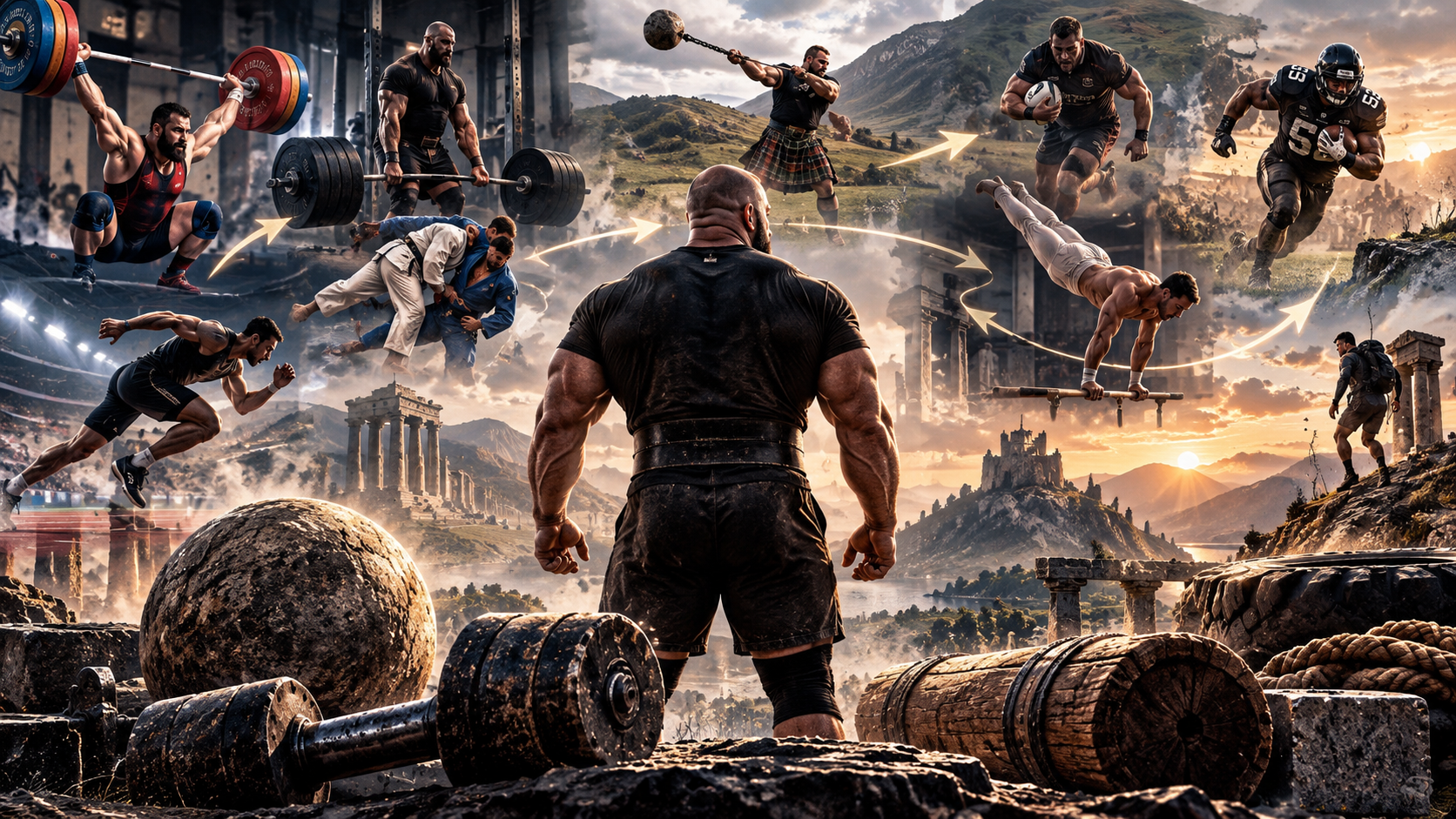
Transfer of sporting adaptations: when does a physical quality become useful in another discipline?
The core question: what does it mean to transfer an adaptation?
Transfer is neither a superficial resemblance between two exercises nor the assumption that an athlete who is strong in one sport must excel in another. Operationally, transfer occurs when training one task produces a measurable change in a different task that has not been trained to the same extent. This definition requires pre- and post-intervention comparisons, a precisely defined outcome and preferably a comparison condition that separates the program's effect from familiarization, biological fluctuations and measurement error. If squat performance improves but yoke-carry speed does not, the appropriate conclusion is not that training was useless. It is that transfer to the specified yoke outcome has not been demonstrated.
Strongman presents an additional methodological difficulty: it is not one movement but a collection of challenges with different mechanical and temporal requirements. Overhead lifting, asymmetric carries, vehicle pulling and stone handling share some physical resources while using them differently. Better hip-extension capacity may help several events without being sufficient for any one of them. The meaningful question is therefore not whether an exercise transfers to strongman in general, but which precise performance outcome changes, under what conditions and for which athlete.
The phrase physical quality conceals several distinct measurements: maximal strength, power, rate of force development, isometric holding capacity, coordination, work tolerance and postural control. Some characterize neuromuscular capabilities while others describe performance in a complex task. Confusion between them leads to overstatements. More power in a vertical jump does not automatically demonstrate faster acceleration while carrying a 300 kg implement. Between available capacity and competitive performance lie technique, implement geometry, force-application time and individual movement strategy [1–4].
This episode treats transfer as a hypothesis to test rather than a mysterious feature of supposedly functional exercises. Numerical illustrations clarify physical relationships without inventing transfer percentages between sports. We distinguish experimental findings from plausible mechanisms and practical proposals that lack a direct strongman experiment. Such caution matters because peer-reviewed research on competitive implements remains limited and many familiar coaching beliefs are still open scientific questions [1,2].
Why transfer exists, and why its limits matter
Training changes muscle tissue, tendons, neural control and the practical ability to solve the trained motor problem. Some changes have broad potential: increasing knee-extensor force capacity may be useful across actions that require knee extension. Others are highly task-dependent, such as controlling a barbell path or regripping an awkward sandbag. Transfer occurs when the newly developed capacity matters for the target task and the athlete can express it within the required geometry and timing.
A 2025 meta-analysis by Saeterbakken and colleagues examined dynamic resistance training and subsequent performance on dynamic and isometric strength tests targeting essentially the same muscle groups. Mean standardized effects were greater for dynamic tests resembling the training mode, approximately 0.98, than for transfer to isometric outcomes, approximately 0.42. These are not transfer percentages and do not quantify strongman improvements. They demonstrate that the apparent strength benefit can depend substantially on how it is assessed. The authors emphasized that very few studies evaluated genuinely untrained dynamic exercises [1].
The finding is a warning against treating a single one-repetition maximum as a universal currency. When someone repeatedly practices one squat variant and is tested in precisely that movement, performance may improve through physical adaptation and learning of the test. Some of the gain can be useful elsewhere, but its magnitude cannot be inferred automatically. Another event may demand force at a new joint position, a different grip or a longer duration and may therefore benefit much less. The actual degree of transfer has to be measured rather than guessed.
Transfer limitations do not make general training obsolete. They clarify its role: developing physical resources that can subsequently support specific skills. An athlete may first need basic strength to handle an implement and then controlled exposure to its shape and rules to express that strength competitively. Conversely, practicing only the competitive event may constrain the volume available for muscular development or impose excessive mechanical fatigue. Intelligent programming blends general resources with event-specific competence without pretending they are identical [2,4,5].
Specificity is not a simple law of visual resemblance
Two exercises can look similar yet present different mechanics. A barbell squat, a lightly loaded squat jump and a low sandbag pickup all involve hip and knee extension, but differ in available time, object acceleration, moment arms and the way forces are transmitted. Conversely, visually different tasks may share a critical capacity: rapid force development against the ground can matter in sprint acceleration and during the start of a very heavy push. Functional similarity requires a mechanical explanation rather than a photograph.
Useful dimensions for comparing tasks include involved joints, muscle lengths and ranges of motion, concentric-eccentric-isometric behavior, external-force direction, segment velocity, ground-contact duration, unilateral versus bilateral demands and coordination complexity. Their relevance changes by event. In a long heavy carry, secure contact and stable holding may dominate; in a rapid throw, the brief acceleration window becomes decisive. The contributions of individual dimensions remain empirical questions rather than equally weighted items on a generic checklist.
The power-development reviews by Cormie, McGuigan and Newton emphasized movement, load and velocity specificity. That supports matching explosive training to the power demands of an outcome, but it does not require imitating every centimeter of the contest action in every session. Assistance exercises may develop capacities that are currently limiting even when their outward appearance differs from the sport. Only target-task testing can establish whether useful transfer actually occurred [3,4].
In strongman, implement shape can overturn conclusions based only on joint patterns. Two carries involving similar lower-body extension may be limited respectively by hand friction and by pressure against the chest. A technically excellent solution with one implement can be counterproductive with another even though both are called carries. Exercise selection should therefore consider the contact system linking athlete, object and ground, not simply list muscles that appear active.
Neural adaptation: what is learned and what cannot simply be carried across
Strength gains are not explained solely by hypertrophy. The nervous system can change how muscles are activated and how a repeated movement is coordinated. Classic work by Rutherford and Jones highlighted learning and coordination during strength training, while Carroll and colleagues investigated neural sites of adaptation after resistance training. Those findings do not establish that a neural improvement in one exercise will reproduce itself to the same extent in another movement [7,8].
Practically, athletes may learn to recruit relevant musculature more effectively, suppress unhelpful movement and time muscular contributions. Yet neural activation must not become an unmeasured catch-all explanation. Higher electromyographic amplitude does not automatically mean greater muscle force, and better maximal-test performance cannot by itself locate an adaptation in cortex, spinal circuitry or muscle. Activation data depend on task, electrode placement, contraction type and speed.
An athlete moving from powerlifting to strongman may possess substantial extensor strength yet still need to learn new implement contacts, transitions and movement rhythms. Bringing a heavy stone to the chest demands different stabilization from holding a standardized barbell; pushing a vehicle requires distinct force direction and duration compared with squatting. Broad neural improvements may facilitate learning a new skill without automatically providing mastery of it.
Neural adaptation matters even when tests look simple. A participant may improve maximal isometric output after becoming more comfortable with the position and the instruction to produce force rapidly. When that test is used to infer transfer, control and intervention groups should receive equivalent familiarization. Otherwise, apparent differences may partly reflect practice in taking the test rather than an underlying physiological change.
There is no single general-purpose score for nervous-system efficiency that explains every strongman event. It is more informative to examine which part of performance changes: pickup delay, time to useful force, implement-path variability, number of regrips or segment velocity. These observable outcomes can guide mechanistic hypotheses without pretending to localize the neural change on their own.
Maximal strength, available potential and task-imposed ceilings
Maximal strength is the ability to express high force in a specified test under stated conditions. An improved one-repetition maximum can reflect muscle hypertrophy, neural adaptation, better technique and increased familiarity with heavy loads. Currier and colleagues' 2023 synthesis included 178 studies in its strength network and found that heavier training loads tended to maximize strength improvement compared with lighter alternatives. The finding does not establish that all of this advantage transfers to an unrelated strongman event [6].
Working posture matters. Someone capable of deadlifting a 250 kg barbell may struggle with a load whose center of mass sits far in front of the body, or with an implement whose grip fails before hip extension becomes limiting. The external moment depends on the force and its perpendicular lever arm about the chosen axis. Consequently, the same nominal mass can create very different joint and contact demands when its distance from the body changes. No barbell personal record abolishes this relationship.
Two diagnostic constraints can be imagined: a resource limitation and an application limitation. In the first, available muscular force is insufficient to accelerate the object. In the second, overall force capacity may be substantial, but grip, balance, movement path or coordination prevents effective transmission. Both may yield the same observation, an object that does not move. Yet the training response would differ: raising general strength might address the first, whereas targeted technical exposure might address the second.
This distinction is a coaching model, not a classification proven by a strongman trial. Limitations often overlap and change within a repetition. If an attempt fails after the object rises a few centimeters, video alone cannot tell us that strength was sufficient but technique was deficient. Mechanical demands may change along the path. Credible diagnosis combines observation, measurement and repeated experience under comparable conditions.
Mechanical power and the time available to generate force
In ordinary conversation, strength and power are often treated as synonyms despite describing different physical quantities. Force is measured in newtons; instantaneous mechanical power is the scalar product of force and the velocity at its point of application, P = F · v. An athlete can exert enormous force on a nearly stationary object and generate little external mechanical power, or exert a more moderate force at high velocity and generate substantial power. Strongman includes both situations: a maximal pickup may proceed slowly, while a throw demands rapid acceleration. There is no single power number characterizing every event.
The force-velocity relationship should not be treated as one formula that applies identically to every muscle and compound movement. At the muscle-fiber level it varies with contraction type, activation, muscle length and conditions. In compound lifts, body segments, elastic contributions, implement paths and contact with the ground complicate the relationship. Cormie, McGuigan and Newton discussed these mechanisms in reviews on maximal neuromuscular power, stressing that power emerges from interactions among force capacity, velocity, coordination and the task itself [3,4].
Consider a vertical pickup in which a 100 kg object rises one meter in 0.8 seconds. The gain in gravitational potential energy is about 981 joules and the average power associated with that component alone is around 1,226 watts. If the same displacement takes 1.2 seconds, the corresponding value is about 818 watts. Neither number is the athlete's total power output: body displacement, acceleration, braking and losses are omitted. The illustration simply shows that identical mass and height do not determine the temporal aspect of performance.
Power transfer depends on the athlete's ability to express useful force within the target task's time constraint. Very heavy slow resistance training can improve force capacity without automatically improving an explosive throw if the athlete cannot organize impulse quickly. Conversely, lightly loaded ballistic exercise may improve movement speed without being sufficient to overcome the inertia of a massive object. Programming should ask which relationship among force, velocity and available time constrains the event rather than naming one method universally superior.
A related mistake is importing ideal percentages of one-repetition maximum from one exercise directly into another. A percentage of squat maximum does not produce the same mechanics in a jump squat, clean or push press. The 2026 ACSM evidence synthesis supports moderate loads and fast concentric actions as useful for developing power in healthy adults, but it does not validate any fixed percentage for an elite competitive strongman event [5].
Rate of force development and the relevant time window
Rate of force development, or RFD, describes how rapidly force increases and can be approximated by ΔF/Δt. It is not synonymous with maximal force. An athlete may achieve great force after two seconds, but when ground contact lasts only fractions of a second, force available within that brief interval is especially relevant. This makes RFD important to sprinting, jumping and explosive gestures. However, many strongman events permit longer force application and may be constrained more by continued control over a large implement than by the fastest initial force rise.
Aagaard and colleagues studied adaptation following 14 weeks of heavy resistance training in 15 men. They reported improvements in RFD alongside changes in early electromyographic measures. This supports the proposition that heavy training can influence features relevant to rapid force production. It does not prove that a particular RFD value predicts truck-pulling time or bag-toss height. Their measurements concerned specified knee-extensor tasks and must be interpreted within that context [9].
The measurement interval is critical. RFD calculated over 0–50 milliseconds differs from 0–200 milliseconds, and results depend on how contraction onset is identified and which portion of the force trace is analyzed. A laboratory number reported without these details is difficult to relate to sport. Moreover, RFD from an isometric dynamometer is not the same as mechanical impulse transmitted to a moving implement. The variables are related without being interchangeable.
As a purely mathematical example, suppose force increases approximately linearly from zero to 1,000 N over 0.2 seconds. Average slope is 5,000 N/s and the triangular area under the force-time curve is 100 N·s of impulse. A slower rise to the same force over 0.4 seconds gives a smaller slope but may accumulate more total impulse if force is maintained for longer. This hypothetical profile is not a representation of any particular muscle or strongman task. It shows why peak force, early slope, impulse and effort duration should be kept conceptually distinct.
In practice, athletes may monitor the acceleration segment of a carry or time to implement pickup, but these outcomes need careful interpretation. Faster initiation can follow from improved setup or grip without any identifiable change in neural RFD. To attribute a result to RFD training, control learning, implement mass, surface and fatigue. The simplistic claim that every explosive single automatically transfers to strongman is unsupported.
Joint angles, movement range and where force becomes usable
Transfer can be limited by the joint positions in which strength has been trained or measured. A short-range squat uses muscle lengths and joint configurations that differ from a deep object pickup. Someone exceptionally strong near full extension may struggle to generate force from highly flexed hips and knees. That does not automatically make partial-range training useless; it can serve particular purposes, but should not be sold as a universal replacement for strength through broader ranges.
The ACSM 2026 position stand reports that heavy loading and full-range resistance training can support strength development in the studied healthy populations. This is a synthesis-level tendency, not a guarantee that any full-range squat produces equivalent improvements in Atlas Stone performance. A large stone constrains arms, torso and hips in ways that do not occur with a standardized barbell. Similar multi-joint involvement does not erase the different mechanical task [5].
Mechanically, an external joint moment depends on force and its perpendicular lever arm about a reference axis. With a barbell, bar position and gravity account for important parts of the external demand. With an irregular implement, the center of mass can occupy a different location and contact surfaces may redirect forces through the body. Repeating one barbell movement range therefore cannot guarantee preparation for every portion of another implement's movement path.
Angle specificity is not an argument against general development. A broad increase in contractile capacity may make more resources available across movements. The problem arises when strength measured at one angle is interpreted as representing every angle. Applied research could test several safe submaximal positions along a target event, identifying where performance becomes limited. There is no universal set of ideal joint angles for every strongman event.
Exercise selection should begin with the critical part of the event: the position where speed collapses, control is lost or progress ends. Sometimes specific loading at that posture is useful; sometimes contact with the implement is the actual problem, and more load solves nothing. The intervention is judged through target-task retesting, not by assumed geometric resemblance alone.
Concentric, eccentric and isometric actions are not interchangeable
Muscle can generate tension while shortening, lengthening under load or maintaining approximately constant length. These are commonly described as concentric, eccentric and isometric actions. In real movement, one joint can appear stationary while other joints move, and individual muscles behave differently because tendons and joint geometry interact. It is consequently misleading to classify an entire event by only one contraction type. During a carry, arm muscles may work nearly isometrically while the legs undergo complex dynamic cycles.
Purely concentric training can build capacities relevant to picking up a heavy implement without necessarily preparing the athlete for repeated braking and impact during walking. Isometric training may improve position holding without reproducing rapid transitions between positions. The Saeterbakken meta-analysis is directly relevant because dynamic and isometric strength outcomes did not improve to identical degrees. It does not prove that any contraction mode is best for every event [1].
During stone or sandbag loading, floor pickup, lap support and transition to the shoulder combine motion and stabilization. An athlete might improve greatly at holding the object on the thighs while still failing to complete the task because regripping and subsequent acceleration remain poorly coordinated. This is a mechanically plausible illustration; its practical transfer has to be tested rather than assumed.
Combining dynamic exercises with position-specific holds can be justified when the event demands both characteristics. Yet there is no valid conversion rule equating ten seconds of holding to ten meters of carrying. Time, mass, posture and contact are separate variables. A static hold supported safely by a rack also does not replicate the instability and drop hazards of an irregular stone. Targeted learning requires progressive, reproducible conditions.
It is also unsafe to attribute all difficulty during a carry to one contraction type or one muscle group. Strong lumbar effort does not automatically mean that lumbar extensors are the only limit. Poor grip can move the implement's center of mass and magnify external moments. Changing contact may alter the task without changing intrinsic muscular capacity. This is precisely why transfer science distinguishes capacity from the ability to apply it.
Fatigue alters force expression and can conceal transfer
Assessing transfer at the beginning of a session is not equivalent to assessing it after several demanding events. Competitive force production is influenced by neuromuscular fatigue, cardiovascular strain, local grip tolerance and recovery between attempts. These mechanisms do not overlap perfectly. One athlete may maintain lower-body extension capacity but lose a carry because the forearms can no longer stabilize the implement; another retains grip but cannot accelerate after a long locomotor event. Transfer demonstrated in a rested test therefore cannot be assumed to have identical magnitude in competition.
A training program may improve a rested one-repetition maximum while leaving performance in a multi-event contest uncertain. When the target task follows a taxing effort, recovery and effort sequencing become part of the performance constraint. This should not be reduced to a generic term such as conditioning. Contraction duration, recruited muscle mass, pickup count and allowed rest alter metabolic and mechanical demands. Competitions with the same events in different orders may produce different final rankings.
A sound evaluation holds sleep, food intake, warm-up and preceding activity as comparable as reasonably possible. Day-to-day performance variation should not be treated immediately as proof that adaptation appeared or disappeared. A poor result following unusually strenuous training may reflect temporary fatigue. The value of a program should be assessed over repeated observations rather than a single attempt.
Fatigue can also change technique. An implement initially held close to the body may migrate forward as holding capacity declines, increasing the external moment and potentially accelerating performance deterioration. This relationship can become self-reinforcing: fatigue changes posture, and posture makes the task less economical. Measuring first regrip, time to grip loss or changes in speed across the course can be more informative than recording final distance alone.
Producing force and directing it usefully
Useful force always has direction. During a vehicle push on level ground, the horizontal component of contact force directly contributes to forward acceleration, while vertical components can modify normal loading and contact balance. A height throw needs adequate vertical release velocity. A carry distributes forces among support, stability and forward movement. Exercises recruiting similar muscles may differ dramatically in the direction in which external force must be applied.
Vector reasoning should not become a rigid coaching slogan. A leaning athlete in a truck pull does not generate purely horizontal muscular force; the whole system involves ground reactions, harness tension and joint moments. Harness angle can alter vertical force components and traction. When sled work is used as preparation, equipment geometry, surface and sliding resistance should be described. Mechanical analogy informs training but is not direct proof of transfer.
As an illustration, a hypothetical 1,000 N force oriented 30 degrees above the horizontal has a horizontal component of about 866 N and a vertical component of 500 N. Another angle changes both components at the same total force magnitude. These values cannot predict race outcomes because resistance, acceleration and contact conditions have not been specified. They demonstrate why total force magnitude alone can be insufficient.
Transfer of force orientation may be more likely when the trained action reproduces important directions and timing of the target movement, but this proposition still requires outcome testing. An athlete might become better at transmitting force through a sled and improve at a vehicle event, without any fixed conversion between sled mass and truck tonnage. Vehicle mass is not identical to the horizontal resistance experienced by the athlete [2].
Motor learning, variability and transfer to an unfamiliar implement
Motor skill is more than the sum of physiological capacities. An athlete must perceive implement position, anticipate its motion and adjust forces in real time. A new object changes tactile information and may require unfamiliar motor solutions. This explains why a very strong competitor can appear hesitant during the first encounter with an unusual stone, barrel or giant dumbbell. Initial hesitation does not prove a deficit in general strength; it may indicate the absence of a practical model for that task.
Learning involves repetition and adaptation. Repeated identical practice can improve precision under familiar conditions, while controlled variations in height, dimensions and object position may prepare the athlete to solve a family of related problems. That is a plausible motor-learning hypothesis, not evidence that unlimited exercise variety automatically improves transfer. Excessive novelty may instead reduce the opportunity to consolidate an effective technique.
Strongman organizers may change the implement even while retaining the same event name. Stones can differ in surface texture, logs in handle placement and giant dumbbells in globe dimensions. Training with one perfectly familiar implement may produce excellent local performance without ensuring adaptability to a new one. Yet constantly switching very heavy implements may be impractical and excessively fatiguing. A rational approach doses both familiarization and controlled variation.
A research protocol could compare groups developing similar general strength but practicing either one standardized implement or several controlled versions. Final testing would include the familiar object and an untrained object of comparable load and geometry. Superior performance only on the new variant would suggest skill transfer rather than necessarily greater maximal strength. Total practice time, fatigue and experience would need to be controlled.
Readers should distinguish learning a solution from developing the physical resources to perform it. The former can improve rapidly over initial trials; the latter may require many weeks or months. Both influence competitive outcomes and are difficult to separate when only final time is recorded. A training log documenting grip errors and trial-to-trial variation can reveal technical learning without attributing everything to hypertrophy.
Unilateral transfer and what it reveals about central mechanisms
Cross-education is a phenomenon in which unilateral resistance training can improve strength performance in the opposite, untrained limb. It matters because improvement in an untrained task does not necessarily require local hypertrophy. Neural control may contribute to strength gains outside the directly trained segment, although observed magnitudes vary with participant characteristics and the intervention.
A 2026 systematic review and meta-analysis of unilateral upper-limb training included 31 studies and 1,214 participants. It reported small but statistically significant gains in contralateral strength without clear evidence of corresponding muscle-thickness increases. The authors judged certainty low to very low. This supports an example of neural transfer, not a conclusion that one-arm training is superior for strongman or that the same effect sizes can be applied to every event [13].
In giant dumbbell lifting, an indirectly improved untrained arm still needs local preparation for holding and stabilizing the implement. Complete performance includes torso positioning, center-of-mass alignment and control of the receiving position. Cross-education trials have not sampled elite strongman competition in sufficient detail to supply event-specific performance forecasts. Applying their effect sizes directly to giant dumbbell would be an unjustified extrapolation.
Cross-education has conceptual and sometimes clinical relevance, but its application needs individual context. An injured athlete can discuss safe training of the unaffected limb with qualified clinicians, within the constraints of the diagnosis. This is not a blanket instruction to train hard around injury. For healthy athletes, the phenomenon mainly illustrates that adaptation is not entirely local and can involve neural pathways while remaining smaller than gains in the directly trained movement.
Hypertrophy, muscle architecture and adaptive reserve
Increasing muscle cross-sectional area can raise the potential for force production without automatically producing sport performance. Individuals of similar muscle size may differ because of fascicle architecture, coordination, muscle lengths, movement skill and test familiarity. Conversely, exercise performance can improve with little measurable change in muscle size, especially early in practice. Arm circumference alone cannot adequately explain a new log-lift record.
Currier and colleagues' 2023 network meta-analysis found hypertrophic improvements across a range of resistance-training loads, while maximal strength outcomes more strongly favored heavier loading. The 2026 ACSM synthesis highlighted training volume and selected contraction features as relevant to hypertrophy, while acknowledging variation and uncertainty across outcomes. These data describe heterogeneous healthy populations rather than exclusively elite strongmen [5,6].
For transfer, hypertrophy can create additional resources which must then be organized through task-specific training. A bigger muscular base may make heavier implements possible, but it does not automatically improve a novel grip. If an object slips before leg propulsion becomes limiting, more quadriceps size may do little for the immediate result. If the actual constraint is extension force, the same adaptation can become highly relevant.
A useful programming model alternates emphasis on developing general resources and expressing them in competition tasks. This statement is not a mandate for one fixed training sequence or proof that a particular periodization scheme is universally optimal. It explains why strongman preparation may reasonably contain hypertrophy work alongside implement exposure. The balance depends on training history, recovery, calendar and measured event-specific limitations.
Measuring transfer without confusing progress with test practice
Transfer becomes a scientific claim only after the target outcome has been defined. In strongman this might be distance with a fixed implement, time over a standardized course, initial vehicle speed, release height or valid repetitions within a fixed window. Raw results need context: verified mass, dimensions, ground surface, warm-up, route, turn count and timing method. Changes in any of these can create apparent progress without physiological adaptation. Good testing starts with an operational definition of the outcome rather than an appealing exercise selection.
Suppose eight weeks of barbell training are followed by an improvement in 20 m carry time from 17.0 to 15.5 seconds. The change is 1.5 seconds or roughly 8.8% of baseline time. That number is not a strength-transfer rate; it is the relative change in an external result. If the athlete practiced the carry during the same weeks, the barbell's effect cannot be separated from target-task learning. If the implement changed, comparison becomes even weaker. The arithmetic is correct but the causal inference is not.
Controlled research can compare groups with similar specific preparation and different auxiliary interventions. Outcomes are measured with the same procedures before and after. A condition without the auxiliary exercise can help estimate its added value, although randomization does not remove every difference in experience or fatigue. Elite-sport samples are often small and individual variation large, so effect estimates require uncertainty intervals and cautious generalization.
Coaches do not need an expensive laboratory for every assessment. A measured course, verified implement mass, appropriately placed cameras and a repeatable warm-up can provide valuable information. Record pickup time, pace over each half of the course, first regrip and turn duration. Course geometry must remain consistent. Such observations do not replace advanced instrumentation, but they reduce reliance on statements that an athlete merely looks more explosive.
Reliability matters. When trial-to-trial variation is large, a small post-training change may fall within ordinary variation. Familiarization and repeated submaximal trials can help estimate reliability. With extreme loads, repeated maximal attempts solely to improve statistical confidence are not justified. The value of a test must be weighed against the mechanical exposure it creates.
Correlation, prediction and causal effects are different claims
A study might find that athletes with greater squat strength tend to perform better in the yoke. This is an association, not proof that a particular squat increase produces a proportional yoke improvement. Experienced competitors may be stronger and more technically skilled; body mass, years of training and equipment access can affect both outcomes. A causal explanation requires a systematic intervention and reasonable control of alternative influences. Associations remain useful for generating hypotheses.
Prediction is yet another problem. A statistical model might use maximal strength, body mass and experience to estimate performance probabilities. Even a good prediction model does not show that changing one predictor will cause the corresponding model-implied improvement. Changing body mass, for example, may affect force production and the cost of locomotion simultaneously. A model can describe differences between athletes without indicating the best intervention for a particular person.
Comparator selection changes what a training study can show. Comparing a squat group with no exercise demonstrates effects of training relative to inactivity, not that squats outperform another active program with similar workload. When both groups practice the target event, the additional value of auxiliary training can be investigated. A single monitored group leaves familiarization, recovery and seasonal variation as possible explanations.
Meta-analyses synthesize multiple studies and can improve precision for well-defined questions, but do not automatically repair the absence of direct studies on the target task. Hindle and colleagues' reviews document both the value of existing strongman biomechanics and the diversity of methods and implements. A synthesis of related exercises cannot validly be converted into a fixed prediction for every competitive event [2,12].
Rigorous communication distinguishes three forms of statement: an association was observed, a model predicted an outcome, and a controlled intervention caused an improvement. These are not interchangeable. This distinction also explains why a coach may propose a reasonable auxiliary exercise without claiming definitive experimental superiority for an unstudied event.
Why a transfer index cannot be calculated from two percentages
A tempting coaching shortcut is dividing percentage improvement in the target event by percentage improvement in an auxiliary lift. If squat increases by 10% and event speed by 5%, calling the result 50% transfer creates a seemingly precise but misleading quantity. The measures have different scales, errors and nonlinear relationships; time and speed can even represent improvement in opposite directions. The target change may also have causes unrelated to the auxiliary intervention.
Suppose one-repetition maximum rises from 200 to 220 kg, a 10% increase. A 20 m time falling from 20 to 18 seconds improves by 10% when measured as time reduction. Meanwhile average speed rises from 1.00 to about 1.11 m/s, an 11.1% increase. Calling this 100% transfer because two percentages match is conceptually wrong. Merely changing the target metric modifies the ratio without another biological adaptation.
Research is better served by between-group effect estimates with uncertainty intervals and models that account for baseline differences. Coaches can ask whether target-task gains exceed typical variation and the gains expected from ongoing specific practice. Practical importance is not identical to statistical significance. A small but reliable change may matter in a final decided by tenths of a second.
Positive transfer must also be distinguished from absent or negative transfer. If performance declines after a program, fatigue, reduced specific practice or an unfavorable coordination change may be responsible. This does not automatically prove that the auxiliary exercise damages performance. Persistent negative transfer requires evidence and testing during unusual fatigue can create false impressions.
Responsible reporting presents raw numbers, test conditions and plausible alternatives. A bare percentage without method may appear scientific while communicating less than a careful qualitative account. For events with variable implements, measurement transparency is part of the scientific value of the result.
What biomechanics can explain and what it cannot decide alone
Biomechanics describes motion, forces, moments and physical interactions. It can explain why a posture increases a lever arm or why a wheeled vehicle differs from a sliding sled. But mechanical resemblance does not demonstrate that a training program transfers. Longitudinal measurements of adaptation and target performance are needed. Biomechanics supplies plausible mechanisms; interventions test whether those mechanisms actually contribute to improvement.
Force platforms characterize ground reactions but do not directly reveal every muscle's force. Video estimates trajectories and angles but cannot determine internal tendon stress by itself. Electromyography provides information about electrical activation and requires careful normalization; large signals can coexist with different force outputs depending on muscle length and velocity. These limitations are well known, and strongman adds difficulties from unusual implements and extreme external loads [12].
Methods can be combined. Inertial sensors attached to an implement and torso may describe relative acceleration and rotation, while synchronized video reveals regrip timing. Force platforms provide ground-reaction measures under their installed conditions. Competition-wide instrumentation is difficult because courses are long, surfaces vary and equipment may be damaged. Standardized submaximal laboratory tasks followed by field checks may be a reasonable compromise.
The method must answer the actual question. If we want to know whether auxiliary training improves official distance, showing a changed joint angle is insufficient. We need the distance outcome and reasonable evidence that the improvement exceeds familiarization and variability. Conversely, an improved time without instruments can establish practical progress even when the mechanism remains uncertain. Separating outcome from explanation strengthens both types of knowledge.
From auxiliary exercise to target event: building a correspondence map
Exercise selection should start with the competitive task rather than the traditions of a neighboring sport. First define what winning requires: covering a distance, reaching a height, completing valid repetitions or maintaining a heavy implement without interruption. Next identify the decisive phases and likely limitations, such as inadequate force, insecure contact, instability, low speed or fatigue. Only then select auxiliary work capable of addressing one of those constraints. This sequence reduces the chance of adopting a method simply because it is fashionable or used by successful athletes elsewhere.
A correspondence map might include required force magnitude, object velocity, contraction duration, joint range, force orientation and contact type. These dimensions should not be combined into an arbitrary numerical score supposedly measuring transfer. Great similarity across several dimensions does not necessarily compensate for one critical difference in grip. If an athlete repeatedly loses the object from the hands, a stable barbell exercise may offer limited practical transfer even when hip extension looks very similar.
Consider a loaded carry and an acceleration task. Both require ground-reaction forces and propulsion, but carrying imposes a large external mass and sustained stabilization, while unloaded acceleration uses brief and rapidly changing support contacts. This does not prove that sprinting is useless to strongmen or that it is guaranteed to help. The actual question is whether the desired adaptation concerns first-step acceleration, late-course speed or the ability to preserve the load position. Those outcomes may respond differently to the same exercise.
A correspondence map can also reveal redundant training. If an athlete possesses ample extension strength but loses events through grip or implement positioning, adding another nearly identical extension exercise may provide little additional benefit. If implement handling is excellent but propulsion is limited, power development may be more relevant. These are conditional diagnoses, not a universal ranking of the top five transferable exercises.
A defensible process records the reasoning as well as the outcome: what limitation was observed, which exercise was selected, what change was expected and how that change was tested. The method does not guarantee transfer, but makes programming a series of testable hypotheses. When results fail to change, the hypothesis can be revised instead of being protected with explanations about insufficient aggression or motivation.
Applied case: gym strength and performance in an unfamiliar event
Imagine an advanced athlete whose general strength rises measurably while heavy-carry time remains unchanged. The first impulse might be to add still more load to the primary barbell exercises. A more informative step is to determine whether the limitation occurs during pickup, during stabilization or while walking. If pickup time improved but walking time did not, the program may already have produced partial transfer concealed by the total stopwatch result. If pickup did not improve, the proposed relationship becomes less convincing.
Suppose initial total time over 20 m is 25 seconds, comprising six seconds for pickup and nineteen for the walking segment. Following training, total time falls to 23 seconds, comprising four seconds for pickup and the same nineteen seconds of walking. Reporting a two-second improvement is correct; claiming that loaded walking became faster is not. The numbers are entirely hypothetical and describe no real athlete. They illustrate why phase-specific timing is essential before assigning a mechanism.
Now imagine pickup still takes six seconds, but walking time falls from nineteen to seventeen. A hypothesis about propulsion or stability becomes more interesting, although not yet demonstrated. The athlete may have practiced turns or become accustomed to pressure from the implement. Additional information about speed distribution, regripping and specific practice exposure is needed before drawing an attribution.
Transfer is rarely an all-or-nothing event. An auxiliary exercise may improve one phase while leaving another unchanged. A faster start may also increase instability, allowing an early gain to be lost later in the carry. Optimizing performance requires assessment of the whole task rather than treating any one phase-specific metric as the complete outcome.
The logic also applies to athletes moving across sports. A weightlifter may learn to accelerate an object effectively but need additional preparation for prolonged holding; a powerlifter may bring excellent maximal strength but have to learn loaded locomotion. These are mechanical possibilities rather than stereotypes about athletes. Subsequent episodes can evaluate particular disciplines in detail without confusing their training traditions with proved transfer.
Individual response: why group averages do not describe every strongman
Athletes following the same program may show different changes in strength, power and event performance. Initial ability, movement history, total workload, sleep, recovery and actual exercise execution can all influence the response. Not every difference is evidence of special genetics or poor motivation. Some variability is measurement noise and some reflects unequal exposure to what is described as the same intervention.
Adaptive reserve is useful when applied carefully. Beginners frequently have numerous opportunities to improve through familiarization and broad training, whereas elite competitors may achieve smaller changes in a familiar test. This does not prove that beginners always transfer more to every new task. Their technique may remain unstable, and early gains on a new event may be dominated by learning. Resource development and ability to express the resource should be evaluated separately.
For an advanced athlete, the limiting resource may be training time rather than a physical quality. Adding five auxiliary disciplines may create excessive fatigue or displace essential event practice. Individualization can mean temporarily removing attractive but marginally relevant exercises. That is an efficient use of training resources, not rejection of cross-sport methods.
Practical decision-making can compare several opportunities: improve maximal force, improve power in the relevant time window, improve implement contact or improve repeated-effort tolerance. Select the option most likely to change the competitive bottleneck rather than the one with the most impressive gym result. When individual evidence is limited, the choice remains provisional and needs reassessment. A group-average finding cannot entirely replace observation of the particular athlete.
This individual perspective also discourages copying a famous competitor's entire training plan. The athlete being copied may possess different proportions, a different event calendar or several years of experience with an implement the new trainee has barely touched. Copying the outward exercise without understanding the targeted limitation confuses a successful training history with a universally effective causal mechanism.
Adaptation cost: time, recovery and exercise compatibility
Useful transfer should be evaluated against the cost of obtaining it. An exercise that provides a small target-event improvement but requires very high volume and interferes with recovery may have limited practical value. Another exercise may generate a modest gain while fitting easily into the training week and sparing tissues already heavily loaded. The question is not only whether transfer exists, but whether it is an efficient use of the athlete's finite preparation capacity.
Interference need not be imagined as a mysterious cancellation of adaptations. Numerous exercises can create overlapping fatigue, time constraints and difficulty sustaining appropriate effort quality. High-volume pulling may degrade later carry training when grip and back musculature have not recovered. This is a plausible scheduling explanation, not a claim that everyone requires an identical number of recovery hours.
Programming can use alternating emphases, reduced workload before competition and careful regulation of session difficulty. However, a universal sequence of weeks and percentages cannot be inferred directly from generic resistance-training reviews. The ACSM 2026 document provides evidence-informed guidance on strength, hypertrophy and power in healthy adults, not a complete recipe for multi-event elite strongman competitions [5].
A practical comparison identifies exercises with overlapping benefits. If two methods target nearly the same resource, but one has much higher fatigue cost or compromises specific sessions, both do not necessarily deserve a place in the program. If they provide different capabilities, integration may be sensible. The decision relies on performance observations and tolerance rather than the wish to symbolically include as many sports as possible.
Cross-sport transfer therefore does not mean collecting a long list of spectacular movements. It means choosing interventions with sound mechanical and physiological rationale, acceptable exposure, realistic scheduling and a defined target outcome. A successful program is not the one that borrows the most methods, but the one that converts borrowed capacities into reproducible competitive improvement.
Running an individual experiment without turning training into a laboratory
An athlete who wants to know whether an exercise improves a competitive event can organize a simple individual assessment. First establish a baseline using the same implement, the same route and the same warm-up. Then introduce one clearly defined auxiliary intervention while keeping other training components as consistent as is reasonably practical. After enough time for adaptation, repeat the target test under comparable conditions. This is more informative than changing exercise selection, volume, frequency, technique and equipment simultaneously and attributing any resulting progress to one convenient explanation.
An individual before-and-after design still does not establish causality as robustly as a controlled trial. Athlete development, familiarization, body-mass changes and ordinary fluctuations can all influence outcomes. Repeating comparisons across training periods may strengthen inference when the competition calendar and recovery allow it. The primary outcome should be declared in advance: reduced time, increased distance or fewer regrips. Selecting a favorable outcome after viewing the results risks a misleading interpretation.
A manageable assessment might use a standardized submaximal carry. Several attempts completed on separate days with sufficient recovery help estimate typical variability. After intervention, the procedure is repeated. If results fall within ordinary variation, improvement should not be declared certain. A persistent shift supports a hypothesis of progress, while causal attribution still requires information about other training and event-specific practice.
Safety shapes study design. A maximal carry involving an unstable object may impose a recovery cost vastly out of proportion to its informational value. Standardized manageable tests can be more useful over months than weekly personal-record attempts. Competitive results can complement the log when maximal efforts are unavoidable, but should not be the only data source.
Unfavorable outcomes are valuable too. If a borrowed training method does not improve the targeted event, that finding may prevent months of further investment in an unproductive direction. It is not a failure of science, but a legitimate assessment of the limitations of a transfer hypothesis. In elite sport, rejecting a plausible but unsupported idea can be as valuable as validating a successful one.
Velocity sensors and the limits of a single number
Devices that measure barbell velocity have become common in strength training. They provide feedback about movement execution, identify changes in speed under a standardized load and may assist workload regulation. Yet barbell velocity is not the same as vehicle speed, stone motion or athlete speed while carrying a yoke. Sensors observe selected parts of a system, so the resulting number is useful only when its measurement point and relationship to the target outcome are understood.
If a 150 kg barbell is lifted at greater mean velocity than on a previous day, the athlete might be better recovered, execute with different technique or possess improved force-producing capacity. A single value cannot separate those explanations. When the implement follows a curved path, a sensor measuring only vertical motion can miss part of its trajectory. With a deformable sandbag, the center of mass may move differently from the point on the fabric where a sensor is attached.
Mechanical power requires compatible force and velocity values referring to the same point and direction. Multiplying an implement's mass by its mean speed does not produce mechanical power; the force and correct time relationship are missing. In a simplified vertical lift, potential energy change divided by time can estimate a component of average external power, but not total muscle power. Clarifying the equations prevents technology from producing elegantly formatted errors.
Velocity feedback is most useful when interpreted longitudinally with consistent hardware, methods and conditions. Maintaining the same velocity under a heavier standardized load suggests progress in that particular task. Transfer to strongman, however, requires separate testing of the strongman event. The sensor can help regulate training stimulus, but it cannot substitute for the target outcome. A readiness indicator and competition performance answer different questions.
Coaches should also consider the uncertainty of measurement. Sensor placement, sampling frequency, algorithm settings and the definition of the concentric phase can change the reported value. Agreement between readings is not guaranteed simply because a display shows several decimal places. When an important training decision depends on a tiny change, verify whether that change exceeds the system's typical error.
When transfer stops at a seemingly minor detail
In a complex task, one contact detail can become the limiting condition of the entire system. An athlete might generate sufficient force to lift an implement but lose the grip because its handle is unusually thick. Another has enough power to press an object overhead but cannot stabilize its rotation. When the limitation is highly implement-specific, general physical development can occur without any change in competitive outcome. This is not a paradox; it is how a task with multiple necessary conditions behaves.
Imagine a simplified task requiring three things: pickup force must exceed a threshold, grip must remain secure and balance must be maintained. Failure of any one condition can end the attempt, regardless of the development of the other two. A program increasing lifting strength by a hypothetical 15% might produce no visible benefit if grip capacity still fails before the object leaves the ground. This is a logical example, not an estimate of actual strongman percentages.
The coach should identify the constraint limiting the complete movement rather than assuming that the smallest muscle or most heavily loaded joint must be responsible. Sometimes implement geometry is the issue: a broad object places forearms in an unfavorable position. Sometimes low friction changes how much squeezing is required. Better contact can let the athlete express strength that was already available, even when intrinsic force capacity has not increased.
This provides a useful criterion for interdisciplinary training. A method imported from another sport can be valuable when it develops a genuine bottleneck even if it looks different from the competition event. If it develops a capacity that is already sufficient, its immediate practical benefit may be small. The model must be reassessed as performance improves because the limiting factor may move: once grip is secure, locomotion may become decisive, and once walking improves, initial pickup may become the dominant issue.
The problem also cautions against explaining all failures with effort or mindset. An athlete can produce maximal effort against an unfavorable mechanical constraint and still fail. A constructive diagnosis describes the contact, force path and timing that might be changed, then tests whether the modification actually improves the task.
The athlete is not one test: performance as a system of demands
Strongman championships typically require performance across several events. An auxiliary exercise that improves one event but reduces capacity to prepare for other events may not be optimal for overall results. Transfer assessment should therefore specify its level: one phase of an event, the entire event or a multi-event competition. Those are distinct outcomes. A personal record in one lift does not guarantee higher overall placing if the program compromises other capacities.
An overall profile can track maximal lifting, carries, throws, stabilization and recovery between attempts separately. These outcomes should not be forced into one arbitrary coefficient. Competition rules assign points according to relative positions, and the impact of personal improvement depends on how the field performs. Athletic capability and ranking are linked but not identical measurements.
For example, a two-second gain may move a competitor three places when results are tightly packed, or change nothing when large gaps separate athletes. This does not alter the physiological value of the improvement, but it influences priorities before a specific competition. Depending on scoring and opponent strengths, a coach may prioritize an intervention improving several events moderately or one that corrects a severe weakness.
The real goal is therefore not maximizing each physical quality in isolation. It is building a resource profile that permits reliable solutions to the competitive tasks with enough recovery and adaptability. Scientific programming need not be maximalist. It becomes more defensible when it explains why certain abilities are prioritized now, why others are maintained and how their contribution will be checked in real events.
This system-level view also warns against assuming that better laboratory numbers must always improve tournament performance. Laboratory tests are valuable for identifying capacities, but competition adds tactical decisions, uncertainty, equipment variation and limited recovery. A complete training evaluation should preserve the distinction while seeking useful links between both worlds.
Impulse, acceleration and transfer to the movement of heavy masses
In a displacement task, applied force has to be considered alongside its duration. Mechanical impulse is the time integral of force, and net impulse determines change in momentum: ∫Fnet dt = mΔv for a system of constant mass. This is a mechanical balance for the chosen system, not an equation of muscle activation. An athlete can reach a very high force peak briefly and change object velocity less than another athlete who maintains a slightly lower useful force for longer. The distinction becomes especially relevant when analyzing the initiation and continuation of heavy-implement movement.
Consider a hypothetical 500 kg object traveling along a straight route. A net impulse of 250 N·s changes its velocity by 0.50 m/s. A net impulse of 500 N·s changes its velocity by 1.00 m/s, assuming resisting forces have already been accounted for when calculating net impulse. This example says nothing precise about the force an athlete must produce in competition. Friction, grade, contact geometry and the athlete's own motion may substantially alter the requirement. It simply demonstrates why mass, force duration and impulse belong in the same mechanical analysis.
Transfer from acceleration training could be useful if it changes how an athlete produces impulse in the time window relevant to the target event. An unloaded sprint operates with very different mass and contact-time constraints from heavy pulling or loaded carrying. Target-task speed or object acceleration must be measured to determine whether the adaptation became useful. Faster unresisted sprinting is not itself evidence of a better truck-pull result.
Impulse considerations do not mean that slower movement is automatically better. When an athlete can sustain effective force at a faster cadence without losing control, total time may improve. Yet aggressive steps that create grip loss or implement oscillation can erase the apparent advantage. Efficiency belongs to the complete event outcome under actual constraints, not to a single force peak isolated from the object.
This perspective captures the central idea of transfer: it is not enough for muscle to become capable of more force. The new capacity must be expressed in the direction and interval where it changes the target movement. The same adaptation might matter greatly for the first step and hardly at all near the end of a carry. We should investigate transfer to meaningful phases rather than searching for one universal transfer score.
Negative results and the value of differences between sports
When a program borrowed from another sport does not improve strongman performance, at least three explanations should be separated. First, the intervention may have failed to develop the relevant limiting capacity. Second, the athlete may have acquired physical resources but cannot express them because of grip, balance or coordination constraints. Third, the evaluation may be unreliable, conducted too soon after tiring activity or distorted by inadequate familiarization. Without distinguishing these possibilities, a negative result may cause premature rejection of a useful method or stubborn retention of an ineffective one.
Imagine an athlete improving vertical jump performance without improving the height of a heavy sandbag throw. The observation means that the jump gain was not detectably expressed in the assessed throw. It does not prove that lower-body power is irrelevant, because release trajectory, upper-limb coordination and implement mechanics also influence throwing height. Nor does it prove that several more weeks of jumping practice must eventually produce transfer. Both assertions would exceed the evidence.
Sports using highly standardized objects have a methodological advantage: tasks can often be repeated with small equipment variation. Strongman introduces greater variation in object dimensions and competition context. That does not place it outside scientific study; it increases the importance of documenting conditions. An experiment on one manufactured implement may provide useful findings for that implement without automatically generalizing to natural stones or devices constructed differently.
Interdisciplinary research becomes valuable when it recognizes its boundaries. Olympic lifting can illuminate the production of power in complex multi-joint tasks; sprinting can inform impulse and ground-contact timing; gymnastics can inform questions of body control. Each contributes only part of the explanatory picture rather than a complete manual of strongman preparation. Integration requires a coherent mechanical model and outcome data from the target discipline.
A negative transfer study can also be informative when its intervention was genuinely adequate. If participants did not train long enough, did not perform the assigned exercises or were tested during severe fatigue, the absence of improvement may reveal problems with the study instead of showing the method to be ineffective. Good evidence requires reporting what was actually done, not merely the intended program written on paper.
A research agenda for the next decade of strongman training
Future studies should standardize implement descriptions: verified mass, dimensions, estimated centers of mass, grip and contact heights, course surface, regripping rules and timing procedures. Without these variables, apparent training effects are difficult to separate from equipment differences. Existing strongman biomechanics research shows that measurement is feasible but still limited in volume, diversity and comparability [2,12].
A meaningful longitudinal study could choose a precise event, such as carrying a standardized object over a fixed distance, and compare two auxiliary interventions with similar total workload. All groups would receive the same amount of event-specific practice. Researchers could assess official performance as well as strength, object velocity, movement consistency and grip stability. If one intervention produced superior improvement, the finding would apply first to the tested population, exercises and implement. Stating that limit is a mark of credibility rather than a weakness.
Research on transfer to unfamiliar implements could be particularly useful. Participants might practice a family of objects with controlled variation and then be tested on a new design. Such a protocol could distinguish skill with one familiar implement from adaptability to a related class of mechanical challenges. It should avoid unnecessary repeated maximal attempts that increase injury exposure without proportionate scientific value.
Statistical reports should include uncertainty around average effects, individual response variation and measurement reliability. Because elite strongman samples are small, collaboration across clubs and event organizers could produce more representative datasets and common protocols. Publishing null and unfavorable results would reduce the distortion created when spectacular techniques and successful interventions attract most attention. Scientific maturity requires documenting what fails as well as what works.
Ethical design is essential. Studies involving extreme loads should use progressive exposure, qualified supervision, controlled drop procedures and adequate recovery. Athletes should not be pushed into avoidable maximal attempts merely to support a hypothesis. Research quality is determined by clarity, reproducibility and a sensible balance between information and risk, not by the dramatic appearance of an implement.
There is also scope for collaboration between biomechanists and experienced competitors in defining useful outcomes. Researchers can provide controlled methods, while practitioners identify which phases actually decide contest results. Neither perspective is complete alone. The strongest studies will use both without turning anecdotal experience into proof or dismissing field observations simply because they arise outside a laboratory.
Conclusion: transfer is an outcome, not an exercise label
A physical quality becomes useful in another sport when it measurably changes how an athlete solves the target task. Muscular and neural adaptations can create general resources, but their application depends on joint angles, timing, velocity, force direction, contact, learned control and competitive context. An exercise may have excellent physiological rationale yet show little transfer to a particular event. That does not make it worthless; it means its actual role must be defined more carefully.
Current evidence supports task specificity in many strength improvements together with partial transfer between conditions. The 2025 meta-analysis comparing dynamic-training gains with untrained isometric outcomes is a concrete demonstration of the gap between improvement on a practiced task and expression under a different contraction condition. Work on neural adaptation, RFD and power provides mechanisms by which general preparation might support performance without removing the need for event-specific learning [1,3,4,7,9].
For athletes and coaches, useful questions are concrete. What constraint can be observed? Which physical capacity might address it? Which exercise can train that capacity with acceptable risk? What result will demonstrate a competitive benefit? These questions transform transfer from a slogan into a practical and testable concept. Without a specified outcome and a reproducible assessment, transfer remains a promise rather than demonstrated performance.
The remainder of the series will investigate what strongman can borrow from specific sporting disciplines, starting with Olympic weightlifting. Each episode will focus on distinct mechanisms instead of repeating a broad comparison between sports. Findings will be differentiated from plausible but untested applications, and unsupported event-specific effect sizes will not be invented. The purpose is not to declare one discipline better than another, but to understand when complementary training produces a meaningful advantage [2,4,5].
The scientific lesson is also editorial: the strength of an argument does not rise with the number of confident claims it makes. It rises when mechanisms are explained, measurements are transparent and uncertainty remains visible. An elite athlete may be exceptionally strong yet unfamiliar with a particular implement, while a technically skilled competitor may still lack the force needed to complete the task. Both realities can coexist, and a serious theory of transfer must account for them.
Ultimately, strength training can expand what the body is capable of doing, whereas skill learning determines which of those capacities can be expressed under specific constraints. The two processes interact rather than forming separate worlds. Their relationship is exactly what makes strongman such an interesting field for research: the athlete repeatedly has to turn general capability into an effective solution for an object that may never have appeared in training. That achievement deserves a precise explanation rather than an effortless claim of transfer.
Scientific references and verifiable sources
[1] Saeterbakken AH, Stien N, Paulsen G, Behm DG, Andersen V, Solstad TEJ, Prieske O. Task Specificity of Dynamic Resistance Training and Its Transferability to Non-trained Isometric Muscle Strength: A Systematic Review with Meta-analysis. Sports Medicine. 2025;55:1651–1676. DOI: 10.1007/s40279-025-02225-2. View source
[2] Hindle BR, Lorimer A, Winwood P, Keogh JWL. The Biomechanics and Applications of Strongman Exercises: a Systematic Review. Sports Medicine - Open. 2019;5:49. DOI: 10.1186/s40798-019-0222-z. View source
[3] Cormie P, McGuigan MR, Newton RU. Developing Maximal Neuromuscular Power: Part 1, Biological Basis of Maximal Power Production. Sports Medicine. 2011;41:17–38. DOI: 10.2165/11537690-000000000-00000. View source
[4] Cormie P, McGuigan MR, Newton RU. Developing Maximal Neuromuscular Power: Part 2, Training Considerations for Improving Maximal Power Production. Sports Medicine. 2011;41:125–146. DOI: 10.2165/11538500-000000000-00000. View source
[5] Currier BS, D’Souza AC, Fiatarone Singh MA, et al. ACSM Position Stand: Resistance Training Prescription for Muscle Function, Hypertrophy, and Physical Performance in Healthy Adults. Medicine & Science in Sports & Exercise. 2026;58:851–872. DOI: 10.1249/MSS.0000000000003897. View source
[6] Currier BS, McLeod JC, Banfield L, et al. Resistance training prescription for muscle strength and hypertrophy in healthy adults: a systematic review and Bayesian network meta-analysis. British Journal of Sports Medicine. 2023;57:1211–1220. DOI: 10.1136/bjsports-2023-106807. View source
[7] Carroll TJ, Riek S, Carson RG. The sites of neural adaptation induced by resistance training in humans. Journal of Physiology. 2002;544:641–652. DOI: 10.1113/jphysiol.2002.024463. View source
[8] Rutherford OM, Jones DA. The role of learning and coordination in strength training. European Journal of Applied Physiology. 1986;55:100–105. DOI: 10.1007/BF00422902. View source
[9] Aagaard P, Simonsen EB, Andersen JL, Magnusson P, Dyhre-Poulsen P. Increased rate of force development and neural drive of human skeletal muscle following resistance training. Journal of Applied Physiology. 2002;93:1318–1326. DOI: 10.1152/japplphysiol.00283.2002. View source
[10] Cormie P, McGuigan MR, Newton RU. Influence of strength on magnitude and mechanisms of adaptation to power training. Medicine & Science in Sports & Exercise. 2010;42:1566–1581. DOI: 10.1249/MSS.0b013e3181cf818d. View source
[11] Winwood PW, Cronin JB, Brown SR, Keogh JWL. A biomechanical analysis of the farmer's walk, and comparison with the deadlift and unloaded walk. International Journal of Sports Science & Coaching. 2014;9:1127–1143. DOI: 10.1260/1747-9541.9.5.1127. View source
[12] Hindle BR, Lorimer A, Winwood P, Keogh JWL. A systematic review of the biomechanical research methods used in strongman studies. Sports Biomechanics. 2020;19:90–119. DOI: 10.1080/14763141.2019.1598480. View source
[13] Hernando-Garijo I, de-Miguel-Hernando N, Fraca-Fernández E, et al. Cross-education of upper-limb strength and muscle thickness following unilateral resistance training: a systematic review and meta-analysis. Physiotherapy Theory and Practice. 2026;online ahead of print. DOI: 10.1080/09593985.2026.2689440. View source
More From The Journal
Training Science
TRANSFER OF STRENGTH: WHAT CAN STRONGMAN LEARN FROM OTHER SPORTS? | Episode 10: Interdisciplinary Synthesis, Method Selection and Validation of Competition Performance
Evidence-based synthesis of transfer from other sports to strongman: biomechanical criteria, individual diagnosis, programming, testing and limits of the evidence.
Training Science
TRANSFER OF STRENGTH: WHAT CAN STRONGMAN LEARN FROM OTHER SPORTS? | Episode 6: Wrestling and Judo: Unstable-Object Control, Balance and Force Production from Disadvantageous Positions
Scientific analysis of grips, off-balancing, center-of-mass control, isometric force, awkward positions and evidence limits for transfer into Strongman.