Biomechanics
ADAPTED STRONGMAN: BIOMECHANICS, DISABILITY AND PERFORMANCE | Episode 2: Force Production in Athletes with Spinal Cord Injuries
November 3, 2026
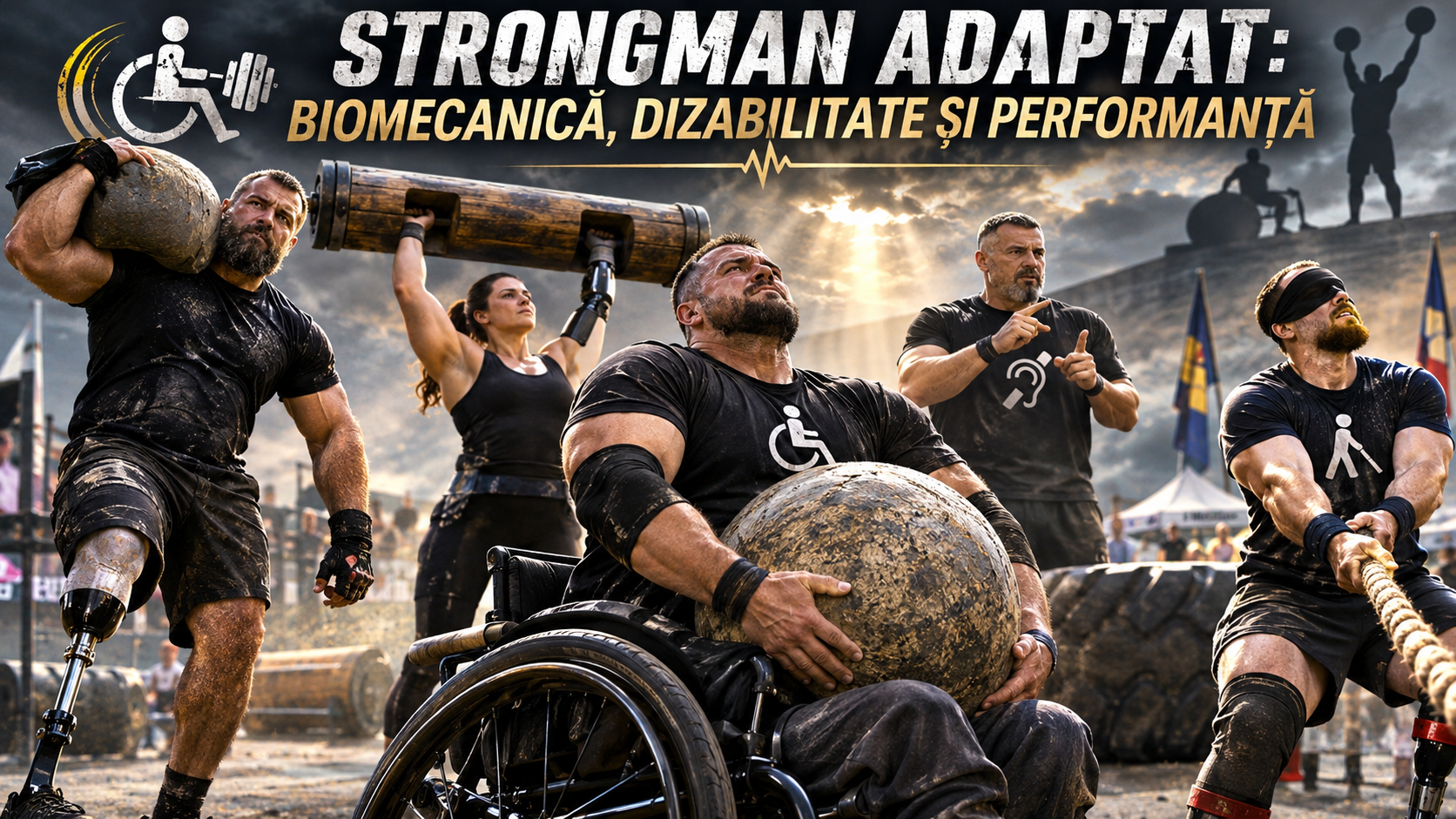
Spinal cord injury and force production: functional capacity, not a verdict
Spinal cord injuries may affect motor command transmission, sensory integration and autonomic regulation in markedly different ways. Neurological level, completeness, time since injury and associated conditions all influence function, but no single variable can capture an athlete's abilities. Voluntary strength depends on muscles that remain under motor control, training-induced neuromuscular adaptations and the way the individual organizes the task.
In a seated pushing exercise, upper-limb muscles can produce substantial force, yet performance also depends on pelvic and trunk stability, line of force and equipment fixation. Two athletes with similar upper-limb strength can record different results when one must dedicate more effort to balance. A valid test therefore needs to state whether it targets arm strength, combined postural control and strength, or a complex functional activity.
Biomechanical analysis distinguishes the external force applied to an implement from internal joint moments. Bench height, handle orientation, limits on trunk movement and friction in a pulling apparatus may all change the outcome. Standardizing these conditions supports longitudinal measurement and fairer comparisons. The mass of an object alone does not fully describe the loading experienced by the body.
Injuries at different neurological levels may affect activation of abdominal and intercostal muscles and other structures involved in stabilization and breathing. This has practical consequences for positioning, fatigue management and exercise tolerance. Individual prognosis, however, requires appropriately qualified clinical assessment rather than assumptions from a generic exercise list.
Potential risks include upper-limb overuse, pressure injuries when sensation is reduced, altered thermoregulation and, in some individuals with injuries at or above T6, autonomic dysreflexia, which may be a medical emergency. Sudden headache, a major rise in blood pressure or unusual autonomic symptoms warrant stopping exercise and following an appropriate medical protocol. Maximal lifting should never supersede those precautions.
Candidate adapted Strongman events may include cable pulls, presses performed from a verified stable position and controlled object handling at accessible heights. If straps, supports or restraints are used, rules should clarify whether they solely improve safety or also contribute mechanically to performance. Assistive devices cannot simply be assumed neutral.
Training progression must reflect functional ability, experience and recovery responses. Rapid load increases may be appropriate in some trained athletes but are not a default recommendation for someone early in rehabilitation. Movement consistency, repeatable task performance and local upper-limb endurance may complement load-based measures, alongside monitoring of skin integrity and autonomic symptoms.
From a research perspective, a classification approach based solely on injury level risks confusing diagnosis with athletic capacity. A defensible system would examine the relationship between eligible impairments, the actual demands of a specific event and the competitive outcome. IPC principles explain why classification must be sport-specific, but they do not supply a ready-made classification list for adapted Strongman [1].
Therapeutic progress, sport-specific strength development and competition outcomes should be interpreted separately. Greater independence during transfers may be functionally valuable without equating to an improved cable-pull score. Conversely, excellent competition results do not guarantee an absence of pain or overuse problems. Each domain deserves its own measurement.
The guiding principle is collaboration between the athlete, coach, rehabilitation physician and other qualified professionals where appropriate. The athlete leads decisions about personal goals, while specialists support the translation of those goals into informed training practice. This article offers conceptual guidance, not individualized treatment.
In conclusion, spinal cord injury can change how force is generated and transmitted to an implement without eliminating the possibility of high athletic performance. Adapted Strongman can be meaningful when it states exactly what is measured, standardizes task geometry, accounts for autonomic and overuse risks and avoids unsupported cross-athlete comparisons.
Selected references: [1] International Paralympic Committee, Classification Code, 2025, https://www.paralympic.org/classification-code ; [2] World Health Organization, WHO Guidelines on Physical Activity and Sedentary Behaviour, 2020, https://www.ncbi.nlm.nih.gov/books/NBK566046/ .
More From The Journal
Biomechanics
ADAPTED STRONGMAN: BIOMECHANICS, DISABILITY AND PERFORMANCE | Episode 1: Strength and Disability: Principles of Participation in Resistance Sports
An introduction to adapted Strongman: strength, accessibility, biomechanics, safety and sport classification.
Training Science
OPERATIONAL STRENGTH: STRONGMAN IN MILITARY AND EMERGENCY RESPONSE TRAINING | Episode 10: An Integrated Model of Operational Physical Preparation: Programming, Adaptation and Strongman Exercise Transfer
Evidence-based synthesis of the series: integrated occupational conditioning combining strength, endurance, Strongman carries, valid testing, recovery and safety.