Biomechanics
ADAPTED STRONGMAN: BIOMECHANICS, DISABILITY AND PERFORMANCE | Episode 1: Strength and Disability: Principles of Participation in Resistance Sports
November 3, 2026
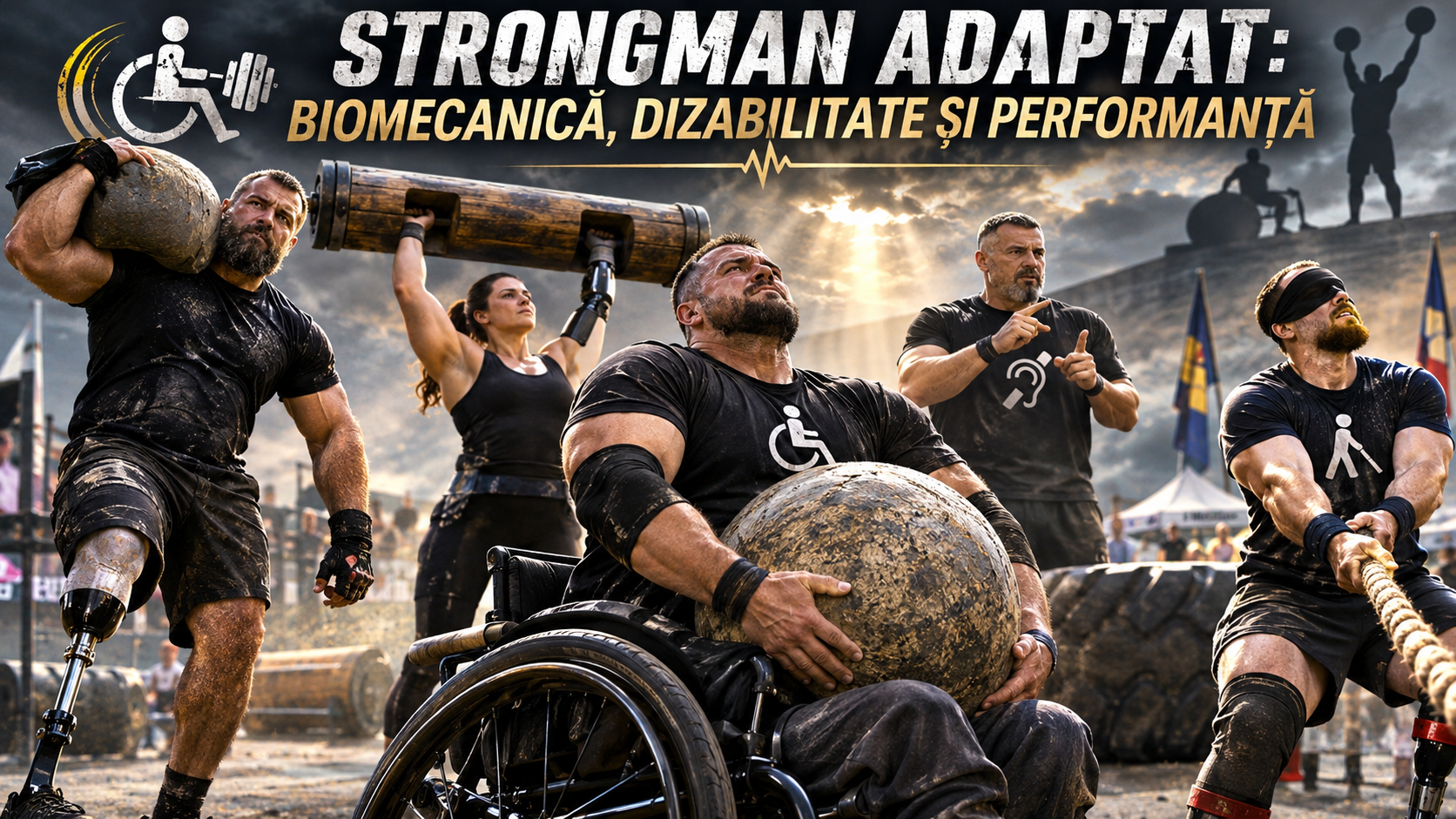
The foundation of participation: disability is not the opposite of strength
Traditional Strongman competition highlights athletes who lift awkward objects, move heavy loads and withstand intense physical demands. Yet strength is not exhausted by a single visual template. Biomechanically, force is a mechanical interaction, whereas performance reflects the combined contributions of the nervous system, muscles, skeletal geometry, movement skill, equipment and environment. An athlete with a disability may demonstrate exceptional force production, adaptation and technical precision even when the competitive movement differs from the conventional version. The central question is what the event actually measures and under which conditions its outcome can be compared fairly.
The World Health Organization recommends regular physical activity, including muscle-strengthening exercise, for adults living with disability, adapted to their abilities and circumstances. These public-health recommendations support opportunities to train strength, but they do not establish that every Strongman event is suitable for every impairment or health condition. Responsible participation may require clinical input, individualized risk assessment and progressive training aligned with previous experience and personal goals [1].
Barriers arise not only from bodily impairments but also from inaccessible environments and assumptions embedded in equipment and rules. A stage that cannot be reached, an implement that cannot be secured, instructions provided only verbally or a compulsory walking requirement can prevent participation regardless of an athlete's genuine physical capabilities. Adaptation should preserve a meaningful athletic task while removing irrelevant obstacles, rather than reducing sport to an unstructured demonstration.
Three questions must be kept separate: access to physical activity, participation in an adapted competition and formal sport classification. Access concerns the training environment, equipment and communication. Competition requires reproducible technical rules and safety procedures. Classification requires evidence that an eligible impairment affects the fundamental tasks of a specific sport. An inclusive community event need not claim to offer official sport classes.
Important mechanical parameters include joint moments, moment arms, the center of mass, stability of support and direction of applied force. Raising a sandbag from chest height is mechanically different from lifting it off the floor. For a wheelchair user, implement height, wheel locking and trunk control can change both muscle recruitment and balance demands. These are not minor modifications; they are core features of the measured task.
Adapted events may use distinct competitions or standardized versions of a shared task. Cable pulling, accessible loaded transport and resisted pushing against a secure apparatus may all provide legitimate challenges. However, each variation changes the demands on strength, coordination and technique. Results should only be equated across versions when evidence supports such equivalence and the relevant rules have been communicated transparently.
Safety has to be designed into the event. Organizers should assess implement fixation, tipping risks, grip interfaces, emergency access, movement surfaces and procedures for rapid assistance. Neurological disorders, sensory loss and cardiovascular differences can require individualized precautions. A lack of pain does not always demonstrate a lack of tissue injury in someone with altered sensation, and a generic stop rule may be inadequate.
Psychological autonomy matters alongside biomechanics. Athletes should receive accessible information, retain meaningful control over participation and have reliable ways to report discomfort, withdraw consent or request a pause. Coaches cannot infer a person's goals from a diagnosis. Athlete involvement in event design is essential to respectful, credible competition.
Paralympic classification is sport-specific and seeks to reduce the impact of eligible impairments on competitive outcomes. The 2025 IPC Classification Code and related standards provide useful principles, not an existing transferable Strongman classification system. Any proposed adapted Strongman categories must therefore be described as research models or organizer-specific rules, not as IPC-recognized classes [2, 3].
Initial collaborative assessment can consider force production in stable positions, available active range of motion, exercise tolerance, postural control, grip and the effects of assistive devices on technique. Findings should shape observable training goals without reducing an athlete's identity or potential to a clinical score.
Progressive overload, specificity, recovery and individualization remain central training principles. Nevertheless, neither volume nor intensity can be prescribed solely from diagnostic labels. Two people with the same diagnosis may differ sharply in training history, motor control, cardiovascular responses and recovery. Technical consistency and tolerability should be monitored alongside external load.
A responsible research program would begin with interviews involving athletes, clinicians and coaches, followed by biomechanical analysis and reliability testing. Only after repeatability, adverse events and the acceptability of adaptations have been assessed should cross-group performance comparisons be attempted. Competitive equity is a methodological achievement, not a promise made by applying a single rule to everybody.
In conclusion, adapted Strongman can be understood as a family of meaningful strength tasks rather than a rigid imitation of conventional events. Success depends on genuine access, safety, biomechanical validity and restraint in interpreting results. These are design principles, not individualized medical instructions or an official classification system.
Selected references: [1] World Health Organization, WHO Guidelines on Physical Activity and Sedentary Behaviour, 2020, https://www.ncbi.nlm.nih.gov/books/NBK566046/ ; [2] International Paralympic Committee, Classification Code, 2025, https://www.paralympic.org/classification-code ; [3] International Paralympic Committee, Classification, https://www.paralympic.org/classification .
More From The Journal
Biomechanics
ADAPTED STRONGMAN: BIOMECHANICS, DISABILITY AND PERFORMANCE | Episode 2: Force Production in Athletes with Spinal Cord Injuries
A biomechanical account of strength following spinal cord injury: stability, motor control, adapted events and safety.
Training Science
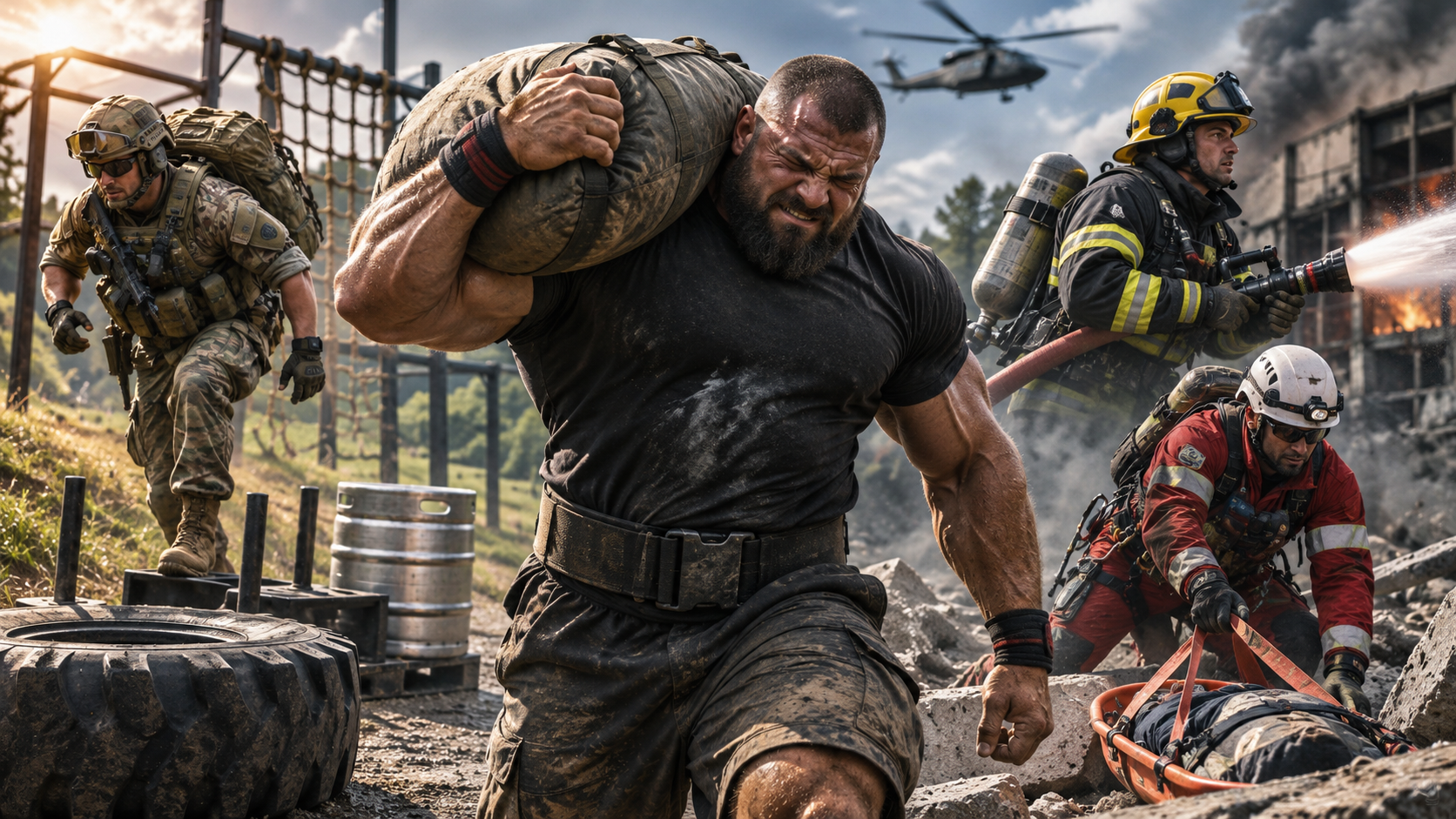
OPERATIONAL STRENGTH: STRONGMAN IN MILITARY AND EMERGENCY RESPONSE TRAINING | Episode 10: An Integrated Model of Operational Physical Preparation: Programming, Adaptation and Strongman Exercise Transfer
Evidence-based synthesis of the series: integrated occupational conditioning combining strength, endurance, Strongman carries, valid testing, recovery and safety.