
Training Science
OPERATIONAL STRENGTH: STRONGMAN IN MILITARY AND EMERGENCY RESPONSE TRAINING | Episode 10: An Integrated Model of Operational Physical Preparation: Programming, Adaptation and Strongman Exercise Transfer
November 3, 2026
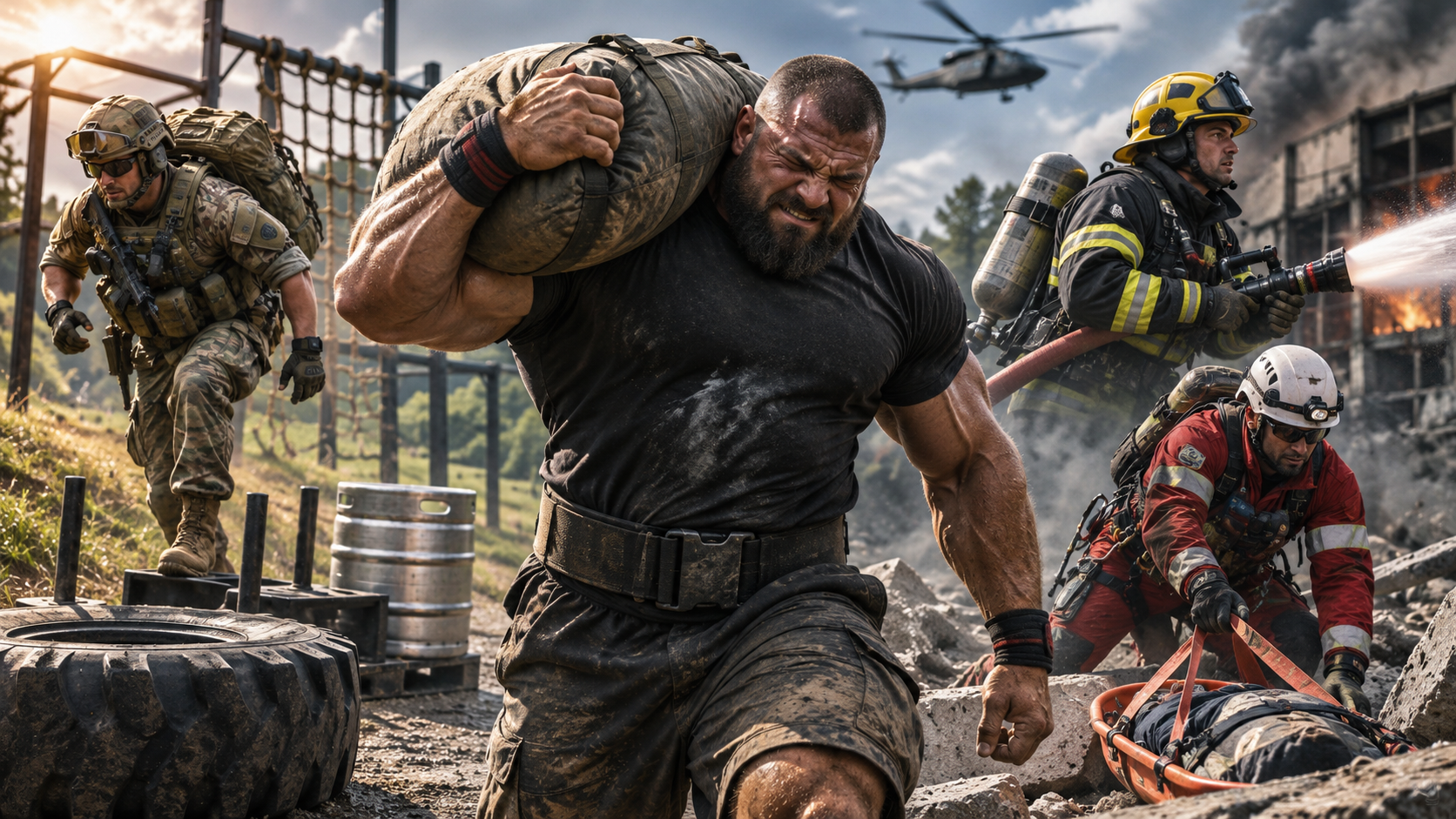
Final premise of the series: performance must be judged against the mission
In military and emergency occupations, the crucial question is not how much an individual can lift once but whether essential duties can be performed repeatedly, with technical control, under approved procedures and without undermining readiness for subsequent tasks. Strongman provides lifts, pulls and carries that resemble aspects of occupational work. Resemblance, however, is not evidence of transfer. Program effectiveness must be examined through outcomes independent of the training exercises themselves. If a responder improves heavy-dumbbell carrying but does not improve at a defined job task, the adaptation may be sporting rather than occupational. This final episode proposes an integrated logic: identify actual demands, develop general physical resources, practise relevant movement patterns, monitor fatigue and validate outcomes. The emphasis is on the relationship among capability, safety and context, not theatrical imitation of competition. Practical implications should be presented as testable propositions, not as guarantees of job performance. Strongman methods belong within a larger occupational system that includes professional skill, teamwork, judgment, equipment training and organizational safeguards [1–3].
Essential occupational demands and occasional demands. Job analysis starts by distinguishing frequent duties from rare but potentially consequential events. Equipment carriage, loaded travel, object lifting and assisted evacuation do not occur with identical frequency, duration or complexity in every organization. Fire-service tasks may differ from military tasks, and soldiers assigned different positions may have different physical requirements. Exercise selection must reflect these distinctions. A defensible analysis documents the mass or resistance involved, travel distance, handling height, repetition, protective equipment, teamwork requirements and stopping conditions of each duty. These observations determine programming priorities. Strongman exercises should not be selected because they are fashionable but because they provide a relevant, controllable stimulus. Where occupational data are absent, uncertainty must be acknowledged rather than disguised through arbitrary standards. Research on relationships between physical fitness and military job tasks shows that predictors vary with the task studied [2]. The analysis should also distinguish minimum critical capability from desirable reserve capacity: passing a task does not necessarily mean that the task is easy, while greater reserve may be useful without justifying unlimited training load.
Maximal capacity and strength reserve. Maximal strength can serve as a resource for submaximal tasks. When a given load represents a lower fraction of capacity for a stronger person, that individual may possess greater mechanical reserve. Yet the relationship between gym strength and usable occupational force depends on posture, tools, grip, fatigue and environment. It cannot responsibly be converted into one universal equation. A large deadlift does not guarantee safe handling of a bulky object from a cramped location. Programming should develop force using standardized exercises while assessing its application separately. Periods emphasizing maximal force can be alternated with work emphasizing movement quality and tolerance of repeated effort. The 2026 ACSM position stand synthesizes evidence that resistance training improves strength and multiple physical-function outcomes, but it does not validate every exercise for every occupation [1]. Greater reserve should be considered alongside mobility, aerobic fitness and technical competence. Its value is conditional: a resource becomes operationally meaningful only when a person can access and direct it in the circumstances actually encountered.
Mechanical power and rapid force development. Some duties require moving an object quickly, but speed must not be confused with uncontrolled haste. Mechanical power describes work per unit time and, in dynamic tasks, is related to force and velocity. Power can be developed through appropriately loaded explosive movements without maximal loads on every attempt. The ACSM review distinguishes prescription variables associated with maximal force from those supporting power development [1]. Occupational relevance depends on the task: accelerating equipment is not the same as precisely stabilizing an unstable object. Jumps or throws may assess neuromuscular resources, but they do not automatically become occupational tests. When fast Strongman movements are used, implements should be stable and the environment controlled. Performance criteria must not reward velocity at the expense of control or procedural compliance. Coaching decisions should also account for prior technical competence, since fatigue or an unfamiliar implement can alter movement patterns. A fast training repetition is useful only when it supports, rather than replaces, the force and coordination demands of the target occupation.
Grip strength is not synonymous with dexterity. Heavy handled carries can develop sustained gripping capacity and local forearm endurance. These resources may matter for lifting or carrying equipment, yet they do not fully characterize tool use in protective gloves or operation of small controls. Peak grip force, grip endurance and dexterity are distinct dimensions. A soldier may score well on a dynamometer but struggle with fine manipulation if equipment limits tactile feedback. General assessments therefore require supplementation by authorized job-specific tasks when fine control is essential. Farmer's walks and unilateral carries may sit alongside controlled forearm and stabilization exercises, but losing grip under extreme loading should not become a training objective. Loads, distances and handle surfaces must reflect participant ability and the need to retain object control. Progress should be measured with the corresponding capacity in mind; improvements in heavy carrying do not justify claims about precision work unless those outcomes are assessed directly. This distinction illustrates the broader principle that fitness characteristics are useful components of competence, not substitutes for competence.
The trunk as an interface for force transmission. The trunk contributes to transmitting and controlling forces between limbs and the handled object. An asymmetric carry can impose different demands from a bilateral lift. One-arm carries, sandbag work and lifting variations expose the body to distinct configurations, but this does not automatically prove injury prevention. Some personnel may need endurance under sustained demand; others may need control in an unfamiliar action. Programming should not simplistically attribute every episode of low-back pain to a supposedly weak core. Assessment of symptoms and functional limitation belongs to qualified professionals. For healthy participants, controlled progression, technical practice and recovery provide a more defensible framework than promises of an invulnerable trunk. Moreover, occupational equipment may shift the center of mass and restrict movement, supporting separate assessment from unloaded gym training. Coaches should describe the intended adaptation precisely, whether force production, endurance, movement tolerance or coordination, rather than prescribing the same generic exercise to every worker.
Aerobic capacity as a resource for repeated work. Emergency occupations often require successive bouts of work, movement, climbing and activity while equipped. Cardiorespiratory conditioning can support repeated carriage and recovery between demanding bouts. Firefighter research identifies substantial associations between cardiorespiratory fitness and performance on occupational circuits [4]. These associations do not mean endurance replaces the force needed for heavy objects. An operator may run well but still be limited by grip strength or leg power. The practical answer is not choosing exclusively between running and lifting, but distributing training so both qualities can develop. Aerobic work can be individualized through duration, intensity and modality. Occupational loading need not be imitated through excessive marching if a similar conditioning stimulus can be obtained more safely. Transfer should be examined under representative conditions rather than inferred solely from higher VO₂max. The balance between aerobic and strength resources should ultimately reflect how often, how long and how intensely the actual job requires personnel to work.
Anaerobic metabolism and high-intensity bouts. Fast pulling, repeated lifting or stair climbing may temporarily raise energy demand beyond what oxidative processes alone can immediately supply. Anaerobic capacity and muscular power can matter, but not all occupational tasks are sprints. A recent firefighter meta-analysis found task-dependent associations between anaerobic and muscular variables and performance [5]. A long circuit with short rests may demand different resources from one maximal pull. Sessions must therefore specify whether the target is brief power, repeated-effort tolerance or technical learning. These goals should not automatically receive identical workloads. Strongman events can provide high-intensity intervals, but duration, mass and surface conditions need control. Intensity is not synonymous with total exhaustion. Adequate recovery is necessary when movement quality is the priority. Interpretation should also separate acute metabolic strain from lasting adaptation: feeling overwhelmed after a session does not prove that the program will improve duty performance weeks later.
Initial profiling: measure before prescribing. Before a program begins, it is useful to document training experience, exertion tolerance, relevant injury history, institutional test results and professionally established medical restrictions. A novice does not need the same loading as an advanced strength athlete even if their duties overlap. Profiling can include general strength, aerobic capacity and mobility tests, while avoiding invasive or hazardous procedures without justification. Baseline results establish comparison points rather than permanent labels. Interpretation depends on sleep, familiarization, equipment, test protocol and ordinary day-to-day variation. A responsible organization defines who may access these records, why they are collected and how they will inform decisions. Performance must not be reduced to a spreadsheet detached from real duty conditions. This first step connects individualization with organizational accountability. It also protects against prescribing a competitive Strongman workload to a person whose immediate objective is basic physical competence, sustainable progression or safe return to training.
Gap analysis between capacity and requirement. Once job tasks and physical resources have been documented, the next step is to analyze gaps between requirements and current capacity. One person may be very strong but lack tolerance for repeated carrying; another may have good aerobic fitness yet struggle with heavy-object handling. Programs should address limitations that affect essential duties rather than only qualities that are easy to measure. Each gap requires a hypothesis: insufficient force, limited conditioning, technical difficulty or poor adaptation to equipment. An intervention and an observable outcome can then test that hypothesis. If task performance does not improve, automatically adding weight is not the answer. Exercise selection may need revision, or the constraint may be organizational rather than muscular. This approach is the value of occupational programming: exercises serve defined purposes instead of becoming ends in themselves. It discourages collecting impressive gym statistics when critical job capabilities remain unexamined.
Periodization as distribution of priorities
Periodization is not a decorative training chart; it is a method of distributing limited physiological and organizational resources. Strength, power, endurance and job-specific skills cannot all receive maximal emphasis every week. During demanding duty periods, maintaining capacities may be more valuable than setting new records. During predictable blocks, coaches can allocate greater effort to developing identified weaknesses. Reasonable progression can include accumulation, consolidation and deliberate reductions in workload when warranted. The literature does not support a single mandatory periodization model for every adult or occupation [1]. Principles should be adapted to shifts, field exercises, unpredictable responses and training experience. Every phase needs a testable purpose, tolerable dosage and explicit link to actual job requirements. The practical rule is controlled flexibility, not rigid obedience to a calendar after conditions change. A good program can be adjusted without abandoning its aims, while a highly precise plan may fail if it ignores operational reality.
Internal and external training load must be distinguished. External load describes performed work: kilograms, repetitions, distance, duration and implement characteristics. Internal load concerns the body's response, such as perceived exertion or heart rate under suitable circumstances. Two people can lift the same mass yet experience substantially different demands because of strength, experience or recovery differences. Conversely, similar external sessions can create different internal responses if one follows a demanding shift. Useful monitoring combines these perspectives without treating either as infallible. Heart rate does not adequately characterize a brief maximal lift, and perceived exertion does not by itself identify the mechanism of a limitation. For military personnel, total exposure also includes duty workload that may be difficult to quantify precisely. Adjustments should therefore rely on convergent observations rather than one number. Records can be concise and practical: what was done, how difficult it felt, whether movement remained controlled and how the person performed during subsequent duties.
Managing volume in heavy lifting. Training volume must be defined in relation to purpose. Sets and repetitions are useful for standardized lifts, but do not fully describe carrying events in which distance, speed and grip adjustments also matter. Submaximal loading performed with control can stimulate adaptation without requiring muscular failure on every set. The 2026 ACSM position stand synthesizes evidence that prescription variables influence strength, hypertrophy and power differently, while training to momentary failure is not universally required [1]. In emergency occupations, volume management must account for work outside the gym and unexpected operational demands. The objective is not permanent maximization of weekly tonnage. Effective volume produces observable improvement at an acceptable cost, and that relationship changes among participants and across periods. When performance plateaus as strain accumulates, automatically adding more sets is not a validated solution. Coaches should examine technique, recovery, task specificity, workload distribution and the reliability of measurements before deciding what to change.
Intensity and selecting loads. Intensity may mean percentage of one-repetition maximum, perceived effort or metabolic demand depending on the exercise. These meanings should not be conflated. Relatively heavy loads can be useful for maximal strength, but carries, sled work and irregular sandbags do not always permit safe and repeatable maximal testing. Progression can instead use ranges of distance, duration and execution quality. A novice soldier may benefit from moderate loading with stable technique, whereas an experienced athlete may require greater stimulus to adapt. Standardization matters: a sled on another surface or a differently filled bag changes the task. A load does not become functional simply because it is heavy. Functionality describes the relationship among exercise, objective, participant and real duty requirement. Selecting loads also involves considering whether the person must remain capable of work shortly after the session; a valid training stimulus is not necessarily the heaviest stimulus that can be survived.
Session frequency and shift constraints. General resistance-training recommendations must be interpreted in light of practical availability. Shift workers may experience fragmented sleep, intense duty and varying recovery opportunities. Every calendar week need not contain an identical fixed combination of exercises when occupational conditions make that unrealistic. A flexible model can retain essential priorities while adjusting order, duration or session count. More important than mechanically following weekdays is avoiding unnecessary accumulation of hard training on top of duty demands. If an emergency call involves prolonged carrying and manual labor, that is real physical exposure even when absent from the gym log. Planning should account for it. Conversely, missed sessions do not have to be compensated by doubling the next day's volume. Sustainable continuity takes priority over aggressive catch-up. Coaches should communicate which elements are indispensable, which are optional and which may safely be deferred during unusually demanding working periods.
Concurrent strength and endurance development. Developing strength and endurance together is necessary in many occupations, but organization can influence adaptations. Concurrent-training research describes possible interference with particular outcomes, varying with training status, sex, exercise order and proximity of sessions [6–7]. These findings do not justify removing cardiovascular conditioning from the preparation of people who lift weights. Emergency work often demands both resources. When the immediate objective is maximal strength, coaches may separate some sessions or adjust endurance volume. When repeated-work tolerance is the priority, a slower rate of maximal-strength improvement may be acceptable. There is no universally mandatory magic interval for every person. Studies must be interpreted according to their populations and interventions. Successful programming maximizes the overall usefulness of fitness rather than one physiological variable. A practical decision should be based on which deficit matters most for actual work and what additional training can be sustained without reducing readiness.
Mobility should be defined by the task. Mobility is not synonymous with the greatest possible joint range in every movement. A duty requires particular positions, and equipment may constrain motion in ways absent from the gym. Assessment should begin with actual task demands and distinguish equipment restrictions, individual limitations and technical strategies. Barbell exercises can develop capacity through useful ranges, but cannot guarantee overhead object handling in restricted spaces. Integrated programming may combine movement-control work with strength development without claiming that isolated flexibility prevents every injury. When a position produces persistent pain, the answer is not forcing range but obtaining appropriate assessment. In training, movement quality should be maintained under loading compatible with technique and purpose. The expression functional mobility requires a clear operational meaning rather than being used as a marketing label. Coaches should document which task-specific limitations an intervention aims to improve and whether the change is observable in practice.
Farmer's carry: carrying strength and transfer limits. Farmer's carrying loads the legs, trunk and grip during bilateral weighted locomotion. The biomechanical studies reviewed by Hindle and colleagues identified stride and ground-contact characteristics associated with event performance [3]. Yet standardized handles do not fully reproduce fire extinguishers, stretchers or tactical equipment. Training can manipulate distance, mass and frequency while keeping attempts comparable. A common mistake is increasing all variables simultaneously, obscuring why fatigue or improvement occurred. Grip duration may become a different limiting factor from the force required to initiate motion, so assessments should describe both. For professionals, the main advantage is developing loaded-carry capacity under controlled conditions, not perfectly simulating every intervention object. If a real task requires teamwork, individual farmer's carries cannot replace coordinated handling practice. Transfer claims remain conditional until occupational outcomes are measured independently of the training event itself.
Yoke carry: axial loading and locomotion. Yoke carrying involves locomotion beneath a loaded frame, creating substantial demands on posture and gait. Load distribution differs from handled carrying, while frame stability and ground surface influence difficulty. Strongman biomechanics literature identifies remaining gaps in quantitative understanding of events including the yoke [3]. It is therefore unjustified to assign precise military benefits based on visual similarity. The yoke may be an option for experienced athletes under competent supervision, but it is difficult to argue that every soldier needs very heavy shoulder-supported loads. Simpler carries may provide sufficient stimulus with fewer logistical demands. If yoke work is introduced, selection, technique, progression and stopping criteria should be explicit. The occupational objective remains effective loaded locomotion, not achieving a competition record beneath a specialized frame. Its inclusion must be justified by a documented training goal and evaluated against alternatives.
Sled pulling and resistance control. Sled pulling allows resisted locomotion, but the mass placed on the apparatus does not alone describe the force required. Friction, surface, pulling angle and acceleration can change the demand considerably. Comparing times across gyms or different surfaces is therefore problematic. Studies summarized in the Strongman review describe biomechanical characteristics of heavy pulling, but extrapolation to vehicles or specialized rescue equipment remains limited [3]. A sled may be useful for gradual progression and a work pattern that does not necessarily involve the same loaded eccentric phase as free-weight lifts. This does not make the exercise risk-free. Operators must control the route and equipment while avoiding hazards. A good protocol documents mass, surface type, distance and pulling method so that changes in performance can be interpreted sensibly. If these parameters shift, the recorded improvement may reflect changed resistance rather than a meaningful gain in capability.
Sandbags and deformable loads
A loaded sandbag can deform against the torso and forearms, changing contact points and the distance between its mass and the body. Compared with a rigid bar, it requires adjustments in gripping and can be difficult to standardize. Some occupational objects have unconventional shapes, but resemblance does not establish equivalent demands. A training sandbag is not an injured patient, whose handling involves protection, procedures and qualified personnel. Sandbags may help develop carrying resources and control of deformable objects when mass, filling and dimensions are appropriate. Progress can be assessed through distance, repetitions and handling quality rather than maximal mass alone. If a bag changes shape between sessions, test comparisons become less reliable. For research, standardization of the implement matters. For professional practice, the boundary between physical conditioning and medical or technical rescue procedures remains essential. An athlete should never infer that a successful heavy-sandbag lift is a credential for casualty handling.
Atlas stones and spherical objects. Atlas stones require lifting and handling a round object without conventional handles. Their contact characteristics can challenge the trunk and upper limbs differently from barbell lifting. Yet competition stones impose specific sporting demands, and analogies with industrial handling or rescue operations should remain cautious. Available biomechanical literature has been described as limited in several quantitative areas [3]. There is no justification for requiring very heavy stones in the basic training of every professional. Alternatives with more controllable objects can develop some of the intended resources. When stones are used, implement characteristics, loading height and handling rules must match the participant's level. An occupational program should not equate discomfort tolerance with useful performance. The final objective is relevant capacity, not the reproduction of a traditional Strongman event. The question is whether the exercise adds value beyond safer or more accessible alternatives, not whether it looks impressive on video.
Overhead lifting and tool specificity. Overhead lifting develops force production in elevated arm positions, but its relevance depends on job duties. Some occupations require handling equipment at height, while others rarely use comparable movements. Log presses and push presses are demanding exercises, not substitutes for authorized procedures to position or handle operational devices. Arm position, trunk freedom and personal equipment can greatly alter difficulty. For inexperienced personnel, controllable loading and gradual progression are more appropriate than maximal efforts with unfamiliar implements. Assessment should document range, control and tolerance for training volume. If gym strength increases without improvement in the target duty, that finding should guide program revision. No single sporting movement should be presented as a universal recipe for emergency capability. Technical familiarity with actual equipment belongs to job-specific instruction, while strength training supplies a potentially useful general resource.
Tire flipping and multi-phase mechanics. Large tire flipping combines initiation, whole-body movement and object control across phases that can be studied biomechanically. Research has examined determinants of these phases, but does not show that tire flipping is superior to other exercises for every occupational task [3]. Tire diameter and mass do not fully describe resistance; ground contact and technique influence performance. Using such an implement requires space, supervision and controlled conditions. Soldiers and firefighters should not be encouraged to move hazardous real-world objects merely to display strength. In conditioning, potential benefits must be weighed against logistics and alternatives. The event can be included when its purpose is clear and qualified personnel are available, but it is not an indispensable component of occupational training. A dramatic-looking exercise is not necessarily a valid occupational assessment, and increased event performance should be documented without exaggerating its transfer.
Unilateral carrying and asymmetry. One-hand carrying requires control of an asymmetrically distributed load and may change trunk demands and gait. Some occupational objects are carried on one side, but their handles and centers of mass may differ greatly from a dumbbell. The exercise can develop grip endurance and moving control provided the load is suitable and the route free of hazards. Alternating sides may be sensible, although this does not automatically resolve every individual asymmetry. People can have side-to-side strength differences without those differences necessarily representing a clinical problem. Assessment should distinguish normal variation from meaningful functional limitation. An occupational protocol may include relevant walking directions, distances and equipment conditions, while recognizing limits of sporting comparison. The purpose is control of asymmetric loads, not collecting unusual exercises without a rationale. Progress should be judged by technically consistent performance under standardized conditions rather than by choosing the heaviest weight available.
Lateral movement and changes of direction. Gym carries are often performed in straight lines, while occupational duties may require turning, avoiding obstacles and moving short distances through awkward areas. These demands involve anticipation, object control and step adjustments. Adding direction changes to controlled exercises may broaden motor practice, but should not turn routes into hazardous races. Assessments with obstacles need comparable conditions and rules distinguishing speed from procedural compliance. Outcomes cannot be attributed exclusively to strength because route familiarity, visibility and coordination also influence execution. If the aim is carrying force, a simple course may be preferable; if the aim is load management during movement, standardized turns may be justified. The choice depends on the evaluation question rather than a circuit's apparent difficulty. Physical training environments can challenge movement without imitating hazardous operational structures or rewarding reckless contact with equipment.
Tactical load carriage remains a distinct task. Marching with a backpack and body armor involves distributed loading, duration and repeated ground contact that Strongman carries do not completely reproduce. Although both may demand postural and leg musculature, load distribution and task duration limit comparison. Programs can use heavy carries to build force while retaining justified doses of actual load-carriage practice. Cumulative exposure needs management because repetitive marching and heavy events can impose substantial musculoskeletal strain. There is no reason to increase pack mass, distance and pace simultaneously without monitoring. Endurance progression may also use more controllable modalities depending on the objective. Military loaded-march assessments must follow institutional procedures. A yoke or farmer's carry score should not be converted into a numerical prediction of marching success without specific validation. The aim is complementarity between general conditioning and task-specific preparation, not pretending that all forms of loaded movement are interchangeable.
Handling equipment in pairs. Some professional objects are handled by two people, with load sharing changing according to height, hand position and synchronized movement. Team performance is not the mechanical sum of individual strength records. A stronger member cannot consistently compensate for absent communication or unsynchronized steps. Controlled exercises with safe objects may develop paired carrying without recreating complex technical procedures. Commands, stopping rules and responsibility for direction should be defined. If one partner loses control, the attempt stops regardless of elapsed time. Assessment can observe speed together with communication and object stability. In practice, some tasks require mechanical assistance or additional personnel; the pair's strength cannot replace risk assessment. This example demonstrates why an exclusively individual fitness battery does not capture the whole meaning of occupational readiness. Team coordination and authorized technical competence are independent requirements that physical conditioning can support but cannot certify.
Casualty handling and the ethical limits of sporting analogy. A training sandbag has mass and shape but no pain, injury, breathing or vulnerability. Handling an injured person is a medical and rescue task, not a Strongman event. Fitness may help personnel meet physical demands, but technique selection, indicated immobilization and coordination belong to professional training. Heavy-object exercises may develop general resources but do not justify improvised casualty movement without appropriate instruction. Evaluation of evacuation protocols must protect people and comply with institutional rules. Times obtained using a mannequin depend on mannequin characteristics and do not transfer automatically to real patients. Greater force does not eliminate environmental assessment or the possible need for specialized devices. The distinction between physical preparation and rescue competence must also be preserved in public communication, where dramatic sporting comparisons can encourage unsafe misunderstandings. Occupational success includes the person's welfare, not only the responder's ability to move mass quickly.
Protective equipment influences strength expression. Helmets, armor, protective footwear and gloves may alter freedom of motion, balance and object contact. Someone may perform excellently on a lift without equipment and differently in a duty configuration. That difference does not necessarily represent reduced muscular strength; it may reflect altered task geometry. General physical preparation occurs under controlled conditions, while familiarization with authorized configurations belongs to professional instruction. Removing required protective components merely to improve a test score is not justified. Tests must document exactly which equipment was used; otherwise comparisons become unreliable. This principle connects prior biomechanical analysis with integrated programming: physiological adaptation and equipment functionality are distinct components requiring coordination rather than conflation. An instructor cannot solve a poorly fitting protective configuration simply by prescribing progressively heavier gym loads. Functional readiness requires both bodily capability and equipment that permits the intended job.
The relationship between balance and object stability
During loaded transport, body balance and object stability are related but distinct. A person can remain upright while a bulky object swings or strikes the surroundings. Conversely, control of a stable object can be undermined by the walking surface. Assessment should distinguish corrective steps, unintended contact and loss of object control from simple reductions in speed. Strongman events offer opportunities to develop loaded control, but competition conditions differ from emergency demands. In professional work, an operator may deliberately slow down to protect equipment or nearby people, and that decision should not automatically count as poor performance. Progression should begin on safe and predictable surfaces. Introducing uneven terrain or obstacles requires justification and supervision, not merely a desire to make strength training more difficult. Stability needs explicit measurement criteria instead of being inferred vaguely from successful completion. These criteria can improve both coaching feedback and the credibility of occupational assessments.
Duty fatigue and the training decision. Military and emergency personnel may enter the gym after physical or cognitive work absent from a conventional sport plan. Prolonged duty, field exercises, curtailed sleep or heat can change concentration and exercise tolerance. Responsible programming treats these circumstances as relevant information rather than as excuses. After unusually demanding work, the immediate objective may shift toward lighter technical practice, controlled aerobic activity or recovery, according to circumstances. Such flexibility is not the abandonment of discipline. Discipline means sustaining the long-term objective without turning every session into a maximal examination. Training records should be interpreted alongside time availability and occupational demands. There is no evidence that ignoring fatigue signals automatically creates resilience. Progress comes from repeatable and recoverable exposures rather than permanent displays of exhaustion tolerance. Coaches should also avoid making negative moral judgments when a worker follows a sensible reduction in workload.
Recovery is not the absence of preparation. Recovery encompasses sleep, appropriate nutrition, workload organization and temporary reductions in training demand when warranted. It cannot be replaced by one gadget, supplement or ritual. For a professional, recovery has operational value: being ready for the next duty may matter more than the result of an isolated session. Strength-training stress should be dosed so cumulative exposure remains tolerable. Persistent pain, serious sleep disturbance or functional decline warrants appropriate assessment rather than assuming every symptom is normal. Not every feeling of fatigue indicates clinical overloading, but neither should it be dismissed automatically. Lighter periods can maintain movement practice and consolidate skills. Recovery is an active programming component, assessable through performance trends and duty function, not a reward given only after complete exhaustion. A sustainable system recognizes that training and work compete for some of the same recovery resources.
Sleep and exercise planning. Sleep affects processes related to recovery, vigilance and motor learning, although individual needs and duty circumstances vary. One short night does not produce identical performance changes in every person, and lack of obvious symptoms does not prove that all functions are intact. Shift personnel may face scheduling difficulties, so exercise planning must be realistic. Technical sessions with heavy unfamiliar objects demand attention, and pronounced fatigue may undermine execution quality. Where feasible, coordination-intensive sessions can be placed during periods of better physical and mental availability. This is not a universal clock-based rule but a contextual decision. Sleep management also operates at an organizational level: a coach cannot solve an incompatible duty schedule through exercise selection alone. Strength programming works best when it acknowledges the limits imposed by real human recovery rather than treating sleep as a personal weakness.
Psychological stress cannot be reduced to a hormone. Occupational stress may affect perceived effort, concentration and training readiness. Yet one biomarker cannot fully characterize psychological state or decision-making capability. Operational programming should avoid informal diagnosis based on a laboratory result or an instructor's impression. Questionnaires and fatigue conversations can identify difficulties, but require privacy and appropriate professional boundaries. Personnel should not have to disclose clinical information to a coach in order to receive suitable exercise. Loading adjustments can rely on observed function and restrictions communicated through authorized channels. An environment where concerns can be reported without stigma supports responsible decisions. Physical preparation may contribute to well-being, but it cannot substitute for psychological or medical care when needed. Equating resilience with an inability to acknowledge fatigue would be scientifically and professionally misguided. Organizational leadership shares responsibility for conditions that allow realistic monitoring and support.
Cardiovascular safety and responsible prescription. Heavy resistance training can impose substantial cardiovascular demand, especially when combined with long duration, heat or heavy equipment. Fitness for maximal exertion cannot be assumed merely because someone's occupation is physically demanding. Medical assessment, when indicated, belongs to qualified professionals, and instructors should respect established restrictions. People with warning symptoms should not be urged to finish a test at all costs. An integrated program can be effective without repeated maximal challenges. Intensity should match individual capacity and job demands, while professional performance goals do not justify uncontrolled hazard exposure. Resistance-training research indicates that adaptation can occur across different combinations of loading and volume [1]. Prescription should be guided by intended benefit and tolerability. Training safety is a quality criterion rather than a bureaucratic obstacle. This is particularly important when public demonstrations or competitive attitudes risk overshadowing the central purpose of occupational preparation.
Tissue tolerance versus one-time performance. A strong single attempt does not demonstrate that the body can tolerate the same loading repeatedly throughout a working week. Tissues respond to cumulative exposures, and adaptation may occur at different rates across systems and individuals. Rapid improvement in a gym record should not trigger equally rapid increases in occupational handling volume. Repeated load management depends on effort duration, rest, technique and environment. In a unit performing substantial manual labor, supplemental training must remain compatible with existing workload. Some periods may appropriately consolidate capacity at stable loading rather than pursue continuous increases. Persistent symptoms or declining function justify reassessment. No single test reliably predicts every injury, and promises of absolute prevention are unsupported. The aim is prudent exposure management while developing required capabilities. The success of a program cannot be judged solely by how challenging individual sessions feel; durability across months and availability for duty matter.
Implement accessibility and infrastructure. Not every organization has a yoke, atlas stones, specialty logs or dedicated facilities. An integrated model should not become impossible to implement without competition-specific Strongman apparatus. The principle is to identify the desired stimulus and then choose accessible tools that provide an appropriate, controllable challenge. Stable handled objects may develop carrying strength; purpose-built resistance devices can support pulling; conventional lifting equipment often suffices for general force development. Selection should be justified by outcomes and logistics rather than association with a sport. Improvised implements can be unpredictable and are not automatically acceptable. Duty equipment should not be damaged or diverted from service for unauthorized conditioning. A scalable program can work in a modest facility if objectives are clear and instruction competent. Accessibility increases the likelihood of continuous preparation instead of rare demonstrations dependent on specialized equipment. Low-tech solutions can be scientifically defensible when their training dose and intended effects are measured.
Instructor competence and professional boundaries. A strength coach can design progressions, observe movement and interpret changes in physical performance, but cannot replace a rescue specialist, clinician or occupational safety officer. Heavy-object work requires personnel familiar with implements, hazards and participant capabilities. Moving into actual duty-equipment tasks also requires institutional authorization. In a multidisciplinary program, each professional supplies distinct expertise: the physical instructor manages conditioning; occupational specialists describe tasks; clinicians establish relevant medical restrictions; leaders provide resources and procedures. This arrangement may appear slower than organizing an informal internal competition, but it creates more defensible decisions. An unreliable test without stopping criteria can generate hazards without useful information. The shared goal is improved duty capability under ethical and safe conditions, not a demonstration of one profession's authority. Professional boundaries also support clearer accountability when a program is evaluated or changed.
Implementation for beginners. For a participant with little resistance-training experience, the first phase emphasizes familiarization, control and effort tolerance. Loads should permit technically stable repetitions, and progress may be judged by improved execution before substantial mass increases. Early exposure to very heavy unstable objects is not a requirement of functional preparation. Beginners can develop useful strength through standardized lifting, pulling, pushing and carrying variations. Aerobic sessions should match actual capacity, while occupation-specific technical training remains separate under approved procedures. The initial goal is not imitation of elite competitors but development of foundations that permit later progression. As performance improves, one variable can be adjusted while others remain stable enough to interpret the response. A simple and consistent program may be more valuable than an impressive catalogue of events without common criteria. Confidence should arise from demonstrated competence and gradual exposure, not pressure to perform a spectacle.
Intermediate trainees and varied tasks
Participants who have developed control of basic exercises can begin exploring more varied implements, but progression should not raise technical complexity and loading simultaneously. A coach might introduce unilateral carries or lighter sled work while preserving familiar elements elsewhere. At this stage, program quality depends more on progression logic than on the number of exercises. Some sessions develop general force, others carrying tolerance and object control. Periodic assessment can show whether a new exercise advances objectives or merely consumes recovery resources. Intermediate trainees also need appropriate aerobic conditioning, since improving strength does not eliminate the cardiovascular demand of repeated work. A common difficulty is retaining too many competitive goals even when they lack professional relevance. Simplifying a program can reflect methodological maturity rather than regression. A coherent set of measurable priorities is preferable to a crowded schedule in which every exercise is treated as indispensable.
Advanced trainees and diminishing additional returns. Among very strong athletes, further record improvements may become increasingly expensive in time and recovery. For some occupational tasks, an already sufficient strength reserve may make improvements in endurance, relevant mobility or team competence more valuable. This is not a universal conclusion without job analysis, but it is an important hypothesis. An operator with an exceptional deadlift should not automatically receive more heavy lifting if the limiting duty is repeated marching or a technical task. Advanced programming can include strength-maintenance periods alongside new priorities. High-intensity work may remain present, yet its volume and frequency require justification. Not every professional competence improves through greater tonnage. Evaluating the marginal usefulness of each intervention helps prevent occupational preparation from becoming an uncritical extension of elite sport. The central decision is not whether someone could become stronger, but whether that specific improvement would create enough occupational value to justify its cost.
Individual differences and equitable access to preparation. Personnel differ in age, experience, body dimensions, fitness and medical limitations. A shared program may target the same occupational capacities without prescribing identical masses or progression rates to every person. Artificial uniformity can undertrain some people and overload others. Essential professional standards, when justified by job duties, should be distinguished from individual development goals. This allows training adjustments without arbitrary changes to occupational requirements. Concurrent-training research indicates that individual variables can influence adaptation, while highly trained populations are often underrepresented [6–7]. Instructors should avoid stereotypes based solely on demographics and observe actual individual responses. Fair assessment uses transparent criteria, reasonable accommodations when permitted and protection of medical privacy. Collective effectiveness grows from individualized preparation and shared, verifiable objectives. Personalized training is not synonymous with lowering standards; it is a method of helping different individuals develop the capabilities genuinely required by their roles.
A conceptual microcycle example. A microcycle may be organized around complementary priorities: one general-strength session, aerobic conditioning, controlled carrying or pulling and relevant mobility or support work. The exact distribution is not a universal prescription. Depending on duties and experience, objectives can be combined, reduced or separated. A novice may need more technical repetitions at moderate intensity; an advanced trainee may use heavier loading with constrained volume. Days involving substantial actual duty must enter workload analysis. A session should not be retained merely because it appears on a calendar when the worker has not recovered sufficiently from demanding work. This model illustrates programming logic rather than serving as a standardized medical or military regimen. Outcome measurements and personnel feedback should determine adjustments. The best week is not necessarily the one with the most kilograms but the one that contributes sustainably to targeted capacities. Practical simplicity can improve adherence and interpretation.
An example of a medium-term development phase. Over a medium-term period, a program may begin with baselines and technical familiarization, continue with development of strength and work capacity, and finish with evaluation on independent tasks. This broad structure imposes no fixed durations because adaptations vary by participant and objective. New Strongman exercises should be introduced gradually after basic movement control has been demonstrated. Throughout, coaches monitor whether training volume remains compatible with occupational duties. At the end, results are compared with baseline using the same equipment and rules, or all differences are documented. If gym performance improves but occupational outcomes do not, the intervention should be reconsidered. Applied research should distinguish training effects from familiarization effects. A phase structure has value only when it helps explain change, not when it merely reports a succession of hard sessions. Meaningful progress is a defensible change in capability under well-described conditions.
Baseline testing and appropriate retesting intervals. Testing too frequently can turn a program into repeated maximal attempts that consume time and recovery resources. Conversely, no testing at all makes effectiveness difficult to establish. Assessment frequency should reflect risks, measurement sensitivity and expected adaptation rates. A simple standardized lift may be easier to repeat than a complex multi-equipment circuit. When both are used, they can answer complementary questions. Results should account for measurement error and participant familiarity. A small change may reflect ordinary variation rather than meaningful improvement. Reports should therefore not display impressive percentage differences without context. They should document conditions, limitations and consistency of results. This methodological discipline protects organizations from exaggerated claims. The assessment process itself should not create so much fatigue or disruption that its costs outweigh the value of the information collected.
Performance indicators should be defined in advance. A program is easier to evaluate when target outcomes are specified before its first session. Indicators might include a standardized strength test, an endurance measure, a controlled carry and a relevant occupational task. Each serves a separate function and should not be arbitrarily blended into one score. Participation, duty availability and exercise-related incidents may also be tracked with appropriate privacy protections. Indicators need to be feasible so the program does not become an excessive administrative project. If objectives change, the alteration should be documented to avoid selective interpretations of success. A favorable Strongman result should not be advertised as improved professional performance when the primary occupational task was not reassessed. Defining outcomes in advance reduces the temptation to report only advantageous numbers. It makes the training process auditable and useful for decisions. Meaningful measurement should clarify whether the intervention has worked, not simply furnish promotional claims.
Interpreting change: real effect or noise?. A difference between two scores may reflect adaptation, familiarization, environmental variation, timing error or changes in motivation. Attributing improvement to a program requires consideration of these uncertainties. Repeating a test after familiarization may provide a more stable reference than one first attempt. Formal research uses comparison groups, randomization when feasible and transparent procedures to estimate effects. Day-to-day practice may use simpler methods, but documenting the rules remains essential. A credible report explains whether load, route, surface and equipment were unchanged. It also notes when the test itself changed. Without such information, interpreting a few saved seconds is impossible. Assessment culture should favor correct answers, including acknowledgment of no improvement, over artificial success claims. Only then can programming improve rationally. This is particularly important when stakeholders may interpret fitness scores as evidence of occupational effectiveness beyond the observations actually collected.
Repeated-task tolerance and assessment strategy. Some duties involve repeating the same action with limited rest. The first attempt may reflect available strength or power, while later attempts may depend more on specific endurance and recovery. Research on repeated military occupational tests indicates changing contributions of physical attributes across attempts [8]. One exceptional time therefore does not fully characterize tolerance for repeated work. Multi-attempt assessments need occupational justification, standardization and safety controls. There is no reason to push participants toward severe exhaustion merely to produce a dramatic score. Rest periods, loads and stopping criteria must be described. In training, repeated-performance capacity may be developed through intelligent volume distribution and aerobic conditioning. The goal is retaining useful capability rather than demonstrating unlimited discomfort tolerance. Test interpretation should distinguish physiological change from learning, pacing strategy and simple differences in the amount of rest.
Motor learning and the familiarization effect. A new exercise may produce rapid improvements in time or repetitions without comparable gains in muscular force. Participants learn the route, hand positioning and movement rhythm. These adaptations are real and may be useful, but should not be confused with development of a general physical capacity. If the final test exactly reproduces the practiced exercise, much of the improvement may be task learning. To examine transfer, a separate assessment resembling actual job duties is useful. Familiarization opportunities should be comparable across participants so scores do not favor those already experienced with the event. Research descriptions should document familiarization sessions to support reproducibility. In practice, instructors should value technical learning without treating it as proof that every occupational task will become easier. Improvement in one movement is a specific result; generalization requires independent investigation. This distinction helps avoid inflated claims about novel Strongman-based programs.
Comparing programs: what does a control group mean?
Claiming that Strongman-based programming is superior to conventional conditioning requires rigorous comparison. If one group trains four times weekly and another only once, an observed difference cannot confidently be attributed to exercise type. Groups should be considered in terms of experience, volume, intensity, intervention duration and baseline measures. Randomization can reduce some systematic differences, although it does not eliminate every methodological problem. Outcomes should be defined before data collection rather than selected after favorable results appear. Strongman biomechanics studies can generate hypotheses, but are not, by themselves, comparative trials of occupational effectiveness [3]. Institutions may use pragmatic evaluations while documenting differences between groups and maintaining safety. A modest conclusion supported by evidence is preferable to a dramatic unsupported claim. An integrated model remains a proposal requiring testing rather than a solution proven across every organization. This distinction is central to scientific honesty and practical resource allocation.
Secondary outcomes and hidden costs. A primary fitness outcome can improve while other outcomes worsen. For example, higher maximal strength may coexist with accumulated fatigue or reduced time for technical instruction. A program should be evaluated through benefits and costs rather than records alone. Secondary indicators may include duty availability, perceived exertion, training tolerance and logistical demands. Data collection should remain proportionate and privacy-conscious. A small change should not be exaggerated, but neither should it be ignored if it affects actual work. In a small unit, losing a participant to injury can have organizational consequences even if mean fitness scores improve. This is why training effectiveness must be evaluated as a system. Negative findings and implementation difficulties should be reported so others can avoid similar mistakes. A program with no recorded incidents is not automatically effective, just as a challenging program is not automatically valuable. Net occupational usefulness remains the appropriate standard.
Benefit-risk balance of dramatic events. Heavy Strongman events can attract interest and provide motivating objectives. Their value nevertheless needs comparison with available alternatives and with risks introduced by mass, instability or difficult handling. When a capacity can be developed using a simpler exercise, a dramatic version is not mandatory. This does not mean all unconventional events are inappropriate; it means selection requires justification. Instructors should know the intended adaptation, how progress will be measured and which conditions require stopping. The existence of a sporting competition does not demonstrate that the same event is appropriate for beginners or heterogeneous occupational groups. Without analysis, an enormous tire or vehicle-pulling demonstration may become publicity rather than pedagogy. Integrated programming should avoid reversing those priorities. Sporting excitement is compatible with occupational preparation only when it remains subordinate to safety, relevance and measurable benefit.
Selection effects and generalizing results. Athletes who choose Strongman may already differ from other populations in body mass, experience and motivation. If a study observes exceptional performance in this group, the advantage cannot automatically be attributed to their exercise selection. Differences may precede the intervention. Researchers should describe participants and selection methods to support generalization. A small sample of advanced athletes does not necessarily represent novice soldiers, career firefighters or emergency medical personnel. Conversely, results from sedentary participants cannot be applied mechanically to elite strength athletes. The Strongman review identifies gaps in biomechanical research, indicating that some practical conclusions remain provisional [3]. Institutional programs may benefit from piloting with a limited group before expanding a method broadly. Limits on generalization are scientific information rather than defects to conceal. A credible conclusion states to whom the evidence applies and where new studies are needed.
Tasks under elevated temperature. Heat can increase cardiovascular strain, complicate thermoregulation and raise perceived effort. Protective equipment can alter heat exchange, while muscular activity generates additional heat. A score obtained in a cool gym cannot be converted directly into a prediction for work in extreme temperatures. Preparation for hazardous environments belongs within professional safety protocols, not uncontrolled recreation of danger. Strongman training may develop force under ordinary conditions but does not confer immunity to heat-related illness. Program design should account for hydration, session duration, environmental conditions and stopping options. Warning symptoms require appropriate action rather than continued exertion for a score. Equipment-based occupational assessments should be interpreted in light of ambient temperature and humidity. Perfect environmental standardization may be difficult, but documenting conditions is essential. The goal is relevant and safe readiness, not using dangerous heat as an intensity multiplier.
Tasks in cold environments and on difficult surfaces. Cold temperatures and slippery surfaces can change the difficulty of handling and moving loads. Additional clothing may restrict movement, while gloves alter contact with tools. Such conditions do not justify intentionally hazardous training. Strength and endurance can develop under controlled conditions, while adaptation to particular equipment and procedures belongs to occupational instruction. When assessments occur under different environments, comparisons need to reflect testing conditions. A slower time on reduced-traction ground does not automatically demonstrate declining fitness. This distinction matters when organizations interpret annual performance scores. Sound interpretation separates individual capacity from external task difficulty. In practice, safe footing, appropriate footwear and implement control take priority over theatrical realism. Environmental demands can be documented without turning a conditioning session into an uncontrolled simulation of professional hazards.
Near transfer and far transfer. Near transfer refers to improvement when training and assessment tasks share closely related demands. Far transfer would mean improvement in a substantially different activity through more general adaptations. The greater the differences in object, posture, duration and equipment, the less secure any automatic inference becomes. Improved handled carrying may be relevant to another handled carry, but does not establish better dexterity or decision-making under stress. Research must define the distance between trained exercise and occupational outcome. Integrated programming can target general resources while also practicing movements related to real duties. These components should still be assessed separately to identify their contributions. Functional transfer is a useful expression only when connected to observable changes. Without independent assessment, it risks becoming a promotional label attached to any unusual exercise.
Participant education and explaining objectives. Programs are easier to implement when participants understand why an exercise is prescribed, what outcome is expected and how progress will be measured. Explanations should be precise rather than promise that one implement miraculously activates the whole body. A carry may target grip endurance or loaded gait; a lift may target general force; aerobic work may support repeated-task tolerance. Distinct objectives require distinct expectations. Education also includes stopping criteria, reporting pathways and understanding that a lower-volume day may support long-term progress. Advanced sport-oriented trainees may expect records, while inexperienced personnel may find unfamiliar heavy objects intimidating. Communication should match the participant's experience and support responsible engagement. Good preparation culture values questions and correction of errors rather than apparent intensity alone. Clear explanations also make it easier to distinguish normal training variation from outcomes that genuinely require professional assessment.
Research ethics involving operational personnel. Studies involving soldiers and emergency personnel need to consider hierarchical relationships and the possibility that individuals feel pressure to accept excessive exertion. Research participation should follow institutional requirements, ethical rules and appropriate consent. Collecting health or performance data can have professional implications, so purpose, access and information protection must be explained. Supplemental exercises should not compromise duty capability. Credible protocols include inclusion and stopping criteria, incident monitoring and withdrawal procedures. Expected benefits should be described without exaggeration. In occupational Strongman research, separating pressure to demonstrate toughness from freedom to stop is particularly important. Methodological rigor and respect for participants are complementary, not competing goals. A study producing spectacular outcomes through unnecessary hazard exposure is not a model of good practice. Clear oversight also protects instructors and institutions from confusing experimentation with routine authorized training.
Leadership and institutional support. Physical preparation does not depend on individual motivation alone. Access to facilities, allocated time, safe equipment and collaboration among professionals are organizational decisions. When personnel are tested on capacities for which they receive no reasonable preparation opportunities, the system becomes inconsistent. Leaders should define objectives and avoid treating individual lifting records as the sole indicator of collective effectiveness. A unit can contain a few exceptionally strong athletes and still struggle with team tasks. Programs should remain accessible to the intended workforce and adaptable to operational fluctuations. Aggregated data may identify trends but should not conceal individual or subgroup problems. Investment in preparation should be evaluated through relevant improvement and availability rather than photographs of dramatic exercises. Effective leadership creates conditions in which strength serves professional capability instead of turning into an informal competition without clear rules.
An instructor's decision log
A concise decision log may support implementation by recording each session's objective, principal exercises, changes from plan and reasons for those changes. Obsessive collection of every physiological variable is unnecessary. What matters is whether decisions can be understood later: why was loading modified, an exercise replaced or volume reduced? Such records can show whether adjustments relate to duty work, recovery or equipment availability. They also promote continuity when coaching personnel change. Information must be handled under institutional data policies, especially when records involve personal details. Medical diagnoses should not be entered without an appropriate basis and authorization. A sound log supports professional judgment without replacing it. The quality of an integrated model is reflected partly in its ability to explain decisions rationally rather than justifying them retrospectively after results appear.
An example of analyzing a carrying task. Consider, as a conceptual example, a job duty in which two people must move stable equipment over a defined distance. Analysis begins by confirming that the duty genuinely belongs to the role and that the procedure is authorized. Mass, dimensions, handles, route and teamwork requirements are documented. Potential physical resources are then identified: lifting strength, grip endurance, locomotor capacity and coordination. General conditioning might use individual carries and strength exercises, while practice with actual equipment follows specialist instruction. Final assessment needs control and communication criteria rather than time alone. If completion becomes faster but one participant violates procedures, the result is not valid. This example shows how task analysis prevents athletic records from being mistaken for professional competence. It also demonstrates the need for both a general conditioning component and a separate domain-specific assessment.
An example of analyzing equipped stair climbing. Stair climbing in occupational equipment combines vertical locomotion, external mass and cardiovascular demand. A program based exclusively on squats might improve leg strength without demonstrating proportional gains in repeated stair-climbing tolerance. Conversely, aerobic training may support endurance while not covering every stabilization requirement. Job analysis should document vertical distance, duration, equipment configuration and safety rules. General strength, aerobic fitness and professional practice complement one another. Hazardous thermal conditions need not be recreated to train these resources. Assessment should never reward incorrect equipment use. If a score improves only because test loading was reduced, a conclusion about improved physical capacity is invalid. Outcomes become interpretable only when conditions are documented consistently. This example shows that different physiological resources contribute to a task without any one of them being a complete substitute for the task itself.
An example of analyzing an object-dragging task. Dragging an object may appear similar to Strongman sled pulling, but actual assessment must include surface type, distance, attachment method, route and object stability. A sled on synthetic flooring and equipment moving across concrete do not necessarily impose equivalent resistance. Occupational procedures may also require multiple people or mechanical devices depending on risk. If the training aim is general pulling capacity, sled work is one option but not the only one. If the aim is execution of a job procedure, technical competence requires separate assessment. Fitness instructors cannot determine safe maneuvers in damaged structures through sporting analogy. Research logs should describe relevant mechanical conditions and success criteria should include control. This analytical example prevents simplistic extrapolation from an object's listed mass to the true difficulty of moving it. It also reinforces the distinction between exercise selection and professional authorization.
An example of adjustment after a demanding week. Suppose a staff member has completed several physically demanding duties, slept poorly and reports marked fatigue. The original plan called for heavy carries and technically demanding work. A responsible adjustment might reduce loading, substitute easier activity or defer the event depending on assessment. This example should not become a rigid rule applied to every report of tiredness. Instructors need to distinguish ordinary fluctuation from signs requiring professional attention. Recording the change supports later interpretation of progress. Treating a postponed record as a character failure would undermine the program's purpose. Operational readiness is not measured by willingness to make every difficult day a competition. It includes judgment about preserving capacity for the real tasks that follow. Adaptability is a programming skill rather than a concession to insufficient motivation.
An example of improvement without transfer. Imagine a program that substantially improves farmer's carry time while an independent occupational test remains unchanged. Several explanations are possible. Participants may have learned the sporting event, adaptation may be highly specific, or the job task may depend on other resources. It would be unscientific to declare the entire intervention worthless: carrying ability may genuinely have improved. Yet it would also be incorrect to claim better occupational readiness without evidence. The next step is to examine task differences, test sensitivity and intervention quality. More endurance or technical instruction may be needed rather than heavier loads. This is the purpose of assessment: feedback capable of changing programming, not merely confirming the coach's existing beliefs. A useful evaluation framework can report both the sporting improvement and the absence of demonstrated job transfer.
An example of occupational progress without a new record. A person may fail to improve a maximal lift during a period yet perform a job task more efficiently because of aerobic conditioning, coordination or technical familiarization. This does not mean strength training has become useless. It may indicate that existing strength was sufficient and the main limitation lay elsewhere. An integrated model accepts multidimensional outcomes without declaring failure whenever one indicator plateaus. Equally, occupational progress should not automatically be attributed to one exercise when a program includes multiple interventions. Causal interpretation requires modesty. In professional practice, performing a duty more safely and consistently may matter more than a new barbell record. This perspective marks the fundamental difference between preparation oriented toward competition and preparation oriented toward service. It also helps identify when an existing resource should be maintained rather than constantly increased.
Future research: what remains unknown. Research should compare Strongman-based programs with conventional programs under comparable volume and intensity, using independent occupational outcomes and adequate follow-up. Different occupations, experience levels and equipment configurations should be represented. Studies should report unfavorable findings as well as improvements, incidents, duty availability and logistical costs. Existing biomechanical evidence offers a starting point but does not answer every question about occupational effectiveness [3]. More data are needed on unilateral carriage, unconventional object handling, interaction with aerobic conditioning and performance under fatigue. Implement standardization would improve comparison across laboratories and organizations. Without these data, recommendations should remain conditional. Scientific knowledge advances through testing hypotheses and acknowledging uncertainty, not converting personal preferences into universal rules. Transparent publication of null findings would be particularly valuable to institutions deciding whether the additional complexity of specialty implements is justified.
Methodological conclusion of the complete series. The ten episodes follow one common principle: strength is an important resource, but its usefulness depends on task and context. Lifting, carrying and pulling can be developed through progressive training, including methods inspired by Strongman. These exercises do not replace aerobic endurance, technical qualification, communication or professional decision-making. An integrated model starts with job analysis, defines objectives, selects accessible methods, doses exertion, measures relevant outcomes and revises programming according to evidence. It does not demand that everyone become a strength athlete or promise to eliminate risk. Instead, it seeks sufficient capability, demonstrated transfer and sustainable readiness. Existing research supports development of strength and other fitness dimensions while limiting claims of universal superiority for any particular method [1–5]. The ultimate criterion is not the dramatic appearance of an exercise but its demonstrable contribution to competent duty performance. This distinction should guide both future research and institutional practice.
Epilogue: from demonstrated strength to available strength. In sport, a record may represent the peak of preparation arranged around one chosen day. In operational work, strength must be available at a moment the professional does not get to select. This creates another definition of success: not merely producing great force, but using it appropriately, maintaining control and remaining ready for subsequent tasks. Strongman can contribute to that physical reserve through varied exercises and controlled loading. Its effectiveness, however, must be evaluated alongside endurance, recovery, occupational competence and safety. The series ends not with an endorsement of one implement but with an argument for evidence-based and proportionate preparation. Such a culture values strength without idolizing it and acknowledges its limits without dismissing its usefulness. Only in that form does physical conditioning become a reliable support for people whose work depends on both capability and judgment.
Scientific bibliography and verifiable references
[1] Currier BS et al. American College of Sports Medicine Position Stand: Resistance Training Prescription for Muscle Function, Hypertrophy, and Physical Performance in Healthy Adults: An Overview of Reviews. Medicine & Science in Sports & Exercise. 2026;58(4):851–872. DOI: 10.1249/MSS.0000000000003897. https://pubmed.ncbi.nlm.nih.gov/41843416/
[2] Hauschild VD et al. Fitness tests and occupational tasks of military interest: a systematic review of correlations. Occupational and Environmental Medicine. 2017;74(2):144–153. DOI: 10.1136/oemed-2016-103684. https://pubmed.ncbi.nlm.nih.gov/27810940/
[3] Hindle BR, Lorimer A, Winwood P, Keogh JWL. The Biomechanics and Applications of Strongman Exercises: a Systematic Review. Sports Medicine - Open. 2019;5:49. DOI: 10.1186/s40798-019-0222-z. https://pubmed.ncbi.nlm.nih.gov/31820223/
[4] The relationship between cardiorespiratory fitness and firefighter occupational performance: a systematic review and meta-analysis examining absolute versus relative VO2max. Ergonomics. 2025. DOI: 10.1080/00140139.2025.2471542. https://pubmed.ncbi.nlm.nih.gov/40091826/
[5] Muscle and Anaerobic Performance Relationships With Firefighter Occupational Tasks: A Systematic Review and Meta-Analysis. Journal of Strength and Conditioning Research. 2026. https://pubmed.ncbi.nlm.nih.gov/41670622/
[6] Petré H et al. Development of Maximal Dynamic Strength During Concurrent Resistance and Endurance Training in Untrained, Moderately Trained, and Trained Individuals: A Systematic Review and Meta-analysis. Sports Medicine. 2021. https://pmc.ncbi.nlm.nih.gov/articles/PMC8053170/
[7] Huiberts RO, Wüst RCI, van der Zwaard S. Concurrent Strength and Endurance Training: A Systematic Review and Meta-Analysis on the Impact of Sex and Training Status. Sports Medicine. 2024. https://pmc.ncbi.nlm.nih.gov/articles/PMC10933151/
[8] Ojanen T, Pihlainen K, Vaara JP, Kyröläinen H. Performance changes during repeated military occupational test and its associations to physical performance. Ergonomics. 2023;66(12):2223–2231. DOI: 10.1080/00140139.2023.2193869. https://pubmed.ncbi.nlm.nih.gov/36939035/
[9] Loriaux H et al. Training Interventions and Firefighter Performance: A Systematic Review. Wilderness & Environmental Medicine. 2026. DOI: 10.1177/10806032261472439. https://pubmed.ncbi.nlm.nih.gov/42616367/
More From The Journal
Biomechanics
ADAPTED STRONGMAN: BIOMECHANICS, DISABILITY AND PERFORMANCE | Episode 1: Strength and Disability: Principles of Participation in Resistance Sports
An introduction to adapted Strongman: strength, accessibility, biomechanics, safety and sport classification.
Biomechanics
ADAPTED STRONGMAN: BIOMECHANICS, DISABILITY AND PERFORMANCE | Episode 2: Force Production in Athletes with Spinal Cord Injuries
A biomechanical account of strength following spinal cord injury: stability, motor control, adapted events and safety.