Training Science
OPERATIONAL STRENGTH: STRONGMAN IN MILITARY AND EMERGENCY RESPONSE TRAINING | Episode 9: Evaluating Functional Strength in Tactical Occupations: Tests, Validity and Strongman Performance Transfer
November 2, 2026
What constitutes a valid functional test
An occupationally relevant test measures a capacity or task justified by actual job duties. An exercise can be difficult and spectacular without representing the occupation. Validity is not determined by kilograms alone, but by job analysis, success criteria, and demonstrated relationships with performance. A review of tactical personnel research found no single test predicting every duty [1].
General tests and occupational simulations
General tests measure force, power, endurance, or aerobic capacity under controlled conditions. Simulations reproduce defined occupational tasks such as load carriage or equipment handling. The first supports comparison and adaptation monitoring, while the second examines application in representative circumstances. A 2017 review combined 27 studies and 533 correlation coefficients, showing task-dependent relationships between fitness components and job performance [2].
Test fidelity is not theatrical realism
An elaborate simulation may contain noise, loads, and obstacles, but unrepresentative or uncontrollable elements can undermine interpretation. A simple standardized test may be more valuable. Relevant fidelity concerns actual job demands rather than dramatic appearance. Hazardous conditions need not be recreated unnecessarily to assess strength reserve.
Reliability and familiarization
When participants obtain markedly different results on an unchanged test, progress is difficult to interpret. Familiarization reduces learning effects and improves comparability. Research on a military task-test battery evaluated reliability and relationships with general fitness, reporting high reliability for the aggregate outcome [3]. This does not make the battery universal but demonstrates the value of an explicit protocol.
Maximal strength and lifting assessments
A standardized lift can measure available force, but the result also depends on geometry, height, grip, and experience. A meta-analysis of military maximal lifting tests identified relationships involving lean mass, dynamic strength, power, and lifting capacity [4]. It does not establish that a deadlift score automatically predicts prolonged carrying or technical rescue performance.
Aerobic capacity in military duties
Marching time and repeated-work tolerance may depend substantially on cardiorespiratory endurance. The 2017 review found important correlations between aerobic tests and several categories of occupational tasks [2]. This does not mean endurance substitutes for the force needed to lift a heavy load. Assessment should include endurance and strength capacities according to real duties.
Loaded and unloaded testing
An unloaded jump or sprint is not equivalent to the same task in military equipment. A 2025 study of 30 infantry soldiers compared weighted and unweighted assessments and found reliability characteristics and distinctions supporting their complementary use [5]. Equipment changes mechanics and outcomes, but no single configuration represents every mission.
Body mass and body composition
Absolute strength capacity may increase with muscular mass, but greater body mass also means more weight to move. In some duties, absolute force matters; in others, walking economy and endurance contribute more. A study of urban combat tasks reported relationships involving lean mass and lower-body power, but its final sample was small [6]. No single body type is optimal for every position.
Strongman events and the transfer problem
Farmer's carry, yoke, sled work, and heavy sandbags may develop carrying and stabilization resources, but improvement in these events does not automatically certify job performance. Transfer requires outcomes independent of practiced exercises. The Strongman biomechanics review describes mechanical similarities rather than universal evidence of occupational superiority [7].
Completion time alone does not capture safety
An operator may gain speed by sacrificing control or using equipment incorrectly. Occupational assessments need rules for invalid attempts and stopping criteria. If time improves while execution becomes unsafe, progress is ambiguous. In actual emergencies, professional judgment may require slowing a maneuver.
Employment standards and developmental monitoring
A minimum threshold tied to an essential duty serves a different purpose from an individual's training-progress test. The former requires job analysis, while the latter may be individualized. Combining those purposes can misrepresent occupational ability. British military research describes separate general fitness tests and representative job tasks [8].
Fatigue changes performance predictors
A task performed after repeated efforts may depend on different qualities from the first rested attempt. In a study of 114 soldiers, explosive-power contribution became smaller while military-specific aerobic endurance became more relevant in repeated tests [9]. Peak and repeated-effort assessments are complementary rather than competing measures.
Monitoring adverse effects and duty availability
A program that improves gym numbers while increasing unavailable duty days may have poor occupational value. Research should consider recovery, musculoskeletal problems, and subsequent task performance. Not all discomfort is injury, but persistent pain or functional deterioration requires professional assessment. Kilograms alone are insufficient to measure net benefit.
A multidimensional model for operational assessment
A defensible system combines force, aerobic capacity, power, and task-specific occupational assessments, each serving a distinct purpose. An exceptional score should not mathematically compensate for failure in an independent critical requirement. Research can guide test selection, but thresholds belong within the job requirements and institutional procedures. Strongman may serve preparation without becoming a universal selection standard.
Conclusion: what matters is capability demonstrated in the task
Evaluating functional strength requires more than measuring a record. It must show whether someone possesses needed resources, applies them under relevant conditions, and preserves control and availability. Evidence supports occupation-specific batteries rather than one universal test. Strongman transfer must be demonstrated, not assumed, while standardization, safety, and responsible interpretation remain essential.
Scientific bibliography
[1] The Use of Fitness Testing to Predict Occupational Performance in Tactical Personnel: A Critical Review. Int J Environ Res Public Health. 2021;18(14):7480. DOI: 10.3390/ijerph18147480.
[2] Hauschild VD et al. Fitness tests and occupational tasks of military interest: a systematic review of correlations. Occup Environ Med. 2017;74(2):144–153. DOI: 10.1136/oemed-2016-103684.
[3] Predicting Soldier Task Performance From Physical Fitness Tests: Reliability and Construct Validity of a Soldier Task Test Battery. J Strength Cond Res. 2021;35(10):2749–2755. PMID: 31343546.
[4] Systematic Review and Meta-Analysis of Predictors of Military Task Performance: Maximal Lift Capacity. 2017. PMID: 28135227.
[5] Heilbronn BE et al. Reliability and Divergent Validity of Novel Tools to Assess Occupationally Relevant Performance in Infantry Soldiers. J Strength Cond Res. 2025;39(6):e815–e823. PMID: 40267459.
[6] Lower-body muscular power predicts performance on urban combat simulation. 2024. PMID: 38517830.
[7] Hindle BR et al. The Biomechanics and Applications of Strongman Exercises: a Systematic Review. Sports Med Open. 2019;5:49. DOI: 10.1186/s40798-019-0222-z.
[8] A comparison of role-related physical fitness between British Army trainees and trained soldiers. 2024. PMCID: PMC11680188.
[9] Performance changes during repeated military occupational test and its associations to physical performance. Ergonomics. 2023;66(12):2223–2231. DOI: 10.1080/00140139.2023.2193869.
More From The Journal
International Strongman
Nordic Training Gear: Equipment, Athletes and Its Connection to Strongman
An overview of Swedish brand NTGear, its origins, athlete team, presence around Strongman competitions and the practical uses of its strength-sport equipment.
Biomechanics
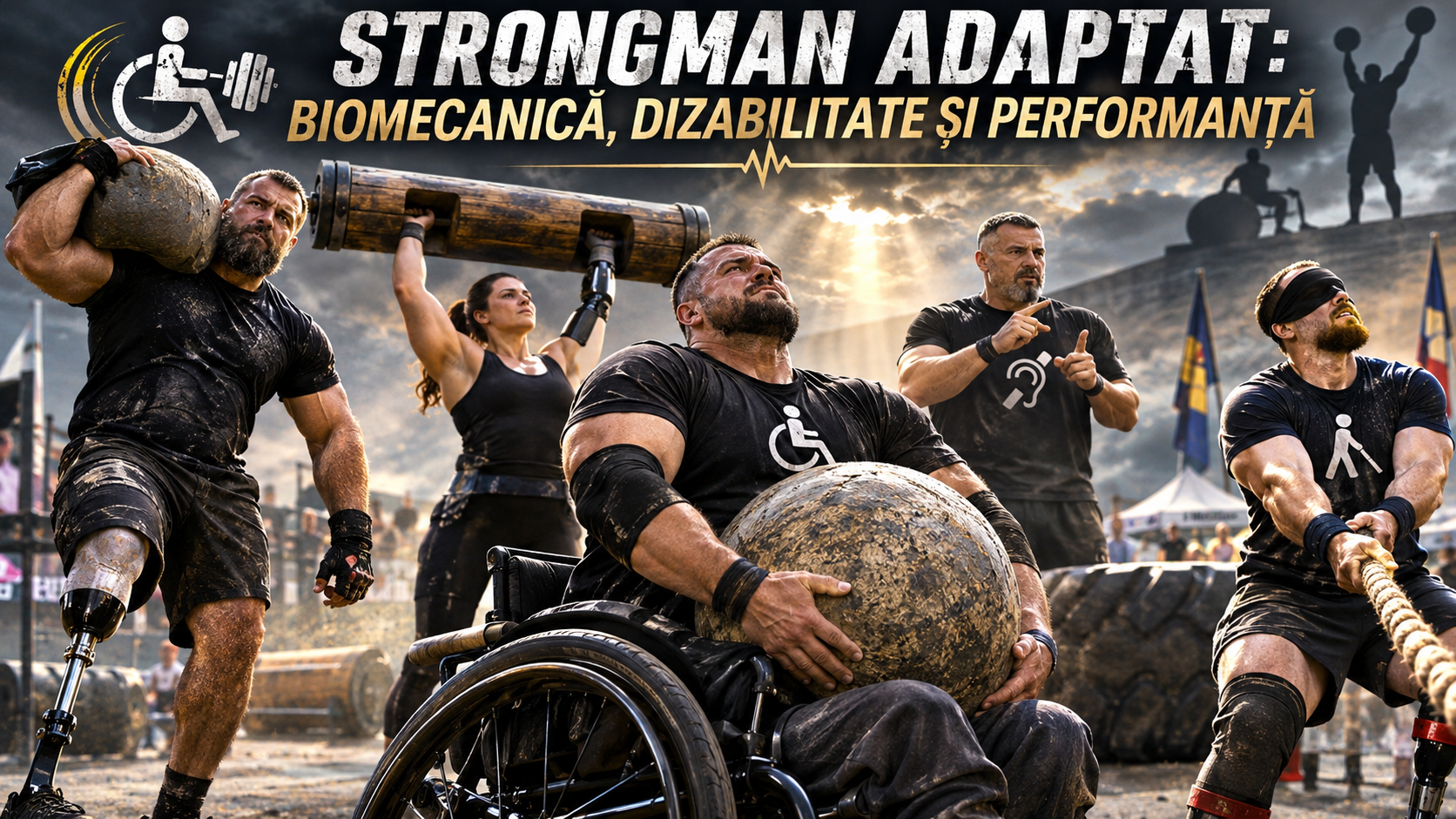
ADAPTED STRONGMAN: BIOMECHANICS, DISABILITY AND PERFORMANCE | Episode 1: Strength and Disability: Principles of Participation in Resistance Sports
An introduction to adapted Strongman: strength, accessibility, biomechanics, safety and sport classification.