
Training Science
OPERATIONAL STRENGTH: STRONGMAN IN MILITARY AND EMERGENCY RESPONSE TRAINING | Episode 8: Operational Fatigue: Interactions Between Muscular Demand and Cognitive Performance
November 2, 2026
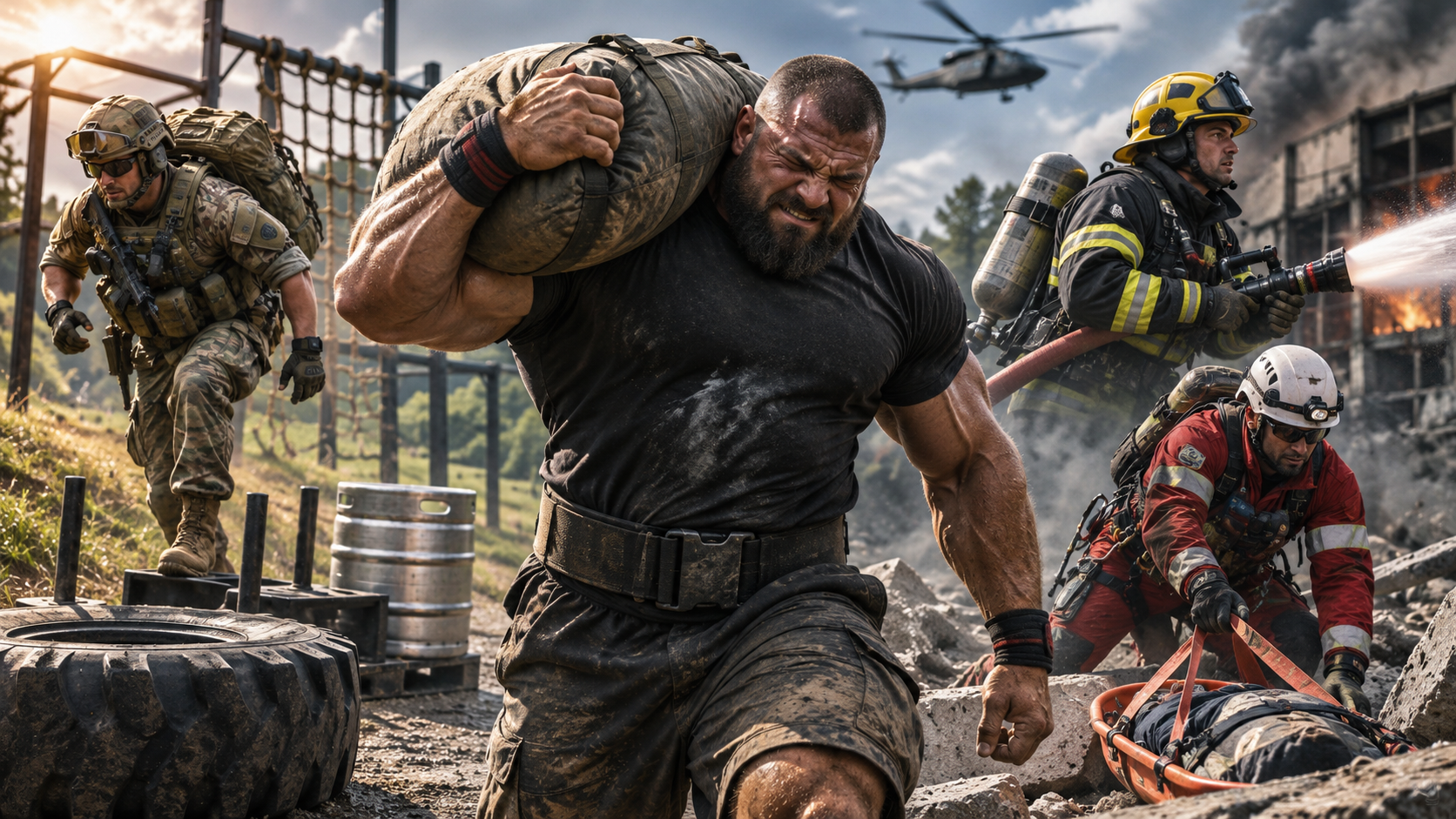
Physical fatigue is not identical to mental fatigue
Muscular fatigue can reduce the ability to produce or sustain force, whereas mental fatigue involves a psychobiological state following prolonged cognitive demand. They can coexist, but their mechanisms and manifestations are not interchangeable. Operators may remain strong in a brief test while finding prolonged vigilance difficult, or report physical exhaustion without measurable deterioration in every cognitive function. Rabat and colleagues review these distinctions [1].
Loaded marching and subsequent cognitive tasks
Military marching imposes muscular demand, energy expenditure, and attention to route and equipment. A 2026 meta-analysis examined cognitive outcomes following load carriage, indicating that effects should be interpreted by cognitive domain and testing conditions rather than through an assumed uniform impairment [2]. Sleep, temperature, and task complexity may influence results. Claiming every march invariably reduces intelligence or decision-making would exceed the evidence.
Sustained attention and omission errors
Surveillance work requires operators to detect infrequent changes across long periods with little stimulation. Impressive muscular exertion does not automatically train this ability. Mental fatigue may emerge even without intense physical effort after prolonged attention. A 2025 military review discusses time-on-task and circadian influences [1]. Vigilance assessments should be distinguished from strength tests and interpreted in context.
Situational awareness is a team phenomenon
Situational awareness involves perceiving relevant elements, understanding their significance, and anticipating change. A 2026 systematic review of emergency care identified contributions from individual expertise, information flow, team leadership, and environmental complexity [3]. It cannot be reduced to one person's reaction speed. A physically well-conditioned responder still requires reliable information and structured communication to decide appropriately.
Acute stress hormones do not provide a simple cognition score
Cortisol is often discussed as a stress indicator, but its relationship with cognition is complex. A meta-analysis combining 18 studies and 572 military participants did not identify cortisol as a consistent moderator of cognitive change [4]. An isolated hormone measurement therefore cannot establish whether a soldier will make good or poor decisions. The cognitive domain and research design matter.
Remaining force after repeated tasks
Across repeated military occupational tasks, the relative contributions of explosive power and aerobic endurance can change between attempts. In a study of 114 soldiers, predictors of the first simulated test differed from later repetitions [5]. This illustrates that physical availability under fatigue differs from rested peak capacity. Strongman may develop force but should be complemented by conditioning matching task duration and repetition.
Sleep restriction and circadian fluctuations
Insufficient sleep and activity at unfavorable circadian times may affect vigilance, working memory, and reaction time. These effects vary across individuals, and stimulants do not recreate every benefit of sleep. A systematic review among military pilots reported short-term benefits of some countermeasures for alertness without full restoration after severe sleep restriction [6]. Shift organization and recovery remain essential.
Caffeine cannot replace fatigue management
Caffeine may temporarily alter alertness, but its effect depends on dose, tolerance, timing, and sleep. Masking sleepiness cannot solve every cognitive deficit, and excessive consumption can produce adverse effects. Organizational risk reduction, breaks, and recovery opportunities matter more than reliance on stimulants alone. Medical advice requires individual assessment.
Decision-making under time pressure
Critical interventions involve incomplete information, competing goals, and time constraints. A review of 70 emergency-management papers identified stress and fatigue, interoperability, and ethical decision-making as major challenges [7]. Physical preparation may reduce demand from some tasks but does not replace procedures, coordination, or decision training. Cognition must be considered within a system.
Perceived fatigue is not the same as measured performance
Ratings of perceived exertion and fatigue questionnaires may be useful but are not direct tests of memory, attention, or force. Some people underestimate strain, while others report fatigue without proportionate decline across tasks. Rigorous assessment combines subjective data, physical measures, and appropriate cognitive tests. One vague nervous-system fatigue score cannot explain every mechanism.
Conditioning and work economy
Better-conditioned operators may experience some physical tasks as less demanding, but this does not automatically establish better decisions. Reducing the relative cost of a load may preserve physical resources, while attentional consequences depend on context and require verification. Strongman is an option for strength and carrying preparation rather than a validated cognitive intervention for every occupation.
Training under fatigue requires justification
Combining physical demand with attention tasks may help study transfer, but participants need not be driven toward severe exhaustion. Assessments should be job relevant and include stopping criteria and risk controls. An incorrectly completed task under fatigue is not proof of resilience. Training should build competence rather than turn predictable errors into spectacle.
Recovery as part of operational capability
Readiness for the next task depends on physical recovery, sleep, and work organization. A session producing new records while harming subsequent duty performance may offer poor net value. Monitoring should include occupational work, not just sport volume. During demanding periods, lower-volume strength maintenance may be preferable to aggressive progression.
Conclusion: strength and cognition are complementary, not interchangeable
Operational fatigue emerges through interactions among muscular demand, cognitive requirements, sleep, stress, and team organization. Evidence does not support a simple rule whereby greater strength automatically produces better decisions or a single hormone explains performance. Assessment should distinguish fatigue states and evaluate relevant tasks separately. Strongman can contribute physical reserve while professional preparation keeps attention and sound judgment central.
Scientific bibliography
[1] Rabat A et al. Fatigue and management of warfighter mental endurance. BMJ Military Health. 2025. https://doi.org/10.1136/military-2025-002963
[2] van der Weyden MS et al. A Systematic Review and Meta-Analysis on the Impact of Military Foot Marches on Performance, Part 2: Cognitive Performance. J Strength Cond Res. 2026;40(6):e647–e662. DOI: 10.1519/JSC.0000000000005463.
[3] Pedersen I et al. Factors affecting paramedics situational awareness in out of hospital emergencies: a mixed methods systematic review. Int Emerg Nurs. 2026;89:101894. DOI: 10.1016/j.ienj.2026.101894.
[4] Cortisol, stress, and cognition in military subpopulations: A systematic review and meta-analysis. 2025. PMID: 41232232.
[5] Performance changes during repeated military occupational test and its associations to physical performance. Ergonomics. 2023;66(12):2223–2231. DOI: 10.1080/00140139.2023.2193869.
[6] Alzahrani AA et al. Efficacy of Fatigue Countermeasures on Cognitive Performance and Operational Safety in Military Pilots: A Systematic Review. Cureus. 2025;17(10):e95823. DOI: 10.7759/cureus.95823.
[7] Butler P et al. Emergency management decision-making in a changing world: 3 key challenges. Australian Journal of Emergency Management. 2024;39(4):23–32. DOI: 10.47389/39.4.23.
More From The Journal

International Strongman
Nordic Training Gear: Equipment, Athletes and Its Connection to Strongman
An overview of Swedish brand NTGear, its origins, athlete team, presence around Strongman competitions and the practical uses of its strength-sport equipment.
Biomechanics
ADAPTED STRONGMAN: BIOMECHANICS, DISABILITY AND PERFORMANCE | Episode 1: Strength and Disability: Principles of Participation in Resistance Sports
An introduction to adapted Strongman: strength, accessibility, biomechanics, safety and sport classification.