
Training Science
OPERATIONAL STRENGTH: STRONGMAN IN MILITARY AND EMERGENCY RESPONSE TRAINING | Episode 6: Muscular Work Under Personal Protective Equipment: Mechanical and Physiological Limitations
November 2, 2026
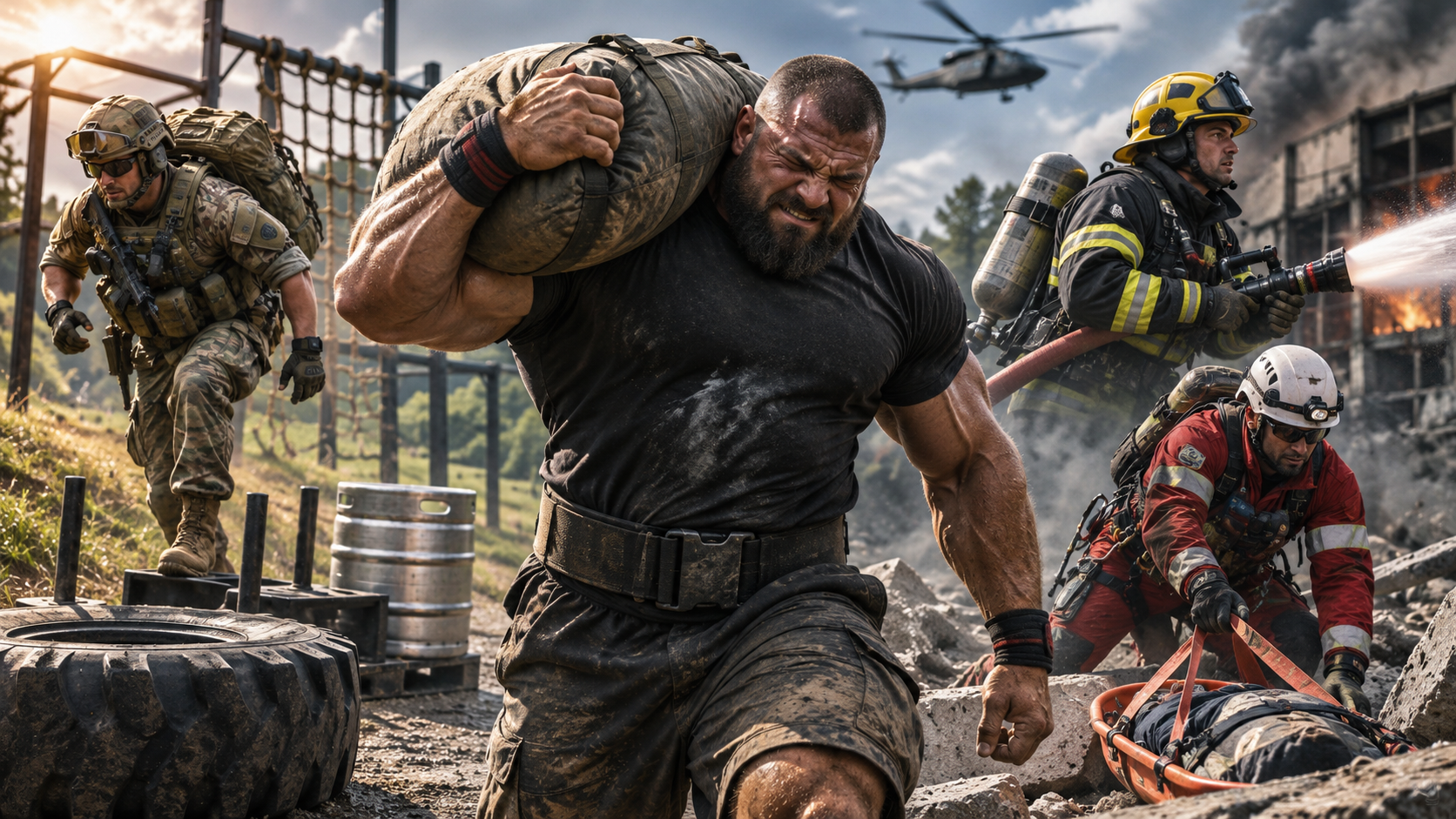
PPE is a system, not merely additional mass
Ballistic vests, helmets, gloves, heat-resistant clothing, and respiratory devices simultaneously change mechanical demands and the body's interaction with its environment. Resistance to movement depends on more than kilograms: material stiffness, pressure distribution, contact points, and equipment shape can restrict joint motion. A systematic scoping review of police protective equipment synthesized 35 articles and identified effects on mobility, discomfort, and metabolic strain, sometimes influenced more by design and location than by total mass [1].
Metabolic cost of protective equipment and limits of backpack comparisons
Equal external masses do not necessarily impose equal energy costs. Load positioned around the torso can affect breathing and balance, while distal loading changes repetitive limb movement. Military load-carriage research indicates that equipment positioning and thoracic compression can influence energy expenditure [2]. A farmer's walk does not fully reproduce such conditions. Tests should specify mass distribution, equipment type, and pace rather than assume equivalent kilograms mean equivalent physiological demand.
Self-contained breathing apparatus and physiological strain
A meta-analysis of nine studies involving 289 participants associated self-contained breathing apparatus use with changes in heart rate, perceived exertion, and other physiological outcomes [3]. The authors emphasized that the effects could not be explained by device mass alone. These findings help explain the demand of equipped work but do not justify using respiratory protection outside approved procedures or without required checks. In 2026 NIOSH published guidance on medical readiness, fit testing, and safer apparatus use [4].
Thermoregulation under protective clothing
Muscular work produces heat, while protective clothing can restrict heat exchange with the environment. During intense activity, cardiovascular strain may rise before muscular strength becomes the main limitation. A systematic review of firefighter studies identified increases in heart rate, body temperature, and oxygen consumption under PPE conditions [5]. Deliberately imposing extreme heat to make training appear realistic is not justified. Preparation and operations require safety procedures, appropriate hydration, monitoring, and recovery.
Joint mobility and the difficulty of tool handling
Restrictions on trunk flexion, arm elevation, or rotation can change how personnel lift objects or work overhead. Equipment fit matters because cut and contact points affect motion. Barbell training may increase strength reserve but cannot guarantee that tools move equally fast while wearing gloves and armor. Mobility testing and occupational tasks should be interpreted together without treating every reduction in range as an injury.
Gloves, grip, and tactile feedback
Gloves can alter handle contact, tactile sensitivity, and fine manipulation. Even someone with exceptional grip strength may struggle with small device controls if these are difficult to access. Farmer's carrying develops gripping capacity but does not assess dexterity in occupational gloves. Programs need to distinguish peak grip, sustained holding, and precision tool control, while real equipment practice must follow approved procedures.
Protective footwear and the cost of each step
Protective boots alter distal-limb mass and the interface with the ground. Effects on gait depend on stiffness, fit, surface, and duration. A component-level firefighter study suggested that reducing boot mass could offer meaningful physiological advantages under the investigated conditions [6]. This does not justify removing required footwear during response. From a training perspective, conditioning should account for task-appropriate footwear without interpreting discomfort as evidence of program quality.
Peak strength under equipment and force remaining after fatigue
An operator may lift heavy loads while rested yet express a smaller proportion of capacity after equipped travel, repeated work, or thermal strain. These changes cannot be summarized by one universal percentage because studies use different protocols. Assessment can distinguish general strength tests from occupational tasks after a standardized preceding workload. The objective is not exhaustion but understanding duty-relevant limitations while protecting participant safety.
Ballistic configurations and military-specific demands
Military equipment can include ballistic protection, helmets, communications, and accessories that change load distribution. A systematic review of body armor among law-enforcement personnel described effects on balance, task time, and stability [7]. Findings cannot be applied mechanically to every military unit because equipment and mission profiles vary. Sound programs assess general capacity separately from performance in approved duty configurations.
Equipment must not be modified merely to improve sporting scores
Personal protection is designed around defined hazards, not around making gym comparisons convenient. Removing required components may apparently improve timed performance while undermining occupational validity and safety. Research should compare authorized configurations and document both weight and geometry. A physical instructor cannot independently decide which protection may be removed; equipment-based readiness assessment requires coordination with the responsible professionals.
Introduction and the limits of transfer
Strongman develops force-production resources, but occupational preparation requires applying those resources under equipment, spatial, and risk conditions different from competition. Visual resemblance between a sport event and an occupational action is not proof of transfer. A plausible biomechanical mechanism, existing experimental evidence, and hypotheses requiring validation must be distinguished. Beyond external mass and completion time, important outcomes include movement control, recovery, and the person's availability for subsequent duties.
Why absolute strength does not describe the complete task
A high squat, deadlift, or loaded-carry score demonstrates capacity under the conditions of that exercise. It does not automatically describe handling an irregular object while wearing occupational equipment in restricted surroundings. In applied work, object position relative to the body, grip, traction, velocity, and available posture adjustments can become limiting. Coaches should identify the missing resource rather than automatically prescribe more weight. The limiting factor may be muscular, technical, aerobic, or organizational.
Progression without recreating operational danger
Stable, inspectable training objects can build strength and control without recreating the dangers of actual interventions. Progression can adjust mass, distance, or duration while monitoring technique and recovery. Copying elite competition loads is unnecessary for occupational personnel. Real equipment practice follows institutional procedures and qualified supervision. Within that framework, Strongman is a conditioning tool rather than a technical qualification.
Evaluating outcomes against occupationally relevant criteria
A useful fitness assessment defines its load, course, conditions, stopping criteria, and execution rules. If these change between tests, timing differences may reflect protocol variation rather than improvement. General tests and occupational tasks answer different questions: the former measure resources while the latter examine their application. Research programs should report benefits together with limitations and costs, including time unavailable for duty or persistent symptoms.
Operational success is not an isolated record
Occupational preparation does not aim to turn every participant into a Strongman competitor. It aims to support safe and sustainable performance of necessary duties. A single exceptional lift demonstrates an impressive peak, but a mission may require repeated tasks, communication, and decisions after exertion. Strength remains valuable when integrated with endurance, control, and specific competence. Genuine transfer must be demonstrated through relevant outcomes rather than assumed.
Scientific bibliography and professional guidance
[1] The comfort and functional performance of personal protective equipment for police officers: a systematic scoping review. Ergonomics. 2024. https://pubmed.ncbi.nlm.nih.gov/38263946/
[2] Novel approaches to evaluate characteristics that affect military load carriage. BMJ Military Health. 2025. https://militaryhealth.bmj.com/content/jramc/early/2025/05/21/military-2024-002899.full.pdf
[3] Quantifying self-contained breathing apparatus on physiology and psychological responses during firefighting: a systematic review and meta-analysis. 2022. https://pubmed.ncbi.nlm.nih.gov/34983320/
[4] NIOSH. Safe Use of Self-Contained Breathing Apparatus (SCBA) for Firefighters. DHHS (NIOSH) Publication 2026-104. July 2026. https://www.cdc.gov/niosh/publications/numbered/2026-104.html
[5] The effects of personal protective equipment on heart rate, oxygen consumption and body temperature of firefighters: A systematic review. https://pubmed.ncbi.nlm.nih.gov/36776094/
[6] Component contribution of personal protective equipment to the alleviation of physiological strain in firefighters during work and recovery. https://pubmed.ncbi.nlm.nih.gov/24773624/
[7] The impact of body armor on physical performance of law enforcement personnel: a systematic review. https://pubmed.ncbi.nlm.nih.gov/28515947/
[8] dos Santos ML et al. The Metabolic Demand of Firefighting: A Systematic Review. Physiologia. 2025;5(2):12. DOI: 10.3390/physiologia5020012.
More From The Journal
International Strongman
Nordic Training Gear: Equipment, Athletes and Its Connection to Strongman
An overview of Swedish brand NTGear, its origins, athlete team, presence around Strongman competitions and the practical uses of its strength-sport equipment.
Biomechanics
ADAPTED STRONGMAN: BIOMECHANICS, DISABILITY AND PERFORMANCE | Episode 1: Strength and Disability: Principles of Participation in Resistance Sports
An introduction to adapted Strongman: strength, accessibility, biomechanics, safety and sport classification.