Training Science
OPERATIONAL STRENGTH: STRONGMAN IN MILITARY AND EMERGENCY RESPONSE TRAINING | Episode 5: Lifting and Moving Obstacles in Rescue Operations
November 2, 2026
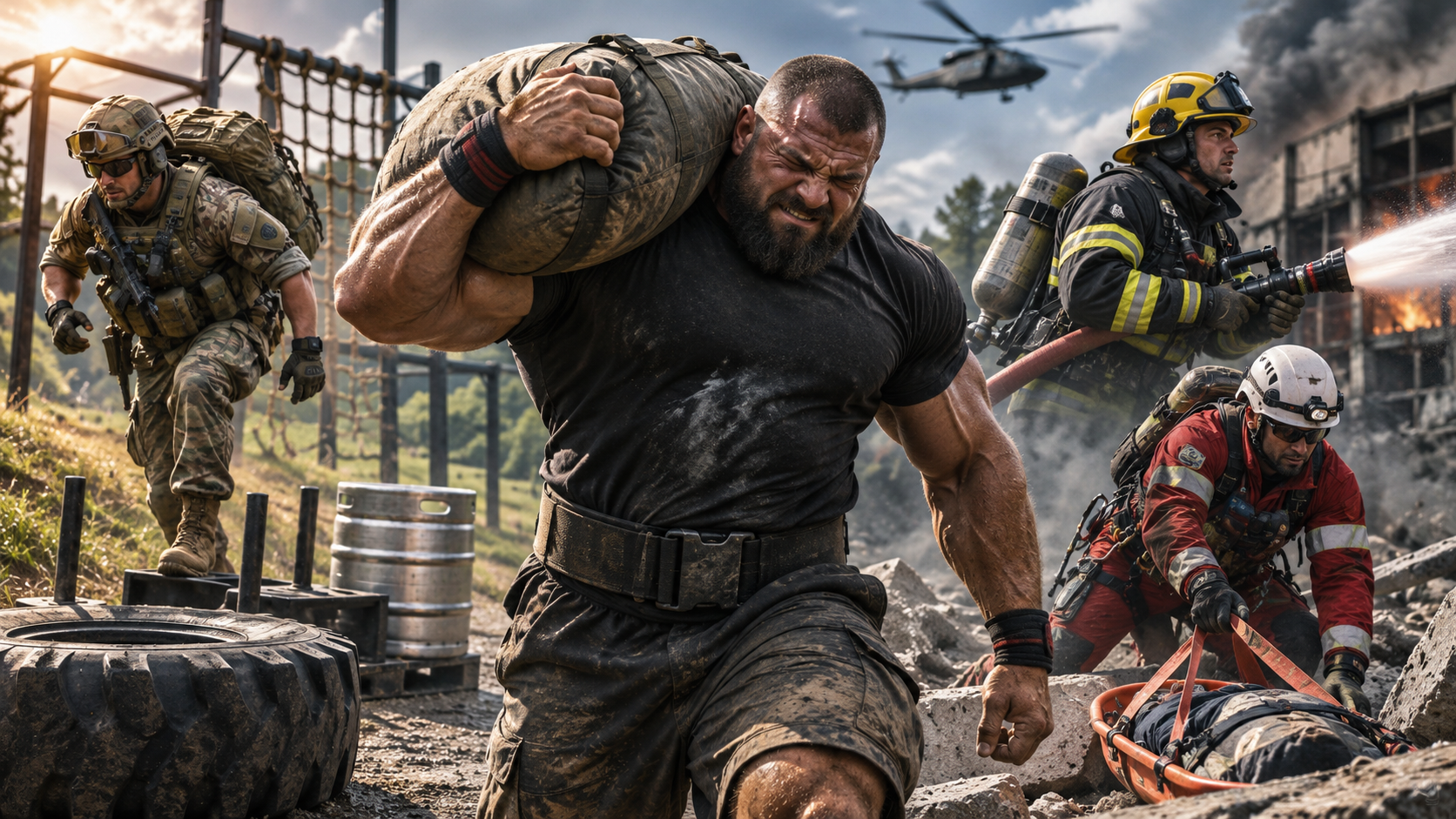
A heavy obstacle is not an Atlas stone: defining the rescue problem
A concrete slab, beam, metal fragment, or piece of furniture obstructing access to a casualty may appear to be a straightforward strength problem. In reality, it may be part of an unstable structure, support other masses, or connect to components under tension. Moving it without understanding the surroundings can trigger secondary movement and endanger both the trapped person and rescuers. Strongman implements are selected and arranged for controlled competition courses; rescue loads require identification of their structural role before deciding whether any movement is appropriate. This difference is fundamental to evaluating performance transfer [1–3].
Maximal strength can help with tool handling and material positioning, but cannot determine which object should be moved, from where, using what device, or in what sequence. Those decisions belong to incident command, hazard assessment, and personnel trained in technical rescue. OSHA's structural-collapse guidance identifies hazards including instability, secondary collapse, and hazardous exposures. The US Army Corps of Engineers describes the structural specialist's role in evaluating instability and identifying measures to reduce risk [2,3]. No deadlift record replaces that expertise.
This episode examines mass, force, moments, and friction conceptually, then asks how relevant physical capacities may be developed through progressive training. It does not provide structural-lifting instructions or advocate improvised rescue. Structural lifting, anchoring, stabilization, hydraulic-device use, and rigging require trained personnel, rated equipment, and approved plans. The purpose is to understand the relationship between human strength and rescue mechanics rather than turn a sports article into an operational manual.
Object mass and weight alone do not describe resistance to movement
An object's weight depends on its mass and gravity, but the force required for a particular movement also depends on direction, supports, and contacts. An object resting on the ground may oppose horizontal movement through friction, while vertical lifting creates a different demand. When an item is jammed, attached to other components, or loaded by something else, required force cannot be inferred from visible mass. Irregular objects also have centers of mass that may be difficult to estimate, and they can rotate under applied force. Saying someone can lift two hundred kilograms therefore offers little evidence about whether a structural obstacle can be moved safely [1,7].
In Strongman, an Atlas stone, bag, or frame offers controlled practice in producing and regulating force against a known load. Mechanics are comparatively predictable even when manipulation is difficult. During real operations, a fragment may not be independent of the surrounding structure, and loading the wrong location can redistribute forces into adjacent components. Identifying constraints is therefore more important than immediately applying maximal force. Rescuers are not expected to defeat every resistance by strength; they contribute to a safe plan developed by qualified personnel.
Physical preparation can use stable inert implements to develop lower-limb strength, trunk control, grip, and carrying ability with individually appropriate loads. Training must not be confused with manipulating real structures. During an incident, uncertainty about stability cannot be resolved through a sporting record or simply by assigning a stronger teammate.
Center of mass, rotation, and load stability
A body is described not only by mass but also by its distribution. Center-of-mass position affects an object's response to applied force, while the distance between the force's line of action and a pivot creates a moment. Long or asymmetric objects may rotate instead of translating as intended. Such behavior also exists in strength sport, but rescue consequences differ because movement can affect a support or a space occupied by people. Identifying load geometry is part of technical assessment, not a guessing exercise before a maximal attempt.
In real incidents, mass distribution may be uncertain because debris is buried, concealed, or connected to other components. The rescuer's applied force is not the only force in the system: support reactions, additional loads, and structural contacts may be present. Elementary free-body calculations therefore provide a conceptual language but cannot replace engineering assessment of a scene. FEMA training material on lifting and rigging emphasizes assessing weight, stability, and attachment points as part of specialized technician education [1].
Strongman can develop tolerance of asymmetric loads and trunk stabilization when objects oscillate. That is a conditioning benefit, not proof of competence in calculating or controlling rotation of a building fragment. The latter requires separate training, equipment, and procedures. In real rescue, the best solution is often to reduce muscular demand rather than maximize it.
Leverage is a physical principle, not an invitation to improvise
Leverage changes the relationship between applied force and mechanical effect according to lever arms and support configuration. This helps explain why a load that cannot be moved directly may be managed using appropriate technical systems. Mechanical advantage does not eliminate energy requirements or make risk disappear. The system must withstand forces, support points need evaluation, and resulting movement can alter nearby structural balance. In rescue, using levers is a technical competency involving approved equipment and procedures, not an experiment with improvised bars.
Physics distinguishes a reduction in force at one contact point from a change in displacement through a mechanism. Real systems also experience friction, deformation, and material limits that reduce ideal efficiency. A person's ability to exert great force says nothing about the strength of a support or the safety of the assembly. OSHA describes struck-by, crushing, and pinching hazards during rigging operations, while structural-rescue materials call for trained personnel and site assessment [2,7]. Those constraints precede discussion of muscular power.
Strongman conditioning may help develop stability and tool-handling capacity, but loaded exercise does not replace knowledge of mechanical advantage or certification in technical rescue. A very strong operator can make the correct professional decision not to apply muscle force to an unstable mass. That decision demonstrates competence rather than lack of courage. The objective is preserving lives, not displaying an individual maximum.
Friction and support reactions during movement of massive objects
An object resting on the ground may resist sliding, with resistance depending on contact materials, normal reactions, and surface geometry. An idealized model expresses friction as a coefficient multiplied by normal force, but rescue scenes contain multiple contacts, edges, fractures, deformation, and attachments that make this equation insufficient for operational planning. Concrete with connected debris does not behave like a sled on turf. Force applied to overcome sliding resistance can also induce rotation or load a region not designed to withstand it.
Controlled sled movement may train horizontal force production and coordination of the lower limbs and trunk. Yet the nominal kilograms loaded on a sled are not equal to force measured at the handle, and changing surfaces can dramatically alter resistance. Training comparisons require standardization. During rescue, pull direction and intensity are not chosen simply for the fastest time. Structural safety and technical assessment take priority [1–3].
Mechanics is valuable here as professional literacy. Personnel should understand that mass is not the only variable and contact conditions change the physical problem. Applying these principles to actual debris remains the responsibility of trained specialists. Strongman builds muscular resources; it does not authorize experimental tests of stability on real obstacles.
Lifting and moving are distinct phases with different demands
Repositioning an object may involve separate demands during initial lifting and subsequent movement. Initiating a lift requires overcoming support constraints and controlling a load without convenient contact points. Continued movement then challenges stability, direction of force, and sustained work. Someone with a very large deadlift may possess substantial capacity for the first phase but be limited by grip on an awkward object or inability to control it while moving. Competence is judged by the entire system rather than one muscular score.
In structural rescue, these phases may also be separated by technical means. Lifting and support devices are designed for specified loads and have limitations that cannot be replaced with assumptions. An object is not necessarily stable because it has left the ground, and secondary movement can redistribute force into neighboring elements. Official rescue and rigging materials emphasize assessment of load properties and stability before handling [1,7]. Improvisation is not recommended.
Physical conditioning can use standardized lifts and progressive carries with stable implements under supervision. Exercises need not imitate the hazards of damaged structures to be valuable. General strength, grip endurance, trunk control, and coordination can be developed in predictable environments and integrated through qualified professional instruction. Similar object shapes do not establish biomechanical identity.
Why a seemingly light obstacle may still be mechanically unsafe
A relatively small fragment may be wedged among much larger components and carry forces not visible from its own mass. Low weight does not reveal contact loads or stored stress. Changing one support can reorganize the entire arrangement. Similar situations arise in damaged structures, where an object can unexpectedly provide temporary support. A superficial impression that an obstacle is light enough to lift does not justify touching or moving it. Structural assessment and control of hazardous areas are essential professional steps [2,3].
Strongman can develop confidence in handling demanding loads, but confidence is not the same as identifying unsafe structures. A lifting record increases physical potential; hazard interpretation comes from technical training. Where an organization celebrates strength alone, powerful operators may feel pressure to solve problems individually. Professional culture should recognize stopping an unauthorized maneuver as competent behavior.
Training programs should separate judgment and role discipline from muscular development. Stable inert implements can provide intense training without structural hazards. Real loads should be addressed only within approved rescue plans, using qualified personnel and inspected equipment. Useful strength requires discernment, not an assumption that more effort defeats every resistance.
Hydraulic equipment and lifting systems change the role of human strength
Technical rescue may use devices capable of producing forces far beyond human muscular output. That capacity does not eliminate danger, because force must enter a structure capable of accepting it and resulting movement must be controlled. Equipment has working limits, inspection requirements, and conditions specified by manufacturers and institutional procedures. Sporting experience cannot replace these obligations. Compared with Strongman, the primary objective changes: technology supports controlled handling rather than a comparison of muscular performance.
Strong rescuers may contribute by carrying devices, moving support materials, and transporting tools to an incident. Yet the ability to lift a heavy bag does not establish competence with a jack or hydraulic system. Physical resources and technical knowledge require parallel but distinct education. Structural-rescue training materials explicitly treat specialized equipment and stabilization as separate areas of qualification [4,8].
Assessment can measure equipment-carriage time separately from correct procedure execution. If strength improves but practice remains unsafe, the occupational objective is not fully achieved. Conversely, technically proficient teams may still need physical conditioning to sustain work over lengthy incidents. Complementarity is more realistic than treating muscles and machines as competitors.
Stabilization is not a decorative step in rescue
When a load can create secondary movement, controlling its stability is fundamental. Damaged structures may have fragile supports and failure mechanisms that are not visually obvious. Specialized rescue treats stability assessment and supporting measures as activities distinct from lifting or moving. An apparently movable object does not become safe merely because a rescuer can apply enough force. USACE and OSHA documents describe specific responsibilities for identifying and reducing structural hazards [2,3].
Strongman develops the athlete's own stability and control of free implements, but does not teach stabilization of connected structural materials. The distinction between personal balance and structural stability is decisive. Training can use supervised, stable inert objects; intervention decisions about shoring and structural change belong to qualified personnel.
Effective operational culture does not equate speed with success. Sometimes movement should be deferred until risks are assessed and controlled. Choosing not to apply the greatest available force immediately can be correct professional behavior. Muscular effort remains valuable only within a plan designed to preserve lives.
Pinch and crush zones: risks absent from a record
Moving massive objects can create spaces where surfaces converge, locations where materials shift unexpectedly, and areas exposed to falling loads. These hazards cannot be assessed from mass alone. OSHA identifies pinching, struck-by, crushing, and falling or swinging loads among rigging hazards [7]. Rescue work therefore requires adherence to procedures and exclusion zones. The ability to hold a heavy object does not confer immunity against unexpected movement.
Strongman athletes encounter large implements, but their environment is organized for controlled competition. Real operations may involve undefined loads and uncertain supports. Conditioning should not introduce comparable hazards without justification. Known implements, inspected surfaces, and supervised progression are sufficient for developing strength.
Program evaluation must consider not only movement speed but also compliance with safety zones and approved procedures. A faster result achieved through imprudent proximity to an unstable load is not progress. Professional strength is controlled force within a safety system.
Suspended loads carry risks unlike ground-level carries
Suspended objects can oscillate, rotate, and change direction under external forces. Unsuitable attachment points or an unstable assembly may generate motion beyond any person's ability to control manually. Nominal weight does not fully describe stored energy or a possible trajectory. Lifting and rigging equipment therefore require qualified use and systematic controls. Technical rescue procedures cannot be derived from sport training methods [1,7].
Strongman carrying and loading events challenge stability but do not teach suspended-load operations. Coaches may use stable or carefully controlled oscillating implements to build bodily control in safe settings. This does not qualify participants to assess cables, anchors, or load attachment points.
Recognizing the limits of one's qualifications is a professional strength. A powerful rescuer may transport equipment for a specialized team but must not assume that muscle force can control a suspended object beyond system limits. Appropriate devices and procedures are more important than demonstrations of strength.
Irregular shapes alter center of mass and gripping
A flexible sandbag, elongated metal component, and concrete slab of identical mass impose different demands. Center of mass may lie closer to or farther from the handler, grips can be rigid or deformable, and an object may tend to rotate. Strongman deliberately uses varied shapes to challenge coordination and control, but that does not establish identity with rescue debris. Structural material may be fractured, connected to other components, or unstable, changing the task fundamentally.
Training with sandbags and asymmetric implements can develop general strength and stability. Progression should nevertheless use purpose-built training objects and avoid sharp surfaces or uncontrolled mechanisms. These adaptations are components of physical preparation rather than certification for any structural-handling task.
Reporting mass alone is inadequate during assessment. Shape, dimensions, grip, and route must also be described, or comparisons across exercises and organizations become misleading. A hundred-kilogram implement with comfortable handles is not the same test as an irregular object without handles. Specificity begins with describing the complete task.
Controlling acceleration and stopping matters as much as starting
Once a massive object moves, inertia may make stopping difficult, especially on slopes or slippery ground. Force needed to initiate motion does not automatically describe braking ability or directional control. A Strongman event may end at a marked line; rescue movement must follow a plan protecting people and structures. Rapid movement is not a successful outcome if the load cannot be stopped predictably.
Inert-object conditioning can develop stability and load control at suitable intensities. Training with structurally unstable or suspended loads is not part of ordinary sport conditioning. Specialized professional practice belongs to qualified personnel following approved procedures.
This changes assessment. Useful outcomes may include control, procedural compliance, and safe passage rather than timing alone. If speed increases at the expense of safety, fewer seconds do not represent progress. Professional responsibility means applying necessary force while also knowing when and how it must be limited.
Confined-space rescue imposes different mechanics from the gym
Narrow passages and low obstacles restrict foot and trunk positioning. Force readily produced on an open lifting platform can become difficult to apply when joints work at constrained angles. Personal protective equipment may further reduce movement range. This explains why a barbell record does not guarantee performance during restricted-space handling. Technical rescue adds spatial constraints to structural hazards and requires specialized procedures.
Official urban-rescue courses include distinct modules for confined spaces, structural collapse, rope systems, and rescue equipment [8]. The curriculum itself shows that individual strength is only one competency. Strong musculature may help, but access and extraction choices depend on qualified hazard assessment.
Submaximal exercises through varied controlled positions can develop movement capacity without recreating the dangerous environment of collapse debris. Coordination challenges should not be confused with real hazard exposure. Preparation is valuable partly because abilities can be developed under safer conditions than those encountered during interventions.
Teamwork can reduce individual demand while requiring coordination
When several people carry a training object, demand can be distributed but rarely equally. Differences in stature, hand position, synchronized stepping, and route alter each person's share. During real rescue, coordination also involves people monitoring structural conditions and protecting the casualty. A very strong team member can contribute greatly but cannot replace communication and clearly assigned roles.
Many Strongman events rank individual performance. Rescue success may instead depend on using a device or distributing a load rather than maximizing one person's contribution. Training objectives should reflect this distinction. Individual force and collective competence can be assessed separately without merging them into arbitrary rankings.
Occupational standards need to describe how essential tasks are actually completed, including personnel numbers, available devices, and individual responsibilities. Where an operation normally uses mechanical assistance, requiring manual reproduction merely to test strength may be unjustified. Competence means selecting appropriate resources and executing safe procedures.
Potential energy and changes in elevation
Lifting an object increases its gravitational potential energy in proportion to mass and height change in a simplified model. This explains why moving a large mass through even a short vertical distance can require substantial mechanical work. Calculated energy does not capture every real hazard, however, because materials can deform, objects rotate, and supports fail. Rescue assessment must consider what happens during unintended movement, not merely the energy required to lift.
Stable training implements can develop muscle capacity and illustrate the distinction among mass, height, and velocity. Real debris may have unknown structural connections and cannot be reduced to elementary calculations. FEMA training material treats gravity and balance as central to qualified rescue education, not permission to improvise [1].
Athletes may manage exceptionally heavy objects in controlled sport settings, but energy and risk associated with suspended loads require suitable systems and expertise. Training does not authorize exceeding equipment working limits. In intervention, force is one element of a controlled technical solution.
Material deformation and structural resistance
Heavy objects are not always rigid. Metal may deform, timber may fracture, concrete may expose reinforcement, and assemblies can redistribute loading as force is applied. Purpose-built Strongman implements are usually consistent enough for practice and judging. Damaged rescue materials may respond unpredictably, including failures without obvious warning movement. Their risk cannot be assessed correctly from mass alone.
Structural specialists train in recognizing damage mechanisms, monitoring hazards, and choosing suitable mitigation [3]. Excellent fitness does not replace those competencies, though it may support handling approved tools and materials. Possessing force to carry a device differs from knowing where that device can be used.
Training should avoid damaged or improvised implements that may fail unpredictably. Effective strength programs do not need to expose participants to real collapse debris to produce adaptation. Separating conditioning from intervention environments is a professional safeguard.
Body angles and lumbar moments during object handling
Trunk demand during handling depends on body posture, distance to the object, and direction of force. Two lifts of identical mass can impose different external moments when one load is close to the torso and another requires extended arms. No universal risk-free posture solves every situation. Object geometry, individual characteristics, and exposure history shape demand. Biomechanical research on Strongman events reports distinct trunk loading patterns across exercises [6,10].
This supports training force under varied controlled conditions without advocating maximal lifts from unstable positions. Technical rescue may impose constrained postures, and an ergonomically unfavorable task may require mechanical assistance or organizational change. Decisions belong to qualified teams rather than the person with the largest deadlift.
Assessment should distinguish strength under a standardized lift from competence handling the devices required by the occupation. When the first is strong but the second remains poor, limitations may involve technique, equipment, or available space. Correcting the actual constraint matters more than automatically adding kilograms.
Grip and gloves alter the human-load interface
Force generated by legs and trunk reaches an object through hands, tools, or purpose-designed contact points. Gloves may alter tactile sensitivity and friction, while bulky objects require hand positions unlike a metal bar. Grip endurance may limit a task even when other muscles have ample reserve. Yet contact points cannot be chosen solely for rescuer comfort; they must suit equipment and procedure.
Farmer's carries and inert-object handling can develop sustained grip, but do not certify structural material handling. Improvised contact can damage an object or expose hands to pinching and crushing. Lifting safety documents warn about these hazards [7].
Training can use designed handles and progressive loads while teaching safe cessation when grip becomes unreliable. During interventions, approved devices and exclusion-zone rules take priority. Grip strength helps only when force can be transmitted safely.
Protective equipment reduces some hazards but does not make the scene safe
Helmets, eye protection, gloves, and suitable footwear can reduce particular hazards but cannot eliminate collapse, crushing, chemical exposure, or object instability. Equipment must match actual hazards and follow procedures, without assuming that a protected person can safely handle any load. Structural-collapse guidance prioritizes scene assessment and risk management, not protective clothing alone [2].
Mechanically, protective equipment may alter mobility, grip, and balance. Someone lifting in sportswear does not necessarily move identically in rescue gear. Training should nonetheless avoid exceptionally dangerous simulations merely for realism. Familiarization can occur progressively in controlled environments with suitable training implements.
Strongman can build force for moving materials and tools but does not abolish protective requirements. Occupational success means contributing while respecting safety controls. A sporting record does not confer immunity against energy released by damaged structures.
Temperature and weather can change physical demand
Rescue incidents may occur in rain, cold, heat, or wind, conditions that change both the environment and the body's response. Wet surfaces can reduce traction, cold can affect comfort and dexterity, and heat may increase cardiovascular strain. Effects differ among individuals and cannot be calculated from air temperature alone. Protective equipment and exposure duration also matter. A dry indoor test does not automatically describe performance on wet, unstable ground.
Sport settings can standardize conditions to monitor progression without unnecessary environmental variation. Occupational preparation may include controlled familiarity with relevant terrain, but safety requirements must govern exposure. Extreme danger is not necessary to develop force or stability. Actual technical tasks remain subject to incident planning and risk assessment.
Slower performance in rain does not automatically indicate declining strength. Reduced traction and changed movement strategy may explain it. Valid comparisons require environmental documentation. Strongman develops physical capacity but cannot guarantee identical performance across every climate.
Understanding professional roles is part of readiness
Urban rescue involves distinct specialties: incident coordination, structural assessment, equipment operation, victim location, and medical support. Each demands qualifications beyond fitness. USACE describes structural specialists as trained members of urban-rescue teams responsible for evaluating damage and reducing hazards [3]. US Army urban-rescue training separates confined spaces, collapse, rope systems, and vehicle rescue into specialized modules [8]. This organization explains the limitations of relying on the strongest individual.
Strongman-derived conditioning may improve material carriage and muscular reserve but should never imply that athletes are automatically qualified for structural-lifting operations. Often the best contribution of a well-prepared person is performing a defined role in the team plan.
Competent professionals may request additional resources or stop activities exceeding their authorization. This demonstrates recognition that safety and mechanics cannot be replaced by motivation. Occupational strength culture should include disciplined respect for professional limits.
Support conditions and device stability cannot be guessed
Every device contacting the ground transmits forces into its support surface. Damaged terrain may have very different capacities from a gym platform. Powerful equipment is not safe when the surrounding system cannot support its loads. Technical rescue therefore treats support assessment as a separate specialized competency. Choosing a device with high nominal capacity is not enough; qualified personnel must plan the operation.
Structural-rescue training documents emphasize load properties, stability, and scene conditions [1–3]. These principles are not instructions for improvisation; they demonstrate why the problem exceeds individual musculature. Seemingly stable supports can be affected by connected elements, deformation, or changing ground conditions.
Strongman may improve the athlete's bodily stability under load, but that is not equivalent to understanding stability of a technical system. Very strong personnel must follow the same equipment operating limits as everyone else. Muscular ability is a resource, not an exemption from mechanics.
Equipment inspection is a competency distinct from strength
Tools, lifting devices, connectors, and support systems may experience wear or damage not obvious through superficial observation. Professional use requires checks under manufacturers' instructions and equipment limits by authorized personnel. Even a moderate load can become dangerous if a component fails, and a strong operator cannot compensate for loss of mechanical integrity. Rescue education therefore emphasizes equipment as well as physical abilities.
Strongman athletes work with purpose-built implements and known contact regions. Equipment checks matter there too, but should not be confused with inspection of technical-rescue rigging. Professional competence includes recognizing when a device should not be used and requesting suitable resources.
Integrated programs can assess individual strength, tool-carriage tolerance, and compliance with procedures separately. Outcomes should show duty readiness rather than only movement of a large mass in a gym. Technical safety is an independent criterion from muscular force.
Wood, metal, and concrete obstacles are not biomechanically equivalent
Materials differ in density, stiffness, and failure behavior, while shape and connections determine how obstacles respond. A relatively light timber fragment may be long and difficult to control, whereas a compact metal object may have poor grips. Damaged concrete can connect to reinforcement and adjacent components, so its behavior cannot be inferred from its own mass. None of these examples justifies direct handling without technical assessment.
Different training-object shapes can challenge grip, trunk control, and coordination. Those objects should be stable and purpose-built rather than real debris with sharp edges or unpredictable connections. Visual resemblance to rubble is unnecessary for muscular development.
Comparing tests by mass alone can mislead. A sled, bag, and rigid component of identical weight may demand different forces and movement strategies. Valid occupational testing describes the object, route, and conditions rather than claiming all masses with the same kilogram value are equivalent.
Debris removal and operational sequence are system problems
Objects within a damaged structure cannot safely be treated as independent without understanding their relationships. One component may support another, and moving a piece may change the balance of the entire assembly. Specialized rescue operations are therefore planned by qualified personnel who assess hazards and required resources. A universal sequence of public lifting instructions would be inappropriate because safety depends on the specific scene.
Conditioning can develop the ability to handle independent, stable training materials and contribute to authorized tasks. Strongman does not automatically teach collapse-pattern recognition or engineering assessment. USACE emphasizes structural evaluation as a means of reducing risks to rescuers and casualties [3].
System performance is not simply the sum of individual records. Even a very strong team can fail without correct scene assessment and coordination. Where the objective is preserving life, judgment and adherence to plan can matter more than handling speed.
Monitoring scene changes is a continuous task
Hazards in unstable environments may change throughout an incident. Material movement, vibration, weather, and additional loading can alter initial conditions. An assessment made at the start does not guarantee the scene remains unchanged. Structural rescue therefore relies on specialist personnel, monitoring procedures, and incident coordination [2,3]. These are not strength exercises, but they determine when and how strength can be used.
An operator may be physically capable of continuing while structural conditions require stopping. Treating that decision as poor performance would be a mistake. Success is not the maximum mass moved, but hazard control and safe accomplishment of the objective.
Integrated education can teach personnel to follow instructions and communicate relevant observations without performing technical operations beyond their qualifications. Fitness and organizational discipline are complementary. Strongman builds physical resources without replacing continuous environmental observation.
Incident duration turns handling into an endurance problem
A rescue incident may involve repeated tool carrying, difficult-terrain movement, and prolonged work before a particular obstacle can even be addressed. Maximal strength is not the only limiting factor. Aerobic fitness, muscular endurance, nutrition, heat, and recovery between phases can affect team availability. An athlete capable of an exceptional lift does not automatically possess resources for every prolonged rescue task.
Force remains useful for moving authorized materials, but programs should also develop the ability to repeat moderate work. Strongman contests may include several events, but their duration and organization do not necessarily reproduce urban-rescue missions. Professional contexts may require role rotation and mechanical resources.
Assessment should ask more than whether someone can lift the load. It should examine whether personnel can contribute safely across relevant activities and preserve function afterward. Duty availability, not a single record, is the occupational outcome of interest.
Task ergonomics may provide more benefit than additional strength
A task may be difficult not because an operator lacks strength, but because the object must be handled in a poor position or through an unsuitable interface. Reorganizing work, using a designed carrying device, or distributing a load among qualified team members may reduce demand. Such solutions do not indicate weakness or diminish the importance of fitness. Occupational efficiency emerges from people, devices, and environment interacting.
Strongman can provide strength reserve for unexpected situations, but it is not rational to solve every difficulty through heavier training loads. Where someone already has adequate strength, technique or endurance development may yield greater benefits.
A training intervention should pose a clear hypothesis: what limitation will improve and how will it be measured? If the objective is reduced handling demand, ergonomic solutions and instruction can be compared with strength progression. Without verification, spectacular exercises remain sporting demonstrations rather than evidence of occupational benefit.
An operator's maximal force does not determine equipment capacity
Lifting devices have their own mechanical limits, which do not increase when the operator becomes stronger. Belts, connectors, and support systems must remain within their designed parameters. Technical rescue relies on procedures for equipment selection, inspection, and use. Sporting strength demonstrations provide insufficient information about device integrity or the capacity of the structure receiving the load.
Strongman athletes are accustomed to seeking performance limits, whereas technical professions often involve limits that must not be approached or exceeded. The aim is not discovering the force at which a system fails, but operating within its authorized range. Restraint is a professional competency.
Physical conditioning may help personnel carry and position equipment, but technical certification remains distinct. Good training explains both the value of strength and why strength cannot replace material assessment. Those ideas are complementary.
A seemingly static load can become dynamic
An object at rest may appear predictable, yet a small movement can change its contact points and initiate rotation or sliding. Ideal static force calculations apply to one configuration; real motion can change conditions immediately. Technical rescue must account for this distinction rather than rely on estimated object weight alone.
Strongman implements are generally independent and used in controlled settings. Even there, oscillating loads can alter an athlete's balance. In damaged structures, comparable physical changes may have far greater consequences. Similar physics does not imply similar risk.
Managing dynamic loads belongs to qualified rescue specialists. Conditioning with inert objects can build control resources but should not simulate unpredictable movement of actual debris. Sport-developed strength is valuable when integrated into safe procedures.
Mechanical work and metabolic expenditure are not interchangeable
Physics can describe mechanical work performed on an object, but the body also expends energy on stabilization, posture, and physiological processes not fully represented by external displacement. Static effort can incur metabolic cost without external mechanical work from moving the load. Mass and distance therefore do not directly reveal a rescuer's calorie expenditure. Duration, posture, and repetition also matter.
Strongman can develop peak force and tolerance of brief intense work, whereas rescue may involve prolonged support and carrying. Readiness cannot be estimated from maximal kilograms alone. Muscular endurance and aerobic capacity may become more important during extended incidents.
Occupational assessment should consider functional outcomes, perceived difficulty, and recovery without pretending to derive precise metabolic cost from incomplete data. Powerful people may enjoy advantages in some phases but are not immune to fatigue. Planning must recognize biological limits.
Technical work needs stopping criteria as well as success criteria
Sporting success may be defined simply by crossing a line or placing an object on a platform. Technical rescue also needs conditions requiring work to stop. These may involve environmental changes, equipment problems, or exceeding authorized operating limits. Strong personnel must not disregard them to finish faster.
Responding correctly to a stop command is an observable occupational competency. An operator who interrupts work when conditions require it may demonstrate better judgment than one who continues for a faster time. Assessment should value control and compliance, not speed alone.
Strongman may cultivate determination and tolerance of difficult tasks, but those qualities must be integrated with technical discipline. Courage does not change material strength, and muscular effort does not remove uncertainty. Rescue success sometimes includes deciding not to proceed.
Communication about mass and stability cannot rely on impressions
Statements such as “it's light,” “it moved a little,” or “I'll hold it” may conceal dangerous ambiguities when several people work around one load. Technical operations require established communication methods and role assignments, with changes reported to responsible personnel. Sporting experience is not an engineering assessment.
Inert-object training may include clear communication and synchronization rules without recreating hazardous operations. This can build cooperation but cannot certify structural-rescue competence. Standardized language and responsibilities belong to professional instruction.
Individual strength becomes more valuable when it can be deployed predictably within a team. A powerful rescuer who disregards roles can undermine safety. Competence means applying suitable force only when an authorized plan calls for it.
Carrying tasks associated with lifting operations
A rescuer's physical work does not always involve moving the obstacle blocking access. Much effort may be spent transporting tools, support materials, and specialized equipment to an authorized work area. These tasks can challenge strength, grip, and loaded walking in ways more closely resembling Strongman carries than direct manipulation of collapse debris. Duration and terrain may still vary far more than in competition.
Farmer's carries, sandbag carries, and other controlled exercises may support general transport capacity. Selection should reflect actual equipment and ergonomic requirements rather than copy extreme sporting loads. When tools must be carried over distance, aerobic fitness may be as important as peak force.
Assessment can use a safe standardized route and load, plus criteria for control at completion. This differs from certification to operate equipment at structural incidents. Keeping the domains separate allows physical improvement without confusing professional qualifications.
Heavy obstacles during medical incidents are not necessarily construction debris
An obstacle preventing access to someone may be furniture, machinery, a vehicle component, or industrial material. Each has distinct mass distribution, stability, and connections. Some situations require technical assistance while others follow specific service procedures. There is no universal object-moving algorithm based on weight alone.
Inert training implements can develop lifting and carrying resources, but professional scenarios also require knowledge of the surrounding hazards. An electrically or mechanically connected component is not a gym sandbag. Fitness does not replace qualified isolation of hazards.
This example broadens the potential relevance of Strongman without overstating the sport. It can build handling resources, while the practical solution depends on the incident configuration and safety procedures. The value of a strong athlete lies in appropriate contribution rather than assuming every object can be moved.
Professionals should not treat uncertainty as a competition
When mass, connections, and stability are uncertain, safety cannot be inferred from the strength of the person intending to move an object. Structural uncertainty requires assessment by qualified personnel. Strongman events use known implements and rules, while real debris may respond unpredictably. This is not a criticism of the sport but a necessary boundary between competencies.
Strong personnel can be valuable for equipment transport and authorized handling tasks while accepting that some problems require delay and specialist assistance. Professionalism also appears in decisions not to intervene directly.
Physical education can teach effort management and teamwork without presenting uncontrolled challenges as proof of courage. The desired occupational outcome is human safety rather than strength ranking.
Functional assessment must compare genuinely comparable tasks
A standardized inert-object carry can reveal strength, stability, and endurance, but it is not identical to structural lifting. In one test the object is independent and controlled; in the other it may have unknown connections and supports. Comparisons should specify shape, mass, distance, surface, and completion criteria.
This transparency allows Strongman programs to be evaluated without exaggerating transfer. A faster carry demonstrates improvement in that particular task. Claiming better rescue performance requires appropriate occupational outcomes.
Responsible programs report both improvement and assessment limitations. An exercise that looks realistic does not automatically certify professional competence.
Mathematical models describe mechanics but do not authorize intervention
Equations describing force, moments, and energy explain physical mechanisms, but simplified models may omit deformation, connections, and instability in damaged structures. Calculating an object's weight does not determine whether it can be lifted safely. Real operations require specialists with additional information and approved methods.
Conceptual understanding remains valuable. It clarifies why not every resistance should be defeated by brute force and why devices have working limits. Strongman can make balance and control challenges intuitive but cannot replace engineering education.
The key boundary separates explanation from instruction. An article can describe why an object rotates without providing a procedure for handling actual debris. Safety requires qualifications and assessment of the particular conditions.
Storage and distribution of rescue materials influence physical demand
Moving tools from storage or staging areas to authorized work locations may consume substantial effort. Distance, access, object shape, and available personnel determine demand. Compared with direct structural lifting, equipment transport more closely resembles some Strongman carries, though real devices still have distinctive handles and mass distributions.
Strength programs may develop material-carrying capacity without recreating structural hazards. Assessment can use training objects, standardized distances, and control criteria. If sporting records improve while required carriage remains difficult, the program needs adjustment.
Better storage and access arrangements can reduce physical demand without changing anyone's fitness. This demonstrates the complementarity of ergonomics, logistics, and strength. The best outcome is efficient, safe work.
Sometimes slower movement is the correct performance
In competition, speed often determines ranking. In rescue, the primary criterion is resolving a problem within safety constraints. Fragile objects or devices requiring precise control may demand slow movement regardless of operator strength. Reducing time while disregarding procedure is not professional progress.
Assessment needs validity conditions: maintaining control, following instructions, and stopping when risk appears. A participant who is slower because they follow these requirements cannot fairly be ranked against someone who ignores them.
Strongman develops the ability to move large masses but does not determine the proper speed of a technical operation. That follows from the rescue plan. Professionalism means using strength reserve for control, not necessarily for haste.
Incident and near-miss analysis can improve preparation
Organizations can learn from successful operations as well as situations where load control was nearly lost or a procedure failed unexpectedly. Analysis should examine circumstances, equipment, communication, and physical workload rather than immediately assign personal blame. A problem may stem from inadequate resources, unclear procedures, or insufficient physical preparation.
Strongman conditioning may address certain muscular deficits but cannot independently solve organizational or equipment-inspection failures. Responses should follow the mechanism involved. Better carriage capacity can be checked through retesting, while procedural changes require different measures.
A sound safety culture recognizes that collective performance is not defined by its strongest member. Incident observations can guide improvement when interpreted competently and handled responsibly.
Choosing a suitable comparator is essential in research
If one group receives organized Strongman training and another does not train, improvement in the first group does not establish Strongman's specific superiority over conventional conditioning. It may show only that structured physical training produces adaptation. Meaningful comparisons require similar duration, effort, and supervision, with outcomes independent from practiced exercises.
Rescue research should avoid using unsafe real operations as experimental tests. Inert implements, occupational simulations, and explicit control criteria provide more defensible alternatives. Findings should remain limited to the conditions tested.
A method improving standardized load carriage may be useful without demonstrating effectiveness in structural lifting. Recognizing the limitation does not diminish the intervention; it prevents recommendations that evidence cannot support.
Hypothetical case: two strong people and one apparently movable object
Consider two operators with excellent gym lifting records who encounter an object blocking access. If it is an independent, stable training object, their muscular capacity can be assessed through a defined handling task. If the visually similar object belongs to a damaged structure, however, nominal mass reveals little about its connections or stability. The problem becomes technical rather than a contest between the stronger individuals. Applying force before appropriate scene assessment may be unsafe.
This is why Strongman success cannot be converted directly into structural-rescue competence. Operators can contribute through equipment transport and other authorized duties, but intervention choices follow hazard assessment and qualified direction. Additional physical strength may increase available working reserve without reducing uncertainty about the surrounding structure. The difference between strength and judgment remains fundamental.
The correct professional criterion is using appropriate resources safely. In some situations, the suitable action is to request specialized equipment or personnel. That is competent conduct rather than surrendering to a difficult task. This is a hypothetical teaching scenario and not a procedure for moving real debris.
Hypothetical case: moderate strength with effective organization
Another operator may have modest sporting records but extensive experience carrying equipment, communicating, and managing workload. In a team task, these characteristics can contribute to effectiveness even without leading strength tests. Strength still matters; the point is that collective outcomes depend on multiple factors. Where an essential task has a minimum force requirement, any deficit needs attention. Once that requirement is met, different capacities may become limiting.
Strongman can increase muscular reserve for someone with limited strength, but progression should reflect their starting level and real work. Programs should also develop tolerance of repeated carrying without spending all available recovery on maximal attempts. Evaluation ought to check individual tasks as well as the capacity to work within a team.
The example demonstrates that good training need not turn every professional into an elite athlete. It develops the abilities relevant to the job and sustains them. Competence cannot be inferred from appearance or a single record.
Load progression should remain controllable and interpretable
Heavy-object progression may increase mass, distance, repetitions, or the difficulty of controlling movement. Changing every variable simultaneously makes the source of adaptation difficult to identify and may add excessive workload. Beginners may improve substantially through stable technique before increasing weight. For operational personnel, recovery available for duty must be considered alongside training targets.
Strongman exercises can be scaled to submaximal loads rather than imitating the contest conditions of elite competitors. A purpose-built sandbag can provide useful training without recreating the hazards of structural obstacles. Progress should include movement quality and the capacity to repeat the task.
More weight is not automatically an occupational benefit when technique deteriorates or availability declines. Programming requires balance between stimulus and recovery. Intervention preparation seeks usable capacity rather than constant pursuit of physical limits.
One occupational test cannot certify every form of rescue
A standardized inert-object carry can measure one component of functional strength without certifying handling of unstable debris, hydraulic-equipment operation, or work inside damaged structures. These activities involve separate requirements and qualifications. Giving a sporting circuit realistic-looking obstacles does not make it a valid assessment of complete professional competence.
Validity begins with defining the task: what must be done, by whom, under which conditions, and using which resources? One test may measure carrying, while another evaluates procedural compliance. Combining them into an arbitrary score can conceal a critical deficiency. Assessment must remain transparent and reproducible.
Strongman can support preparation for some physical tasks, but professional qualifications are determined by competent institutions. Biomechanical resemblance is a hypothesis of transfer, not authorization. This boundary protects responders and the people who depend on them.
Research quality depends on monitoring costs as well as gains
If Strongman training improves inert-object carriage time, the result is promising but incomplete. Recovery, persistent pain, missed training, and duty availability should also be monitored. A program gaining a few seconds at high organizational cost may offer less value than one producing moderate, sustainable improvement. Cross-sectional research cannot determine these tradeoffs.
Studies should use comparable groups, well-described exercises, and occupational outcomes independent from the practiced events. When one group trains precisely the final assessment, improvement may reflect familiarity rather than general transfer. This distinction is particularly important in rescue, where safety criteria cannot be discarded for speed.
Without strong longitudinal evidence, recommendations must remain proportional. Strongman may contribute to preparation but cannot be said to replace technical rescue qualification or automatically prevent injuries. Good research states both what was demonstrated and what was never measured.
Psychological pressure cannot replace mechanical analysis
Rescue incidents can involve urgency and responsibility for other people's lives, increasing psychological pressure. Emotional intensity, however, does not change physical laws or authorize exceeding equipment limits. A motivated and strong operator must still follow the team's approved plan.
Strongman athletes may gain experience managing competitive pressure, but such experience does not automatically establish judgment during rescue. Competition uncertainty usually concerns performance within a controlled environment. Technical rescue uncertainty can concern hidden structural loads, unstable materials, and safety-critical decisions for others.
Professional preparation should separately assess judgment, communication, and procedural compliance. Psychological qualities matter, but cannot replace technical expertise. A decision to stop and seek specialist support may represent a more competent response than an impressive but unjustified physical effort.
Heavy-load exposure accumulates across an intervention
Carrying tools, moving under equipment, and repeating handling tasks can generate fatigue even when no isolated lift approaches maximum capacity. Total duration, rest intervals, and environmental conditions shape available resources. Completing one task does not guarantee equal capacity for the next.
This distinction matters when translating Strongman training. A spectacular single lift measures peak capacity, whereas repeated occupational work depends on endurance, recovery, and workload management. Both can be trained, but their relative priority must reflect the job. A unit with long-duration missions may gain less from repeated maximal testing than from a program balancing strength and sustained work.
Assessment should observe retention of movement quality across appropriate repeated tasks. It should also avoid deliberately exhausting participants without a clear, safe occupational reason. Readiness means sufficient capacity when needed, not merely the ability to survive one extreme training session.
Exercise outcomes must be separated from incident outcomes
A faster sandbag carry or higher deadlift score establishes improvement in that particular exercise. It does not automatically prove faster rescue operations or fewer injuries. Research must treat exercise outcomes separately from incident outcomes. Demonstrating transfer requires relevant assessments independent of the trained movement.
Controlled simulations can be useful for emergency occupations, but they cannot reproduce every unstable structural condition or the responsibilities associated with real casualties. Generalization therefore demands caution. Biomechanical resemblance is a starting point for investigation rather than final proof of effectiveness.
Mature programs accept that some exercises improve general capacities without demonstrating superiority during a particular incident. This precision makes preparation easier to improve without unsupported promises. It also protects responders from training expectations based on sporting achievements rather than validated occupational requirements.
Technical qualification must remain independent from sporting performance
Rescue standards and training programs define competencies involving equipment, hazard recognition, and procedures. Exceptionally strong athletes do not obtain these qualifications simply by practicing Strongman. Conversely, technically proficient specialists may benefit from physical conditioning without that need diminishing their professional knowledge.
Each domain requires appropriate assessment. Strength tests describe physical abilities, while technical qualification evaluates specific knowledge and skills. Combining them within a team can improve readiness, but conflating them creates false confidence.
Safety remains more important than sporting comparisons. Respecting the limits of one's qualifications demonstrates professional conduct at every strength level. Organizations should avoid cultures in which the strongest person is expected to take responsibility for tasks requiring specialist expertise.
Why a better plan may use less force to achieve a better outcome
Appropriate technical solutions can change how a load is supported and reduce the muscular demand required to complete a task. This does not indicate a weak team. It reflects effective use of available resources. During real rescue, avoiding unnecessary movement can be more valuable than completing it rapidly.
Strongman develops physical resources that may be useful when required, but does not make maximal force the principal measure of efficiency. Logistics, ergonomics, and qualified specialist support can sometimes offer greater gains than another increase in gym loading.
Training culture should recognize these differences. Fitness supports the operator's role within a coordinated team, while the technical plan determines the appropriate action. Professionalism means selecting the correct resources rather than insisting that every challenge be overcome through individual muscle force.
Physical training can be effective without recreating danger
Developing strength does not require unstable materials, sharp debris, or damaged structures. Stable training objects allow load progression and assessment under controlled conditions. Dramatic appearance does not guarantee occupational relevance.
Strongman exercises can be scaled to moderate loads and integrated with general conditioning. Technical instruction about equipment and rescue procedures remains separate under qualified supervision. These domains can support each other without importing structural hazards into ordinary physical training.
An effective program develops strength, movement control, and endurance sustainably. That result is more valuable than needless exposure to danger for the appearance of realism. Fidelity to the physiological demand of an exercise is not the same as reproducing every hazard of an actual emergency.
Components of integrated preparation for materials and equipment
Effective preparation may combine general strength, stable-object carries, locomotor endurance, and professional instruction in equipment use. These components serve different purposes. Barbells provide easily dosed loading, Strongman-style exercises introduce grip and shape variety, and occupational practice verifies correct use of devices under approved procedures.
When training time is limited, selection should follow genuinely frequent or critical tasks. Not every operator needs identical amounts of dragging and carrying. Experience, existing duty workload, and recovery determine appropriate dosage. A well-trained person who already meets a requirement may benefit more from another capacity than from continually increasing the same sporting record.
The objective is a team capable of completing its duties safely, not a competition using improvised structural materials. Good programs remain repeatable and evaluable without recreating collapse hazards. They use conditioning to expand physical reserve while leaving the technical choices of actual rescue to qualified personnel.
How to investigate transfer without exposing participants to real hazards
Researchers can compare conventional resistance training with Strongman-inspired methods using inert objects, standardized courses, and safe carrying tasks. Outcomes should include not only maximal mass but also movement time, control, fatigue, and repeatability. Physical adaptations can thus be examined without introducing unstable structures into an experiment.
Programs need comparable duration and workload so a benefit is not attributed to Strongman merely because participants received more training. Familiarization should precede baseline testing, and final occupational tasks should differ from the exact exercises performed each week. This reduces the risk of mistaking practice effects for generalized transfer.
Where an intervention improves inert-object carriage, conclusions should state precisely that result. Structural-lifting effectiveness and safety during real incidents require different evidence and separate qualifications. Good research does not promise more than it measured. It also documents adverse events and preserves availability for duty rather than treating performance time as the only valuable outcome.
Strength reserve: a possible advantage, not a guarantee
When two people transport the same external load, the stronger person may use a smaller proportion of maximal force capacity. This is a plausible mechanism through which Strongman training can support demanding handling tasks. The relationship does not independently determine metabolic cost, object control, or the ability to continue working for hours.
Bulky equipment may be limited by gripping and stability, while prolonged work may depend heavily on aerobic endurance. In structural rescue, whether force may be applied is itself constrained by safe procedures. Muscular reserve is useful only when the task and technical plan permit its expression. An exceptionally strong person cannot make an unstable structural system safe by possessing reserve capacity.
Continuously increasing peak force is not necessarily the best allocation of training time once essential requirements have been met. Conditioning, movement skill, and equipment familiarity may then provide larger occupational benefits. Priorities must reflect the individual and the role, not the sporting prestige of ever-larger numbers.
Team competence exceeds the sum of individual strength
A team of strong individuals can still struggle when roles are unclear, communication fails, or equipment is used improperly. Outcomes depend on organization, scene assessment, and coordination. Individual force can facilitate certain tasks without solving system-level problems.
Controlled team carries using stable training objects may develop synchronization and communication. They do not certify use of specialized rescue devices, however. Assessment must distinguish physical contribution from procedural competence.
Professional programs should reject the assumption that the strongest member must always perform the heaviest maneuver. Duties should be allocated according to the approved operation and the availability of the whole team. Strength reserve is a shared resource, not an obligation to expose one person repeatedly to disproportionate strain.
What responsible use of science means in rescue
Strongman literature provides biomechanical information about lifting and carrying, while rescue documents describe technical competencies and occupational hazards. The fields can inform one another but do not have identical objectives. A sports experiment does not automatically validate an emergency procedure.
Responsible recommendations specify what was measured, in whom, under which conditions, and over what interval. Mechanical analogy should be identified as a hypothesis where direct transfer evidence is absent. Improvement in transporting an inert object cannot be extended automatically to structural-collapse operations.
Scientific precision has practical value: it protects personnel from unsupported expectations and allows selection of exercises with verifiable benefits. Operational strength means muscular resources integrated into professional competence. Its success is judged through responsible task completion and preserved safety, not the dramatic appearance of the exercise.
Episode 5 conclusion: strength is a resource, not the rescue plan
Lifting and moving rescue obstacles involves interacting masses, centers of gravity, support reactions, friction, and stability. An apparently independent object may connect to vulnerable structures, so its handling requires technical assessment and authorized procedures. Strongman develops useful capacities for equipment carriage and control of known loads, but does not certify work on collapse debris.
Physical conditioning should complement specialized instruction rather than replace it. Rescue effectiveness depends on selecting suitable human and technical resources while protecting everyone involved. Where stability or equipment limits are uncertain, qualified assessment has priority over an individual demonstration of force.
Episode 6 continues the series by examining muscular effort under individual protective equipment, with particular attention to mechanical restrictions, physiological demand, and the difference between sporting load carriage and occupational protection systems. The central lesson remains that strength becomes useful when applied intelligently within the requirements of the profession.
What a heavy-sandbag test actually measures
A stable, purpose-built heavy sandbag can assess the ability to lift and carry an awkward load under controlled conditions. Performance may depend on strength, grip, trunk control, walking distance, and experience with the implement. Yet the test does not include structural instability, risk assessment, or competence with specialized lifting devices. It is a physical assessment, not a comprehensive rescue qualification.
An improved time may arise from better technique, conditioning, or force production. Distinguishing these mechanisms requires additional measures, a reproducible protocol, and ideally a comparator. It is not enough to time one athlete before and after practice and conclude that the increased speed represents a generalized improvement in rescue capability.
The distinction matters because the visual appearance of a sandbag may suggest an awkward piece of debris while the surrounding physics differ. Training objects are independent, inspected, and intended to move. Structural fragments may be connected to other loads, unstable, or unsafe to disturb. A controlled sport test can be valuable precisely because it removes those hazards and isolates a physical capacity.
Long-term planning targets health and sustainable work capacity
Strength development requires progressive overload and recovery, while intervention occupations add unpredictable physical work. Gym loading must therefore be evaluated together with duty exposure. Excessive programming may undermine availability even if it produces impressive short-term sport results.
During some periods, maintaining strength may provide more occupational value than chasing another record. At other times, developing greater muscular reserve may be appropriate. The decision depends on the mission profile, current capacity, and recovery opportunities, not on a universal calendar copied from competitive Strongman.
Long-term planning should also monitor technique, persistent discomfort, and the ability to complete relevant tasks after preceding work. Physical conditioning and technical rescue education must remain coordinated but distinct. A training block can improve carrying strength without replacing qualification in hazard evaluation, structural stabilization, or specialized equipment use.
Organizational evaluation must include mission availability
A unit's readiness cannot be estimated from the sum of its members' personal records. Available personnel, technical qualifications, material resources, and coordination all contribute. Training that raises peak force but frequently removes people from duty may have limited practical value. Recovery and occupational task outcomes therefore need to be interpreted alongside gym performance.
This organizational perspective changes what counts as success. An individual may become stronger while the team becomes less available because of poorly managed workloads. Conversely, modest improvements combined with reliable participation and better technique can produce meaningful benefits. The training intervention should be judged within that broader context.
Strongman-inspired exercises can remain in a program when they offer verifiable benefits and can be delivered safely. Extreme implements are not compulsory. The decisive outcome is useful working capacity when an incident occurs, rather than an impressive isolated score during a controlled training session.
Episode synthesis: mechanics, technique, and strength must be considered together
Muscular force can assist equipment transport and material handling, but lifting obstacles during rescue also depends on structural stability, available devices, and team competence. In a damaged environment, visible mass does not describe every reaction and connection. Uncontrolled force can create additional risks.
Strongman exercises may develop valuable resources through carries, drags, and lifts, yet transfer must be assessed using appropriate safe tasks. Technical education and professional qualification remain independent. This boundary does not diminish the sport; it defines how its benefits can be used responsibly.
An effective model separates what can be trained safely in a gym from what requires specialized technical instruction at a rescue facility. It then coordinates the results without treating strength as permission to improvise. The ability to act with appropriate restraint is as important as producing force when the intervention calls for it.
Additional conclusion: the goal is safe rescue, not a dramatic strength display
In modern rescue, maximal strength is a potential advantage but does not change stability requirements or equipment limits. The best preparation combines muscular resources, endurance, technical education, and coordination. A strong professional knows not only how to generate force but also when force must not be applied.
Strongman should therefore be understood as a source of methods for occupational physical conditioning rather than a replacement for technical rescue. Good programming builds capacity without turning danger into an exercise. Professional performance is assessed through tasks completed safely and with appropriate qualifications.
The broader series will continue exploring these distinctions. Protective equipment, constrained spaces, accumulated fatigue, and functional testing all affect how strength is expressed. Understanding those factors enables useful translation between strength sport and emergency professions without confusing sporting achievement with comprehensive readiness.
An additional distinction concerns the relationship between load size and professional judgment. Heavy-object training can improve confidence in controlled movement, yet confidence does not measure the stability of the environment. A trained rescuer should be able to recognize that an apparently movable object may have a structural role or a hazardous connection. In those circumstances, not attempting a movement is compatible with high readiness. Physical preparation contributes most when personnel possess adequate strength to perform authorized activities without feeling compelled to demonstrate it at every opportunity. This protects the boundary between occupational capability and sporting competition.
In practical programming, stable sandbags, sleds, and standardized equipment carries can create measurable progression without introducing the uncertainties of actual collapsed structures. Over an appropriate period, instructors may evaluate carrying time, movement control, repeated-work tolerance, and recovery, always documenting object configuration and surface conditions. These measures can identify whether general muscular resources are improving. Their interpretation remains limited, however, to the defined training or occupational simulation. Demonstrating that these gains translate to the much broader requirements of rescue would need independent tests, suitable comparators, and safety outcomes.
Technical expertise and physical conditioning should therefore be treated as complementary investments. A person may have strong lifting ability but insufficient knowledge of rescue devices; another may possess technical qualifications while requiring improved physical endurance. A team benefits from both resources. Neither should be used to substitute for the other. Incident command, structural specialists, trained operators, and medical personnel retain their responsibilities, while physical preparation supports the people performing authorized work. Strongman contributes a repertoire of movement challenges, not a universal method of dealing with obstructing structures.
The central scientific conclusion is deliberately narrower than the visual analogy: heavy sporting lifts and rescue handling share some physical principles, but the latter operates within a system of uncertain supports, equipment ratings, human safety, and specialized procedures. Where such uncertainty is removed through stable training objects, Strongman-inspired conditioning can be studied and progressed. Where it remains, professional hazard assessment is indispensable. The distinction prevents exaggerated claims while preserving a legitimate role for strength training in emergency-response preparation.
Scientific references and technical guidance
[1] Federal Emergency Management Agency (FEMA). National Urban Search & Rescue Response System: Structural Collapse Technician, Module 4, Lifting and Rigging. Training manual, 2000. https://www.fema.gov/pdf/emergency/usr/module4.pdf
[2] Occupational Safety and Health Administration (OSHA). Structural Collapse Guide, Emergency Preparedness and Response. https://www.osha.gov/emergency-preparedness/guides/structural-collapse
[3] U.S. Army Corps of Engineers (USACE). The Urban Search and Rescue Program: Structural Specialist Roles and Hazard Reduction. https://www.usace.army.mil/Media/Fact-Sheets/Fact-Sheets-View/Article/3439326/the-urban-search-and-rescue-program/
[4] Federal Emergency Management Agency (FEMA). Resource Typing Definition for Mass Search and Rescue Operations: Structural Collapse Rescue Team. September 2021. https://rtlt.preptoolkit.fema.gov/
[5] National Fire Protection Association (NFPA). NFPA 2500, Standard on Organizational Capabilities for Technical Search and Rescue and Life Safety Rope and Equipment for Emergency Services. Current edition listing 2027, consulted November 2026. https://www.nfpa.org/codes-and-standards/nfpa-2500-standard-development/2500
[6] Hindle BR, Lorimer A, Winwood P, Keogh JWL. The Biomechanics and Applications of Strongman Exercises: a Systematic Review. Sports Medicine - Open. 2019;5:49. DOI: 10.1186/s40798-019-0222-z.
[7] Occupational Safety and Health Administration (OSHA). Process: Rigging. Traumatic and Acute Injury Hazards (pinching, crushing, falling and swinging loads). https://www.osha.gov/sites/default/files/rigging_ships.pdf
[8] U.S. Army Fort Leonard Wood. Urban Search and Rescue Rescuer Course: Rope, Confined Space, Structural Collapse, Vehicle and Machinery Rescue Training Components. https://home.army.mil/wood/units-tenants/hdcso/CC/USRRC
[9] McGill SM, McDermott A, Fenwick CMJ. Comparison of Different Strongman Events: Trunk Muscle Activation and Lumbar Spine Motion, Load, and Stiffness. Journal of Strength and Conditioning Research. 2009;23(4):1148–1161. DOI: 10.1519/JSC.0b013e318198f8f7.
[10] Hindle BR, Lorimer A, Winwood P, Keogh JWL. A Systematic Review of the Biomechanical Research Methods Used in Strongman Studies. Sports Biomechanics. 2020;19(1):90–119. DOI: 10.1080/14763141.2019.1598480.
More From The Journal
International Strongman
Nordic Training Gear: Equipment, Athletes and Its Connection to Strongman
An overview of Swedish brand NTGear, its origins, athlete team, presence around Strongman competitions and the practical uses of its strength-sport equipment.
Biomechanics
ADAPTED STRONGMAN: BIOMECHANICS, DISABILITY AND PERFORMANCE | Episode 1: Strength and Disability: Principles of Participation in Resistance Sports
An introduction to adapted Strongman: strength, accessibility, biomechanics, safety and sport classification.