Training Science
OPERATIONAL STRENGTH: STRONGMAN IN MILITARY AND EMERGENCY RESPONSE TRAINING | Episode 4: Firefighter Strength: Pulling, Carrying, Lifting and Equipment Handling
November 2, 2026
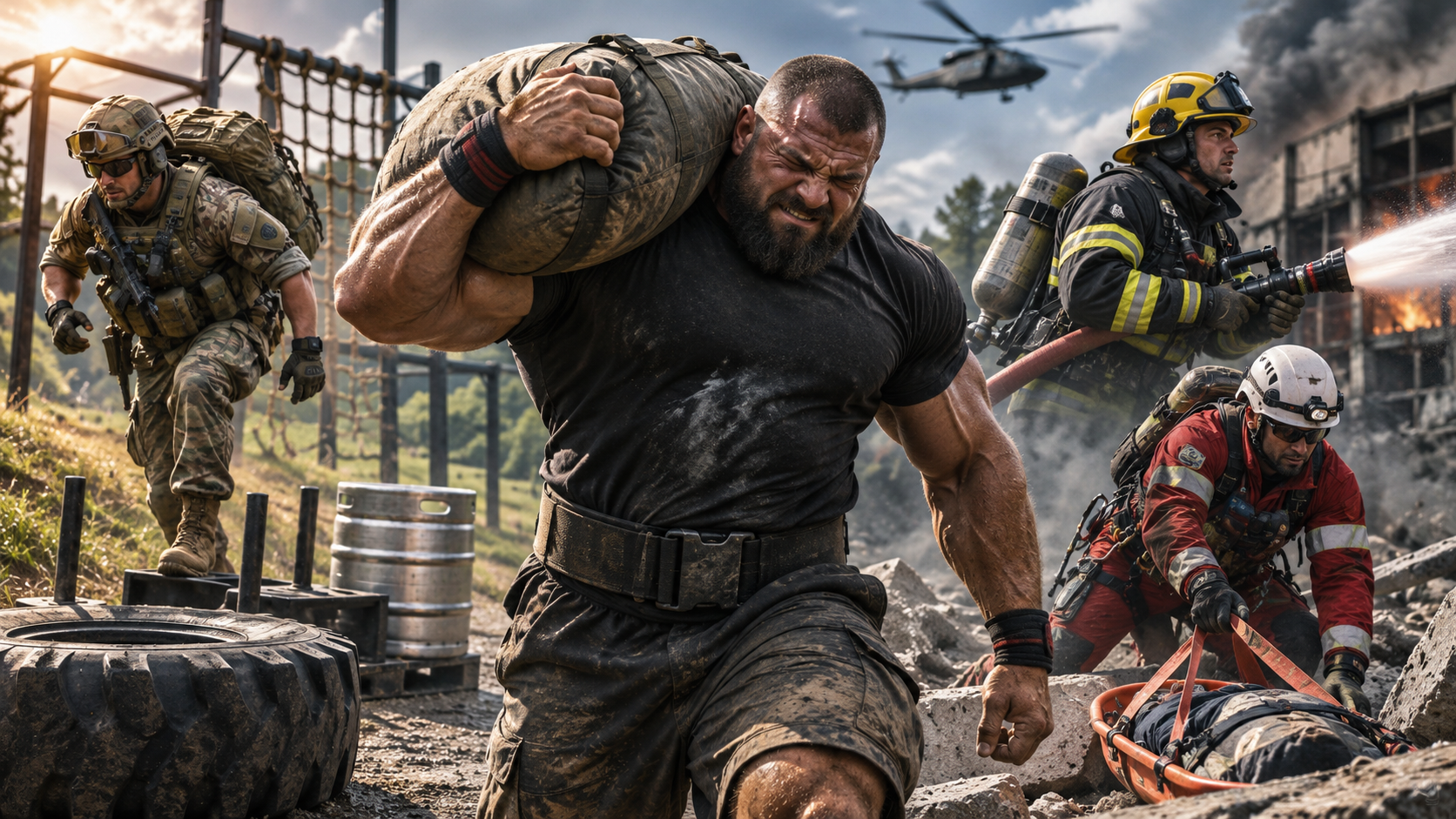
A firefighter does not compete in a strength event but performs a sequence of occupational tasks
When analyzing firefighter strength, it is tempting to compare a heavy hose with a sled, an equipment carry with a farmer's walk, and ladder handling with an overhead press. Mechanical similarities exist, but they do not fully describe the occupation. Firefighters perform successive and varied tasks: stair climbing, moving materials, controlling hoses, handling ladders, forcible entry, and searching for or evacuating a person. These activities take place in protective equipment, sometimes with breathing apparatus and under significant thermal stress. Someone may possess exceptional absolute strength yet be limited by prolonged-work tolerance, occupational technique, or recovery between tasks. The relevant question is not which Strongman event looks similar, but which physical ability contributes measurably to a defined job task [1–5].
A competition event typically has a known implement, fixed rules, and a limited performance window. Firefighters work with variable mass distribution, irregular support points, flexible or rigid materials, and serious consequences when control is lost. A hose does not behave as a uniform object, and a ladder is not a barbell moving on a fixed axis. Resistance, rotational moments, and contact points can change throughout the action. Unconventional-object training may therefore have value, but must be complemented by learning service-specific techniques, correct equipment use, and standardized safety procedures. Strength is a professional resource rather than a substitute for professional preparation.
Contemporary research supports this distinction. Martin and colleagues' 2026 meta-analysis synthesized 32 studies relating muscular and anaerobic qualities to firefighter occupational tests, finding that the importance of particular measures varied by task [1]. A separate meta-analysis of cardiorespiratory fitness found substantial associations between maximal oxygen uptake and simulated occupational-circuit times, without establishing aerobic fitness as the only predictor [4]. Together these results justify multidimensional preparation involving strength, power, endurance, coordination, and equipment familiarity. They do not demonstrate that Strongman training is compulsory or superior to every alternative.
Hose dragging: the mechanics of variable resistance
Dragging or advancing a hose may require predominantly horizontal force, but resistance does not equal a simple nominal mass. It depends on the length of material in contact with the ground, bends, obstacles, internal pressure, surface conditions, and pulling direction. When a section passes over an edge, new contact points form and required force may rise suddenly. As the path straightens, resistance may decrease. This makes hose handling different from a conventional gym sled. Occupational tests use defined setups to compare performance, but no single setup represents every field situation [2,3,5].
During a Strongman sled pull, the athlete can concentrate on body orientation, shoe traction, and force production. These qualities may transfer partly to hose tasks, but hose handling also involves route management, professional procedures, and team communication. Firefighters need to control acceleration and stopping, not merely move quickly along a straight course. Rapid execution with poor material control may have little occupational value. Professional performance should therefore be judged through both completion time and quality, rather than timing alone.
Maximal strength may provide useful reserve when initiating a difficult pull, while muscular endurance supports continued movement. Nevertheless, assuming that every deadlift record predicts hose-drag time would be unjustified. Firefighter studies have identified relationships involving upper-body strength, grip, endurance, and hose-task outcomes, with results varying by protocol [1–3]. Effective preparation can combine general resistance exercises, controllable pulling tasks, and specific occupational rehearsal. Each has a distinct purpose: developing resources, learning their application, and evaluating competence.
Equipment carriage: why the farmer's carry is useful but incomplete
Firefighters may carry tools, rolled hoses, containers, and specialized implements over varying distances. Such work challenges trunk musculature, grip, shoulders, and lower limbs in combinations resembling certain Strongman carries. Farmer's walking permits load progression while monitoring distance, time, and walking quality, which makes it a useful conditioning method. Yet standard dumbbell handles do not reproduce every equipment grip, and symmetrical loads do not necessarily represent bulky or unstable devices. The key similarity is sustained force during locomotion, not identity between the tasks.
Object dimensions and position change demand beyond what nominal mass indicates. Two equal loads can generate different external moments when one is held close to the body and another far away or only on one side. A long tool may create rotational demands and contact hazards absent from a symmetrical farmer's carry. Travel may also involve stairs, obstacles, and narrow doorways. General muscular capacity can be developed through simple exercises, then application checked using actual equipment under controlled instruction. Barbell performance does not replace competent use of professional tools.
Firefighter fitness studies often include equipment carrying as an occupational test, but do not establish one universally ideal training method. The 2026 muscular meta-analysis reports task-dependent relationships between measures and outcomes [1]. If someone already possesses enough force for a required object yet struggles during travel, conditioning or movement technique may deserve more attention than another farmer's-walk record. Training should address the limitation affecting the occupation rather than impose the same event on everyone.
Raising and extending ladders: a task dominated partly by rotational moments
A ladder is not merely a mass to lift. Its geometry creates rotational moments that change as its angle relative to the ground changes, while stability depends on support contacts and prescribed procedure. Force application points, ladder length, and center-of-mass movement can alter demand without any change in total weight. Overhead pressing develops potentially useful upper-body and trunk resources but does not fully replicate control of a long structure with multiple support points. The Strongman log press similarly requires coordination and stabilization, yet the implement's geometry and path differ from those of a professional ladder.
Training should distinguish general force production from specific handling competence. An operator who can press a large weight but struggles to control a long object may be limited by technique, anticipation of external moments, or communication with a teammate. Additional strength might help, but is not the only solution. Qualified familiarization and supervision are necessary, without turning equipment handling into an improvised maximum-load contest. Stabilization procedures and control of the surrounding space are safety requirements rather than optional details.
Standardized CPAT testing includes ladder raising and extension among eight occupational events [5]. Such tests show whether participants can complete defined simulations, not universal competence in every ladder operation. Isometric force may associate with some handling tests, but outcomes remain influenced by other factors. Practical preparation therefore combines force development with approved equipment-specific instruction.
Forcible entry and the transfer of impulse
Forcible entry sometimes requires transmitting impulse through a tool, but the task cannot be reduced to maximal barbell force. Performance depends on tool mass and velocity, joint coordination, impact geometry, and the properties of the contacted material. Instantaneous force, kinetic energy, and the capacity to repeat a movement without losing control are distinct characteristics. An athlete capable of pushing an enormous load is not automatically the most effective at an action demanding precision and timing. Occupational procedures also determine what may be contacted safely and how tools are used.
Forcible-entry elements in firefighter assessments use defined setups to support comparisons [5]. They neither demonstrate competence with every material nor certify real tool handling. Strength training can develop trunk and limb resources, while occupational practice addresses effort direction, communication, and safety. Repeated intense actions may also challenge anaerobic capacity. Sound programming develops these components separately and checks their integration rather than turning repeated blows against an object into the sole training method.
Stair climbing under load tests endurance, not just knee extension
Stair climbing repeatedly raises the body's center of mass against gravity and can sustain high metabolic demand. Firefighters move their own body mass, personal equipment, and sometimes additional materials. Although lower-limb strength contributes to each step, performance over multiple levels also depends on aerobic capacity, repeated-work tolerance, and load distribution. In reviews of firefighter performance, some lower-body strength tests showed limited relationships with stair times, whereas cardiorespiratory conditioning remained relevant [3,4]. This does not make leg muscles irrelevant; it shows that maximal force capacity does not describe the entire requirement.
Heavy squatting or yoke walking may build muscular reserve, but cannot replace tolerance of repeated stair climbing. Exclusive stair work may conversely leave insufficient force for exceptionally heavy equipment handling. Programming should combine complementary components while considering occupational workload. CPAT uses a defined loaded stair task to provide a reproducible measure for a particular purpose, not a perfect representation of every incident in a multistory building [5]. Assessment conditions and familiarization must remain comparable.
Overhead pulling and shoulder endurance
Overhead material handling imposes demands different from maximal pressing. Supporting or repeatedly moving a tool above shoulder height requires shoulder and scapular musculature to maintain arm position while the trunk controls external moments. Local endurance, not only peak strength, can limit performance. An athlete with an exceptional strict press may have substantial muscular reserve without automatically tolerating many repetitions in protective equipment. Conversely, someone with good endurance may struggle if an initial task exceeds available force.
Occupational ceiling-pull and similar assessments are useful when rules are clear and interpretation remains task-specific [5]. Strongman log pressing can develop force and coordination under load, but intervention equipment has different shapes, grips, and maneuverability demands. Progressive shoulder development is one component of preparation. Professional execution requires equipment familiarity, procedural positioning, and sustained control through completion rather than one maximal lift.
Victim rescue: physical force must remain subordinate to patient care
Dummy dragging appears in firefighter assessment batteries because it demands strength, trunk control, and movement of a relatively large mass. A dummy, however, has no injuries, pain response, or clinical transport requirements. Timed performance describes only a physical component of the task. With a real casualty, decisions about movement, equipment, and monitoring must follow medical instruction and response procedures. Strongman can improve force resources but does not determine whether an intervention is appropriate for a patient.
Firefighter studies report associations between rescue-drag performance and several fitness measures, including muscular strength, endurance, and aerobic conditioning [1–3]. Strength may reduce the relative difficulty of a load, but technique, grip, surface, equipment, and fatigue remain influential. Programs targeting this task should assess both physical performance and movement control without rewarding improper handling. Functional rescue is not a contest in abruptly moving mass, but the ability to contribute safely to an operation.
Protective equipment changes the physical system within which firefighters work
Helmets, protective clothing, boots, gloves, and self-contained breathing apparatus add mass and may alter movement, grip, and heat loss. Effects are not exclusively mechanical: some configurations increase perceived exertion, alter thermoregulation, and reduce tolerance of prolonged activity. A systematic review and meta-analysis of self-contained breathing apparatus reported physiological and psychological effects, including increases in heart rate and perceived effort and reduced measures of aerobic capacity [7]. The authors emphasized that these changes were not explained simply by apparatus weight. This argues against direct comparisons between one kilogram worn on the body and one kilogram lifted in the gym.
An unloaded test may describe baseline physical capacity without determining how it can be expressed during interventions. A firefighter with strong grip may struggle when gloves reduce tactile feedback; someone with powerful shoulders may move differently when garments restrict range. Gradual equipment familiarization matters, but extreme heat exposure should not become a courage test. Safety procedures, monitoring, and environmental management take precedence over dramatic training experiences.
Strongman can contribute to general loaded-work capacity, but cannot automatically reproduce breathing-apparatus or protective-garment effects. Transfer should be examined through safe occupational tasks using appropriate equipment and clear criteria. Good preparation develops physical reserve without assuming it abolishes thermal and ergonomic constraints.
Grip strength across hoses, tools, and equipment carriage
Many interventions transmit force through the hands, so grip may limit performance even when the legs and trunk are strong. A dynamometer provides a convenient measure but does not describe every contact configuration. Hoses differ from metal handles, and wet tools or gloves impose other requirements. Sustained gripping endurance differs from peak force produced for a few seconds. Assessment must specify which form of gripping is relevant to occupational work.
Firefighter reviews report associations between grip measures and various tasks, including carrying, hose handling, and simulated rescue [1,3]. This does not make dynamometry a perfect predictor of intervention time. Training with varied inert handles may support adaptability, but unauthorized grips on actual equipment are not justified. Improved ergonomic interfaces can reduce force requirements and raise safety more than pursuing another dumbbell record.
Isometric force and its limits for predicting dynamic tasks
The isometric mid-thigh pull measures force in a fixed configuration without moving an external load. It is attractive for personnel assessment because appropriate equipment and standardized rules can produce relatively reproducible outcomes. Yet the position does not reproduce walking, object rotation, or changing joint angles during an intervention. A useful peak-force indicator may relate differently to manikin dragging, ladder handling, and stair climbing.
A 2026 study of firefighter trainees found relationships between isometric pulling and some occupational tests, without the same predictive ability for every task [10]. This supports a test battery rather than one score. Maximal force should be considered alongside endurance, conditioning, and occupational execution. If static-force results improve while job-task times remain unchanged, technique and other limiting qualities deserve investigation instead of declaring the test worthless.
Absolute and relative aerobic capacity in firefighting work
Maximal oxygen uptake may be expressed in liters per minute or relative to body mass. These measures answer different questions. Absolute capacity describes total oxygen use, while relative capacity accounts for body mass; neither determines performance in every task. When firefighters handle large external equipment loads, total resources matter; when moving their own bodies rapidly, body mass and movement economy may have different effects. Interpretation depends on task structure.
A 2025 meta-analysis covering 32 studies reported negative associations between VO₂max and firefighter task-completion times, with absolute oxygen uptake showing stronger average associations in some occupational circuits [4]. Correlations are not individual guarantees or proof of causality for every protocol. They demonstrate why a program devoted only to maximal strength is incomplete. Strongman may provide varied muscular loading, but aerobic endurance should be developed and assessed independently.
Repeated anaerobic effort and sustaining power output
Some firefighting tasks are brief and intense, while others follow before complete recovery. The ability to produce power and limit its decline can therefore matter. Energy systems contribute simultaneously, even though their proportions change with duration and intensity. A short pull is not exclusively anaerobic, nor is an extended circuit exclusively aerobic. Muscular, metabolic, and cardiovascular resources need consideration together.
Martin's meta-analysis identified important relationships between anaerobic measures and simulated occupational-circuit times [1]. This supports repeated-effort conditioning but does not justify exhausting participants in every session. Force development may require generous rest, while conditioning may use different work-recovery structures. Programming should distinguish increasing peak force from preserving performance across multiple demanding tasks.
Body mass, absolute strength, and rapid movement
A firefighter with substantial muscle mass may produce high absolute force while also carrying more personal mass during stairs and equipment movement. These relationships are not linear: people of equal weight may differ markedly in aerobic fitness, mobility, and technique. Anthropometry provides context but cannot replace functional assessment. In particular, body mass index alone does not fully distinguish muscle from adipose tissue.
Absolute strength can be a major advantage for some handling tasks, while walking economy and cardiorespiratory tolerance matter more in sustained travel. This contrast explains why an elite Strongman physique is not automatically ideal for every emergency role. Preparation should improve the capacities required by the job rather than produce one body type. Occupational standards must follow actual duties and be validated fairly.
Trunk endurance during complex occupational work
The trunk transfers forces between limbs and helps maintain posture during handling. Carrying heavy material may impose largely static demands on some muscles, becoming dynamic as acceleration and direction change. During prolonged interventions, fatigue can affect postural control, especially when many gripping and pulling tasks follow each other. This does not make every spinal-position change an injury; assessment should focus on adaptability and controlled movement.
Strongman carries may expose the trunk to loading in varied planes, but yoke records cannot be assumed to provide absolute protection against lumbar problems. Biomechanical research documents different demands across events [8]. Firefighter conditioning should develop trunk strength and endurance alongside handling skills without presenting maximal rigidity as the one appropriate strategy for every movement.
Team coordination can matter more than one member's strength
Moving long or bulky equipment can require two or more firefighters. The load is not necessarily shared equally because hand position, height, step timing, and route affect individual demand. Poorly synchronized initiation may temporarily place a large share on one operator. Exceptional individual strength can help but cannot solve poor communication or an unsuitable handling procedure. Team success requires clear roles and rules.
Strength training builds individual resources; occupational practice tests how they are integrated. Treating each team carry as a contest among the strongest participants distorts the goal. Team assessment can consider stability, communication, and obstacle management alongside time. Strongman remains a useful source of conditioning methods, but collective performance is distinct from sporting achievement.
CPAT as a case study in occupational standardization
The Candidate Physical Ability Test was designed around a sequence of representative firefighter activities. The International Association of Fire Fighters describes eight events: stair climbing, ladder handling, hose dragging, equipment carrying, forcible entry, searching, rescue dragging, and ceiling pulling [5]. Specifying equipment, route, and load allows more reproducible comparisons than an improvised competition. The program also emphasizes familiarization because first exposure to unfamiliar implements may reflect task learning as well as fitness. That principle is important for occupational assessment generally.
A standardized test's usefulness is not the same as universal applicability. CPAT was developed for a particular institutional context and cannot automatically become the standard for every country, intervention type, or specialty. Units may use different equipment and perform different tasks, so selection criteria need local job analysis. Finishing a circuit quickly also does not establish technical competence with all real tools. Physical testing can support occupational decisions without replacing procedural instruction and assessment.
Correlation does not establish an exercise as the cause of better performance
When stronger firefighters complete occupational circuits faster, strength may contribute, but training experience, body composition, aerobic conditioning, and test familiarity may also matter. Observational research cannot completely isolate these factors. The 2026 meta-analysis reports associations across numerous capacities and tasks but does not prove that a particular Strongman exercise improves every occupational test [1]. Causal conclusions require intervention studies with appropriate comparators and documented training exposure.
A frequent error is turning a relationship between a capacity and a task into a single exercise prescription. If grip correlates with carrying time, this does not mean all sessions should emphasize grip. For some people, aerobic endurance may be limiting; for others, technique. Effective programs use research to formulate hypotheses and then check whether gains appear in actual duties. Strongman is one possible training method rather than an automatic answer to a correlation.
Training interventions: promising outcomes from a small evidence base
An August 2026 systematic review of physical-training interventions and firefighter occupational performance found only five experimental studies meeting its inclusion criteria [6]. Programs included high-intensity functional work, circuit training, nonlinear periodization, and complex methods, with improvements reported for several simulated tasks. This evidence comes closer to causal investigation than correlation alone, but the small number of studies requires caution. It does not show that every intense program is superior or that the same methods have identical effects across experience levels.
For Strongman integration, the key implication is the need for direct comparisons. A program featuring farmer's carries and sled drags should be assessed against a well-designed alternative rather than against no training at all. If both approaches improve performance, the relevant question concerns effectiveness for the unit's tasks at comparable doses and acceptable safety. Mature programming can combine methods without declaring one universally superior. Research offers direction, not a definitive list of compulsory exercises.
Power and rate of force development are not synonymous with 1RM
Maximal strength concerns producing high force, but some tasks require producing force quickly. Mechanical power depends on force and movement velocity, while rate of force development describes how rapidly force rises. These properties are related but distinct. A person may have an exceptional 1RM without being fastest during a task involving starts, acceleration, and turns. Anaerobic power may contribute to firefighting circuit times, though its importance differs by task [1].
Strongman can include events requiring fast object movement, but excessively heavy loading may turn controlled acceleration into survival of an attempt. Occupational training should choose methods according to the requirement: initiation force, endurance, or loaded movement speed. No single session must maximize all of them. Measuring strength and task time separately better identifies the actual limitation.
Accumulated fatigue changes technique and can conceal progress
A firefighter may perform an occupational test well after two rest days and more slowly after demanding duty. That difference does not automatically indicate lost fitness. Previous work, heat, limited sleep, and repeated tasks can temporarily reduce available resources. Testing under inconsistent fatigue conditions undermines comparisons. Performance after exertion can still be occupationally relevant because incidents do not occur only under ideal conditions. The solution is clear test purpose.
To measure maximal strength, conditions should minimize uncontrolled fatigue. To assess repeated work after a circuit, preceding exertion may be included but must be standardized and monitored. Mixing the aims generates misleading conclusions. Training should not treat exhaustion as moral achievement; progress means increased capability rather than merely tolerating an extreme session.
Assessing pain and preserving availability for duty
Physical preparation should also be judged by personnel availability. A program that increases gym scores but produces persistent symptoms or frequent missed duty may offer limited occupational value. Not every post-exercise soreness is an injury, but pain affecting gait, grip, or movement control deserves attention. Individual history, previous injury, and total workload matter, especially when heavy carrying combines muscular load with prolonged exposure.
Risk management does not require banning a fixed list of exercises; it requires appropriate progression and dosage. A well-controlled sled can be useful, while even moderate mass can create problems under severe fatigue or on unsuitable ground. Instructors should observe execution quality and adapt training to actual duty. Professional culture does not equate ignoring physical warning signs with resilience.
Return to duty after injury requires task-specific criteria
Return to duty after injury cannot be decided solely from a regained 1RM. A person may produce high force in a controlled lift yet remain limited during repeated work, equipment carriage, or ladder tasks. Medical assessment and verification of essential occupational abilities are therefore necessary under institutional rules. Standardized occupational tests may contribute but require interpretation by qualified personnel.
Strongman-style exercises may provide progressive general conditioning when appropriately indicated and supervised. Maximal awkward-object lifting is not compulsory and may be unsuitable at some stages. Recovery should target missing function rather than recreation of a sporting spectacle. Professional capability matters more than loyalty to a particular exercise.
Thermoregulation: muscular heat becomes an occupational constraint
Muscular work converts a substantial portion of chemical energy into heat. In cool conditions, the body can dissipate some of it through ordinary pathways, but protective clothing and hot environments may restrict cooling. A task with moderate external mass can become highly demanding as temperature, humidity, and exposure duration increase. Knowing object weight is therefore insufficient; conditions of handling matter. A Strongman event in a ventilated gym cannot automatically reproduce fully equipped firefighting work.
Research on self-contained breathing apparatus found changes including increased skin temperature, heart rate, and perceived difficulty compared with certain control conditions [7]. Interpretation depends on study designs and recognition that respiratory protection is necessary in specified environments. Removing protection to improve performance is not justified. Conditioning can develop general capacity while organizations manage heat through procedures, monitoring, work organization, and recovery. Uncontrolled extreme-temperature exposure is not a substitute for physical preparation.
Thermal readiness and muscular readiness are not interchangeable. A firefighter can have enough strength for an object yet be limited by overall physiological strain and safety requirements. Time spent in equipment should be considered separately from kilograms lifted. The objective is not to normalize serious symptoms through performance culture, but to develop operational capacity compatible with health and professional rules.
Breathing apparatus changes more than total mass carried
Self-contained breathing apparatus adds mass, but weight is only one part of the demand. Contact points and straps can alter posture, while protective systems may affect respiratory and thermal experience. A meta-analysis found that physiological responses could not be explained mainly by apparatus mass alone [7]. A backpack of equal weight is therefore not equivalent to breathing apparatus. Geometry, configuration, and equipment function matter.
Loaded carrying can develop trunk and leg strength, but familiarity with breathing apparatus requires separate professional instruction and supervision under approved procedures. A yoke record does not demonstrate effective performance while fully equipped, and backpack walking does not reproduce every constraint of firefighting equipment.
Assessment should distinguish baseline physical capacity from occupational performance in required gear. The difference may inform understanding of adaptation, fit, or contextual demand without independently providing a diagnosis. Proper preparation does not maximize equipment exposure as punishment. It develops the necessary technical competence and physical tolerance while keeping safety central.
Hydration and work duration influence repeated-effort capacity
During prolonged intervention, sweating and fluid intake affect physiological state, and substantial water loss can impair work tolerance. Sweat rate varies among firefighters with temperature, equipment, intensity, and individual characteristics. Hydration status cannot be inferred reliably from fatigue or heart rate alone. Fitness may improve work tolerance but does not abolish institutional recovery and fluid-management requirements.
Strongman culture sometimes emphasizes finishing one difficult attempt, while professional intervention may extend across several work intervals. Recovery between them becomes part of the outcome. If a firefighter is extremely strong on the first task but unable to contribute after several phases, conditioning and effort organization may need attention.
Research should report exposure duration and thermal conditions. Comparing tests across different environments can incorrectly attribute heat- or rest-related effects to fitness. Applied assessment should consider availability for the next intervention as well as initial completion time. Operational capacity includes adequate recovery, not only instant performance.
Shift schedules and sleep are part of the performance equation
Firefighters may begin an intervention after demanding duty and insufficient sleep. This context can affect attention, perceived exertion, and recovery. Testing under ideal conditions describes baseline capacity but not every situation in which it must be expressed. Not every short night produces a fixed strength decline; effects depend on the person, duration, and task. Relevant circumstances should nevertheless be documented before attributing outcomes solely to training.
Duty and sport sessions contribute to the same total workload. A maximal Strongman carry session after demanding interventions may add fatigue without improving adaptation proportionally. Reduced-volume strength maintenance may be more appropriate than aggressive progression during some periods. Such adjustment represents professional resource management rather than lack of discipline.
Efficient preparation should reject the idea that rest opposes performance. Sleep and recovery influence duty readiness, and programming should reflect that reality. The goal is not the athlete tolerating the greatest training stress but the professional able to perform consistently.
Turning under load: balance rather than acceleration alone
Equipment carriage may require negotiating obstacles and turning along restricted routes. Moving loads have inertia, and changing direction demands additional control. A straight farmer's walk tests only part of this problem. Turning courses may increase trunk and lower-limb demand but require standardization for fair timing. Changing angle or surface can make the assessment a different task.
Controlled submaximal loaded turning can be developed progressively. Maximal masses in congested routes may add complexity while reducing controllability. Occupational training seeks repeatable execution rather than drama. If someone has adequate strength but loses time during turns, coordination rather than additional kilograms may be the limiting factor.
Real equipment behavior and safety requirements may demand slower movement than a competition. Sound evaluation recognizes when slowing down is prudent. Occupational performance is not always identical to the fastest possible speed.
Bilateral and unilateral work impose different demands
Carrying equal masses in both hands creates relatively symmetrical demand, whereas a load held on one side can generate lateral moments requiring additional control. Some firefighting tools are asymmetric or temporarily handled with one hand. Bilateral farmer's walking can improve grip and loaded travel but does not represent every configuration. Unilateral training may add useful variety when loads and technique remain appropriate.
Asymmetry is not automatically harmful or something to eliminate from every task. Bodies adapt their posture, and many duties naturally require unilateral movement. Risk depends on load, volume, control, and personal characteristics. Testing rules about hand changes or object positioning must be documented for valid comparisons.
Strongman can provide exercises challenging control under varied mass distributions, but the aim is general capability rather than uncontrolled difficulty. Real tool-handling technique follows occupational procedure. Sport exercises support rather than replace that practice.
Interpreting injuries without myths about dangerous exercises
Exercise science does not divide activities neatly into those that always injure and those that are always safe. Heavy loads, unfamiliar technique, unsuitable surfaces, and inadequate recovery may contribute to problems, but individual situations are multifactorial. Experienced Strongman athletes may perform particular events safely through progression, while firefighters may struggle with moderate tasks after demanding duty. Risk requires considering exposure and individual capacity rather than relying on exercise labels.
Programming should include equipment checks, appropriate preparation, progression, stopping rules, and attention to persistent pain. It must also consider occupational work before and after training. Better sporting results do not justify reduced availability for intervention. Monitoring missed duty and musculoskeletal problems may be as important organizationally as monitoring records.
Research needs clear injury definitions and exposure-adjusted rates; otherwise comparisons between sports and professions mislead. Similarity between an exercise and a job task does not prove injury prevention. Such a claim requires longitudinal intervention evidence.
Force vectors explain why the same muscles produce different outcomes
An operator may generate high forces during a vertical exercise yet perform less effectively when resistance must be moved horizontally. Force direction, ground contact, and joint angles influence transmission efficiency. Pushing a sled, lifting an object, and pulling a hose can involve overlapping muscles without identical mechanics. A large squat score therefore cannot accurately predict every occupational event.
Strongman training may expose athletes to different force directions and develop capacity across several configurations. This variety is potentially valuable, but exercise selection should start with the actual job task and a measurable outcome. Where friction or object position is the true limitation, a technical change may matter more than increasing 1RM. Useful performance emerges when muscular resources can be applied in the right direction and at the right moment.
The distinction also explains why occupational testing must specify whether resistance is applied through a handle, rope, or tool, and whether the floor is dry, wet, or inclined. A nominal load does not define the entire task. Without those details, changes in test results may reflect changed mechanics rather than true adaptations. General strength training and specific equipment practice answer complementary questions, and neither should be treated as a full substitute for the other.
The metabolism of a circuit is not simply the sum of its events
Firefighter assessments can combine several activities with limited recovery. Heart rate, ventilation, and energy availability reflect preceding work, making the same task harder when performed late in a circuit. A stand-alone hose test is not equivalent to hose handling after loaded stairs and equipment carriage. This interdependence gives combined assessments value but also creates a limitation: total time can hide the exact stage where performance deteriorates.
Meta-analyses show relationships between aerobic, anaerobic, and occupational-circuit performance [1,4]. For programming, it helps to retain segment times alongside the aggregate result. Strong operators who slow mainly late in the circuit may need more endurance. Those who struggle with initial load movement may benefit from strength or technical work.
Strongman competitions also include multiple events, but their work-rest structure rarely duplicates an occupational circuit. Adopting a sporting event requires specifying which adaptation is intended: maximal force, power, or repeatability. Without that separation, a program may produce tremendous fatigue without revealing whether participants have developed the capacity needed in service.
Rest intervals and recovery time are part of the task
Two people may finish a circuit at the same time while differing greatly in how long they need to recover before repeating it. Immediate performance does not fully describe work capacity. Real response rest periods depend on service organization, available resources, and thermal conditions. Training rest intervals should not simply be copied from a Strongman contest.
For maximal-force development, adequate recovery can preserve attempt quality. Repeated-work conditioning may use different work-rest ratios. Both belong in broader preparation, but their objectives should remain distinct. A recovery assessment must specify the interval and the criteria used to judge readiness for another task.
Simple measures such as time until the next technically acceptable effort and perceived exertion can complement completion time. No universal recovery interval certifies firefighter readiness. Recovery must be interpreted relative to mission duration, initial fitness, and total demand.
Assessing technique differs from assessing strength
Firefighters may complete a test faster through more efficient technique without substantially increasing muscular strength. Familiarity with equipment, route selection, and movement coordination can reduce time. Research should distinguish such learning from physiological adaptation. If training repeats precisely the evaluation task, progress may reflect test practice. That can be occupationally useful, but should not be labeled automatically as greater maximal force.
Balanced assessment uses general fitness tests alongside occupational tasks. The first measure capacities such as strength, power, and endurance; the second examines their application. Execution errors need clear definitions, and assessors must recognize them consistently.
Strongman rules judge a sporting objective, while interventions prioritize safety and functionality over time. A technique accepted in competition should not automatically be transferred to professional equipment handling. Institutional procedures take precedence.
The force required to use a tool is not equivalent to its mass
A tool may be relatively light yet demand substantial muscular effort through posture, vibration, reaction forces, or repeated handling. Holding a device away from the trunk can produce meaningful external moments even at moderate mass. Comparing tool weight with a gym lift does not describe the complete demand. Body position, operating duration, and equipment characteristics also matter.
Dumbbells and shoulder training can increase general resources, but do not reproduce every device's vibration or mechanics. Authorized equipment practice remains indispensable. Precision and control, rather than force alone, may limit tool performance.
Assessment should focus on task quality and physical capacity after repetitions. Increasing gym load is not always the most effective solution when controlling a device is the actual limitation. Strength is the foundation, but specificity determines how it is used.
A mixed training protocol may be more useful than a single method
For firefighters, one session may develop general strength through squatting, pulling, and pressing, while another focuses on carries and conditioning. Equipment-specific practice remains a separate professional component. This is not a universal prescription, as schedules, experience, and recovery differ. It simply illustrates why every objective need not be compressed into one circuit to exhaustion.
If Strongman is introduced, each event should have a reason: which quality does an awkward-object carry develop? What is the purpose of a sled pull? How will improvement in hose or stair performance be evaluated? After a suitable training interval, comparison may show whether the program contributes useful value. Without occupational outcomes, resemblance remains a hypothesis.
The 2026 intervention review supports the promise of structured programs, but its limited study base warrants restraint [6]. Well-designed training can combine barbells, Strongman, and aerobic work without making any one method compulsory.
A hypothetical comparison of two firefighters
Consider two firefighters who can carry the same load over a short distance. The first has much higher maximal strength but modest conditioning; the second is less strong but has better aerobic endurance. For one exceptionally heavy task, the first may have an advantage; across a long circuit, that gap may narrow or reverse. These profiles are hypothetical and imply no fixed percentages, but illustrate why one fitness measure cannot describe every duty.
Now introduce protective equipment and stair climbing. Thermal tolerance, walking control, and material familiarity may influence the outcome. Training devoted only to the strongest person's existing advantage may fail to address their actual occupational limitation. Assessment should identify the exact task where difficulty arises.
This is the logic of individualization. Firefighters who already possess adequate strength reserve may benefit more from conditioning, while others need force and technique. Strongman offers tools, not one identical prescription for every body and role.
Firefighter periodization must account for unpredictable incidents
A competitive athlete can organize training around a known event date, while a firefighter cannot schedule when physically demanding emergencies will occur. Preparation should therefore preserve reasonable ongoing readiness. During periods with heavy occupational work, maintaining strength and managing fatigue may be preferable to pursuing records. More ambitious progression may fit quieter periods.
Flexibility does not mean abandoning structure. Programs can maintain exposure to strength, aerobic conditioning, and relevant tasks while adjusting dose. Progress assessment should account for duty work and recovery. Strongman may be valuable but should not monopolize time needed for other abilities.
This changes the meaning of successful periodization. The aim is not necessarily one extraordinary peak followed by a lengthy recovery, but a sustainable range of performance across variable workloads. Decisions should be based on the unit's demands, the person's experience, and observed response rather than a fixed competition template.
Differences across urban, rural, and other firefighting contexts
A team working frequently in multistory buildings may face different physical demands from one operating across large outdoor areas or varied terrain. Some duties emphasize stairs, others equipment carriage, prolonged travel, or sustained manual work. No single exercise can therefore be optimal for every unit. Job analysis and incident records can help identify dominant requirements.
Strongman methods may be adapted through carefully selected carries, drags, and lifts without theatrically reproducing every scenario. Sporting equipment need not look identical to professional devices to develop general qualities. The final relevance, however, must be checked through actual job tasks.
Training protocols should also distinguish tasks performed individually from those normally completed by several members. Individual conditioning and collective procedure are complementary, and an intervention may rely on both. A unit's optimal program is grounded in its responsibilities rather than the aesthetic appeal of a particular sport.
Static effort can be demanding without object movement
Some duties require holding a position or tool with relatively little visible movement. Muscles still generate force and consume energy while the implement remains nearly stationary. Holding duration and joint configuration become important, and a dynamic 1RM does not fully describe endurance. Conversely, prolonged static holding is not automatically the optimal way to develop maximal strength.
Isometric exercises can improve relevant resources, but adaptations depend on joint angle and dosage. For firefighters, assessment may combine peak force with tolerance of specified holding tasks. Strongman provides examples of loaded support but these should be selected for their training purpose rather than appearance.
The distinction also matters for recovery. Local muscular fatigue can accumulate during holding tasks even when the total distance traveled is negligible. Programs based entirely on transport distance or lifted kilograms may miss this aspect of occupational workload.
Technical competence should not disappear inside a fitness score
Occupational circuits can combine physical fitness with knowledge of equipment operation. When the only outcome is total time, strength and procedural learning become difficult to disentangle. Research can reduce this confusion by examining individual stages and execution quality. A person may become faster through practice without a major change in muscular strength.
This does not diminish the value of learning; it means adaptations should be labeled correctly. Better tool use is occupationally beneficial even when Strongman training did not cause it. Responsible instructors should not claim every improvement as evidence for their preferred method.
Clear reporting also improves program design. If technical errors decline while force scores remain unchanged, the next training phase may require maintaining fitness rather than increasing load. If technique is already sound but a required force cannot be produced, strength development becomes a more plausible priority.
Training programs should monitor total workload
Gym kilograms do not represent a firefighter's entire workload. Equipment carriage, incidents, stair travel, and routine occupational duties all contribute. Ignoring these demands can lead a program to add stress without sufficient recovery. No single score perfectly captures total exposure, but simple records of duration and difficulty can inform decisions.
Coaches can reduce strength-training volume during heavy occupational periods and emphasize progression when recovery is more favorable. The objective is readiness rather than competition between duty and sport.
This principle applies even when athletes are highly trained. Great strength does not make them biologically exempt from accumulated fatigue. Strongman should support professional performance instead of becoming a second exhausting physical occupation layered over emergency duty.
Occupational standards must be valid, reproducible, and justified
A very difficult test is not automatically a good test. When a task does not represent essential work, its score may reward sporting ability without proven occupational relevance. Standards require job analysis, clear outcome definitions, and reproducibility. Thresholds should not be set by observing only the strongest participant.
General health assessment may use individually scaled norms, whereas a critical occupational criterion may require a minimum tied to task completion. These purposes must be distinguished. Training programs can use personalized progress measures without changing justified professional requirements.
Fairness depends on the validity of the requirement and consistency of measurement, not on making every test equally difficult for everyone. Good standards protect both operational effectiveness and the people being evaluated.
What the next Strongman-firefighter study should measure
A useful trial would compare a well-planned Strongman program with conventional strength and conditioning at similar total training exposure. Participants would undergo baseline and follow-up testing on occupational outcomes independent of the practiced exercises, such as hose movement, stairs, and equipment carriage. Familiarization, job workload, injuries, and availability for duty should be documented. Otherwise, improvements may be attributed incorrectly to the method.
Follow-up measurement could establish whether gains persist. Immediate improvement on a familiar test may reflect learning, while robust occupational adaptation should also appear in reasonably related but nonidentical conditions. Research should monitor benefits and costs alike.
Until stronger evidence exists, Strongman is best regarded as a family of potentially useful tools rather than a compulsory formula. Exercise choice should follow actual occupational requirements and measured results, not spectacle.
Teaching case: high strength with limited stair performance
Consider a firefighter with excellent squat, deadlift, and short loaded-carry performance but a relatively slow time on a stair task performed in equipment. A superficial response would be to prescribe even heavier lower-body training, assuming every difficulty must reflect insufficient force. That conclusion is not justified. If the operator can initiate and control individual steps, the limiting factor may be aerobic fitness, prolonged-work tolerance, movement economy, or equipment handling. Firefighter research reports variable relationships between maximal strength and completion times across different occupational tasks [1,3,4].
A useful assessment would examine stair performance alongside aerobic measures, perceived difficulty, and observation of movement under equipment. It would also consider whether the person has practiced the particular stair task and whether testing conditions are consistent. Time spent learning an unfamiliar device may not reveal a genuine deficit of leg strength. The objective is to separate capacity from task familiarity and environmental constraints rather than assign all variation to one physical quality.
If a subsequent program improves stair completion time without increasing 1RM, the improvement remains occupationally relevant. Strongman-style carries can stay in the program for developing or maintaining strength reserve, but they need not dominate the training schedule. This is a hypothetical teaching case, not an individual treatment protocol or a quantified prediction. It illustrates the value of identifying the actual limitation before deciding what kind of stimulus to add.
Teaching case: good aerobic fitness but insufficient handling strength
Now imagine a firefighter who climbs stairs efficiently and tolerates sustained work, yet struggles to initiate or carry a particularly heavy piece of equipment. In this profile, superior aerobic conditioning cannot automatically solve the force requirement. Progressive development of lower-body, trunk, and grip capacity may deserve more emphasis than additional endurance work. The choice of exercise still needs to follow observation: an unsuitable contact point or inefficient technique can limit performance despite adequate muscular strength.
Strongman offers potentially useful carrying and awkward-object exercises. These may complement standardized barbell training because they challenge control of objects with changing grips and mass distribution. The program should be matched to the person's current ability and accompanied by qualified instruction. There is no reason to copy the extreme loads used in elite competition to obtain the general conditioning benefits of controlled carrying.
Progress must be verified on the occupational task rather than inferred from higher gym numbers. If tool handling remains difficult, technique, equipment configuration, and specific familiarity should be reexamined. A high strength score is a resource, not a sufficient explanation of every result. This hypothetical contrast with the previous case illustrates why different individuals performing the same job may require different training priorities.
What makes a test reproducible and sensitive to progress
A useful occupational test should measure approximately the same capacity when repeated under comparable conditions. Changes in distance, load, commands, or ground surface can create time differences unrelated to training. Familiarization is particularly important when participants first encounter an implement or course. To interpret small improvements, organizations need to understand normal test variability instead of treating every fraction-of-a-second gain as meaningful adaptation.
Sensitivity to change differs from maximal difficulty. If every participant finishes easily, the test may have a ceiling effect and fail to distinguish improvement. If nearly nobody finishes, the test offers limited information for progressive training. The appropriate task difficulty depends on the assessment's purpose: developmental monitoring, entry selection, or maintenance of occupational competence. These purposes may justify different measures even within the same organization.
A good battery uses clear execution criteria and continuous outcomes where meaningful. Comparisons between Strongman and conventional training should rely on occupational measures preferably independent of the exact exercises practiced. This is how researchers can begin to distinguish genuine transfer from merely learning a sporting event. A difficult-looking drill is not automatically valid, reliable, or informative.
Safety as a measurable outcome of a strength program
Firefighter training success cannot be judged solely from sporting records and occupational-circuit speed. Programs should also be examined for musculoskeletal problems, missed training, availability for duty, and the ability to complete tasks without losing control. Faster performance combined with frequent absence may provide little organizational value. Not every painful sensation indicates injury, but symptoms impairing function require qualified interpretation.
Assessment should include stopping rules, inspected equipment, and a distinction between expected post-exercise fatigue and warning symptoms. Injury comparisons need adjustment for exposure; raw event counts from differently sized or differently loaded programs can mislead. An intense workout that appears successful may also affect the person's ability to work later that day, an outcome conventional fitness rankings rarely capture.
Strongman deserves the same scrutiny as every other training method. Its value depends on developing occupationally relevant capacity without imposing disproportionate costs. Where a program improves one lift but reduces availability for essential work, the balance may require adjustment. The professional goal is not a perfect training-room score achieved at the expense of the next incident.
The distinct roles of strength coaches and occupational instructors
Strength coaches assess neuromuscular qualities, plan progression, and observe movement in selected exercises. Occupational instructors understand response procedures, equipment limits, and performance criteria for the institution's duties. Medical and occupational-health professionals contribute expertise in health risks, recovery, and fitness for duty. These roles overlap but are not interchangeable. A Strongman expert does not automatically qualify as a firefighter equipment instructor.
Integrated programming emerges through communication among these specialists. When occupational instructors identify difficulty carrying a particular material, a coach can investigate strength or endurance interventions. When the limitation is procedural, additional heavy lifting may offer little value. Periodic assessment determines whether the chosen intervention improves the intended outcome.
This collaboration prevents training culture from valuing one impressive capacity above every other requirement. Maximal strength becomes a resource supporting professional work rather than a separate organizational objective. It also allows programs to change when the unit's equipment or mission profile changes instead of preserving exercises solely from habit.
Equipment changes over time and tests need thoughtful updating
Firefighting equipment evolves. New tools, different protective systems, and modified handling procedures can change mass distribution, gripping, and the movements required during duty. A fitness test originally designed around older devices may lose some occupational representativeness even while the underlying strength qualities remain useful. Updating the test requires renewed job analysis and validation of criteria rather than arbitrary changes to weight or timing.
This distinction matters when an institution uses the same occupational assessment for many years. Better equipment may reduce a particular task's force requirement while creating other demands involving precision, mobility, or repeated work. A change in test time could reflect equipment modernization rather than physical adaptation.
Strongman provides general exercises that may remain valuable across technological changes, but these should not be mistaken for direct competence with new devices. Mature preparation preserves strength, endurance, and control while updating equipment-specific instruction. The objective is professional adaptability rather than preserving a spectacular drill merely because it has become traditional.
Incident duration changes the meaning of performance
A single task's completion time can be useful for comparison but does not fully represent a lengthy incident. Operators may need to carry materials and perform other maneuvers repeatedly, under different recovery intervals. The ability to preserve quality across these episodes becomes important. A short Strongman event does not automatically measure this kind of availability.
Occupational work may involve pauses that are neither predictable nor fully restorative. Wearing equipment while waiting can maintain static and thermal demands. A firefighter who performs exceptionally in a rested test may still experience meaningful fatigue during prolonged operations, without that fatigue proving inadequate effort or character.
Training should combine strength and conditioning, while assessment states whether it measures peak performance or repeatability. If two individuals achieve similar initial times but diverge on subsequent work, that difference deserves independent consideration. Work tolerance should be developed without sacrificing movement control or safety.
Cardiovascular risk and muscular performance are complementary concerns
High muscular strength does not abolish cardiovascular health risks, just as good aerobic fitness cannot guarantee the force needed for a critical lift. In physically demanding occupations, medical assessment and athletic preparation require coordination among competent professionals. Firefighter research has examined fitness alongside health indicators associated with occupational performance [3].
This does not mean that every variation in heart rate is a medical problem or that high training intensity is inherently inappropriate. It means performance should not be evaluated in isolation from health, recovery, and relevant symptoms. An individual can improve strength while still needing separate medical attention for an unrelated condition.
Strongman training may develop muscular capacity, but should not be portrayed as universal prevention or treatment for cardiovascular disease. Exercise intensity, symptom interpretation, and fitness-for-duty decisions belong within the appropriate medical and occupational context. The objective is functional capacity that remains compatible with health and sustained availability.
A composite score can conceal a critical limitation
Arbitrarily combining strength, endurance, and completion times into one total can allow exceptional performance in one component to mathematically compensate for failure on an essential task. Professional work does not always permit such substitution. An individual may score highly overall while remaining unable to handle a required piece of equipment safely.
This is especially relevant when testing is used for selection or return-to-duty decisions. A composite measure may have value for summarizing general fitness but should not conceal failures on separately justified occupational requirements. Criteria need to be supported by job analysis and administered consistently.
General capacities and professional tasks should be reported independently with explicit interpretation limits. Strongman resemblance is not a validity criterion. A useful test identifies training needs and confirms relevant competence rather than merely ranking participants. It also avoids treating the highest sporting performer as automatically the most capable professional.
Initial education and continuing development require different stimuli
Beginners may improve substantially through technique, familiarization, and basic strength development, whereas experienced firefighters may require more targeted interventions. Giving identical loads and volumes to every person can produce uneven progress and disproportionate strain. Program dosage should reflect experience and actual occupational work.
Strongman elements can be introduced through simple, controllable carrying and pulling tasks without maximal attempts. Initial success may mean stable technique and consistent completion rather than dramatic kilogram increases. Later development may focus on maintaining established capacities or correcting a specific limitation revealed by occupational assessment.
Periodic testing should establish whether the program produces relevant improvement rather than merely more fatigue. When a firefighter is already competent at a task, additional maximal strength may have diminishing occupational returns compared with other capabilities. Rational training allocation depends on the work required, not the prestige of an exercise.
Interim conclusion: strength sport must be adapted to the profession
Firefighters may benefit from strength, power, grip endurance, and loaded-carry capacity developed through Strongman-style exercises. Yet interventions also demand aerobic conditioning, specific equipment skills, communication, technical competence, and hazard control. Available research supports the role of several physical qualities while exposing the limitations of claims that any single method is universally superior [1,4,6].
Strength sport should therefore be adapted to professional duties rather than imposed as a complete model. Exercise selection must follow the tasks carried out by the unit, the individual firefighter's needs, and the time available for recovery. Progress in a sled drag or barbell lift cannot automatically be called comprehensive operational readiness.
The objective remains a responder who is available, competent, and capable of applying force when required. The professional value of Strongman lies in the transferable resources it can provide, not in replacing the profession's established procedures. This distinction creates a coherent foundation for comparing exercise adaptations with real occupational outcomes.
Concrete evidence on isometric strength and occupational performance
A 2026 study by Lockie and colleagues examined 47 firefighter trainees, comparing isometric mid-thigh pull force with a manikin drag, ladder extension, and loaded stair climbing [10]. Isometric strength correlated with the manikin drag and ladder-extension performance but did not show the same relationship with stair-climb results. The distinction illustrates why a useful strength measure should not be treated as a universal occupational predictor.
The study's strength lies in relating a relatively practical neuromuscular assessment to more than one defined job task. Its limitations include a modest sample and the specific testing environment. The findings cannot demonstrate that every Strongman exercise improves ladder handling or that isometric force entirely explains the variance in evacuation times. Even the strongest relationships leave room for other determinants such as task familiarity and movement technique.
For coaches, the lesson is concrete: identify the limiting task before selecting an exercise. When insufficient force plausibly constrains movement, strength development may deserve priority. Where endurance, equipment familiarity, or technique is the larger limitation, adding maximal-load work may not produce proportional benefits. Testing has value when it informs a decision rather than merely generates a score.
Precision of conclusions and the danger of extrapolating from sport
Hindle and colleagues' systematic review described the biomechanics of several Strongman exercises and considered possible applications to daily and physically demanding occupational tasks [8]. Mechanical resemblance does not directly prove that Strongman training improves every firefighter task. Such claims require intervention research with appropriate comparators and occupational tests measured before and after training.
The same caution applies to short comparisons between sporting training methods. If two programs improve general muscular performance, it does not follow that the more visually dramatic program must be preferred for emergency services. Equipment availability, supervision, injury exposure, and actual job requirements may be more important than novelty.
An exercise can still be valuable without proof that it outperforms every alternative. If controlled loaded carries develop strength or stability, that finding matters within the domain measured. Claims of automatic injury prevention or faster performance at every incident go beyond available evidence. Accurate scientific language protects the credibility of occupational preparation.
Unit-level data can turn preparation into a verifiable process
Organizations can monitor general fitness and relevant occupational tests while documenting assessment conditions, preceding workloads, and availability for duty. Data should be handled responsibly and must not become a ranking system that disregards professional roles or individual circumstances. The purpose is to identify limitations and evaluate the usefulness of programming.
Where only the practiced exercise improves while occupational tasks remain unchanged, the chosen intervention should be reconsidered. Improvement across several independent outcomes strengthens the plausibility of transfer, although without an appropriate comparator it may still be difficult to attribute cause to one method. Consistent monitoring can nevertheless identify patterns requiring attention.
Simple records may be more valuable than an elaborate dashboard that cannot be interpreted. A well-run program needs clear measures, reliable protocols, and a willingness to change its methods when evidence conflicts with expectations. Strength development becomes a testable contribution to operational readiness rather than an identity adopted by the unit.
A strong professional culture recognizes the limits of strength
In emergency occupations, strength can assist with difficult handling but cannot replace communication, judgment, and procedural compliance. An exceptionally strong firefighter who struggles to cooperate is not automatically the unit's most effective resource. Similarly, someone with moderate sporting results may possess substantial professional competence. Preparation should recognize this diversity rather than equate a physique with capability.
Strongman may develop physical discipline and relevant muscular resources, but it does not automatically confer professional judgment. During an incident, the person who identifies an unsafe action and communicates the hazard can contribute as importantly as the one who moves a demanding load.
A mature unit respects both contributions. Readiness is a collective outcome shaped by fitness, knowledge, coordination, equipment, and control of risk. Competitive achievements can be impressive and useful without becoming a substitute for the professional standards governing an emergency operation.
A practical framework for selecting Strongman-inspired exercises
Exercise selection should begin by identifying a professional task and the physical characteristic limiting it. The next step is choosing a safe, repeatable, progressively adjustable method, followed by assessment of occupational outcomes after an appropriate interval. Dragging, carrying, and unconventional lifting can fit this framework without becoming mandatory for every unit.
If the objective is better equipment carriage, farmer's walking may be one useful method. Where initial pulling force is limiting, controlled sled work may be relevant. If repeated stair movement is the concern, conditioning and specific stair practice remain important. No exercise should be selected merely because it produces an impressive image or resembles an emergency from a distance.
Following intervention, the organization should examine whether the occupational task improved, not just whether gym performance increased. Safety, adherence, and recovery must be part of the appraisal. A sustainable program with demonstrable job benefits has a stronger justification than one offering extraordinary training scores without meaningful task transfer.
Episode 4 conclusion: functional strength is task-dependent
Firefighter performance emerges from muscular capacities, cardiorespiratory fitness, professional technique, equipment, and environmental constraints. Strongman can contribute through carrying, pulling, and control of awkward objects, but does not constitute complete occupational preparation. Systematic reviews and training-intervention evidence identify roles for multiple physical qualities while emphasizing the limits of extrapolation [1,4,6].
Mature programming preserves maximal strength as a resource, develops needed endurance, and verifies results using relevant occupational outcomes. A large sporting record cannot replace task-specific assessment, and no one physical measure describes every intervention. Training should respect the risk and recovery demands of the profession while using strength methods where their benefits are plausible and measurable.
Episode 5 examines lifting and moving obstacles during rescue operations. In that setting, muscular force must be understood alongside structural stability, technical equipment, and professional safety. The common principle remains unchanged: strength becomes operationally valuable through appropriate application, not through the mere ability to produce extreme force.
Why no single strength prescription can fit every firefighter
Firefighters differ in specialties, equipment, schedules, training experience, and the particular tasks they perform most often. These differences undermine the idea of one universally optimal strength prescription. Someone whose essential handling task exceeds their available force may benefit from progressive resistance and controlled object work. Someone who already has sufficient reserve may gain more through aerobic conditioning, movement economy, or repeated-task endurance. Assessment should identify such differences rather than impose identical loading across the entire workforce.
Strongman can supply important training stimuli through carries, pulls, lifts, and object control. Their selection still requires job analysis, realistic goals, and recovery planning. A personal record on a barbell or farmer's walk is evidence of improvement in that exercise until transfer has also been demonstrated through independent occupational testing.
This distinction allows professional organizations to borrow useful methods from strength sport without treating sporting identity as an operational standard. The quality of a program should be judged by task relevance, repeatability, safety, and availability for duty. Adaptation is real when an operator becomes more capable at the work that actually matters.
Evidence synthesis: an integrated model rather than one miracle exercise
The available literature supports roles for strength, muscular endurance, anaerobic power, and aerobic capacity in numerous firefighter tasks, with relationships varying between specific events [1–4]. Intervention evidence remains narrower than observational research [6]. Accordingly, the defensible conclusion is not that Strongman is ideal for every unit, but that it offers potentially relevant exercises to integrate with professional preparation.
The occupational task remains the organizing principle. What equipment must be moved, over what distance, while wearing which protection, and after what previous work? Without such information, a numerical prescription involving kilograms and repetitions may be inappropriate. A mature model develops muscular reserve, conditioning, and task-specific competence, then measures whether these resources are expressed in the required work.
This approach preserves the legitimate advantages of strength without assigning it powers that research has not established. It also protects program resources: if the limiting factor is technique or aerobic capacity, the next improvement may not come from another maximal lift. Strongman earns a place in preparation through measurable contribution, not through reputation alone.
Scientific bibliography and professional sources
[1] Martin JR, Abel MG, Newman K, Fyock-Martin M, Clark NC. Muscle and Anaerobic Performance Relationships With Firefighter Occupational Tasks: A Systematic Review and Meta-Analysis. Journal of Strength and Conditioning Research. 2026;40(4):476–510. DOI: 10.1519/JSC.0000000000005332. https://pubmed.ncbi.nlm.nih.gov/41670622/
[2] Nazari G, MacDermid JC, Sinden KE, Overend TJ. The Relationship between Physical Fitness and Simulated Firefighting Task Performance. Rehabilitation Research and Practice. 2018;2018:3234176. DOI: 10.1155/2018/3234176. https://pubmed.ncbi.nlm.nih.gov/29850253/
[3] Ras J, Kengne AP, Smith DL, Soteriades ES, November RV, Leach L. Effects of Cardiovascular Disease Risk Factors, Musculoskeletal Health, and Physical Fitness on Occupational Performance in Firefighters: A Systematic Review and Meta-Analysis. International Journal of Environmental Research and Public Health. 2022;19(19):11946. DOI: 10.3390/ijerph191911946.
[4] The Relationship Between Cardiorespiratory Fitness and Firefighter Occupational Performance: A Systematic Review and Meta-Analysis Examining Absolute Versus Relative VO2max. Ergonomics. 2025. DOI: 10.1080/00140139.2025.2471542. https://pubmed.ncbi.nlm.nih.gov/40091826/
[5] International Association of Fire Fighters (IAFF). Candidate Physical Ability Test (CPAT): Development and Administration; description of eight events, equipment requirements and familiarization procedures. https://www.iaff.org/cpat/development-administration/
[6] Loriaux H, Del Arco A, Fuentes-García MA, et al. Training Interventions and Firefighter Performance: A Systematic Review. Wilderness & Environmental Medicine. Published online August 19, 2026. DOI: 10.1177/10806032261472439. https://pubmed.ncbi.nlm.nih.gov/42616367/
[7] Quantifying self-contained breathing apparatus on physiology and psychological responses during firefighting: a systematic review and meta-analysis. 2022. PubMed PMID: 34983320. https://pubmed.ncbi.nlm.nih.gov/34983320/
[8] Hindle BR, Lorimer A, Winwood P, Keogh JWL. The Biomechanics and Applications of Strongman Exercises: a Systematic Review. Sports Medicine - Open. 2019;5:49. DOI: 10.1186/s40798-019-0222-z.
[9] Winwood PW et al. Strongman vs. traditional resistance training effects on muscular function and performance. Journal of Strength and Conditioning Research. 2015;29(2):429–439. DOI: 10.1519/JSC.0000000000000629.
[10] Lockie RG, Dawes JJ, Campana T, Kramer J, Orr RM, Romero M. Relationships Between Isometric Midthigh Pull, Body Mass, Countermovement Jump, Upper-Body Muscular Endurance, and Intermittent Running With Job Task Performance in Firefighter Trainees. Journal of Strength and Conditioning Research. 2026;40(7):815–821. DOI: 10.1519/JSC.0000000000005412. https://pubmed.ncbi.nlm.nih.gov/42335114/
More From The Journal
International Strongman
Nordic Training Gear: Equipment, Athletes and Its Connection to Strongman
An overview of Swedish brand NTGear, its origins, athlete team, presence around Strongman competitions and the practical uses of its strength-sport equipment.
Biomechanics
ADAPTED STRONGMAN: BIOMECHANICS, DISABILITY AND PERFORMANCE | Episode 1: Strength and Disability: Principles of Participation in Resistance Sports
An introduction to adapted Strongman: strength, accessibility, biomechanics, safety and sport classification.