Training Science
OPERATIONAL STRENGTH: STRONGMAN IN MILITARY AND EMERGENCY RESPONSE TRAINING | Episode 2: Casualty Evacuation: The Biomechanics of Moving a Person Under Physical Pressure
November 2, 2026
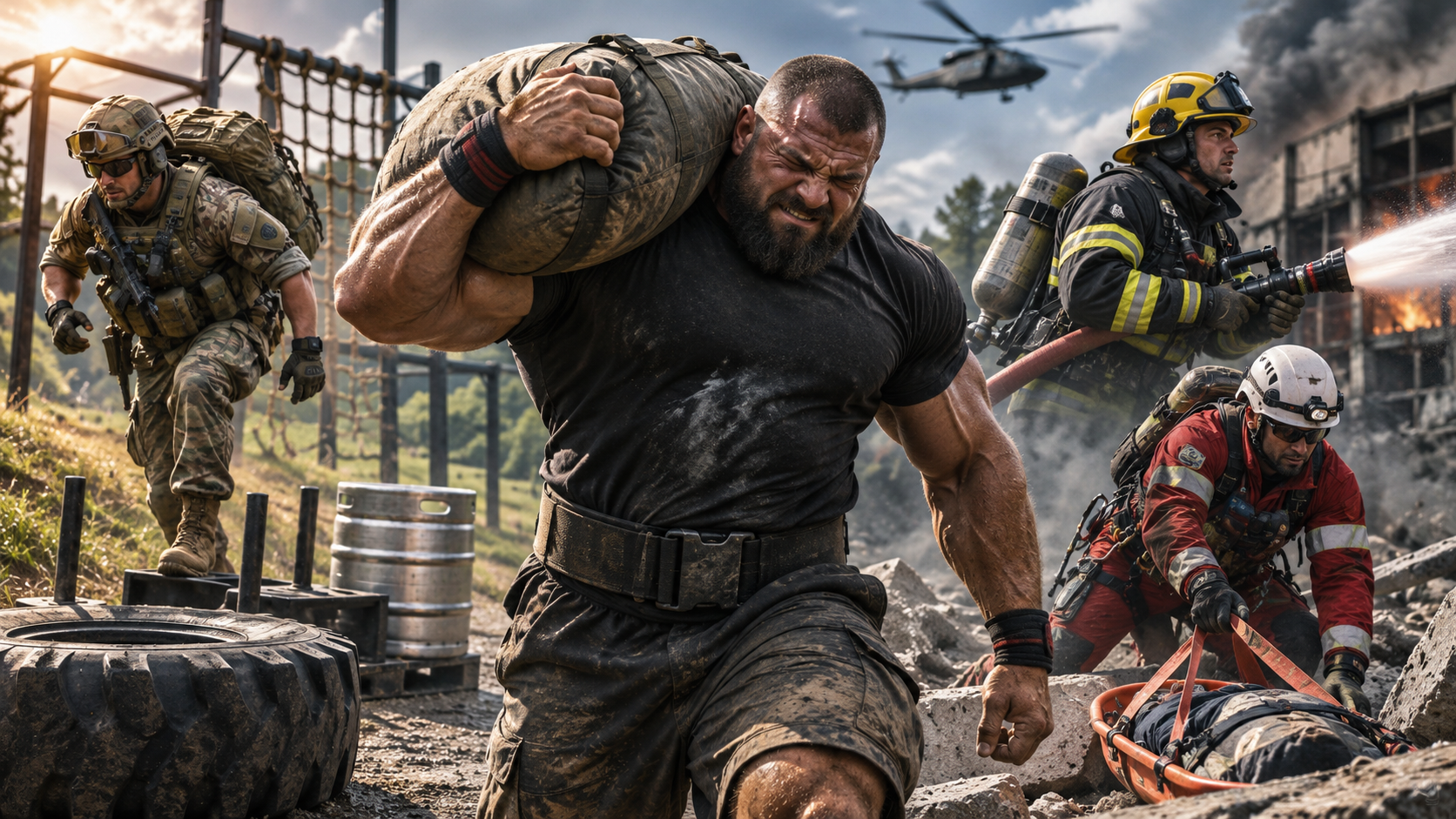
An injured person is not a competition implement
Casualty evacuation is an occupational activity in which three problems must be solved simultaneously: moving mass, protecting the person being moved, and maintaining team safety. In Strongman, a sled, bag, or training dummy is handled as an object with relatively predictable mechanical properties; in real patient care, the human body may be injured, may respond to movement, and may require medical interventions that immediately alter the appropriate transport strategy. Moreover, the casualty may be equipped, conscious or unconscious, and able to assist partly or not at all. Evacuation competence cannot therefore be inferred simply from the capacity to move a sandbag of comparable mass. Performance must be judged through physical, procedural, and safety criteria, while the choice of method depends on clinical circumstances and environmental hazards [1–4].
A casualty weighing approximately eighty kilograms and a dummy with the same mass do not behave identically. A living body has moving joints, variable muscle tension, possible bleeding, and sensitivity to positioning. Clothing may facilitate or obstruct grip, while rigid equipment can place pressure on vulnerable regions. Mechanically, the challenge is not only weight but also center-of-mass location, the number and shape of contact points, surface resistance, and the ability to control motion at every instant. Medically, even this description remains incomplete: the person may need ongoing reassessment, hemorrhage management, or airway support, and priorities must be established by personnel trained in applicable procedures [3–5].
Separating physical competence from medical competence does not minimize strength; it locates strength where it can genuinely help. A powerful rescuer may have more options for initiating and sustaining movement, may better tolerate muscular loading, and may possess reserve capacity when obstacles appear. That reserve does not authorize disregard for suspected spinal injury, respiratory compromise, or the need for specialized evacuation equipment. In research, manikin-drag times describe physical efficiency under a protocol, not clinical outcomes for real patients. This episode therefore examines the physical component of evacuation and the limits of transferring Strongman performance without presenting patient-handling instructions that supersede professional casualty-care procedures.
Immediate extraction, organized evacuation, and medical transport: three different aims
A sound analysis distinguishes extraction from immediate danger, movement toward a point of care, and subsequent medical evacuation. In the first situation, time may be critical because the environment remains hazardous; in the others, stabilization, monitoring, equipment, and continuity of care may become more important. Tactical Combat Casualty Care guidance updated in 2026 distinguishes phases of care according to the existing threat, while Tactical Evacuation Care recommendations separately address organization and handover to evacuation resources [3,4]. This distinction is not merely semantic: it changes the definition of success. A rapid drag exercise may partly model one component of extraction but does not cover preparation for transport or care during transfer.
During urgent extraction, an operator may need to initiate movement of a person lying in an unfavorable position. During planned transport, a team may have time to select a litter, assess the route, and coordinate the lift. The mechanical configuration changes dramatically: different contact surfaces, multiple carriers, distributed loads, and longer travel periods all enter the picture. Physical ability in one task cannot automatically be converted into performance in another. Someone capable of dragging a manikin twenty meters may not efficiently sustain a litter carry over a long distance; another person may tolerate prolonged transport but struggle with the initial movement of a person resting on the ground.
Occupational analysis must not mistake tactical scenarios for medical recommendations. Professional guidance prioritizes scene safety and measures that limit further harm, adapted to conditions. Where no immediate danger is present, patient-handling devices and methods should follow clinical assessment and local procedures; rushing without justification may be counterproductive. Physical training can improve the rescuer's general resources, but does not independently determine when, how, or whether a casualty must be moved. Those decisions belong within the relevant professional practice framework [3–5].
Mass, center of gravity, and the geometry of a carried person
Body mass describes only part of the problem; center-of-mass location and segment distribution influence how a rescuer can apply force. When a person lies on a surface, contact may extend across much of the body, while head, trunk, and limbs retain different degrees of movement. Raising one segment changes ground reactions and may introduce unintended rotation. If the operator's force is directed away from the desired line of travel, part of the effort may create rotation rather than useful translation. Strongman implements are sometimes rigid enough for this issue to be less pronounced; a human body and articulated training manikins introduce additional complexity. Estimating difficulty from kilograms alone ignores essential mechanics.
In ergonomics, the distance between a load and the handler's body often has major consequences for external moments at the joints. An object held close to the trunk may impose different moments than the same mass held with extended arms. Proximity cannot, however, be universally prescribed when handling an injured person: injuries, body positions, and equipment constrain appropriate movement. Force analysis must therefore be combined with clinical objectives; a mechanically efficient solution for the rescuer could be inappropriate for the patient. Physical training recommendations address implements and training manikins, while clinical patient-handling techniques must be taught separately within authorized professional procedures.
Anthropometric dimensions may also influence testing. Two manikins with identical total mass but different height or weight distribution can present different resistance and stability. Clothing, body armor, and attached equipment change contact surfaces and available grips. Mussalo and colleagues explicitly reported both the equipment mass worn by participants and the mass of the casualty manikin, an example of the detail required for reproducibility [2]. Where an organization compares completion times without documenting the precise test configuration, variations caused by equipment may be incorrectly attributed to fitness. Validity begins with task geometry, not with the results table.
Friction, ground surfaces, and horizontal force: why dragging is not simply lifting weight
During dragging, the rescuer does not necessarily overcome the object's entire weight vertically; instead, they must overcome contact resistance and control acceleration. In a simplified mechanical model, sliding friction depends on the normal reaction and a coefficient associated with the materials in contact. In reality, a manikin has multiple surfaces, joints, clothing, and support points that may change as movement proceeds. Pavement, sand, grass, wet concrete, and rubble do not produce identical resistance. Manikin mass therefore cannot be translated directly into required pulling force or compared with the nominal mass of a gym sled. A valid test should specify the surface and how the body contacts it.
Force direction changes the problem. If the pull has an upward component, the normal reaction against the ground may decrease, but the rescuer then carries part of the load. If the pull is nearly horizontal, more weight remains supported by the ground, and drag resistance may increase. Neither configuration is universally preferable: medical, ergonomic, and environmental constraints may override the goal of minimizing force. During a sled drill, an athlete can explore force angles in a controlled setting; in actual casualty care, the direction of movement cannot be chosen solely for sporting efficiency. The example demonstrates an important limit of the Strongman analogy.
At movement initiation, static friction and the geometry of contact may require more force than during steady sliding. If the rescuer's shoes lose traction, additional muscular force cannot be transferred efficiently. If the person must stop and restart repeatedly, force impulses and local demands may increase. These processes support progressive pushing and pulling practice using standardized training objects, combined with education about positioning and control. The desired competency is not simply to “pull harder,” but to recognize mechanical conditions and select a professional solution compatible with the transported person's safety.
Movement initiation: peak force and neuromuscular reserve
In a casualty-drag test, the first seconds may demand substantial force because contact points must be reorganized and a stationary mass must begin accelerating. An excellent deadlift may indicate useful neuromuscular resources, yet the force-transmission pathway is different: the rescuer's trunk, arms, and footwear form a coordinated system of levers while the load moves horizontally. If the contact geometry changes during movement, peak demand may occur unexpectedly. Progressive Strongman pulling exercises can develop tolerance for high force production without guaranteeing control of an articulated manikin or appropriate handling of an injured person. Those capacities require specific practice, supervision, and a clear separation between training implements and real patients [1,7].
Maximal strength reserve can reduce the relative intensity of a standardized pull, but does not automatically make the task easy. Friction, hand placement, footwear, and the ability to develop ground reaction forces all contribute to success. Exceptionally strong athletes may lose efficiency when pulling at an unfavorable angle or becoming unbalanced during initial acceleration. Testing only a barbell 1RM therefore provides incomplete information. For occupational personnel, measuring general strength and standardized manikin-drag time separately is more informative than assuming the first entirely explains the second. High strength is a supportive characteristic, not a certificate of professional competence.
Trunk position and moments imposed on the hips and spine
The mechanical demand imposed on the spine is not equal to the manikin's mass, because external moments depend on body-segment positions and force direction. An individual may produce substantial horizontal pulling force with a forward-inclined trunk and a particular lower-limb configuration, but that arrangement changes the demand on extensor musculature and passive tissues. No universally safe posture can be prescribed without knowing the technique, equipment, and casualty's condition. Training observations can focus on stability, movement control, and the ability to slow or stop an effort. Biomechanical research on Strongman events shows substantial variation in trunk muscle activation and lumbar loading across exercises, making simplistic event-to-event extrapolation inappropriate [7,8].
Fatigue can complicate the picture by reducing control and changing pulling strategy. Someone who begins with steady motion may end up moving in jerks, stopping unexpectedly, and struggling to coordinate body segments. These observations can increase effort without automatically proving injury. During assessment, movement quality matters alongside the stopwatch; during training, progression should preserve controllability. A prepared rescuer is not merely someone capable of producing high force in a static position, but someone who can maintain appropriate movement as conditions change.
Grip strength: the vulnerable interface between muscle and load
During any pulling task, force generated by the legs and trunk must pass through a mechanical interface. That interface may be a strap, a manikin handle, fabric, or a dedicated evacuation device. If grip is unstable, high capacity in the posterior muscular chain cannot be fully expressed. Hand-grip dynamometry provides a useful but limited indicator because it does not reproduce prolonged gripping, opening the hand around thick materials, or the effects of gloves. Vaara and colleagues include grip strength among the abilities associated with casualty evacuation, although relationships vary across testing protocols [1]. The specificity of the interface cannot be ignored.
Farmer's carries, varied handle diameters, and controlled load carries may improve the ability to sustain objects, but a powerful grip does not justify attaching force to any available component of a casualty's equipment. Professional devices have their own instructions and loading limits, while contact points are selected according to established procedures. If material tears or slips, adding muscular force does not solve the error. Occupational assessment should therefore consider grip reliability and load control rather than completion time alone. In many situations, a better handling interface is the appropriate solution rather than a more forceful attempt.
Forward, backward, and lateral locomotion are not interchangeable
Dragging a mass may require a rescuer to move in a direction different from ordinary running or marching. Backward walking alters visual information, stepping orientation, and the distribution of demand across muscle groups. Sideways movement and direction changes can require additional coordination to preserve balance. A farmer's walk performed forward on a straight course does not test these capacities. Occupational testing must therefore specify whether a single movement technique is required or several variants are allowed; these decisions measure different things. Moreno and colleagues' 2024 research found differences in dummy-drag times depending on the mass used and the permitted technique [6].
Statistical comparisons between techniques must not be mistaken for clinical advice about casualty evacuation. Allowing choice may make a test accessible to people with different physical characteristics, but increases variability and complicates standardization. Requiring a fixed technique may improve reproducibility while also measuring familiarity with that particular movement. Either way, assessment for intervention professionals must remain anchored in real procedures and patient safety. Physical training may involve alternative directions of movement with sleds or inert objects, but these activities are not instructions for medical transport.
Confined spaces change biomechanics before they change load mass
Within a narrow passage, between vehicle seats, or beneath a low obstacle, operators may have to reduce movement range and reorganize trunk orientation. Lower limbs can no longer produce force at the same angles available during a standard barbell lift, while visibility and object movement may be restricted. A small change in available space can determine whether motion is continuous or repeatedly interrupted for repositioning. A 2026 study of simulated tactical casualty-care scenarios involving Canadian reserve medics described the additional demands imposed by trench postures and constrained patient movement [10]. Such observations do not establish a universal law, but they illustrate the importance of the environment.
For physical preparation, this suggests cautiously integrating awkward-object work with controlled movement constraints, without unsafe scenarios or unprotected people. Restricted space can amplify the difficulty of a relatively simple task and reduce the efficiency of an exceptionally strong operator. Test protocols should document course dimensions, obstacles, surfaces, and permitted methods, as changes may affect the outcome more than small adjustments in dummy mass. In actual operations, teams may need specialized extraction equipment and specific procedures; no sporting improvement replaces those competencies.
The 2025 Finnish study: an evacuation test combining low crawling and upright dragging
A particularly relevant example is the study by Mussalo, Kyröläinen, and Vaara, published in Military Medicine in 2025, examining twenty-five conscripts, twenty men and five women. Participants wore combat equipment averaging 11.7 kilograms and dragged an equipped manikin weighing approximately 80.2 kilograms. The task involved twenty-eight meters of low-position movement following a zigzag course around markers, followed by twenty meters of upright dragging along a relatively straight path. Researchers recorded evacuation time, heart rate, blood lactate, and perceived exertion, as well as strength, anaerobic power, endurance, and body composition. This detailed task description matters: conclusions apply to the investigated configuration, not automatically to every conceivable evacuation [2].
The findings connected performance strongly with anaerobic measures, lean body mass, and maximal force capabilities, while cardiovascular strain was substantial. Nevertheless, a sample of twenty-five limits generalization, and combining low and upright movement can change the relative importance of physical abilities. The study does not prove that every person with greater muscle mass necessarily evacuates faster or that one Strongman event is the best training intervention. It suggests that force production and anaerobic performance can matter for a short, intense task of this kind. Validation would benefit from larger samples across different units and controlled programs with independent occupational outcomes.
Dummy mass and permitted technique change the outcome of a drag test
In 2024, Moreno and colleagues compared dragging manikins weighing approximately 74.84 and 90.72 kilograms over a 9.75-meter course using several execution rules. The study involved forty-three healthy, physically active adults serving as a surrogate population for police recruits. Both dummy mass and technique definition affected completion time. The lighter manikin was generally moved faster, and a protocol beginning with the dummy already positioned for dragging yielded different times from variants incorporating an initial lift. This illustrates a methodological problem: two agencies may both call their task a “victim drag” while actually measuring different physical actions [6].
The study does not prescribe clinical handling techniques and cannot be transferred uncritically to soldiers in actual operations. There were no living patients, and the dummy did not have physiological responses. Yet the research is valuable for test standardization. An assessment should specify whether timing starts before the first grip or after preparation, whether grip changes are permitted, whether movement direction can be selected, and how successful completion is judged. Without these details, a program may seem effective merely because post-training testing uses a more favorable configuration. Evidence quality depends on measurement comparability rather than dramatic appearance.
Canadian tactical-care simulations reveal the cost of environmental constraints
A 2026 investigation of Canadian Armed Forces reserve medics examined physiological demands during simulated tactical casualty-care scenarios, including carrying and handling tasks in differing conditions. The authors compared activities conducted in restricted environments, where trench posture altered the dragging movement. The work illustrates why a simple drag on a flat indoor surface may underestimate the complexity of an intervention in a trench or confined passage. One scenario included a team carry of a manikin, emphasizing that distributing effort among several people does not make individual physiological demand negligible [10].
These observations require careful interpretation: a simulation remains controlled, and participants, distances, loads, and roles differ across institutions. No universal intensity estimate for all evacuations can be extracted from a single protocol. The study nonetheless supports an important conclusion: spatial constraints, equipment, and coordination change demand even when dummy mass is unchanged. Training may therefore combine a strength foundation with task-specific environmental familiarization, while avoiding improvised scenarios that raise risk without a measurable objective. Occupational relevance requires balancing realism, control, and safety.
Why a short evacuation is often predominantly anaerobic
During short, high-intensity movement, muscles use energy resources rapidly to produce force and motion. The phosphagen system and glycolysis can contribute substantially, but oxidative metabolism does not stop; its share depends on duration and intensity. When the load is heavy, movement must begin quickly, and the route includes changes in body position, anaerobic power becomes especially relevant. In the 2025 Finnish study, anaerobic indicators correlated strongly with evacuation time, while other fitness measures were not equally predictive within that particular model [2]. This is a conclusion about a short task, not about every evacuation activity. Prolonged litter carrying may impose a different emphasis on aerobic metabolism.
For training, the findings support developing the ability to produce intense effort without neglecting broader conditioning. An athlete capable of one exceptionally heavy pull may not sustain quality over repetitions, while someone with excellent aerobic fitness may lack sufficient initial force. Programs may combine maximal strength, power, and repeated-effort elements according to individual capacity and the relevant mission. Every session need not become an exhaustion test. Unnecessary training fatigue can impair operational availability, which needs to be considered during programming [1,11].
Heart rate, lactate, and perceived exertion: what each measure means
An elevated heart rate during evacuation indicates cardiovascular strain, but does not by itself provide a precise estimate of each energy system's contribution. Elevated blood lactate after exercise may reflect substantial glycolytic activity, yet the measured value depends on sampling time, production, transport, and clearance. It is neither a direct fatigue meter nor proof that muscles have run out of oxygen. Perceived exertion adds information about subjective experience but can be influenced by stress, familiarity, and motivation. Mussalo and colleagues measured these different variables precisely to describe task demand from several angles [2]. Interpreting one value in isolation would be inadequate.
For military units, continuous biomarker collection is not always needed or justified. Completion time, movement quality, perceived effort, and the ability to repeat a task are often more accessible field indicators. In research, physiological measurements complement performance outcomes and can help explain mechanisms. Claims such as “high lactate means a good workout” or “high heart rate proves inadequate fitness” should be avoided. Intensity may be high even for well-trained individuals, and the same person may respond differently under different thermal or psychological conditions. Assessment requires context, not merely instruments.
Team evacuation: individual load depends on coordination
When two or four people carry a litter, loading is not automatically divided equally. Each carrier's position, height, arm length, direction changes, and differences in cadence may alter demand. If the team does not synchronize the start, one person may temporarily support a disproportionately large share. Changes in elevation and obstacles add external moments that do not arise on level ground. Competitive Strongman events are often standardized around an individual's effort, while real evacuation is cooperative work intended to protect the patient and preserve team capability. Exceptional individual strength can help but does not replace coordination and communication.
Effective team readiness includes keeping a load under control along the entire route rather than simply recording one person's speed. Assessment must specify carrier numbers, positions, opportunities to exchange roles, and stopping criteria. These details are indispensable for valid comparisons. Research on simulated tactical scenarios indicates that team carrying may remain physiologically demanding even when the mass is distributed [10]. In professional practice, training with litters and securing devices should follow the relevant service's rules; heavy-object conditioning remains complementary rather than a medical qualification.
Patient safety: when limiting movement matters more than speed
Some injuries call for special precautions when changing a patient's position, for example after trauma raising concern about spinal damage. Not all trauma requires the same approach, and current guidance does not reduce to the simplistic claim that every casualty should be rigidly immobilized. Clinical assessment, available supervision, tactical circumstances, and equipment determine appropriate care. British guidance on cervical spine management describes the purposes and limitations of rigid extraction devices and emphasizes context-specific precautions [9]. In sport, speed and force may be the main goals; in a rescue, appropriate patient movement is the higher criterion.
An occupational test should therefore avoid rewarding uncontrolled force. If a manikin is jerked violently or dropped, completion time alone does not describe good performance. Assessment may consider procedural adherence, continuous control, integrity of support points, and communication with partners. These requirements reduce direct comparability with Strongman but increase professional relevance. Strength is useful precisely when it gives the operator additional control rather than encouraging undiscriminating maximal force. The actual patient-handling technique belongs to trained personnel and cannot be derived from general fitness principles.
Monitoring and continuity of care during movement
A manikin cannot develop respiratory deterioration, express pain, or report that equipment is pressing on an injured region. Real evacuation, however, occurs within a sequence of medical assessments and decisions. Tactical-care guidelines emphasize reassessment, communication of interventions, and transfer of information to the receiving team [3–5]. Occupational competence therefore includes respecting one's team role and adapting physical effort to the transport plan, not merely covering distance. High movement speed may be unhelpful if coordination fails and the procedure is interrupted.
This is another reason why physical test performance must not be interpreted as a medical evacuation outcome. A short completion time may correlate with strength or anaerobic power, but it does not demonstrate better survival, fewer complications, or improved quality of care. Those claims require specific clinical and operational studies. Strongman training may improve the rescuer's muscular resources; patient monitoring, communication, and protection represent separate competencies. Complete preparation integrates them without treating them as interchangeable.
Preceding exertion: the rescuer does not always start rested
In standardized studies, participants are often tested after rest or a controlled warm-up. During duty, an operator may begin evacuation after loaded movement, manual labor, thermal stress, or limited sleep. These conditions may influence force production, grip, and movement coordination. A 2026 meta-analysis observed reductions in some measures of lower-body and trunk strength and postural stability after military foot marches [12]. Effects varied across outcomes and the evidence has methodological limitations; one cannot predict a fixed change in evacuation time from those averages.
Introducing preceding exertion into occupational research may increase realism, but only when it is standardized and performed safely. Comparing participants arriving with different fatigue levels is problematic. A development program can separately measure peak rested ability and preservation of performance after a relevant moderate workload. The difference may reveal useful information about functional reserve without requiring personnel to work to exhaustion. The aim is to identify mission-relevant limitations rather than accumulate unnecessary stress in the name of realism.
Heat, protective equipment, and available space modify demand
During evacuation, armor, helmets, boots, gloves, and protective garments may alter mobility, grip, and heat dissipation. Muscular activity generates heat, while some materials restrict cooling through evaporation and convection. Testing at a moderate temperature without equipment does not necessarily reproduce comparable work in a hot, restricted environment. Deliberately introducing extreme conditions into training, however, may add risk without demonstrated benefit. Gradual equipment familiarization, environmental checks, and supervision are more defensible than converting an evacuation drill into an extreme heat-tolerance challenge.
Research protocols should document temperature, humidity, equipment mass, and spatial configuration whenever these variables may influence outcomes. Changing gloves or footwear can alter grip and traction even when dummy mass is unchanged. During real operations, personal protection takes priority and should not be removed merely to improve a time score. Strongman may help develop load-control ability under different grip challenges, but professional tasks and protective procedures determine which configurations matter. A useful performance is one that can be repeated safely within mission requirements.
Litter transport and transferring load to equipment
A litter fundamentally changes the mechanics of moving a person compared with direct dragging. The patient is supported by a structure that can distribute pressure and provide purpose-built grips, and several operators may share the work. Increasing carrier numbers does not guarantee equal load distribution, however: hand positions, arm lengths, litter dimensions, and changes in elevation affect individual demand. Restricted environments can impose additional maneuverability requirements on the chosen device. In sport, farmer's carries may develop grip endurance and loaded walking, but they do not automatically develop the coordination of a team moving a patient under clinical securing rules [4,5].
During assessment, physical capability should be separated from device-handling competence. A team-carry test may include initial lifting, level movement, obstacle passage, and controlled lowering, each with different demands. Timing alone is incomplete if stability and procedural compliance are not checked. To reduce variability, equipment, carrier numbers, and routes should be held constant. In practice, choosing a litter and positioning the patient are matters of professional procedure. Physical conditioning prepares muscles for work but cannot replace instruction in medical handling devices.
Repeated evacuations and the ability to sustain more than one rescue
A single test may reveal peak capacity, but complex operations can require successive movements. Repeating exertion changes the analysis: recovery between attempts, heart-rate behavior, grip maintenance, and movement control become increasingly important. An operator may perform exceptionally on the first trial and slow considerably by the third, without a gym-measured maximal-strength score fully explaining the decline. Research benefits from recording each time separately and examining the trajectory rather than combining everything into one total. This can reveal limitations involving endurance, technique, or recovery organization.
Training can complement strength and power development with appropriately dosed repeated work, without requiring multiple maximal casualty simulations from every participant. Inert objects with adjustable mass and distance provide better load control than improvised drills involving people. Intensity and rest should match experience and current occupational workload. When fatigue degrades technique, progression may require reducing difficulty rather than insisting on a predetermined time. This approach develops reliability, the quality that matters when an operator must remain available after the first intervention.
Variation in casualty mass: standards cannot assume an idealized body
A dummy with a fixed mass is convenient for standardization, but cannot represent every body size or equipment configuration. The total mass of an injured soldier may include armor, helmet, and other gear, while body height and mass distribution can differ substantially from the test manikin. Moreno and colleagues found that increasing dummy mass significantly changed drag times [6]. The result is intuitive but important: a standard using a relatively light dummy does not prove competence with every heavier casualty. Equally, testing extreme masses without occupational justification may create unnecessary risk and measure a task outside the actual job.
Developing an occupational threshold requires analysis of essential tasks, the served population, and available evacuation devices. Minimum individual capacity for a critical maneuver must be distinguished from competence by a properly equipped team. Progress tests may use scaled loads for gradual development, while competency criteria require separate justification. Successful manikin performance must never be translated into a guarantee of safety for a real patient. Similar mass provides mechanical relevance, not clinical certification.
When completion time becomes a misleading outcome
Time is an attractive indicator because it is easy to record and produces numerical comparisons. Yet it does not describe the entire process. Someone may reduce completion time by moving faster, but also by omitting a step, using an unauthorized grip, or reducing load control. If the protocol fails to define the movement clearly, identical times may represent different behaviors. Research into law-enforcement drag techniques demonstrates the importance of initial conditions and timing rules [6]. Assessing occupations responsible for people must give procedural compliance as much consideration as seconds or minutes.
A carefully designed protocol can separately report total time, interruptions, observed stability, and events requiring trial termination. Research also needs inter-rater reproducibility so assessors recognize similar errors in similar ways. Not every condition can be compressed into a numerical score without losing meaning. Sometimes a safety pass/fail criterion combined with continuous timing for compliant participants is more defensible than an arbitrary composite ranking. The aim is to identify usable capability rather than reward uncontrolled shortcuts.
Maximal strength is a resource, not a complete explanation
Associations between maximal strength and evacuation time matter, but no individual exercise represents the entire phenomenon. A person with good deadlift and squat scores may struggle with gripping, backward movement, or fatigue in confined space. In the Finnish study, lean mass, anaerobic power, and maximal strength were relevant to performance [2]. Other research reviewed by Vaara identified relationships with muscular endurance and aerobic capacity, depending on the duration and configuration of evacuation [1]. These findings show that preparation is multidimensional, not that every physical quality has equal importance in every task.
Training may first improve general strength and then integrate pulling, carrying, and task-specific movement with suitable training manikins. Occupational performance must nevertheless be retested independently. If 1RM rises while evacuation time remains unchanged, possible explanations include limiting technique, insufficient endurance, or a task that does not strongly depend on the improved quality. In research, a null result does not make strength irrelevant; it prompts closer attention to mechanisms and goals. Gym progress is one contribution to operational availability, not a substitute for assessing it.
What training interventions have demonstrated for simulated evacuation
Associations between muscular force and task performance do not by themselves prove that every strength program improves the task. Causal claims require interventions and comparisons. Vaara and colleagues' review summarizes studies with heterogeneous outcomes. Among previously untrained civilian men, eight weeks of physical preparation improved evacuation times, yet improvement with external resistance training was not clearly superior to a standardized military-style program. Another study among recreationally active women found that improvements in some fitness measures after eight weeks did not translate into a significant group improvement in evacuation performance [1]. Transfer is therefore possible, but neither automatic nor uniform.
A study of active-duty soldiers reviewed in the same publication reported more favorable results from a program including strength, agility, power, and loaded movement than from traditional preparation across seven weeks. The intervention was multicomponent, however, so its whole benefit cannot be assigned to one Strongman-like exercise. Baseline differences, adherence, occupational workload, and test familiarity may also influence the outcome. Citing only a percentage improvement misses the key scientific questions: what was compared, in whom, and using which criteria? The evidence supports integrated preparation rather than the inevitable superiority of one training style.
Long-term periodization and experienced operators
Experienced personnel may respond differently to training than recruits. A longitudinal study involving specialized operators, summarized by Vaara and colleagues, followed successive phases of periodization and measured simulated evacuation performance among other outcomes. Improvement was not identical in every phase, with some results becoming clearer after modifications in program structure [1]. Yet temporal sequence does not prove that one periodization model is universally superior: previous training effects, workload changes, and individual development cannot be eliminated completely. The practical lesson is to evaluate long-term programming through actual outcomes and adjust it to the operators' characteristics.
In such populations, even a small percentage improvement may matter occupationally if it reduces exposure time during a critical task, but the significance is not automatic. The change should exceed the test's normal variability, persist over time, and avoid unacceptable loss of availability for duty. A strength-focused phase may be followed by repeated-work development and occupational integration, but the sequence must be justified by data. Strongman can be introduced as a method of handling awkward objects without turning sport-specific ranking into the aim of the program. An operator need not become a champion in an event to perform professional tasks better.
Lean mass and the relationship between available resources and inert load
Lean body mass is often related to the amount of available muscular tissue, although it also includes water, bone, and other components. In casualty-evacuation research, higher lean mass can correlate with better performance on certain tests, which is plausible when substantial external mass must be moved. Lean mass alone does not measure strength, technique, or anaerobic capacity. In research summarized by Vaara, a statistical model combining a ratio involving active body mass and inert load with maximal strength explained an important portion of performance variability in a prolonged evacuation protocol [1]. Such a model must not be presented as a universal individual prediction equation.
In practical assessment, body composition provides context while the actual task still needs direct measurement. Two people with comparable muscle mass may differ in experience, grip, and fatigue response. The training goal is not indiscriminate weight gain: substantial increases in body mass can also change loaded mobility and aerobic requirements. Mature programming emphasizes useful force, its application, and tolerance of repeated work. Physical appearance cannot reliably determine evacuation competence; observable performance and safety criteria are required.
Individual differences and defensible occupational standards
An evacuation test is valid for selection only when it represents an essential occupational task and its passing threshold is justified through job analysis. Choosing an extremely heavy dummy and declaring that the fastest participants are universally better professionals is insufficient. Sex, age, proportions, muscle mass, and experience influence performance, but essential task requirements must be described separately from the distribution of participants' characteristics. An organization may need individually scaled progress tests alongside shared minimum criteria for particular critical duties. These forms of assessment serve different purposes and should not be conflated.
When developing standards, dummy mass and route must be documented, and assessors trained to apply the rules consistently. A test is not fair merely because it is maximally difficult; fairness derives from occupational relevance and reproducibility. Where operations are normally team-based, evaluating both baseline individual ability and collective competence may be necessary. Strongman training can provide strength-development tools but should not become a moral or identity-based criterion. Professional competence means completing the required tasks safely and according to procedure, not recording the highest absolute gym score.
Why Strongman studies are not direct proof of evacuation effectiveness
Strongman biomechanical research describes trunk demand, carrying techniques, and characteristics of events such as farmer's walking, yoke movement, dragging, and unconventional lifting. It can identify relevant mechanisms without proving that the same adaptations automatically improve human evacuation. Hindle and colleagues' 2019 systematic review highlighted both similarities with everyday tasks and substantial evidence gaps across several events [7]. Winwood's 2015 comparative trial found broadly similar effects from Strongman and traditional training for various performance measures among rugby players; medical evacuation was not a central outcome of that experiment [13].
Demonstrating occupational transfer would require studies assessing participants before and after interventions, matching overall training exposure, measuring outcomes independent from practiced exercises, and monitoring safety. Improvement on a sled drag can reflect familiarity with the sled rather than readiness for every evacuation configuration. Similarly, an excellent farmer's carry does not demonstrate an ability to handle a litter with a partner. The reasonable conclusion is that Strongman provides potentially useful exercises whose place must be determined by task requirements rather than assumed superiority.
A test battery must distinguish strength from actual task performance
A useful occupational protocol should not collapse into a single spectacular event. Assessment may include standardized maximal strength, anaerobic capacity, an inert-manikin handling task, and a repeated-effort measure when job analysis justifies these components. Selection should not imitate a Strongman competition; it should identify limiting factors. An isometric pull or deadlift result may help interpret task performance but should not be arbitrarily added to evacuation time in a composite score that conceals a critical deficiency. Outcomes should be reported separately, with their individual meaning and measurement error [1,2].
A sound battery must also be reproducible. Consistent loads, courses, instructions, warm-up procedures, and stopping criteria are basic requirements. If one participant may use a technique prohibited to another, comparison no longer reflects only physical ability. Tests should be safe enough to administer with qualified staff and inspectable equipment. Assessors must recognize invalidating errors consistently. Without these safeguards, ranking personnel may reflect protocol inconsistency rather than genuine differences.
Finally, testing purpose must be explicit. In training, results identify deficits and monitor progress. In occupational selection, thresholds require professional justification and validation. Exceptional strength cannot automatically compensate for failure on an essential task, and mediocre sporting results do not establish professional incapacity. People have different physical resources and may achieve occupational competence through different training pathways. Good assessment produces information that leads to defensible decisions.
The stopwatch and measurement error
Evacuation time may vary between days even when underlying fitness is unchanged. Familiarity with the course, sleep quality, footwear, surface, motivation, and small changes in grip can affect the result. If an operator improves by a fraction of a second, adaptation cannot automatically be inferred. Research should estimate normal test variability through repeated trials under consistent conditions. Organizations should not interpret selection thresholds while ignoring measurement error.
The outcome also depends on when timing begins. Including initial grip preparation and lifting measures the initiation phase, whereas starting with a prepared manikin can yield a faster result from the same person. Moreno and colleagues' technique comparison illustrates this distinction [6]. Defining a rule is not sufficient; it must be consistently applied and explained to participants. Otherwise, a training comparison may be invalid before statistical analysis begins.
Individual monitoring should interpret time alongside movement quality and context. Progress accompanied by instability is not equivalent to progress with improved control. If a participant is slower after a demanding duty week, the result may reflect transient fatigue rather than deterioration of underlying capacity. Avoiding premature conclusions protects both the person assessed and the institution's credibility.
Practicing with real equipment and the limits of familiarization
Uniforms, armor, helmets, and gloves can alter access to grip points, trunk posture, and the ability to take long steps. Familiarization with these constraints is valuable, but should not become a maximum-load competition. Initial training can emphasize understanding equipment, checking freedom of movement, and rehearsing procedures at controlled speed. As personnel demonstrate competence, scenarios may progressively resemble occupational conditions. This progression does not replace the authorization and medical instruction required for moving a real patient.
Introducing all difficulty variables simultaneously is a common mistake: high mass, poor visibility, uneven terrain, restricted space, and fatigue. If performance is poor, the cause becomes difficult to identify. Research and training gain more useful information by introducing variables progressively, which may also manage risk. A simple task on predictable ground can establish technique before a single relevant constraint is added.
Realism does not mean chaotic imitation. A well-designed scenario has a purpose, a measurable outcome, and clear stopping procedures. Participants should recognize circumstances requiring interruption. An injured person is not an experimental implement for testing operator endurance. Physical conditioning and clinical instruction can be coordinated, but each must respect its own professional boundaries.
Psychological readiness cannot be inferred from a drag record
Evacuating someone in a dangerous environment can demand attention, emotional regulation, communication, and decisions under pressure. These capacities are not identical to maximal strength. Experienced athletes may be accustomed to competition stress and intense effort, but that does not prove they will prioritize clinical responsibilities or coordinate a team effectively during a critical incident. Psychologically, performance depends on trained skills, role clarity, experience, and context. Sporting rankings are not substitutes for behavioral assessment.
Communication and decision-making elements can be introduced through progressive scenarios without making confusion the objective. Physical technique and procedural understanding should be established before additional attentional demands are evaluated. Team behavior may be observed against clear criteria such as adherence to assigned roles and communication of relevant information. Quiet participants are not automatically less competent, just as very vocal participants are not necessarily effective coordinators.
A program combining fitness with operational instruction needs to distinguish physiological adaptation, procedural learning, and cognitive performance. When all indicators improve, it is useful to know which intervention helped and under which conditions. If strength increases while teamwork remains problematic, adding more mass to a sled may not solve the actual deficit. Correctly identifying the limitation matters more than the symbolic intensity of a workout.
Cost-benefit analysis of Strongman-style exercises in institutions
Strongman implements may be useful but involve purchase, storage, maintenance, space, and supervision costs. Some events require durable surfaces and coaches experienced with particular movements. Institutions should not adopt an exercise simply because it resembles an intervention task. They need to establish which quality it develops, how progression will occur, what alternatives exist, and whether the gain appears in occupational testing. Sled drags or dumbbell carries can sometimes train important general components without specialized equipment.
An economical, well-managed program may outperform one that looks impressive but cannot be delivered consistently. Where personnel frequently change locations, easily standardized tools may offer advantages. In restricted space, increasing load mass is not necessarily the best substitute for missing movement distance. Coaches should avoid solutions that raise risk without demonstrated benefit. Training quality comes from consistent execution and task relevance, not from the number of unusual implements in the facility.
Ideally, organizations evaluate programs before and after implementation while monitoring both performance and adverse events. Without that verification, investment may offer more promotional appeal than preparation value. Strongman is a useful source of ideas for occupational strength conditioning, but the final criterion is improved ability to work safely. A good method is one that can be justified, repeated, and adjusted.
The kinetic chain and force transmission during casualty movement
Effective dragging emerges from interaction among the lower limbs, trunk, shoulder girdle, and gripping interface rather than an isolated arm action. Lower-limb muscles contribute to ground propulsion, while trunk musculature transfers and controls force toward the contact point. Poor coordination may direct effort into movements that fail to move the load. Nevertheless, the human body is not a perfectly rigid mechanism, and joint adjustments are essential for balance. Strongman sled pulls can train aspects of this coordination, but inert implements do not reproduce all characteristics of an injured person [7,8].
Force capacity at the hips and knees can be measured in standardized exercises, but scores are not additive. Effective pulling force cannot be calculated by adding a squat 1RM to a deadlift 1RM. Each exercise has distinct joint positions, support conditions, and velocities. Footwear traction may also limit the force transmitted into movement even when muscular reserve is large. This supports occupational task testing alongside general fitness measures.
Physical preparation should build robust capacity progressively rather than repeat uncontrolled movement to exhaustion. A program may separately develop lower-limb strength, trunk stability, and grip before checking their integration in inert-load tasks. The final criterion is controlled, reproducible movement, not a demonstration that every body segment can be maximally contracted at once. An exercise is useful when it improves what an operator can actually do under relevant working conditions.
Braking and stopping safely are part of performance
Drag assessments often emphasize starting and movement speed, but controlled stopping can be equally important. A moving body or device carries momentum and may continue travelling if braking forces are insufficient. On sloped ground, gravity changes the problem further. An operator must maintain balance, control the load, and respond to route changes without unnecessary jerking. Sport may define completion by crossing a line; occupational work must also consider how and where movement stops.
In manikin research, stopping and turning may offer additional information about control, but protocols must describe them precisely. If participants can let the dummy slide uncontrolled toward the finish, a fast time may not reflect responsible professional handling. Stopping requirements and observation of control are therefore important. The stopwatch and movement quality represent distinct dimensions; neither replaces the other.
Training can develop braking and control with sleds and inert objects at intensities permitting correct repetition. Better control does not necessarily require greater weight. It can involve more predictable stopping, less oscillation, or maintained balance after direction changes. Actual casualty application depends on authorized evacuation procedures. The general principle is that mechanical performance does not end once a load starts moving.
Ergonomics and assistance devices can reduce force requirements
Where an operation can be performed using an appropriate litter, sliding aid, or mechanical system, such equipment may reduce individual demand and improve control. This does not indicate a fitness deficiency but a justified ergonomic choice. The purpose of an intervention is to solve the task with appropriate resources and risk, not to demonstrate maximal strength. Research comparing manual and assisted movement must describe the device, surface, and personnel involved. Without such detail, differences cannot be assigned solely to participants' fitness.
A cultural error arises when using technical assistance is treated as weakness. Emergency occupations depend on integrating people with equipment rather than artificially separating them. High strength can be valuable where mechanical access is limited, but does not justify ignoring suitable devices. Similarly, distributing a load among teammates may improve control even when one person could perform the task alone in ideal conditions.
This perspective affects assessment. Individual unaided capability may matter in defined situations, while correct team use of available devices represents another outcome. They should be measured separately. Strongman develops physical capacity for difficult tasks; ergonomics reduces avoidable demand. Together they can support operational readiness, provided medical and safety procedures remain paramount.
Recovery after intense intervention and readiness for the next task
After a brief, intense effort, the body continues restoring physiological balance. Heart rate and ventilation may remain elevated, energy resources need replenishment, and muscles may show local fatigue. Recovery duration depends on intensity, experience, temperature, and prior conditions. Completing one evacuation quickly does not guarantee immediate readiness to repeat it. Recovery capacity may be a relevant occupational outcome where multiple interventions are likely, but assessment should avoid excessive or unnecessary fatigue.
Strongman training can involve repeated efforts with prescribed rest, but these choices must reflect the intended adaptation. If the aim is maximal force, insufficient recovery may turn a strength session into a fatigue-tolerance test and undermine movement quality. If the aim is repeatability, recovery interval becomes a planned variable. No single interval applies to all operational tasks. Observing performance and fatigue signs is more useful than copying a competition's rest schedule.
At the organizational level, recovery relates to duty schedules, sleep, nutrition, and the number of consecutive tasks. An exceptionally strong person may have high peak capacity yet incur substantial cost from repeated maximal efforts. Distributing duties and using technical resources can reduce unnecessary stress. Physical preparation should enlarge available reserve rather than establish an expectation that the same individual always performs the heaviest task.
How to formulate a research hypothesis about Strongman transfer
A broad claim such as “Strongman makes soldiers more functional” is too vague to test scientifically. A better hypothesis specifies the population, exercises, intervention duration, comparator, and outcome. For example, researchers could ask whether progressive carries and drags integrated into usual training without increasing total workload improve the time and quality of a manikin-handling test compared with conventional strength programming. Another question could concern performance retention after a standardized aerobic task. Safety criteria must be explicit in either design.
Sound research requires familiarization before baseline testing, comparable groups, adherence monitoring, and trained assessors. If participants merely learn the precise evaluation course, improvement may largely reflect familiarity. An occupational outcome related to actual work but not identical to weekly training exercises would therefore be useful. Adverse events, missed training, and availability for duty should also be monitored. Otherwise, improved times might conceal important operational costs.
Transfer should also be assessed by initial ability. Beginners can improve through a wide range of methods, whereas experienced operators may require more targeted stimuli. Multisite studies involving different occupational specialties would help establish generalizability. Until stronger evidence becomes available, Strongman is best regarded as a plausible repertoire of complementary exercises rather than a universal remedy for every occupational fitness deficit.
Hypothetical scenario: equal strength, different competence
Imagine two operators with comparable maximal-strength scores. One has experience handling a rescue manikin; the other knows mainly barbell exercises. During an evacuation task, the experienced operator may have an advantage through grip selection, movement control, and familiarity with the object's dimensions. This does not make strength unimportant; it demonstrates the role of task learning. After familiarization, the gap may narrow before muscular capacity changes substantially. Research must distinguish neuromuscular adaptation from learning the assessment itself.
Now change the surface. Someone who practiced only on a smooth floor may need to reorganize steps and pulling forces when traction changes. A stronger person is not immune to slipping. With the same manikin and procedure, ground conditions can change the need for force and control. Performance should therefore not be reported without environmental description.
A well-designed program would assess strength and the occupational task separately, provide initial familiarization, and determine whether improvement survives a reasonable alternative configuration. Even this cannot predict every real incident, but it can reduce confusion between familiarity and capability. What matters professionally is an ability available under credible, safe conditions rather than one isolated daily score.
Hypothetical scenario: the strong operator arriving fatigued
Consider a strong soldier who must assist with evacuation after prolonged loaded movement. When rested, the person may move a manikin quickly; after carrying equipment, movement speed may decline and grip may become harder to sustain. This hypothetical scenario does not imply a fixed performance loss. It distinguishes peak capacity from capability available in context. A 2026 meta-analysis of military marches reported decreases in certain neuromuscular measures, but cannot predict any individual's exact evacuation time [12].
A program devoted solely to maximal lifts may enlarge strength reserve without adequately preparing travel tolerance. A program devoted only to endurance may leave insufficient force for initiating a heavy pull. Mixed preparation is more plausible, but must reflect duty schedules and individual history.
Assessment can distinguish rested task performance from preservation of control after a standardized preceding workload. The goal is not participant exhaustion but identifying a mission-relevant limitation. Fatigue-based assessment needs prudent loading and stopping criteria. Improving occupational ability does not justify disproportionate risk during its measurement.
Managing overload through dosage rather than exercise prohibition
A sled drag or heavy carry is not automatically dangerous, just as a barbell exercise is not automatically safe. Risk depends on load, frequency, experience, technique, surface, and recovery status. Occupational programming must also include workload performed during duty, not only supervised gym sessions. If an operator has already moved heavy equipment all day, adding maximal work may not be appropriate. Adjusting dosage is part of professional preparation.
Progression can gradually change mass, distance, or repetitions, but simultaneously changing everything makes monitoring difficult. Obvious loss of control, inability to complete a movement safely, or persistent symptoms warrant stopping and reassessment. Not every discomfort indicates injury, but pain undermining function should not be normalized.
Institutions may benefit from simple exposure records and monitoring availability for duty. If a program improves a test time but increases musculoskeletal-related absence, its net usefulness requires reconsideration. A competitive Strongman record may be a legitimate sporting objective; occupational preparation seeks sustainable, usable capability.
Evidence quality: sample, comparator, and representativeness
Casualty-evacuation studies differ in sample size, sex distribution, occupation, training status, and dummy mass. Small samples may identify promising relationships, but estimates can be unstable and generalization difficult. Research among recruits may not directly represent experienced operators, while police data are not interchangeable with medical rescue. Methodological quality must therefore be examined before recommendations are made. The work of Mussalo and Moreno is useful precisely when interpreted within its explicit limitations [2,6].
Comparative interventions provide more causal information than correlations but require attention to total training volume and intensity. If a Strongman group receives more training hours than a comparator group, gains may reflect greater dose rather than method superiority. If post-training assessment includes precisely the exercises practiced by only one group, testing may reward specific familiarity.
Responsible reporting also avoids selecting only favorable outcomes. A program improving one test while showing no effect on two others should be described fully. A bibliography is a verification tool, not decoration. Establishing Strongman as a robust occupational option requires evidence separating its specific benefit from the ordinary effects of any well-designed training program.
Questions that research must still answer
The first question concerns which exercises most efficiently develop each component of evacuation: initial force, sustained pulling, stability during direction change, and repeated-work tolerance. The second asks whether gains persist when the surface, dummy, or equipment differs moderately from training. The third concerns physiological cost relative to benefit: a program might reduce task time while requiring excessive recovery for current duties. Different research methods are needed; no single coefficient resolves these issues.
Research should also examine appropriate evacuation devices, team performance, and safety outcomes. Testing only individual drags may overstate absolute strength's relevance where teamwork is the normal solution. Conversely, testing only team tasks may miss a rare but critical individual requirement.
Validation across different populations also matters. Age, experience, body composition, and occupational profile can modify observed relationships without justifying stereotypes about competence. Longitudinal studies and transparent protocols can clarify Strongman transfer. Until then, recommendations should remain proportional to evidence: develop strength, practice occupational tasks, and assess medical and physical quality separately.
The training pathway: from general capacity to applied competence
Preparing operators for evacuation need not begin with a maximal simulation. The first stage can address fundamental movement control, lower-limb and trunk strength, and the safe support of objects. A second stage may introduce drags and carries with inert implements using loads matched to experience. Integration then connects physical tasks with institutional procedures, equipment, and safety criteria. This is a training logic, not a universal medical handling protocol.
Progress should be judged through more than increasing weight. Reduced oscillation, stability through turns, sustained grip, and controlled stopping can also be tracked. Beginners may improve through familiarization before gaining substantially more strength, which helps explain why rapid improvement in test time does not necessarily indicate hypertrophy or profound metabolic adaptation.
In actual operations, the goal is physical ability integrated with transport and care procedures. Strongman exercises are optional tools rather than the compulsory center of preparation. Testing must confirm that general resources become relevant occupational performance. A highly accomplished strength athlete may possess useful potential, but fitness for duty requires independent assessment.
The training week and operational workload: avoiding redundant stress
A training week should be constructed around existing occupational demands. Marches and material handling already provide physical stimulus even when they are not labeled exercise. Adding heavy dragging on the same day may increase total load without proportionate benefit. During intense duty periods, maintaining strength and movement control may be preferable to aggressively chasing records. During lighter periods, larger progressions may be introduced under supervision.
For general conditioning, one session might emphasize standardized strength, another controlled awkward-object handling and conditioning, while occupational procedures are rehearsed separately. This is an illustrative structure rather than a mandatory frequency prescription. Recovery depends on experience, sleep, intensity, and physical activity outside the gym.
Monitoring need not be unnecessarily complex. Session duration and difficulty, performance on major lifts, persistent pain, and duty workload can guide decisions. If progress stalls after a demanding period, increasing intensity is not automatically the answer. Reducing volume and consolidating technique may preserve availability. In intervention occupations, good training develops abilities without exhausting resources needed for duty.
Different adaptations: motor learning, hypertrophy, and endurance
When someone improves an evacuation-test time, several adaptations may contribute. Familiarity with course and grips can reduce unnecessary movement, whereas greater force can accelerate mass more quickly. Better conditioning may help sustain intensity or recover between attempts. These mechanisms unfold at different rates and cannot be distinguished from final time alone. Research seeking causal explanation should combine occupational assessment with independent physical-capacity measurements.
Hypertrophy may increase longer-term force potential but does not automatically establish better manikin handling. Similarly, good jumping performance may indicate muscular power without guaranteeing grip maintenance or control of articulated loads. Coaches should avoid assuming that every improvement reflects the same biological adaptation.
The distinction supports more precise interventions. Where force is adequate but time is lost during turns, movement learning may help. Where the load cannot be initiated, strength development may be important. Where speed declines across repeated efforts, conditioning and rest management may be more relevant. Individualization starts by identifying the limiting mechanism.
Rare but critical tasks: assessment without unnecessary spectacle
Not all physical tasks occur equally often. An operator may spend most duty time carrying moderate materials and only rarely assist with extracting a person. Rarity does not make the task unimportant, but neither does it justify hazardous simulations. Job analysis should specify failure consequences, likely occurrence, and available resources. Standardized assessments with appropriate manikins and equipment can then be designed.
A difficult test has selection value if it represents a genuine essential requirement and its passing criterion is valid. Difficulty chosen merely for drama may create confusion and risk. Every assessment need not push participants toward absolute maximal force. Controlled completion of a relevant standard can be more informative than discovering the largest possible mass.
Strongman demonstrates adaptation to heavy loads, but competition differentiates athletes rather than completely modeling occupations. Institutions may borrow exercises while keeping their success criteria professional. Treating rescue work like a ranking event can distort both training and assessment.
Operational availability is the ultimate physical-training outcome
An operator's strength may improve in the gym, but institutions need personnel capable of completing tasks repeatedly and safely. Availability for duty depends on fitness, health, recovery, and work organization. A program producing impressive records alongside frequent periods of unavailability may offer poor net value. Such outcomes cannot be established by one contest or exercise photographs; they require longitudinal monitoring.
For evacuation tasks, relevant outcomes include physical capacity, procedural competence, coordination quality, risk control, and the ability to remain functional after an intervention. Some can be measured through time and force, while others require safety criteria and technique observation. A faster time obtained by sacrificing load control is not an unambiguous occupational benefit.
Strongman integration should therefore depend on measurable improvements in specific tasks rather than the sport's prestige. A mature program preserves the advantages of absolute strength while recognizing its limitations. This provides a foundation for the series' subsequent discussion of equipment carriage, occupational fatigue, and comprehensive physical preparation.
The fundamental distinction among strength, procedure, and medical outcome
Discussions about Strongman in military preparation risk conflating three different dimensions. The first is the physical capacity to generate and transmit force; the second is the procedural competence required to use available resources during professional work; the third is the medical outcome for the person receiving care. These dimensions can interact, but none automatically proves the others. An operator may be exceptionally strong yet inadequately trained for a clinical maneuver; another may understand the procedure but require assistance with an unusually heavy load. Responsible assessment evaluates the dimensions separately and examines their safe integration.
Manikin-evacuation studies primarily describe physical performance and its determinants. They offer information about strength, body composition, anaerobic capacity, and time but do not directly measure patient survival or recovery. Clinical guidelines establish care and movement principles but do not independently quantify every rescuer's physical capacity. Complete preparation needs both kinds of expertise. Sports studies are therefore interpreted here as evidence about mechanics and training rather than authorization for clinical handling.
Operational units can benefit from cooperation among physical-training instructors, medical personnel, ergonomists, and professionals responsible for response procedures. Each contributes different expertise. Strength supplies a resource; instruction governs its use; assessment examines practical outcomes. The best program is not the one producing the heaviest training drag, but one that increases usable capacity without compromising patient or team safety.
Integrating findings into a professional preparation culture
A professional training culture values performance without reducing competence to a record. It defines essential tasks, identifies physical demands, selects appropriate methods, and checks progress through relevant testing. Strongman offers pulling, carrying, lifting, and awkward-load control exercises, but each should be selected for a defined purpose. If operators improve on those exercises while occupational outcomes do not change, programming should be reconsidered. Transfer is measured rather than assumed.
Instructors should distinguish maximal-strength development from team-based occupational practice. The former can be individualized by capacity and recovery, while the latter must follow established procedures and safety conditions. Unplanned overlap may create fatigue and reduce instructional quality. Coordinated correctly, strength development can provide more reserve for materials handling and repeated work. That is a stronger justification than simply declaring Strongman functional.
Internal records of progress, execution problems, and availability for duty could help organizations refine programs. Personal data require responsible handling, and testing should not become a stigmatizing tool. The purpose is to identify needs and allocate resources effectively. For institutions, quality means a verifiable, adaptable process that remains safe enough to sustain over time.
Conclusion: effective evacuation means more than moving mass
Casualty evacuation is biomechanically demanding and also a professional responsibility that cannot be reduced to drag time. Maximal strength, functional muscle mass, anaerobic capacity, and work tolerance may influence performance, but their importance varies with course, equipment, technique, distance, and clinical context. Available evidence supports physical preparation without proving that a Strongman record certifies competence in moving people. Finnish research, police manikin studies, and Canadian simulations show why the actual protocol must be described before the result can be interpreted [1,2,6,10].
Strongman exercises can support general preparation through strength, grip, stability, and carrying development, but occupational practice and medical training remain essential. Assessment should consider physical performance alongside control, procedural compliance, and availability for subsequent tasks. Effective training is not the loudest or most spectacular; it develops useful resources without unnecessarily consuming the health of personnel.
Episode 3 examines another fundamental military requirement: movement with heavy equipment. It explores how external mass affects gait, posture, metabolic cost, and accumulated fatigue. The connection with evacuation is direct. Operators sometimes reach critical tasks after prolonged carriage, when their available force may differ from strength measured in a rested gym test.
Scientific references and professional guidelines
[1] Vaara JP et al. Physical training considerations for optimizing performance in essential military tasks. European Journal of Sport Science. 2022;22(1):43–57. DOI: 10.1080/17461391.2021.1930193.
[2] Mussalo J, Kyröläinen H, Vaara JP. Physical Fitness Determinants of a Military Casualty Evacuation Test. Military Medicine. 2025;190(3–4):e790–e796. DOI: 10.1093/milmed/usae414.
[3] Committee on Tactical Combat Casualty Care / Joint Trauma System. Tactical Combat Casualty Care Guidelines. Revision May 1, 2026. https://tccc.org.ua/en/collection/recommendations
[4] Committee on En Route Combat Casualty Care. Tactical Evacuation Care (TACEVAC) Guidelines, 2024. https://tccc.org.ua/en/guide/tacevac-guidelines-enroute
[5] United Kingdom Defence Medical Command. Care of the Injured Patient: Clinical Guidelines for Operations. Updated guideline collection 2026. https://cgo.mod.uk/clinical-guidelines-for-operations/treatment-guidelines/urgent-and-emergency-care-guidelines/care-of-the-injured-patient/
[6] Moreno MR, Dawes JJ, Orr RM, Dulla JM, Lockie RG. Effects of Technique and Dummy Mass on Law Enforcement-Specific Body Drags: Testing and Training Implications. International Journal of Exercise Science. 2024;17(4):1235–1249. DOI: 10.70252/YFKX5370.
[7] Hindle BR, Lorimer A, Winwood P, Keogh JWL. The Biomechanics and Applications of Strongman Exercises: a Systematic Review. Sports Medicine - Open. 2019;5:49. DOI: 10.1186/s40798-019-0222-z.
[8] McGill SM, McDermott A, Fenwick CMJ. Comparison of Different Strongman Events: Trunk Muscle Activation and Lumbar Spine Motion, Load, and Stiffness. Journal of Strength and Conditioning Research. 2009;23(4):1148–1161. DOI: 10.1519/JSC.0b013e318198f8f7.
[9] United Kingdom Defence Medical Command. Cervical Spine Management & Clearance: Clinical Guidelines for Operations. https://cms.cgo.mod.uk/clinical-guidelines-for-operations/treatment-guidelines/urgent-and-emergency-care-guidelines/cervical-spine-management-clearance/
[10] Adams T, Cameron H, Tingelstad HC, Belgiorgio MP, Reilly T. Physiological Demands of Canadian Armed Forces Reserve Medics During Simulated Tactical Combat Casualty Care. Prehospital Emergency Care. 2026;30(7):967–976. DOI: 10.1080/10903127.2026.2628839.
[11] Mikkonen RS et al. Importance of strength training for sustaining performance and health in military personnel. BMJ Military Health. 2025. DOI: 10.1136/military-2024-002744.
[12] A Systematic Review and Meta-Analysis on the Impact of Military Foot Marches on Performance, Part 1: Physical Performance. Journal of Strength and Conditioning Research. 2026. PMID: 42017984.
[13] Winwood PW et al. Strongman vs. traditional resistance training effects on muscular function and performance. Journal of Strength and Conditioning Research. 2015;29(2):429–439. DOI: 10.1519/JSC.0000000000000629.
More From The Journal
International Strongman
Nordic Training Gear: Equipment, Athletes and Its Connection to Strongman
An overview of Swedish brand NTGear, its origins, athlete team, presence around Strongman competitions and the practical uses of its strength-sport equipment.
Biomechanics
ADAPTED STRONGMAN: BIOMECHANICS, DISABILITY AND PERFORMANCE | Episode 1: Strength and Disability: Principles of Participation in Resistance Sports
An introduction to adapted Strongman: strength, accessibility, biomechanics, safety and sport classification.