
Analysis
Series: THE ECONOMICS OF STRONGMAN: THE MONEY BEHIND STRENGTH - Episode 9: Developing a Strongman Market in Romania
October 27, 2026
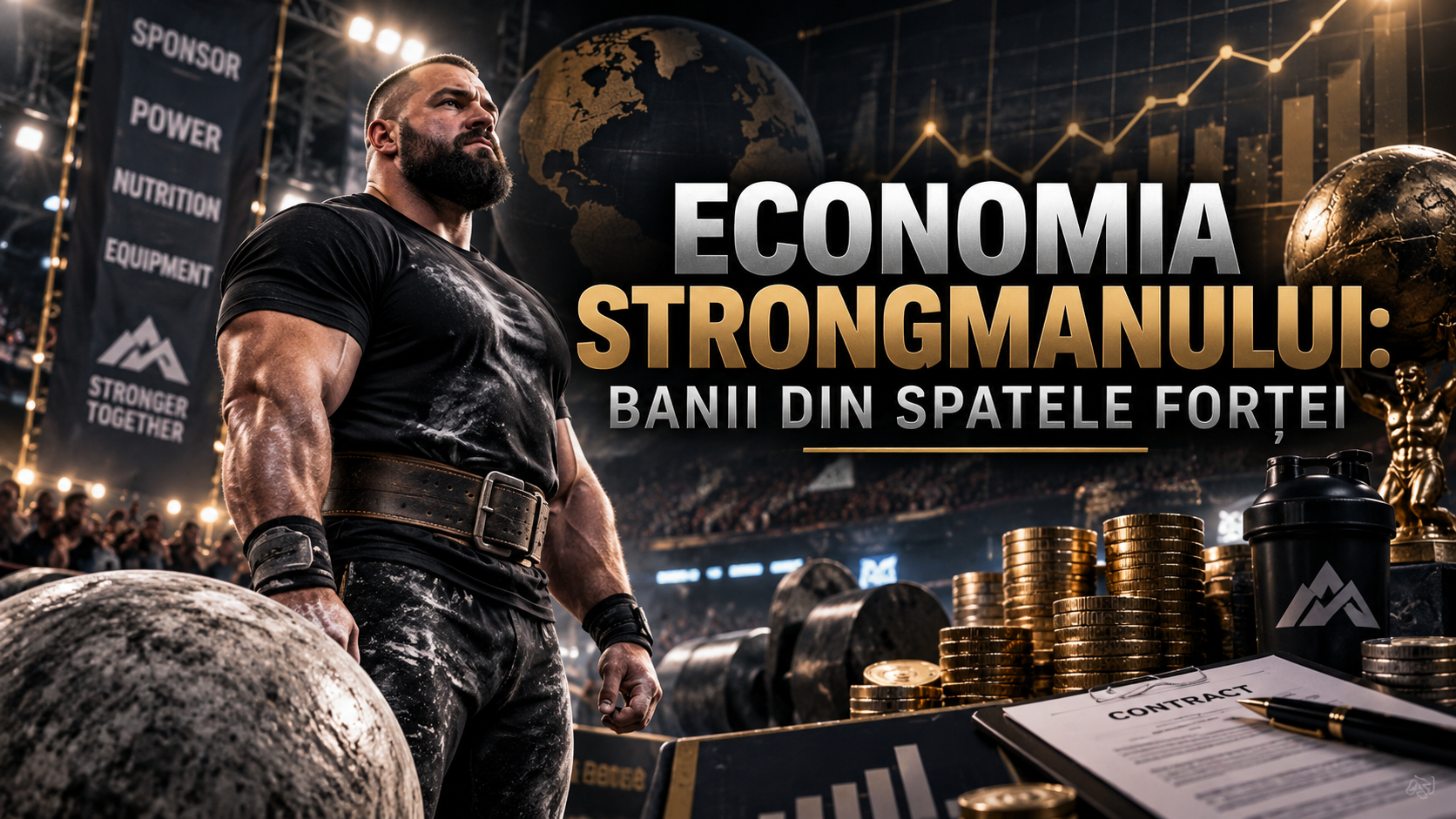
An atlas of Romania's strongman economy must look beyond the spectacular final lift: training facilities, implement builders, logistics, refereeing, media, sponsors, athletes and consumers all shape the market. Episode Nine of “THE ECONOMICS OF STRONGMAN: THE MONEY BEHIND STRENGTH” examines what a credible domestic market could look like, using official European surveys and legal sources while keeping illustrative financial scenarios distinct from reported market data [1–6].
1. Defining the Romanian strongman market
The audience economy, participant market, equipment supply, event services and commercial sponsorship are overlapping but distinct segments. Not everyone who visits a gym wishes to compete in strongman; not every festival viewer will become a paying spectator. Market sizing requires observed transactions and clearly defined boundaries, not multiplication of social-media follower counts by hypothetical ticket prices.
Local club contests, sponsored free-access festivals and ticketed arena shows face different cost structures and serve different objectives. Research could start with a voluntary register of events, organisers, categories, starters, attendance and infrastructure, reporting missing values honestly rather than extrapolating a national total from a few visible contests.
2. Evidence from European sport participation
The European Commission's September 2026 Eurobarometer found that 39% of EU respondents never exercise or play sport, compared with 66% in Romania [1]. That figure concerns general sport participation, not latent demand for strongman. A spectator inspired by heavy lifting does not automatically become an active participant.
Eurostat reported about 1.8 million people employed in EU sport in 2025 and 5,380 sporting-goods manufacturers with approximately €8 billion turnover in 2024 [2]. These broad sector totals cannot be allocated numerically to strongman without specialist data. They establish context, not an industry valuation.
3. Legal and institutional structure
Romanian Law No. 69/2000 defines sports structures, affiliation and national federation roles, with relevant amendments in 2025 and 2026 [3]. An event promoter using an impressive international name is not thereby a legally recognised Romanian national federation. Organisational identity, permissions, safety responsibilities and financial obligations must be checked.
The European sport model emphasises transparency, good governance, open competition and solidarity [4]. These principles are useful for designing strongman structures but do not automatically confer the same legal standing on every independent tournament.
4. Equipment and infrastructure economics
Strongman requires specialised implements, safe movement lanes, storage and transport. The total cost of yokes, farmers handles, atlas stones and loading equipment includes inspection, space, logistics and maintenance. A regional equipment-sharing network could reduce duplication but may create dependencies on a few suppliers and transport routes.
An illustrative €18,000 investment with €8,400 annual receipts and €4,800 incremental annual expenses produces €3,600 contribution before tax, depreciation and owner's labour. Simple payback would be five years if assumptions held; actual demand and replacement costs may change this radically. These figures are hypothetical, not market quotations.
5. A repeatable spectator product
Athletic spectacle alone does not guarantee paid attendance. Technical explanations, credible scoring, safe sightlines and predictable programming all contribute to audience value. A local club contest, free-entry festival and ticketed arena event require different revenue models.
For illustration, 300 tickets at 40 RON bring 12,000 RON gross, while 600 tickets at 25 RON bring 15,000 RON gross, before costs and taxes. The larger revenue does not imply larger profit. Repeat attendance and useful audience feedback matter more than one spectacular but unrepeatable festival.
6. Promoter budget and liquidity
A hypothetical regional event might cost €22,000, including arena, equipment, officials, medical care, prizes, athlete travel, production and marketing. Planned receipts of €10,000 sponsors, €7,000 tickets, €3,000 exhibitors and €2,000 other commercial activity merely balance the plan if all materialise.
When sponsors pay after the event and ticket purchases occur late, a nominally balanced budget can face an immediate liquidity crisis. A €3,000 ticket shortfall should trigger controlled contingency plans, not undisclosed prize reductions or removal of essential medical provision.
7. Sponsors in a specialist market
Equipment brands, local transport firms and training centres may value different outcomes from a strongman event. A credible commercial offer identifies the actual audience, deliverables, rights and measurement plan. An untested first event should not present hypothetical future impressions as observed data.
In-kind support can reduce necessary expenditure but is not cash. If a transport service worth €1,200 is genuinely supplied and would have been purchased anyway, it may save that cost. Multi-event sponsorship can support repeat exposure, provided rights and exclusivities are correctly allocated.
8. Regional cross-border opportunity
Cooperation among promoters in Romania and neighbouring countries could improve athlete access, calendar coordination and technical learning. It also introduces travel expense, recovery demands and payment-risk questions. Bilingual invitations and clear hotel, transport and prize provisions can be more valuable than an impressive international label.
Cooperation should enhance information and safety without anti-competitive restrictions on participant access or commercial pricing. Benefits must be evaluated rather than assumed.
9. Public support and local impact
OECD guidance on event impact assessment cautions against naive claims about local economic benefits [5]. A hypothetical 80 out-of-town visitors spending 300 RON each create 24,000 RON of gross local expenditure, not necessarily 24,000 RON of net benefit. Displacement, visitor counterfactuals, leakage and public costs require examination.
Local governments may also value inclusion, education and community activity if appropriately measured. Erasmus+ offers eligible small-scale sport partnerships subject to criteria and application calls; it is not an automatic subsidy for a commercial competition [6].
10. Grassroots access and women's participation
A sustainable market needs safe introductory opportunities as well as elite spectacle. Women's categories deserve proper equipment, transparent rules, credible officiating and genuine commercial attention. Travel cost and the scarcity of specialist implements can restrict access for all athletes.
Regional equipment hubs and introductory sessions could lower some barriers if safely managed and evaluated. The Council of Europe's revised Sports Charter promotes accessibility, dignity and safe participation, providing principles rather than a universal strongman rulebook [7].
11. Safety and sports medicine budgets
Competition safety must be planned before prize and advertising budgets exhaust available funds. Implement inspection, competent loading staff, protected camera lanes, stopping rules and appropriate medical access are operational necessities. Different events require different hazard assessments.
Injury data should be collected with consistent definitions and appropriate privacy safeguards. A single injury-free contest is not evidence of zero risk. Athlete contracts should not financially coerce medically inappropriate participation.
12. Professionalising organisers and athlete agreements
Professionalism means identifiable responsibilities, trained officials, written invitations and punctual payments, not necessarily large permanent organisations. Appearance fees, rankings prizes and reimbursed expenses should remain separate. Sponsor rights and image licences must be defined.
Published technical rules and fair appeals protect judging from commercial pressure. Trust and consistency may help a small market more than multiplying poorly financed competitions.
13. A transparent market atlas
A Romanian strongman register would need precise definitions of 'active competitor', 'training participant' and 'registered member'. These categories cannot be added without accounting for overlap. Useful public information includes event identity, dates, technical rules, categories and verified results, without publishing private medical or financial data.
A voluntary sample of 20 promoters is not automatically a representative national census. The method of recruitment, missing data, reporting dates and distinction between announced and paid money should be explicit.
14. Development options for 2027–2029
One path focuses on local club contests and beginner training. Another concentrates resources into a small set of strong regional events with shared logistics. A third adds organised cross-border participation and multilingual media. None is an inevitable or universally superior step.
A good local event does not need to become a televised international tour. Financial discipline, athlete access and repeatability matter more than the size of the advertised ambition.
15. Hypothetical three-event season
Three events at €18,000 each plus €6,000 shared coordination produce €60,000 planned expenditure. Assume €26,000 contracted sponsorship, €18,000 forecast ticketing, €10,000 exhibitors and €6,000 other commercial receipts. The arithmetic balances only if contingent sales occur.
If tickets achieve 70% of plan and exhibitors pay €8,000 rather than €10,000, the total shortfall is €7,400. Promoters need early decision thresholds, a financing buffer and transparent cancellation rules rather than diverting guaranteed prizes or cutting essential safety provisions.
16. A credible bilingual media archive
Results archives, authorised footage and accessible technical commentary can help audiences understand strongman and enable sponsors to verify athletes' achievements. The context of weights, distance, judging and event identity is essential. Romanian and English versions should preserve the same official results rather than exaggerating titles in translation.
Images, archive footage and spectator data require clear rights. View totals are not fixed advertising revenue, and sponsors should receive evidence of actual deliverables.
17. University and technical cooperation
Universities, coaches and clubs could jointly study implement safety, event timing, technical criteria and the costs of participation. Findings require valid methods, ethical data handling and awareness of the limits of small samples. Research cannot be required as a condition of participating in unrelated competitions.
Economic literacy matters too: competitors need to distinguish guaranteed remuneration, result-contingent prizes, reimbursement and the financial impact of exclusivity.
18. Growth governance and verified promises
Expansion should be contingent on paid prizes, safe equipment, reliable logistics and the ability to meet prior commitments. Institutional authority must be verified rather than inferred from logos or championship names.
Annual reports could distinguish completed events from announced plans and summarise participation, payment timing and safety improvements. Missing data are better reported openly than replaced with attractive guesses.
19. A staged operational calendar
A national development project can begin with voluntary calendars, contact details, equipment inventories and standard invitation information. The next phase could pilot introductory workshops, referee training and one financially disciplined regional event. Expansion should follow observed demand and fulfilled commitments rather than promotional pressure.
Different towns may sustain clubs, free festivals or arena shows. A healthy market does not require every region to copy the same event format.
20. What maturity would look like
After three seasons, useful measures include verified competitors, repeat participation, timely prize payments, real travel costs, early publication of rules and repeat sponsorship. Stable operations, trained substitutes and consistent results may matter more than the sheer number of events announced.
OECD impact guidance helps distinguish observed local spending from net benefits [5]. The European sport model emphasises openness and good governance [4]. A credible market admits missing data and reports only claims it can support.
Conclusion
Romanian strongman development needs safe infrastructure, honest financial commitments, accessible participation and verifiable results. Broad EU sport participation and employment statistics establish context, not the value of this niche market [1,2]. Regional cooperation, media, commercial partners and responsible legal structures can form a viable ecosystem if each initiative is financed and evaluated on its own merits.
References
[1] European Commission, Special Eurobarometer on sport and physical activity, September 2026: https://sport.ec.europa.eu/whats-new/news/strong-increase-in-active-commuting-and-some-positive-changes-in-sport-and-exercise-habits-latest-special-eurobarometer-shows .
[2] Eurostat, Sport employment and manufacturers, September 2026: https://ec.europa.eu/eurostat/en/web/products-eurostat-news/w/wdn-20260922-1 .
[3] Romania, Law No. 69/2000: https://legislatie.just.ro/public/detaliidocument/22262 .
[4] European Commission, European Sport Model: https://sport.ec.europa.eu/sport-in-the-eu/the-european-sport-model .
[5] OECD (2023), Measuring Impact of Global Events, DOI 10.1787/c7249496-en: https://www.oecd.org/en/publications/how-to-measure-the-impact-of-culture-sports-and-business-events_c7249496-en.html .
[6] Erasmus+, Small-scale Partnerships: https://erasmus-plus.ec.europa.eu/opportunities/organisations/sport-actions/small-scale-partnerships .
[7] Council of Europe, European Sports Charter: https://www.coe.int/en/web/sport/esc .
[8] EU Work Plan for Sport 2024–2027: https://eur-lex.europa.eu/legal-content/RO/TXT/?uri=CELEX%3A42024Y03527 .
More From The Journal
Training Science
TRANSFER OF STRENGTH: WHAT CAN STRONGMAN LEARN FROM OTHER SPORTS? | Episode 10: Interdisciplinary Synthesis, Method Selection and Validation of Competition Performance
Evidence-based synthesis of transfer from other sports to strongman: biomechanical criteria, individual diagnosis, programming, testing and limits of the evidence.
Training Science
TRANSFER OF STRENGTH: WHAT CAN STRONGMAN LEARN FROM OTHER SPORTS? | Episode 6: Wrestling and Judo: Unstable-Object Control, Balance and Force Production from Disadvantageous Positions
Scientific analysis of grips, off-balancing, center-of-mass control, isometric force, awkward positions and evidence limits for transfer into Strongman.