
Strongman Events
BEYOND CLASSIC EVENTS: THE SCIENCE OF SPECIAL STRONGMAN EVENTS | Episode 9: Húsafell Stone Carry, Frontal Stone Carriage and the Limits of Trunk Stabilization
October 28, 2026
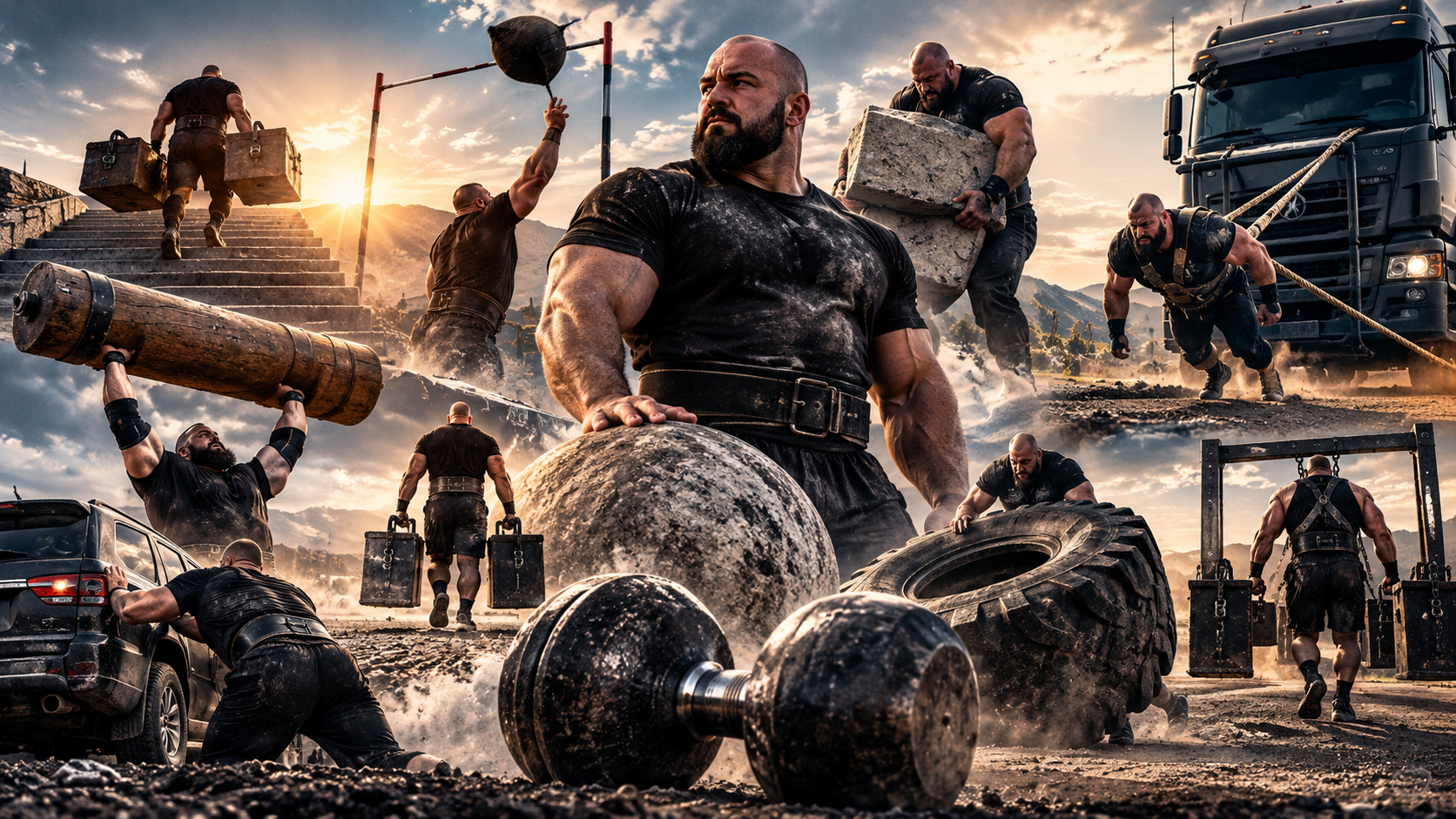
Húsafell Stone Carry: how an irregular stone turns frontal carriage into an integrated strength test
The Húsafell carry belongs to the family of load-carriage events but it is not interchangeable with the Farmer’s Walk, Yoke Walk or Duck Walk. The implement is held in front of the torso without standardized handles. Its surface, thickness, outline and friction determine how securely it can be lifted, embraced and carried. The challenge cannot be reduced to kilograms. A relatively flat stone with awkward edges and uncertain centre-of-mass position may demand more control than a symmetrical industrial object of equal mass. This article focuses on the biomechanics of natural stone rather than repeating the general theory of loaded carries [1,4].
Húsafell refers simultaneously to a place in Iceland, a specific historical stone also known as Kvíahellan, and a pattern for replicas used in competitions. That distinction is scientifically important. The traditional test with the original stone, a timed contest on a flat course with a replica, and gym training with a manufactured concrete slab may share a commercial name without presenting identical mechanics. Any technical comparison must report the start position, whether thigh or lap support is permitted, implement dimensions, surface conditions, distance, turns and rules governing a drop [2,3].
The evidence base is uneven. Studies of anterior load carriage, trunk activation and walking economy help interpret the task, but they are not direct measurements of elite athletes carrying the historic stone. We distinguish documented observations, general physical relationships, hypothetical calculations and coaching propositions requiring individual validation. There is no basis for assigning a universal spinal force, extrapolating backpack energetics directly to Húsafell or declaring one carrying posture optimal for all athletes [1,4–7].
Origins and mass uncertainty: what is documented and what has been corrected
The historical stone served as part of a stone sheep pen and later became a recognized test of strength. The local tradition associates the full achievement with carrying the object around the enclosure without setting it down. Liftingstones.org describes a course of roughly 34 m and documents lifting, lapping and carrying achievements. Such records are historical rather than controlled experimental evidence, yet they are essential for establishing what the original test actually entails [2].
The original stone's mass illustrates a useful source-critical problem. Older accounts, including the official World's Strongest Man event page, give figures around 182–186 kg. Liftingstones.org reports a July 2026 weighing of 157.1 kg. It is unsound to silently merge those numbers or to compare all historic results as if every athlete used an identical, verified mass. Responsible reporting identifies the source, date and whether the stated weight belongs to the original stone or a replica. Repetition does not improve the precision of an old estimate [2,3].
Competition replicas create another distinction. Even at the same declared mass, thickness, roughness, edge length and centre-of-mass position may differ. They impose roughly the same total gravitational force yet different external moments about the athlete. The event should therefore be characterized by an implement profile rather than a traditional label alone. The following episode will examine a more deliberately manufactured relative, the shield.
From floor to chest: pickup, lapping and securing the object
The first task is transforming a floor-supported object into a controlled load. Depending on the stone, the athlete flexes the hips and knees, places the forearms around suitable edges and raises the mass toward the thighs. Some traditional styles employ an intermediate lap position before the arms are reorganized and the body extends to secure the stone high against the torso. Competition rules may instead permit a raised start. These variations change the mechanics and prevent simplistic comparison between athletes.
A simplified vertical equation for the object is F ≈ m(g+a), assuming we are considering the net upward force and ignoring additional contact details. For an illustrative 160 kg object, gravity contributes approximately 1,570 N; an extra upward acceleration of 0.3 m/s² requires about 1,618 N. This is not an estimate of a specific tendon load, spinal compression or per-hand force. It is the external force balance for the implement, whose distribution across the athlete depends on geometry and contact.
The transition from lap to chest deserves particular attention. The stone's centre of mass follows a different path from the moving joints, while the hands may have to change position before the object is fully supported. Sliding or rotation then requires fast corrections. This is not merely a heavy deadlift: the forearms, trunk, hips and postural system must stabilize a mass with an imperfect grip. No percentage contribution should be attributed to any muscle without appropriate measurements.
Why holding the stone closer changes the external moment
Once the implement is secured, support comes from contact against the torso, the arms surrounding the stone and ground reaction forces transmitted through the legs. A key variable is the horizontal distance of the stone's centre of mass from a chosen reference axis. Moving the stone farther forward generally increases the external gravitational moment that must be balanced, although the true distribution of forces depends on body orientation and multiple contacts. Keeping the stone close is often mechanically useful, but excessive chest compression or compromised breathing cannot be treated as harmless.
For illustration, a 160 kg mass at a horizontal distance of 0.20 m produces a gravitational moment of roughly 314 N·m about that reference; at 0.30 m, the value rises to about 471 N·m. This is a geometrical comparison, not a measurement of lumbar moment at L5/S1. The body-stone system contains multiple forces, support points and moving joints. Still, it explains why a few centimeters of sliding can materially increase the difficulty of maintaining control. Athletes with different chest geometry or arm lengths may experience the same stone very differently.
Anderson and colleagues found that load height and walking influenced trunk posture and muscle activity in experimental anterior carriage. The study demonstrates the importance of load placement, not a quantitative rule that can be directly transferred to a stone weighing more than 150 kg. We cannot use laboratory hand-held tasks to prescribe a single chest position for competitive Húsafell [4].
Trunk stability is controlled movement, not complete immobilization
The coaching instruction to keep a rigid torso can be useful but must not be interpreted literally. Walking requires pelvic and thoracic adjustments while the base of support alternates between feet. Effective stabilization means constraining movements that threaten the stone while retaining mobility necessary for progression. Trunk extensors, abdominal muscles and shoulder-girdle musculature work as an interacting system rather than a single muscle group with fixed contributions.
Anterior-carriage studies report changes in trunk orientation and, under some circumstances, higher muscle activity than unloaded walking. One treadmill study involving 30 young adults compared loads equal to 0%, 10% and 20% of body mass and found changes in trunk angle without statistically significant differences in step length in those conditions. The study used relatively light loads and a controlled setting. It does not prove that stride length remains unchanged when a strongman carries a much heavier stone [5,6].
A small backward adjustment of trunk orientation may help balance the frontal load, but excessive leaning can impair visual access to the ground or move the combined centre of mass toward an inconvenient support boundary. Excessive forward inclination creates other trade-offs. The useful position is not defined by a universal angle: it must preserve stone contact, breathing and repeatable stepping.
Grip without handles: friction, pressure, skin and forearm contact
The original stone offers no ergonomic handles. Holding force arises from squeezing the object, supporting it against the body and friction at contact surfaces. A high coefficient of friction does not guarantee security because normal pressure and the active contact area change through the carry. Dust, moisture, irregular edges, sleeves and permitted protective materials all influence the interface. The implement's surface must be treated as part of the task rather than an irrelevant detail.
Friction depends on adequate normal contact force. As the ability to squeeze decreases with fatigue, the stone may slide even if the legs still have ample capacity to walk. The event is not simply a biceps test: elbow flexors, shoulder muscles and torso tissues all contribute to positioning and supporting the arms, but their relative roles depend on implement shape. An EMG ranking or precise muscle-force distribution cannot be claimed without appropriate measurements.
Practical warning signs include gradual lowering of the upper edge, loss of arm symmetry, sudden changes in stone height and pauses to restore contact. Each observation raises a different hypothesis rather than identifying a single failing muscle. Sometimes a geometrical repositioning is more effective than trying to squeeze harder; for a slippery stone, local contact mechanics may be the decisive limitation.
Anterior-loaded gait: support, cadence and propulsion
With the stone secure, the task becomes locomotor. Every step must support the combined load, absorb collision-related forces and generate forward impulse. Vertical ground reaction forces fluctuate during walking; instantaneous peaks are not equal to the static sum of the athlete's and stone's weights. Slow-looking locomotion may still place substantial repeated demands on the ankles, knees and hips.
A systematic review and meta-analysis of anterior carriage found an overall reduction in stride length across included studies, while several other gait parameters were less consistently changed. Other experimental work found differences in trunk orientation. These observations should not be misrepresented as universal rules for heavy Húsafell carries: study populations, loading conditions and walking environments differed from strongman competitions. They nevertheless support treating stride as a compromise between moving forward and preserving control [5,6].
Faster cadence may reduce elapsed time, but if it produces excessive movement of the stone the apparent advantage can disappear. Longer steps can raise speed when grip remains secure, yet they may also increase trunk adjustment demands. A large stone may obstruct vision of the ground, making course reconnaissance and controlled turns important. Unloaded walking cues cannot simply be imposed on maximal frontal carriage.
Breathing, chest contact and short-duration fatigue
A mass pressed against the front of the torso can mechanically restrict how freely the chest expands and require coordination between breathing and holding effort. This is a plausible mechanism, not a diagnosis of ventilatory impairment without measurement. Breath-holding and Valsalva maneuvers may occur under high loads, but sustained breath-holding through a long carry should not be presented as a universally safe method. Breathing behavior needs controlled practice and individual assessment.
A failed carry may reflect several simultaneous limits: the object slides, the torso loses position, leg propulsion declines or breathing becomes difficult to coordinate. Neither final distance nor finish time isolates the cause. Useful performance records separate pickup duration, time needed to establish the chest position, distance before the first readjustment and the stage at which the carry ends. Video assists observation but cannot replace internal force measurements.
Standardized walking studies with backpack loads have shown increases in mechanical work and metabolic expenditure as mass is added. Their precise values cannot be applied to a large stone at the chest in a short maximal event, because mass placement, speed and duration differ. Increased loading requires additional energetic work, but a photograph cannot establish oxygen uptake or the exact metabolic cost of a Húsafell performance [7].
Turns and terrain: why thirty meters are not always the same test
A turn may determine the outcome of a maximum-distance event. On a straight line, the athlete seeks sustained progression; changing direction requires lateral ground reaction forces to redirect the system's centre of mass. Greater speed, mass or smaller turning radius generally increases the control challenge. Walking around the original pen and traversing a straight indoor lane are not equivalent just because their total lengths happen to match.
The stone's irregular edges may shift laterally during a turn, requiring the forearms to maintain pressure and alignment. A single-foot pivot under a very heavy object can pose balance problems, so turning strategies should be practiced progressively with predictable traction. There is insufficient direct research to prescribe one universal turn strategy for every replica and every body type.
Grass, gravel, asphalt, concrete and damp flooring differ in grip and support consistency. Event comparisons therefore require surface conditions, turn radius, number of turns, markings and weather alongside official times and distances. Nominal load and final distance alone cannot explain the mechanical environment.
Transparent calculations: one mass, two positions and two walking strategies
Consider a hypothetical 130 kg athlete carrying a 160 kg replica over 30 m. The combined supported mass is 290 kg, with static gravitational weight of approximately 2,845 N. That is not the force under each foot or an estimate of spinal-disc compression. At an average walking speed of 0.75 m/s, the moving segment lasts 40 seconds, excluding the initial pickup and pauses. At 1.0 m/s it lasts 30 seconds. The faster result is useful only if grip and balance remain sufficient.
Now assume, purely as a geometrical example, that the object moves from 0.18 to 0.26 m horizontally from the selected reference axis. Its external mgd moment increases from about 283 to 408 N·m despite unchanged mass. The values are not clinical L5/S1 moments because the simplified model omits muscle forces, limb posture and body contacts. The calculation illustrates the mechanical cost of a seemingly modest shift in stone position.
If the fast strategy leads to a drop after 20 m, the athlete may be unable to resume or may incur a large time penalty, depending on the rules. A steady, controlled strategy may therefore produce a better official distance than a spectacular early acceleration. This example does not mandate a speed; it shows why distance achieved and grip stability must be measured together.
Training for transfer: pickup, holding, walking and local endurance
Preparation should combine general strength with implement-specific skill. Deadlifts and squats develop useful resources but do not reproduce friction against an irregular stone or the necessary mid-lift grip change. Safe sandbag carries, suitably shaped blocks and stone replicas can teach frontal contact and walking control. If an athlete can lift a heavy object but loses it after several strides, improvements in placement and continuity may be more productive than an immediate increase in one-repetition maximum.
A sensible progression starts with controlled pickup and set-down, then short straight carries, followed by turns and longer distances. Training volume must respond to accumulated fatigue rather than an arbitrary model. Frequent heavy attempts against hard-edged implements may stress tissues unnecessarily. The strongman injury literature documents problems associated with implement training, but provides no universal safe loading threshold for Húsafell [8].
Track implement mass and shape, uninterrupted distance, pickup time, readjustment count, course details and perceived effort. Comparative progress is more credible when conditions stay consistent. Unstable stones, hazardous edges and unsupervised routes should be avoided; clear escape paths, spotters and controlled drop zones take priority over maximal attempts.
What a modern Húsafell study should measure
A rigorous investigation of the original stone or replicas should first document three-dimensional geometry, verified mass, approximate centre-of-mass position and contact roughness. Synchronized motion capture could then describe pickup, walking and turns. Force platforms, inertial sensors and video would characterize ground forces and segment orientation, but cannot directly resolve the forces within each muscle.
Surface electromyography can add information about activation, although friction against the torso and arms may displace sensors and generate artifacts. Comparing a natural stone with a symmetrical manufactured object would require controlling mass, course, attempt order, fatigue and familiarization. Findings from a small sample of elite athletes should not be automatically generalized to novices or clinical populations.
The useful research question is not a vague inquiry into whether the core is active, but how implement shape, pickup height and centre-of-mass distance affect performance, force distribution and the likelihood of losing control. Those variables make the time-honored practice a testable biomechanical problem [1,4,5].
Anthropometry, relative dimensions and differences among athletes
The functional geometry of an object is not the same for every body. Shoulder breadth, forearm length, chest circumference and stature can alter the contact points and how closely the stone remains against the torso. An implement that one athlete can cradle under its lower edge may force another to squeeze mostly from the sides, changing the balance between vertical support and friction. These differences do not prove superiority of one body shape; they show why a technique tested on one athlete does not establish a universal rule.
Body mass may contribute to resistance against imbalance and overall force capacity, but the ratio of carried mass to body mass does not explain performance by itself. A heavier athlete must also move additional body mass and may have a different distribution of tissue at contact surfaces. A lighter competitor with proportionally longer arms may occasionally obtain a more favorable clasp. Both are mechanical hypotheses rather than demonstrated Húsafell performance correlations.
A comparative protocol should report stature, body mass, upper-limb segment lengths and some measure of torso breadth alongside implement dimensions. These characteristics should be analyzed as continuous variables instead of automatically dividing athletes into advantageous and disadvantageous categories. A particular body profile might suit one replica and conflict with another, precisely because the stone is not scaled to the athlete's proportions.
Anthropometry also changes the coaching question. Rather than demanding the same stone height relative to the sternum from everybody, a coach can identify an individually repeatable position relative to forearms and pelvis. Its merit should be demonstrated through walking continuity, secure contact and forward visibility, not exact imitation of a champion's posture in a photograph.
Natural asymmetry and rotational moments in three dimensions
Simple models often focus on flexion-extension, but a stone can also impose lateral and rotational demands. When its centre of mass lies away from the athlete's midline, gravity may generate an external tendency for one side to drop. The athlete compensates by unequal arm pressure, torso adjustments and changes in the base of support. These corrections may be difficult to observe from a single camera angle.
As an illustration only, consider a 160 kg stone whose centre of mass is 0.05 m laterally displaced from a chosen reference axis. The associated gravitational moment is about 78.5 N·m. This is not a measured spinal-twisting moment because real contacts and changing body positions are omitted. It shows why apparently small lateral offsets may require continuous corrections under large loads.
Rotation during walking can be amplified by asymmetric contact. One edge pressing more firmly into the left forearm does not guarantee balanced forces, and an abrupt attempt to straighten the stone may create a new instability. A coach may notice the same side dropping repeatedly, but that observation does not automatically prove unilateral muscle weakness. The object itself may be responsible.
Future work could place inertial sensors on the stone and torso to distinguish relative object rotation from body rotation. Useful variables would include relative angle, correction speed and time to the first readjustment. This would provide a more informative description of stability than the binary observation that an athlete did or did not drop the implement.
Mechanical work: vertical lifting, horizontal travel and losses
A common error is to multiply the stone's weight directly by horizontal distance and call the result mechanical work. During level movement at unchanged height, the work done by gravity on the stone is approximately zero because gravity is vertical while net displacement is horizontal. That does not mean carrying is effortless. Muscles perform work on body segments, compensate for step-to-step collision losses and consume energy during sustained stabilization.
For the initial pickup, raising a 160 kg stone vertically by 0.80 m increases its gravitational potential energy by approximately mgh = 1,256 J. This is an idealized external mechanical quantity for the object, not the total metabolic cost. It excludes raising the athlete's own body, kinetic energy, muscle efficiency and the additional positioning involved in obtaining a stable hold.
During walking, the combined centre of mass moves up and down with every step. Muscles and tendons can partially store and return elastic energy, but braking and redirecting the body still involve mechanical and metabolic costs. Backpack-carriage experiments show increasing work and expenditure with load, but do not establish exact internal work per meter for Húsafell [7].
This distinction between external work and physiological effort helps explain why an athlete may become exhausted while nearly statically holding a stone. Active muscle can consume ATP without producing much external mechanical work. Therefore neither carried mass, nor pickup potential energy, nor weight multiplied by distance gives a complete account of a strongman carry.
Video evidence, time to slipping and interpretation of attempts
Video analysis is useful when the target observation is defined before filming. A lateral camera can suggest how far the stone projects from the torso, while a frontal view can reveal lateral rotation and arm symmetry. A single uncalibrated angle cannot provide an accurate three-dimensional model. Lens distortion, perspective and clothing may hide the true contact areas. Claims about internal muscles or joints should stay within what the images can establish.
A promising operational indicator is time until the first visible slip. It can be combined with the number of readjustments, change in height of the upper stone edge and distance completed without loss of position. These measures are more reproducible than an undefined judgement of good technique, but they need standardized definitions and agreement between observers. If analysts identify different moments of initial slipping, the measure needs refinement.
Athlete comparisons require standardization of conditions, not merely results. Verified mass, replica type, start location, turns and contact surface may alter performance before individual strength comes into the equation. An official ranking is meaningful within that event's rules, but does not establish which athlete would perform better with every other stone.
Measurement reliability can be checked by repeated trials with comparable recovery. Yet learning and fatigue can overlap: a second attempt may improve through familiarization or deteriorate from the previous effort. A sound experimental design would counterbalance conditions and document participants' implement-specific experience.
Putting evidence into practice while respecting its limits
An applied protocol begins by asking where performance is lost. If pickup is the problem, assess start height, use of a lap position and the transition to the chest. If the stone moves down within the first meters, prioritize grip, friction and centre-of-mass position. If difficulty develops only after a turn, training on the actual course may be more beneficial than another deadlift record.
No demonstrated one-repetition-maximum threshold guarantees a certain Húsafell distance. Maximal strength matters, but the competitive task also requires holding capacity, coordination and loaded locomotion. Training transfer must be verified under conditions close to the event. This accords with the principles of strongman exercise specificity without suggesting that every Húsafell variation has been directly studied [1].
Persistent pain, neurological symptoms, unusual breathing difficulty or dizziness call for stopping the effort and seeking appropriate assessment, not continuing because the clock is running. Natural objects with hazardous edges, wet surfaces or no controlled drop zone do not belong in unsupervised maximal attempts. A technique that cannot be practiced with an acceptable safety margin is not a good coaching recommendation.
The Húsafell challenge can be studied rigorously without diminishing its historical character. Verified mass, transparent implement documentation, separation of evidence from hypothesis, respect for individual variation and course-specific performance interpretation all make both the science and the athletic story more credible.
Safety and conclusion: precision respects the historic challenge
Carrying a massive natural stone creates specific plausible hazards: sudden grip loss, tissue pressure at edges, imbalance in turns, impact to the feet and repeated exposure to heavy pickup attempts. These hazards cannot responsibly be turned into Húsafell-specific injury rates without direct epidemiological research. Clear rules, qualified observation and course safety provide more useful safeguards than treating tolerance of pain as proof of readiness.
The Húsafell Stone Carry combines irregular-object pickup, unhandled frontal restraint, loaded gait and careful management of contact surfaces. Performance is shaped not only by brute strength but also by object geometry, its position in the arms, stepping rhythm and the ability to keep a stable mechanical connection with the stone. Research gives strong general principles for anterior carriage while leaving major event-specific questions unanswered. Recognizing that boundary is essential to an accurate scientific account of this remarkable traditional challenge [1–8].
References and verifiable sources
[1] Hindle BR, Lorimer A, Winwood P, Keogh JWL. The Biomechanics and Applications of Strongman Exercises: a Systematic Review. Sports Medicine - Open. 2019;5:49. DOI 10.1186/s40798-019-0222-z. Open source
[2] Liftingstones.org. Húsafell Stone / Kvíahellan: history, challenges and July 2026 reweighing. Open source
[3] The World's Strongest Man. Stone Carry: event description and historical account. Open source
[4] Anderson AM, Meador KA, McClure LR, Makrozahopoulos D, Brooks DJ, Mirka GA. A biomechanical analysis of anterior load carriage. Ergonomics. 2007;50(12):2104–2117. DOI 10.1080/00140130701450195. Open source
[5] Effects of anterior load carriage on gait parameters: a systematic review with meta-analysis. Applied Ergonomics. 2022;98:103587. DOI 10.1016/j.apergo.2021.103587. Open source
[6] Effects of anteriorly-loaded treadmill walking on dynamic gait stability in young adults. 2022. PubMed PMID 35248916. Open source
[7] Mechanics and energetics of load carriage during human walking. Journal of Experimental Biology. 2014. DOI 10.1242/jeb.091587. Open source
[8] Winwood PW, Hume PA, Cronin JB, Keogh JWL. Retrospective injury epidemiology of strongman athletes. Journal of Strength and Conditioning Research. 2014;28(1):28–42. DOI 10.1519/JSC.0b013e3182986c0c. Open source
[9] Winwood PW, Cronin JB, Brown SR, Keogh JWL. A biomechanical analysis of the farmers walk, and comparison with the deadlift and unloaded walk. International Journal of Sports Science & Coaching. 2014;9(5):1127–1143. DOI 10.1260/1747-9541.9.5.1127. Open source
More From The Journal
Training Science
TRANSFER OF STRENGTH: WHAT CAN STRONGMAN LEARN FROM OTHER SPORTS? | Episode 10: Interdisciplinary Synthesis, Method Selection and Validation of Competition Performance
Evidence-based synthesis of transfer from other sports to strongman: biomechanical criteria, individual diagnosis, programming, testing and limits of the evidence.
Training Science
TRANSFER OF STRENGTH: WHAT CAN STRONGMAN LEARN FROM OTHER SPORTS? | Episode 6: Wrestling and Judo: Unstable-Object Control, Balance and Force Production from Disadvantageous Positions
Scientific analysis of grips, off-balancing, center-of-mass control, isometric force, awkward positions and evidence limits for transfer into Strongman.