
Strongman Events
BEYOND CLASSIC EVENTS: THE SCIENCE OF SPECIAL STRONGMAN EVENTS | Episode 6: Arm-over-Arm Pull, Hand-over-Hand Traction and Muscular Chain Coordination
October 28, 2026
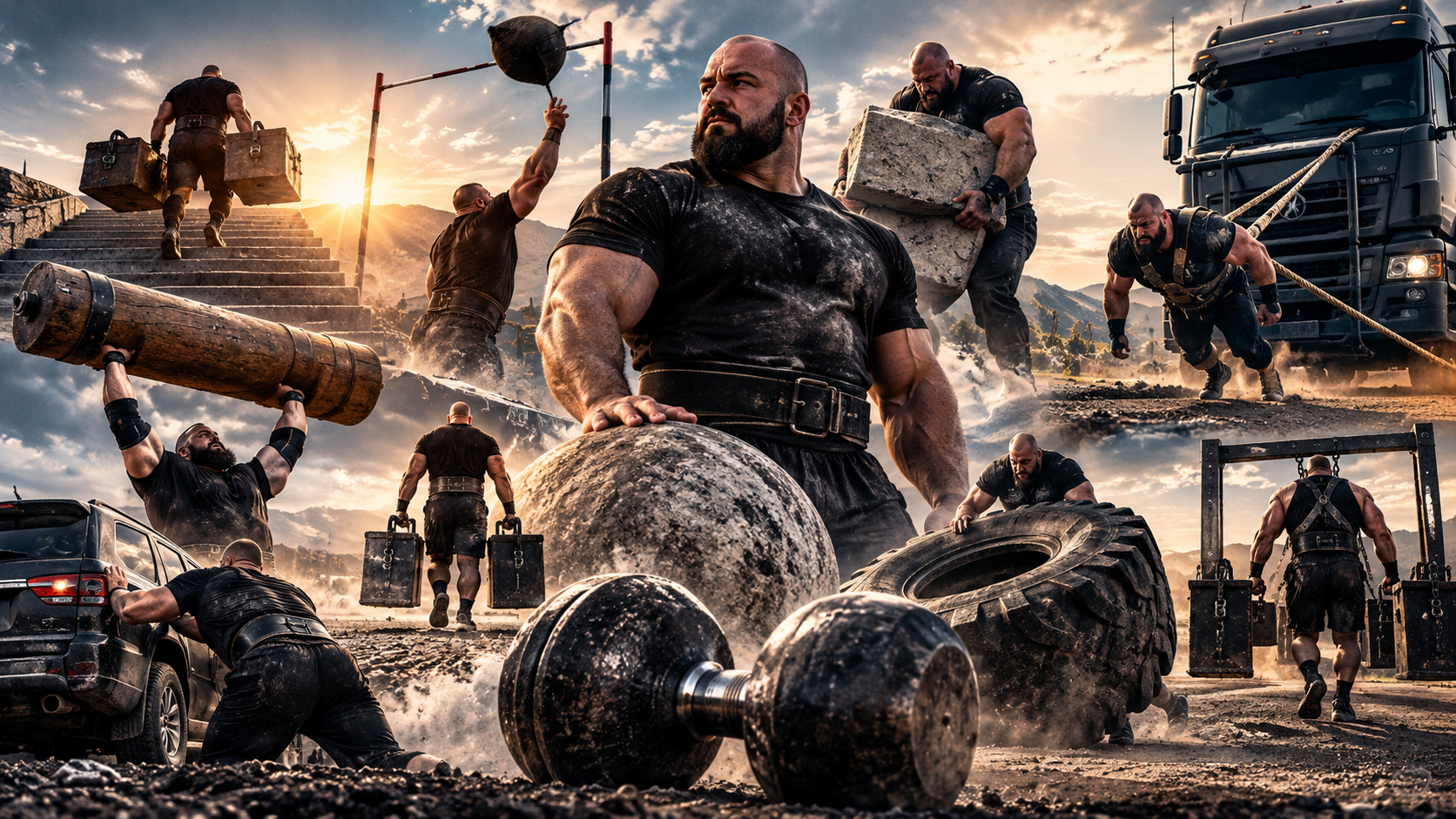
Arm-over-Arm Pull: the force chain linking feet, trunk, hands and rope
At first glance, Arm-over-Arm Pull seems a contest of arm strength. The athlete grips a rope, pulls alternately with the hands and brings a very heavy object closer. The event name, however, does not capture the entire mechanics. The rope is the interface through which force reaches the load, while the body needs a reaction surface: a footplate, seat or anchoring structure. Without effective support, pulling the rope may move the athlete rather than the object. Performance emerges through coordinated lower-limb extension, pelvic positioning, trunk control, scapular action, shoulder movement, elbow flexion and finger grip. None of these components can responsibly be declared the single universal determinant without specifying the system.
World’s Strongest Man describes an event configuration in which a competitor stays seated and stationary, keeps the feet against a solid base and pulls an object along a timed course using a rope. Its description notes that athletes often use leg-press-like movement to contribute to traction and that grip can become a major limiting factor [1]. This is an important event description rather than a universal rulebook for every competition; implementations and athlete positions can differ. We focus primarily on the seated, braced configuration and repeated rope-pulling cycles, noting where changes in geometry or rules change the task. We also distinguish this episode from Truck Pull, which involves resisted forward locomotion by the athlete.
The physics begins with rope tension, not with the object's nominal mass. A five-ton vehicle does not automatically produce five tons-force of rope tension. If it rolls, tire resistance and course inclination contribute to the load; if dragged on a sled, sliding friction becomes relevant; if pulleys are used, displacement and tension depend on the mechanism. Likewise, how hard a hand squeezes the rope is not identical to the axial tension it carries. Grip must prevent slipping, while larger shoulder and trunk muscle groups create the pulling motion through that contact. Keeping these variables separate provides a more rigorous explanation than the claim that the event merely requires enormous arms.
Direct biomechanical evidence from elite Arm-over-Arm Pull competitions remains scarce. Reviews by Hindle and colleagues identified limited research methods for many Strongman exercises and a need for more detailed investigations [2,3]. Grip research, upper-limb pulling studies and rope mechanics can inform carefully bounded analogies, but they do not provide a complete EMG map of an athlete hauling a multi-ton vehicle. We therefore distinguish well-established mechanical principles, reasonable biomechanical hypotheses and remaining unknowns. Numerical examples will use transparent hypothetical models rather than invented measurements from particular contests.
Rope tension, object resistance and the mechanics of repeated traction
A rope primarily transmits tensile force along its own axis. In the ideal model of a flexible rope with negligible mass, no friction at guides and negligible rope-segment acceleration, tension may be treated as uniform along a continuous section. When pulleys, drums or heavy cables enter the system, this simplification may no longer hold. In Arm-over-Arm Pull, athletes do not necessarily lift a vehicle's stated weight vertically with their hands. They transmit through the rope the force required by the object's resistance and acceleration. A rolling object may require tension far below its gravitational weight; a heavily loaded sled on high-friction material may behave very differently. Distinguishing tension from nominal mass is the first step in a scientifically useful description.
For a load moving horizontally, the simplified one-dimensional equation is T − R = ma, where T is useful rope tension, R represents total resistance, m is object mass and a its acceleration. At nearly constant slow speed, tension is approximately equal to resistance, not mg. When the athlete pulls abruptly, tension may rise above the value required to maintain speed because the object is being accelerated. If grip fails during such a peak, that does not automatically indicate weak back muscles. Proximal force capacity may remain substantial while rope–finger contact becomes the bottleneck. Load should therefore be described through tension and resistance rather than tonnage alone.
Consider a hypothetical 5,000 kg vehicle with effective rolling coefficient Crr = 0.02 on level ground. Ideal rolling resistance is about 981 N. If the rope is nearly horizontal and the athlete transmits 1,481 N of useful tension, the 500 N surplus would ideally accelerate the vehicle at 0.1 m/s². This is simple under a continuous-force model, but an arm-over-arm pull is cyclic rather than continuous. Each hand passes through gripping, pulling, release and repositioning. While the rope is held without displacement, the vehicle may decelerate; during strong pulls, tension rises again. The result is a sequence of accelerations and slowdowns rather than one smooth motion.
Slack can be decisive. If the athlete releases tension to reach forward for another grip and the other hand does not maintain contact, the rope can become loose. The next pull spends part of its available movement merely taking up slack, without immediately moving the object. An elastic cable can store and release energy dynamically, generating oscillations. With a heavy load, these oscillations may be experienced as forceful jerks at the hands and shoulders. Interpreting every jerk as a sudden increase in muscular force would be misleading; it may reflect rope elasticity and changing tension between cycles.
Rope displacement per complete two-hand cycle is a useful variable. If an athlete effectively retrieves 0.70 m per cycle while maintaining two cycles per second, theoretical rope speed is 1.4 m/s. Slipping, pauses or pulley mechanisms may prevent object speed from matching that value. With a single ideal fixed pulley changing only direction, rope and object travel distances may be equivalent. With a block and tackle offering mechanical advantage, the ratio changes. A 2:1 arrangement is not equivalent to direct towing. Ideal work conservation explains the trade-off: a mechanism reducing required force generally demands more rope displacement for the same object travel.
Friction at guides matters too. When a rope wraps around a stationary cylinder, the Euler–Eytelwein capstan equation can, under its stated assumptions, describe the limiting ratio between tensions: T2/T1 = e^(μθ), where μ is the friction coefficient and θ the wrap angle in radians [6]. This does not mean every competition rope operates like a winch, nor should the equation be applied indiscriminately to a nearly straight rope. It illustrates why contact path and friction can alter the force required. A well-maintained bearing pulley and a seized one are not equivalent, and tension measured near the athlete's hand need not equal tension near the load when transmission losses exist.
Rope orientation also changes body demands. A rope above the athlete's torso may create different pitching moments from one aligned near pelvic height. When the line runs off-centre, the athlete must manage rotational moments about the trunk. As the load approaches, rope angle may change continuously. A changing angle seen in video does not by itself prove that organizers intentionally adjusted resistance; it may follow from installation geometry. Sound investigation documents anchor position, seat height, rope orientation and vehicle location through the attempt.
Biomechanical analysis should therefore separate at least three physical systems: the athlete, the rope and the load. The athlete experiences foot and seat reactions countering rope tension. The rope transmits tension and may experience friction. The load must overcome resistance and develop acceleration. Treating them as one 'weight pulled by the biceps' obscures the mechanism that can distinguish competitors of similar general strength but very different technique.
Rope grip: friction, hand geometry and specific fatigue
A hand gripping a rope must turn finger-squeezing force into contact capable of transmitting substantial axial tension without slipping. In a simplified description, transmissible friction depends on the normal force at the interface and an effective friction coefficient. Real hand–rope contact is much more complex than a rigid block on a flat plate. The rope deforms, fibres occupy spaces around the fingers, the hand may partially wrap around the cable and individual finger segments apply forces in different directions. Rope diameter can favor particular hand dimensions without there being a simple linear relationship between cable thickness and grip capacity. Geometry and texture are event variables, not minor accessories.
Standard handgrip dynamometry is a useful test of one component of gripping strength, but it does not reproduce the entire Arm-over-Arm Pull task. A dynamometer measures maximal squeezing on a standardized handle. In competition, the athlete must prevent a flexible surface from sliding, pull along the rope's axis and alternate supporting hands repeatedly. A systematic review of measurement properties reported good reliability of handgrip dynamometry in several populations [7]. That does not establish that the score directly predicts rope-pull completion time. Dynamometry can monitor general capacity, whereas tests with the actual rope examine contact specificity, coordination and repeatability.
Grip may be limiting while the back and elbow flexors remain capable of producing sufficient force. If rope tension exceeds available contact friction, the hand slips before the proximal muscles reach their limits. The athlete may squeeze harder to compensate, but this increases finger-flexor demand and can accelerate local fatigue. Over many regrips, the task becomes one of specific endurance as well as maximal force. A hand capable of holding substantial tension once may not maintain it across repeated cycles, particularly when skin becomes wet or irritated. Without measurements of tension and contact time, precise separation of muscular and mechanical causes is impossible.
Rope diameter alters finger-joint positioning. A very thick cable may prevent the fingers from wrapping far enough, whereas a thin rope may concentrate high pressure on a narrow area. Material determines roughness, deformation and response to moisture. Smooth synthetic rope, natural fibre and worn cable do not behave identically. Texture can even vary along a single rope after multiple athletes have used it. Comparing results across competitions without knowing rope construction is consequently imperfect, since an apparently small equipment difference can change when grip becomes limiting.
High-tension sliding against skin can cause abrasion, blisters and other tissue damage. Protection must comply with event rules and suit the actual cable; gloves or topical products cannot be assumed universally legal or effective. Some gloves protect skin while worsening friction, and other conditions may favor them. Athletes should check regulations and test permitted equipment safely before competition. There is no universal scientifically demonstrated solution across all ropes and hand dimensions.
Hand exchange matters as much as hand strength. In a hand-over-hand cycle, the hand completing a pull should generally release only after the other has established sufficient contact if the goal is continuous tension. Simultaneous relaxation may create slack, allowing the load to slow or reverse. Conversely, excessively long overlap may shorten the repositioning hand's useful stroke. Technique balances continuous tension against effective pulling range. Some setups favor rapid alternation; others permit more bilateral action. Efficiency must be evaluated under the real load rather than inferred from unloaded hand speed.
Grip physiology combines isometric and dynamic demands. Finger flexors must maintain sufficient tension while the wrist and arm move. Prolonged contraction can affect local circulation and fatigue sensation, but no universal threshold of rope tension guarantees vascular restriction; individual posture, relative effort and tissue properties differ. When the hand slips late in an attempt, the cause may involve reduced muscular force, contact pain, coordination fatigue or a combination. Slipping alone is not a physiological diagnosis.
Training can combine general grip exercises with controlled practice on competition-style rope while accounting for total finger and tendon loading. Dead hangs, heavy carries and isometric holds may develop useful capacities, but grip direction and texture differ. An athlete can possess an exceptional farmer's walk yet struggle with rope traction without contradiction. A rigid handle held continuously is not the same task as repeatedly regripping a moving rope. Training until the skin is damaged is not a sensible progression. Gradually improving tension tolerance, cycle volume and hand-exchange precision is preferable to treating every session as a failure test.
The footplate: why biceps alone cannot explain the event
In the seated configuration described by World’s Strongest Man, the feet push against a solid platform while the athlete faces the rope leading to the load [1]. This allows lower-limb extension to create reaction forces and move the trunk relative to hands maintaining rope contact. When grip remains effective, body movement can produce a longer pull than elbow flexion alone. Calling the action a reverse leg press is useful only as a rough analogy. A conventional leg press has different constraints and movement directions. The shared principle is lower-limb contribution to force and displacement, not biomechanical identity.
The footplate must be stable enough to accept the force generated. If it slides or deforms, athlete movement can be wasted without corresponding rope displacement. Ankle, knee and hip positions determine the available stroke and strength at each portion. Starting with knees almost extended can leave little movement reserve; excessive flexion can make it difficult to establish initial tension. No direct evidence supports one universal knee angle for every athlete. Individual geometry and apparatus configuration must be evaluated together.
A complete cycle may involve gripping in front, building tension, moving the trunk backward through lower-limb extension or other permitted body motion, then recovering position for another pull. Some competitors may rely more on the arms, others on leg-driven displacement, depending on the rules. Greater leg contribution is not automatically optimal in every configuration. Rapid but badly timed extension can create slack during hand exchange, whereas a very long stroke may require a costly return movement. Lower-limb power must be integrated with whole-system rhythm.
Mechanical work delivered through the rope is W = ∫Tdx, with T representing axial tension and dx rope displacement. If 1,200 N is maintained over 0.8 m, useful work at the interface is approximately 960 J. That work cannot be attributed exclusively to quadriceps or biceps because several muscles contribute and the body changes its own mechanical energy. A longer leg-assisted stroke may increase transmitted work if tension is maintained, but if it markedly reduces cycle rate, total completion time may not improve. The trade-off concerns force, range and frequency.
Hip and knee extensors can move the body relative to its support, while trunk and shoulder-girdle muscles maintain a controlled connection between the footplate and rope. There is no single anatomical chain that transfers all force without complex joint movement. If the hips extend but the shoulders collapse forward, some body displacement may be absorbed by changing joint angles without corresponding rope retrieval. Conversely, an unnecessarily rigid trunk can restrict useful repositioning. Control should not be equated with complete immobility.
Pelvic position relative to the seat matters. Sliding on the seat can change stroke length and foot-force direction. A high seat may produce very different geometry from a lower one for athletes with differing leg lengths. The presence of a backrest changes reaction forces and potential use of trunk movement. Research should describe seat height and shape, footplate distance, rope angle and rules governing pelvic motion. Without these details, comparing equal nominal loads can mislead. Equipment and body form one mechanical system rather than separate background and performer.
Coordination between foot pressure and hand grip is essential. If the legs begin driving before the hands establish secure contact, body movement can produce slipping. If the arms pull maximally while the feet are repositioning, loading may concentrate temporarily on the upper limbs. Efficient technique organizes the buildup and transfer of tension to reduce such disruptions. There is no event-specific validated timing prescription in milliseconds. Synchronized rope-tension and motion recordings could reveal phases where effective transfer is lost and support testable interventions.
Stronger legs increase potential, but cannot guarantee event success when grip, seat geometry or timing is limiting. Squats, leg presses and other general resistance exercises may help, yet their influence on useful rope displacement needs checking. An athlete capable of enormous leg-press loads may still struggle with a thick cable under tension. Excellent hand exchange cannot overcome insufficient force to initiate a demanding load either. The event should be analyzed as an integrated action, not reduced to one preferred muscle group.
Shoulder, scapula and elbow: what happens during a one-arm pull
An active hand-over-hand stroke involves much more than elbow flexion. As the hand grasps rope in front and draws it backward, the humerus changes position relative to the torso, the scapula moves in coordination over the thorax, and the elbow flexes according to hand and body position. Muscles around the shoulder produce and regulate moments, elbow muscles help reduce the hand-to-body distance, and wrist and finger muscles maintain load-transmitting contact. No single muscle explains the action. Latissimus dorsi, teres major, biceps brachii, brachialis, scapular musculature and trunk muscles have roles varying with geometry. Assigning exact percentages of rope force to each without direct measurement would invent physiology.
Scapular mechanics deserve attention because the shoulder is a coordinated multi-joint complex. During horizontal pulling, the scapula may protract and retract along with adjustments at the clavicle and thorax. Movement amplitude depends on hand position, load and trunk motion. General research on scapulohumeral coordination demonstrates that scapular movement cannot be reduced to one rigid universal ratio. Yet arm-elevation studies do not directly measure maximal Strongman rope traction. The transferable principle is that shoulder-girdle function requires coordinated movement rather than a command to immobilize the scapula throughout every pull.
At the start of a stroke, when the hand is far forward, muscle lengths and moment arms differ from those at the finish near the torso. An athlete may be strong in the mid-range but struggle to establish tension in the extended position. Another may initiate easily but lose capacity near the end because of elbow geometry or contact constraints. This helps explain why a cable-row one-repetition maximum does not fully predict performance on a competition rope. The gym machine has a controlled path and resistance, whereas posture, rope and event load change demands across the movement.
A unilateral stroke can produce rotational moments at the trunk. When the right hand pulls hard while the left reaches forward, rope reaction at the right shoulder may tend to rotate the torso, requiring control from trunk, pelvis and foot support. Such asymmetry can be minimized by well-timed cycles or become more pronounced under fatigue. Some trunk rotation may increase useful pulling range in certain setups, so not all rotation is automatically faulty. Uncontrolled twisting under high tension can, however, disrupt grip and the following hand exchange.
Overreliance on elbow flexion may make smaller muscle groups a major limitation. Rows are often described as back exercises, but elbow flexors remain involved. Coordinated use of legs and trunk can reduce some locally concentrated demand without eliminating forearm and shoulder loading. Accessory exercises should consequently target pulling capacity and tension transmission rather than only biceps strength. A program consisting solely of arm curls ignores most of the task, while deliberately omitting all elbow-flexor training also neglects a real component.
Ergonomic studies of pushing and pulling with the hands help interpret muscle recruitment, but their relevance is limited. One experiment examining seated pushing and pulling under different hand loads found changes in upper-extremity muscle activity according to force direction and loading [9]. Those loads were vastly smaller than competition Strongman resistance, and the laboratory implements were not event ropes. The study illustrates that direction matters; it does not provide a transferable EMG profile for hauling a five-ton vehicle.
Stabilizing muscles cannot be judged by EMG amplitude alone. Greater electrical activity in one condition does not necessarily imply greater net joint torque or better performance. Electrode placement, individual differences and deep muscles affect interpretation. Comprehensive research would combine kinematics, rope tension, support reactions and possibly EMG rather than reducing outcome to one signal. In practice, athletes can observe whether shoulder positioning deteriorates, useful pulling distance shortens or grip begins slipping. These observations generate better questions than generic claims about activating the lats.
Repeated loading raises questions about tissue tolerance. Elbow flexors, forearm tendons and shoulder structures experience cycles of contraction and relaxation. Progressing too rapidly to high tension can exceed recovery capacity, and sudden rope slipping can create unexpected load changes. No universal force value guarantees tendon injury; risk depends on history, posture, repetition and conditions. Acute severe pain, sudden weakness or neurological signs warrant stopping and appropriate evaluation, not another maximal effort. Biomechanical analysis is not medical diagnosis but can identify conditions worth changing.
Coaches should first establish the limiting phase. If the load will not move, examine object resistance, body position, initial grip and force capacity in the long range. If early cycles are fast but later strokes deteriorate, investigate fatigue, tension continuity and pulling range. If the hand repeatedly slips while the object moves, rope contact may matter more than adding back volume. Effective training tests a specific, observable explanation instead of automatically prescribing more rows or curls.
Pulling-cycle rhythm: maintaining tension and economical hand exchanges
Hand-over-hand pulling is a succession of alternating contacts rather than one identical bilateral movement. One hand grips, applies force and retrieves rope while the other prepares to take over. Well-timed phases can maintain relatively continuous tension; pauses and slips may cause the load to lose speed. This matters particularly when resistance makes the object decelerate quickly between strokes. Very fast cycling is not necessarily effective if each grip retrieves only a few centimetres. Conversely, an extremely long stroke may move much rope but require a slow return, reducing cycle frequency.
Mean rope-retrieval velocity can be described approximately as v = Lf, where L is mean effective rope distance recovered per cycle and f is cycle frequency. At 0.6 m per cycle and 1.5 cycles per second, ideal rope speed is 0.9 m/s. If frequency rises to two cycles per second but useful stroke shrinks to 0.35 m, speed falls to 0.7 m/s. Faster-looking hands can therefore move the load more slowly. These examples assume direct transmission without slipping, pauses or mechanical-advantage pulleys. They illustrate a kinematic trade-off and are not measurements of a particular champion.
Stroke length depends on anatomy and setup. A longer-armed athlete may access greater movement range, but the advantage may be constrained by strength at the extended position or time needed to regrip. A shorter-armed competitor might use a more compact, higher-frequency cycle but spend more time changing hands. No event-specific evidence establishes a universal arm-length ranking. Grip, shoulder mobility, footplate distance and rope tension all influence outcome. Anthropometry should inform adaptation, not dictate predictions of competitive results.
Hand coordination may include overlap, with both hands maintaining contact, or a quicker transfer where one takes over as the other releases. Overlap can preserve tension while limiting free movement range; quick transfer can enable cadence while risking short periods of low tension. Event rules may restrict particular grip methods. The variables worth measuring are time under tension, useful displacement and contact continuity, not merely visible hand frequency. Phase-marked video could reveal whether losses occur at hand exchange or during active pulling.
Leg action introduces a second rhythm that must be coordinated with hands. Pressing strongly into the footplate before secure grip may move the body without drawing in rope. Regripping during controlled body return can save time but might allow tension to fall. Efficient cycles need not have completely separate phases, because some actions can overlap. Overlap itself is not necessarily beneficial if control deteriorates. The aim is sustained useful force transmission and repeatability under fatigue, not the most dramatic visual pattern.
External rope power is P = Tv when tension T and velocity v are measured along the same line. At 1,000 N and 0.8 m/s, external power is approximately 800 W. Greater tension with greatly reduced speed may change power in counterintuitive ways. Moreover, external power is not equivalent to metabolic expenditure: muscles perform internal work and the body has limited efficiency. The formula describes the rope–load interface but cannot distribute power percentages among individual muscles. Meaningful measurement requires synchronized tension and velocity.
Rope oscillations may further complicate the cycle. With elastic cable and a moving load, each jerk can store or release energy and create peaks of tension at the hands. An apparently steady tempo may still contain high transient loads at regripping. These peaks may matter for fatigue and safety. Smoother movement might reduce tension variability without sacrificing mean displacement, but this is a mechanical hypothesis requiring force sensors, not an established universal rule. Subjective ease does not quantify peak tension.
Training assessment can film repeated fixed-distance efforts with the same rope and resistance, recording total time, number of cycles, displacement per cycle and slips. Falling total time with stable cycle count suggests faster execution of similar strokes. Fewer cycles may indicate longer effective pulls. More cycles combined with a better time may show cadence compensating for shorter strokes. Comparable video and apparatus are needed to interpret these patterns. Such monitoring does not prove which muscular adaptation occurred, but offers practical direction.
As fatigue accumulates, athletes may shorten strokes, pause longer between grips or alter trunk position. Declining stroke length may reflect reduced strength at extended positions, grip fatigue or lost synchronization with the legs. Stable stroke length with slower cadence suggests other repeatability limitations. No evidence supports a universal hierarchy among these mechanisms. The goal is to identify the actual pattern rather than automatically labeling every slowdown 'exhausted biceps'.
Physiology of intermittent high tension, regripping and incomplete recovery
Timed Arm-over-Arm Pull is not one maximal contraction. It consists of brief episodes of high tension separated by grip transfer and repositioning. This structure demands both force and its reproduction under accumulating fatigue. Forearm muscles alternate intense contact holds with finger and wrist adjustments; elbow flexors and back muscles create movement; legs and trunk help generate and transmit impulse. With a demanding load, considerable time may be spent at high tension with little object displacement. Energy expenditure cannot be estimated solely from distance, because ATP is consumed even when external mechanical work remains low.
Energy systems contribute in varying proportions according to duration, contraction intensity and pauses between strokes. Phosphocreatine supports rapid ATP resynthesis during intense episodes, glycolysis contributes under high demand, and oxidative metabolism participates during work and recovery. Labeling the event 'purely anaerobic' oversimplifies it. A clean twenty-second finish and a sixty-second attempt interrupted by many slips are physiologically distinct. Exact pathway percentages cannot responsibly be assigned without direct measurements and appropriate modeling.
Local grip fatigue is particularly important because it may stop force transmission before lower-limb capacity is exhausted. If fingers can no longer produce sufficient contact friction, powerful leg extension may move the body without retrieving the rope. Performance then becomes limited by a vulnerable interface rather than the weakest muscle group in absolute terms. A stalled load is not automatic proof of weak biceps. Back and legs may retain capacity that cannot be transmitted effectively. Coaches should observe slipping and hand-exchange quality, not only effort expression and duration.
Intense finger-flexor contractions may affect local circulation and fatigue sensation. Claims about exact intramuscular pressure or blood-flow reduction would require measurement. Moreover, contact pain from rough rope may contribute separately from metabolic fatigue. Athletes may reduce grip force to avoid skin pain, increasing slipping and altering technique. The interaction between mechanical contact and physiology matters more than the simplistic label 'weak hands'.
Trunk and scapular muscles can also fatigue. Across repeated cycles, a competitor may lose shoulder-retraction range, change pelvic position or slow leg extension. These changes may be adaptations or emerging technical breakdown. Video alone cannot always distinguish them. Comparable trials and symptom records provide context. Better research would synchronize rope speed, tension and body kinematics to characterize when fatigue begins affecting performance.
Reaching forward to regrip is a rest period only for some tissues. The opposite arm may still hold high tension, while legs and trunk remain active. A continuous hand-over-hand series is not physiologically equivalent to separate pulls spaced thirty seconds apart. Tension endurance must be developed progressively, with attention to forearm loading and skin integrity.
In multi-event contests, athletes may reach Arm-over-Arm after farmer's walks, deadlifts or heavy carries that have already taxed grip and trunk. No validated equation converts farmer's walk performance into precise seconds lost on rope pulling. Yet prior local fatigue may shift the limiting factor toward grip much earlier than in isolated training. A heavy, high-volume rope warm-up may worsen the problem; too little familiarization may leave the athlete unprepared for the cable. Choices must reflect experience, available rest and current condition.
Programming: pulling strength, grip endurance and event skill
Effective preparation develops three interacting capabilities: high tension in individual strokes, repeated secure contacts and coordination of legs and hands. A very strong rower may lose the rope during regripping. A competitor with tremendous endurance grip may lack the force to initiate a heavy load. Another may have both capacities but waste time recovering between strokes. The actual limiting factor should guide exercise selection, while general work supports rather than replaces specific practice.
The ACSM's 2026 review of resistance-training evidence describes improvements in strength and power through appropriate loading and movement intent [8]. This supports general muscular development but provides no universal cable-row 1RM percentage that determines optimal competition rope tension. Two cable machines marked '100 kg' can produce different handle forces because of pulley mechanisms. Seated braced rope pulling also differs from standing rows or pull-ups. General principles should be borrowed carefully, and transfer checked under actual event conditions.
Accessories may include heavy controlled rows, appropriate pull-up variations, unilateral scapular work, lower-limb extension exercises and isometric holds using handles or rope under measurable tension. Selection should not become random accumulation. If the beginning of the stroke is weak, controlled long-range pulling may be relevant. If performance deteriorates late in a continuous course, submaximal rope cycles with a defined rhythm may target repeatability. If contact slips, the rope surface and grip strategy need examination rather than only adding biceps volume.
A practical progression begins with manageable resistance that allows the seated position, footplate interaction and hand exchange to remain controlled. Once technique is repeatable, tension or sequence length can increase gradually, without necessarily raising both aggressively. Later phases can simulate competition distance and time. This is a logical progressive-overload approach rather than a directly randomized, event-validated protocol. Progression rate should reflect training history, skin integrity, tendon symptoms and other pulling workloads. Unsafe rope or anchor systems cannot be justified in the name of specificity.
Rows, deadlifts and farmer's walks can already place considerable weekly demand on forearms, elbow flexors and back muscles. Adding failure-based rope sessions requires consideration of total recovery. No single formula converts all such exercises into equivalent Arm-over-Arm sets because their gripping, posture and force requirements differ. A journal can document duration, cycles, approximate resistance, movement quality and symptoms. These do not generate one perfect fatigue score, but can reveal deterioration trends. Finishing every session with torn skin and repeated unplanned slips is unlikely to be an efficient route toward controlled skill development.
Short high-intent pulls may address acceleration capacity, while submaximal cycle series with rest may develop repeatability. Intensity should be anchored to actual equipment force rather than nominal object mass. A 200 kg sliding sled and a 3,000 kg rolling vehicle are not equivalent loads. An appropriately rated inline sensor could measure rope tension, but instrumentation must be assessed for dynamic safety. Good programming controls the stimulus instead of inventing mechanical conversions between unrelated devices.
Near competition, familiarity with rope texture, seat height and event resistance may matter more than a new gym-row personal best. Yet repeated maximum attempts that provoke pain are not justified by proximity to the event. Reducing accumulated fatigue before competition is a general performance principle, but no direct research identifies one ideal final-week number of Arm-over-Arm cycles. Calendar, prior contests and recovery differ among athletes. Preparation should leave secure grip, forceful pulls and efficient exchanges available on the day rather than bring already-exhausted forearms to the start.
Rope-system safety: anchors, skin and dynamic loading
Arm-over-Arm Pull has hazards different from forward harness towing. The athlete may remain seated while the rope moves toward the body and the external load advances. Risk includes rope or anchor failure, fingers trapped near guides, skin abrasion under tension, loss of foot support, uncontrolled trunk rotation and impacts involving the moving load. Organizers must isolate both the object’s path and the cable route, prevent access to pinch points and establish a means of stopping the load when the athlete loses control. A cable that merely looks strong is not equivalent to one assessed for the actual dynamic forces.
Dynamic loads can exceed relatively steady pulling tension. When a rope becomes slack and is then caught abruptly, tension may rise rapidly, with stored elastic energy contributing to force peaks. Material and attachment details alter the response. Safe installations require components compatible with expected tension and inspection by competent personnel; choosing a knot based on an online demonstration is not sufficient. Guides and pulleys can trap fingers, especially near the end of a pull when the hands approach hardware. Proper separation or guarding should prevent such contact while preserving fair judging.
Footplates must withstand pressing forces, and seats must remain stable while the athlete moves. A sliding footplate or poorly secured support can abruptly alter biomechanics and cause a fall. Rope routing should avoid uncontrolled contact with the legs, neck or other body regions. Large coils of retrieved rope may become obstacles, and poorly organized slack can form loops capable of catching on clothing or equipment. The already-retrieved portion needs a safe arrangement that allows continued hand cycling without creating a new hazard.
Skin and tendon tolerance also matter. Repeated high-tension slipping can produce severe abrasions, while sudden load changes may expose fingers to unexpected force. No formula converts vehicle mass into exact force at each finger. Tension passes through complex contact distributions influenced by grip orientation, friction and limb position. Severe pain, sudden weakness, numbness or loss of gripping control justify stopping and appropriate assessment, not compensating with a more violent regrip. Managing exposure and recovery is part of effective preparation.
Winwood and colleagues' retrospective Strongman injury study reported commonly affected regions including the lower back, shoulder, biceps and knee [10]. It did not isolate Arm-over-Arm Pull injury incidence and should not be converted into individual single-attempt risk. Hand and rope hazards are mechanically plausible, but their epidemiological frequency needs prospective studies recording actual exposure and equipment details. Recognizing this limitation is essential. Structural hazards can be identified without inventing injury percentages or claiming that one grip pattern is proven safest in every configuration.
Occupational pushing and pulling risk guidance identifies large starting forces, repetitive movement, awkward postures and equipment condition as important factors [11]. It was not designed for elite vehicle-towing contests, but provides useful categories for recognizing preventable hazards. Using those guidelines to impose a numerical maximal rope tension on Strongman athletes would be inappropriate. Assessment should consider athlete level, seat and footplate geometry, pulley condition, cable path and the possibility of stopping the load. Coaches should not repeatedly turn maximal loading into a challenge when safe abandonment is impossible.
Breathing and cardiovascular response deserve attention. During intense pulling with substantial trunk bracing, breathing strategies can change intrathoracic pressure and blood pressure. There is no universal breath-holding duration appropriate to every stroke, nor can peak blood pressure be calculated from nominal load mass. People with uncontrolled hypertension, relevant cardiovascular history or symptoms need individualized clinical evaluation before maximal exertion. Chest pain, severe dizziness, confusion or unusual breathing difficulty require stopping and seeking help. Competition does not make warning signs irrelevant.
Technical stopping criteria may prevent avoidable harm. Repeatedly losing the rope, becoming unstable on the seat or striking the hands against the guide should prompt reassessment. Reduced loading may permit better technique practice after the system has been verified safe. If the object itself moves uncontrollably, mechanical stopping and protection of others take priority over continued timing. Good rules assign responsibility to officials and helpers, establish clear stop signals and allow athletes to abandon without being expected to restrain a huge load alone.
One safety concern is the direction of recoil if a hand suddenly loses grip. Rope movement can injure skin even without a full cable failure, and the body may move abruptly against the seat or footplate as reaction forces change. Competitors benefit from learning a controlled release and stop procedure with manageable resistance before using heavy loads. This does not mean practicing dangerous failure; it means ensuring that the athlete understands what to do when the expected movement cannot continue. A clear protocol is more reliable than relying on instinct during exhaustion.
Protection choices should be assessed in the context of rules and mechanical contact. Gloves may alter friction, finger movement and perception, while chalk or other permitted treatments can affect surface conditions. No product should be assumed legal across all organizers. The same athlete may experience different skin loading with a wet synthetic rope versus a dry natural-fibre one. Monitoring the rope's condition and familiarizing with permitted equipment are therefore safety and performance concerns at once.
Finally, a scientifically grounded discussion of injury should not equate visible exertion with tissue damage. A demanding trunk position is not automatically harmful, and a successful lift does not guarantee that no excessive loading occurred. Risk depends on force, duration, progression, prior injury, environmental conditions and individual tolerance. Video analysis can show slipping, body motion and loss of coordination, but cannot diagnose tendon damage or internal joint injury. Clinical assessment remains separate from biomechanical description.
Measuring Arm-over-Arm Pull without confusing time, force and technique
Official outcome may be distance covered, time to finish a defined course or progress within a time limit. Such measures determine ranking but do not explain success. Two athletes may record identical times with very different rhythms: one might use long slow strokes, the other short rapid pulls. One may maintain relatively continuous tension while another produces large peaks separated by slack. Final time alone cannot establish which used less energy or which would be better at a higher resistance. Useful analysis needs cycle timing, tension, rope displacement and body-position data.
A field method can begin with two stable cameras. One captures hands, rope and trunk from a useful side view to evaluate stroke length. The other captures foot position, seat and, when possible, object displacement. Timestamps should be synchronized, and a known rope length can serve as a motion reference without modifying the system unsafely. Investigators may mark each new grip, onset of useful pulling, recovered length and hand transfer. These data distinguish slowing caused by shorter strokes from slowing caused by lower cycle frequency.
An appropriately rated inline load cell can record rope tension when professionally installed for dynamic forces. Combined with synchronized rope velocity, it allows calculation of mechanical power at the interface, P = Tv. This is not total muscle power or metabolic expenditure. The body performs internal work during repositioning, and an elastic cable can store mechanical energy. If pulleys are involved, tension and displacement must be transformed according to the actual apparatus. A sensor on one side of a frictional mechanism may measure a different tension from that available at the load.
The fraction of total time devoted to useful rope retrieval is another possible metric. If an athlete spends long intervals regripping without moving the rope, time efficiency may be limited by technique despite powerful individual strokes. Yet more deliberate regripping may be appropriate at extreme tension, where rushing increases slipping. There is no established universal optimal active-time fraction. The value of the metric lies in comparing similar attempts by the same athlete rather than turning one arbitrary percentage into a standard across different equipment.
Body movement should also be recorded. A competitor using greater leg extension may exhibit more pelvic displacement and a different trunk angle. Lateral video can estimate those differences, but precise net joint-moment analysis would require three-dimensional kinematics, inertial parameters and external reactions. A colored overlay of the lumbar region cannot reveal intervertebral disc loading. Even inverse dynamics generally estimates net moments rather than tendon-specific forces. Rigor means labeling estimates as estimates and not treating general motion analysis as clinical measurement.
Reliability depends on operational definitions. One observer may count a cycle whenever the right hand returns to contact; another may count every individual hand pull. Unless the unit is defined, calculated frequency has little comparative meaning. Investigators should state whether a cycle is one stroke or a full two-hand sequence. They should likewise distinguish length of retrieved rope from distance traveled by the load, since pulleys can change the relationship. These details may look administrative but are necessary for valid numbers.
Longitudinal data may reveal better stroke length, higher cadence or improved grip stability. If time decreases with similar mean tension but higher cycle frequency, coordination may have improved. If peak tension rises without better completion time, resistance endurance or regripping may remain limiting. If slipping decreases after familiarity with rope texture, improvement can occur without detectable muscle growth. These possibilities should be tested rather than declared from one session. A structured log helps coaches formulate checkable hypotheses.
The timing of tension peaks can also be informative. Repeated large peaks at the start of each stroke may indicate that slack is being taken up abruptly. A smoother tension profile might reflect better continuity, but if average force or distance falls, smoothness alone is not proof of superior performance. The relevant outcome must be clearly stated: completion time, valid progress, force reliability, tissue-loading indicators or another measurable target. Researchers should avoid selecting whichever metric looks most impressive after data collection.
Video frame rate creates practical measurement limitations. At 60 frames per second, consecutive frames are separated by approximately 16.7 milliseconds, but hand contact and rope slip may be difficult to identify within one frame due to blur and occlusion. This error can exceed the frame interval. Numerical differentiation of rope position to estimate velocity magnifies noise. Software output with many decimal places does not confer physical accuracy. Researchers should report realistic uncertainty and, where possible, agreement between multiple observers identifying the same events.
Apparatus geometry requires documentation. Rope diameter and texture, seat height, footplate distance, pulley layout, course slope, load type and attachment position can all influence performance. Recording only the mass and time removes much of the information needed to compare studies. In Strongman, implements are often custom-built; specification is therefore especially important. A valid study does not necessarily need every sophisticated instrument, but it must describe the mechanical task participants were actually asked to perform.
An experimental intervention could compare training blocks emphasizing grip endurance, pulling strength or coordinated body movement, with baseline familiarization and standardized outcome testing. To make causal claims, studies should account for previous experience, total training volume, rest and equipment changes. Elite sample sizes may be small, so transparent individual results and uncertainty estimates matter. If a group improves after a training block, the explanation should not automatically be assigned to one muscle without suitable control conditions.
One practical benefit of careful measurement is detecting equipment changes. If athletes suddenly perform much faster on the same nominal load, the rope might have become smoother, the load's wheels may be rolling better, or a pulley may have been lubricated. Such mechanical changes can improve times independently of physiological adaptation. A record of equipment conditions protects athletes and coaches from misleading explanations. Data are useful only when they are connected to a precise description of how they were produced.
Ultimately, the event's true performance profile has several layers: the load's resistance, rope tension, athlete contact and movement, cyclical force transfer, and the overall judged outcome. An athlete may improve one layer without immediately improving the others. Recognizing this allows targeted training and honest interpretation of the limited direct research. The objective is to explain how the system works, not merely to decorate a stopwatch result with scientific terminology.
A hypothetical numerical case: two hands, one rope and useful velocity
Consider a 4,000 kg vehicle on level ground with an assumed effective rolling coefficient of Crr = 0.025. Ideal resistance is Frr = 0.025 × 4,000 × 9.81 ≈ 981 N. If useful tension in a horizontal rope is 1,381 N, the 400 N surplus yields ideal acceleration of 0.1 m/s². This does not mean each finger squeezes the rope with 1,381 N. Total axial rope tension differs from the distribution of hand contact forces. Actual movement also alternates pulling and transition phases, so acceleration varies. The model establishes the relation among resistance, transmitted force and net acceleration.
Suppose an athlete retrieves 0.55 m per complete pulling cycle and maintains 1.6 cycles per second. Ideal mean rope speed would be 0.88 m/s. Without mechanical-advantage pulleys and with negligible slip, object velocity could approach the same value after the system reaches steady motion. If instead a pulley arrangement offers an ideal 2:1 mechanical advantage, the same rope retrieval may correspond to roughly half as much load travel. Rope speed of 0.88 m/s would then yield about 0.44 m/s of load movement. Comparing times without knowing the pulley system may generate false conclusions about athlete capacity.
Increase effective stroke length to 0.70 m while keeping 1.6 cycles per second. Theoretical rope speed rises to 1.12 m/s. But the longer stroke may require strength in more demanding end positions, and frequency may not remain constant under heavy load. If cadence falls to 1.1 cycles per second, speed becomes 0.77 m/s, below the original 0.88 m/s. The geometric advantage disappears because frequency declined. Coaches should therefore not automatically demand the longest possible pull without checking how it affects cadence and grip tolerance.
Now assume an otherwise stable athlete loses 0.1 m of useful displacement at each hand exchange because slack develops and is taken up again. A nominal 0.55 m stroke yields only 0.45 m of effective retrieval. At 1.6 cycles per second, speed falls to 0.72 m/s. Losing ten centimetres per cycle can meaningfully reduce speed without any change in maximal strength. Real slack and recoil behavior is more complex than a fixed distance loss, but the example illustrates the value of continuous tension. Technical improvement in regripping can matter greatly without a new gym-row personal record.
External power at the rope is approximated by P = Tv. At 1,381 N and rope velocity 0.88 m/s, power is approximately 1,215 W in this model. At 0.72 m/s with unchanged tension, the value falls to about 994 W. These are not measurements of total muscular or metabolic power. In reality, both tension and velocity fluctuate through the cycle. Measuring continuous T(t) and v(t) and integrating their product is more appropriate than multiplying means when their variations may be correlated. If transmission losses occur, power at the moving load may be lower than power at the athlete's hands.
The example also reveals why acceleration and velocity should not be treated as interchangeable. An athlete may initially generate a very high tension peak to accelerate a stationary object, then use a lower mean force to maintain motion once resistance is balanced. A second athlete might have lower peak tension but superior regripping and avoid repeated decelerations. Which performs better depends on course duration, object resistance and the equipment. A single maximal tension figure cannot predict the result.
Consider two athletes on a twenty-metre direct-pull course. If one sustains average rope speed 0.8 m/s after a five-second initiation phase and the other sustains 1.0 m/s after a ten-second initiation phase, theoretical total times under a crude piecewise model would be 5 + 20/0.8 = 30 s and 10 + 20/1.0 = 30 s. Their scores match despite very different limitations. The first could improve by accelerating pulling cadence, the second by shortening initiation. This is a deliberately simplified comparison, since actual distance accumulated during initiation has been neglected; it illustrates why phase timing matters rather than providing a realistic full motion model.
Friction at a rope guide introduces additional difficulty. Even when the nominal pulley arrangement appears to provide mechanical advantage, bearing friction or rope rubbing can reduce its efficiency. If a stationary guide causes different tension on the two sides, the force measured near the hands cannot be substituted directly for force at the load. A research report should identify where sensors were located. Otherwise, comparing pulling force between two setups may mix athlete output with mechanical losses of the system.
Seat and footplate geometry may also change the effective stroke. A small shift in chair distance might allow a greater backward movement of the hands, but could put the knees at a disadvantageous starting angle. Altering one dimension can improve one phase while worsening another. This is why controlled testing should modify one or a small set of variables rather than simultaneously changing rope length, seat position and load. The benefit of a new setup must be assessed by repeated useful displacement and controlled technique, not just one unusually fast pull.
The physiological cost is not captured by cable power. Muscles may consume ATP to stabilize the trunk and retain grip while rope speed is near zero, producing little external mechanical work. Returning the hands and repositioning the body also require effort. Therefore two athletes delivering similar work to the load may differ in metabolic stress and fatigue. The relationship cannot be quantified without additional measurements; it is enough to distinguish external mechanics from total organism energy expenditure.
Finally, tension exceeding 1,000 N can create demanding rope–hand contact, but there is no universal tendon-injury or skin-damage threshold corresponding to that number. Rope diameter, texture, finger position and load sharing determine local stresses. When both hands grip simultaneously, their contributions need not be equal. Specialized contact measurements would be required to estimate forces on individual fingers. External numerical values can guide progressive training, but cannot replace assessment of control, symptoms and safe equipment.
The numerical lesson has four parts: object mass is not rope tension, stroke length does not guarantee speed, hand exchanges can waste displacement, and external mechanical power is not metabolic expenditure. Each distinction matters in an event that appears to involve only arms and a moving load. Efficient competitors combine adequate tension with reproducible range and controlled rhythm, rather than seeking maximum instantaneous force on every stroke.
Competition tactics, unanswered research questions and coordinated muscular chains
In timed Arm-over-Arm Pull, strategy cannot be reduced to pulling as quickly as possible. The athlete must decide how to start the load, preserve tension and organize regrips to reduce time without displacement. An excessively violent start can provoke slipping or unnecessary tension peaks, while a very slow initiation consumes the available window. Very high cadence may shorten useful stroke length, whereas extremely long pulls may extend recovery time between contacts. Direct controlled research is insufficient to establish one universal tactic. The most defensible approach is to identify the combination of tension, stroke length and frequency that yields consistent movement under the actual event conditions.
In multi-event competition, grip may already be fatigued from heavy carries, deadlifts or suspended-object tasks. This can change strategy relative to isolated training. An athlete may use more lower-limb contribution to reduce some local elbow-flexor demand, but cannot eliminate the need for effective hand contact. Pulling predominantly through the arms may restrict the body's available range. Depending entirely on body movement while grip slips prevents lower-limb effort from reaching the load. Tactical skill involves coordinating available capacities rather than choosing one universally dominant muscle group.
Historical archives should document nominal load mass and type, surface, distance, time, rope material and diameter, pulley layout, seat height and foot-support rules. Two competitions featuring 5,000 kg vehicles are not necessarily comparable. A mechanical-advantage system changes displacement and force requirements relative to direct towing. A thin rigid rope and a thick flexible rope create different hand-contact demands. Records remain valid results under their particular rules, but should not be represented as a single universally standardized strength test. Context does not diminish a record; it makes the achievement interpretable.
Future research could record rope tension, cycle rhythm, segment motion and grip response simultaneously. A protocol with multiple athletes and well-described apparatus could compare techniques using different amounts of leg versus arm action without assuming that maximal arm strength explains all outcomes. Researchers might investigate how rope diameter affects contact, how stroke length changes under fatigue and whether specific rope training improves event performance beyond general resistance work. Causal claims would require appropriate comparison conditions and transparent reporting of measurement error and individual variation. Filming three champions is valuable descriptive work, not proof that one champion's technique is universally optimal.
An important unresolved issue is the relationship between handgrip dynamometry and practical rope pulling. Dynamometry is reliable for its intended measurement under controlled conditions, but event performance combines repeated frictional contact, tension tolerance, trunk support and locomotion of the load. A study could test whether baseline handgrip strength predicts completion time after accounting for body size, rowing strength and previous rope experience. Even a strong association would not show that improving the dynamometer score causes faster performance. Longitudinal intervention is needed to establish transfer.
Another issue is whether varying rope thickness changes the identity of the limiting factor. With a thin rope, high local pressure and skin comfort may matter greatly; with a thick rope, finger enclosure and capacity to maintain a secure wrap may be more challenging. But these are hypotheses requiring direct comparison under identical resistance. An experiment should describe hand dimensions and the actual frictional properties of the cable rather than treating texture as an unmeasured constant. This could inform fairer apparatus design and more specific training guidance.
The footplate presents comparable unanswered questions. Seat-to-plate distance, foot angle and pelvic movement can change available stroke length and lower-limb contribution. Direct measurement might reveal whether some configurations allow higher external power without increasing unwanted shoulder loading. Such tests need equipment designed for very high forces and must prioritize safety. A result that favors one setup in a particular athlete does not establish one preferred geometry for everyone. Anthropometry and technical experience can create meaningful individual variation.
Fatigue research could compare early and late cycles during the same attempt. If rope tension remains high but useful displacement per cycle declines, regripping or stroke mechanics may be limiting. If tension drops with preserved stroke length, force-production capacity may be more important. If both change, several processes may interact. Simultaneous grip measurements, contact timing and body motion would help distinguish these patterns. Perceived exertion could add context but cannot identify the precise causal mechanism by itself.
Organizers can contribute to better science by documenting the apparatus. Pulley arrangement, rope length, load type, course grade and seat dimensions often determine whether records are comparable. This information can be captured without expensive laboratory technology. A standardized technical description for Arm-over-Arm events would make both coaching and historical analysis substantially more informative. It could also prevent the common error of equating nominal vehicle mass with force experienced by the hands.
Coaches should develop hypotheses around the observed phase of failure. A load that never starts invites assessment of resistance, initial grip and combined pulling force. Early success followed by slowing invites assessment of fatigue, cycle cadence and hand exchange. Repeated slipping points toward the contact interface even when larger muscles remain strong. Effective intervention targets the limiting part of the system and then checks whether the actual event improves. Increasing a gym exercise is valuable only insofar as it contributes to the performance goal.
The competition's visual language can obscure this sophistication. Spectators see alternating arms drawing rope toward the athlete, and it is tempting to credit the entire achievement to upper-arm size. The mechanical reality is richer: lower-limb reaction, pelvic orientation, trunk control, shoulder motion, forearm force and rope friction all influence the result. They interact rather than contribute fixed independent percentages. A competitor may be capable of impressive isolated pulling force and still lose because repeated transmission breaks down.
Arm-over-Arm Pull is thus a test of a complete force-transmission system, not two isolated arms. Feet create reactions, the trunk organizes posture, shoulder and elbow move the hand, and grip maintains the connection with rope. The load's resistance and equipment geometry define required tension, while cycle coordination determines how much available force becomes useful displacement. A visibly powerful athlete may fail because regrips are slow or contact slips; another of similar general strength may win through control and continuity. This scientific understanding offers practical training directions without inventing muscle percentages or neglecting safety.
Why a gym pulling test cannot be converted directly into a rope record
A cable-row strength test, maximal handgrip dynamometry and Arm-over-Arm Pull can describe related capacities, but they are not interchangeable units. On a cable-row machine, effective resistance depends on pulley arrangement and efficiency, while body position is usually more constrained. During dynamometry, the hand compresses a standardized device without repeated rope exchanges. In competition, rope tension fluctuates, hands change, feet contribute and the object moves over a potentially variable surface. A high score on one test may suggest potential but cannot yield a reliable numerical prediction for another.
This matters whenever an athlete reports a new personal record in a gym exercise and expects equivalent improvement in Strongman. A 10% increase in cable-row load does not imply a 10% reduction in course time. Time depends on resistance, acceleration, stroke length, cadence and regripping. Similarly, increasing maximal grip dynamometer score does not ensure that a flexible rope will stop slipping under repeated contact. Grip endurance, skin friction and hand position may change independently of static peak squeezing force.
If transfer is to be studied, general strength should be measured separately from event performance over multiple sessions with a stable apparatus. Improvements in rows accompanied by faster rope pulling do not automatically establish causality because the athlete may simultaneously become more familiar with the equipment. A useful intervention study would compare training conditions, control other loading and report the variability of individual outcomes. This caution does not diminish general strength training. It prevents every performance gain from being attributed to whichever gym exercise happened to improve.
Measurement should also consider the difference between nominal external mass and actual resistance. A cable machine labeled 100 kg may use a system where the handle tension is not equal to the gravitational force on a 100 kg mass. A rolling vehicle labeled 5,000 kg does not require 5,000 kg-force to tow on level ground. Comparing those labels as though they represent the same force is a dimensional and mechanical error. What matters for the athlete is the force transmitted at the hands over the movement path, together with the mechanical constraints of each apparatus.
From a motor-learning perspective, repeated exposure can improve the timing of hand exchanges even when force capacity stays constant. An athlete might shorten pauses, reduce unintended rope slack and coordinate leg movement more consistently. Those gains are genuine improvements, but they are not necessarily hypertrophy or greater maximal voluntary strength. A good training journal records both general capacities and task-specific behavior, allowing plausible explanations to be tested rather than assumed.
The athlete's body size can add further complexity. Larger hands may interact differently with rope thickness; longer arms may allow longer strokes while requiring different joint positions; heavier athletes may produce different seat or footplate reactions. None of these features automatically guarantees success. They should be understood as geometric variables potentially interacting with skill and strength. A sound comparison uses repeated performance on the same implement rather than presuming one body type is always superior.
Performance interpretation should therefore preserve three levels: available muscular capacity, ability to transmit force through the hand–rope interface and the outcome achieved in the complete system. Only the final level determines the competitive score, but all three can inform preparation. Separating them provides a more constructive account of how to improve than trying to reduce an intricate traction event to one laboratory strength number.
References: official descriptions, mechanics and verifiable studies
[1] World’s Strongest Man. Arm Over Arm Pull. Descriere oficială a poziției așezate, a suportului pentru picioare și a tracțiunii frânghiei. Read source
[2] Hindle BR, Lorimer A, Winwood P, Keogh JWL. The Biomechanics and Applications of Strongman Exercises: A Systematic Review. Sports Medicine - Open. 2019;5:49. DOI: 10.1186/s40798-019-0222-z. Read source
[3] Hindle BR, Lorimer A, Winwood P, Keogh JWL. A Systematic Review of the Biomechanical Research Methods Used in Strongman Studies. Sports Biomechanics. 2020;19:90–119. DOI: 10.1080/14763141.2019.1598480. Read source
[4] OpenStax. University Physics, Volume 1. Section 5.6: Common Forces. Modelul tensiunii într-o frânghie și forțele de contact. Read source
[5] OpenStax. University Physics, Volume 1. Chapter 7: Work and Kinetic Energy. Calculul lucrului mecanic și al transferului de energie. Read source
[6] Applied Mechanics, Jönköping University. 5.6 Friction, Example 4: Flexible Belts and the Capstan Equation. Aplicarea relației Euler–Eytelwein. Read source
[7] Measurement Properties of the Hand Grip Strength Assessment: A Systematic Review with Meta-analysis. Archives of Physical Medicine and Rehabilitation. PubMed PMID: 31730754. Read source
[8] Currier BS et al. ACSM Position Stand: Resistance Training Prescription for Muscle Function, Hypertrophy, and Physical Performance in Healthy Adults. Medicine & Science in Sports & Exercise. 2026;58:851–872. DOI: 10.1249/MSS.0000000000003897. Read source
[9] Effect of Hand Loads on Upper Extremity Muscle Activity during Pushing and Pulling Motions. Applied Ergonomics. 2021. DOI: 10.1016/j.apergo.2021.103504. Read source
[10] Winwood PW, Hume PA, Cronin JB, Keogh JWL. Retrospective Injury Epidemiology of Strongman Athletes. Journal of Strength and Conditioning Research. 2014;28:28–42. DOI: 10.1519/JSC.0b013e3182986c0c. Read source
[11] Health and Safety Executive. Risk Factors Associated with Pushing and Pulling Loads. Recomandări ocupaționale de gestionare a riscurilor. Read source
[12] Harvard Natural Sciences Lecture Demonstrations. Friction around Pole: verificare experimentală a efectului fricțiunii asupra tensiunii în frânghie. Read source
[13] Impact of Potential Moderating Factors on Absolute Test–Retest Reliability of Grip Strength Measurements in Healthy Populations: A Systematic Review with Meta-Analysis. 2025. PubMed Central PMCID: PMC12418191. Read source
More From The Journal

Training Science
TRANSFER OF STRENGTH: WHAT CAN STRONGMAN LEARN FROM OTHER SPORTS? | Episode 10: Interdisciplinary Synthesis, Method Selection and Validation of Competition Performance
Evidence-based synthesis of transfer from other sports to strongman: biomechanical criteria, individual diagnosis, programming, testing and limits of the evidence.
Training Science
TRANSFER OF STRENGTH: WHAT CAN STRONGMAN LEARN FROM OTHER SPORTS? | Episode 6: Wrestling and Judo: Unstable-Object Control, Balance and Force Production from Disadvantageous Positions
Scientific analysis of grips, off-balancing, center-of-mass control, isometric force, awkward positions and evidence limits for transfer into Strongman.