
Strongman Events
BEYOND CLASSIC EVENTS: THE SCIENCE OF SPECIAL STRONGMAN EVENTS | Episode 5: Truck Pull, Biomechanics of Harness-Assisted Vehicle Towing
October 28, 2026
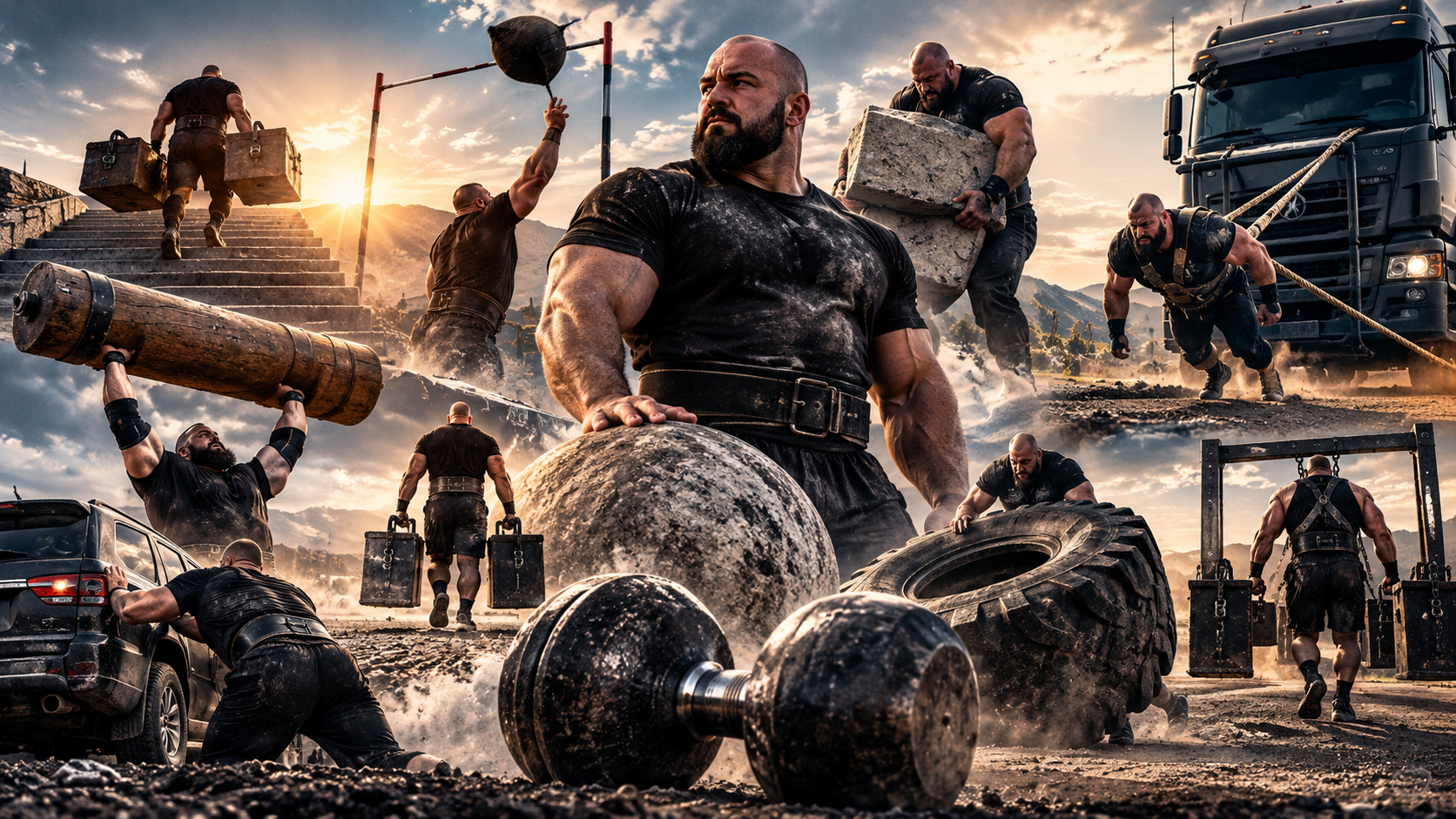
Truck Pull: moving a heavy vehicle is a traction problem, not merely a mass problem
An athlete pulling a truck while wearing a torso harness provides an iconic image of extreme strength. Physically, however, the vehicle's nominal mass is not the force the athlete must develop in the rope or harness. A multi-ton truck can roll on wheels against horizontal resistance equal to a fraction of its weight, and that fraction varies with surface, tires, inflation, road slope, braking and wheel condition. Consequently, two Truck Pull events cannot be compared by vehicle tonnage alone. A heavier truck on smooth pavement may challenge an athlete differently from a lighter vehicle on deformable terrain, a slope or a course with additional resistance. This episode distinguishes transmitted pulling force from vehicle mass and explains how the athlete uses ground contact to produce useful horizontal traction.
World’s Strongest Man describes Vehicle Pull as a long-established event introduced in 1977 and performed with different vehicles, distances and surfaces throughout its history. Its official description mentions both harness-only configurations and versions combining a harness with a rope [1]. This distinction defines our scope: we focus mainly on an athlete moving forward while transmitting force through a harness attached to the vehicle, sometimes assisted by a rope fixed ahead. We distinguish this from Arm-over-Arm Pull, where the athlete remains relatively stationary and brings the object closer through repeated hand-over-hand pulling cycles. The two events impose different patterns of ground reaction, lower-limb contribution and movement organization.
Three mechanical tasks must be solved. First, the vehicle must overcome its initial resistance. Second, the athlete must produce effective force without losing foot traction. Third, once motion starts, enough speed must be maintained over the prescribed course. These tasks create initiation, acceleration and rhythm-maintenance phases, which need not have equal duration or difficulty. An athlete may possess sufficient force to start a truck but lose time through inefficient short steps. Another may accelerate a light vehicle effectively but fail to initiate a much greater resistance. There is no sound basis for attributing success to squat strength, body mass or step length alone. Every contribution must be interpreted relative to the actual equipment and conditions.
The research base is limited. Hindle and colleagues' systematic review collected a relatively small number of Strongman biomechanics studies and noted limited direct quantitative information on vehicle pulls; related evidence includes heavy-sled pulling and associations between athlete anthropometry and vehicle-pull performance [2]. Heavy-sled research is useful for understanding stepping and trunk-angle mechanisms, but a sliding sled and a wheeled truck have different resistance. We therefore distinguish directly measured human data, standard physical principles and plausible event-specific inferences. Numerical illustrations use clearly defined hypothetical parameters and are not represented as measurements of competition trucks.
Rolling resistance, slope and starting force: what pulling ten tons actually means
When the vehicle rolls on wheels, rolling resistance must be distinguished from sliding friction. A simplified estimate is Frr = CrrN, where Crr is an effective rolling-resistance coefficient and N is the road's normal reaction on the vehicle. On level ground, neglecting other vertical forces, N is approximately mg. This model represents macroscopic effects of tire and surface deformation and is not the same as the sliding-friction expression for a rigid block. Crr changes with tire construction and pressure, temperature, surface condition, load and operating speed. There is no universal constant for all trucks. Any numerical coefficient chosen without measurement must be identified as an assumption rather than an observed competition value.
Consider a hypothetical 8,000 kg vehicle on level ground with assumed Crr = 0.015. Its gravitational weight is approximately 78,480 N, but modeled rolling resistance is 0.015 × 78,480, roughly 1,177 N. In this example, the athlete is not applying eight tons-force to maintain very slow motion; the immediate challenge is overcoming horizontal resistance and producing any additional force needed for acceleration. If Crr is instead assumed to be 0.04, resistance becomes approximately 3,139 N. These are not measured values on two known surfaces but hypothetical illustrations of sensitivity to the coefficient. The difference exceeds 1,900 N without changing vehicle mass, demonstrating why tonnage alone poorly describes the competitive load.
On a slope, the gravitational component along the course must be included: Fg,parallel = mg sinθ. The normal reaction, approximately mg cosθ when other vertical forces are absent, also affects rolling resistance. An approximate expression for required forward tension during ascent is Ft = ma + Crrmg cosθ + mg sinθ + other resistance, assuming the pull acts parallel to the road. The gravitational term increases demands uphill and changes its effect downhill. A small slope matters greatly at high mass. On an 8,000 kg truck, a one-degree uphill grade adds approximately 1,370 N of gravitational resistance, comparable to the entire rolling-resistance force in our first model. Organizers therefore need reliable course-grade measurements rather than assuming a route is level because its slope is difficult to see.
Starting motion can require a greater force than maintaining motion. Tire position, small surface deformations, residual braking, driveline play and rope extension may produce an initiation phase distinct from steady rolling. Calling all of these effects 'static friction' would oversimplify a complicated system. Brakes may be partly engaged, wheel bearings may have problems, and an elastic cable can store energy before visible vehicle motion begins. When the truck finally starts after several seconds, that does not automatically demonstrate a sudden physiological threshold or extraordinary new muscular force. The observation may reflect changes in both mechanical resistance and tension accumulated in the system.
Newton's second law should be applied separately to the vehicle. If horizontal pull on an 8,000 kg vehicle exceeds all resistance forces by 800 N, ideal acceleration is a = 800/8,000 = 0.1 m/s². If that acceleration were constant from rest for ten seconds, speed would reach 1 m/s and displacement would be five metres. Real athletes produce fluctuating force linked to stepping, and vehicle resistance may also change. Nevertheless, the example shows how small differences in net force can produce meaningful differences in completion time on a short course. Under a 60-second limit, losing five seconds at the start may matter more than a small reduction in later peak speed.
Aerodynamic resistance may also act on a large vehicle, although at the relatively low speeds common in many Truck Pull events it can be less important than rolling resistance. A drag model is Fd = 1/2ρCdAv², with a quadratic dependence on speed relative to the air. Trucks have large frontal areas, and a strong headwind can affect the task even when road speed is modest. But without vehicle shape, air density and wind measurements, a specific drag force cannot responsibly be assigned to a competition. A transparent hypothesis is preferable to a dramatic but unsupported claim about how much force is required to pull an aircraft.
Vehicle loading introduces further variation. Two otherwise identical trucks can distribute mass differently between axles and tires even at the same total weight. Tire pressure, bearing and brake condition, cable attachment and the location of ballast may affect resistance or stability. If organizers add ballast, its distribution as well as total mass should be documented. A vehicle rolling slightly off-line may require steering correction, changing effective resistance. It follows that a time and tonnage alone cannot guarantee fair comparison between two courses. Standardization, or at minimum careful description of the system, is part of meaningful performance measurement.
The mechanical model also suggests a research approach. A properly rated inline load cell could measure actual pulling tension, while position and velocity sensors describe the truck's response. Synchronized data would help estimate resistance and reveal when force is used primarily to overcome friction versus acceleration. Such instruments must be selected and installed by competent personnel with adequate safety margins; additional hardware must not introduce a failure point under high load. A peak reading from a load cell does not reveal which muscles produced it or prove optimal technique. It measures a useful external variable that must be interpreted alongside athlete kinematics.
Foot traction, ground reaction and whole-body orientation
An athlete does not move a truck through muscular contraction alone. To apply forward-moving tension through the harness, the feet must interact effectively with the ground. Each stance phase involves the foot exerting force on the surface and the surface producing an equal and opposite reaction. The horizontal component contributes to propelling the body against vehicle resistance, while the vertical component supports body weight and changes in vertical motion. 'Leg strength' must therefore be understood in terms of force direction and duration, not merely a gym score. Someone may squat extremely heavy loads yet transmit horizontal traction inefficiently at a particular body angle.
In a simplified static-friction model, the tangential force transmitted without slipping is limited approximately by μsN, with μs representing shoe–ground friction and N the normal reaction. A hypothetical 145 kg athlete bearing vertical load approximately equal to body weight has N ≈ 1,422 N. At μs = 0.6, the ideal tangential limit is about 853 N; at μs = 1.0, about 1,422 N. These are not measured athlete forces or absolute limits during dynamic movement: normal reaction changes through the step, force is distributed between feet, and shoe construction affects the contact. The calculation shows why footwear, surface and loading distribution can affect performance even when gym strength remains unchanged.
A large forward lean is common during Truck Pull, but its function is not simply 'lean into the harness and the truck moves'. Leaning changes the body's centre-of-mass position and joint geometry, potentially favoring horizontal force direction. Yet an unfavorable harness line or foot position may reduce traction or efficiency. Excessive lean can constrain stride length and bring the knees dangerously near the ground. Insufficient lean may increase trunk demands or reduce horizontal force production. No universal lean angle has been established, and a photograph does not prove that the athlete leaning most produces the greatest traction.
Balance conditions change with each step. During single-leg support, ground reaction differs from periods of simultaneous contact. A harness line passing high relative to the body's centre of mass can create a pitching moment that must be opposed by trunk position and muscle action. A lower harness attachment changes those relationships. The anchor's position on the chest or waist may affect demands on trunk and hip muscles. The Strongman biomechanics review discusses how harness-generated resisting moments could influence posture and pulling performance, but these suggestions are not direct measurements of every joint during an actual truck pull [2].
Contact quality matters independently of posture. Athletes may encounter dry asphalt, concrete, grass, sand, wet soil or artificial track surfaces, each with different combinations of friction, deformation and stability. On soft ground, some mechanical work is dissipated in surface deformation, and forceful steps can lead to slipping or sinking. Trying to compensate by accelerating cadence can increase limb movement without useful vehicle displacement. Step rhythm should reflect how much horizontal impulse can be produced while maintaining reliable contact, not an arbitrary demand to take more steps per second.
Horizontal impulse during a stance interval is Jx = ∫Fxdt. For the athlete, its effects on momentum must be considered alongside opposing harness tension and other forces. A brief step with substantial useful force can contribute to propulsion, while a longer contact with poorer force direction may not. Simply increasing cadence does not guarantee that the truck accelerates. Contact duration, average horizontal force and whole-body displacement must be interpreted together. Short frequent steps may be useful during one phase and inefficient in another, depending on resistance.
Pelvic and spinal positioning influence force transmission, but commands such as 'keep the back perfectly straight' can oversimplify an athlete's steeply inclined posture. More relevant is whether body segments remain controlled under tension and produce repeatable movement without uncontrolled compensation or symptoms. Some trunk-angle changes during acceleration are inevitable. Repeated deterioration in position under fatigue deserves reassessment, yet video evidence of a changed angle is not a medical diagnosis of lumbar injury.
If a fixed forward rope is available, pulling on it can also contribute to the athlete's forward drive. That rope produces a reaction toward the forward anchor, while the truck harness pulls backward. They are not independent engines: the forces act on the same body and influence the way the legs load the ground. Excessive rope pulling may disrupt lower-limb rhythm in one athlete, whereas another may benefit during initiation. Without separate tension measurements from the harness and forward rope, assigning precise percentages of contribution would be speculation.
Practical analysis can begin with two stable cameras, one lateral for steps and another frontal for body alignment. Under comparable surfaces and harness configurations, athletes can assess slipping, stride length and changes in trunk angle after movement begins. Total time alone offers none of these explanations. Direct ground-reaction measurement would need specialized instruments and calibration rather than visual estimation. Observed facts and inferred mechanisms should remain distinct so the coach can identify both correctable issues and unanswered questions.
Stride length and cadence: where seconds disappear after the vehicle begins rolling
Success in a timed pull is not determined only by maximal starting force. Once the vehicle is moving, athletes must organize steps that convert muscular effort into useful displacement without major losses of speed between contacts. Two observable variables are stride length and cadence. Average walking or running velocity is approximately the product of mean step length and step frequency when definitions are consistent and major pauses are absent. This is descriptive rather than causal. Demanding very long and very fast steps at once does not guarantee success, since force production under load constrains both variables.
Keogh and colleagues studied the heavy sprint-style sled pull in six experienced resistance-trained subjects completing three 25 m pulls with a roughly 171.2 kg sled and three-minute rest periods [4]. Their cameras captured early acceleration and the final five metres for temporal and kinematic analysis. Relative to unrestricted sprinting, heavy sled pulling featured shorter steps, lower step frequency, longer ground contact and a more horizontal trunk. Comparisons of faster and slower efforts often associated faster performance with greater step length, cadence and shorter contact time. These findings inform understanding of heavy resisted locomotion, but they were not measured during truck towing on wheels.
Winwood and colleagues also compared heavy sled-pull mechanics with back squatting in six experienced Strongman competitors [5]. They identified differences between movements and between the opening pull step and later displacement. This supports treating initiation as mechanically distinct from established motion without transferring force values directly to every Vehicle Pull event. Squatting can develop general strength, yet identical joint geometry and force direction should not be assumed in vehicle towing. Transfer should be explained through shared capabilities and verified by actual performance.
Close to a standstill, an athlete may need a comparatively long stance contact to generate sufficient impulse. Later, as the vehicle moves, cadence can increase and steps may lengthen if resistance and traction permit. There is no universal distance or time at which technique should change. Behavior emerges from truck inertia, available strength, harness direction and road surface. A rule such as 'three long steps, then sprint' may be useful in some coaching contexts but should not be presented as established for all loads and athletes. Its relevance must be tested on the actual course.
Long steps can increase displacement per contact but reduce cadence if the athlete lacks strength at extended positions. Short steps can permit favorable joint angles and rapid rhythm, but excessive shuffling may consume time and create unnecessary transitions. Performance is a compromise among interacting variables. Neither maximum stride length nor maximum step frequency automatically implies the greatest useful horizontal force. Simultaneous measurement of vehicle velocity and athlete motion would clarify the relationship.
With an extremely massive vehicle, moment-to-moment fluctuations in athlete force may yield smaller changes in truck speed than with a lighter sled. But when tension falls below total resistance over sufficiently long intervals, the vehicle decelerates. Maintaining continuity is therefore important. If large gaps occur between forceful steps, gains from acceleration are gradually dissipated against resistance. Efficient cadence is not simply fast; it is compatible with maintaining harness tension and controlled body trajectory. This helps explain why the athlete who appears to work most frantically does not always record the fastest time.
Fatigue alters step mechanics. An athlete may begin with consistent forward lean and stride length, then show longer contacts, lower cadence or changing pelvic orientation as effort continues. Event-specific evidence is insufficient to establish one universal sequence of changes. Slowing may reflect lower-limb fatigue, foot slippage or a section of deteriorating terrain. Without surface information and external force measurements, interpreting every slowdown as metabolic exhaustion is unjustified. It is better to examine how trajectory, foot traction and harness tension change together.
A practical monitoring method divides the course into sectors, for example the first five metres, middle section and final five metres. Section time can be compared with step count, slips and body-position changes. Slow initiation followed by relatively fast later sectors points toward a different limiting problem from a good start followed by pronounced slowing after ten metres. The former may warrant more attention to initial horizontal force; the latter may require assessment of repeatability, fatigue and movement economy. These are hypotheses requiring comparable testing, not automatic prescriptions.
Research on lighter resisted sprinting provides additional context rather than direct equivalence. Lockie and colleagues reported changes in step length, cadence and trunk lean while towing sleds with loads scaled to body mass [6]. Those loads were much smaller than those found in many Strongman events. Their findings can guide questions about stepping and posture, but numerical velocity decrements should not simply be assigned to an eight-ton Truck Pull. Similarities of movement do not erase substantial differences in resistance magnitude and mechanics.
The practical lesson is that athletes need to produce forceful, well-directed steps and then repeat them efficiently. General strength supplies potential; movement skill determines how much reaches useful vehicle displacement, while external conditions determine sustainable rhythm. There is no magical universal step pattern. Measurable questions do exist: How long does initiation take? What step length can be maintained without slipping? When does cadence collapse? How does trunk angle change? These questions turn a spectacular event into a more reproducible process of performance analysis.
Harness, assistance rope and the interface with the body
The harness directly connects external vehicle resistance to the athlete's body. Its shape, contact area, anchor location and load distribution may substantially affect performance and tolerance. A chest harness does not transmit resistance in exactly the same manner as one positioned lower near the pelvis. When the force application line is offset from relevant body axes, it creates external moments that must be countered through muscular action and postural adjustments. A harness that slides during pulling changes its geometry from start to finish. Equipment at the human–vehicle interface therefore belongs in any meaningful performance description.
Pressure on the chest is distinct from rope tension. Total force is distributed across a variable contact area, and local pressure may be high where a strap is narrow, rigid or poorly fitted. Actual harness pressure cannot be calculated merely from vehicle mass: tension differs from weight, contact is nonuniform and materials deform. The simple expression P = F/A helps explain why an identical force concentrated on a smaller area can increase average pressure, but it does not describe local peaks or changing contact. Skin abrasion, defective buckles and straps drifting toward the neck can become safety problems before muscular capacity is exhausted.
Adjustment matters, but one universal strap configuration cannot be prescribed. A high position may produce external moments affecting torso orientation, while a lower placement changes how pelvis and legs transmit force. A harness that restricts thoracic expansion or causes local compression may disturb comfort, but an exact performance-loss percentage would require direct measurement. Body proportions differ, so the same strap length does not produce identical pressure distribution for everyone. Familiarization with the actual harness should be part of preparation rather than improvised seconds before the start.
Some Truck Pull versions provide a fixed rope ahead of the athlete. Pulling on it can help draw the body forward while the harness transmits resistance from the truck behind. The forward rope and truck connection are not the same thing. Hand force acts toward the front anchor, whereas the harness pulls the athlete backward. The athlete's force balance then involves ground reaction, body weight, forward-rope reaction and harness tension. Observing vigorous arm pulling cannot establish what proportion of useful impulse came from the arms versus legs. Separate force sensors would be needed.
Combining front-rope assistance with stepping rhythm may provide tactical benefits. During initiation, a strong hand pull could help establish body orientation or produce initial forward impulse, followed by greater reliance on faster steps. But this is a plausible technique rather than a proven universal rule. Sustained maximal rope pulling can fatigue the arms, while repeated regrips may interrupt the extra support. Efficiency depends on coordinated force transmission, not simply maximal use of every muscle group. Video can identify timing differences but cannot assign exact force shares.
The connecting cable presents important safety concerns. An elastic rope or strap can store energy under tension and release it suddenly if an anchor fails. Materials and anchors must be chosen and examined by competent personnel for dynamic loads, not just for the vehicle's static mass. Attachment points and cable paths should be kept clear of people. A poorly fitted harness or improvised connection introduces structural hazards separate from athlete technique. A personal-record attempt is not justification for using components of unknown load rating.
Harness angle changes force components. If tension T makes angle α above the horizontal, useful horizontal force is T cosα and the vertical-component magnitude is T sinα, with sign determined by actual geometry. At T = 2,000 N and α = 20°, horizontal force is approximately 1,879 N and the vertical component about 684 N. This is a vector illustration, not a real harness measurement. Vertical force may alter normal loading and therefore traction or rolling resistance. Attachment angle is consequently a meaningful mechanical variable rather than merely a visual detail.
Angle may also vary during the course. A truck anchor located above the harness can apply a vertical component to the athlete opposite to the one acting on the vehicle; reversing the attachment heights changes those effects. A lower cable is not always automatically better, because the whole installation and bodily safety matter. Moving anchors without structural assessment to seek performance benefits can introduce serious hazards. Force vectors and moment arms must be described before a technique is evaluated.
Applied research could compare the same athlete under identical external resistance using two safely assessed harness configurations, measuring tension, initiation time, stride mechanics and trunk control. If one condition improves performance, repetition and order effects should be examined to rule out familiarization. Athlete comfort ratings may supplement measurements but do not replace them. In the absence of direct comparisons, precise harness recommendations remain practical hypotheses rather than demonstrated universal truths.
Asphalt, sand, grass and variable surfaces: why the same event is never reproduced perfectly
The surface under a vehicle determines part of its mechanical resistance, while the surface beneath the athlete determines how much traction the feet can produce. These may be the same roadway but are not the same phenomenon. For truck wheels, tire and ground deformation, irregularities and inflation influence rolling resistance. For footwear, friction, texture, moisture and ground deformation influence force transmission without slipping. A road favorable for the truck's wheels may be unfavorable for an athlete's shoes, while high-traction terrain for the athlete may create additional vehicle resistance. One label such as 'hard ground' does not capture the interaction.
Dry smooth asphalt can provide more predictable vehicle rolling than a damaged surface, but no two road conditions are perfectly identical. Aggregate, temperature, moisture and wear matter. On sand or soft soil, wheels may sink and displacement requires compacting and moving material beneath them as well as deforming the tires. A constant rolling coefficient may poorly describe this process when rut depth changes. Resistance can differ markedly between sectors, and an athlete may wrongly interpret an unexpected increase as sudden physical weakness. Event descriptions should document the type and condition of the ground and, where possible, its profile.
Even a small slope matters at high vehicle mass. Uphill, gravity adds resistance; downhill, gravity assists motion but can increase the need for safe control. An apparently flat course may have enough incline to change time, while bumps can generate brief resistance spikes. Tonnage and distance alone therefore do not make historical performances identical. An eight-ton truck on smooth level concrete and the same tonnage on wet, slightly uphill ground represent different mechanical tasks. Comparing their completion times as direct evidence of differences in athlete strength would be misleading.
Tires are active components of the system. Underinflation changes deformation, while temperature and wear can influence rolling resistance and initial movement. A towing vehicle with residual braking may demand significantly more effort than one with fully released brakes. Misaligned wheels can introduce lateral resistance and steering correction. These are mechanical considerations, not allegations about particular organizers. They explain why a fair event setup requires equipment inspection and consistent operating conditions for competitors.
Footwear introduces another layer. A shoe offering strong traction on asphalt may perform differently on grass or a damp track. Friction depends on the specific contact materials and can change with temperature. An athlete slipping on each step may increase apparent cadence without achieving equivalent centre-of-mass displacement. More squatting strength alone does not necessarily solve this problem. Appropriate footwear and examination of stance and surface can be valuable interventions, though they do not explain every aspect of the result.
Wind can affect vehicle and athlete differently. A large truck presents substantial frontal area and may experience meaningful aerodynamic resistance in a strong headwind. Effects may be small on a sheltered road and greater in an exposed outdoor setting. No universal drag value can be assigned across different vehicles. Wind direction and intensity deserve documentation when comparing times. Claiming that a gust cost exactly two seconds without calibrated aerodynamic and force measurements would invent precision.
Ambient temperature also affects the athlete as well as the equipment. Very intense work generates metabolic heat, and hot humid conditions can challenge thermoregulation. Cold slippery ground may reduce traction and alter warm-up requirements. No universal optimal temperature exists across all events and athletes. Duration, clothing, hydration and acclimatization should be considered without pretending that environmental variables automatically explain all differences in performance. Mechanical and physiological conditions interact.
When a course contains multiple surface types, interpretation becomes more difficult. The first five metres might be smooth, the next section gritty and the final section slightly uphill. Slowing in the middle does not necessarily establish failing muscular endurance. Resistance or traction may have changed. Sector timing, video and surface documentation help distinguish competing explanations. Even without laboratory instruments, coaches can record clear observations such as slipping, rhythm disruptions and locations where the vehicle meets greater resistance.
Surface variability is both an athletic challenge and a research problem. Competitors must adapt technique to permitted conditions and use appropriate footwear. Researchers should not present times from different terrains as measurements of one pure physical capacity. Organizers can improve consistency through preparation and inspection, but outdoor variation cannot be eliminated completely. Records should consequently identify apparatus and environmental conditions. The interaction of exceptional strength with unpredictable real-world equipment makes Strongman fascinating while demanding caution about simplistic scientific conclusions from dramatic performances.
Physiology of a demanding 20–60-second effort
Truck Pull is commonly described as a strength event, but a pull lasting tens of seconds tests more than one maximal burst of force. The athlete must maintain and repeatedly generate force while fatigue accumulates. At the beginning, phosphocreatine may contribute substantially to rapid ATP resynthesis, while anaerobic glycolysis and oxidative metabolism contribute according to intensity, duration and individual condition. Assigning a fixed fraction such as '70% phosphagen' to all 30-second pulls would require event-specific measurement. A 15 m course completed rapidly and a one-minute attempt interrupted by stalls have different physiological profiles even when the vehicle is identical.
Many muscle groups work together. Lower-limb extensors contribute propulsion, trunk muscles control position, and arms and shoulders may help when a forward rope is available. Broad muscle involvement affects metabolic demand, but exact calories per pull cannot be calculated from that observation without external power, duration and metabolic-efficiency data. Athletes can experience extreme exertion while a vehicle barely moves because high muscular tension does not necessarily produce proportional external displacement. A stalled attempt may create major physiological stress without improving the recorded distance.
Heart rate, ventilation and blood lactate can describe aspects of physiological response, but each has limits. Heart rate changes with effort, heat, arousal and hydration and does not reveal which muscle limited performance. Elevated lactate reflects metabolic processes but does not prove that lactate caused failure or that one energy system supplied all ATP. Perceived exertion is useful for a training journal but remains subjective. Combining these indicators with vehicle speed and stride mechanics is more informative than measuring physiological strain in isolation.
Fatigue can affect force and coordination differently. Foot slipping late in a pull might reflect lost control of foot orientation or a surface with worse grip. Shorter strides under constant vehicle resistance could be an adjustment to muscular fatigue. Failure to hold the forward rope can reduce its contribution while the legs retain force capacity. Several mechanisms can coexist, and their relative importance differs by athlete. One video cannot show depletion of a particular enzyme or establish precisely which metabolic pathway caused slowing.
Metabolic preparation does not require repeatedly attempting maximal truck pulls until failure. Heavy sled intervals, resisted locomotion and other dosable tasks may build relevant capacities, but transfer depends on resemblance in horizontal loading, posture and duration. Prolonged light work can improve broad conditioning without solving insufficient starting force. Conversely, maximal efforts lasting only a few seconds do not guarantee sustainable rhythm across a 20–30 m course. Preparation needs both initiation capacity and repeatable effective stepping.
Recovery between events matters. Truck Pull may follow deadlifts, presses or heavy carries that have already stressed legs and trunk. Phosphocreatine recovery involves oxidative processes, and full performance restoration depends on more than one mechanism. No single rest duration, such as exactly five minutes, guarantees identical recovery for all athletes. Familiar hydration, food and warm-up routines may support readiness but cannot substitute for accumulated training adaptations. Avoiding unnecessary heavy efforts between events can conserve capacity.
Training for Truck Pull: transfer from general strength to resisted steps
General resistance-training evidence provides a framework for strength and power development. The 2026 ACSM position stand, which synthesized 137 systematic reviews, describes benefits of heavier loading for maximal strength and faster movement intent for power [7]. These findings do not establish a direct conversion from a squat percentage to the horizontal tension required to start a truck. Squat loading is expressed in barbell kilograms, whereas vehicle rolling resistance is a horizontal force affected by terrain. Good programming distinguishes general stimulus from competition-specific demands.
Athletes entering the event can benefit from strong squats, hip extensors, trunk control and the ability to repeat powerful steps. But these are foundations, not guarantees. Heavy sled practice offers a dosable way to learn forward lean and resisted stepping, often with less logistical complexity than moving a multi-ton vehicle. A sled sliding on turf still differs mechanically from a wheeled truck, and pulley resistance may introduce yet another load pattern. Coaches should control conditions and monitor actual performance rather than equating nominal sled weight with vehicle towing force.
A practical progression may begin with controlled harness force transfer and reliable foot contact under manageable resistance. Greater starting loads and longer intervals can then be introduced gradually. Later, event practice can simulate competition distance and rules without making every session maximal. This is a logically grounded progression, not a directly randomized and validated Truck Pull protocol. Experienced competitors may need a different sequence according to their history, calendar and tolerance.
Training choices should respond to observed limitations. If an athlete starts heavy loads well but cannot maintain speed, cadence and repeatability may deserve priority. If the vehicle cannot be initiated, light conditioning alone will not provide the missing starting force. If footing slips, footwear, surface and step orientation require attention. If the harness creates an unstable or uncomfortable position, adjustment and familiarization may matter more than another heavy squat set. Accessory exercise is useful when its intended contribution can be checked on the actual task.
Cumulative workload across Strongman can be substantial. Deadlifts, yokes, farmer's walks and squats stress some of the same regions used in towing, even though movement patterns differ. Adding maximal Truck Pull sessions indiscriminately on top of heavy leg training may compromise recovery and movement quality. Set count alone does not capture loading: one long high-tension pull may differ greatly from several brief controlled attempts. Distance, duration, perceived effort, speed and foot-control quality can help guide programming without pretending that one summary number perfectly describes the stress.
Progress can be assessed under consistent surface, harness and resistance conditions. Athletes may record initiation time, sector splits, step count and slipping. Better performance only in the opening metres suggests changes in initial force production or technique; improvement in later sectors may reflect greater rhythm endurance. Repeated observations do not automatically prove causality, but they are more informative than isolated records. Symptoms and environmental variations should be documented as context rather than used as unsupported diagnoses.
Over longer periods, coaches may alternate general-strength phases with specificity blocks and reductions in accumulated fatigue before competition. Stage durations cannot be derived from one broad resistance-training review, and competition frequency affects preparation. An athlete competing frequently faces different recovery demands from one preparing a single annual event. The central requirement remains adequate force for starting resistance and sufficient repeatability to cover the course while preserving traction and control. Fast towing comes from useful force directed and repeated effectively, not from assuming that an impressive gym record transfers automatically.
Vehicle-towing safety: mechanical, cardiovascular and organizational hazards
When an athlete pulls a multi-ton vehicle, risk extends beyond muscular and joint loading. The system includes a massive moving object, wheels, brakes, harness, cables, anchors and a course where other people may be present. Brake failure, anchor failure or rope rupture can have consequences completely unlike a missed ordinary gym repetition. Cable forces fluctuate during acceleration and changes of rhythm, so components need to be evaluated for dynamic loads rather than vehicle mass alone. Responsible organization requires competent inspection of the apparatus, verified attachments and an exclusion zone preventing spectators and helpers from entering the line of potential cable recoil.
A tensioned rope can store elastic energy and move rapidly if it or an anchor fails. A highly extensible cable is not automatically safer simply because it feels softer; a stiff cable is not free of danger either. Material, wear, knots, contact angles and connectors alter system capacity. Arbitrarily prescribing one rope diameter without knowing actual forces and relevant equipment requirements would be irresponsible. Organizers must use components with appropriately assessed ratings and inspect them before use. Spectators should never stand in line with tensioned towing equipment, and athletes need a clear stopping and withdrawal procedure.
The vehicle must be controlled separately from the athlete. Wheels must operate properly, braking and steering must follow defined procedures, and the truck should not move uncontrolled if the competitor falls or stops. On slopes, a change in tension can allow gravity to accelerate the vehicle dangerously depending on route orientation. Uneven ground can cause wheel deviation and unpredictable lateral cable forces. Responsibility for vehicle control must be assigned explicitly rather than left to the athlete currently performing the pull. Organizational error cannot reliably be compensated for by muscular strength.
Athlete loading includes intense lower-limb extension, external moments on the trunk, harness pressure and sometimes shoulder and arm tension. Winwood and colleagues' retrospective survey of 213 Strongman athletes reported commonly affected regions including the lower back, shoulder, biceps and knee [8]. The injuries were self-reported, and the study covered Strongman as a whole rather than truck pulls individually. The fraction of athletes reporting injury cannot be converted into risk on a single towing attempt. Nor can Truck Pull be declared more dangerous than every other event without prospective exposure-specific data and verified diagnoses. The results support attention to heavily loaded regions but not invented event-by-event rankings.
The UK's Health and Safety Executive describes systematic risk categories for occupational pushing and pulling, including substantial starting force, awkward posture, repetitive exposure without recovery, insufficient space and poor surfaces [9]. These guidelines were not written to certify competitive elite vehicle towing. They do not establish a safe contest weight, but they are useful for recognizing preventable environmental and equipment hazards. A Truck Pull risk assessment should distinguish intended athletic stress from defects that should be eliminated before the event. Even the strongest competitor cannot make unsafe infrastructure reliable.
Cardiovascular responses also deserve caution. Very intense exertion, trunk bracing and forced breathing can produce marked temporary changes in blood pressure and heart rate. Neither a vehicle's tonnage nor completion time allows an exact prediction of an individual's peak pressure. Athletes with uncontrolled hypertension, chest symptoms, near-fainting or other relevant concerns need individualized medical assessment before maximal efforts. Chest pain, severe dizziness, unusual breathing difficulty or sudden loss of coordination during the pull are reasons to stop and seek appropriate help, not signs that the competitor should push through a final few metres.
Slippery ground and unsuitable footwear introduce mechanical and musculoskeletal hazards. A foot slip can abruptly change body position while harness tension remains high. The athlete may be pulled backward, fall or load one limb unexpectedly. Surface preparation, traction checks and controlled access are more useful than merely telling the competitor to be careful. Familiarization should allow athletes to understand how their harness behaves without immediately facing maximum resistance. Having once towed a heavy vehicle does not guarantee safe adaptation to a different apparatus and terrain.
Stopping criteria are important. If a vehicle will not move despite extreme exertion, prolonged maximal contractions may increase stress without improving the score. Repeated slips, migrating harness position and signs of cable deterioration should trigger reassessment. These observations concern control and equipment condition rather than serving as medical diagnoses. Competition organizers should establish stop commands and abandonment procedures, while training groups need someone explicitly responsible for the vehicle system. Long-term development requires preserving athletes' ability to continue training rather than treating one dramatic time as the only important outcome.
There is also a difference between the normal behavior of a heavy vehicle and an equipment problem. A difficult initial pull may be expected when rolling resistance and inertia are high; sudden lateral movement, uncontrolled acceleration or unusual mechanical sounds may indicate hazards that require inspection. The athlete should not be asked to decide whether a brake is malfunctioning while pulling at maximum effort. Qualified personnel need authority to interrupt the attempt when the equipment behaves unexpectedly. Clear responsibility prevents a technical problem from becoming a test of how much risk competitors will tolerate.
Assistants and officials need safe positions. A timekeeper may require a clear view of the start and finish without standing beside a highly tensioned attachment. An official checking vehicle movement should remain outside the wheel path and any potential rollback zone. Rope handlers must not attempt to catch an uncontrolled moving connection. Event design can use barriers and remote observation where appropriate. These choices are not cosmetic; they make the competitive situation predictable and reduce the chance that spectators or staff will interfere with the athlete's movement.
Fatigue management is also a safety decision. An athlete who repeatedly loses footing or cannot maintain controlled trunk position under resistance may no longer be working within the conditions anticipated by the coach. More maximal attempts can magnify rather than solve the problem. A reduced-resistance technical session may be useful after appropriate reassessment, but acute pain or concerning symptoms require a different response, potentially clinical evaluation. Mechanical troubleshooting and medical diagnosis must not be confused.
Finally, fair competition and risk reduction overlap. Consistent braking status, inspected ropes, known route grade and reliable surface preparation allow athletes to be judged on performance rather than equipment variation. No event can eliminate every inherent demand of heavy towing, but avoidable mechanical failures should not be treated as part of the sport's challenge. Responsible Truck Pull preserves the spectacle while keeping the hazards of moving tons under control.
Measuring performance: beyond total time toward a mechanical course profile
If research records only final completion time, many causes of athlete differences remain hidden. Two competitors may cover a 20 m course in the same time even though one struggles to initiate the truck and then accelerates strongly, while the other starts easily but progressively loses rhythm. A more useful evaluation records time to first observable truck movement, displacement in the opening seconds, section splits, approximate speed, step count, slipping and trunk-position changes. Mass, surface, slope, harness, tires and rules must also be documented. Otherwise apparent athlete differences can largely reflect changes in the mechanical installation.
A practical recording protocol can use stable lateral video far enough from the athlete to capture useful movement, supplemented by a frontal view of alignment and slipping. Markers at known distances allow calculation of mean speed between sectors. Closely spaced markers and oblique viewing can introduce substantial error. Tracking a point on a moving truck also requires appropriate calibration when perspective changes. Millisecond precision should not be claimed if the exact onset of motion cannot be identified. Smartphone video may be valuable for learning but is not equivalent to laboratory instrumentation.
An advanced study could use an appropriately rated inline tension sensor, with motion sensors on the vehicle or calibrated video providing speed and acceleration. Knowing mass and measured acceleration, the difference between transmitted force and ma can estimate combined resistance under appropriate assumptions. The calculation also requires cable angle, vertical-force effects and possible changes in resistance. If the athlete has a separate forward assistance rope, multiple instruments may be needed to describe the system fully. Inverse dynamics for the athlete would require ground-reaction data, anthropometry and three-dimensional kinematics. One rope tension value cannot reveal quadriceps muscle force.
The early tension profile deserves investigation. A high force peak before movement might reflect initial resistance and cable elasticity. Tension rising after motion begins could reflect vehicle acceleration or terrain changes. Interpretation requires synchronizing force and displacement. A series of disconnected maxima is less informative than a complete tension curve aligned with vehicle speed. At the coaching level, repeated submaximal trials on a consistent route can reveal which part improves. Longitudinal data support practical decisions but do not prove one physiological mechanism simply because completion time falls.
Reliability matters. If one observer starts timing on the command, another on the athlete's first step and a third on the truck's first movement, results are not equivalent. Each measured event needs an operational definition consistently applied. Stable equipment conditions are preferable to uncontrolled surface comparisons, particularly during early familiarization. A useful log records interruptions, harness changes and tire condition. Not every variable needs a complicated statistical score; some are necessary descriptions of the conditions that created the result.
This analysis helps distinguish limiting factors. Shorter initiation time with unchanged later cadence suggests one kind of improvement, perhaps starting force or setup technique. Speed increasing throughout the course may reflect broader adaptation, but lower mechanical resistance must first be ruled out. Fewer slips after changing footwear can contribute to better performance even without measurable muscle growth. Preserving such distinctions makes training more targeted and historical comparisons more credible.
Researchers should also report uncertainty. Distance markers positioned by eye, vehicle accelerometers with unverified orientation and video measurements affected by motion blur may yield very different errors. Deriving acceleration from position data magnifies noise. A device reporting values to three decimal places does not mean those values are accurate to three decimal places. Measurement quality depends on calibration and repeatability, not the number of digits displayed. An honest methods section should explain where uncertainty is largest, including the exact time at which truck movement becomes detectable.
A reasonable study could compare several athletes using the same vehicle and course, measuring whether stronger lifters tend to produce higher initial tension and whether step mechanics explain variation in time after movement begins. But correlations would not prove that changing one factor causes better performance. Body mass, experience and footwear might confound the relationship. Intervention studies would need sufficiently controlled training and pre–post measurement. In elite Strongman, small sample sizes can limit statistical confidence, making transparent individual data and cautious inference particularly important.
If investigators compare harness-only and harness-plus-forward-rope versions, both systems should be characterized separately. The added rope changes whole-body force balance and may permit upper-body contributions that alter stepping. Calling the two formats the same event for biomechanics would ignore a meaningful intervention. It would be more informative to report tension at the harness, rope assistance, body angle and ground reactions under each configuration. That would reveal not merely which version was faster but how the force pathways differed.
Measurement also has a practical value beyond laboratory science. Even without sophisticated sensors, coaches can mark the course, standardize filming and identify whether a personal best comes from improved starting response or better sustained rhythm. That feedback can guide the next training block. It can also prevent erroneous conclusions when a heavy vehicle seems easier one week because tires have changed or the course has been cleaned. A careful observer avoids turning equipment variation into an invented account of rapid muscular adaptation.
The essential research principle is that a Truck Pull result belongs jointly to athlete and apparatus. Time is a legitimate competitive score but is not a pure measurement of strength. A better performance profile includes starting resistance, transmitted force, body movement, travel distance, vehicle acceleration and conditions of the environment. With those quantities, the event can be studied as a reproducible biomechanical problem without losing the extraordinary physical challenge that makes it compelling.
A numerical case study: an eight-ton truck on two different surfaces
Consider a fully hypothetical example with explicitly chosen values rather than observations from a real contest. An 8,000 kg vehicle rests on level ground with no residual braking and negligible aerodynamic resistance. We assume Crr = 0.015 and useful horizontal towing tension of 1,800 N at the truck. Rolling resistance is approximately 1,177 N, leaving net force around 623 N. From F = ma, ideal acceleration is 623/8,000 ≈ 0.078 m/s². Starting from rest and maintaining this acceleration for ten seconds would yield only about 3.9 m of travel. That may look slow relative to some competition footage, but the model is not a prediction of those performances. Real tension may be much higher, while resistance and acceleration change across time.
Keep truck mass and tension identical but change the hypothetical rolling coefficient to Crr = 0.025. Resistance rises to approximately 1,962 N, greater than the assumed 1,800 N pull. Under this model, the athlete cannot accelerate the stationary truck forward with that tension alone; more force is needed, and startup may impose additional demands. The same nominal truck, athlete and mass now form a fundamentally different task because surface resistance changed. This illustrates why tonnage is an incomplete loading specification and why failing one course does not automatically imply reduced muscular strength compared with success on another.
Now add a one-degree uphill grade to the original Crr = 0.015 case. The uphill gravitational component is approximately 1,370 N, while rolling resistance remains close to 1,177 N after a small cosine adjustment. Total resistance approaches 2,547 N, well above the assumed tension. The vehicle would not accelerate uphill from rest in this model despite unchanged tire coefficient. A slope that looks nearly invisible may transform the mechanical requirement. Downhill gravity can reduce required towing tension but creates other control concerns. Responsible event descriptions should document grade and road condition as well as mass and distance.
Changing the athlete's effective tension illustrates another sensitivity. Returning to the initial level-road scenario, assume 2,600 N rather than 1,800 N of useful pulling tension. Net force becomes approximately 1,423 N and ideal acceleration about 0.178 m/s². At constant acceleration from rest for ten seconds, travel approaches 8.9 m. An 800 N increase is associated with more than twice the distance in this example because the initial surplus available for acceleration was small. This demonstrates threshold-like behavior: a relatively modest improvement in total applied force may have a large effect when the athlete is just overcoming a high resistance. The relationship will not necessarily remain the same at higher speeds, where other forces may change.
Now consider available ground force. A 145 kg athlete has gravitational weight of approximately 1,422 N. Assuming hypothetical static shoe–ground coefficient 0.8 and normal reaction exactly equal to weight, the ideal tangential friction limit would be about 1,137 N. That value is below the higher towing tensions considered above. The apparent inconsistency is a warning against combining oversimplified models without checking their assumptions. Real harness angles, vertical force components, changing normal reactions and possible forward-rope assistance alter athlete force balance. Inventing an arbitrarily large friction coefficient to 'fix' the calculation would be bad science. Instead, the model must be expanded to represent the actual system.
A further hypothetical comparison isolates the effect of force direction. If total harness tension is 2,600 N but the rope is angled 20 degrees relative to the route, its horizontal component is approximately 2,443 N rather than 2,600 N. The remaining magnitude acts vertically with a direction determined by the attachment geometry. This changes horizontal acceleration and may affect normal reactions and traction. The angle matters even if the athlete produces the same magnitude of tension. However, a calculation that ignores the changed vertical forces cannot be used to declare the exact final difference in competition time.
Suppose a short course is judged by distance completed in one minute. If the vehicle initially fails to move at all because applied force remains below resistance, an athlete may expend substantial metabolic energy while receiving no distance score. After a modest increase in effective traction, the vehicle might begin moving. It would be wrong to interpret the appearance of movement as a sudden discontinuous change in muscle function. The crucial change can be a crossing of the mechanical threshold at which the net horizontal force becomes positive. This is an especially useful conceptual distinction for athletes comparing sessions conducted on different surfaces.
The calculations also show why a vehicle's gravitational potential energy should not be used naively as a measure of work on a flat course. If its centre of mass stays at the same height, the truck's potential energy does not increase substantially just because it moves twenty metres. The athlete performs work against rolling resistance and to change kinetic energy, not necessarily to lift the entire vehicle vertically. On an uphill route, gravitational potential energy does rise and adds to the demand. Failing to separate these contributions is one of the most common misconceptions in descriptions of vehicle-pulling strength.
The purpose of numerical work is to make relationships transparent rather than produce a universal performance calculator. Accurate prediction would require measurement of rolling resistance, tension, grade, speed, traction and body configuration. Without those data, we can establish sensitivities and plausible orders of magnitude, not exact contest seconds. Well-designed research could test how changing rolling resistance affects start time, how harness angle changes horizontal tension or how ground contact relates to acceleration. Hypothetical figures are not athlete facts; they reveal why truck mass alone cannot ground a scientific explanation.
Competition tactics, research priorities and the meaning of useful strength
In Truck Pull, athletes must understand what the organizer scores: course completion, finishing time or distance achieved within the limit. The distinction changes tactical choices. A maximal-looking start that causes foot slippage may be slower than a more controlled initiation. Rapid early acceleration followed by collapsing cadence may perform worse than a steadier pull. Yet no direct experiment establishes one universally optimal pacing strategy. Choice depends on initial resistance, course, traction, assistance rope and individual capacity. Athletes benefit from knowing their split-time profiles and adapting rhythm to the actual conditions rather than equating aggressive appearance with mechanical efficiency.
Historical performance archives would become much more informative by recording vehicle type, tire condition, surface, gradient, harness setup and forward-rope availability along with nominal mass, distance and time. A record on low-resistance ground is not automatically athletically inferior to one obtained on difficult terrain; the two test different combinations of force and movement. Direct comparison without these variables is misleading. If organizers documented mean resistance or tension required for movement and the startup phase, event mechanics would become clearer. Full standardization may be difficult in Strongman, but systematic description is attainable.
Future studies should distinguish wheeled vehicles from sliding sleds, harness-only from harness-plus-rope configurations and initiation from later locomotion. Synchronized tension sensors and cameras could test whether body angle, cadence and attachment geometry explain performance after accounting for external resistance. Researchers should recruit athletes of different levels and characteristics, including women and lighter categories, and report individual variation rather than treating a few very heavy male athletes as representative of everyone. Small samples may describe phenomena but cannot establish universal technique laws. Negative results are valuable: showing that greater forward lean or faster cadence does not improve time under certain conditions would help correct overconfident coaching assumptions.
There is a methodological challenge in measuring the actual human contribution when resistance changes during the course. A force sensor at the harness may register tension, but part of that force can be directed vertically, and separate assistance ropes create additional force pathways. Ground-reaction instruments placed under a fixed laboratory track can provide highly informative data, yet might alter the surface on which the athlete practices. A moving field setup preserves ecological validity but introduces measurement challenges. Combining laboratory assessments of specific variables with carefully recorded competitions may therefore provide a better research program than expecting one apparatus to answer every question.
Biomechanical research could also investigate equipment design. Harness position, strap width, attachment height and rope elasticity may influence movement and comfort. Experiments could compare safely evaluated configurations under controlled loads, measuring both force transmission and movement quality. They should not simply identify whichever setup produces the highest one-time force peak. A useful design must also permit repeatability and safe withdrawal. Equipment that improves an athlete's best trial while creating unpredictable recoil or pressure points would not represent an unqualified performance improvement.
The role of anthropometry deserves nuanced investigation. Body mass can influence ground contact and system inertia, while height and segment lengths affect posture and stride geometry. But heavier athletes are not automatically better truck pullers, and taller athletes do not always have longer useful strides under high resistance. Strength, footwear, motor control and conditions interact. Investigators should test these relationships rather than assigning fixed advantages based on stature or body mass. The finding that anthropometric measures correlate with performance in a particular novice sample does not prove that changing body mass causes improved towing performance.
Training research should compare strategies that develop starting force, sustained resisted locomotion and skill using the actual harness. One group might emphasize heavy short-distance pulls, another longer submaximal efforts, and a third a combination. Outcomes should include initiation time, section splits and force measures where feasible, not only one final time. Participants should be familiarized with equipment before baseline testing to reduce the chance that simple learning dominates results. Statistical interpretation would still need to account for initial strength, experience and training load.
Fatigue offers another unresolved question. Some athletes may maintain initial force but lose movement economy, whereas others may preserve cadence while suffering a decline in effective horizontal impulse. Combining phase-specific force and velocity measurements with repeated attempts could clarify these patterns. It would also help distinguish true fatigue from mechanical changes along the course. Such findings could inform more targeted conditioning than a generic prescription to increase cardiovascular work for every slow finish.
Practical analysis begins by identifying the actual bottleneck. If the vehicle will not move, examine resistance, traction, harness position and initial force capacity. If it starts but remains slow, assess stepping and force transmission. If velocity deteriorates late, distinguish fatigue, contact loss and changing terrain. If structural hazards appear, eliminate them before further loading. This decision process allows strength development without reducing technique and safety to secondary concerns.
The social and historical appeal of pulling a huge truck is understandable: the visible disparity between athlete and vehicle is striking. Science does not diminish that accomplishment. It makes the achievement more specific. An athlete does not vertically lift the truck's entire mass, but overcomes resistance, controls ground reactions and repeatedly transmits horizontal impulse through a system dependent on equipment and terrain. This may still demand remarkable human force, coordination and endurance. Understanding the mechanism makes the performance more impressive in a technically meaningful way.
We should also distinguish sporting achievement from numerical spectacle. A vehicle weighing more does not guarantee a harder event if resistance is lower. A faster time does not necessarily prove greater maximal strength if the surface or rules differ. A slower athlete may be stronger in an isolated force test but less efficient across the course. Good science resists reducing this multidimensional performance to a single ranking beyond the agreed competition score. It respects both the legitimacy of results and the conditions that produced them.
Ultimately, Truck Pull is a problem of useful strength: how much horizontal force can be transmitted, for how long, in which direction and under what mechanical constraints. Force is essential, but success depends on its orientation, repetition and the prevention of losses through slipping or ineffective movement. This framing gives athletes testable questions, coaches targeted interventions and researchers a route toward meaningful evidence. The relevant scientific question is not simply how many tons a human can 'pull', but what resistance the athlete overcomes and how effectively it is transformed into movement on an actual course.
References: official sources, physics and peer-reviewed research
[1] World’s Strongest Man. Vehicle Pull. Pagina oficială privind formatul, istoricul și diversitatea suprafețelor din probă. Read source
[2] Hindle BR, Lorimer A, Winwood P, Keogh JWL. The Biomechanics and Applications of Strongman Exercises: A Systematic Review. Sports Medicine - Open. 2019;5:49. DOI: 10.1186/s40798-019-0222-z. Read source
[3] Hindle BR, Lorimer A, Winwood P, Keogh JWL. A Systematic Review of the Biomechanical Research Methods Used in Strongman Studies. Sports Biomechanics. 2020;19(1):90–119. DOI: 10.1080/14763141.2019.1598480. Read source
[4] Keogh JWL, Newlands C, Blewett S, Payne A, Chun-Er L. A Kinematic Analysis of a Strongman Event: The Heavy Sprint-Style Sled Pull. Journal of Strength and Conditioning Research. 2010;24(11):3088–3097. PMID: 19996774. Read source
[5] Winwood PW, Cronin JB, Brown SR, Keogh JWL. A Biomechanical Analysis of the Heavy Sprint-Style Sled Pull and Comparison with the Back Squat. International Journal of Sports Science & Coaching. 2015;10(5):851–868. DOI: 10.1260/1747-9541.10.5.851. Read source
[6] Lockie RG, Murphy AJ, Spinks CD. Effects of Resisted Sled Towing on Sprint Kinematics in Field-Sport Athletes. Journal of Strength and Conditioning Research. 2003;17(4):760–767. PMID: 14636109. Read source
[7] Currier BS et al. American College of Sports Medicine Position Stand: Resistance Training Prescription for Muscle Function, Hypertrophy, and Physical Performance in Healthy Adults. Medicine & Science in Sports & Exercise. 2026;58:851–872. DOI: 10.1249/MSS.0000000000003897. Read source
[8] Winwood PW, Hume PA, Cronin JB, Keogh JWL. Retrospective Injury Epidemiology of Strongman Athletes. Journal of Strength and Conditioning Research. 2014;28:28–42. DOI: 10.1519/JSC.0b013e3182986c0c. Read source
[9] Health and Safety Executive. Risk Factors Associated with Pushing and Pulling Loads. Recomandări ocupaționale utile pentru identificarea pericolelor, nu standarde de greutate pentru Strongman. Read source
[10] OpenStax. University Physics, Volume 1. Section 5.6: Common Forces. Relațiile dintre greutate, reacțiunea normală, frecare și tensiune. Read source
[11] Winwood PW et al. Interrelationships Between Strength, Anthropometrics, and Strongman Performance in Novice Strongman Athletes. Journal of Strength and Conditioning Research. 2012. PMID: 22233785. Read source
More From The Journal

Training Science
TRANSFER OF STRENGTH: WHAT CAN STRONGMAN LEARN FROM OTHER SPORTS? | Episode 10: Interdisciplinary Synthesis, Method Selection and Validation of Competition Performance
Evidence-based synthesis of transfer from other sports to strongman: biomechanical criteria, individual diagnosis, programming, testing and limits of the evidence.
Training Science
TRANSFER OF STRENGTH: WHAT CAN STRONGMAN LEARN FROM OTHER SPORTS? | Episode 6: Wrestling and Judo: Unstable-Object Control, Balance and Force Production from Disadvantageous Positions
Scientific analysis of grips, off-balancing, center-of-mass control, isometric force, awkward positions and evidence limits for transfer into Strongman.