
Strongman Events
BEYOND CLASSIC EVENTS: THE SCIENCE OF SPECIAL STRONGMAN EVENTS | Episode 10: Shield Carry, Front-Loaded Implement Mechanics and the Distribution of Muscular Demands
October 28, 2026
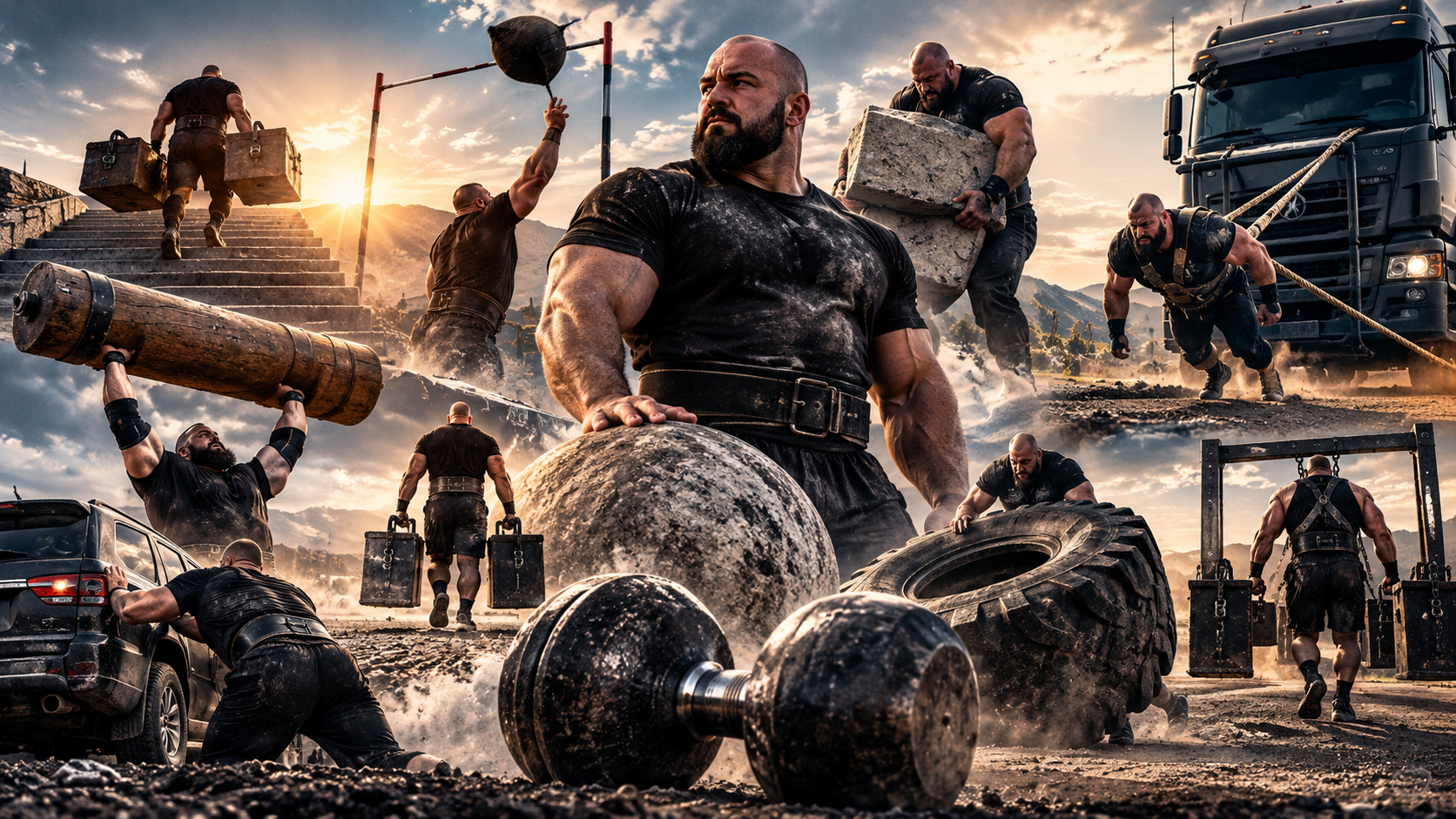
Shield Carry: when implement design determines the distribution of effort
Shield Carry is an anterior load-carriage event in which an athlete moves a massive shield-shaped, panel-like or contoured object, generally cradled in the arms against the front of the body. Unlike the historic Húsafell stone, a competition shield is commonly purpose-built and may permit controlled changes in thickness, material and added mass. Visual resemblance does not establish mechanical equivalence. A tall narrow steel shield, a broad rounded panel, a convex-bottom shield or a loadable version equipped with handles produces different grip and contact conditions [1,2].
This episode asks what changes when load geometry is deliberately designed. Rather than repeat the natural stone's history, it examines pressure distribution, implement stability, contact forces, centre-of-mass location and the consequences for loaded locomotion. A shield is more than a heavy object: it is a mechanical interface among the arms, chest, abdomen and lower limbs. When that interface is unfavorable, performance may be limited before the legs reach their available strength capacity.
Direct laboratory research on competitive Shield Carry is scarce. Experimental anterior carriage and other strongman exercises inform plausible mechanisms without yielding automatic quantitative predictions. We distinguish verified outcomes, elementary physics, hypothetical calculations and testable coaching proposals. Neither backpack measurements nor results obtained with lightweight frontal objects can be scaled mechanically into exact predictions for an elite shield event [3–7].
What counts as Shield Carry? Apparent standardization and actual variation
Strongman Archives records Shield Carry contests with different implement masses, distances, time limits and ranking criteria. Events include maximum-distance efforts, fixed 20 m or 40 m courses and formats involving multiple implements. Such records establish how competitions were organized; they do not validate one universal carrying technique. Meaningful comparison requires the shield's geometry, start height, rules for dropping or regripping, surface, turning points and whether built-in handles may be used [1].
Construction details matter as much as the displayed mass. Two shields labelled 160 kg may have different internal load distributions and different centres of mass relative to their upper edges. One may press a small region of the abdomen while another distributes much of its contact over the chest and forearms. Equal weighing-scale mass therefore does not imply equal external moments about the torso or hips. Without an implement description, comparisons of results remain incomplete.
A manufactured shield may provide a more predictable surface than a natural stone, yet predictability does not guarantee comfort or safety. A narrow steel edge may concentrate pressure more than a rounded stone surface. Internal plates must also be secured against unexpected movement. Genuine standardization aims at reproducible mechanics, not merely equal nominal kilograms.
Contact geometry: pressure, area and concentrated loading
For a given normal contact force, simplified mean pressure is p = F/A, where A is the effective contact area. If a shield transmits 600 N through 0.020 m², calculated average pressure is 30 kPa; distributed through 0.060 m², it becomes 10 kPa. These values are illustrative rather than measured shield pressures. Actual pressure is nonuniform, changes with movement and depends on soft-tissue deformation. The example shows why edge shape, contact area and intervening materials can change an athlete's tolerance of the implement.
The entire weight of the shield does not press normally into the chest. Some load is supported by the forearms and hands, and contact-force directions vary as the athlete moves. The effective area may shift as the shield settles lower. Measuring these effects would require robust pressure sensors that do not themselves alter friction or movement. Values from a simple pressure calculation cannot be interpreted as thresholds for bruising or tissue injury.
A concentrated contact near an upper edge may load the forearm or lower thorax, while a wider base can interfere with thigh motion. The instruction to hold the shield as high as possible must therefore be checked against breathability, sustainable support and the ability to see the route. A visually impressive carry position is not automatically the mechanically best one.
Designed centre of mass: tall, wide and asymmetrically loaded shields
The centre of mass represents the point through which the resultant gravitational force can be modeled. It is not necessarily the geometric centre of the panel. Loading plates near the bottom can lower it; a thicker outer face can place it farther from the torso. Even small changes may alter external moments substantially when the implement weighs more than 100 or 150 kg. However, muscle-force changes cannot be computed from geometry alone.
A taller shield may support its upper region against the chest and let the forearms cradle a lower edge, but may obstruct vision. A very broad shield can enlarge contact area while forcing the arms into an uncomfortable position. Convex profiles change the locations at which pressure is concentrated. Effective design must be judged through the complete system of contacts rather than how comfortably a single athlete appears to hold it.
Asymmetrical loading can also produce a tendency to rotate toward one side. The athlete then generates compensatory forces with the arms and adjusts trunk orientation. Inertial sensors and a documented mass-distribution map could help test this behavior. In practical competitions, organizers should verify that loadable components are secure and consistently positioned before the event begins.
The arms as a support structure: elbow angle is not a single answer
During Shield Carry, the arms form an adaptable support structure that squeezes the implement and carries part of its vertical load. Elbow angle affects local leverage while humeral orientation changes shoulder and scapular demands. Yet more elbow flexion is not universally stronger, and one spacing of the elbows cannot be assigned a fixed metabolic advantage. Relationships depend on thickness, edge geometry and the athlete's proportions.
An under-cradle with the forearms provides different support from compression applied mostly through the sides of the panel. Handles may transfer more of the load to the hands and change the event mechanically relative to a handle-free carry. Handle availability and permitted use must be recorded in event comparisons. The Farmer’s Walk literature illuminates loaded gait but does not supply directly transferable percentages or joint loads for a shield [3,10].
The arms fatigue from sustained support as well as the small corrections required with each step. Gradual lowering of the elbows can change the shield's pressure against the abdomen instead of merely lowering it vertically. A local forearm limitation can thus develop into a torso-stability problem even if the legs were initially capable of maintaining pace.
Ground reaction and the division of work between trunk and legs
On level ground at approximately constant average speed, the athlete must support the complete system and replace the mechanical energy lost throughout walking. Ground reaction forces alternate between feet according to gait phase and centre-of-mass trajectory. Increasing external mass does not uniformly increase every muscle's tension. Joint angles, loading response and shield motion all affect the resulting demands.
A preliminary experimental study of anteriorly loaded overground walking assessed ground reactions and muscle activation under submaximal conditions. Its findings cannot be treated as a complete activation map of Shield Carry. Another study on anterior load carriage with different shoes reported increases in certain lumbar extensor activity under its tested conditions. The studied loads were small relative to competition shields and the values cannot be linearly scaled upward [6,7].
A useful functional model assigns leg muscles important roles in support and propulsion, arm muscles roles in connecting to the implement, and trunk muscles roles in controlling orientation between those systems. These are not exclusive anatomical compartments: hip muscles also stabilize posture and the shoulder girdle influences the implement's trajectory.
Walking behind a shield: stride length, balance and limited visibility
A large panel can restrict thigh motion and obstruct the sightline toward a turn. Unlike a yoke, which rests farther back and above the body, a shield places its most demanding contact on the anterior torso. Excessively long strides may drive the shield into the thighs, whereas very short steps increase the number of gait cycles over a fixed distance. Efficient technique must therefore be judged by time, distance and the consistency of the holding position.
Meta-analyses of anterior carriage suggest an overall reduction in stride length, but the underlying studies used different participants, loads and courses. Backpack research also documents adaptations to load, yet posterior carriage changes the mechanical situation; numerical results do not transfer directly. Strongman-specific evidence remains insufficient to define an ideal cadence or a universally optimal shield-to-body-mass ratio [3,5,9].
Turning requires lateral forces at the ground to redirect the combined centre of mass. The shield may rotate within the arms, prompting rapid corrections. Turning practice should begin with manageable loading and a safe space in which the implement can be dropped, particularly when its height obstructs the athlete's view.
Torso, abdomen and breathing: frontal loading is not distributed uniformly
A shield can press against the sternum, ribs, abdomen or combinations of those regions. Contact distribution may influence breathing comfort, but assigning a precise reduction in lung capacity would require direct measurement. Under intense effort an athlete may alternate shallow breaths and short bracing episodes. Prolonged breath-holding under very heavy load should not be represented as a universally safe method. Individual assessment is preferable to one fixed breathing instruction.
Stabilization does not consist of isolating one muscular group. The abdominal wall, back extensors, diaphragm and hips contribute to positional control in task-dependent ways. When the shield slides, its centre of mass, chest pressure and lever arm about the spine may all change together. What looks like a weak core may partly reflect unfavorable implement geometry.
A wider and more comfortable contact area might permit longer uninterrupted holding, but that is a testable mechanical hypothesis, not an established randomized-trial result in strongmen. A meaningful experiment would compare two shapes at equal mass and standardized conditions, recording time to slipping, trunk motion and respiratory responses.
Starting the carry: separating pickup, acceleration and sustained movement
A Shield Carry can be divided into pickup, stabilization, acceleration, carriage and completion. Total time is the sum of these phases, and savings in one phase can be offset by losses in another. One athlete might pick up explosively but then move slowly because the shield requires repeated readjustment. Another may take slightly longer to establish a grip but walk continuously afterward. Either strategy may be appropriate depending on scoring.
During pickup, the shield's position relative to the knees and hips determines available movement and the lifting path. Some organizers allow an elevated platform start; others require a floor pickup. An elevated start can reduce initial lifting demands without changing the difficulty of the ensuing walk. Rules should specify whether a drop terminates the attempt, whether a regrip is allowed and how distance is measured.
During acceleration, the combined centre of mass moves forward through net ground-reaction impulse. The change in linear momentum follows the time integral of net horizontal external force. An aggressive first step is not automatically useful if it destabilizes the shield. Effective acceleration improves the official result while preserving enough mechanical control to finish.
Illustrative calculations: 170 kg, shifted centre of mass and local pressure
Consider, strictly as a numerical illustration, a 170 kg shield carried by a 120 kg athlete. The shield's weight is about 1,668 N and the combined static weight about 2,845 N. If the shield's centre of mass is 0.15 m anterior to a chosen axis, its gravitational moment is approximately 250 N·m. At 0.25 m it rises to about 417 N·m. These figures are not measured spinal moments or estimates of erector-spinae contractile force.
Suppose a 500 N normal contact component acts over 0.025 m², giving simplified mean pressure of 20 kPa. If effective area drops to 0.010 m², calculated pressure rises to 50 kPa. Neither example assumes pressure is actually uniform or establishes medical harm thresholds. Both merely illustrate how contact geometry changes a physical variable. Real shields generate multiple, shifting contacts.
For a 40 m uninterrupted walk, average speeds of 0.8 m/s and 1.0 m/s correspond to 50 s and 40 s of carriage, respectively. Pickup time is excluded, while speed is inseparable from how securely the implement remains supported. A more comfortable design may permit greater speed, but only a controlled comparison could attribute the improvement to contact shape rather than familiarization or fatigue.
Distinct risks: edges, migrating plates, compression and impact
A manufactured shield introduces hazards that may differ from those of natural stone: protruding fasteners, slick metal surfaces, loose internal plates and sharp or tightly curved edges. Inspection should confirm structural integrity, load retention and symmetrical assembly before training or competition. Knowing the total mass does not make poorly secured equipment safe.
During walking, a sudden drop can strike the thighs, abdomen or feet; the shield may also block the corrective step after a loss of balance. Courses need clear drop zones, predictable traction and supervised procedures. Assistants should never stand in the likely falling path of the implement. Protective equipment must comply with the rules and should not be mistaken for a substitute for apparatus safety.
Winwood and colleagues documented injuries in a strongman sample, but did not establish a Shield Carry-specific injury rate. Claims that shields are inherently safer than stones would therefore be unjustified. Changing materials and shapes can alter the type of risk, not simply its magnitude [8].
Training and materials: specificity without needless exposure
Preparation should include pickup technique, stable support, short carries, progression toward competition distance and turns when relevant. General squats, deadlifts, rows and sandbag carries develop useful resources but are not perfect substitutes for holding a particular panel. Transfer should be judged by actual shield performance, not inferred from improvements in gym lifts alone.
A practical progression might first improve technical stability, then increase mass and finally distance or speed, without treating that order as a universal law. If localized pain or uncontrolled slipping appears, simply adding mass is a poor response; geometry and surface properties should be reassessed. Padding or clothing changes can affect both comfort and friction, and any modification must comply with event rules.
Training records should state verified mass, dimensions, handles, surface, pickup duration, first slip point, uninterrupted distance and turns. These details make repeated attempts comparable. Without them, a spectacular performance improvement could reflect nothing more than switching to a mechanically easier shield.
Materials and friction: more than a fixed coefficient
The shield-to-body interface is not determined by the material's label alone. Painted steel, textured surfaces, rubber coatings and fabric coverings behave differently in the presence of sweat, dust and movement. In elementary descriptions, available friction is often represented as Ff ≤ μN, with N the normal force and μ an effective coefficient. Real contacts between deformable materials can depend on speed, pressure and surface condition. The equation is a conceptual starting point, not a precise calculator for shield grip.
A rough-textured top may change friction as well as perceived comfort; a smooth shirt can create a different contact pattern. Any strategy must comply with competition rules, while greater apparent friction does not automatically make the event safer. High friction can locally anchor fabric and change the way skin and soft tissue move. Both implement stability and tolerance of local pressure matter.
Ambient temperature and humidity can affect the interface. A shield that performs consistently indoors may slip differently in an outdoor competition when condensation or sweat accumulates. Training records should identify contact materials, surface condition and permitted equipment, not just weight.
Research could first measure selected material combinations on an instrumented fixture under controlled pressure and sliding conditions, then test their behavior with athletes at progressively heavier loads. Even that preliminary testing would not replace full-implement trials because contact area, angle and soft-tissue deformation change during walking.
Structural design and implement inspection
A loadable shield must withstand not only static weight but also pickup acceleration, gait-related oscillation and possible impact during controlled set-down. A declared maximum mass is not proof of structural integrity. Welds, closures, fasteners, handles and internal restraints require competent inspection. For custom-made apparatus, professional technical review matters more than dramatic appearance.
Internal plates or ballast must be prevented from moving. A sudden internal shift can displace the centre of mass precisely when the athlete has a restricted view of the implement. That introduces a variable which muscular strength may not be able to overcome safely. Secure retention is part of both athlete protection and competitive fairness.
Edge protection deserves structural consideration. A tightly curved metal edge can concentrate pressure on the forearm, while a protrusion may catch clothing and unexpectedly change shield position. Conversely, an unevenly applied soft layer can shift contact geometry and load distribution. Any modification requires documentation and checking before the attempt.
Organizers can reduce uncertainty with an implement specification sheet: verified mass, height, width, thickness, surface type, approximate ballast location, retention system and handle rules. This does not turn every contest into a laboratory, but it removes avoidable ambiguity from performance interpretation.
Athlete morphology and compatibility with shield geometry
Anterior contact varies among athletes with different body proportions. A wide shield may permit an athlete with long arms to support its lower edge, while an athlete with shorter arms relies more heavily on compression from the sides. Torso depth and chest shape change how far the shield's centre of mass sits from the hips. These characteristics can affect pickup and stabilization, but they cannot justify ranking body types without appropriate research.
Greater waist circumference may provide a different supporting surface, but assuming body mass always provides an advantage merges competing mechanisms. The athlete must accelerate personal mass along with the shield, and contacts may be favorable or unfavorable depending on design. A very strong athlete may struggle with a narrow shield if it prevents the familiar elbow position.
Instead of one universal elbow angle, a coach can establish a practical range that keeps the object clear of thigh motion, permits breathing and allows stable stepping. Repeat the observation with the same implement to separate familiarization effects from shape-related differences.
Future studies could combine segment-length models and centre-of-mass estimates to examine interactions among stature, chest circumference and performance. However, a relationship observed with one shield cannot be generalized to all anterior carries, particularly when some variants have handles or curved panels.
Repeatability and fairness: when results are truly comparable
A 40 m performance with a 160 kg shield cannot be compared directly to the same distance at another event using nominal mass alone. Time limits, turns, ground-contact rules, permission to regrip and the precise finish-line definition can all change difficulty. Competition archives are useful for identifying official outcomes, but rarely preserve every variable required for a biomechanical comparison [1].
A standardized test must specify exactly when timing begins and how completion is defined. If one athlete stabilizes the implement before the clock starts while another is timed from pickup, the times describe different sequences. Technical analysis should distinguish pickup duration, carriage time and time spent turning.
Repeatability of video observations improves with fixed camera positions and course markings. A marker on the shield could help estimate vertical sliding relative to a mark on the athlete's shirt, although clothing movement adds measurement error. This would be an approximate operational indicator, not a validated direct measure of the centre of mass.
A serious study reports variability between trials rather than only the best value. Without repeated measurements, apparent advantages of a new shield design may reflect chance, fatigue or learning. Testing protocols for very heavy implements must also remain safe and ethical: repeated maximal attempts solely for statistical precision may not be justified.
Competition preparation: diagnosing a Shield Carry race
Applied analysis begins by decomposing the event. If time is lost before standing, contact points and pickup trajectory should be studied independently of gait. If the shield lowers during the first meters, the limitation may involve grip geometry, uneven pressure or overly aggressive acceleration. If the problem occurs only after turning, change-of-direction technique and surface traction become important.
A coach might run submaximal trials of two or three holding configurations under comparable conditions, recording time, stability and comfort. There is no need to test every option at maximal load. Submaximal results do not perfectly predict maximal performance, but they can eliminate obviously unsuitable arrangements before a competitive effort.
Programming should account for cumulative demand on forearms, torso and legs rather than recording distance alone. Two training sets with equal distance can impose different loads if one includes three extra pickups. Useful volume descriptors therefore include pickup count, mass, distance and rest interval. This is a practical training framework, not a validated clinical threshold.
Convincing progress means more reproducible mechanics and better performance with the same implement and rules. The purpose is not to win every training session, but to identify the mechanism limiting competition performance and improve it without unnecessary exposure to injury risk.
A research program and conclusion: the shield as a controllable laboratory tool
Shield Carry offers an unusual opportunity: unlike a historic stone, a manufacturer can alter geometry while preserving mass. Researchers could compare shields with matched mass and centre of mass but different contact surfaces, or identical shells containing differently located internal weights. Contact pressure, 3D motion, muscle activation and respiratory measurements could separate local interface demands from whole-body locomotion costs.
A credible protocol would include familiarization, counterbalanced trial order, identical courses, measured mass and adequate recovery. Small samples of elite strongmen and variation in body proportions would limit generalization. Most importantly, a plausible mechanism must not be confused with an observed performance effect. Increasing contact area at the same normal force should reduce mean pressure, but it does not follow that the athlete must automatically carry farther.
Shield Carry shows that load distribution is partly designed before the athlete reaches the start line. Geometry, surface, centre of mass and grasping options condition how force is transmitted and how long the position can be maintained. Unlike Húsafell, this manufactured event permits systematic alteration of the implement while preserving the general challenge of frontal carriage. Good science does not proclaim one perfect shield; it identifies the variables by which better designs and techniques can be demonstrated [1–10].
References and verifiable sources
[1] Strongman Archives. Distance Carry event database: Shield Carry contests, equipment loads, course lengths and formats. Open source
[2] Liftingstones.org. Húsafell Stone: the original stone and how loadable shields reproduce aspects of its carrying challenge. Open source
[3] Hindle BR, Lorimer A, Winwood P, Keogh JWL. The Biomechanics and Applications of Strongman Exercises: a Systematic Review. Sports Medicine - Open. 2019;5:49. DOI 10.1186/s40798-019-0222-z. Open source
[4] Anderson AM, Meador KA, McClure LR, Makrozahopoulos D, Brooks DJ, Mirka GA. A biomechanical analysis of anterior load carriage. Ergonomics. 2007;50(12):2104–2117. DOI 10.1080/00140130701450195. Open source
[5] Effects of anterior load carriage on gait parameters: A systematic review with meta-analysis. Applied Ergonomics. 2022;98:103587. DOI 10.1016/j.apergo.2021.103587. Open source
[6] Ground reaction forces and muscle activities during anteriorly-loaded overground walking: Preliminary results. International Journal of Industrial Ergonomics. 2022;90:103328. DOI 10.1016/j.ergon.2022.103328. Open source
[7] Influence of anterior load carriage on lumbar muscle activation while walking in stable and unstable shoes. PubMed PMID 29096180. Open source
[8] Winwood PW, Hume PA, Cronin JB, Keogh JWL. Retrospective injury epidemiology of strongman athletes. Journal of Strength and Conditioning Research. 2014;28(1):28–42. DOI 10.1519/JSC.0b013e3182986c0c. Open source
[9] Liew B, Morris S, Netto K. The Effect of Backpack Carriage on the Biomechanics of Walking: a Systematic Review and Preliminary Meta-analysis. Journal of Applied Biomechanics. 2016;32(6):614–629. DOI 10.1123/jab.2015-0339. Open source
[10] Winwood PW, Cronin JB, Brown SR, Keogh JWL. A biomechanical analysis of the farmers walk, and comparison with the deadlift and unloaded walk. International Journal of Sports Science & Coaching. 2014;9(5):1127–1143. DOI 10.1260/1747-9541.9.5.1127. Open source
More From The Journal
Training Science
TRANSFER OF STRENGTH: WHAT CAN STRONGMAN LEARN FROM OTHER SPORTS? | Episode 10: Interdisciplinary Synthesis, Method Selection and Validation of Competition Performance
Evidence-based synthesis of transfer from other sports to strongman: biomechanical criteria, individual diagnosis, programming, testing and limits of the evidence.
Training Science
TRANSFER OF STRENGTH: WHAT CAN STRONGMAN LEARN FROM OTHER SPORTS? | Episode 6: Wrestling and Judo: Unstable-Object Control, Balance and Force Production from Disadvantageous Positions
Scientific analysis of grips, off-balancing, center-of-mass control, isometric force, awkward positions and evidence limits for transfer into Strongman.