Strongman Events
BEYOND CLASSIC EVENTS: THE SCIENCE OF SPECIAL STRONGMAN EVENTS | Episode 1: Power Stairs, the Biomechanics of Lifting and Moving Loads Up Steps
October 28, 2026
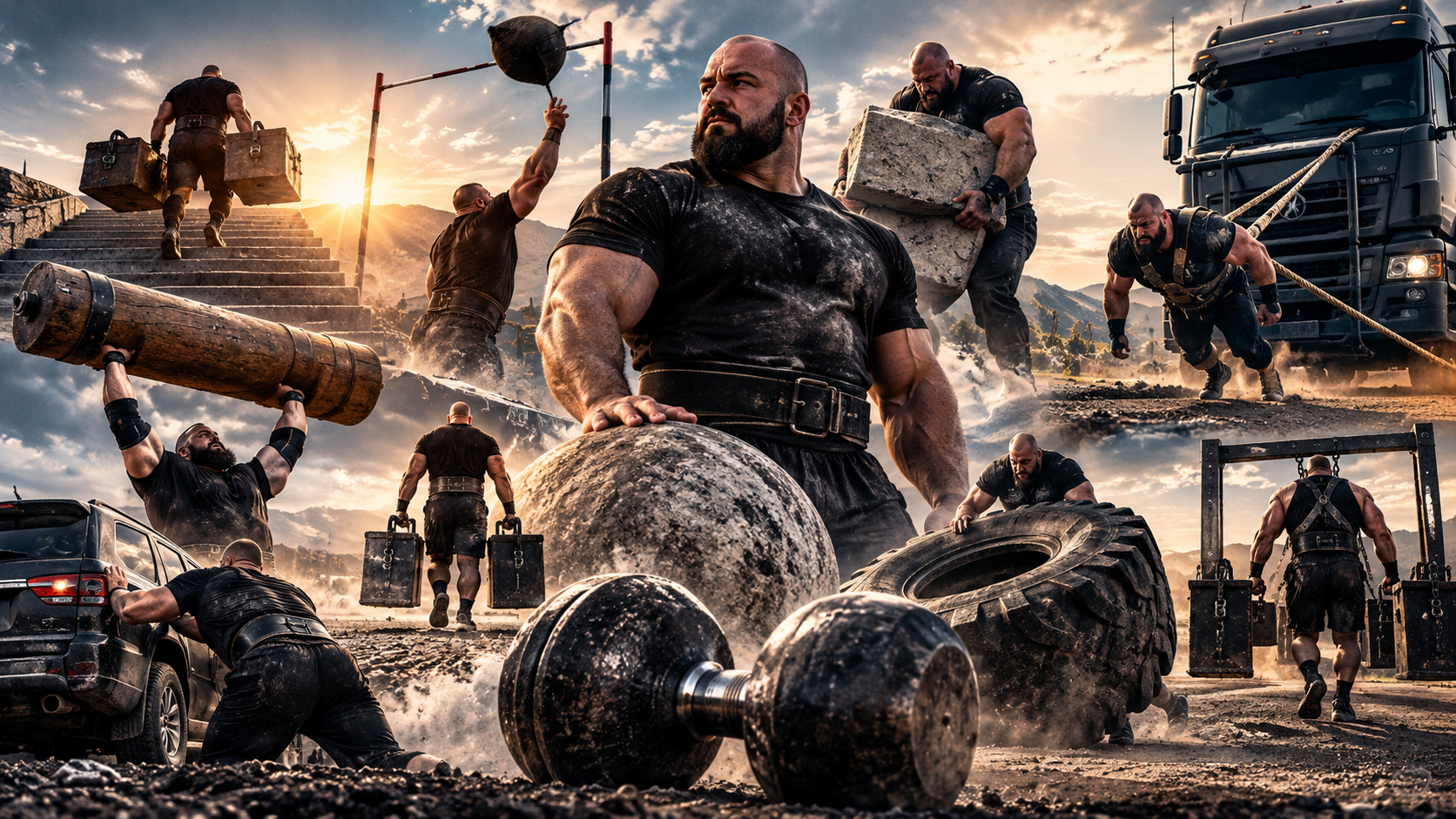
Power Stairs: strength must climb, not merely lift
In Strongman, implement weight tells only part of the story. A deadlift event can be described by load, vertical displacement and judging standards; in Power Stairs, the same kilograms present a different problem at every step. The athlete must break a very heavy implement from rest, control any swing, reposition, raise the implement's centre of mass to the next platform, place it securely and repeat without wasting movement in transitions. Maximum strength remains a prerequisite, but the result emerges from strength, position, balance, mechanical power, grip and decision-making. The official World's Strongest Man description presents heavy implements moved up a staircase and explicitly stresses speed, stamina and skill [1].
We must be precise about the strength of the evidence. Direct peer-reviewed studies of the Power Stairs event are sparse compared with research on normal stair ascent, loaded stair negotiation, manual materials handling and resistance exercise. Accordingly, this article separates three levels of argument: documented descriptions of the event, experiments conducted on related tasks, and mechanical deductions made from elementary physics. Explaining why moving a load farther from the torso increases its moment arm is mechanics; reporting greater knee moments during the stair transport of a 13.6 kg load requires an experimental citation [3]. Recommending a particular footwork strategy for a 200 kg implement is an applied coaching hypothesis, not a claim that an experiment with elite Strongman competitors has demonstrated its superiority.
What is the unit of effort in Power Stairs?
Many versions use handled metal blocks or suitcase-like implements that must be moved up one step at a time. The number of implements, their weights, stair height, platform depth, order of execution, timing rules and valid-placement standards can vary between competitions. Even the 182–273 kg range described on the World's Strongest Man website characterizes particular event arrangements rather than a universal standard [1]. Comparing performances without accounting for these parameters can be misleading. Moving 180 kg over three shallow steps is not equivalent to moving the same mass over taller steps with a differently placed handle or a smaller landing area.
For analysis, a useful technical unit is the cycle of gripping, breaking from rest, lifting, landing and repositioning. These phases do not challenge the neuromuscular system in identical ways. Breaking the implement from rest requires sufficient upward force and trunk stiffness; transport requires trajectory and balance control; landing requires management of momentum, placement accuracy and prevention of an unstable drop. Between repetitions the athlete must move the feet while breathing rapidly, with grip and extensor muscles already under load. This helps explain why a lifter capable of an enormous single pull may not be the quickest competitor across several implements and many steps.
Mechanics behind each step: force, work, impulse and power
The first tool for understanding the event is the relationship between force and acceleration. In an idealized vertical model, F − mg = ma, where m is mass, g gravitational acceleration and a vertical acceleration. A 200 kg implement weighs approximately 1,962 N; at liftoff, the net upward force must exceed this if positive upward acceleration is required. In practice, force also has horizontal components, and the implement trajectory is constrained by handle design, stair geometry and body position. The 1,962 N figure does not describe the force generated by individual muscles or, by itself, predict repetition difficulty: this would require information about body-segment lever arms, coordination and tissue loading.
The second tool is work against gravity, W = mgΔh. Raising the centre of mass of a 200 kg implement by a net 0.40 m increases gravitational potential energy by about 785 J. If the same load gains 0.40 m on each of three levels, the idealized total increase is approximately 2,354 J. This represents external gravitational work on the implement alone. It does not include elevating the athlete, changes in kinetic energy, stabilization, co-contraction, braking, slipping or metabolic expenditure. Two attempts may produce equal gains in potential energy while placing very different demands on the athlete because completion time, mechanical inefficiencies and movement strategies differ.
A third distinction separates work, power and impulse. Mean mechanical power over a phase can be estimated as P = W/t, whereas instantaneous power depends on applied force and the velocity of its point of application. Raising the same implement more quickly requires greater mean power in this simplified comparison, but uncontrolled speed may increase braking demands at the landing. The impulse of force, its integral over time, governs change in linear momentum; an implement arriving rapidly at the step edge may require aggressive braking or bounce. The athlete therefore does not win simply by accelerating the load. The art is to select a speed that can be controlled, stopped and immediately converted into the next efficient repetition.
Implement geometry and the distance from the body
The same mass becomes a different biomechanical challenge when the location of its centre of mass changes relative to the hip and spine. In a simplified planar model, external joint moment is force multiplied by its perpendicular moment arm. Moving the line of action of the gravitational force of a 200 kg object 10 cm farther from a relevant axis adds approximately 196 N·m of external moment in that model. This is not a direct prediction of an in-vivo L5/S1 joint moment, because body orientation and internal force distribution are considerably more complex. It nevertheless illustrates why a few centimetres matter. Manual-handling guidance to keep a load close to the body is compatible with this reasoning, even though elite Strongman competition lies far outside the intended applications of occupational guidance [8,9].
In Power Stairs, the handle may position the hands above or beside the mass, and implement shape determines how the object clears each stair edge. Some layouts favor an almost vertical path; others require a slight backward pull to clear the edge and then a guided forward placement. The shortest trajectory is not automatically the safest, because an early collision with the stair can halt the lift or rotate the implement. Handle position, surface friction, riser height and the available foot space create a specific geometric problem. This is why the implement's advertised mass and a single photograph are inadequate descriptions of the task.
An oscillating implement adds a control cost. A nearly constant gravitational force does not imply constant grip or trunk moments: reversing direction requires acceleration and acceleration changes demands on the athlete. Standing extremely close may shorten the load path but restrict hip extension or knee travel. Creating more space may improve body mechanics while increasing the required implement displacement. Neither strategy deserves the status of a universal rule. Athletes and coaches can test alternatives with side and frontal video, assess landing accuracy, and favor reproducible positions that do not compromise safety.
What experiments on loaded stair ascent actually show
Stair negotiation is not level walking with a change of scenery. In an investigation by Protopapadaki and colleagues, 33 healthy adults used a laboratory staircase with 18 cm risers while three-dimensional motion and ground-reaction forces were measured. Hip and knee angles and joint moments differed between ascent and descent [2]. These are reference values for ordinary locomotion, not measurements of 200 kg Power Stairs blocks. They do, however, clarify why single-leg support, elevation of the body centre of mass and controlled forward progression demand meaningful contributions from the lower-limb extensor system.
Hall and colleagues compared walking, stair ascent and stair descent in 16 healthy participants under unloaded conditions and while carrying 13.6 kg in front or in a backpack. External knee adduction moments were greater with the additional load, and their peaks during ascent were higher than during walking and approximately twice those recorded during descent under the study's protocol [3]. This result does not prove that any given Strongman technique causes osteoarthritis. The external knee adduction moment is a mechanical surrogate, not a diagnosis or a direct individual injury probability. The defensible inference is that loaded vertical locomotion alters joint demands and implement weight alone does not identify where those demands occur.
Research on asymmetric carriage adds another dimension. Experiments using 10% and 20% of body weight found that unilateral loading altered lateral-bending moments around the lumbosacral region and frontal-plane lower-limb demands, whereas bilateral carriage reduced some of those frontal-plane moments in relevant comparisons [4,5]. Extrapolation to Strongman is limited: the loads were much smaller, the tasks consisted of ordinary stair negotiation, and participants did not repeatedly stop and land a massive implement. Still, frontal-plane control matters. Even when a handle is centered, an off-center pull, poor unilateral stance or an oblique landing can create rotational demands requiring rapid correction.
The muscular system: generating force and preserving control
Hip, knee and ankle extension jointly contribute to elevating the athlete and applying force to the implement. Gluteus maximus and adductor magnus are involved in hip extension; quadriceps contribute to knee extension; soleus and gastrocnemius help control and propel the ankle depending on joint angles and movement phase. The hamstrings play angle-dependent roles and cannot be named the sole prime mover of the lift. Spinal extensors and abdominal muscles help regulate trunk geometry, while shoulder-girdle and forearm muscles transfer force to the handle. This event cannot be assigned to a single muscle group.
Roles shift throughout the repetition. When the implement starts low, substantial hip flexion may make hip extension especially important early in the pull. As the body approaches the stair, knee extension and ankle control may become more evident. During placement, the aim changes from producing upward acceleration to managing contact with the platform. Stabilizers can develop substantial force even when little visible movement occurs. Consequently, a feeling of local muscle fatigue is not a direct measurement of how much mechanical work that muscle performed. Establishing individual muscle contributions would require kinematics, kinetics and carefully interpreted electromyography.
Calling Power Stairs 'a deadlift followed by a step-up' is useful only as a rough teaching analogy. A barbell deadlift follows the geometry of the bar and the athlete; a normal step-up mainly elevates the athlete's body rather than a massive implement through a narrow opening. Power Stairs combines and transitions between these demands while adding implement contact. Manual-lifting research shows that squat and stoop techniques cannot be ranked under one universal injury-prevention rule [7]. The relevant message is not that technique is unimportant, but that it must be evaluated against load geometry, the athlete's build, goals, symptoms and whole-system control.
Three critical positions: liftoff, clearance and landing
Efficient liftoff depends on the relationship between handle position, the centre of pressure under the feet and the ability to extend without losing overall alignment. There is no universal ideal hip or knee angle. The same staircase may be used by a 1.70 m athlete and someone taller than 2 m, while handle height may vary drastically. Observable features include avoiding unnecessary horizontal movement immediately after liftoff, keeping both feet stable, avoiding sudden twisting and maintaining a breathing rhythm that allows control to be regained. Gradually creating tension before a heavy pull is often a plausible strategy, but this should not be turned into a claim that one optimal lifting speed has been established for every athlete.
Clearance is where geometry and strength meet. Unless the bottom of the implement rises above the level of the landing surface, the athlete cannot complete the placement without striking the edge. An excessively large movement wastes time and raises braking demands, but insufficient height risks a failed lift. The useful target is adequate clearance with a controllable margin, not maximal range at any cost. In side-view footage, identify the instant of liftoff, the instant the load clears the edge and the first contact with the step. Differences among these intervals may be more actionable than total event time alone.
Landing is a distinct athletic task. A free drop may appear fast, but it should not be confused with controlled, valid placement. Competition rules may require stabilization, while collisions with stair edges can create unpredictable rotation. An excessively slow lowering may reduce impact but needlessly tax grip and trunk muscles. The useful technique lies between these extremes and depends on platform materials, implement shape and the permitted contact standards. Between lifts, foot repositioning should establish repeatable support rather than resemble a hurried run next to a swinging block. The event organizer, equipment and judges determine valid execution, not the athlete's preference.
Grip: the mechanical connection between handle and athlete
Grip is the interface transmitting much of the whole body's force to the implement. If the handle slides within the palm, the effective contact position changes and the athlete must correct it while the forearm muscles are under tension. Handle diameter, texture, contour and moisture all affect the quality of contact; implement mass does not by itself describe how hard the object is to hold. Wrist orientation influences transmission between the elbow and fingers. No universal grip configuration follows from these observations: hand size and handle design vary, and chalk, straps or other aids are permitted or prohibited according to specific event regulations.
A two-handed, apparently symmetrical pull need not distribute forces symmetrically. An athlete may stand slightly obliquely or habitually favor one side. Video might show one corner lifting before the other, or repeated rotation during the ascent. This observation does not prove unilateral muscular weakness; handle geometry, uneven surfaces, wear patterns and initial positioning may explain it. A sound assessment compares frontal footage, the starting alignment, lighter practice repetitions and the direction of implement travel. Only then is it reasonable to decide whether extra unilateral resistance work is warranted.
Heavy intermittent gripping differs from a static handgrip test. Power Stairs involves brief tension peaks, changes in finger position and demands associated with braking the load. Therefore, static holds on a similar handle, controlled short-range pickups and lighter placement drills can be more task-specific than endless maximal attempts. This follows the principle of task specificity; it is not a claim that a trial has directly compared every possible grip-training method in elite Power Stairs competitors. A good program should make grip and contact more repeatable under stress, not merely improve a number on a dynamometer.
Energy demand, breathing and fatigue across repetitions
Stair ascent without Strongman implements is already physiologically demanding. A field study involving 180 stairs and 27 m of vertical ascent reported an average oxygen uptake of 33.5 mL/kg/min and heart rate of 159 beats/min during its final ascent interval; descent produced different values [6]. These measurements describe extended locomotion and cannot be numerically applied to a handful of 200–300 kg lifts. They do establish that repetitive ascent has meaningful cardiovascular demands. In Strongman, short duration and high intensity also make phosphocreatine breakdown and anaerobic glycolysis important, alongside oxidative processes involved in recovery. Exact contributions depend on duration and the athlete and cannot be assigned a universal percentage.
Fatigue is not a single event. Grip can fail before hip-extensor capacity; precision during placement can deteriorate while the athlete still has the strength to lift; poorly timed breathing can make trunk stiffness harder to regulate between efforts. Research discussing the physiology of Strongman training recognizes its mixed muscular and cardiometabolic demands [10]. It would nevertheless be misleading to invent a lactate concentration or heart-rate threshold at which Power Stairs performance supposedly collapses. Movement quality, relative repetition speed, landing accuracy and foot stability are more directly observable coaching indicators.
Breathing management needs special care. Increasing intra-abdominal pressure through a bracing maneuver can assist trunk control during heavy lifting, but prolonged breath holding and successive attempts without resetting can cause dizziness and pronounced transient blood-pressure responses. There is no basis for advising an athlete to hold a breath throughout an entire extended Power Stairs sequence. More defensible is a pattern of brief preparation, exertion and controlled recovery breaths suited to each phase. Individuals with cardiovascular symptoms or medical conditions need appropriate clinical assessment before engaging in this category of maximal effort. Safety is part of performance because loss of consciousness or control renders small time savings irrelevant.
A stopwatch measures more than strength: breaking down performance
Total time can be separated into distinct components: approaching the implement, establishing grip, first liftoff, moving it over each riser, stabilizing contact, repositioning feet and changing to the next load. An initial breakdown need not require a biomechanics laboratory. Two steady cameras with visible event markers can capture useful timing information. However, precise estimates of joint forces and moments require more than ordinary video; force platforms and validated three-dimensional motion analysis would be needed. A video can answer 'how long did the phase take?' much more reliably than 'how many newtons were transmitted through the knee?'
A repeated protocol should hold constant the athlete, implement, staircase, start and finish rules, footwear and, as far as feasible, fatigue status. If a lift cycle improves from 3.2 to 2.8 seconds, that matters, but the change may reflect gripping, familiarization, foot placement or the actual clearance height rather than pure strength. Where safe, several submaximal trials can reveal within-athlete variation. Maximal competition efforts should not be repeated merely for statistical neatness, as fatigue and risk may outweigh the value of another data point. Training footage is often a better source for longitudinal assessment than a single all-out event.
A useful coaching instrument is a 'time-loss map' marking delays in initiation, clearance, landing and repositioning. This can radically alter the next training choice. If the object moves quickly but feet take half the cycle to reset, raising a conventional deadlift personal best may not address the bottleneck. If the load repeatedly stalls below the edge, force production from that specific position is a more likely limiting factor. If later steps slow disproportionately, specific endurance, breathing and technical consistency deserve attention. Diagnosis begins with the observed limiting phase, not an athlete's favorite exercise.
Training specificity without an obsession with maximal attempts
Power Stairs preparation can be organized around three separate capacities: a reserve of general strength, technical ability with the implement and preservation of quality under fatigue. The first may be developed through hip and knee extension exercises, heavy pulls, squat variations and movements demanding trunk control. The second requires a staircase and handle sufficiently similar to competition conditions for the movement to transfer. The third can be trained with moderate-load repetitions during which timing, placement precision and deterioration under fatigue are monitored. This three-part approach is an applied programming framework informed by task specificity, not the product of a controlled trial establishing a single optimal Power Stairs program.
Currier and colleagues' 2023 network meta-analysis found that resistance training across multiple prescriptions improves strength and hypertrophy compared with no training, with heavier loads especially useful for strength development [12]. A 2026 ACSM position stand, based on a broad overview of systematic reviews, describes improvements in muscle function and performance and notes that training to muscular failure is not universally required for adaptation [11]. These studies do not prescribe how many Power Stairs sets should be performed on Tuesday or the exact rest interval between implements. They do support a careful principle: fundamental strength can be built using more controllable exercise conditions, while event-specific practice should be dosed to develop skill without making every session resemble a competition final.
One illustrative progression would begin with loads permitting clean, repeatable placements, advance toward heavier exposures alternating with lighter sets emphasizing controlled speed, and then reduce overall volume before competition. Fixed percentages of a supposed Power Stairs one-repetition maximum would be misleading: the event has no standardized 1RM and implement mass is not its only difficulty variable. Loads should be contextualized against riser height, time to the first technical error, stability of the placement and the individual response. If a prior heavy yoke or deadlift session has already produced pronounced axial fatigue, adding another hard event practice is not automatically beneficial just because a training spreadsheet lists it.
A numerical illustration: 180, 220 and 260 kg on one staircase
Consider a hypothetical physics example, not a documented competition: implements of 180, 220 and 260 kg, each elevated three times by a net 0.35 m per step. The total gravitational potential-energy gain is W = 9.81 × 0.35 × 3 × (180 + 220 + 260), approximately 6,800 J. Calculated separately, the implements require about 1,854 J, 2,266 J and 2,678 J of idealized gravitational work. This is a reproducible calculation of external work: any reader can verify the factors. It does not imply that the athlete spends only 6.8 kJ metabolically, that all objects follow identical acceleration profiles or that joint loads are distributed equally.
If one attempt takes 40 seconds and another 32 seconds with identical implements and elevation gains, mean external mechanical power associated only with those potential-energy changes would be approximately 170 W and 213 W, respectively. That is not 'total athlete power'; the latter would require accounting for other mechanical work, kinetic energy changes and internal costs. The calculation highlights an important relationship: completing the same physical task faster increases its mean power. But the increase does not reveal whether the athlete gained maximal strength, improved landings or merely shortened transitions between implements.
Now suppose a promoter changes each riser to 0.45 m while other assumptions remain constant. The implement energy gain becomes approximately 8,741 J, almost 29% greater than before because vertical displacement rises from 0.35 to 0.45 m. Perceived or physiological difficulty might rise by more or less than that percentage, as joint positions, clearance demands, balance and stabilization time also change. Keeping precise physical quantities separate from complex biological responses is fundamental to interpreting this event. The formula describes potential energy, not an athlete's probability of finishing the course.
Risk management when implements weigh hundreds of kilograms
Power Stairs risk depends on both load and environment: hard edges, variable elevations, handles that may slip, inconsistent surface friction and the inability to abandon an object instantly without consequences. Official manual-handling guidance emphasizes stable footing, keeping the load close when feasible, avoiding abrupt twisting and planning the movement environment [8,9]. The NIOSH Revised Lifting Equation must not be applied mechanically as a formula that 'approves' Power Stairs. Official documentation specifies limitations for unstable loads, carrying, pushing, pulling and rapid movements, all relevant to this event [8]. Occupational ergonomics seeks to manage workplace exposure, not certify the safety of competitive extreme lifts.
Responsible practice begins with infrastructure. Each platform must tolerate expected loads, edges should be inspected, contact surfaces should not permit unexpected sliding, and the likely drop zone must be cleared. Training should have suitable supervision and explicit rules for failed attempts. Acute symptoms such as chest pain, severe dizziness, visual disturbances, loss of balance or sudden severe pain call for stopping and appropriate medical evaluation. They are not signals to push through until the judge's whistle. Uncontrolled hypertension, cardiovascular symptoms or other relevant conditions warrant individualized clinical assessment before maximal loading.
Injury cannot be reduced to a single spine or knee angle. Manual-material-handling studies describe trade-offs in joint loading between different lifting strategies; reducing estimated load in one region can increase demand elsewhere [7]. An experienced athlete may tolerate positions that a beginner cannot control, but previous adaptation does not negate the consequences of grip failure or a missed step beside hundreds of kilograms. Gradual exposure, testing the actual implements, checking footwear traction and limiting repetitions once landing quality deteriorates are sensible principles. They reduce avoidable hazards without promising that injury becomes impossible.
Competition variables that never appear on the results sheet
An athlete seeing only implement weights before competition lacks enough information for effective planning. Useful details include riser dimensions, implement-base geometry, handle placement, starting distance, number of levels, load order, permitted grip changes, valid contact requirements and the exact finishing criterion. A lighter opening implement may invite fast execution, but if it swings and delays placement, uncontrolled acceleration may save no time. A very heavy final object changes the tactical calculation: conserving accuracy during early cycles may preserve a better chance of completing the decisive phase.
Competition-day preparation deserves equally careful interpretation. In a questionnaire study involving 132 Strongman athletes, Winwood and colleagues described self-reported warm-up and event-preparation practices, finding that most respondents used some form of warm-up [13]. This tells us what competitors reported doing; it does not show that the observed average duration is ideal for every event or that the same protocol optimizes Power Stairs performance. An effective warm-up should prepare the movement and familiarization without exhausting resources required for the main lifts. In multi-event contests, event order, the time between disciplines and already-tested nutrition strategies will affect the state in which the athlete reaches the staircase.
Judging and safety procedures are part of the task environment even though they do not appear in mechanical formulas. An implement can touch the platform without being judged stable, a hurried foot placement can meet a narrow landing area, and training may occur on a surface that behaves very differently from the competition apparatus. Strategy should therefore be a set of decisions rather than rigid numerical commands: control the first pickup, do not accelerate beyond braking capacity, keep the pathway clear, observe the implement's response and comply with the specific event's judging requirements. In Power Stairs, adapting technique to the physical setting is itself an element of competitive performance.
What can be demonstrated, and what still needs investigation?
A substantial gap remains between the precision with which we can describe the mechanics of a raised mass and the precision with which we can explain a Strongman athlete's complete Power Stairs performance. We can calculate an implement's change in potential energy when its mass and net height gain are known; we can measure phase times and count valid landings; we can model external moments from load position. We cannot assign an exact percentage of a lift to one muscle without individualized measurements and an appropriate model. Nor can we establish that a particular spinal angle guarantees freedom from injury or that the exercises yielding the biggest conventional deadlift numbers always transfer best to this event. Maintaining a clear boundary between explanation, prediction and direct measurement is central to credible science.
A focused research protocol would recruit athletes with varying experience, use standardized implements with documented dimensions, include stairs of known height, time each cycle and report test–retest reliability. Appropriate instruments could estimate implement-centre-of-mass motion, joint kinematics and ground-reaction forces. Surface electromyography could characterize aspects of muscle activation but would not directly measure individual muscle force. Distinct techniques should be compared on the same implement and staircase; fatigue should be assessed before and after; and technical errors should be recorded alongside total time. This would allow hypotheses proposed by coaches to be tested without mistaking visual impressions for causal evidence.
Interpreting existing studies also requires careful attention to context. Research involving adolescents wearing backpacks on stairs cannot certify the technique of professionals manipulating metal blocks weighing hundreds of kilograms. Occupational ergonomic guidance does not supersede competition judging rules. A laboratory experiment involving a small sample cannot establish personalized injury thresholds for extreme sport. Nevertheless, loaded-stair research can identify candidate mechanisms, and the laws of mechanics remain applicable regardless of sport. The strongest synthesis accepts both points: evidence transfer has limits, but a lack of perfectly specific trials is no license to invent explanations.
Conclusion: efficiency means repeated control of a very heavy object
Power Stairs is not merely a maximum-strength event disguised as a speed contest. It is a succession of mechanical problems: lifting from rest, producing sufficient vertical displacement, clearing an edge, managing momentum and establishing a position for the next successful repetition. Strength provides the capacity; technique influences how that capacity is used; breathing, grip and footwork determine whether performance can be repeated. A fast but unstable movement may be less effective than a slightly slower controlled placement. The best overall execution does not maximize one variable in isolation; it negotiates demands that sometimes compete with one another.
For the athlete and coach, the useful question is not simply 'how much can we lift?' but also 'where is time lost, when does trajectory change, at which stair does the first error appear, and which correction can be repeated safely?' These questions turn training from a sequence of heroic attempts into a process that can be observed: measure the implement and stairs, film the movement, identify limiting phases, develop strength under controlled conditions, then test transfer on the apparatus. If the major problem is positioning, the answer is not necessarily heavier weights. If the major problem is force production at liftoff, faster footwork alone will not solve it. Specificity means matching the intervention to the observed bottleneck.
The event's scientific appeal lies in turning gravity into a problem that appears different at every level. Physical laws remain unchanged, but the athlete encounters a new support geometry, a different moment arm, an altered state of fatigue and another contact with the implement. This separates the ability to lift a weight from the ability to move it competitively along a vertical course. A serious popular-science series on Strongman should respect that distinction. Clear hypotheses, checkable calculations, genuine references, acknowledged limitations and practical but cautious interpretation can make the subject accessible without oversimplifying the movement.
References and verifiable sources
[1] The World's Strongest Man. Power Stairs: event description and event-specific requirements. Open source
[2] Protopapadaki A, Drechsler WI, Cramp MC, Coutts FJ, Scott OM. Hip, knee, ankle kinematics and kinetics during stair ascent and descent in healthy young individuals. Clinical Biomechanics. 2007;22:203–210. DOI: 10.1016/j.clinbiomech.2006.09.010. Open source
[3] Hall M, Boyer ER, Gillette JC, Mirka GA. Medial knee joint loading during stair ambulation and walking while carrying loads. Gait & Posture. 2013;37:460–462. DOI: 10.1016/j.gaitpost.2012.08.008. Open source
[4] Wang J, Gillette J. Carrying asymmetric loads during stair negotiation. Gait & Posture. 2017;53:67–72. DOI: 10.1016/j.gaitpost.2017.01.006. Open source
[5] Wang J, Gillette JC. Carrying asymmetric loads during stair negotiation: loaded limb stance vs. unloaded limb stance. Gait & Posture. 2018;64:213–219. DOI: 10.1016/j.gaitpost.2018.06.113. Open source
[6] Teh KC, Aziz AR. Heart rate, oxygen uptake, and energy cost of ascending and descending the stairs. Medicine & Science in Sports & Exercise. 2002;34:695–699. DOI: 10.1097/00005768-200204000-00021. Open source
[7] Bender A, Schmidt H, Wellner DL, Duda GN, Brandl C, Damm P. In vivo load on knee, hip and spine during manual materials handling with two lifting techniques. Journal of Biomechanics. 2024;163:111963. DOI: 10.1016/j.jbiomech.2024.111963. Open source
[8] National Institute for Occupational Safety and Health (NIOSH). Revised NIOSH Lifting Equation: scope, constraints and manual-handling assessment. CDC/NIOSH, 2024. Open source
[9] Health and Safety Executive (HSE). Manual handling at work: good handling technique. United Kingdom. Open source
[10] Woulfe C, Harris N, Keogh J, Wood M. The Physiology of Strongman Training. Strength & Conditioning Journal. 2014;36(6):84–95. DOI: 10.1519/SSC.0000000000000104. Open source
[11] Currier BS et al. American College of Sports Medicine Position Stand: Resistance Training Prescription for Muscle Function, Hypertrophy, and Physical Performance in Healthy Adults. Medicine & Science in Sports & Exercise. 2026;58(4):851–872. DOI: 10.1249/MSS.0000000000003897. Open source
[12] Currier BS et al. Resistance training prescription for muscle strength and hypertrophy in healthy adults: a systematic review and Bayesian network meta-analysis. British Journal of Sports Medicine. 2023;57:1211–1220. DOI: 10.1136/bjsports-2023-106807. Open source
[13] Winwood PW, Pritchard HJ, Wilson D, Dudson M, Keogh JWL. The Competition-Day Preparation Strategies of Strongman Athletes. Journal of Strength and Conditioning Research. 2019;33(9):2308–2320. DOI: 10.1519/JSC.0000000000003267. Open source
More From The Journal
Training Science
TRANSFER OF STRENGTH: WHAT CAN STRONGMAN LEARN FROM OTHER SPORTS? | Episode 10: Interdisciplinary Synthesis, Method Selection and Validation of Competition Performance
Evidence-based synthesis of transfer from other sports to strongman: biomechanical criteria, individual diagnosis, programming, testing and limits of the evidence.
Training Science
TRANSFER OF STRENGTH: WHAT CAN STRONGMAN LEARN FROM OTHER SPORTS? | Episode 6: Wrestling and Judo: Unstable-Object Control, Balance and Force Production from Disadvantageous Positions
Scientific analysis of grips, off-balancing, center-of-mass control, isometric force, awkward positions and evidence limits for transfer into Strongman.