
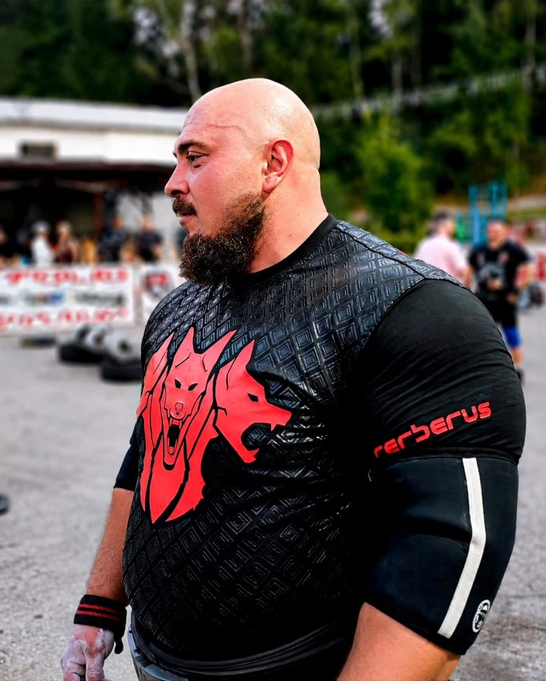
When you compete in strongman at a serious level, nutrition is not simply about “eating clean” or “getting enough protein.” It is an integral part of competition preparation, every bit as important as training itself.
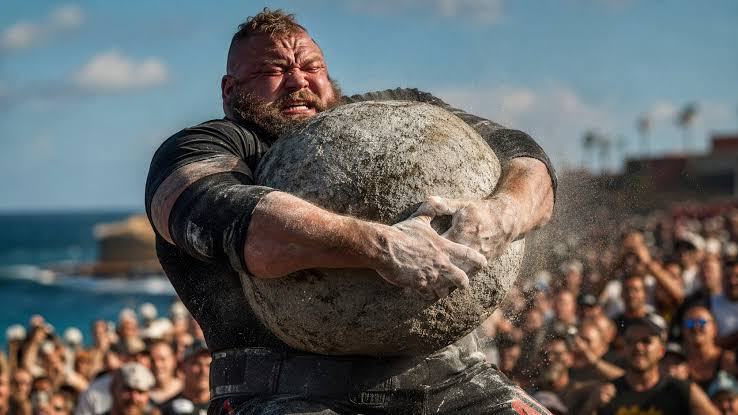
I compete in a sport that requires me to lift, push, pull, carry, and throw extremely heavy weights, sometimes in rapid succession. In a single competition, I may have to perform events such as the Log Press, Deadlift, Farmer’s Walk, Yoke, Frame Carry, Sandbag, Atlas Stones, Truck Pull, or other disciplines that combine maximal strength with repeated high-intensity effort.
At approximately 1.80 m and 150 kg, my goal is not to arrive at competition as light as possible. My goal is to arrive strong, fueled, recovered, and capable of expressing my strength from the first event to the last.
I Don’t Eat Like a Bodybuilder. I Eat Like a Strongman.
In bodybuilding, competition dieting is primarily focused on body composition and physical appearance.
In strongman, the final criterion is brutally simple:
Can you move the weight or can’t you?
That changes the entire perspective.
I need enough protein to maintain and develop muscle mass, but carbohydrates become extremely important because my training combines strength, volume, and repeated efforts. Research in strength athletes suggests that carbohydrate availability can become increasingly important as training volume rises.
That is why, during competition preparation, I do not see carbohydrates as the enemy.
Rice, potatoes, oats, pasta, bread, fruit, and other carbohydrate sources are fuel.
1. Protein: The Foundation
For a strongman of my size, protein needs to be consistently present throughout the day.
My main sources can include:
- chicken;
- turkey;
- beef;
- eggs;
- fish;
- dairy products;
- Greek yogurt;
- low-fat cheese;
- whey protein when convenient.
Not every meal needs to look like an Instagram photograph featuring 300 grams of chicken breast and broccoli.
The important thing is to have multiple protein feedings distributed throughout the day, so recovery does not depend on one enormous meal.
The sports nutrition literature for strength and physique athletes frequently recommends relatively high protein intakes, although the exact amount should be determined according to the athlete’s goals, body mass, and total caloric intake.
For me, protein is the foundation of the entire system:
muscle → recovery → adaptation → strength.
2. Carbohydrates: The Fuel for Competition
This is one of the biggest differences between strongman nutrition and the classic idea of a “diet.”
When I have to go through:
Log Press → Yoke → Farmer’s Walk → Deadlift → Sandbag → Atlas Stones,
I do not want to reach the third event with an empty fuel tank.
Carbohydrates contribute to the replenishment of muscle glycogen and can support performance when training volume is high. During preparation, my carbohydrate sources may include:
- rice;
- potatoes;
- sweet potatoes;
- oats;
- pasta;
- bread;
- cereals;
- bananas;
- other fruits;
- honey;
- easily digestible foods around training.
Not every meal needs to be identical. On heavy strongman days, carbohydrate intake needs to be sufficient to support both the volume and intensity of training.
3. What a Day of Eating Can Look Like During Preparation
A practical structure for my day could look something like this:
Breakfast
A substantial meal containing:
carbohydrates + protein + a moderate amount of fat.
For example:
- oats;
- bananas or other fruit;
- eggs;
- Greek yogurt;
- possibly honey.
The goal is not to make it “perfectly fitness.” The goal is to give me enough energy for the first part of the day.
Lunch
A simple combination:
meat + rice/potatoes/pasta + vegetables.
For example:
- beef or chicken;
- rice;
- vegetables;
- a small amount of olive oil.
It is a very easy meal to control in terms of calorie intake and can be adjusted depending on how demanding the training session is that day.
Pre-Workout Meal
As training approaches, digestibility becomes the priority.
I do not want to walk into a Yoke event with my stomach loaded with an enormous meal.
I would rather have:
- rice;
- potatoes;
- bread;
- banana;
- cereal;
- a lean source of protein.
The closer I get to training, the simpler and easier to digest the meal should become.
During Training
For very long or extremely demanding sessions, I may use:
- water;
- electrolytes;
- readily available carbohydrates;
- potentially a carbohydrate drink.
I am not trying to turn training into a picnic. The goal is to maintain energy levels and hydration.
Post-Workout
After a hard strongman session, the combination is very simple:
protein + carbohydrates + fluids.
For example:
- meat + rice;
- meat + potatoes;
- whey + banana if I cannot eat immediately;
- yogurt + cereal/fruit.
When I have another hard session or a competition coming up soon, carbohydrate replenishment becomes even more important. Consuming carbohydrates together with fluids after exercise can support recovery for subsequent efforts.
4. Fat Does Not Disappear From the Diet
Preparing for competition does not mean eliminating dietary fat.
I can use:
- olive oil;
- eggs;
- avocado;
- nuts and seeds;
- peanut butter;
- fatty fish.
However, the quantity should be managed around training because very high-fat meals can be more difficult to digest.
In practice:
more fat farther away from training, less fat immediately before events.
5. As Competition Gets Closer
Preparation does not mean radically changing my diet three days before competition.
Quite the opposite.
The closer I get to competition, the more I want predictability.
The same foods.
The same tested quantities.
The same schedule.
The same hydration strategy.
Any new strategy should be tested during training before it ever reaches the competition floor. This includes carbohydrate strategies and competition-day nutrition.
There is no prize for the athlete who discovers on competition morning that “maybe I should eat something completely different.”
There is, however, a very good chance that he will discover that his stomach has opinions of its own.
6. The Final 24–48 Hours
During this period, I do not want to experiment.
The objective is to arrive at competition:
with full glycogen stores, properly hydrated, with a calm stomach, and without feeling excessively heavy.
Carbohydrates can play an important role before competition, especially when repeated efforts are expected. However, aggressive manipulation of water and electrolytes is not something I would ever treat casually.
For a sport like strongman, where I have to produce force and repeat maximal efforts, hydration is part of performance, not merely a matter of comfort.
7. Competition Day
This is where nutrition stops being simply a diet and becomes a tactical strategy.
Research involving strongman athletes has shown that competition-day nutrition tends to revolve around carbohydrates, easily digestible foods, and hydration. Many athletes use fruit, simple sugars, and small amounts of food between events.
Before the First Event
I want a familiar, easily digestible meal.
For example:
rice/oats/bread + protein + fruit.
I do not want an enormous meal.
I want energy without feeling as though I have a brick sitting in my stomach.
Between Events
This is where fast, easily consumed carbohydrates come into play:
- bananas;
- fruit;
- cereal bars;
- gummy bears / jelly sweets;
- gels;
- carbohydrate drinks;
- other sources I have already tested during training.
The research on strongman athletes reflects this exact tendency: fruit and simple sugars are among the strategies used between events, alongside easily digestible foods and hydration.
I am not trying to build muscle between two events.
I am trying to fuel the next event.
8. Hydration
At my bodyweight, and in a sport where I may have events such as the Yoke, Farmer’s Walk, Truck Pull, Deadlift, or consecutive medleys, hydration needs to be planned.
Water is the foundation.
Depending on sweat rate and competition conditions, electrolytes can become extremely important. Research on strongman athletes has also identified electrolyte-containing drinks among the strategies used on competition day.
I do not want to start “water loading” or making extreme manipulations simply because I watched a video on the internet.
Hydration should support performance.
9. What I Do Not Do Before Competition
There are several rules I consider more important than any internet “hack”:
- I do not introduce new foods. If I have not eaten something during preparation, competition day is not the time to test it.
- I do not make dramatic dietary changes. The final days are not the time for experiments.
- I do not try to starve myself. In strongman, showing up without enough energy can cost far more than a few hundred extra grams on the scale.
- I do not eliminate carbohydrates without a reason. I need fuel for my training and events.
- I do not unnecessarily manipulate water and sodium. Performance comes first.
10. My Nutrition Has to Match the Type of Competition I Do
My competitive career includes events such as:
- Log Press;
- Deadlift;
- Car Deadlift;
- Farmer’s Walk;
- Frame Lift;
- Frame Carry;
- Yoke;
- Truck Pull;
- Tire Flip;
- Sandbag;
- Loading Medley;
- Dumbbell;
- Atlas Stones;
- Keg Toss.
This means I am not preparing for “strength” alone.
I am preparing for the ability to produce maximal force repeatedly, sometimes with relatively short rest periods.
That is why my nutrition needs to support three things:
1. Strength
Enough protein, enough energy, and adequate recovery.
2. Glycogen
Enough carbohydrates to support training and competition.
3. Recovery
Carbohydrates, protein, fluids, electrolytes, and sleep.
11. When Competitions Are Very Close Together
This is where things become even more interesting in my case.
I have had periods when competitions were scheduled very close together, including situations where I competed on consecutive days.
During such periods, I can no longer view nutrition simply as a tool for “losing weight.”
It becomes a tool for recovering between competitions.
After competition:
fluids → carbohydrates → protein → complete meal → rest.
I do not want to remain depleted of glycogen heading into the next competition.
12. My Strongman Nutrition Philosophy
If I had to reduce everything to a few principles, it would sound like this:
I eat enough to train hard enough.
I eat enough protein to recover.
I eat carbohydrates so I can use my strength.
I control my fat intake, but I do not eliminate it.
I stay hydrated and manage my electrolytes.
I do not experiment before competition.
On competition day, food is fuel, not a reward.
Conclusion
At 1.80 m and approximately 140 kg, with a current strength profile that includes roughly 240 kg squat, 180 kg bench press, 270 kg deadlift, 120 kg military press, 140 kg overhead press, 135 kg Log Press, 71 kg Circus Dumbbell, and approximately 400 kg Yoke for 20 metres, my nutrition has to be viewed within the context of the sport I compete in.
I am not trying to be the most “diet-friendly” person in the gym.
I am trying to be the best fueled athlete for the work I have to perform.
In strongman, a good diet is not the diet that looks best on paper.
It is the diet that allows me to step onto the competition floor, take an object weighing hundreds of kilograms into my hands, and say:
“Let’s see who breaks first.”
And the answer should almost always be:
not me.
More From The Journal

Training
The Science of Strongman Training - Episode X: Competition Programming
How to build a complete Strongman competition preparation block: calendar, events, volume, intensity, specificity, simulations, autoregulation, tapering and fatigue management.
Training
The Science of Strongman Training - Episode IX: Peaking
Peaking in Strongman: how to turn months of training into maximal competition performance by reducing fatigue, preserving adaptations and managing specificity.