
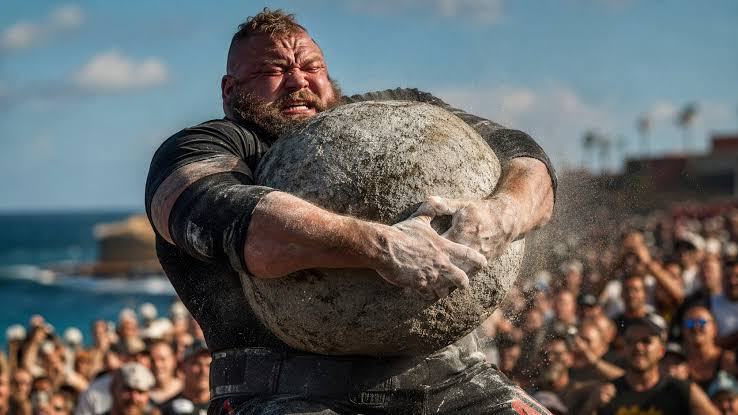
In Strongman, peak performance is not built during the final days before competition. It is built over the weeks and months before it, while the final phase has a different mission: allowing the athlete to express what has already been built. Peaking is the process of bringing performance potential and readiness as close together as possible on competition day.
That distinction matters. You can possess excellent strength and still arrive at competition fatigued. You can have enormous physical capacity but fail to express it after a week of excessive training volume. You can be recovered but insufficiently familiar with the events. Peaking is not simply resting. It is reducing the cost of fatigue while preserving the adaptations that create performance.
1. What is peaking, actually?
Peaking is the final phase of preparation in which the main objective shifts from accumulating adaptations to expressing them. During an accumulation block you build capacity. During intensification you develop high-quality strength and specificity. During the peak you want the athlete strong enough, specific enough and rested enough to perform on the day that matters.
Tapering is one component of peaking, but the terms are not identical. Tapering primarily describes reducing training load before competition. Peaking is broader and includes final specific exposures, intensity management, fatigue reduction, psychological preparation, nutrition, sleep and competition strategy.
2. Why you do not need to become stronger in the final week
Important adaptations take time. A very hard session three days before competition may be a useful long-term stimulus, but there is not enough time for a new adaptation to fully develop before the start. The fatigue produced by that session, however, can arrive exactly when performance is required.
As competition approaches, the relationship between stimulus and cost changes. You no longer try to maximize the amount of work. You preserve the relevant signal and remove as much unnecessary fatigue as possible. This is one of the central ideas of tapering: less training does not automatically mean less fitness.
3. Fitness and fatigue: why performance can rise after training is reduced
A simplified model of performance views training as producing two simultaneous effects: positive adaptation and negative fatigue. Adaptation may persist longer, while part of acute fatigue dissipates relatively quickly. If training is reduced at the right time, the athlete can retain much of the built fitness while removing part of the fatigue that was masking it.
That is why an athlete may lift better after several lower-volume days without having physiologically become much stronger during those days. You did not build a new engine. You allowed the existing engine to run with fewer brakes.
4. What does the literature say about tapering in strength sports?
Strongman-specific experimental evidence remains limited, but strength-sport literature provides useful context. A 2020 review of peaking for powerlifting concluded that direct experimental evidence was insufficient to support a universal protocol, requiring practitioners to individualize the final preparation phase.
More recently, a 2026 systematic review of weight lifting sports found a consistent pattern: tapers are generally short, around five to nine days, with training volume reduced by roughly 40-45%. Athletes typically reported peak volume four to six weeks before competition and peak intensity two to three weeks before competition. These findings describe reported practices, not a universally proven prescription for every athlete.
5. Strongman has a special problem: events are not identical
In powerlifting you have three standardized lifts. In Strongman you may have Log Press, Axle, Deadlift, Yoke, Farmer’s Walk, Stones, loading, medleys and events that appear only once. Some are maximal, some are timed, and others combine strength, speed and local endurance.
A strong peak therefore cannot be built only around one intensity number. You must ask what fatigue each event produces, how long recovery takes and how valuable the final specific exposure is. Strongman research indicates that athletes report deadlift, Yoke Walk and stone work as requiring longer recovery than several other lifts.
6. Reducing volume is usually the central piece
Volume is the variable you can often reduce without abandoning specificity. You can keep a relatively heavy load and reduce sets. You can keep the event and reduce distance. You can keep the Stone and reduce the number of loads. You can keep Log Press and remove assistance work that no longer provides enough benefit for its cost.
In Strongman, volume also hides inside density. Two sessions with similar total loading can have very different costs if one uses long rests and the other is performed as a medley. During a peak, you are not only asking how many kilograms were moved. You are asking how much fatigue was produced for each unit of relevant preparation.
7. Intensity does not necessarily have to disappear
A common mistake is aggressively reducing both volume and intensity until the athlete no longer feels anything close to competition loads. In strength sports, maintaining short exposures to relatively high intensity can help preserve specificity and familiarity with heavy loads.
That does not mean performing PRs in the final days. Intensity can remain relatively high while volume falls sharply. The difference between one strong, controlled repetition and five hard sets to exhaustion is enormous in terms of cost.
8. The final heavy session: how close to competition?
There is no universal number of days that works for every Strongman. In a 2018 survey of 454 athletes, participants reported stopping training completely about 3.9 days before competition on average, while taper volume decreased by approximately 45.5%. Athletes also reported that deadlift, Yoke Walk and Stone work required longer recovery.
These figures are useful reference points, not rules. An athlete who recovers quickly from Log Press may have a different window from one who remains stiff for several days after heavy Yoke work. Experience from previous competitions becomes highly valuable here.
9. Specificity during the peak: less, but more relevant
Peaking is not the time to learn a completely new event. Final exposures should confirm mechanics, rhythm and familiarity with the implement. But specificity must be dosed. A demanding event can have high training value, yet performing it too often can consume the exact resources you are trying to protect.
In Strongman, a short exposure may be enough: a few Log repetitions, several Yoke starts, a few Farmer’s carries or a handful of Stone loads. The goal is not to prove that you can complete the competition before the competition. The goal is to remind the nervous system and technique what the real task looks like.
10. Why medleys can be costly in the final week
A medley is an excellent tool for developing capacity, but it can be expensive during a peak. Transitions, acceleration, grip, breathing and local fatigue combine into a large stimulus. Too close to competition, that stimulus may train fatigue more than performance.
Instead of reproducing the whole medley, you can preserve the section with the highest technical value. If the problem is the transition between two implements, train the transition. If the problem is the first pick, train the start. If the problem is pacing, perform a short controlled exposure. Specificity can be fragmented.
11. Peaking and autoregulation
The previous episode on autoregulation becomes especially important here. The plan may say that a heavy session remains, but the athlete may provide different information. If warm-up movement is unusually slow, RPE is high and technique is unstable, mechanically following the plan can be a mistake.
During a peak, autoregulation often becomes more conservative. A session that needs to leave the athlete ready five days later should not be judged by how impressive it looks that day. The criterion is whether it produced the intended stimulus without compromising competition.
12. When tapering starts too early
If you reduce too much and too early, you can lose elements of preparation. The athlete may feel rested but unusually far from heavy loads or specific rhythm. In Strongman this can be amplified because some implements differ greatly from conventional exercises.
A good taper is not a vacation. It is a controlled reduction. The final phase therefore has to be designed as part of the whole preparation block, not as an isolated week. If enormous volume was maintained until three days before competition, no taper can magically erase all of the accumulated fatigue.
13. When tapering starts too late
The opposite mistake is continuing hard training because the athlete fears losing strength. This is a common pathway to a failed peak: the fitness is there, but the athlete cannot express it.
A Strongman does not need to enter competition feeling as if he has just finished the hardest block of his career. He needs to enter feeling capable of producing force when it matters. Sometimes the difference between these states is only several days of intelligent fatigue management.
14. The peak differs by event type
A maximal Deadlift requires a different final exposure from a 30-meter Farmer’s Walk. A one-repetition Log Press does not have the same logic as a 60-second rep event. A Stone to Shoulder does not carry the same cost as a loading medley.
For maximal events, the goal is to preserve the feel of heavy loading and coordination without accumulating fatigue. For speed events, preserve explosiveness. For local-endurance events, avoid emptying the tank before competition. For technical events, make the final exposures clean.
15. Peaking and the nervous system
The phrase “fatigued nervous system” is often used too broadly. Still, it is reasonable to discuss changes in the ability to produce and coordinate force after heavy loading, particularly when muscular and general fatigue are added. During a peak, the aim is to reduce that burden without eliminating relevant exposure.
This is where short, high-quality sets become valuable. One strong technically sound repetition can have a much more favorable stimulus-to-cost ratio than a long volume session.
16. Sleep, nutrition and travel are part of the peak
Peaking does not end at the gym door. Sleep, energy intake, hydration and travel management can influence the state in which the athlete reaches the start line. A perfect taper on paper can be undermined by fragmented sleep, long travel or inadequate nutrition.
A study of 132 Strongman athletes found that 94% used warm-ups in competition, while many reported cognitive and nutritional strategies. This reinforces an important principle: peaking is a performance-preparation process, not merely a reduction in training.
17. The psychology of peaking: trusting the process
Many athletes become anxious when volume falls. If they are accustomed to proving fitness through hard sessions, a lighter week can feel like weakness. This is where extra sessions, PR attempts and “just one more medley” appear.
A good peak requires confidence in the work already completed. If capacity has been built for months, the final days do not need to rebuild it. They need to allow it to emerge.
18. What can a practical peak look like?
An illustrative model could look like this: four to six weeks out, volume is still substantial and specificity is increasing. Around two to three weeks out, intensity and exposures close to competition demands reach important levels. During the final week, volume drops substantially and remaining exposures are short and precise.
In Strongman, this has to be adjusted to the events. A very heavy deadlift may be removed earlier than a light technical Log session. Yoke may require more recovery than moderate pressing. Stone work can be maintained through short exposures. There is no single curve for every event.
19. What NOT to do during a peak
Do not try to rescue a poor training block with brutal training. Do not introduce completely new exercises. Do not turn every session into a test. Do not increase volume simply because you feel excellent on one day. Do not keep unnecessary assistance work because it appears in an old program. And do not assume that an identical taper will work at every competition.
Another mistake is confusing sweat and soreness with readiness. In the final phase, the feeling that you worked enormously hard may actually be evidence that you missed the objective. A good peak can feel almost suspiciously easy.
20. How do you know the peak is working?
There is no single marker. Look for a coherent profile: submaximal loads move more easily, RPE falls, technique is stable, pain and stiffness are manageable, sleep is good and the athlete feels capable of producing force without fighting every repetition.
A successful peak does not necessarily produce a training PR. Sometimes the best sign is that a load that felt heavy two weeks earlier becomes controllable at lower perceived effort. Competition is the final test, not the gym during the final week.
21. Peaking and competition strategy
Physical preparation and strategy have to meet. If the first event is a maximal Deadlift, you do not want unnecessary fatigue from the final training session. If the first event is a fast medley, preserving a sense of speed may matter. If there are many events in one day, recovery between events becomes part of the peak objective.
Therefore, peaking should start from the competition rather than only from the gym. The question is not “What can I train hardest?” but “What must I be able to express, in what order and with what resources, on competition day?”
22. Individualization: the athlete’s history beats the recipe
Two Strongmen with the same body mass and the same events can have completely different recovery windows. One may recover from a heavy deadlift in four days, another may need seven. One may keep pressing close to competition, another may lose quality if it is removed for too long.
The best information comes from previous competitions: when the final heavy session occurred, how the body felt on competition day, which event left fatigue, how volume reduction worked and how sleep behaved. Peaking becomes more precise each cycle in which these data are recorded and reviewed.
23. Peaking is not about rest. It is about performance availability
An athlete can be rested and unprepared. An athlete can be prepared and fatigued. Peaking tries to bring these two axes together. Specificity must be sufficient for the athlete to know the task. Intensity must be sufficient to maintain contact with heavy loading. Volume must be low enough that fatigue does not dominate.
Recent literature presents tapering in strength sports as precisely this compromise between maintaining adaptations and removing fatigue. There is no universal protocol, and Strongman is likely one of the disciplines in which individualization has particularly high value.
24. Conclusion: the final victory in training is knowing when to stop
Peaking is the art of not damaging the fitness you have built. You do not need to become stronger in the final days. You need to become more available for performance. That means reducing fatigue, preserving relevant intensity, maintaining specificity and controlling the factors that can either turn fitness into performance or hide it.
For Strongman, this principle is even more important because competition is a system of different events, sometimes extremely demanding, performed in an order that changes the cost of every decision. A good peak does not prepare one lift. It prepares the athlete to be strong, fast, technical and composed when the competition begins.
Ultimately, peaking is not the moment when you build performance. It is the moment when you allow performance to appear.
Bibliography and sources
1. Winwood PW, Travis SK, Barnes MJ, Keogh JWL, Pritchard HJ. Tapering and Peaking in the Weight Lifting Sports: A Systematic Review of Athletes’ Self-Reported Strategies. Sports Medicine. 2026.
2. Travis SK, Mujika I, Gentles JA, Stone MH, Bazyler CD. Tapering and Peaking Maximal Strength for Powerlifting Performance: A Review. Sports. 2020;8(9):125. DOI: 10.3390/sports8090125.
3. Winwood PW, Pritchard HJ, Wilson D, Dudson M, Keogh JWL. Tapering Practices of Strongman Athletes. Journal of Strength and Conditioning Research. 2018;32(5):1181-1196.
4. Winwood PW, Pritchard HJ, Wilson D, Dudson M, Keogh JWL. The Competition-Day Preparation Strategies of Strongman Athletes. Journal of Strength and Conditioning Research. 2019;33(9):2308-2320. DOI: 10.1519/JSC.0000000000003267.
5. Hindle BR, Lorimer AV, Winwood PW, Keogh JWL. The biomechanics and applications of Strongman exercises: a systematic review. Sports Medicine - Open. 2019;5:49. DOI: 10.1186/s40798-019-0222-z.
6. Soligard T, Schwellnus M, Alonso JM, et al. How much is too much? International Olympic Committee consensus statement on load in sport and risk of illness. British Journal of Sports Medicine. 2016;50:1030-1041. DOI: 10.1136/bjsports-2016-096581.
7. Kellmann M, Bertollo M, Bosquet L, et al. Recovery and Performance in Sport: Consensus Statement. International Journal of Sports Physiology and Performance. 2018;13(2):240-245. PMID: 29345524.
More From The Journal

Training
The Science of Strongman Training - Episode X: Competition Programming
How to build a complete Strongman competition preparation block: calendar, events, volume, intensity, specificity, simulations, autoregulation, tapering and fatigue management.
Training
The Science of Strongman Training - Episode VIII: Autoregulation
Autoregulation in Strongman: how to adjust load, volume and effort to the athlete’s real readiness. RPE, RIR, velocity, APRE and training decisions explained scientifically.