
Equipment
Series: STRONGMAN EQUIPMENT: ENGINEERING, PROTECTION AND PERFORMANCE - Episode 8: Specialty Bars: Axle, Deadlift Bar and Other Designs
October 16, 2026
At first glance, a deadlift bar is merely a steel cylinder carrying plates. In practice, it is an elastic structure that deforms under load, transmits moments, interacts with the hands through knurling and friction, and affects when the plates finally leave the floor. A deadlift performed on a long, relatively thin bar can feel markedly different from one performed with a thick, nearly rigid axle, even when both are loaded to the same declared mass. In strongman, where organisers frequently introduce specialised implements, this distinction is more than a commercial detail. It can alter technique, grip demand, the rhythm of floor break and the result. The bar is an active component of the athlete–implement–ground system.
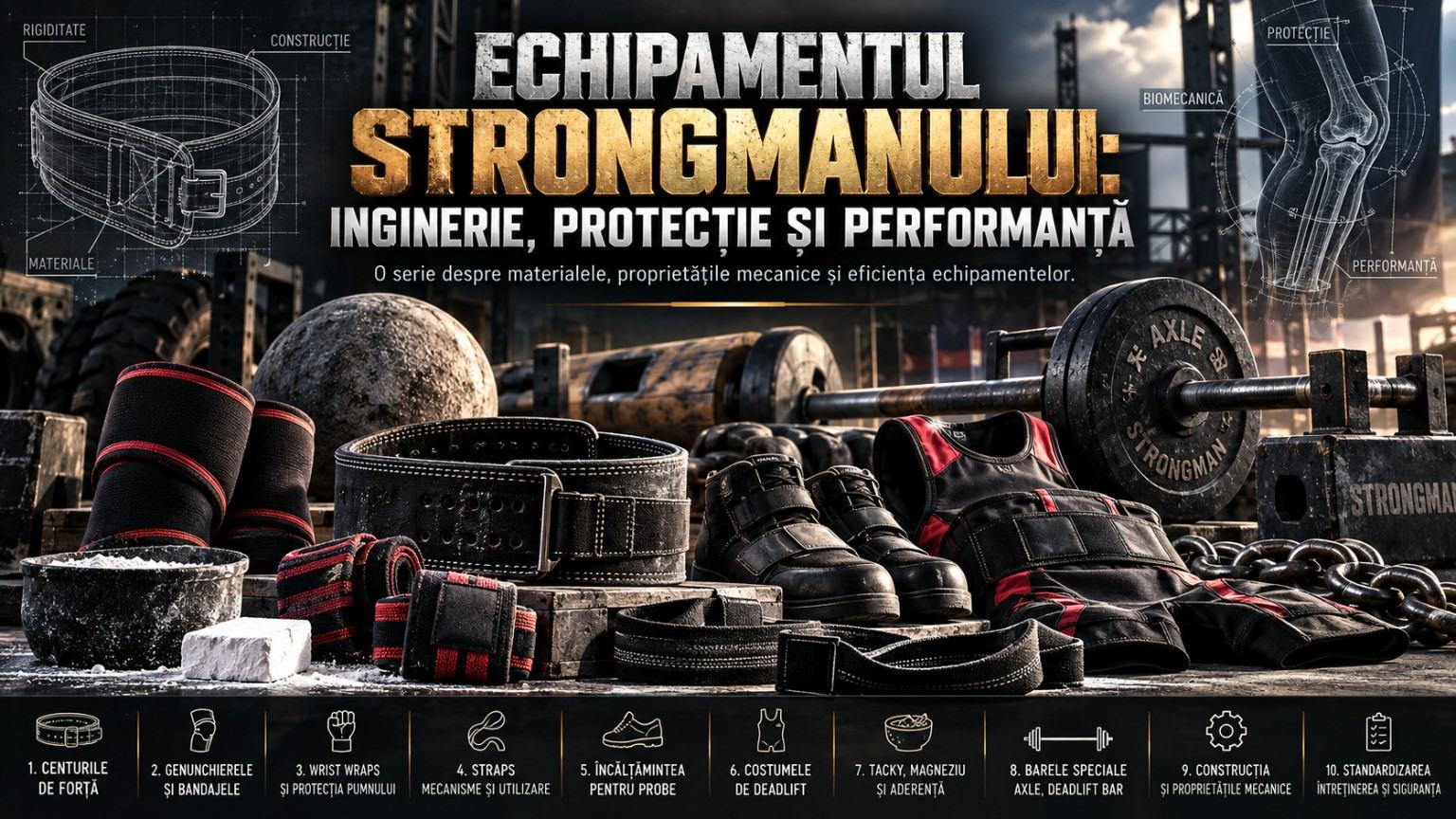
This is Episode Eight of STRONGMAN EQUIPMENT: ENGINEERING, PROTECTION AND PERFORMANCE. After belts, knee sleeves, wrist wraps, lifting straps, footwear, deadlift suits and grip materials, we turn to the geometry and mechanics of bars. The discussion covers Axle, Deadlift Bar, Power Bar, Olympic bars, Elephant Bar, squat-oriented bars and Trap Bar variants, along with diameter, length, spacing of the plates, elastic modulus, second moment of area, knurling, bearings and tolerances. We will connect design with movement technique, score comparisons, event standardisation, maintenance and safety. Our purpose is not to crown one universally superior bar. It is to explain why different constructions create different biomechanical tasks.
An evidence limitation is important from the beginning. Biomechanical studies exist for conventional, sumo and hex-bar deadlifts, but controlled investigations isolating the effect of a specialist Deadlift Bar versus an axle among competitive strongman athletes are much rarer. There is no validated universal equation that converts a given pull on a flexible bar into a fixed loss of kilograms on a stiff axle. Manufacturer specifications are sources for dimensions and constructions, not independent proof of performance gains. Research on related deadlift variants can inform mechanisms without allowing percentages to be transferred automatically from one event to another [3–10].
1. A bar is a structure, not merely a handle
The bar carries plate weight and the forces applied at the grip points. In static loading, gravity tends to bend the shaft while stresses develop in tension and compression across its cross-section. Under movement, acceleration, oscillation, plate inertia and sleeve rotation add further complexity. A simplified analysis can treat the central shaft as an elastic beam, but real bars have varying diameters, knurled regions, sleeves and contact points. Those details mean that nominal mass alone cannot predict the instantaneous geometry of the loaded assembly. A useful engineering perspective examines where the loads act and how the system responds.
Three properties must be distinguished: bending stiffness, material strength and dynamic response. Stiffness concerns how much the system deforms for a given load. Strength concerns its ability to carry stresses without permanent deformation or failure. Dynamic response concerns the speed and amplitude of oscillations when forces change. A bar may be strong enough to withstand enormous loads while still bending visibly because high tensile strength does not imply zero elastic deflection. Marketing sometimes collapses these fundamentally different concepts into the vague phrase 'stronger steel'. The distinction matters both for performance interpretation and for equipment safety.
Elastic deformation is broadly reversible: under appropriate loading, the bar returns close to its original shape after unloading. Plastic deformation is permanent and may indicate overload, a defect or misuse. Fatigue is another concern, involving progressive damage under repeated cycles even when individual loading events appear manageable. A bar designed to exhibit substantial whip should therefore not be confused with one that has become permanently bent or unsafe. The first may deliver controlled flexibility as intended; the second deserves inspection and possibly removal from service. Elastic behaviour is a design feature, not evidence that maintenance can be ignored.
For the athlete, the practical implication is that equal nominal masses can impose different coordination and muscular demands depending on how load is distributed between hands, shaft, sleeves and plates. Two 20-kilogram bars can have different distances between sleeves, central shaft diameters and distributions of their own mass. If the plates also have different thicknesses, the effective locations of the applied weights change. Meaningful comparisons should therefore describe the whole loaded assembly rather than relying on the label 'deadlift bar'. A record belongs to a defined event and its equipment conditions, not to kilograms considered in isolation.
2. Diameter and stiffness: the underlying physics
For an ideal solid circular beam, the second moment of area I equals πd⁴/64, where d is the diameter. Bending rigidity for a section is EI, with E representing the material's Young's modulus. The fourth power is central. If two homogeneous shafts of identical material and length measure 27 mm and 29 mm respectively, the geometric stiffness ratio is approximately (29/27)⁴, or about 1.33. Under these assumptions, the thicker shaft provides roughly one-third greater sectional bending rigidity. That does not imply that an athlete will lift one-third more weight. Cross-sectional stiffness and sporting output are profoundly different quantities.
The distinction becomes even more important when comparing an axle of approximately 50 mm with a shaft of 27–29 mm. Incorrectly treating every product as a solid rod of the same material would produce a very large geometric ratio. Many commercial axles are made from hollow tubing, however. For a circular tube, the second moment of area is π(D⁴−dᵢ⁴)/64, where D is the outside diameter and dᵢ the inside diameter. Wall thickness, alloy, unsupported span and joints therefore matter. Comparing only outside diameters is not a legitimate calculation of the real stiffness of a tubular axle versus a specialised deadlift bar.
The effective length of the deforming structure also matters. In simplified beam models with specified supports and loads, deflection can rise steeply with length, including cubic dependence on a characteristic distance in common loading cases. That is not a universal formula for a bar held by human hands, but it explains why a longer shaft of equal diameter and material may respond very differently. Designers exploit combinations of length and diameter in specialised pulling bars. When comparing published overall lengths, though, separate the portion of the shaft that actively bends from sleeve length used to carry plates. Total length does not independently determine the magnitude of whip.
Steel tensile strength is commonly advertised in PSI or KSI. It describes material resistance to axial tension in a specified test, not bending stiffness itself. Steels with different tensile strengths may have relatively similar elastic moduli. Claiming that a 200,000 PSI bar must be stiffer than a 190,000 PSI bar therefore requires geometric and material context. Section profile may dominate the experience, while impressive tensile-strength figures do not alone certify fatigue life. In engineering terms, stiffness, yield strength, ultimate tensile strength and durability each answer a different question. Athletes should be wary of specifications treated as interchangeable.
3. What whip means and why it happens
Whip is the sporting term for a bar's elastic bending and dynamic rebound. During a heavy pull, the shaft may curve before all the plates leave the floor. As the assembly rises, movement of the central portion relative to masses at the ends can generate visible oscillation. In Olympic weightlifting, elastic response contributes to the behaviour of an implement moved explosively. In deadlifting, initial bending can change the point in the movement at which the discs become fully airborne. Neither situation creates energy from nowhere. The athlete introduces energy, part of which is temporarily stored and subsequently returned by the bar.
When an athlete loads a flexible bar progressively, the shaft may bend before the plates leave the platform. This is commonly described as pulling the slack out of the bar. With a stiffer implement, the initial movement of the hands before complete plate lift-off may be smaller, while the full load may need to be addressed earlier in the motion. With more flexible equipment, the athlete may develop muscular tension and find a favourable position before the entire load becomes airborne, depending on individual technique. The advantage is not guaranteed, and an aggressive jerk can create instability instead of useful pre-tension.
Oscillation after floor break can also become a challenge. If the athlete sharply changes speed, shaft and plates do not necessarily respond at the same instant. Relative motion can alter load sensation and increase the need for control. At near-maximal intensity, this can influence balance, bar trajectory and lockout timing. Someone accustomed to a very rigid axle may initially find the delayed response of a long bar unfamiliar, while another athlete may learn to use its flexibility effectively. Specific exposure matters more than assuming that greater whip automatically improves the result.
Visible bar bend is not proof of an obligatory lifting advantage. Elastic energy is only recovered usefully when deformation and athlete movement interact in an advantageous manner, and some energy is dissipated through friction and damping. If the bar rebounds at an unfavourable moment, it may feel disruptive rather than helpful. Marketing claims that flex 'adds kilograms' should therefore be understood as descriptions of a possible mechanism and reported user experience, not as guarantees applying to every athlete, body geometry, technique and competition.
4. The Power Bar as a reference
To discuss specialised bars, we need a reference point. Power Bar commonly refers to a relatively stiff bar designed to serve squats, bench presses and deadlifts in particular powerlifting settings. Compared with dedicated Deadlift Bars, it often has a thicker shaft and a shorter effective flexible span. Knurling may be aggressive, and a centre knurl can improve the bar's interaction with the athlete's back during a squat. Not every product marketed as a Power Bar is identical, and a label alone does not establish federation approval. Dimensions, surface features and the relevant rulebook must be examined before treating one bar as representative of all others.
The International Powerlifting Federation technical rulebook effective from 1 March 2026 specifies a straight bar no longer than 2.2 metres, with a 28–29 mm diameter, 1.31–1.32 metres between the inner faces of the collars and a combined bar-and-collar weight of 25 kg [1]. Further tolerances apply. This is a particular competitive standard, not a universal strongman regulation or a rule binding every powerlifting federation. Some federations allow separate specialist deadlift bars; strongman may use far thicker or longer implements. Importing IPF bar specifications into a strongman contest without reading the event instructions would be a category error.
As a commercial illustration, the Rogue Ohio Power Bar is listed with a 29 mm shaft and an overall length around 86.5 inches, approximately 2.20 metres, in certain versions [13]. The design aims for comparatively stiff behaviour and knurling suited to controlled heavy lifts. Such specifications permit geometric comparisons, but they are not independent scientific evidence of any particular performance percentage. A bar must also be assessed for tolerances, surface condition, coating and compatibility with the intended event. Two examples of the same model, one heavily worn and one new, may not feel identical.
For a strongman athlete with only one bar available, a robust Power Bar can be a practical foundation for basic strength development. It supports Squat, Bench and Deadlift and provides relatively consistent conditions for tracking progression. However, it does not fully reproduce an unusually flexible Deadlift Bar or the grip challenge of a thick axle. General preparation and competition-specific implement preparation occupy different levels. The first can be excellent on common equipment, while the second benefits from periodic exposure to the geometry, sleeves and rules of the actual competition implement.
5. Deadlift Bar: designed around floor break
A Deadlift Bar is engineered specifically for pulling from the floor. Two commercial examples are the Rogue Ohio Deadlift Bar, with a 27 mm shaft, 90.5-inch overall length and approximately 190,000 PSI stated tensile strength [3], and the Texas Deadlift Bar, described by its manufacturer as having a 27 mm shaft and a 92.5-inch overall length in its current configuration [4]. Both aim to combine easier closure of the grip for some hands with greater elastic deflection under heavy load. Differences in overall length, sleeve arrangement and mass distribution mean they should not automatically be treated as equivalent implements.
A 27 mm bar allows the fingers to wrap farther around the circumference than a 29 mm shaft when hand dimensions and grip positioning are held constant. The difference appears small on a ruler, but circumference equals πd, and final finger contact with the thumb or palm can change the feel of hook or mixed grips. This does not guarantee that every athlete produces greater grip force on the thinner shaft. Individuals vary in hand morphology, flexibility and preference for surface texture. Any advantage needs to be demonstrated through comparable lifts and holds rather than asserted from diameter alone.
At very heavy loads, a longer, thinner shaft may bend visibly before all the plates leave the floor. This can permit the athlete's hands and trunk to rise as the bar progressively takes up tension. Mechanically, the athlete has not avoided moving the discs: their centres of mass must still travel to the required final height. But the sequence in which the system becomes loaded and begins moving can alter the effort profile. Someone accustomed to a stiff Power Bar may need several sessions to become comfortable with the sensation of the shaft flexing before the entire load becomes airborne.
Another detail is the frequent absence of centre knurling on dedicated deadlift bars. Rogue and Texas describe models without centre knurl, potentially reducing abrasion where the shaft travels near the shins and thighs [3, 4]. Smooth centre sections do not guarantee protection against skin damage, and poor bar paths can still create abrasion. Aggressive lateral knurling can improve mechanical engagement with the hands but can also wear calluses and contribute to skin tears. Athletes need to distinguish good instantaneous grip from the skin's ability to tolerate the entire training or competition workload.
Specialist bars are not automatically legal in every powerlifting competition. Approval varies by federation, and IPF requirements do not necessarily match events that employ dedicated deadlift bars. In strongman, the organiser may define equipment parameters specifically for an event. Asking whether the contest uses 'a deadlift bar' can therefore be insufficient. Model, plate height, loading pattern, strap permission and supportive suit rules may all be relevant. The movement task is defined by the assembled equipment and regulations rather than by one nominal product category.
6. Axle: large diameter, difficult grip, stiff response
An Axle is a thick bar associated with both Deadlift and Clean and Press in strongman. Many events use diameters close to 50 mm, almost twice the shaft diameter of an ordinary bar. However, there is no single mandatory construction shared by all contests. Axles can be tubular or solid, may have fixed sleeves or specially constructed ends, and can differ greatly in empty mass. As an example, a commercial Rogue Axle is described as having an outside diameter of approximately 1.9 inches, a length around seven feet and a nominal weight of 25 pounds [5]. It should not be confused with every competition axle.
Diameter substantially changes grip geometry. For a given finger length, a thicker cylinder makes it more difficult to wrap the hand completely around the circumference. Thumb contact changes, and the bar may tend to rotate through the palm. Normal force generated by the fingers, the presence or absence of knurling, the shaft finish and strap rules become important. An Axle Deadlift performed without straps may therefore pose an almost separate grip challenge from pulling on a conventional bar. A record achieved on one implement does not automatically establish the maximal pulling force available on the other.
Traditional axles frequently have non-rotating sleeves, or far less independent sleeve rotation than an Olympic bar. During a clean, the athlete therefore cannot count on the same decoupling between shaft rotation and plate inertia. Not every product labelled Axle uses identical construction, however, so sleeve design should be checked. Restricted rotation combined with large diameter can make moving the bar from the floor to the front rack a different technical task. The Continental Clean has become strongly associated with axle events because it allows the lift to be organised in stages, with controlled contact and changes of hand position.
Usual axle stiffness is not infinite strength. A bar can deform or fail if loaded and used outside its specifications. A large tube with thin walls cannot be properly compared with a solid rod by outside diameter alone. Welds, ends, collars and the plate-retention system are structural components. Improvised axles can also have an empty weight quite different from what an athlete assumes. Weighing the implement before competition is as important as verifying the plates. Standardisation includes construction quality and load verification, not just the convenience of a thick handle.
7. Sleeves, bushings and bearings: managing rotation
On an ordinary Olympic bar, the plates are mounted on sleeves that rotate relative to the shaft. This reduces the transmission of certain rotational moments into the athlete's hands during fast movements. Bar designs may use bushings or bearings with differing frictional and durability characteristics. Bearings are not automatically superior for every exercise. In Snatch and Clean, easy sleeve rotation can be important; in a slow deadlift, strength, grip and construction consistency may matter more than extreme spin speed. The correct comparison considers the intended movement rather than a simple ranking of sleeve technologies.
Bushings provide guided sliding contact, whereas rolling-element bearings use moving elements between bearing surfaces. Real implementations differ in lubrication, clearance, materials and seals. The performance of a bar cannot be predicted simply from one technology label. A poorly maintained bearing may perform worse than a well-engineered bushing. Rotation should also be evaluated under load rather than only by spinning an empty sleeve with one hand. Some strongman implements use fixed sleeves or geometries that make direct comparisons with Olympic bars inappropriate.
Plate rotation can influence control when the shaft changes orientation quickly. During Clean and Press, tangential forces and inertia may impose additional wrist demands if the entire loaded plate assembly follows shaft rotation. This is relevant to Axle Clean, although the magnitude depends on plate inertia, plate thickness, movement speed and cleaning technique. A demonstration with an unloaded axle cannot reproduce the behaviour of a heavily loaded one. Athletes should learn progressively, pay attention to control and preserve the ability to abandon the implement safely when needed.
Over time, dust, chalk, moisture and impacts can alter sleeve function. When a bar develops unusual noise, excessive play or restricted rotation, casually adding an unknown lubricant may not solve the issue. Manufacturer maintenance instructions and competent inspection are appropriate. On competition day, markedly different behaviour between the two sleeves can create asymmetry and undermine fairness. Maintenance is not solely an administrative concern for the gym owner; it influences the material conditions under which athletic performance is evaluated.
8. Olympic bars and weightlifting standards
Olympic weightlifting bars are designed for movements where speed, sleeve rotation and rapid force transmission are important. Under International Weightlifting Federation specifications, the men's bar is 20 kg and the women's bar is 15 kg, with different dimensional requirements [2]. Many gym products that look like Olympic bars are not identical to certified competition models. Shaft diameter, knurling, flexibility, sleeve mechanism and accuracy of mass can vary. For strongman, the link to Olympic weightlifting is especially relevant to Clean and Jerk techniques that provide a technical foundation for overhead events.
An Olympic bar intended for explosive movements may allow relatively free sleeve rotation and a perceptible elastic response. This does not make it automatically ideal for maximal deadlifts or extremely heavy squats. Knurling may be less aggressive than on specialised pulling bars, and bar movement under load can alter control. 'Elastic' also does not mean 'equivalent to a Deadlift Bar': lengths, loadable regions, diameters and design objectives are different. Athletes should recognise that equipment intended for Snatch is not mechanically identical to a long strongman pulling bar.
During Clean and Jerk, the athlete changes the relative orientation of hands, arms and bar, while rotating sleeves reduce some torsional demands transmitted to the grip. With an Axle Clean using fixed sleeves, the athlete must manage the rotation and inertia of the assembly differently. Simply reproducing a weightlifting clean on a thick axle has limitations: grip may fail, the bar may not rotate freely, or the transition into the front rack may be difficult. Olympic lifting technique remains useful for power development and coordination, but adaptation to the actual competition implement is essential.
Strongman athletes sometimes substitute Olympic barbells for specialised implements during general training. The substitution may develop a useful physical quality without recreating the event itself. An athlete who only practises cleans using an easily rotating 20 kg bar should not expect identical comfort when handed a fixed-sleeve axle nearly 50 mm thick. Familiarity with an ordinary bar also does not automatically prepare the athlete for the mass distribution of larger strongman implements. Progression toward specificity should be planned rather than compressed into the final week before competition.
9. Elephant Bar: extreme length and mass distribution
The Elephant Bar became prominent in elite deadlifting at events associated with the Arnold Strongman Classic. Rogue describes a version approximately 9.5 feet long in its 2025 event programme, substantially longer than ordinary bars [6]. The length serves more than a theatrical purpose. Extended loading areas accommodate specialised plates, and the positions of those masses relative to the hands influence deflection and oscillation. Thick plates can move part of the loaded mass farther from the grip points. Such an assembly is not mechanically equivalent to a standard Deadlift Bar fitted with thin calibrated plates.
In 2025, Rogue's Elephant Bar Deadlift event description specified rounds for establishing the heaviest successful lift on the designated apparatus [6]. This illustrates that the event is defined by both equipment and format, not just the word 'deadlift'. Historical accounts have described different equipment details and arrangements across editions; comparisons over time should therefore identify the year and implement configuration. Quoting a record without knowing whether the bar, plates and technical rules matched those of another contest can create an apparently precise but potentially misleading comparison.
A longer bar may display substantial initial bending. Athletes need to establish tension without losing balance or turning the floor break into a violent jerk. Once the plates are fully airborne, oscillations can affect the path and feel of the load. In principle, different geometry can alter the early and late phases of the effort differently. The magnitude depends on loading, tempo and the athlete's anthropometry. There is no validated conversion that translates all Elephant Bar records into stiff-bar records by subtracting a universal constant. Claims of exact transferable kilograms should be treated with caution.
Lack of access to an Elephant Bar does not prevent the development of relevant strength. Appropriately programmed conventional deadlifts, floor-strength work and grip preparation can build the fundamental physical capacity. Periodic safe exposure to similar equipment, when available, may still help coordination and timing. Attempting to imitate an Elephant Bar by loading an ordinary bar outside its design limits is unsafe. Equipment integrity must take precedence over the desire to capture dramatic shaft bending for a training video.
10. Plates: diameter, thickness and where mass sits
Many gyms regard 200 kg as an identical task regardless of the discs used. As nominal mass, that can be true when everything is weighed accurately. As geometry and dynamic behaviour, the statement is incomplete. Outside plate diameter establishes the starting height of the bar above the floor. Plates of different diameter can convert a standard floor deadlift into a higher or lower starting position. That changes range of motion and initial body posture. Comparing results becomes problematic when lifters do not begin from geometrically equivalent conditions.
Plate thickness matters particularly on flexible bars. Thin calibrated discs allow considerable weight to be concentrated relatively close to the shaft. Thicker discs can position part of the mass farther along the sleeve. Mechanically, moving the points where weight acts changes bending moments and dynamic response. Identical outside diameters do not guarantee identical whip. Plate order, sleeve condition and collar attachment also matter. A serious equipment description needs more information than 'standard plates' when the purpose is comparing records obtained under unusually heavy loads.
During explosive lifts, the distribution of mass relative to the rotation axis influences rotational inertia. A plate with more mass farther from its axis may resist changes in angular velocity more strongly. Rotating sleeves reduce how much of that demand is transmitted to the hands, while a fixed-sleeve axle may make more of it perceptible. This cannot be summarised simply through kilograms and shaft diameter. An overhead axle event should be described in terms of the loaded discs as well, particularly at high weights where inertial effects become more noticeable.
Collars are more than objects that keep plates from falling off. They secure the load and contribute to the dimensions of the assembly. Missing or unsuitable collars can permit plate migration, asymmetry or an uncontrolled fall. Some federations explicitly include collar mass in the declared total; elsewhere organisers may use different retention systems. A responsible athlete should ask whether the published load includes collars, how much the empty implement weighs and whether calibrated plates are used. Differences of a few kilograms may matter to both event scoring and the statistical comparability of records.
11. Knurling and finishes: the hand–metal interface
Knurling is a machined texture intended to alter how the palm interacts with the shaft. Depth, angle, pitch and peak geometry can affect both slip resistance and skin abrasion. A thin bar with aggressive knurling may be appreciated for heavy pulling but can tear calluses during high-volume work. A thick smooth axle may demand greater gripping force while producing less direct abrasion. No single texture can be declared optimal for every hand, event and humidity condition. Grip security should be balanced against the skin's ability to tolerate repeated loading.
Metal surface finishes can also change the feel of contact. Bars may be sold in bare steel, chrome, zinc, polymer coatings or other treatments. These differ in corrosion protection, thickness, durability and texture. Marketing claims of 'superior grip' do not independently establish a performance advantage. Demonstrating one would require comparable pressure, moisture and force conditions. Surface wear can also change feel over time, particularly when a bar is aggressively used and cleaned. An older bar may differ perceptibly from a new example of the same catalogue model.
Chalk, straps and grip style alter the relevance of knurling. Where figure-eight straps are allowed, some holding demand is transferred through the straps, although shaft friction and motion still matter. Without straps, diameter and knurling can become substantially more limiting. On an axle, fingers may not wrap fully around the circumference, and very aggressive texture cannot completely compensate for unfavourable grip geometry. Bar choice should be evaluated alongside grip rules rather than separately. The same shaft may pose different practical demands under two event formats.
Across multi-event competitions, skin protection has cumulative value. Aggressive texture may help one lift but damage the palms enough to compromise later events. Athletes should prepare the skin gradually, keep calluses reasonably even and avoid testing unfamiliar bars at maximal volume immediately before competition. Conversely, a smooth shaft is not automatically safer if it leads to uncontrolled jerks or repeated desperate regripping. Safety emerges from contact properties, technical control and appropriate loading rather than any one characteristic.
12. Axle Clean and Press: the clean can determine the event
In Axle Clean and Press, the difficulty does not begin with overhead pressing. First, the athlete must bring a heavy, thick cylinder with typically limited independent sleeve rotation from the floor into the front rack. Someone capable of a remarkable Push Press on an ordinary bar might fail because the axle never reaches the shoulders. This separates pressing power from the technical competence of cleaning the implement. Training needs to address both rather than assuming that a Log or Olympic barbell record will transfer directly to Axle performance.
Continental Clean is a traditional strongman solution. The lifter moves the bar to an intermediate position supported on the abdomen or another surface permitted by the rules, repositions the hands, and then transfers it to the front rack. This is not a standard Olympic Clean and should not be judged using Olympic weightlifting criteria. Strongman coaching manuals describe the staged progression [16]. Yet competition rules differ: one event may allow contact with a belt, another may restrict it. Training should reproduce the relevant contest standard rather than treating a demonstration video as universal permission for every technique.
Mixed grip can assist the initial portion of the Continental Clean when the large cylinder cannot be held securely with both hands pronated. However, the mixed position creates asymmetry at the shoulders and forearms, and changing to symmetrical hands before pressing should be rehearsed with manageable loads. Attempting a first-ever Continental Clean at competition weight adds technical uncertainty to pressure and load difficulty. Risks rise if the axle is placed uncontrollably against the abdomen or if the athlete exaggerates lumbar hyperextension in an attempt to create a shelf.
The movement from abdomen to front rack is particularly sensitive to shaft diameter and sleeve rotation. Fingers must change orientation while the athlete controls vertical movement and rotation. Wrist flexors, forearms and shoulder stabilisers may experience demands unlike those of an Olympic clean. Learning should progress through loads that permit safe abandonment, ideally under guidance from a coach familiar with the event. In competition, every second spent changing hand position can reduce the repetitions left before the time limit expires. Technical efficiency at the clean stage is therefore part of overhead performance.
Once the axle reaches the shoulders, it must be stabilised before the permitted pressing movement. Strict Press, Push Press, Power Jerk and Split Jerk have distinct techniques and may be governed by different rules. A thick cylinder may change wrist positioning and front-rack comfort, while restricted sleeve rotation can influence transitions. There is no universal percentage by which axle geometry reduces overhead ability. Anthropometry, technique, implement mass and construction all contribute. Strategy must suit the event, whether the goal is one maximal successful lift or as many repetitions as possible within a fixed period.
13. Deadlift biomechanics: what changes with the bar
Conventional deadlifting transmits force from the lower limbs and trunk through the arms into the bar. Initial posture establishes moments about the hips, knees and ankles, and the implement's trajectory depends partly on remaining close to the body. Escamilla and colleagues analysed differences between conventional and sumo deadlifts in competitive lifters [9], while more recent investigations have extended the analysis of joint moments and muscle activation [10]. These are studies of lifting techniques, not controlled Deadlift Bar versus Axle comparisons. They help identify the biomechanical variables rather than quantifying how many kilograms a particular shaft 'adds'.
A more flexible bar can alter the relationship between hand displacement and plate lift-off early in the movement. This may change body position when the load becomes fully suspended. Conceptual precision matters: the external load does not disappear, and work required to raise its centre of mass remains relevant. Differences occur in the time course of force, shaft deformation and the athlete's coordination. An advantage in one phase can coexist with a difficulty in another. Examining only the first instant of plate motion cannot explain the whole lift, especially when strongman events allow different completion strategies.
With a stiff bar, the athlete may experience load more directly from the outset. Even when the shaft does not visibly bend, establishing pre-tension remains useful, but initial displacement differs. This is not a recommendation to jerk suddenly from a relaxed position. Bracing, early muscular tension and trajectory control remain essential. Violent pulling can compromise position regardless of the bar. A thick axle adds a grip constraint that might be absent with a thinner Deadlift Bar, particularly in events where straps are prohibited. An identical load can therefore be limited by different components of the performance system.
Anthropometric proportions, including arm, trunk and leg lengths, may influence a lifter's starting position, but their effects are not simple. A small preliminary study explored relationships between body proportions and conventional deadlift variables without finding clear predictors for most examined outcomes [17]. Athlete height alone cannot establish that a given bar will necessarily provide an advantage. The athlete's own movement needs to be observed, preferably through consistent video and a training plan that includes event specificity. Theoretical advantages only matter if they emerge reliably for the actual person lifting.
When comparing records, equipment conditions must be identified. Before announcing a 20-kilogram improvement, check whether both results used the same bar type, start height, strap or suit permission and lockout rules. Sometimes improvement is genuine but its exact magnitude cannot be attributed solely to physiological adaptation. In other cases, equipment variation may explain a substantial component of the result. Serious performance measurement includes the object as well as the final figure displayed on the scoreboard. Without event context, a kilogram number is an incomplete scientific observation.
14. Hex bars: useful evidence but a different mechanism
A Trap Bar, or Hex Bar, allows the athlete to stand within a frame with lateral handles and often a neutral grip. Compared with a straight bar in front of the shins, handle location and load position permit a different body configuration. Some models have raised handles, while others offer lower handles, creating different movement distances. These details matter so much that 'Trap Bar Deadlift' does not always describe one standardised movement. Some strongman frames resemble parts of the hex-bar concept without being identical implements.
Swinton and colleagues compared straight- and hex-bar deadlift mechanics in trained lifters and reported differences in the distribution of mechanical demands [8]. In another experiment, Lake and colleagues observed a higher average maximal load with the hexagonal bar and differences in velocity and power [7]. Neither finding proves that a 50 mm axle will be easier than a Deadlift Bar. The hex bar changes hand position and load geometry, whereas an axle primarily changes shaft diameter and bending behaviour within a straight-bar task. These are different causal mechanisms and should not be merged.
High handles create another important complication. A Trap Bar using raised handles can reduce movement distance relative to a straight bar at standard plate height. In a study involving 31 strength-trained participants, high-handle hex-bar deadlifts permitted a greater average maximal load than conventional deadlifts and a shorter movement distance [18]. That is useful programming information but does not establish automatically superior hypertrophy, long-term adaptation or injury prevention. The mechanical differences must be interpreted relative to training goals rather than converted into simplistic universal rankings.
For strongman preparation, a Trap Bar can serve as an accessory for lower-limb strength and force production in a different geometry. It may be selected for volume, power or particular individual technical constraints. Transfer to Axle Deadlift or Elephant Bar nevertheless needs verification. Athletes should return regularly to the competition implement to practise grip, bar position and the specific pattern of pre-tension. Confusing hex-bar mechanics with the effect of whip would reduce two separate phenomena to an incorrect shared explanation.
15. Squat bars: stiffness, comfort and stability
Strongman preparation may involve thick squat bars, Safety Squat Bars, Cambered Bars and other specialty designs. Their goals differ from those of Deadlift Bars. A squat-oriented bar may be engineered to reduce bending under heavy load or to alter hand and load positions for particular movements. A Safety Squat Bar usually features front handles and a geometry that changes load distribution relative to the body. These products should not be treated as interchangeable or assumed to reproduce a conventional Power Bar.
Long, stiff bars can be used for heavy squats in some powerlifting competitions. A larger shaft diameter can increase sectional rigidity, while comfort also depends on back anatomy, knurling and stabilisation. During a squat, greater shaft flex may produce perceptible oscillation during the reversal from descent to ascent. Some athletes manage this readily; others alter tempo and control. Nevertheless, no universal evidence establishes that a particular stiffer bar prevents injury across all situations. Construction must be evaluated alongside load, technique and individual tolerance.
Cambered and other offset designs move the load's centre of mass or line of action relative to the support points, changing the moments acting on the athlete. A bar can feel much harder without a mass increase because stabilisation demands have risen. This is why specialty bars are more than accessories for novelty. They can distribute work differently and support carefully chosen training objectives. Comparing kilograms across designs without recording geometry and movement range is inappropriate. The bar changes what the exercise is, not just how impressive its load looks.
Athletes preparing dynamic strongman events, including Yoke and Farmer’s Walk, may benefit from appropriate squat variations that build lower-limb and trunk strength. That does not establish that every specialty bar has superior transfer to strongman. Transfer depends on how closely demands match, the athlete's limitations and the structure of the programme. Selection should follow objective, individual tolerance and equipment access rather than marketing fashion. Specialty bars are instruments for specific training decisions, not guaranteed adaptations.
16. Measuring bar deflection without inventing results
A practical investigation of bar flex must define what is actually measured. Athletes can observe height differences between the middle of the shaft and the plates under comparable conditions, but footage from an oblique camera angle is not sufficient for precise deflection measurement. Perspective can exaggerate or reduce the apparent curve, and plates may change position before becoming fully airborne. A controlled protocol would need fixed dimensional references, equal loads, comparable discs, matched load positions and a reproducible method of applying force. Only then can the comparison between two bars yield interpretable observations.
A simplified test might examine progressively loaded bars with comparable support points and mass arrangements under competent supervision. Deflection could be recorded at different loads, but results should not be extrapolated automatically beyond rated capacity. The procedure should never require an athlete to hold a dangerous suspended load while somebody reads a ruler. Dedicated engineering fixtures offer safer testing possibilities; without them, manufacturer specifications and cautious qualitative observations may be preferable. Dramatic bending is not a reason to experiment beyond a bar's design limits.
A sophisticated study could use high-speed cameras and markers placed at several positions on the system. This would distinguish movement of the hands, shaft centre and plate centres, identifying when each component begins moving. A force platform or other instrumentation could relate displacement to forces. Such measurements could directly test whether a given bar changes the time course of loading. Nevertheless, the study would still require an adequate participant sample and counterbalanced comparisons to separate bar effects from athlete adaptation. Better instruments cannot compensate for a weak research design.
Defining the zero point is essential. While plates rest on the floor, the ground supports part of the load. When the athlete starts pulling, the relationship between ground reaction and shaft tension changes. Measuring hand displacement alone may report movement before the discs rise. Measuring only the plates ignores the preloading phase. Both signals describe different aspects of one lift and should be reported together. This distinction explains many popular statements about achieving a 'higher start' with a flexible bar: the statement depends on exactly which component is being tracked.
The final sporting outcome must also be considered. A bar may flex more without allowing the athlete to lift more because control becomes difficult during the middle of the movement. Another bar may feel stiff yet permit more confident execution through familiarity. The technological objective is not maximal deflection for its own sake; it is selecting equipment appropriate to the event. A sound test can find either an advantage or its absence. Rejecting a hypothesis is useful information rather than a failure of the equipment or the athlete.
17. Bar velocity: what a sensor measures and misses
Velocity-monitoring systems, including linear transducers and video analysis, are used to characterise bar motion. With a flexible bar, sensor placement becomes especially important. Displacement of the shaft centre may differ from plate displacement during early deadlift. A sensor following only the shaft can include deformation within its movement signal, while one tracking a disc may produce a different timeline. Neither is necessarily wrong, but they answer different questions. Recording the tracked point is required for valid interpretation, particularly when the intent is to compare bars with different elastic behaviour.
If an athlete performs five repetitions with a stiff axle and then five with a flexible deadlift bar, direct comparison of mean velocity may be influenced by the way the instrument treats deformation. Order effects, fatigue and grip changes further complicate interpretation. For longitudinal progress monitoring, using the same bar and measurement method is a simple solution. When equipment changes, values should be labelled separately and any conversion between velocity profiles must be validated before use. A single metres-per-second value is not a complete description of lifting performance.
Not all strongman events are optimised for the highest possible speed. In deadlift for repetitions, movement economy and grip preservation may matter more than a very fast first repetition. In Axle Clean and Press, time lost between phases can dominate the score. During a maximal Elephant Bar Deadlift, success may depend on tension control and complete lockout rather than high initial velocity. Velocity data help when they address a specific problem, but can mislead when treated as a universal verdict on all bars. Performance variables should reflect the actual objective of the event.
Research methods also require explicit sampling rates, signal processing and measurement locations. Recording at 50 frames per second is not equivalent to high-speed capture, and oscillating motion can be distorted by inappropriate filtering. Synchronisation between video, force signals and actual plate displacement is valuable. For many athletes, a simple and consistent camera protocol can be more useful than sophisticated technology deployed inconsistently. Quality of measurement depends on conceptual clarity as much as on device cost.
18. Starting height and standardising the lift
Deadlift start height is primarily determined by plate radius and the surface beneath the discs. Larger outside diameters raise the bar and can reduce movement distance; smaller ones lower the starting position. This is separate from shaft flexibility. Comparing a block pull with a flexible-bar floor lift cannot identify the bar as the only reason for a difference. External geometry needs to be measured in each case. If the aim is to compare athletic adaptation over time, starting conditions must remain sufficiently similar for the numbers to carry the intended meaning.
Strongman may feature block deadlifts, silver dollar deadlifts, elevated pulls or vehicle-based lever systems. These can involve radically different lever arms, load distributions and start heights. Recording every result in one 'deadlift personal record' column may be acceptable as informal journaling but does not produce a scientifically comparable dataset. Each result needs the event name, implement, start height, required range of motion and applicable rules. A lever-based event cannot be rigorously converted into a straight-bar record using declared mass alone, particularly when mechanical advantage varies through the movement.
Completion height and judging standards matter too. Rules may require fully extended knees and hips, a prescribed shoulder position, holding the bar until the referee's signal and restrictions on particular movement strategies. Other strongman events may permit hitching or variations depending on the technical brief. The bar influences how a lift reaches completion, but validation rules are a separate variable. For two results to be comparable, lifting the plates from the floor is insufficient; both attempts must meet equivalent technical criteria.
The contact surface beneath the equipment also deserves attention. Soft platforms, very thick mats or uneven floors can affect disc stability and the lifter's footing. If the surface compresses or lets the discs shift, initial sensations may change. A firm, consistent surface for all athletes supports repeatability. Competitors should not arbitrarily modify plate positions to gain a convenient start, and organisers should communicate required protective platforms or materials. Standardisation concerns the whole environment, not only the shaft's metal properties.
19. Straps, mixed grip and hook grip across different bars
Grip method can sometimes influence performance more than the difference between bar models. On a 27 mm shaft, some hands close more securely into hook or mixed grip. On a thick axle, the same methods may be far more difficult. When straps are permitted, some holding demand transfers through the straps, although control of arm position and the bar remains necessary. Competitors need to check whether ordinary straps, figure-eight straps or other variants are allowed. Grip rules form part of the task and can determine which limitation becomes decisive.
Mixed grip creates asymmetry because one arm is pronated while the other is supinated. It may help control bar rotation but can change upper-limb loading. Sudden violent pulls with a supinated arm, especially when the elbow flexes involuntarily, may increase concern about musculotendinous injury. This does not mean that every mixed grip is harmful, but maintaining a controlled arm position and avoiding active biceps pulling are sensible. Athletes with a history of arm pain should discuss technical modifications with a suitably qualified clinician or coach rather than forcing one grip style.
Hook grip traps the thumb beneath other fingers and can provide effective retention of a relatively narrow shaft. Local pressure may be uncomfortable, however, and transferring the technique to a much thicker axle can make it difficult or impossible for certain hand dimensions. Familiarisation should be gradual. Forcing a painful position on an unusually thick axle merely to reproduce an Olympic lifting grip is not an intelligent decision. Grip selection needs to follow geometry, rules and individual control rather than an assumption that one method works universally.
Figure-eight straps can modify the feel of floor break and reduce grip limitation for some athletes when the rules permit them. Their attachment and release mechanics still require practice. Equipment that delays separation from the bar can create problems when a load must be abandoned quickly. There is no universal recommendation to use such straps with every bar. They may be prohibited or unsuitable in overhead events, where release behaviour is especially important. Each accessory should be evaluated against the demands and safety rules of the event.
20. Safety and control at maximal loads
Maximal pulling on specialised bars introduces different risks. A very flexible Deadlift Bar can oscillate after lift-off, increasing control demands at lockout. A thick Axle may be limited primarily by grip failure. A bar with defective sleeves can alter load distribution. These are not reasons to fear equipment, but they justify proper technical progression. Athletes need to know the real mass, check plate retention and maintain clear zones for controlled drops. A personal record should not be attempted on an assembly of uncertain structural integrity.
Stiffness and flexibility are not direct medical safety ratings. A stiff bar does not guarantee protection of the spine, and a flexible bar does not inevitably produce injuries. Risk reflects loading, technique, experience, fatigue and sport history. Injury epidemiology across weight-training sports supports multifactorial analysis rather than attributing injuries to one accessory [19]. Claims that a certain bar automatically 'protects your back' need direct evidence before being repeated as medical fact. Context and individual exposure matter more than commercial labels.
During an introductory session with a new implement, submaximal loads allow time to observe starting posture, grip feel, floor break and velocity changes. Demands can rise after familiarisation. A first Elephant Bar session does not need to be a maximal attempt, and a first Continental Clean should not be learned at competition weight. Moderate technical sessions have real value because they reduce the number of uncontrolled variables. For advanced athletes, a disciplined progression is a professional strength rather than a concession to lack of confidence.
Coaches and organisers should establish clear procedures for failed attempts. Where may the bar be dropped? Who may enter the lifting zone? What protects the platform, helpers and spectators? How are plates reloaded safely? An axle may have nonstandard sleeves; an Elephant Bar may require additional space and trained staff. These details matter before the event begins. A safe competition relies not only on strong, skilled athletes but also on the engineering of the workflow surrounding the equipment.
21. Transfer between bars and the specificity principle
Transfer between exercises is not a magical property of equipment. It depends on similarity of mechanical demands and the adaptations produced by training. Deadlifting on a Power Bar may improve general pulling strength used for an axle, but it does not reproduce the challenge of gripping a shaft close to 50 mm. Pulling on a Deadlift Bar can develop relevant strength, but it does not automatically teach the athlete to manage fixed sleeves during Continental Clean. A Trap Bar may improve strength and power without guaranteeing an equal improvement across all deadlift variants. Specificity includes geometry, coordination, tempo and competition rules.
During general preparation, variety can distribute training stimulus and reduce monotony. An athlete might use a Power Bar for foundational sets, a Trap Bar for selected volume work and an Axle for grip or overhead preparation. Each instrument should serve a defined purpose. If the main goal is a maximal pull on a flexible bar, training should eventually include exposure to its particular movement behaviour. If the objective is Axle Press, preparation must address the clean, front-rack stability and overhead phase. Kilograms lifted on auxiliary equipment are not automatically competition results.
A methodological problem arises when the athlete changes implement and training conditions simultaneously. Imagine switching from a stiff bar to a flexible one, adding new straps and reducing the movement range. If the record improves, it is impossible to know how much comes from strength adaptation, assistance from straps or the new geometry. For practical comparison, a controlled change in one variable is preferable. When that is not possible, the training log should document all differences. Without such discipline, apparent improvement can become more dramatic than the information actually supports.
Experienced athletes may deliberately spend periods with limited use of the competition bar to manage fatigue or explore other training stimuli. As competition approaches, specificity often increases through relevant technique, loading and conditions. There is no universal number of weeks appropriate for every athlete. Requirements vary with implement experience, competition frequency, recovery and loading tolerance. Someone who has performed Axle Cleans for years may require less familiarisation than an athlete encountering the implement for the first time. Preparation should reflect actual skill rather than a generic calendar formula.
Programming also needs to distinguish physical development from exact event rehearsal. Building strength may require controlled sets at suitable intensities without the chaotic characteristics of a maximal event. Specific rehearsal coordinates that strength with the implement and the constraints of competition time. Intelligent preparation combines both rather than using one as a substitute for the other. For most athletes, turning every weekend into a maximal test on every available specialty bar is not justified. Sustained productive sessions are more important than collecting dramatic but poorly controlled attempts.
22. A practical comparison of Power Bar and Deadlift Bar
Comparing two bars is best approached through a submaximal protocol rather than repeated attempts to failure. Choose a representative load, use the same type of plates, maintain start height, footwear and a comparable grip strategy. If empty bar masses differ, correct the total load. Record hand position, initial phase duration, differences in bar path and perceived effort. If velocity measurement is available, maintain consistent attachment and processing while acknowledging the limitations described earlier. The objective is to isolate meaningful differences without exposing the athlete to unnecessary maximal-load risk.
Testing can take place on different days with alternating order. On one occasion, a Power Bar might be used before a Deadlift Bar; next time, the order can be reversed if fatigue and safety allow. Advanced athletes should document recovery differences between days, which can sometimes exceed the mechanical effect being examined. Repeating a comparison two or three times does not create a definitive scientific study, but it may reveal whether a difference persists. One spectacular session after extra sleep or unusual motivation does not establish a bar's superiority.
Video should ideally show shaft centre and plates separately. A well-aligned side view with visible dimensional references is preferable to a low dramatic angle that exaggerates bending. Note whether preload changes hip position, whether plates leave the floor together and whether oscillations occur after the bar passes the knees. These observations can help refine technique even without precise deflection measurement. The aim is not to assign false mathematical accuracy to visual impressions. It is to understand movement and decide which technical adjustments might be useful on the real implement.
Results should be interpreted in categories. One bar may offer more comfortable grip, another a more controlled start and a third less oscillation during the middle phase. If one permits more repetitions, stiffness is not necessarily the only reason. Diameter, knurling, familiarity and actual mass may all contribute. A log that separates these variables helps the coach design targeted training. Grip should not be mistaken for muscular strength, and elastic deflection should not be mistaken for removing the mechanical work of lifting the loaded system.
23. A progression for learning the Axle
Introducing an axle should start with checking construction and surface. The athlete confirms empty mass, diameter, sleeve attachment and the condition of the ends. The next question is whether the objective is Deadlift or Clean and Press. For deadlifting, early sessions may use controlled holds and pulls focused on grip closure and safe arm position. The first thick-bar session does not need to establish a record. If straps are permitted in competition, they can be included in specific sessions, but should not eliminate all practice controlling the implement directly.
For Clean and Press, progression has more phases. First, practise the controlled pull from the floor and safe positioning of the axle at an intermediate contact point allowed by the rules, with manageable loads. Then learn to reposition the hands and move the bar into the front rack. Only after these stages become reliable should substantial overhead loading be added. A common mistake is testing press strength with equipment that cannot yet be cleaned safely. In that situation, performing the press from a rack can train the overhead component without confusing it with the limitation imposed by the clean.
In timed events, efficiency between repetitions can be trained separately. Moderate loads allow work on the floor-to-chest transition, the lowering rhythm and the start of the next repetition while respecting technical rules. Several technically sound submaximal repetitions may be more useful than a single maximum when coordination is the target. Volume still needs to account for lumbar fatigue, abdominal contact pressure and forearm tolerance. Axle Clean is both physically and technically demanding, and repetitions performed after control has deteriorated offer reduced training value and potentially greater risk.
Finally, the stages can be combined in a controlled event simulation using submaximal weight and a stopwatch. Strategy becomes important: a complete clean for each repetition, or retaining the bar at the chest between presses where rules permit. An efficient repetition strategy may differ from the technique used for a single maximal lift. Total time, number of transitions and overhead stability should be tracked separately. When the athlete understands where seconds are lost, training can target that exact component instead of vaguely increasing the volume of all related exercises.
24. What to ask organisers before competition
A useful technical briefing should identify the bar type, empty mass, grip diameter, approximate length, starting height and sleeve behaviour. For deadlifting, athletes need to know whether plates are calibrated or thick, whether straps and supportive suits are permitted, whether hitching is accepted and what constitutes a valid repetition. For Axle Clean and Press, clarify sleeve rotation, whether Continental Clean is allowed, where the implement may rest, whether a belt can be used as an intermediate contact point and which overhead methods are authorised.
Organisers should also announce loading increments, time limits and whether athletes may test the implement before their event. Someone discovering at the last moment that the axle's empty mass differs from expectations may have difficulty planning attempts. Another athlete may be surprised by a Deadlift Bar with an unusual amount of flex. Early equipment disclosure improves preparation and reduces advantages based merely on privileged information. Transparency is a component of sporting fairness rather than an inconvenience imposed on officials.
At smaller competitions, implements may be built locally or borrowed from gyms. That is not inherently a flaw because strongman has a tradition of diverse equipment. However, the apparatus must be structurally checked, weighed and inspected. Welds, ends and sleeves need to support planned loads, and retention mechanisms must work correctly. Organisers should not claim compliance with irrelevant or nonexistent universal specifications. Accurately describing a locally constructed axle is more useful than calling it an 'international standard' without documentation.
When technical instructions remain ambiguous, the athlete can request written clarification specific to the event and edition. On competition day, referees need to apply consistent criteria to everyone. Last-minute changes to a bar or starting height can influence comparability and invalidate prepared strategies. Sometimes alterations are unavoidable for safety, but their communication should be transparent. The right question is not only 'How much will we lift?' It is also 'What exactly are we lifting, and under which conditions?'
25. Inspection and maintenance of specialty bars
Maintenance begins by distinguishing cosmetic wear from structural problems. Uncoated steel may show superficial oxidation requiring appropriate cleaning, while permanent bending, a loose sleeve or cracked weld can indicate a serious hazard. Not every defect is visible, and the absence of an obvious crack does not certify safety under extreme load. Gym owners should understand manufacturer capacity limits and inspection procedures. Improvised bars without technical documentation warrant extra caution and competent evaluation before competitive use. A heavy strongman implement should never be treated as safe merely because it survived a previous attempt.
Knurling gradually accumulates sweat, chalk and skin particles. Regular cleaning can preserve contact properties and reduce corrosion, but methods must suit the finish. Very aggressive brushes may damage particular coatings, and unsuitable solvents can affect sleeve components. Immersing the entire bar in water or adding random lubricants is not advisable. Manufacturer guidance takes priority. For tubular axles, joints, ends and plate-retention systems deserve particular attention because failure modes may differ from those of an industrially manufactured Olympic bar.
Storage influences service life. Bars left on damp floors, repeatedly struck or used as improvised levers may be damaged. Storage racks need to accommodate implement length and weight, especially with Elephant Bars and specialised squat bars. Preventing impacts to sleeves and protecting equipment against corrosion are simple measures. Equipment need not be treated like a museum exhibit, but it is equally wrong to assume that steel survives limitless abuse. Durability is not merely a material specification. It is an outcome of design, loading history, maintenance and storage conditions.
Before each contest, a brief inspection form can record implement identity, measured empty weight, shaft condition, sleeve security, collar integrity, knurling condition and permanent deformation. On bars with bearings or bushings, abnormal rotation and excessive play should be noted. Serious doubts about structural integrity require removal from use and assessment by competent personnel, not a trial under the day's heaviest attempted load. For organisers, documenting inspection also creates an administrative record explaining why an unsafe implement was replaced before an event.
26. How to evaluate a bar before buying it
An athlete considering a bar purchase should start with intended competitions and available space. A well-built Power Bar can meet many general training needs. A dedicated Deadlift Bar may add specificity for maximal flexible-bar pulling. For Axle Press, access to an axle with comparable diameter and sleeve behaviour may matter far more. None of these decisions should be based on price or prestigious branding without considering actual frequency of use. The best purchase is the equipment that fills a real training gap safely and repeatedly.
Dimensions should be checked before ordering. A longer Deadlift Bar can occupy more platform space and interact differently with ordinary racks. An axle may require checking sleeve compatibility with existing discs, and some commercial models have an empty weight below 20 kg. Rack compatibility depends on the spacing between sleeve faces and supporting areas, not simply total length. Someone who buys a bar too short for the available rack has encountered a logistical limitation, not a strength limitation. Published measurements matter more than product photography.
Quality is not reducible to the tensile-strength figure. Straightness, manufacturing tolerances, sleeve retention, knurling profile, coating, warranty, available replacement parts and maintenance guidance all matter. A bar used repeatedly in a commercial gym needs reliability across many loading cycles rather than one sensational maximum-weight demonstration. Manufacturers providing clear specifications and coherent care instructions may be more useful than those promising vague 'extreme whip' or 'indestructible steel'. No steel is literally indestructible, and no bar operates without engineering limits.
Total cost includes shipping, maintenance and possible component replacement. An inexpensive bar incompatible with existing plates and requiring workshop modification can become costly and unsafe. Conversely, a well-integrated implement shared by multiple athletes may provide substantial value even at a premium price. Someone who rarely competes in Axle may find periodic access to a properly equipped gym more efficient than immediate ownership. Purchase decisions should be tied to actual need, available alternatives and the safety of the chosen solution.
27. Five myths about strongman bars
The first myth is that a more flexible bar is always easier. Deflection may change plate lift-off and the effort profile, but it may also create oscillations that are difficult to control. The advantage depends on technique, loading, plate distribution and familiarity. The second myth says a thicker bar must always weigh more when empty. A hollow axle can weigh less than a 20 kg Olympic bar; the commercial Rogue Axle provides an example [5]. Outside diameter alone is not enough to establish empty implement mass.
The third myth states that bars with identical tensile strength must exhibit identical whip. Section geometry and active length are critical, while tensile failure resistance is not the same as elastic modulus. The fourth myth claims Elephant Bar records can all be translated into Power Bar records by subtracting a fixed constant. Controlled evidence for such a universal conversion is lacking. Plate geometry and judging standards may also differ. Records should be reported in the context of the implement and competition rather than converted with an invented equation.
The fifth myth is that any visibly bending bar is necessarily defective. Elastic deflection can be intentional and safe within the equipment's operating limits. Problems arise when permanent deformation, cracks, sleeve failures or uncertain capacity are present. Conversely, a bar that merely 'feels stiff' is not necessarily structurally sound. Inspection and adherence to rated capacity remain necessary regardless of the athlete's sensations. Neither flexibility nor rigidity should become a myth about inherent strength or safety.
Another cliché suggests that 'real strength' is measured only with stiff bars. Strongman is fundamentally a sport of varied tests. Axle, Elephant Bar, Log and other implements demand different physical skills, all legitimate when rules are clear. Athletic strength is more than producing muscular tension; it includes controlling a particular object under defined conditions. A flexible-bar result is not morally inferior to an axle record, nor can either be equated without describing the event. Respect for performance begins with accurately stating what the athlete achieved.
28. Research the field still needs
A direct study of deadlift bars could test Power Bar, Deadlift Bar and Axle in the same athletes on separate days after sufficient familiarisation. Loads should be compared in absolute terms and relative to each lifter's capability on the specific implement. Researchers could track shaft and plate displacement, joint angles, velocity, ground-reaction forces and muscle activity, reporting the limitations of each method. Group averages must not be presented as guaranteed individual outcomes. Between-athlete variability is critical in a field where anthropometry and learned technique can influence equipment response.
Women and athletes across weight classes should be included using appropriate implements, without assuming identical or different responses in advance. Hand dimensions, arm length, event experience and grip strategy may alter the effect. A 2025 study by Gundersen and colleagues compared conventional, sumo and hex-bar deadlifts in strength-trained women, finding biomechanical differences [12]. It did not test axle or dedicated deadlift bars, but it demonstrates why population-specific data matter. Future research should treat athletic diversity as a design priority rather than an afterthought.
Another worthwhile question concerns the effect of plate distribution on whip. The same bar could be tested under equal nominal loads assembled from thin or thick plates, with mass locations controlled. Researchers could then evaluate not only bending but athlete performance, asking whether a measurable physical difference translates into a meaningful lift difference. This would be particularly relevant to Elephant Bar competitions, where thick plates and their positions form part of the event's identity. Without such measurements, plausible impressions remain hypotheses rather than guaranteed conversion figures.
Finally, research should examine wear and maintenance. A new bar and one used for years can differ in knurling, sleeve condition and coating. These factors may influence grip and movement consistency yet are rarely reported in studies. Standardisation does not require abandoning strongman's tradition of unusual implements. It requires documenting each object sufficiently to understand why performance occurred and whether it can be reproduced. Good engineering makes competition more transparent without making it less spectacular.
29. Three competition scenarios requiring three different solutions
The first scenario is a maximal deadlift on a long, flexible bar. The athlete is strong on a Power Bar but struggles to control the movement as the discs break from the floor later than expected. The answer is not to pull more violently or assume that flexibility will automatically add kilograms. Preparation should include submaximal work with comparable equipment, observation of the preloading phase and controlled development of tension without sudden changes in hip position. When a similar model is available, the athlete can practise the bar path and lockout under safe loads before competition.
The second scenario is Axle Clean and Press for repetitions. The competitor possesses excellent overhead pressing strength but loses time changing the hand position against the abdomen. Simply increasing Strict Press volume does not address the central limitation. Moderate-load technical work should examine initial floor break, intermediate support, hand repositioning and the transition into the front rack. Advanced sessions can time the clean and press phases separately before integrating the complete event. Competition scoring depends on valid repetitions within the available time, not on the isolated strength of the pressing component.
The third scenario is an Axle Deadlift without straps. The athlete can pull the assigned load with a 27 mm shaft, yet grip fails on an axle near 50 mm before the posterior chain becomes the limiting factor. Adding more strapped deadlift volume will not fully resolve the problem. Training may include controlled submaximal thick-handle holds, gradual exposure to competition diameter and improvement in finger control without excessive skin damage. Pulling-strength work and grip-endurance sessions can be organised separately. This distinction reveals whether the limitation lies mainly in large-muscle force production or at the hand–bar interface.
These situations do not justify the same recommendation. The first concerns pre-tension and elastic response; the second concerns the technical sequence of a demanding clean; the third centres on grip geometry. Bar material, shape, sleeves and rules change the required athletic skill. This is the practical value of engineering for strongman. It does not replace training. It helps identify exactly what should be trained and which assumptions should be tested instead of repeated.
The solution also needs to account for fatigue across competition events. An axle grip that works perfectly at the beginning of training may fail after heavy Farmer’s Walk, while the timing of a Continental Clean may deteriorate after demanding upper-body events. Tests should therefore include some event-order context without subjecting the athlete to unnecessary exhaustion. A useful preparation plan builds the technical solution while protecting the capacity to perform it later in the competition day. This is one reason event-specific adaptation cannot be reduced to a single maximum lift tested in ideal conditions.
30. Recording records without comparing unlike tasks
A sporting record should include minimal technical information about the implement: name, model or construction description, diameter, empty mass, plate type, starting height and judging standard. For specialised bars, sleeve rotation, straps, supportive suits and other authorised equipment can be relevant. For an official contest, the rulebook and footage of the successful attempt provide context. This documentation does not diminish the achievement. It allows the record to be understood years later when equipment and standards may have changed.
In a digital training log, results can be grouped by variant: conventional Power Bar Deadlift, Deadlift Bar, strapless Axle Deadlift, strapped Axle Deadlift, Elephant Bar and elevated pulling events. Such classification preserves visible progress without pretending that every score is equivalent. An athlete may improve markedly in one variant while remaining unchanged in another, revealing a potential training priority. For research, data segmented by implement are more useful than one personal maximum extracted from radically different conditions.
When organisers publish an event record, technical description should be detailed enough that future competitors know what they are attempting to equal. Locally built implements particularly benefit from verified dimensions and measured mass. Absolute standardisation of every strongman challenge is neither necessary nor consistent with the sport's traditions. Accurate documentation, however, is essential. An Axle record is legitimate precisely because axle lifting is a distinct sporting task, not an imperfect copy of conventional deadlifting.
Historical record lists deserve additional caution. Equipment branding can remain familiar while construction specifications change, and contest editions may introduce different plate profiles or lifting rules. A single number displayed beside an athlete's name cannot always reveal those changes. Archives should preserve links to the event technical brief and identify whether a record is an official competition record, a demonstration or a training lift. Such distinctions protect both the athletes' achievements and the credibility of the sport's statistical history.
31. Conclusion: geometry determines part of the event
Axle, Deadlift Bar, Elephant Bar, Power Bar and related designs demonstrate that the bar is not a neutral accessory. Diameter changes grip; length and section influence deformation; sleeves and plate distribution affect rotation and oscillation; knurling alters the interaction with the skin; regulations define what constitutes a successful attempt. Equal nominal kilograms can become a different biomechanical problem when supported by a different implement. This diversity is part of what makes strongman compelling and what makes technical understanding valuable.
No material property guarantees improvement, however. Flexibility does not create free energy, large diameter does not independently measure muscular strength, and a steel tensile-strength figure does not tell us exactly how much an athlete will lift. Direct research on many strongman bar constructions remains limited. The most useful approach combines engineering knowledge, cautious comparative tests, event-specific training and rule compliance. Athletic achievement is not diminished by precise description. It becomes more understandable and more credible.
For athletes, the practical conclusion is to identify the next competition's actual bar and build preparation around its distinctive demands while retaining enough general strength work to progress. For coaches, it means separating limitations of grip, force production and technique. For organisers, it means documenting equipment and maintaining safe, comparable conditions. For researchers, it means measuring both the implement and the human movement. No single bar can solve all four problems, but careful attention to each makes the sport more transparent.
Episode Nine will move from bars to the construction and mechanical properties of competition implements, including Yoke, Farmer's Handles, Log and Sled. We will examine how dimensions, materials, welds, contact surfaces and centres of mass can radically change an event, and why safety begins with implement engineering rather than with the final record displayed on the scoreboard.
References and bibliography
Methodological note: [1], [2] and [14] concern regulation; [3]–[6], [13] and [15] provide manufacturer or event information; [16] is an instructional manual; the other sources are academic research. Hex-bar, single-leg and different-technique research is not direct proof that a flexible Deadlift Bar adds a fixed number of kilograms relative to Axle.
[1] International Powerlifting Federation (2026). IPF Technical Rulebook, effective 1 March 2026, version 3. Sections on bars, discs and equipment. https://www.powerlifting.sport/rules/codes/info/technical-rules
[2] International Weightlifting Federation (2025). Technical and Competition Rules & Regulations, edition applicable from 1 June 2025. Equipment specifications for the men's and women's barbells. https://iwf.sport/wp-content/uploads/downloads/2025/05/IWF-TCRR-2025-as-of-01-June-2025.pdf
[3] Rogue Fitness. Rogue Ohio Deadlift Bar: manufacturer specifications, 27 mm shaft and 90.5-inch length. https://www.roguefitness.com/rogue-ohio-deadlift-bar-bare-steel
[4] Texas Power Bars. Texas Deadlift Bar (27 mm): manufacturer specifications, including shaft diameter, overall length and sleeve construction. https://texaspowerbars.com/products/texas-deadlift-bar
[5] Rogue Fitness (updated 2025). The Rogue Axle: technical description, approximately 1.9-inch diameter, seven-foot overall length and 25-pound empty weight. https://www.roguefitness.com/theindex/gear-how-tos/rogue-axle
[6] Rogue Fitness (2025). Arnold Strongman Classic Events: Elephant Bar Deadlift, event equipment and format, approximately 9.5-foot implement. https://www.roguefitness.com/de/events/arnold-strongman-classic/2025/events
[7] Lake, J., Duncan, F., Jackson, M., & Naworynsky, D. (2017). Effect of a Hexagonal Barbell on the Mechanical Demand of Deadlift Performance. Sports, 5(4), 82. https://doi.org/10.3390/sports5040082
[8] Swinton, P. A., Stewart, A., Agouris, I., Keogh, J. W. L., & Lloyd, R. (2011). A biomechanical analysis of straight and hexagonal barbell deadlifts using submaximal loads. Journal of Strength and Conditioning Research, 25(7), 2000–2009. https://doi.org/10.1519/JSC.0b013e3181e73f87
[9] Escamilla, R. F., Francisco, A. C., Fleisig, G. S., Barrentine, S. W., Welch, C. M., Kayes, A. V., Speer, K. P., & Andrews, J. R. (2000). A three-dimensional biomechanical analysis of sumo and conventional style deadlifts. Medicine & Science in Sports & Exercise, 32(7), 1265–1275. https://doi.org/10.1097/00005768-200007000-00013
[10] Hanen, N. C., Ben Mansour, K., Ertel, G. N., Duchene, Y., & Gauchard, G. C. (2025). Biomechanical analysis of conventional and sumo deadlift. Frontiers in Bioengineering and Biotechnology, 13, 1597209. https://doi.org/10.3389/fbioe.2025.1597209
[11] Comparison of Lower Limb COP and Muscle Activation During Single-Leg Deadlift Using Elastic and Inelastic Barbells. (2025). Sports, 13(8), 242. Related experimental study; single-leg deadlift findings do not quantify benefits of flexible strongman deadlift bars. https://doi.org/10.3390/sports13080242
[12] Gundersen, A. H., van den Tillaar, R., Falch, H. N., Fredriksen, A. B., & Larsen, S. (2025). A Biomechanical Comparison Between Conventional, Sumo, and Hex-Bar Deadlifts Among Resistance Trained Women. Journal of Strength and Conditioning Research, 39(3), 281–288. https://doi.org/10.1519/JSC.0000000000005011
[13] Rogue Fitness. Rogue Ohio Power Bar, technical specifications for 29 mm shaft and heavy lifting. https://www.roguefitness.com/rogue-ohio-power-bar-e-coat
[14] World Strongman. Technical & Equipment Standards, indicative Axle Deadlift dimensions and specifications; these do not replace the rules of individual independent events. https://worldstrongman.org/technical-equipment-standards/
[15] Rogue Fitness (2016). The Rogue Elephant Bar Deadlift at the Arnold Strongman Classic: construction, special plates and event context. https://www.roguefitness.com/theindex/video/the-rogue-elephant-bar-deadlift-2016-arnold-strongman-classic-2
[16] CrossFit / Hybrid Athletics. CrossFit Strongman Manual: Teaching the Continental Axle Clean. Educational manual; technique guidance must be checked against current contest rules. https://assets.crossfit.com/pdfs/seminars/SMERefs/Strongman/CrossFitStrongmanManual.pdf
[17] Keith, D. S., Scherrer, D., Nunley, B., Boykin, J. R., Green, J. J., et al. (2023). Anthropometric Predictors of Conventional Deadlift Kinematics and Kinetics: A Preliminary Study. International Journal of Exercise Science, 16(1), 429–447. https://doi.org/10.70252/CVQH8240
[18] Lockie, R. G., Moreno, M. R., Lazar, A., Risso, F. G., Liu, T. M., et al. (2018). The 1 Repetition Maximum Mechanics of a High-Handle Hexagonal Bar Deadlift Compared With a Conventional Deadlift as Measured by a Linear Position Transducer. Journal of Strength and Conditioning Research, 32(1), 150–161. https://doi.org/10.1519/JSC.0000000000001781
[19] Keogh, J. W. L., & Winwood, P. W. (2017). The Epidemiology of Injuries Across the Weight-Training Sports. Sports Medicine, 47, 479–501. https://doi.org/10.1007/s40279-016-0575-0
More From The Journal

Training
The Science of Strongman Training - Episode X: Competition Programming
How to build a complete Strongman competition preparation block: calendar, events, volume, intensity, specificity, simulations, autoregulation, tapering and fatigue management.

Training
The Science of Strongman Training - Episode IX: Peaking
Peaking in Strongman: how to turn months of training into maximal competition performance by reducing fatigue, preserving adaptations and managing specificity.