
Equipment
Series: STRONGMAN EQUIPMENT: ENGINEERING, PROTECTION AND PERFORMANCE - Episode 7: Tacky, Chalk and Materials That Influence Grip
October 16, 2026
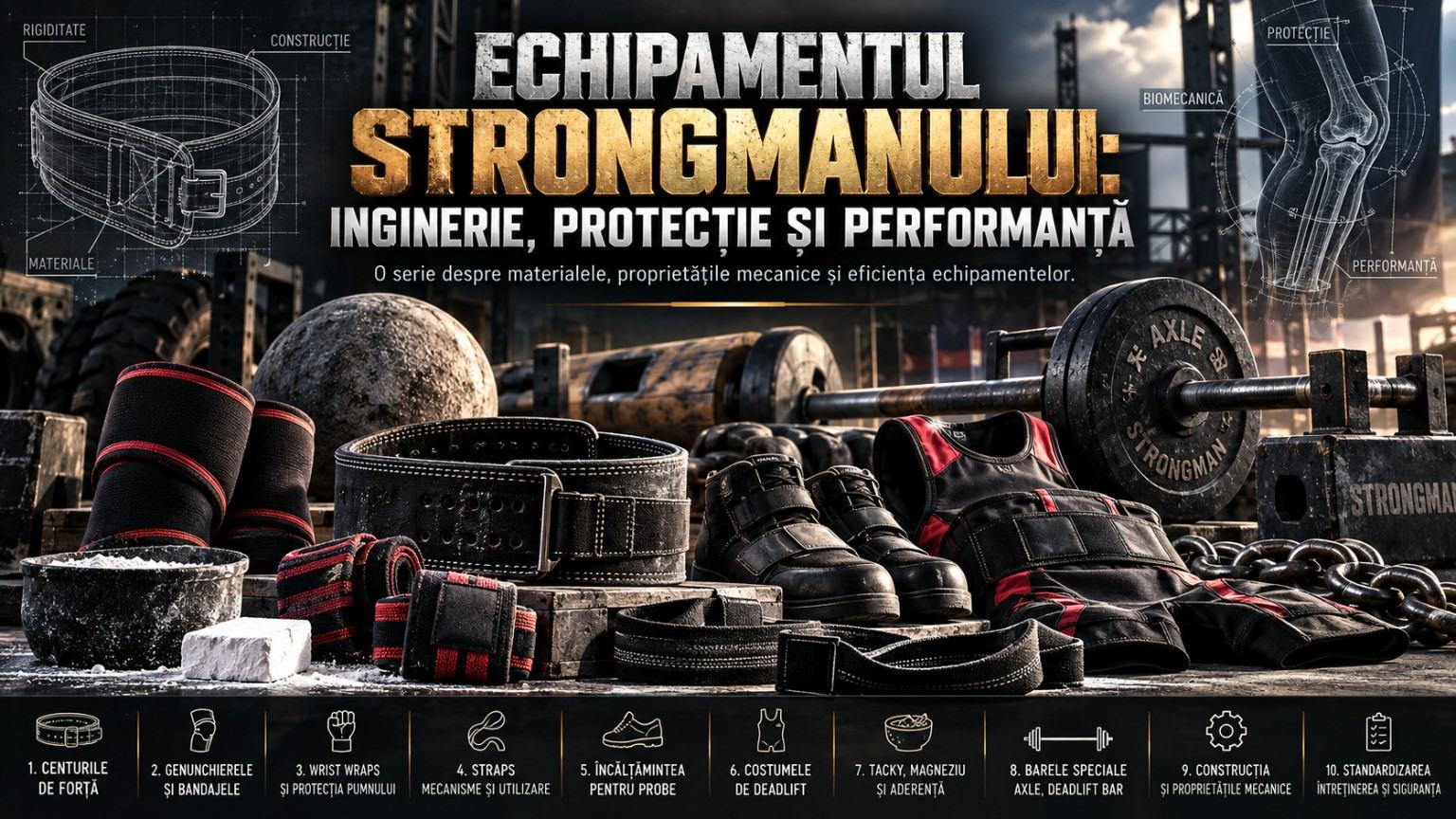
In strongman, the interface with an implement can decide the result before the muscles reach their true limit. An Atlas Stone breaks from the floor but slides off the forearms; a heavily loaded bar begins to rotate in the hand; a Farmer’s Walk handle descends through the fingers although the legs could cover another ten metres. The difference is not always muscular strength. It may lie in how surfaces transmit force. Skin and equipment form a mechanical system sensitive to moisture, temperature, roughness, contact pressure and auxiliary materials. Tacky, chalk and other grip products act on that system, but through distinct mechanisms, and their results cannot simply be assumed equivalent.
This is Episode Seven of STRONGMAN EQUIPMENT: ENGINEERING, PROTECTION AND PERFORMANCE. Following belts, knee sleeves, wrist wraps, straps, footwear and deadlift suits, our focus turns to the chemistry and physics of the athlete–implement interface. We will separate magnesium carbonate chalk, used to manage moisture and modify friction, from tacky, the viscous adhesive primarily associated with Atlas Stones. Rosin, natural and synthetic resins, powders, liquid formulas, temperature, application, removal, technical regulations, skin health, biomechanics and practical testing all belong in this discussion. Our objective is not to identify a miracle product, but to understand when a material helps, when it interferes and what evidence supports the difference.
A major evidence limitation should be stated at the outset. There is no extensive body of controlled experiments directly comparing commercial tacky formulations on Atlas Stones in competitive strongman populations. More relevant published material comes from skin tribology, climbing experiments with magnesium carbonate, grip-performance tests and dermatological investigations of colophony sensitisation. Such findings can inform hypotheses about bars, stones, sacks and metal implements, but extrapolation is not proof of universal performance gains. Throughout this article, measured findings will be distinguished from plausible mechanical explanations and individual practical recommendations that still require testing.
1. Grip is not a single property
Gym vocabulary often says that chalk helps the hand grip and tacky makes the stone stick. These descriptions are intuitive but technically incomplete. Friction opposes relative sliding between contacting bodies; adhesion describes interactions that resist separation of surfaces; cohesion is the internal strength of a material. Their relative importance differs greatly between bare skin against knurled steel and skin against a tacky-coated stone. An adhesive that bonds very effectively to skin may still fail to improve a lift if it detaches from the stone or tears within its own layer. Analysis must therefore follow the complete force-transfer pathway rather than treating the product's stickiness as an independent guarantee.
The introductory Coulomb friction relationship, F = μN, states that the limiting tangential force is related to the friction coefficient μ and the normal force N. This is useful for understanding grip, but skin is not a rigid block and tacky is not an ideal dry interface. Skin deforms; water changes surface interactions; polymeric products respond to loading duration and rate; contact pressure is uneven. Effective friction can change with sliding speed, duration of contact, surface roughness and contamination. Consequently, the equation is a starting framework, not a complete predictive model for every strongman event. Treating μ as a fixed number for every athlete and every substance would be particularly misleading.
During a double-overhand deadlift, the finger flexors increase gripping pressure while available friction resists downward slip and bar rotation. During an Atlas Stone lift, however, the athlete embraces a curved object using the forearms, hands and trunk. The stone must be drawn close, raised and rolled through several distinct phases. Tacky can influence both resistance to sliding and the force required to separate portions of skin from the stone. Successful friction management on a deadlift bar therefore tells us remarkably little about how the same product would behave against a rounded concrete stone. The geometry, direction of force and intended movement are fundamentally different.
Useful grip is not simply the greatest possible adhesion. If an excessively viscous substance is placed where rapid hand repositioning is essential, delayed detachment may become a disadvantage. Log Clean involves controlled rotation, changing trunk contact and quick hand transitions. Atlas Stone loading requires secure purchase while still allowing deliberate correction of the stone's position. On a deadlift bar, unauthorised sticky residue can undermine equipment standardisation and contaminate the surface for subsequent athletes. The first question is not 'How do I maximise stickiness?' but 'What exactly is limiting the event, and which type of contact is required?'
2. Skin is an active biomechanical material
Palm and forearm skin is not an inert protective coating. The outer layer, microscopic relief, tissue elasticity, surface moisture and compliance under pressure all influence the actual area contacting the implement. Two hands that look similar may behave differently when one is dry, the other sweaty, or when one has prominent calluses. A hand after hours of warm-up in a humid venue may not behave like the same hand during the first training set. Effective grip is an interaction between athlete characteristics and the implement, not a fixed attribute possessed by a supposedly strong hand.
Water complicates friction. A very small amount of moisture may change how skin conforms to microscopic roughness and, in some settings, increase direct contact. Larger quantities of liquid may form a separating film, promoting slip. 'Drier always means more friction' is therefore not a universal physical law. The result depends on the contacted material, its surface texture, contact pressure and the starting level of skin hydration. This complexity helps reconcile apparently contradictory results from chalk studies. Different experimental surfaces, participants and protocols can produce different effects without requiring one research group to have made an error.
Calluses deserve separate consideration. They represent an adaptation to repeated mechanical loading and can provide local protection. But a raised, uneven callus can catch on aggressive knurling and tear. The goal is not to remove the entire protective layer but to maintain a relatively uniform surface without cracks or excessive flaking. Athletes who repeatedly apply tacky to their forearms need to monitor skin condition with the same seriousness as grip strength. A product that gives a small benefit during one session but repeatedly inflames or damages the skin may ultimately reduce the number of productive training sessions available.
Temperature influences both comfort and the mechanical environment. Warm, sweaty skin can respond differently from cold skin, and many viscous substances become easier to spread as temperature rises. Yet easier application does not prove better resistance to sliding. An overly fluid formula can migrate, leave deposits or lose cohesion under load. A tacky that feels extremely firm at 12°C may not behave identically at a 32°C summer contest. For meaningful comparisons, athletes should record the testing environment alongside the weight, technique and result, rather than assigning every change to the adhesive itself.
3. Implement roughness and contact pressure
Surface roughness is not synonymous with adhesion. A steel bar with deep knurling can produce substantial mechanical engagement, but also considerable skin stress. A smoother object may create more effective contact area for certain adhesives. On Atlas Stones, finish, dust, magnesium residue, moisture and previous layers of tacky can completely transform the feel of successive attempts. In practice, the same stone mass does not necessarily present the same contact challenge after it has been cleaned, worn or coated with a mixture of substances. Equipment condition is part of performance context.
Local pressure determines how effectively skin conforms to a contacted surface. On a bar, the fingers concentrate force over relatively small areas. On a stone, pressure can be distributed across forearms, palms and sometimes the chest. These are distinct tribological conditions. A powder that helps fingertips may not behave similarly on the forearm. An adhesive appropriate for broad stone contact may be unacceptable on aggressive steel knurling. A useful material recommendation must therefore start with the actual event geometry and the dominant skin–implement interfaces rather than with general claims about grip.
Before competition, the athlete should determine at least three things: what the implement is made of, how clean and rough its surface is, and what relative movement the contact needs to allow. Some events require sliding resistance from start to finish; others demand secure contact followed by rapid release. The rules must then be checked for chalk, tacky, resin or prohibitions. Even a scientifically plausible choice becomes useless when organisers forbid it or demand that the implement be completely cleaned between athletes. Performance and compliance must be considered together.
4. Magnesium carbonate: what it is and is not
In strength-sport language, 'chalk' generally means magnesium carbonate, not metallic magnesium or a dietary magnesium supplement. Commercial products can differ in composition and particle structure, and some formulas contain processing agents. Their interaction with surface moisture helps explain their use in weightlifting, gymnastics, climbing and strength training. Yet saying that the powder simply absorbs all sweat exaggerates what is happening. Initial moisture, product quantity and the layer remaining between skin and implement all affect the outcome. Chalk does not replace gripping pressure generated by the finger flexors, nor does it provide a substitute for sound hand positioning and well-developed grip capacity.
Chalk creates a particulate coating rather than the continuous adhesive film associated with tacky. Particles may help manage moisture, but an excessive amount can form an intermediate layer that slips or interferes with direct contact. Generous application without evaluating the result may therefore be counterproductive. In practical terms, a moderate amount spread evenly across palms and fingers is a more reasonable starting point than a thick white coating that falls from the hands in clouds. The purpose is not the visual appearance of well-chalked hands. It is stable, predictable contact with a particular implement under the conditions of a particular event.
Chalk is not dry glue. It does not primarily create a strong adhesive bond resisting separation as pressure-sensitive adhesives can. It will not automatically turn a smooth Atlas Stone into an object that can be held securely with the forearms. Under certain conditions, chalk may be used to control perspiration before another approved substance is applied, but the combination must be tested and permitted by competition rules. Arbitrarily mixing powder into resin can change viscosity, cohesion, spreading and removal. The result cannot be predicted merely because the athlete has combined two products that are individually associated with grip.
Commercial forms include solid blocks, loose powder, crushed granules, fabric chalk balls and liquids that deposit material after the carrier evaporates. Differences are more than convenience. Fine powder spreads easily but becomes airborne; blocks may help control dosage; fabric balls restrict powder delivery without guaranteeing perfect distribution; liquid products may reduce immediate dust yet introduce solvents or additives worth reviewing. A choice should be based on the resulting skin contact, environmental safety and venue regulations, not just brand identity. Athletes should examine what remains on the skin rather than focusing only on how quickly a product can be applied.
When should chalk be reapplied? A rapidly sweating hand may benefit from application before a maximal attempt, but a hand that remains dry may not need fresh powder after every repetition. During a medley, residue transferred between implements can change grip unexpectedly. The mature approach is to calibrate dosage through controlled sessions: use the same bar or handle, comparable temperatures, a consistent warm-up and repeated observations of the results. Powder consumption is not itself a performance metric, and repeatedly chalking up should never become a substitute for training the forearms, fingers and the technical aspects of the event.
5. Chalk research: why findings disagree
A well-known experiment by Li, Margetts and Fowler, published in 2001, examined fingertip contact with several rock surfaces and found a reduction in the measured coefficient of friction after chalk application. The authors discussed reduced skin compliance and the formation of an intermediate granular layer as potential mechanisms [1]. The work matters because it challenges the assumption that magnesium carbonate must always increase friction. However, it does not prove that chalk is universally ineffective. Experimental pressure, surfaces and actions differed greatly from a knurled steel bar in a deadlift or the prolonged grip demands of Farmer’s Walk.
Another climbing study, published in 2012, reported a positive effect of chalk on friction against certain rock surfaces, with increases of approximately 18.7% on limestone and 21.6% on sandstone in its specific protocol [2]. These numbers are not percentages of improvement in deadlift one-repetition maximum, nor are they dosage recommendations. Instead, they show that the relation between skin and substrate can yield results different from those in another experiment. Responsible interpretation examines participant experience, hand position, humidity, force application and measurement technique before deciding what, if anything, may transfer to strength sports.
Kilgas and colleagues examined chalk during climbing and reported longer hanging time under one protocol without statistically significant changes in several measured friction-related outcomes [3]. The distinction is important to strength athletes. Sporting performance is not just the laboratory measurement of a coefficient. It also reflects perception, motor strategy, local endurance, confidence in the contact and movement adaptation. An athlete who performs better may be benefiting from one or several of these changes. Improvement should not automatically be attributed to a universal increase in skin–surface friction, especially when different performance variables do not all change together.
In 2018, Bacon and colleagues reported increased repetition counts in assisted pull-up tests using open-hand and pinch grips when participants used magnesium carbonate [4]. The investigation demonstrates that chalk may influence a functional performance outcome rather than only an isolated laboratory friction measurement. But the sample included nine participants, and the exercise was not a strongman event. These data do not justify precise claims about improvements in Axle Deadlift or Atlas Stone loading. Grip diameter, force direction, the athlete's strength reserve and the presence of repeated release and regrasping all alter the mechanics of the task.
Research by Clarke and colleagues, published online in 2024 and appearing in a 2026 journal issue, investigated finger–rock friction on several substrates under defined loading and moisture conditions [5]. The effectiveness of chalk depended partly on skin moisture and the geometry of surface irregularities. In some conditions, it also improved the consistency of friction measurements. Reliability can matter almost as much as average performance in competition because predictable contact allows the athlete to execute an established technique under pressure. Nevertheless, stability observed on rock samples cannot simply be claimed for knurled steel handles without corresponding research.
6. Powder, block and liquid chalk: technical selection
In principle, products with the same primary substance might behave similarly if they leave identical quantities and distributions on the same skin under the same conditions. Real-world application rarely meets those assumptions. A solid block rubbed quickly across the palm may produce larger fragments; finely milled powder can distribute broadly but excessively; a fabric ball meters material through a porous barrier; a liquid may leave a different coating after evaporation. Product 'format' must be evaluated through the deposit left on the athlete's hand. Valid comparisons should match dosage and use the same implement wherever practical.
Liquid chalk is often marketed as a cleaner option. Many formulas contain alcohol and magnesium carbonate, while ingredient lists may also include fragrance, resins or other agents. Alcohol evaporates and may temporarily dry the skin; gripping the bar before the carrier has evaporated can produce unintended contact conditions. Some products may also irritate sensitive skin. Following label instructions, using liquid products in a ventilated space, avoiding ignition sources near flammable formulas and checking ingredients are basic precautions. 'Liquid' does not automatically mean safer, more adhesive or superior for performance.
On aggressively knurled steel, excess powder may temporarily fill some surface details and create deposits whose effect is difficult to predict. On smooth metal, the interaction may differ. On a thick axle or Farmer’s handle, finger orientation and diameter influence both gripping force and bar or handle rotation. Athletes should compare formats through repeated practical trials rather than the feeling produced by a single attempt. If an apparent advantage emerges only when equipment has not been cleaned, the improvement belongs to the full contact system, including residue, rather than to the marketed product alone.
Gym equipment should be maintained after chalk use. Magnesium carbonate mixed with sweat, skin oil and environmental dirt may accumulate in knurling and on textured surfaces. Cleaning with methods appropriate to the equipment finish, while avoiding corrosion and unnecessary wetting of sensitive components, helps maintain consistent conditions. A stable cleaning protocol is preferable to occasional harsh interventions. From a performance standpoint, reproducibility is essential to interpretation: a clean bar and controlled dosage produce more useful comparisons than a succession of uncontrolled experiments with differing surface histories.
Cost is relevant but should not dominate the decision. Chalk is generally less expensive than many specialised strongman accessories, yet a higher retail price does not by itself establish superior friction or event performance. Packaging, perfume, texture and brand position may affect preference or ease of dosing without delivering measurable athletic improvement. Consider cost per use, local availability, the chance to reapply during competition and compliance with event regulations. Buying an expensive chalk instead of improving finger strength confuses fine optimisation with the foundations of athletic development.
7. Tacky: an adhesive within the force-transfer system
Tacky is a common name for a category of sticky products used primarily on forearms and hands for Atlas Stone lifting. It is not a single standardised chemical substance. Commercial formulations may include different resins, oils, polymers, plasticisers and other components, and the precise ingredients are not always publicly disclosed. Generalisations about all tacky formulas therefore require caution. Two products promoted for the same event can respond quite differently to cold, heat, dust or pressure because their viscosity and internal cohesion are not identical, even when their appearance and marketing are similar.
Unlike chalk powder, appropriately selected tacky aims to produce greater resistance to relative sliding and, under some conditions, separation. When athletes press the forearms against a stone, the coating may increase the force needed for those surfaces to move across one another. This only helps if the product adheres to both skin and stone and does not fail internally before the lift is completed. Greater initial stickiness is not necessarily better. A very soft material can stretch and migrate, whereas a very firm one might fail to conform to the stone. Failure mode matters as much as the immediate sensation of adhesion.
Many viscoelastic adhesive materials respond to the time and rate of loading. A slow pull can deform the material differently from a rapid load. In Atlas Stones, floor break, lap position and final extension have different movement speeds and force directions. A product can feel excellent during the first part of the lift and interfere with repositioning before the load is completed. Testing should cover the whole movement, not merely whether a small sample sticks to the forearm. A useful test examines the combination of initial purchase, controlled adjustment, resistance to slipping and timely release after loading.
A characteristic problem with tacky is contamination. Concrete dust, sand, loose fibres, skin flakes and chalk powder can become embedded in the adhesive layer. The material then changes properties and may become uneven. A stone repeatedly used without a consistent cleaning procedure develops a material history that influences later attempts. It is misleading to compare two lifts and attribute all the difference to strength when coating thickness, surface cleanliness and temperature vary substantially. Reliable testing must include deliberate control of the stone surface as well as the athlete's application technique.
Additional adhesion is a biomechanical aid, not permission to disregard technique. The lifter must still approach the stone closely, apply suitable pressure around its circumference, avoid allowing the load to drift away from the body's centre of mass and coordinate hip extension with the arms. Tacky may reduce slip but cannot cancel large external moments created by holding the stone too far forward. If an athlete uses adhesive for every session, it may also become harder to distinguish genuine improvements in grip and stone technique from the benefits of changing surface conditions.
8. Resin, colophony and what a product label may conceal
Colophony, also called rosin, is a resinous material derived from plant sources, notably conifer trees. It is not a single pure molecule but a complex mixture of resin acids and other constituents. Its adhesive properties explain use across many industries and some sporting products. Not all tacky should be assumed to consist exclusively of colophony, just as not all resin-based formulations should be treated as interchangeable. Chemical modification, processing, additives and oxidation can change both handling properties and sensitisation potential [6]. A commercial product name is not a chemical analysis, and descriptions such as 'natural resin' reveal far less than many consumers assume.
From a materials perspective, a useful adhesive must combine partly competing qualities. It needs sufficient capacity to spread and conform to irregularities in skin and stone, yet also needs internal strength to avoid splitting when the lift starts. Some formulas emphasise initial adhesion, while others may prioritise thermal stability or ease of removal. Without full ingredient disclosure, athletes cannot reliably predict behaviour from colour, odour or consistency alone. A controlled trial on the actual implement, with a suitable cleaning procedure, is far more informative than the sensation produced by opening a container and touching a small sample.
Natural resins may contain compounds capable of skin sensitisation. Dermatology literature documents colophony allergy and the role of oxidation products in allergic responses [6, 7]. A 2026 systematic review and meta-analysis of studies involving patients with dermatitis estimated a pooled prevalence of colophony sensitisation of approximately 3.54%, with substantial between-study heterogeneity [8]. This is not the probability that a healthy strongman will develop an allergy after one use. Presenting it that way would be misleading. It does, however, establish that colophony is a recognised contact allergen, not something automatically harmless because it originates from a tree.
Irritant reactions must be distinguished from allergic contact dermatitis. Irritation may arise from friction, aggressive removal, solvent exposure or injury to the skin barrier. Allergic sensitisation involves a specific immune response and may cause recurrent symptoms on later exposure. Persistent redness, itching, fissures, blisters or eczema should never be dismissed or treated by adding more tacky. Product use should stop and medical assessment should be sought, with patch testing undertaken through proper dermatological protocols rather than improvised by applying concentrated resin to damaged skin. A clear diagnosis is particularly important when several training products have been used together.
Heating products also deserves caution. Some formulas soften in the hands or at moderate ambient temperatures, but improvised heating over flames or with unsuitable devices can cause burns, fumes and changes in composition. There is no sporting justification for exposing skin to hazardous temperatures simply to improve spreadability. Athletes should follow manufacturer guidance, keep products away from ignition sources and avoid mixing them with unknown solvents. The absence of a technical safety sheet warrants additional caution, not aggressive experimentation shortly before competition. Material performance and the athlete's health should be considered inseparable.
9. Viscosity, elasticity and temperature
Viscosity describes resistance to flow; elasticity describes a material's ability to store and return some energy after deformation. Tacky can show viscoelastic behaviour, so its response depends on the amount and duration of deformation. A compound that feels hard in its container may become spreadable during application, whereas one that seems ideal on first touch can become uneven under the pressure of a heavy stone. An athlete cannot establish competition quality by touching a sample with one finger. The decisive question is how the entire deposited layer behaves across the real sequence of lifting phases.
A sticky interface can fail at two broad locations: between the adhesive and one of the contacted surfaces, or within the adhesive layer itself. When tacky remains on the forearm but fails to engage the stone, force transfer may be lost at the implement interface. Residue left on both surfaces can indicate internal splitting of the material. Observing the failure pattern after an attempt may offer practical clues, although it is not a substitute for controlled mechanical testing. Careful analysis considers not only whether the stone was lifted, but where slip occurred and how the product was distributed afterwards.
In cold conditions, some formulas become firmer and more difficult to spread evenly. In heat, others may become more fluid. This is a common principle of resinous systems, not a universal response curve for every brand. Manufacturers may offer formulations designed for particular temperature ranges, but labels such as 'winter', 'summer', 'heavy' or 'competition' are claims that should be tested. Ambient temperature is only part of the picture. Stone temperature, direct sun, perspiration and time spent in a warm kit bag may matter. A cold stone contacting a warm forearm creates a more complex situation than a single air-temperature reading suggests.
If a formulation feels too firm, an athlete may be tempted to apply a thick layer to increase security. Thickness, however, changes the distribution of deformation. A thick coating can become uneven, split into lumps or trap large quantities of dust. An extremely thin coating may fail to cover the necessary contact area. There is no published universal optimum thickness for every Atlas Stone and athlete. The practical target is the smallest amount that produces sufficiently reliable purchase for a given technique, stone finish and environment. The process should be repeated across sessions before the athlete decides the result is a personal rule.
Temperature should be recorded rather than remembered as a vague impression. When comparing formulations, approximate ambient and surface temperature and the time between application and lifting help make observations interpretable. Product A tested in the morning on a damp stone cannot fairly be compared with Product B after the same stone has been cleaned and warmed in the afternoon. Even without a laboratory, basic comparative principles can be followed: alternate testing order, repeat submaximal attempts and avoid severe fatigue. Grip experiments involving dangerous loads must remain controlled and must not encourage unnecessary risk.
10. Applying tacky: contact area, dosage and distribution
Application starts with the rulebook and the condition of the athlete's skin, not with opening the container. If tacky is prohibited, there is no reason to proceed. If permitted, identify where the stone actually contacts the forearms and hands during the athlete's technique. Covering the entire arm may increase waste, removal difficulty and unintended contact with other objects. Deliberate application to functional contact areas is more rational than indiscriminate coating. Skin with cuts, broken areas or a previous suspected allergic reaction should not be exposed. Application technique is part of sensible preparation, not an excuse to compromise skin health.
The skin should be reasonably free of dirt, oily lotions and unrelated substances that might interfere with the chosen product. This does not imply aggressive degreasing, repeated solvent washing or abrading the forearm until it becomes red. Intact skin is a requirement for sustained training, not an obstacle to be sacrificed. Controlled and even application makes comparisons more meaningful. When athletes repeatedly add layers over contaminated residues, they lose track of both coating thickness and the properties of the mixture. It becomes difficult to distinguish the effectiveness of the original tacky from the behaviour of debris trapped within it.
Contact areas change during an Atlas Stone lift. Before floor break, the forearms may work laterally and underneath the stone's curvature. In the lap phase, the trunk supports a substantial portion of the load. During final extension, the stone moves toward a platform or over a bar. The athlete needs to know where the first meaningful slip occurs. If the problem is initial purchase, one contact region may need improvement. If failure appears during repositioning, more adhesive elsewhere may accomplish nothing and may even obstruct a necessary change of grip. Technique analysis should precede product escalation.
A simple test can compare technique without tacky at safe, light loads to the same movement using a small reproducible amount of an approved product. Record application area, the interval before lifting, which phase felt more secure and whether residue contaminated the implement. Differences in time or successful repetitions should not be interpreted from a single attempt because familiarisation, motivation and fatigue can be substantial. The objective is to identify a stable advantage, not merely confirm an existing preference. Repeating controlled comparisons is far more valuable than producing a single dramatic training video.
Removing tacky is part of the protocol, not an afterthought. Some products require specific removal agents, while applying an unfamiliar industrial thinner directly to the skin is hazardous. Follow manufacturer instructions, protect eyes and mucous membranes and use gentle skin care afterwards. Organisers should specify who cleans the stones, which products are approved for cleaning and how much time is available between attempts. Fair competition should not require the next athlete to inherit uncontrolled chemical residue from the previous competitor. A proper removal procedure protects both equipment and people.
11. Competition rules cannot be assumed
Strongman does not operate under one universally identical rulebook for every local, national and international event. Organisers may allow tacky on Atlas Stones, restrict it for particular events or define separate conditions for chalk, straps and contaminated surfaces. Rules from a familiar federation or previous contest cannot automatically be transferred to the next event. Athletes should obtain current technical instructions and seek written clarification if relevant rules are ambiguous. A product acceptable at one competition may lead to an unsuccessful attempt or sanction at another.
Powerlifting offers a useful example of standardisation, although its rules do not automatically govern strongman. The 2026 IPF technical regulations specify conditions for substances applied to the body and personal gear, restrict lubricants and limit foreign substances on competition equipment [9]. The distinction is fundamental: allowing magnesium carbonate on certain parts of an athlete's body does not mean permitting sticky compounds on a bar. Athletes should never interpret permission to use chalk as general authorisation for any resin or adhesive. The legality of a substance depends on both its nature and where it is applied.
For Atlas Stone contests, organisers should state whether tacky is allowed and whether composition, quantity or application area is restricted. Instructions should also explain whether stones are cleaned between attempts, which cleaning materials are available and whether competitors may use their own formulations. Unclear procedures risk making running order an uncontrolled factor. One athlete might meet a clean stone and the next one a stone carrying multiple layers of adhesive and dust. Residue is not automatically an advantage: a contaminated and inconsistent coating can make contact less predictable.
Rule compliance also protects other competitors. Placing difficult-to-remove substances on an implement not intended for adhesive use changes the conditions faced by subsequent athletes. An individual product choice can therefore have a collective consequence. Referees must be able to inspect the equipment, and organisers require realistic cleaning protocols. The athlete's practical rule should be straightforward: without explicit permission, do not assume a substance is permitted. A clear question during the technical briefing can prevent penalties, avoid conflict and help preserve equipment for everyone.
Training should include two strategies: one for approved grip aids and one for cases where they are unavailable. This does not mean radically changing technique at the last minute. It means practising under less favourable contact conditions with appropriate, safe loads. An athlete who has never lifted a stone without tacky may experience more than a friction problem when a competition forbids the product. Familiarity, timing and confidence may also suffer. Adaptability is a genuine athletic skill, not merely an emergency response to forgotten equipment.
12. Atlas Stones: how adhesion interacts with biomechanics
An Atlas Stone is approximately spherical, heavy and lacks a dedicated handle. Its shape requires the athlete to create a grip by wrapping the forearms around the curvature and generating pressure against the surface. When the stone moves too far from the body, controlling it becomes more demanding and larger external moments may act about the spine, hips and upper limbs. An adhesive may reduce certain slips, but it cannot turn a biomechanically poor position into an efficient one. Improving stone performance begins with proximity, trajectory, leg contribution and coordination of movement phases. Product choice is secondary to a workable physical relationship with the implement.
At floor break, many failures are labelled a lack of grip when the actual problem is inability to keep the forearms close or generate sufficient force through the posterior chain. If the stone rises and then escapes a few centimetres above the ground, contact failure becomes a stronger hypothesis. If it does not move at all, hip position, force direction and available strength deserve scrutiny. Tacky may change contact sensation, but video analysis of shoulders, arms and stone remains important. Without separating these causes, an athlete may repeatedly purchase products for a problem rooted mainly in technique.
During the lap phase, the stone rests temporarily on the thighs and the athlete reorganises the body for final extension. Excess adhesive may slow deliberate hand repositioning, while insufficient or contaminated adhesive can allow the stone to slip as the position changes. Effective contact is therefore a functional compromise: resist slip where necessary and permit adjustment where technique requires it. No universal dosage can suit all stone weights, loading heights or lifting strategies. The correct amount depends on the interaction of athlete dimensions, strength, technical choices, surface condition and the formula being used.
For loading over a bar or onto a platform, hip extension must combine with controlled rotation and timely release of the stone. Extremely adhesive material can delay forearm separation, particularly if it spreads to unplanned areas. Conversely, more secure contact can prevent early loss of the stone and permit completion of a difficult load. The actual advantage should be assessed using full-event time, successful loads and consistent execution, not merely how difficult it feels to peel the stone away from the skin afterwards. The event score depends on all phases, including the transition to the next stone.
Novices may benefit from learning stone geometry and contact pressure with lighter loads and carefully controlled, less adhesive conditions. Experienced athletes can gradually incorporate the intended competition formula into training with enough time to evaluate technique and skin tolerance. Practising without tacky should never become a hazardous test of toughness involving very heavy stones. The useful relationship is between technical stimulus, acceptable risk and sustainable progression. Dropped stones can cause serious injury. Safe loading areas, clear landing zones and suitable supervision must be established before any experiment with surface adhesion.
13. Bars, axles and Farmer’s Walk: a different friction problem
In Deadlift, the primary interface is skin against steel or straps against the bar when straps are allowed. Knurling, diameter, bar flex and grip method all affect finger demands. Chalk may alter contact, particularly when perspiration is substantial, but the effect should be evaluated on the actual bar to be used. The choice between double-overhand, mixed grip, hook grip and straps also changes the overall mechanical problem. Comparing attempts performed with different grips and assigning every difference to chalk is an interpretation error. Grip technique, equipment rules and the specific bar are all part of the experimental condition.
An axle commonly has a greater diameter than a standard bar, altering finger geometry and limiting closure for some athletes. Diameter also changes the rotational demands that the athlete must control. A product that dries the hands may help in particular circumstances, but it cannot replace the force needed to stabilise a thick object. Useful progression may involve isometric holds, controlled sets without aids and selective use of accessories in sessions where the main objective is not grip development. This approach helps separate muscular adaptations from temporary changes in the contact interface.
Farmer’s Walk introduces movement and oscillation. The handles are not simply heavy; they move in relation to the body during each step and experience repeated changes in force direction. A grip that succeeds during a static hold may be inadequate during acceleration or turning. Products should be tested over relevant distances on safe surfaces with manageable loads. A slipping handle can end the event; trying to rescue an uncontrolled drop may create a more serious hazard. Athletes need to accept controlled release when a grip is failing rather than attempting desperate, unsafe movements to preserve a result.
Aggressive knurling also comes with biological costs. It may improve mechanical engagement while stressing and abrading the skin. In multi-event competitions, damage sustained during Deadlift can compromise Farmer’s Walk, Loading Medley or other later events. Chalk should not be evaluated only by the heaviest single hold but also by how the skin tolerates the full workload of the competition. Optimising one event at the cost of being unable to complete the next one is rarely intelligent preparation. A reliable grip strategy must include the cumulative demands of an entire competition day.
Tacky and other adhesives are not standard substitutions for chalk on bars and handles. Beyond regulatory restrictions, sticky compounds can contaminate equipment, change release timing and create contact conditions that are difficult to compare between athletes. When an implement must be dropped promptly for safety, uncontrolled increases in separation force are not obviously advantageous. A knurled metal bar and a spherical stone create fundamentally different interfaces. Products should not be transferred between them merely because both tasks are described as grip-intensive.
14. Sandbags, kegs, tyres and logs: when less may be better
Sandbags introduce a deformable textile or synthetic surface, often with seams and improvised gripping areas. Contact depends on fabric characteristics, moisture, dust and the way the athlete compresses the bag. A product effective on metal or concrete should not automatically be considered useful on fabric. Sticky material may attract fibres, damage the covering or interfere with repositioning during a loading medley. For many athletes, the method of securing the bag, arm pressure and placement relative to the trunk matter more than an auxiliary substance. Technical solutions should be investigated before changing the surface chemistry.
Keg Carry may involve smooth metal, paint or rubberised surfaces. The athlete maintains stability through compression, positioning and control of the centre of mass. If the cylinder slips against the forearms, perspiration, surface coating, diameter or wrapping technique could be responsible. The answer is not automatically tacky. Rules may prohibit contamination, and quick release may be important for safety. Identifying the exact slip region and testing under controlled submaximal conditions provide more useful evidence than improvising with an unfamiliar product on competition day.
Tire Flip combines hand contact with rubber, ground friction and the production of enough moment to rotate the tyre. Rubber may be dusty, damp or worn, while gripping points are often irregular. Chalk might change palm sensation, but decisive factors may include finger placement, body position, pushing angle and shoe traction. A sticky product may seem to help the initial break yet hinder rapid finger repositioning. These variations reveal why there is no universal grip compound suited to every strongman event. Effective force transfer is highly dependent on movement phase and intended contact behaviour.
Log Clean and Press uses integrated handles with mechanics distinct from gripping a straight bar. During the clean, the log rolls through a controlled path relative to the body. The hands must retain control while allowing changes in angle and sometimes hand position. Excessive adhesion could interfere with these mechanics, whereas sweaty hands may reduce confidence and control. If permitted, chalk can be assessed for consistency, but conclusions should be based on the whole movement rather than one isolated set. Secure contact and freedom of movement must be balanced throughout the clean and press sequence.
The common issue is that 'grip' does not serve the same function in every implement. Sometimes stabilisation is nearly static; sometimes the hand must slide in a controlled manner; sometimes contact must end immediately. Athletes and coaches should define the event's mechanical requirements before selecting an accessory: contact surface, force direction, phases, risk and rules. A sound decision may be to use no additional material when it introduces complexity without a demonstrable advantage. Choosing not to use a product can itself be a sophisticated technical choice rather than evidence of incomplete preparation.
15. Evaluating products scientifically without a laboratory
A useful comparison starts with a testable question: does the product reduce slips, extend a grip hold or improve completion time over a fixed distance? Defining the outcome is essential. For deadlift chalk, athletes can record success in controlled submaximal holds and whether the bar slips, without repeatedly attempting maximal records. For stone tacky, they can count technically correct loads and measure time under standardised conditions. An observable result is more useful than the vague statement that one product 'felt much better'. Precision in the question makes practical testing easier to interpret.
Testing may alternate conditions A and B across multiple days or, where fatigue permits, within a session using adequate rest. Change the order so that one product does not always benefit from freshness while the other is tested during fatigue. Load, warm-up, recovery duration, temperature, implement cleaning and hand position should remain as similar as practical. Nobody needs to pretend this is a fully powered randomised clinical trial. However, conclusions from small sets of observations should be modest, because daily strength variation and adaptation are unavoidable. Repetition helps prevent chance from becoming a false performance claim.
For holds, a stopwatch can measure time until voluntary release, although local muscular endurance also affects the result. In Farmer’s Walk, sectional times, loss of control and number of stops can be tracked. For stones, success rate and the exact moment of slip can be extracted from video. No single metric captures every consequence. A product could improve initial grip but delay repositioning, with the two effects cancelling in the final event score. Measuring several relevant outcomes provides a fuller understanding than chasing a single headline number.
Video analysis can remain simple: place a camera at a consistent side or oblique angle and ensure that forearms and implement are visible. Mark floor break, lap and loading phases. If the stone escapes, footage can help distinguish genuine surface slip from loss of whole-body position. For Farmer’s, video may show when a handle begins to rotate through the fingers. Expensive sensors are not needed to identify obvious technical errors. Nevertheless, video alone cannot calculate an exact coefficient of friction without force measurements and an appropriate mechanical model. The strength of the method lies in observation, not invented precision.
A useful log should also include skin reactions, cleaning time, cost, product quantity and feasibility of application during actual competition. A material offering a small mechanical advantage but requiring twenty minutes of preparation between events may be impractical. An adhesive that repeatedly causes irritation can be rejected even if isolated performance results seem promising. Sound evaluation considers more than kilograms lifted. It assesses performance, safety, repeatability, cost and compatibility with the competition format. Products should earn their place in the kit bag through evidence relevant to the athlete's situation.
16. Sweat, humidity and realistic testing conditions
Strong athletes differ in how much they sweat, even at identical temperatures. Perspiration before an event also depends on warm-up, stress, hydration, clothing and venue conditions. A palm can feel dry immediately after chalk application and become wet again within minutes. Choosing a product on the basis of a demonstration lasting only a few seconds is therefore a mistake. For a long hold or a medley with multiple implements, duration of effect may matter more than initial grip sensation. Realistic testing should reproduce the interval between warm-up and the actual competition attempt, including waiting periods.
Environmental humidity does not have identical effects at every interface. Humid air can favour persistent moisture on some surfaces, but temperature and ventilation influence sweat evaporation. A concrete stone, steel bar and rubber-coated handle respond differently, and implement surfaces may be colder than the surrounding air. Simply knowing that humidity is 70% does not permit accurate prediction of friction. Training records should include environmental conditions alongside observed contact and performance. The information becomes useful when repeated experiences establish meaningful patterns rather than relying on a single number.
An athlete using chalk for deadlift should ask whether the primary limitation is sweat, grip strength, bar diameter or technique. If the hand opens under load even when dry, adding more powder may have little benefit. If grip fails only after several hard efforts, local endurance and fatigue may be involved. If the bar slips primarily after being handled by many athletes, equipment cleanliness may be a major variable. This simple differential analysis avoids unnecessary purchases and helps select an intervention targeted at the actual limitation rather than at an assumed lack of chalk.
An athlete who sweats heavily through the forearms before stone events should consider how the chosen tacky formula interacts with that moisture. Some materials may tolerate limited dampness, while others become difficult to spread or develop an unstable layer. This does not justify aggressive drying with irritants. Clean, intact skin prepared according to product instructions is a safer starting point. Applying tacky too early may also allow it to collect fibres from clothing or residue from objects touched in the warm-up area. Timing of application matters alongside the amount used.
The timetable of a contest changes practical effectiveness. An Atlas Stone final immediately after a prolonged Yoke event may find athletes sweating and fatigued in ways absent from isolated stone training. A short reproducible routine may then be more valuable than an elaborate application procedure. Athletes need to know where the product is stored, how to apply it without contaminating other equipment, how long removal takes and when access to the event area is permitted. Logistics contributes to competition readiness and should be treated as part of the performance system.
17. Skin safety and exposure control
Strongman palms and forearms experience repeated friction, pressure and minor tissue damage. Adding substances to these surfaces can influence both mechanical performance and dermatological health. A product that causes no discomfort during its first use cannot guarantee freedom from reactions over following weeks. Introducing unfamiliar tacky should be done cautiously on intact skin, without turning the most demanding session into a tolerance experiment. Gentle washing, maintenance of the skin barrier and attention to early signs of irritation all matter for training continuity.
In sensitised individuals, colophony and related substances can produce allergic contact dermatitis. Symptoms may include itching, redness, eczema-like lesions and worsening upon repeated exposure. The fact that a product is sold for sport does not make it a medical device or prove clinical suitability for every athlete. Dermatological assessment can identify relevant allergens and guide avoidance. Athletes should not attempt to diagnose themselves by repeatedly trying different resins on inflamed skin. Doing so may prolong exposure and obscure which ingredient is responsible for the reaction.
Respiratory exposure is a separate concern. Loose chalk becomes airborne when applied excessively or when athletes vigorously clap and shake their hands. Reducing dust in crowded enclosed spaces is sensible for hygiene and comfort. Lower-dispersion application may be useful, without claiming that one format automatically eliminates every risk. Liquid products may release solvent vapour, and improperly heated resins can produce irritating substances. Ventilation and adherence to labels matter more than the assumption that an entrenched gym habit must be harmless because many athletes practise it.
Heavy implements present risks that additional adhesion does not remove. A stone dropped onto a foot, a Farmer’s handle falling onto fingers or an uncontrolled medley object can cause serious injury. Secure contact does not compensate for insufficient clearance, unsuitable landing surfaces or people standing in the drop zone. Athletes must preserve the ability to release an object when necessary. A substance that unexpectedly delays release may create a hazard at precisely the moment the implement needs to be abandoned safely. Event planning should always prioritise controlled movement and a clear escape or drop path.
A practical kit should contain appropriate removal instructions, approved cleaning supplies, clean towels and means of caring for the skin after training. These measures are not substitutes for medical treatment. Persistent dermatitis, deep fissures or signs of infection should not be managed through random products selected between events. Reducing exposure and seeking medical assessment take precedence over a temporary performance gain. Sensible skin protection is not a retreat from serious competition. It is an investment in preserving the athlete's ability to train consistently.
18. Implement maintenance and contamination chains
An implement's functional surface is not fixed when maintenance practices vary. Chalk may accumulate in knurling alongside sweat and skin oils. On a stone, tacky can trap concrete dust, sand and fibres. On a fabric sandbag, adhesive residue may remain attached to the weave and influence the next user. Grip products can therefore become, in practical terms, equipment-surface modifiers. Any full evaluation should include the effort and cost of returning an implement to a reasonably consistent state rather than measuring only immediate grip sensation.
Not every cleaning agent suits every material. An unsuitable stiff brush may damage finishes; excess water can promote corrosion of some metals; aggressive solvents may damage paint, rubber and plastics. Organisers and gym owners should follow equipment and product guidance. Stones require particular consideration of finish, drying time and whether removal of residue changes the surface itself. Standardisation does not mean scrubbing all implements aggressively with the same chemical. It means using a documented and appropriate procedure that maintains functional comparability without damaging the equipment.
Contamination can also travel with the athlete's hands. Someone who has used tacky on stones may then touch a metal handle, warm-up equipment or another shared object. Without cleaning, unknown residue may transfer to surfaces used by others without adhesives. Tight competition schedules can turn this into a logistical and sporting problem. Designated application areas, separate towels and containers, and clear cleaning procedures reduce variation and conflict. Athletes should recognise that their chosen substances can affect the wider event environment rather than only their own performance.
Maintenance records need not be elaborate. A simple paper log or digital form can note implement type, surface condition, cleaning method, products used and time of last inspection. In a busy gym, those notes may explain recurring grip problems. If several athletes report that a particular handle became unusually slippery after maintenance, surface treatment may be responsible rather than the grip strength of every user suddenly declining. Operational observations can prevent mistaken coaching conclusions and guide a more reliable standard for equipment preparation.
An element of sporting fairness is broadly comparable material conditions across competitors. We cannot eliminate every difference due to temperature or running order, but arbitrary variations introduced by grip-product residues can often be reduced. The same cleaning protocol, inspection schedule and communication of rules help limit uncertainty. If an organiser chooses to leave residue on stones, that policy should be explained as part of the event conditions. Ambiguity is not merely administrative: it can influence outcomes and trust in the competition.
19. Myths about chalk and tacky
The first myth is that more chalk always means more friction. Fingertip–rock investigations have reported both favourable and unfavourable effects depending on test conditions [1–5]. A thicker layer is therefore not a universal scientific recommendation. Excess powder can create a granular interface and contaminate equipment. Useful dosage must be established by observing performance on the relevant surface. Repeated application also cannot correct poor hand positioning or a genuine strength limitation. Chalk should be understood as a contact-management aid rather than as an infinitely scalable source of additional grip.
The second myth claims tacky is only for athletes with weak stone grip. In reality, it can alter the mechanical interface for competitors across different strength levels. When permitted, using it is a technical and regulatory choice rather than a moral test. The opposite extreme is also mistaken: tacky does not automatically overcome poor stone technique. A very strong athlete may lose a stone through surface slip; another may lose the same stone through an inefficient trajectory. Similar-looking failures can have entirely different solutions. Identifying the failure mechanism comes before selecting a grip product.
The third myth assumes natural materials cannot cause skin problems. Colophony is a well-documented natural substance capable of causing contact allergy in sensitised individuals [6–8]. A homemade formula does not guarantee purity, stability or absence of additives. Missing ingredient information should not be mistaken for evidence of safety. Labelling, instructions and the athlete's skin response matter more than a product's association with natural origins. Healthy skin supports long-term performance, while repeated exposure to an unsuitable material can turn a minor accessory choice into a persistent training problem.
The fourth myth is that a percentage increase in laboratory friction equals the same percentage gain in event performance. Even when local friction rises by a measured amount on rock, maximal lifted mass depends on many factors, and the event may be limited by leg strength, range of motion or execution speed. Performance in an assisted pull-up test cannot be directly transferred to Axle Deadlift or Yoke. Laboratory work helps explain a mechanism, while sport-specific assessment establishes whether the mechanism changes a real result. These levels should be connected without being confused.
The final myth says the strongest, stickiest or most expensive product must be the professional choice. A professional strategy instead seeks control, repeatability, legality, skin health, cost and compatibility with the event's mechanics. Very strong tacky may be unsuitable when repositioning is essential. Chalk effective in a cool gym might behave differently at a humid outdoor contest. Performance is not the accumulation of accessories. It emerges from their intelligent integration into a training system in which strength and technique remain central.
20. Perceived improvement versus measured improvement
Confidence in the grip can change how an athlete approaches an attempt. Someone who expects the stone to remain secure may hesitate less, maintain a better body position and move more consistently. Those changes can affect performance, but they are not identical to a measured increase in adhesion. A trial in which the athlete knows the product being used inevitably includes expectations and preferences. Subjective reports should be collected because they are useful, but interpreted alongside observable outcomes and the technique visible in recordings rather than replacing measurement.
Familiarisation may be especially important for athletes using tacky for the first time. During an initial session, a product might feel extraordinarily effective or unpleasant simply because the contact sensation is unfamiliar. After several attempts, the athlete learns to distribute pressure and reposition the hands differently. A single-use comparison can confound material properties with motor adaptation. Responsible testing gives competing options a reasonable opportunity for familiarisation without extending exposure or risk unnecessarily. Otherwise, preference for the better-known product may masquerade as a mechanical advantage.
A meaningful benefit should persist over several sessions with relevant loads and acceptable technique. One additional kilogram on a single attempt cannot establish causation when rest, motivation and warm-up differ. A consistently higher success rate with a particular tacky on the same stone, under similar conditions, is more persuasive practical evidence. Even then, the appropriate conclusion remains individual: this athlete, this stone and these conditions. Generalisation requires larger, better-controlled studies. Precision about the scope of a conclusion strengthens rather than weakens the value of coaching observations.
A sticky sensation during a slow cold test may not predict behaviour when a stone is lifted rapidly. Similarly, the feeling immediately after chalk application may not predict grip near the end of a medley. Athletes need to distinguish static from dynamic tests. One product may increase resistance to initial slip but offer less control during movement; another may feel modest at first contact yet become more secure after sustained pressure. Suitability depends on the full event, movement tempo and how the athlete manages changing contact across the attempt.
Data-informed practice does not eliminate athletic experience. Experience helps formulate relevant questions and notice details that are difficult to quantify. It becomes more valuable when recorded systematically, when alternative explanations are considered and when unexpected results lead to further tests rather than dogmatic conclusions. Equipment engineering in strongman should help turn gym sensations into testable hypotheses. Chalk and tacky demonstrate how surprisingly complex a seemingly simple interface can be.
21. Four practical competition scenarios
The first scenario is a deadlift-for-repetitions event in a warm venue with a bar used by many competitors. The first repetition feels secure, but the bar begins slipping by the fifth. Sweat accumulation is one possibility, yet finger fatigue, changes in bar position and technical deterioration must also be examined. If rules permit chalk, the athlete should test dosage and timing during prior sessions. Competition is not the place to invent a new routine. A realistic goal is predictable grip through the expected workload without wasting time on application or violating regulations.
The second scenario is an outdoor Atlas Stone event in cold weather. Tacky used comfortably in summer is now firm and difficult to spread. A product marketed for lower temperatures may appear logical, but should ideally be tested in advance on a comparable stone. Responsible preparation includes assessing skin tolerance, application time, removal and effects during the lap phase. With no opportunity to familiarise, improvised solvents or hazardous heating are poor choices. Sometimes technical adaptation and a safe, familiar routine are more valuable than gambling on an unfamiliar formulation.
The third scenario is a loading medley with sandbags and kegs. The athlete can maintain contact but loses time repositioning the hands. Applying something stickier might worsen transitions. A more relevant solution may be to analyse the first bag pick, the steps toward the platform and the release point. If a product is considered, the texture of each implement and contamination rules must be taken into account. Gaining one second during initial purchase but losing three seconds during hand transitions is a negative overall result. Full-event timing reveals what an isolated grip test may conceal.
The fourth scenario is a late-day Farmer’s Walk after several events have stressed the hands. The athlete feels finger fatigue and has small irritated skin areas. Additional chalk may modify surface sensation but cannot instantly restore muscular force or repair the skin barrier. Better preparation involves managing training volume during preceding weeks, protecting skin between events and controlling the implement safely. Broken skin should not be covered with an irritating substance to force one more attempt. In complex competitions, overall results partly reflect how effectively the athlete preserves physical resources across multiple events.
These scenarios illustrate a single methodological principle: identify the limitation before choosing the intervention. Tacky is not the answer whenever an object slips; chalk is not the answer whenever a hand becomes fatigued; and an expensive product is not automatically superior because a famous athlete uses it. Surfaces, rules, movement phases and skin condition must be examined together. Athletes who travel frequently can benefit from a short written procedure that can be adapted to organisers and venues without undermining safety or the repeatability of their execution.
22. Training programmes and dependence on grip aids
Grip aids can be entirely legitimate during training designed to reproduce specific competition demands. Problems arise when they consistently conceal a grip-strength or local-endurance limitation that the athlete intended to train. If every deadlift session uses straps while competition requires unassisted grip, specific preparation may be insufficient. Likewise, if every Atlas Stone repetition uses enormous amounts of tacky, the athlete may rarely learn to control the contact under less favourable conditions. The point is not to declare assistance unacceptable, but to clarify which adaptation a training session is intended to produce.
One solution is to separate session objectives. During heavy posterior-chain training, permitted straps may prevent grip from limiting the intended muscular stimulus. In another session, controlled strapless holds with standardised chalk can target grip development. For stones, moderate-load technical work may help identify effective forearm placement, while competition-specific sessions may include the approved tacky formulation. This approach does not require abandoning equipment. It requires aligning its use with the training purpose rather than applying the same assistance automatically at every opportunity.
An athlete can still progress while using the same product consistently, but interpretation is clearer when conditions are documented. Improving from five to seven successful loads on the same stone, with similar tacky dosage and technique, suggests a more meaningful athletic change than comparing a tacky-free session with one using a new adhesive. A training log can record product, approximate quantity, temperature, stone condition, completed repetitions and the location of slips. The records do not need laboratory precision. They do need enough consistency to support useful comparisons rather than retrospective storytelling.
For long-term grip development, varied stimuli make practical sense. Thick-handle holds, loaded carries, grip-and-release drills, skin adaptation and progressively demanding sets expose the athlete to different needs. They should not all be added simultaneously, and overall volume must account for gripping demands already present in strongman training. Perpetually fatigued forearms may compromise primary sessions and increase the likelihood of skin damage. Grip-aid programming should therefore be considered alongside fatigue management, not isolated from the broader training plan.
At the end of a training block, an established baseline can be repeated. The athlete uses the same handle, body position and routine, potentially the same amount of chalk, then compares holding duration or carrying performance. Improvement under these matched conditions supports progress in that specific task. If the improvement appears only after the product changes, the advantage may primarily arise from contact management. Both kinds of progress can matter competitively, but distinguishing them helps guide the next training block and prevents overestimating physiological adaptation.
23. What manufacturers should tell athletes
Strength-equipment marketing frequently uses words such as 'extreme', 'professional' and 'strongest'. For an informed athlete, adjectives cannot replace technical parameters. With tacky, useful information includes general composition, application instructions, intended temperature range, safe removal, storage requirements and skin warnings. If the product contains recognised allergens or flammable solvents, this should be communicated clearly. Without such information, comparing containers becomes excessively dependent on brand reputation and personal impressions. Transparency improves decision-making even when manufacturers cannot disclose every detail of proprietary formulations.
For chalk, relevant information includes ingredients, additives, format and handling guidance. Liquid formulas may require complete evaporation before equipment contact, while scented products may be unsuitable for sensitive skin. Spectacular packaging does not predict friction. Clear product information, reliable availability and reproducible application may be more valuable than a premium price or an impressive advertisement. Responsible selection should also consider gym policies governing dust and chemical use. The product must fit the environment as well as the athlete's hand.
A rigorous technical sheet for a sporting adhesive could describe adhesion testing on standardised surfaces, test temperature and variation over time. Such transparency would support meaningful comparison, but it should not be assumed that all manufacturers conduct those tests. When commercial figures are presented, athletes should ask which surfaces were used, at what contact pressure and whether the procedure resembles skin on concrete. A number without a method is not convincing evidence of superiority in a sporting event. Even technically valid laboratory measurements may not directly predict whole-event performance.
Terms such as 'safe', 'natural' and 'hypoallergenic' can be misunderstood unless supported by verifiable information. A formula may cause no reactions in most users and still be unsuitable for somebody sensitised to one ingredient. Risk depends on actual exposure, skin condition and individual history. Athletes should not demand guarantees that allergy is impossible. They should demand sufficient information to make informed choices and recognise unwanted reactions. Commercial responsibility is visible not only in adhesive strength, but also in the quality of warnings and instructions.
24. Future strongman research methods
The field would benefit from studies directly comparing no chalk, chalk and different tacky formulas in specific events with technically familiar athletes. For Deadlift and Farmer’s, investigators could analyse contact forces, hold duration, sliding behaviour and event scores. For Atlas Stones, success rates, phase times, forearm pressure and stone-to-body distance could be examined. Standardisation of temperature, cleaning, surface finish and dosage is essential. Otherwise, apparent differences between formulations might be explained by uncontrolled conditions rather than material properties.
Participants should be characterised by experience, body mass, hand dimensions, relevant performance measures and familiarity with the products. A formulation manageable for an experienced athlete might be difficult for a novice. Where the design and data permit, effects should be examined across sex and other relevant subgroups without presuming identical or different responses in advance. Sample size, measurement error and variation between attempts need transparent reporting. Publishing only the most successful trials would distort the evaluation of a material whose principal benefit may be consistency rather than maximum performance.
Experimental conditions should ideally be tested in alternating sequences with adequate recovery. With tacky, complete removal between conditions can be difficult and residual effects may contaminate subsequent trials. Investigators need to address this directly, perhaps using separate days and surface inspections. Skin reactions and removal time should also be documented. A product is not automatically superior because it improves one contact measure if it causes repeated adverse effects or cannot legally be used in actual competition. Performance measures must be considered within practical and safety constraints.
Laboratory tribology and sport testing should be connected without being confused. A mechanical device can measure friction or separation resistance between defined materials without reproducing an athlete's movement strategy under a heavy stone. Conversely, a competition result can suggest a product helps without identifying its exact chemical mechanism. The strongest research designs would combine mechanical measurements, movement observations and competition-relevant outcomes. For now, many recommendations remain informed practical experiments rather than definitive conclusions drawn from direct controlled strongman studies.
An interesting direction is the study of grip aids in multi-event competitions, where skin damage and fatigue accumulate across the day. The best strategy for one maximal lift may not be optimal for the overall contest. Investigations could track skin condition, technical consistency and between-event recovery. Standardised stone cleaning could also be evaluated as an intervention to improve competitive fairness. Strong research should not start with 'Which brand is the best?' but with 'Under what conditions, and through which mechanisms, does performance change?'.
25. A practical chalk training protocol
Begin by choosing a reference surface, such as a clean bar, an axle of known diameter or a familiar Farmer’s handle. Complete a normal warm-up, check the skin and choose a submaximal task that reveals grip behaviour without the danger associated with repeated personal-record attempts. Compare a no-product condition with moderate chalk application while maintaining the same finger position and adequate rest. Repeat across several sessions rather than relying on one day. The purpose is to identify a reproducible improvement in contact, not manufacture a dramatic performance demonstration from an uncontrolled maximal lift.
Next, document more than the load. Record hold duration, whether the bar started rotating, whether the fingers required adjustment, perceived hand moisture and any irritation. For carries, measure distance and unplanned stops. When testing a new product, changing the bar, footwear and technique at the same time makes interpretation difficult. Altering one meaningful variable at a time is a simple but valuable principle. Grip performance is affected by enough factors already; the comparison becomes far more useful when those that can be controlled are actually held consistent.
Finally, choose a routine that is feasible during competition. A product that works only after prolonged preparation or creates excessive dust for venue policies may offer an impractical theoretical advantage. Establish approximate dosage, time between application and lifting, and removal procedures. Practising before heavy sessions reduces last-minute improvisation. A good protocol is short enough to repeat and flexible enough to cope with changes in temperature or regulation without becoming a distracting ritual. Familiar, consistently executed preparation often outperforms an elaborate routine assembled for the first time under competitive pressure.
26. A practical Atlas Stone tacky protocol
For stones, first identify when slip occurs. A warm-up with relatively light stones, a safe movement path and careful technique can reveal whether contact is lost at floor break, lap or final extension. Maintain adequate clearance around the implement and avoid maximal tests when comparing unfamiliar formulas. Where tacky is permitted, apply a controlled quantity to appropriate regions of intact skin according to product instructions. The aim is to examine whether contact improves at the relevant movement phase without introducing needless skin exposure or making the stone hazardous to handle.
The second stage concerns repeatability. Using the same stone and platform height, compare submaximal loading success and completion time across compatible conditions, ideally on different days where cleaning and recovery can be managed. It matters not only whether the stone leaves the floor, but whether it can be repositioned without delay and released correctly onto the platform. Video may reveal precisely where the movement changes. If the new tacky produces a slower transition, that fact should not be concealed merely because it creates impressive adhesion during the first phase.
The third stage addresses skin and equipment. After training, remove tacky according to instructions, examine the forearms for redness or fissures, and clean the stone using a method appropriate to its surface. Athletes comparing formulas should avoid allowing old residues to contaminate the next condition. A recurring reaction warrants stopping the product and seeking medical assessment. A sporting advantage cannot justify continued exposure to a suspected allergen. Maintaining a reasonably clean reference surface also makes the next training session more comparable and useful.
27. The pre-competition technical checklist
Before travel, verify technical documentation: which substances are allowed, in which events and on which body areas, and whether the organiser provides cleaning supplies or grip products. Check the kit to prevent tacky leaking onto straps, belts, handles or clothing. Store products according to labels and avoid uncontrolled exposure to extreme temperatures. When travelling by air or other transport, liquid and flammable products must comply with carrier restrictions. Clarifying these details before departure is preferable to discovering a prohibition during security screening or the technical briefing.
On competition day, identify the actual implements and their conditions. A smooth-finished stone may behave differently from the training stone, while a bar already coated with chalk residue may not feel like a clean one. Contact decisions should adapt to these observations without risky last-minute experiments. Questions to referees should be specific: are liquid chalk, tacky or resins allowed, may they be reapplied between attempts, and how are implements cleaned? Direct communication prevents disputes, and organisers should provide the same information to all competitors.
Immediately before the attempt, follow a familiar routine: intact skin, known dosage, correct application area, removal of prohibited residues and attention to technique. If the hand is already damaged, reconsider the risks of particular substances. Unusual conditions do not automatically justify doubling the quantity used. Preserve as many elements of previously successful execution as possible. In strength sport, stable technical habits under pressure can be more valuable than last-minute improvisation inspired by a product's marketing claims.
After the event, cleaning and skin inspection should be completed before moving to another implement. Residue left on equipment affects other competitors. Whether performance was unexpectedly good or poor, notes about product, surface and temperature can be made the same day while details remain fresh. These observations can improve preparation for future contests and prevent repeated mistakes. Post-competition analysis should explain not just placings and kilograms but also the material conditions in which results were achieved.
28. Conclusion: engineering contact, not product magic
Tacky, chalk and related grip aids take up little room in a strongman's bag but act at a decisive point in force transfer. Chalk can change moisture and friction conditions at a skin–implement interface. Tacky seeks to increase resistance to sliding and sometimes separation on surfaces such as Atlas Stones. Neither has a universal effect because implement material, geometry, temperature, dosage, technique and skin condition form one interacting system. Discussing a product without describing the system in which it is used misses the central scientific issue.
The existing evidence is useful but requires careful interpretation. Chalk studies have produced results dependent on surfaces and protocols. Research on colophony establishes the possibility of allergic skin sensitisation. Direct strongman research on tacky is too limited to support universal commercial rankings. These limitations do not make practical experience worthless. They mean experience should be described accurately, tested repeatedly and placed within the conditions that produced it. An informed athlete understands both what has worked personally and what cannot yet be inferred from the observation.
Performance develops through strength, technique, event-specific preparation and the ability to manage actual competition conditions. An appropriately chosen grip aid may improve a limiting interface; an unsuitable one may create residue, delays, irritation or rule violations. The professional choice is not automatically the stickiest or most expensive, but the one producing reproducible benefit without compromising safety or sporting integrity. The next episode moves from contact materials to specialised bars: Axle, Deadlift Bar and other designs, exploring how implement geometry and stiffness alter the mechanics of lifting itself.
References and bibliography
Studies from climbing and skin tribology are not direct evidence for strongman outcomes. The IPF rulebook illustrates equipment standardisation and does not replace event-specific strongman regulations.
[1] Li, F. X., Margetts, S., & Fowler, I. (2001). Use of 'chalk' in rock climbing: sine qua non or myth? Journal of Sports Sciences, 19(6), 427–432. https://doi.org/10.1080/026404101300149375
[2] Amca, A. M., Vigouroux, L., Aritan, S., & Berton, E. (2012). The effect of chalk on the finger–hold friction coefficient in rock climbing. Sports Biomechanics, 11(4), 473–479. https://doi.org/10.1080/14763141.2012.724700
[3] Kilgas, M. A., Drum, S. N., Jensen, R. L., Phillips, K. C., & Watts, P. B. (2016). The Effect of Magnesium Carbonate (Chalk) on Geometric Entropy, Force, and Electromyography During Rock Climbing. Journal of Applied Biomechanics, 32(6), 553–557. https://doi.org/10.1123/jab.2016-0009
[4] Bacon, N. T., Ryan, G. A., Wingo, J. E., Richardson, M. T., Pangallo, T., & Bishop, P. A. (2018). Effect of Magnesium Carbonate Use on Repeated Open-Handed and Pinch Grip Weight-Assisted Pull-Ups. International Journal of Exercise Science, 11(4), 479–492. https://doi.org/10.70252/VQZQ3716
[5] Clarke, B. P., Tomlinson, K., Karunakaran, A., Canden, A., Slatter, J., Slatter, T., Carré, M., & Lewis, R. (2026). The effectiveness of chalk as a friction modifier for finger pad contact with rocks of varying roughness. Proceedings of the Institution of Mechanical Engineers, Part P: Journal of Sports Engineering and Technology, 240(2), 502–514. First published online 2024. https://doi.org/10.1177/17543371241272903
[6] Downs, A. M., & Sansom, J. E. (1999). Colophony allergy: a review. Contact Dermatitis, 41(6), 305–310. https://doi.org/10.1111/j.1600-0536.1999.tb06178.x
[7] Färm, G. (1998). Contact allergy to colophony: Clinical and experimental studies with emphasis on clinical relevance. Acta Dermato-Venereologica Supplementum (Stockholm), 201, 1–42. PMID: 9833065.
[8] Karimian, K., Isufi, D., Jensen, M. B., Johansen, J. D., & Schwensen, J. F. B. (2026). Prevalence of Contact Allergy to Colophonium in Dermatitis Patients: A Systematic Review and Meta-Analysis. Contact Dermatitis, 95(1), 1–16. https://doi.org/10.1111/cod.70153
[9] International Powerlifting Federation (2026). IPF Technical Rulebook, effective 1 March 2026, version 3. Official source: https://www.powerlifting.sport/rules/codes/info/technical-rules . Referenced for comparison only, not as a universal strongman regulation.
[10] Saul, D., Steinmetz, G., Lehmann, W., & Schilling, A. F. (2019). Determinants for success in climbing: A systematic review. Journal of Exercise Science & Fitness, 17(3), 91–100. https://doi.org/10.1016/j.jesf.2019.04.002
[11] Winwood, P. W., Hume, P. A., Cronin, J. B., & Keogh, J. W. L. (2014). Retrospective Injury Epidemiology of Strongman Athletes. Journal of Strength and Conditioning Research, 28(1), 28–42. https://doi.org/10.1519/JSC.0b013e3182986c0c
[12] Keogh, J. W. L., & Winwood, P. W. (2017). The Epidemiology of Injuries Across the Weight-Training Sports. Sports Medicine, 47, 479–501. https://doi.org/10.1007/s40279-016-0575-0
More From The Journal

Training
The Science of Strongman Training - Episode X: Competition Programming
How to build a complete Strongman competition preparation block: calendar, events, volume, intensity, specificity, simulations, autoregulation, tapering and fatigue management.

Training
The Science of Strongman Training - Episode IX: Peaking
Peaking in Strongman: how to turn months of training into maximal competition performance by reducing fatigue, preserving adaptations and managing specificity.