
Equipment
Series: STRONGMAN EQUIPMENT: ENGINEERING, PROTECTION AND PERFORMANCE - Episode 5: Footwear for Static and Dynamic Events
October 16, 2026
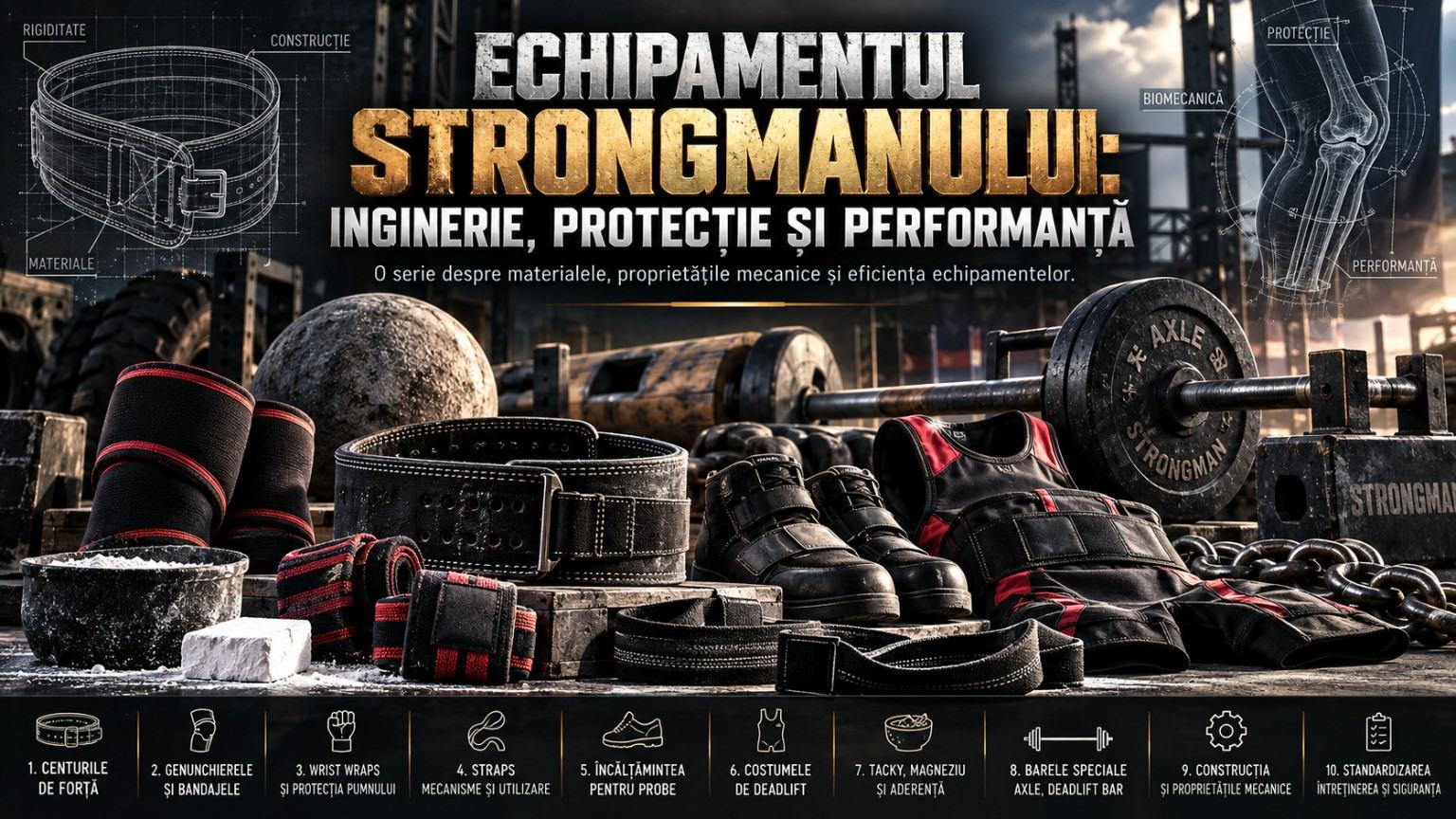
A strongman event may be decided by a few millimetres of rubber. One athlete prepares a heavy Deadlift, another accelerates under a Yoke weighing several hundred kilograms, while a third tries to move a truck using a pulling harness. In all three situations, the force produced by the body reaches the ground through one apparently modest interface: the shoe sole. Yet the demands are very different. A static lift may reward a firm, low-compression and repeatable platform; loaded carrying requires walking and control of oscillations; vehicle pulling depends heavily on traction against the specific competition surface. Recommending one shoe merely because it is marketed for strength ignores the physics of the task.
This is Episode Five of STRONGMAN EQUIPMENT: ENGINEERING, PROTECTION AND PERFORMANCE. Following belts, knee sleeves, wrist wraps and lifting straps, the analysis descends to ground contact. We will examine foot anatomy, force transfer, friction coefficients, sole stiffness and compression, heel height versus heel-to-toe drop, flat and elevated constructions, weightlifting shoes, minimalist models and traction-oriented footwear. We will then address Squat, Deadlift, Log, Axle, Giant Dumbbell, Farmer's, Yoke, Truck Pull, Sled, Tire Flip and Loading Medley. Every recommendation must reflect the actual event and the quality of available evidence, not a brand preference.
Controlled squat research compares weightlifting shoes with running shoes and barefoot conditions. Legg and colleagues [1] observed changes in trunk position and lower-limb angles, while Southwell and colleagues [2] described redistribution of selected joint moments. Neither result establishes that an elevated heel automatically prevents injuries or adds the same amount to every athlete's maximum. Deadlift comparisons of shod and barefoot conditions [3, 4] indicate that shoe geometry can alter work and bar displacement without establishing universal performance superiority. For dynamic events, strongman research provides useful descriptions of step characteristics [5, 6], but direct comparisons of shoe designs are scarce.
A fundamental distinction is that traction, stability and comfort are not interchangeable. A highly adhesive outsole may transfer horizontal forces effectively but sit on a soft, deformable midsole. A rigid shoe may suit squatting and obstruct locomotion. A thin sole can reduce the elevation from which the athlete pulls a bar but may be unsuitable on gravel or uneven terrain. We must separate measurable footwear properties from how the body moves and from actual event scores. That separation governs the article.
1. The Foot: A Living Base for Strength
The foot is not a rigid block bolted to the shin. It contains many bones, joints and ligaments, with longitudinal and transverse arches participating in load distribution. At ground contact, tissues deform, intrinsic and extrinsic muscles contribute to control, and ankle position guides the segment above. Forces do not pass through one fixed point but through regions of contact that shift over time. During a heavy squat, loading is relatively quasi-static. During Farmer's Walk, every step involves changing support, absorption and propulsion.
A ‘stable foot’ does not mean every joint should be immobile. During walking, the foot adapts to the ground, transfers bodyweight and contributes to propulsion. Squatting places greater emphasis on repeatable contact and useful distribution of pressure. Footwear influences freedom of deformation and sensory information received by the nervous system. Yet neither rigid nor minimalist footwear determines technique by itself. Control emerges through interaction among the athlete, load, movement and surface.
Foot dimensions and toe shape matter more than many ‘best shoe’ discussions acknowledge. A narrow toe box can compress toes and constrain their positioning; an excessively roomy shoe may allow unwanted sliding inside it. During heavily loaded carrying, that internal movement can be distracting even if the outsole grips perfectly. Conversely, a fit that causes numbness is not evidence of greater safety. Fit must be checked with the socks and movements of training, not only while standing still in a shop.
2. Ground Reaction Force: No Contact, No Propulsion
Newton's third law supplies the starting point: when an athlete pushes the ground, the ground exerts a reaction force. It has vertical and horizontal components, and footwear mediates their transfer. Deadlifting depends centrally on supporting body and external load vertically. Truck Pull and Sled Push make available horizontal force an obvious constraint. Yoke combines substantial vertical loading with impulses for acceleration and braking. Suitable footwear responds to the type of demand, not merely to the weight listed for an event.
A teaching model for limiting friction is F_t ≤ μN, where F_t is available tangential force before slipping, N is normal reaction and μ the effective friction coefficient. Under model assumptions, greater normal loading may permit greater horizontal force. Real rubber-to-ground contact is more complex: material is viscoelastic, surfaces may be wet and texture and sliding speed affect response. A coefficient measured on dry metal should not be assumed to apply to wet asphalt, rubber track or a dusty platform.
Consider an explicitly hypothetical example. If normal reaction is 1,500 N and effective friction coefficient is 0.60, the simplified limiting tangential force is about 900 N. If surface conditions become slippery and μ falls to 0.35, the idealised limit becomes 525 N. These numbers are not measurements of commercial shoes or a real Truck Pull. They explain why traction can change acceleration potential without altered muscular strength. In practice, step geometry, dynamics and load distribution complicate the picture.
3. A Sole Is Not One Material: Layered Construction
An athletic shoe may include an outsole, supporting or cushioning midsole, insole and an upper fixing the foot in place. Each performs a different role. The outsole influences ground contact and abrasion resistance. The midsole governs part of the deformation, while the upper constrains movement of the foot inside the shoe. A product with very grippy rubber can still have a compressible midsole. A weightlifting shoe may combine a rigid platform with an elevated heel. Calling a shoe simply ‘soft’ or ‘hard’ hides these distinctions.
Stiffness must be defined by loading mode. A material may resist vertical compression yet flex easily at the forefoot. Another may have a longitudinally stiff plate while remaining vulnerable to lateral twisting. Under very high loads, responses can be nonlinear, dependent on loading rate and material temperature. Bending a shoe by hand does not completely describe behaviour under a 300 kg Deadlift or 400 kg Yoke. It is an informal observation, not a biomechanical specification.
The upper deserves equal attention. Loose laces or straps allow the foot to move inside the shoe even when the outsole has not slipped on the floor. During Truck Pull, repeated horizontal pushes can drive the foot forward inside the shoe and cause rubbing, blisters or discomfort. During maximal Squat, heel lift inside the shoe alters the feeling of support. Complete stability therefore involves shoe-to-ground friction, foot-to-insole friction and upper retention.
4. Heel Rise Is Not the Same as Overall Shoe Thickness
Much footwear confusion starts by mixing two measurements: overall sole height above the ground and the heel-to-toe height difference, often called drop. A shoe can have a thick sole but almost zero drop when forefoot and heel are elevated similarly. Another may have a thinner overall sole yet a heel substantially higher than the forefoot. During Squat, this slope may influence ankle and knee positioning. During Deadlift, overall elevation can change the distance between the athlete and the bar. Mixing these quantities creates contradictory explanations.
A simple triangle helps illustrate the geometry. If the heel support is 20 mm higher than the forefoot over an approximate horizontal distance of 180 mm, the slope angle is arctan(20/180), roughly 6.3 degrees. This is a teaching calculation, not a measurement of actual ankle angle or a universal shoe specification. Foot shape, sole compression and load distribution all alter effective posture. Nevertheless, it explains how a few millimetres can matter during movements requiring substantial joint range.
An elevated heel can facilitate some deep squatting positions, but outcomes depend on ankle mobility, segment proportions and technique. An athlete with long femurs and limited dorsiflexion might find the geometry more accommodating. Another may prefer flatter ground contact for balance or specificity. No scientifically established drop is optimal for every strongman. A higher heel should also not become an excuse to ignore painful movement or limitations that require assessment.
5. Sole Compression: Deformation Changes More Than Height
When a 140 kg athlete lifts a heavy implement, forces passing through footwear can substantially exceed static bodyweight depending on the movement. A highly compressible midsole may temporarily alter foot elevation and orientation. Deformation is not necessarily uniform because pressure differs between heel, forefoot and edges. Highly cushioned running shoes can feel comfortable during walking yet less predictable under very heavy lifting. The claim must remain bounded: without measuring the specific shoe and movement, we cannot quantify an exact loss of force or stability.
Materials engineering describes a compressive layer through its relationship between applied force and deformation. Greater deformation at the same force generally indicates lower effective stiffness under the measured conditions. But soles are three-dimensional structures, sometimes combining cellular foams with stiff inserts, and their response may be nonlinear. A product can feel firm during slow loading yet behave differently during rapid impact. Temperature and wear also affect some materials. Pressing a thumb into the sole does not calculate its performance under a heavy Deadlift.
The practical question is whether footwear provides a repeatable base for the intended exercise. If a foot visibly rocks or the heel feels as though it sinks under controlled loading, testing a firmer midsole may be reasonable. During walking and carries, some ability to adapt can be useful. Maximum stiffness is not the universal objective: over a long Farmer's course, surface interaction and comfort may matter more than eliminating every millimetre of material movement. Good footwear is adequately stable for its task, not simply the hardest object to bend.
6. Traction: Rubber, Texture and Surface Work Together
An adhesive outsole cannot be characterised seriously by the phrase ‘super grip’ alone. Effective friction depends on rubber compound, hardness, tread geometry, contamination, temperature and ground texture. A sole that performs extremely well on a dry platform may behave differently on wet running track. Small studs might grip a textured surface but become uncomfortable or illegal on delicate flooring. A smooth outsole can work well on selected clean surfaces yet poorly on others. Traction is a relationship requiring context.
Applied ergonomics research underlines this interaction. A study predicting available friction [9] investigated many shoe designs marketed as slip resistant and considered outsole hardness, geometry and flooring type. The results were obtained under defined laboratory contamination, not during strongman Truck Pull. The transferable methodological lesson is that traction should be measured for a shoe–surface combination, not attributed absolutely to a product. A statistical percentage of modelled friction variation cannot be converted into the same percentage sporting advantage.
ISO 13287:2019 [8] describes a procedure for evaluating slip resistance of personal protective footwear. It is not a certification of strongman performance and has limits of applicability for certain specialised studded footwear. Nevertheless, it illustrates how slip resistance can be tested under stated conditions. When a manufacturer offers test results, surface, contaminant, method and conditions should be disclosed. A number without those details does not tell us what an athlete will experience while pulling a truck.
7. Stability Does Not Mean the Centre of Pressure Must Never Move
Biomechanical studies frequently use the centre of pressure, or COP. It represents the resultant location of normal forces distributed over the support area in a measurement model. During Squat, COP may shift between foot regions without the movement being automatically defective. During walking, such movement is normal and necessary. A promise that a shoe completely ‘fixes the pressure centre’ is therefore not necessarily a desirable biomechanical goal. The key question is how much movement is compatible with controlled execution.
A sole can influence sensory feedback, while upper retention changes perceived control. Stability should nevertheless be described through several characteristics: body sway, implement control, balance recovery and movement consistency. A shoe may reduce the sense of internal foot movement without changing bar path meaningfully. Another may feel more comfortable without producing a measurable time difference. There is no contradiction because experience and performance are different levels of observation.
A common mistake is to call every soft shoe unstable and every rigid shoe stable. Stability is task dependent. Minimal vertical deformation can support reproducible Squat setup. During Truck Pull, a very hard outsole that poorly conforms to the surface may slip. Yoke adds rapid steps and lateral demands. No single material property wins all of these events.
8. Why Weightlifting Shoes Alter Squat Technique
Legg and colleagues [1] compared dedicated weightlifting shoes with ordinary athletic shoes in 32 participants, examining loaded and unloaded Squat. They used three-dimensional motion capture and force measurement. Weightlifting shoes were associated with changes in ankle and knee position, including greater knee flexion and a more upright trunk in some conditions. Experience influenced how participants exploited these differences. Such findings help explain preferences for elevated heels, but do not establish a universal 1RM increase.
A more upright torso may suit certain high-bar or front-squat techniques. However, it must not automatically be equated with reduced spinal injury risk. Internal loading depends on external moments, muscle forces, anatomy and execution. If an athlete also changes stance width, bar position and depth, the final difference cannot be attributed only to shoes. The study supports a mechanical hypothesis, while practical assessment still requires comparable lifting conditions.
For strongman, Squat research matters in training even when competitions feature different implements. Weightlifting shoes may help an athlete repeat a selected position during squat volume work. But performing Yoke or Truck Pull the following day does not mean those shoes remain optimal for locomotion. A product may suit a fundamental strength exercise without being the best choice for all events. That is the basis of rational equipment planning.
9. Southwell and the Redistribution of Joint Moments
Southwell and colleagues [2] examined 24 experienced lifters squatting at approximately 80% of 1RM under barefoot, running-shoe and weightlifting-shoe conditions. They measured three-dimensional movement and net joint moments through the lower limbs and trunk. Selected knee and hip extension moments and rotational components differed according to footwear. The result cannot be reduced to ‘weightlifting shoes are better’. Changing footwear redistributes some mechanical demands and may alter the relative stimulus experienced by different muscle groups under the protocol.
Joint moment is a mechanical variable linked to force and lever arm, not a direct clinical injury score. Greater net knee moment does not mean inevitable knee damage; a smaller hip moment does not prove universal spinal protection. Tissue adaptation depends on dose, time and athlete characteristics. Acute angle and moment measurements should not be repackaged as proof of long-term prevention.
For coaching, footwear becomes one variable for tailoring an exercise alongside depth, bar position and stance. Effects are not identical across athletes, and selection should match mobility and purpose. A shoe facilitating one athlete's front squat might be less preferred in low-bar squatting. Furthermore, data from 24 people do not automatically describe strongman speciality events with different ranges and judging standards.
10. When Squat Studies Do Not Fully Agree
Sinclair and colleagues [7] examined three-dimensional movement and muscle activation during Squat in fourteen trained men under several footwear conditions. Selected differences emerged in depth, joint angles and rectus femoris activity, while athlete preferences did not match every biomechanical measure in a simple way. Some preferred barefoot lifting without that preference constituting proof of a universal mechanical advantage. This matters because coaches sometimes treat an athlete's preference as though it were a direct measurement of joint loading. Sensation may guide a decision, but it does not replace mechanics.
Whitting and colleagues [11] examined nine men squatting at 50%, 70% and 90% of 1RM while comparing weightlifting and conventional athletic shoes. Testing multiple intensities matters because a technique change in an easy set may not be identical during a near-maximal repetition. The small sample still limits broad generalisation, and motion or force-platform data cannot automatically describe long-term clinical outcomes. Experiments can differ because participants, shoes, technique and intensity differ without either study necessarily being wrong.
The practical interpretation is that footwear may adjust Squat mechanics under certain circumstances, but responses depend on the individual and protocol. Selecting one publication to argue that weightlifting shoes are compulsory or useless would be unjustified. The literature collectively supports certain positional and loading changes rather than one universal ideal design. This matters in strongman, where Squat may be only one training method for far more varied competition events.
11. Deadlift: Why Lifting Distance Enters the Equation
During conventional Deadlift, the athlete moves the bar from an initial position to a final lockout. Shoes can change the geometry of that starting position. A thick sole raises the foot relative to the ground while the bar and plates remain at their usual level. Consequently, bar travel may differ even under the same lockout standard. A simple external work model is W = m × g × h, so changes in vertical displacement alter work for the same mass. The body is not an ideal pulley, however, and muscles and joints may respond differently to altered posture.
If a 250 kg bar were lifted 10 mm farther, the idealised additional work on the external load would be 250 × 9.81 × 0.01, or about 24.5 J. This is a hypothetical mechanical example, not an observed performance gain or prediction of 1RM. Real footwear can also change knee, hip and trunk positioning. One centimetre of geometry cannot be converted directly into a fixed number of extra kilograms. The calculation nevertheless explains why many powerlifters prefer thin soles for Deadlift.
Overall elevation and heel-to-toe drop must remain distinct. A raised-heel weightlifting shoe may alter the start position through both height and slope. A flat minimalist shoe provides another setup. Which is preferable depends on proportions and pulling style. During Sumo, foot angle and resistance to lateral slip become especially important. A thin outsole that slips on the platform may negate the practical value of its geometric advantage. A sensible decision considers all variables.
12. The 2021 Conventional and Sumo Deadlift Study
A 2021 experiment published in Sports [3] studied thirty participants performing conventional and Sumo Deadlift under barefoot and shod conditions. Researchers first established maximums and later compared repetitions at approximately 70% of 1RM. The standardised shoes were running shoes, not specialised weightlifting or strongman models. That distinction matters: the experiment compares specified conditions rather than every category of footwear. Outcomes included vertical ground reaction force, mechanical work, vertical bar displacement, peak velocity and lifting duration.
The shod condition produced greater bar displacement, external mechanical work and lift time than barefoot lifting. However, there was no statistically significant barefoot advantage in peak vertical ground reaction force or peak bar velocity. Thus, changes in geometry did not establish an obvious universal performance gain from removing shoes under the tested conditions. This is precisely the kind of finding that challenges the easy claim that a thinner sole always produces more kilograms.
Transferring the results to strongman requires attention to population and event. Thirty people performing submaximal Deadlift do not automatically represent 140–180 kg competitors pulling highly flexible bars or car deadlift apparatus. The study also does not demonstrate that athletes should compete barefoot. Rules and ground hazards may require shoes. The more defensible conclusion is that footwear can add height and external work, while actual performance advantages need separate evaluation under the intended conditions.
13. Hammer and the Shod-versus-Barefoot Question
Hammer and colleagues [4] examined ten men during conventional Deadlift under shod and barefoot conditions at 60% and 80% of 1RM. They evaluated peak vertical force, rate of force development, time to peak force, centre-of-pressure excursion and peak barbell power. The study addresses the popular assumption that a shoe necessarily creates a major mechanical obstacle in every Deadlift. Its small sample and experimental conditions nevertheless limit conclusions about maximal competition records and specialised strongman footwear.
Results must be read in relation to their actual variables rather than reduced to a verdict that barefoot lifting is universally superior or inferior. A trial at 80% does not directly measure competition maximum, and differences among commercial shoe designs may matter more than the binary classification ‘shod’ versus ‘barefoot’. Participants may also have more experience with one condition than the other. Familiarisation and testing environment affect response. A laboratory average is a starting point for decision-making, not a prescription for every athlete.
Across Deadlift studies, precision is essential. If interested in travel distance, examine shoe geometry. If interested in bar speed, use matched loads and consistent measurement. If interested in traction, the platform becomes part of the system. If interested in safety, acute force outcomes are not enough to estimate injury incidence. Suitable footwear may be the design allowing reproducible, legal execution rather than merely the smallest sole thickness.
14. Minimalist, Barefoot and Socks: Three Different Conditions
Online discussions often treat ‘barefoot’, ‘minimalist’ and ‘in socks’ as synonyms. They are not. Barefoot means skin contacts the ground; minimalist shoes add a thin outsole and an upper; socks create a different frictional interface. A sock slipping on a platform is mechanically different from a thin rubber outsole. Bare skin can also contact rough surfaces and contaminants. Hygiene and event rules differ across gyms and competitions.
A minimalist shoe may reduce elevation and provide a more direct perception of ground contact for some athletes. But the label ‘minimalist’ does not guarantee a high friction coefficient or suitable construction for heavy loading. If the sole deforms laterally or the upper fails to retain the foot, stability may suffer. Conversely, a thin well-fitted sole can serve controlled Deadlift effectively. Evaluation should use the actual platform and progress through submaximal practice.
In competition, rules regarding shoes, socks, sole thickness or prohibited designs must be observed where applicable. Powerlifting rules should not be assumed to apply to every strongman organiser. Outdoor events on gravel, uneven ground or surfaces containing sharp debris add reasons to protect the foot mechanically. There is no intrinsic sporting virtue in lifting barefoot when the environment is unsuitable or the competition does not permit it.
15. Yoke Walk: A Different Task From Squatting With the Same Mass
Yoke Walk may involve enormous loads, but it is not a repeated squat with the bar on the athlete's back. The lifter picks up a frame and travels through a succession of unilateral ground contacts while controlling a potentially oscillating implement. Footwear must support vertical loading and allow short, quick steps and lateral corrections. A weightlifting shoe with a very rigid elevated heel may feel excellent while standing still but influence how the foot rolls during walking. A more flexible shoe may facilitate movement yet feel less supportive at pickup. No simple equation automatically decides between them.
Hindle and colleagues [5] examined nineteen strongman athletes performing 20-metre Yoke Walk trials at approximately 85% of their previously determined maximum for that distance. They described stride length, frequency, stance duration and hip and knee movement. As velocity increased across the course, stride length and rate tended to increase while ground contact duration fell. These are directly relevant observations about Yoke biomechanics, but the study did not systematically compare weightlifting shoes with minimalist or running footwear. Stride measurements cannot become a verdict on a particular model.
Selecting shoes for Yoke requires observing pickup and walking together. A thicker sole may slightly alter effective pickup geometry if frame height is not readjusted. A very soft shoe might create an undesirable sensation of sway under load, but it must be established whether the problem is footwear, technique or loading. An extremely rigid model might make forefoot roll less natural. Useful comparison involves matched submaximal courses on the same surface and with the same Yoke height, without assigning every difference automatically to the shoes.
16. Yoke Pickup: Vertical Deformation and Initial Acceleration
The first seconds of a Yoke event differ from later steady movement. The athlete sets up, braces, lifts the frame from its supports and begins accelerating. At this moment, the outsole and midsole experience vertical and lateral demands, while pressure distribution changes quickly. If the foot slips inside the shoe or the heel visibly moves, perceived control may decline. A change in sensation does not directly demonstrate increased internal knee or spinal forces, which would require further instrumentation and modelling.
A low-deformation sole may provide predictable pickup contact, but locomotion immediately follows. A shoe that excessively limits forefoot flexion or accommodation may lead to awkward steps or unnecessary foot lift. That does not mean every weightlifting shoe has this effect, because forefoot flexibility and geometry vary across products. Coaches should watch whether the first steps begin smoothly, whether the athlete maintains balance and whether the course time is affected by unwanted adjustments.
In a hypothetical comparison, both shoes produce the same pickup time but one repeatedly allows lateral sliding after ten metres. If observed across several courses and not explained by surface or fastening, the design may be poorly suited to the event. Maximal trials are unnecessary to identify this incompatibility; moderate loads may suffice. Declaring a shoe superior solely from pickup would overlook the portion of the course that determines the final result. Yoke is a whole event.
17. Farmer's Walk: The Sole Participates in Every Step
Farmer's Walk involves lateral loads and a gait different from ordinary walking. The athlete lifts two implements and travels quickly while controlling handle oscillation and maintaining ground contact. Poor footwear may affect stride comfort, stability around turns and acceleration. A thick cushioned midsole may allow perceived movement; an extremely rigid shoe may resist normal foot roll. Neither mechanism is established as a universal outcome for an entire category of shoes, but both are testable hypotheses.
Hindle and colleagues' systematic review [6] associated better Farmer's Walk performance with stride characteristics such as length, rhythm and reduced contact time. It did not show that changing shoes causes those differences. This distinction is methodologically essential: faster athletes may have better technique, strength, experience and conditioning, rather than superior soles. Footwear may be one contributor without deserving credit for the entire performance.
Practical comparison can time matched submaximal courses using the same implements and surface. Record pickup time, segment speed, drops and stability around turns. A shoe improving turns may be preferable even if initial pickup feels less firm. If differences are only hundredths of a second under manual timing, statistical superiority should not be declared. Gear should be chosen for repeatable and meaningful advantages, not the apparent precision of a stopwatch display.
18. Truck Pull: Footwear as the Traction Interface
Truck Pull is an event where traction may become an obvious limiting factor. The athlete applies force through a harness and legs to overcome resistance preventing vehicle motion. Actual resistance depends on vehicle mass, tyres, surface, gradient, additional mechanisms and event procedure. Required pulling force cannot be calculated exactly from the truck's advertised tonnage alone. Regardless of the resistance mechanism, horizontal force must reach the ground without outsole slipping. A firm shoe with poor traction on the specific asphalt may become unsuitable.
Normal ground reaction depends on body posture and load distribution. Lean angle and harness direction affect this distribution, while steps must coordinate with system tension. The effective friction coefficient in F_t ≤ μN may limit available horizontal force but does not predict performance by itself. Technique, stride length and harness management matter. Recommending the softest or hardest rubber without knowing its behaviour on the actual ground would be unjustified.
Preparation may include controlled trials on asphalt, running track or other available surfaces without pretending one perfectly reproduces another. A sole can grip dry concrete and slip on painted ground; such findings are local and should be documented. Restrictions on studs, spikes or specialised soles must also be checked. Organisers may prohibit certain designs to preserve the surface or competitive fairness. Footwear that would grip best in theory may be illegal in the event. Legality is a functional constraint.
19. Moving the Truck: Initial Breakaway Versus Continued Velocity
The first moments of a Truck Pull need not be mechanically identical to continued movement. Resistance may change after the vehicle begins rolling, and athletes often alter posture and stride rhythm once motion is established. A sole that transfers strong horizontal force at very low speed may help the start but must remain functional as stepping accelerates. A high-traction construction that restricts movement could introduce a compromise. There are insufficient data to prescribe one shoe that optimises both phases under every surface and vehicle configuration.
The strongman review [6] emphasises spatial and temporal characteristics of heavy pulling, including stride behaviour and contact time. But vehicle-pull biomechanics is less developed than research on conventional strength exercises. Findings from heavy sled pulling may transfer conceptually without establishing equivalence to a truck moving on asphalt. Harness characteristics and vehicle resistance can change technique. Footwear choices require attention to the actual event rather than automatic transfer from running or sprinting studies.
A useful log can separate breakaway time, section times and observations about slipping. If traction fails immediately, outsole and surface may matter. If rhythm declines after ten metres without slipping, conditioning, technique or altered resistance may be more important. These are hypotheses rather than diagnoses. Side video and close observation of foot contact can reveal obvious problems without directly measuring the friction coefficient. Interpretations must remain proportionate to the data.
20. Sled Push and Sled Pull: Different Demands on the Same Shoes
Sled Push emphasises horizontal force through the feet while the athlete leans forward; harness-based Sled Pull imposes a different load path. Footwear influences traction in both, but demands differ. During pushing, arm position and pressure against the implement alter trunk mechanics. During pulling, harness or rope changes force direction. The sole does not independently determine sled speed. Load, sled-ground friction and technique interact.
The interface between the sled and ground can dominate resistance. Two sleds with equal mass can feel entirely different when one slides on running track and the other on rough asphalt. Coaches comparing shoes must keep this factor as constant as practical, or elapsed times cannot isolate footwear. Temperature and moisture can change resistance too. A faster trial on a dry day does not prove that shoes used then are better than those used in rain.
Transition performance matters in medleys. Sled may be followed by Sandbag Loading or a carry, leaving no time for shoe changes. Aggressive tread might provide superb pushing traction yet feel awkward on a smooth platform during the next segment. Rational selection considers total event time and control, not only grip during one step. A carefully chosen compromise may outperform extreme optimisation of a single phase.
21. Tire Flip: Foot Demands Change Across the Lift
Tire Flip usually begins from a relatively low posture, then requires the athlete to modify contact rapidly as the tyre rotates. The task is neither purely vertical nor purely horizontal; force direction and posture change across phases. The outsole must permit force transmission without slipping as well as quick foot repositioning. A rigid shoe may feel supportive initially yet awkward during transition. A highly flexible shoe may permit movement while providing inadequate protection on rough ground. The final criterion is control of the entire flip.
The systematic review [6] identified phase-duration differences between higher- and lower-performing athletes in Tire Flip. It did not show that one shoe category causes those differences. Nevertheless, dividing the event into phases helps coaches identify limits. Slipping during the first push may involve outsole and ground. Delay while repositioning the hands after the tyre rises may reflect technique more than footwear. Not every lost second should be diagnosed as a shoe problem.
Outdoor tyres may be dirty, and ground surfaces may contain dust and pebbles. Tread can accumulate debris that changes grip during the event. Adequately protective and well-fitted footwear may be more practical than exceptionally thin shoes chosen only by Deadlift logic. No evidence establishes that one commercial category prevents Tire Flip injuries. Recommendations should focus on ground compatibility, technique and actual conditions.
22. Log Clean & Press: Footwear Participates in Clean and Drive
Log Clean & Press is a compound movement, so footwear must be evaluated across its phases. The athlete lifts the cylinder, brings it to the torso and uses lower-limb and arm extension to drive the implement overhead. In push press, ground contact transmits impulse from the legs through the trunk and arms into the Log. A rigid platform may provide predictable support during dip and drive, while heel elevation may influence knee position. Those possible effects belong within the athlete's actual technique and do not automatically guarantee a higher maximum.
The clean may require rapid foot adjustments and accommodation of the cylinder near the body. A shoe with a rigid heel and relatively inflexible forefoot may make some transitions uncomfortable for certain athletes. Others may appreciate exactly that firmness. Direct controlled research comparing weightlifting shoes, flat models and traction-oriented footwear during strongman Log Clean & Press is insufficient. Recommendations should therefore be labelled as plausible mechanical applications requiring individual testing, not presented as established experimental outcomes.
For Log for Reps, duration and repeatability become important. A shoe may suit one heavy single and grow uncomfortable through repeated dips, drives and repositioning. Athletes should test clean and pressing rhythm together. Selecting weightlifting footwear for firmness during drive requires confirming that it also permits the dynamic portion of the event. A Squat record does not prove superiority of the same shoes during Log.
23. Axle Press and Giant Dumbbell: Balance Over a Small Base
Axle Press can involve a thick bar and continental clean, while Giant Dumbbell demands unilateral control. In both, foot positioning influences how the body supports an unusually shaped load. Axle may require a different setup from conventional Olympic-bar pressing. Unilateral Dumbbell creates asymmetrical demands on trunk and lower limbs. Footwear should permit balance corrections without slipping, but cannot replace muscular coordination. High-traction rubber does not compensate for poor overhead lockout caused by ineffective implement positioning.
For a maximal Dumbbell attempt, athletes may prefer a firm base and secure lateral fit that prevents internal foot movement. If the event involves arm changes or rapid stance adjustments, footwear must also allow those transitions. High frontal-plane stiffness may feel supportive while restricting some movement. Without direct tests, it is unwarranted to claim that one stiffness level reduces shoulder load or improves overhead stability by a fixed percentage.
A training log can record footwear, stance width, foot angle and ability to reproduce setup. Video can reveal large foot movements, but cannot directly measure sole pressure distribution without instruments. Useful comparisons hold implement and load constant during submaximal practice. Shoes may contribute to repeatability, while success remains an outcome of the entire movement technique.
24. Atlas Stones and Loading Medley: Foot Geometry Around Bulky Implements
Atlas Stones usually begin from flexed hips and knees with the arms wrapping around a bulky object. The athlete brings the stone into the lap, stabilises it and loads it onto a platform. The centre of mass of the body–implement system shifts during transition, and sole pressure can migrate between foot regions. A reasonably firm shoe may provide predictable contact while still allowing dynamic positioning. Direct research is insufficient to establish that weightlifting shoes outperform flat models for every Atlas athlete.
During Sandbag Loading and Keg Carry, bulky objects press against thighs and torso, and athletes may need to move without constantly watching the ground. An outsole gripping the platform can reduce some slipping events but cannot guarantee control of an awkward load. A medley may involve short runs, turns and ramps. Shoes effective during a stationary pickup can become uncomfortable while running. Selection should therefore consider the complete course.
Tacky used for stones can contaminate uppers and laces when athletes touch footwear with coated hands. Certain cleaning substances may harm synthetic materials or shoe adhesives. Strong solvents should not be used without checking manufacturer compatibility. The floor can also accumulate sticky residue and change its friction properties. Event organisation and surface cleaning are separate components of safety; footwear is no substitute for them.
25. Competition Surfaces: Track, Asphalt, Concrete, Wood and Platforms
In strength sport, the surface is sometimes treated as background even though it directly affects foot mechanics. Yoke on track differs from Yoke on asphalt, while Deadlift on wood differs from heavy pulls on thick rubber or concrete. Surfaces may be elastic, rough, painted, wet or dusty. Their properties can vary with temperature and contamination. A shoe cannot have one absolute traction value predicting every event. Shoe-to-ground interaction matters more than generic reputation.
Professional organisers should ideally communicate surface details and whether studded shoes are allowed. Travelling athletes may find that favourite gym footwear behaves differently on the actual course. A brief walk and change-of-direction familiarisation, when permitted, may reveal useful information before heavy loading. Testing traction through maximal Yoke acceleration on unknown ground is not prudent. Familiarity should begin conservatively.
Surface conditions can change during competition. Moisture, rain, chalk, spills and tacky residue all alter contact. A shoe that did not slip during warm-up may respond differently later. Athlete and organiser have separate responsibilities: the athlete checks fit and technique, while the organiser maintains appropriate course conditions and clear rules. Traction belongs to an evolving system rather than a fixed label on the outsole.
26. Weather, Moisture and Temperature: Materials Change Their Behaviour
Outdoor competitions expose rubber and ground surfaces to variable temperatures and moisture. A compound behaving one way in warmth may become stiffer in cold conditions. Water can form a layer between sole and ground, and tread affects how that layer is displaced. This does not mean deeper tread always grips wet asphalt better. Behaviour depends on compound, geometry and loading. Without controlled comparisons, such relationships should be described as mechanical possibilities rather than guaranteed advantages.
In rain, the whole event environment becomes relevant. A Truck Pull course may include painted road markings, sand and puddles, each with different effective traction. If organisers clean or alter the course, performance can change without footwear changes. Athletes should obtain updated surface information when possible. Continuing with yesterday's strategy solely because the shoes performed well then may be inadequate after the environment changes.
Thermal comfort matters too. A highly water-resistant upper may retain internal moisture through a long day, while extremely ventilated shoes may feel unpleasant in cold weather. Thermal comfort is not a direct measure of mechanical efficiency. The useful criterion is a combination of traction security, function and tolerance over the event. Choosing solely by cushioning or waterproofing may miss the primary requirement.
27. Foot Protection and the Limits of Injury-Prevention Promises
Shoes can form a barrier against abrasion, small objects and some unexpected contacts, but this does not make ordinary sports footwear certified protective equipment. A thin minimalist outsole may permit close ground feedback and reduced Deadlift elevation yet offer less protection against certain irregularities than a robust model. Where discs or implements might move accidentally, an ordinary shoe should not be treated as crush-resistant protection. Specialist safety requirements must be handled separately from sporting preference.
Joint-angle changes do not automatically establish lower injury incidence. A more upright Squat or shorter Deadlift bar path may have practical advantages, but long-term health depends on many variables: progression, exposure, history, recovery and load management. Promises that a specific model prevents tendon rupture or eliminates lumbar injury risk lack appropriate evidence. Those claims would require adequately controlled clinical research over relevant periods. Selection should acknowledge that limitation.
If persistent foot, ankle or knee pain appears after switching shoes, the athlete can record timing and provoking movements. Temporal association alone does not establish medical cause. Swelling, inability to bear weight, numbness or substantial pain require appropriate assessment rather than repeated heavy attempts to test a shoe. Equipment may be modified and training adapted, but footwear is not universal treatment for structural symptoms.
28. Fit: Width, Volume and Retention May Matter More Than Branding
A shoe can possess excellent outsole material and still fit a particular foot poorly. Forefoot width, instep volume, heel shape and toe length affect fit. Athletes with wide feet may find narrow constructions uncomfortable, particularly under load when tissue spreads laterally. Excessively tight models can produce pressure and numbness, while overly roomy designs allow internal sliding. Neither issue is fixed by choosing grippier rubber.
Laces, straps and other retention systems keep the foot positioned relative to the sole. During Squat, heel movement inside the shoe changes the setup. During Yoke, lateral play can affect turns. During Truck Pull, toes may slide forward if the upper does not retain the foot. Shoes should be tested in movements resembling the event because stationary fitting misses dynamic deformation. Tightening until painful is not a valid measure of stability.
Socks are another component of the system. Thickness and texture affect internal space, foot-to-insole friction and thermal comfort. Wearing thicker competition socks than during training can change fit. Controlled comparisons keep this variable consistent. Athletes do not necessarily need the most expensive pair for every event. They need shoes that fit, comply with rules and perform the intended task on the real surface.
29. A Comparison Protocol That Does Not Confuse Shoes With a Good Day
When an athlete compares two pairs, sleep, fatigue, temperature, warm-up and familiarity can influence outcomes. ‘Yesterday I lifted more in A than today in B’ is inadequate to assign causation to footwear. A better approach begins with a measurable goal: squat depth and comfort, technically controlled Deadlift repetitions, time over 20 metres of Yoke or observed slipping during a sled pull. Select a small number of relevant outcomes and keep conditions as comparable as possible. One structured experiment can be more useful than ten unrelated impressions.
In a submaximal Squat session, the athlete can use A after a standard warm-up, then B at the same load with sufficient rest. In a later comparable session, reverse the order. New shoes need familiarisation before comparison, because unfamiliar movement may create an artificial disadvantage unrelated to materials. The procedure cannot remove every fatigue or learning effect, but reduces obvious confounding. Repeated maximal attempts simply to choose shoes are unnecessary; comfort and compatibility differences often emerge under moderate loading.
For Yoke or Farmer's, use matched distance, handles, pickup height and surface. Time the efforts consistently while also recording stops, slips, stride behaviour and perceived control. If one pair is 0.1 seconds faster over 20 metres, the difference may be smaller than manual timing error or normal variation. Every tenth of a second need not generate a product ranking. What matters is whether an advantage recurs and is practically meaningful.
30. Observation, Subjective Report and Interpretation: Three Different Columns
An equipment log becomes more useful when observed facts, athlete experience and explanations are separated. Observation: on a wet surface, shoe A visibly slipped during the first two steps of a Sled Pull. Report: the athlete felt unable to apply full force. Interpretation: that shoe–surface combination may have insufficient traction. The interpretation is reasonable but testable under comparable conditions. It would be unjustified to declare the material universally poor when it might perform differently elsewhere.
During Squat, observation could be ‘bar path changed slightly’, self-report could be ‘I felt more upright’, and interpretation could be ‘the elevated heel altered trunk position’. The first two are records; the third requires comparative support. Scientific studies use instruments to quantify angles and moments, while ordinary gym video cannot describe every internal force. Coaches can still assess technical consistency and obvious interference without pretending they have measured intervertebral disc loading.
The distinction becomes especially important when symptoms arise. Shoes causing numbness or persistent pain should not be subjected to repeated heavy trials for statistical confirmation. Fit or loading needs reassessment, and clinical evaluation may be necessary. Safety takes precedence over completing a protocol. Applied science does not mean ignoring physical signals to accumulate data; it means decisions proportionate to information and risk.
31. One Pair for Every Event or Several Specialised Designs?
A strongman's training week can include Squat, Deadlift, Log, Farmer's, Yoke, Truck Pull and loading. Wanting one universal pair is understandable. Yet a design optimising one demand may compromise another. An elevated heel and firm platform may suit certain squats, thin soles can reduce Deadlift travel, and high surface-specific traction may dominate Truck Pull. No model guarantees superiority under all conditions. A multifunctional pair can be practical when chosen as a conscious compromise rather than assumed to be a definitive solution.
Athletes with sufficient budget and storage might organise footwear by purpose: firm raised-heel shoes for selected static exercises, flat supportive models for Deadlift and related lifting, and traction-oriented shoes for moving events. This is a possible strategy rather than a compulsory number of pairs. Athletes who frequently compete in medleys without shoe changes should practise in the compromise shoes they will actually use. A model ideal for an isolated lift may be unsuitable for a multi-event sequence.
Total cost includes familiarisation. Three pairs mean three contact sensations, fastening routines and sometimes slightly different start positions. Athletes should not switch without tracking technical effects. Consistent planned use of each model can support sport-specific adaptation. Equipment selection is therefore a programme-organisation decision as well as a purchasing choice.
32. Durability: Shoes That Survive a Platform May Wear Out on Asphalt
Shoes used frequently for Yoke, Farmer's and Truck Pull face different wear cycles from a pair reserved for Squat on a clean platform. Asphalt abrasion can remove tread, while heavy turning loads stress the upper laterally. Rubber once deeply patterned may become nearly smooth after repeated use. This does not automatically mean complete loss of grip, but it justifies rechecking performance on the relevant surface. Outsole properties do not remain perfectly constant over the product lifespan even if the shoe still looks acceptable from the side.
Seams, bonding, insoles and laces also deserve inspection. When the outsole begins separating from the midsole, behaviour may become unpredictable during acceleration. When the upper stretches and no longer retains the foot, exterior grip may remain good while internal stability declines. Continuing heavy events in visibly damaged footwear is not advisable. Replacement should follow function and integrity rather than an invented universal calendar date.
Care depends on materials. Tacky-removal solvents can damage bonding, while forced high-heat drying can affect foams or adhesives. Manufacturer cleaning guidance, ventilation and full drying before storage are preferable. An outsole containing dust or pebbles should be checked before an event on another surface. Equipment maintenance is a modest but genuine part of controlling training variables.
33. Shoe Mass: Energy Savings or Structural Trade-Off?
Lighter shoes may seem advantageous in moving events because feet accelerate repeatedly. Yet footwear mass is not the only determinant of energy use or stride speed. Geometry, location of the mass, stiffness, traction and comfort all influence movement. Higher mass can result from a more robust outsole offering durability or protection. Assigning a fixed number of seconds saved at Yoke for every 100 g removed would not be scientific without direct experiments.
In Squat or Deadlift, shoe mass is a small proportion of the total system, while comfort and support may matter more than a few grams. During long Truck Pull, repeatedly accelerating distal mass could be a factor, but strongman-specific studies are insufficient to quantify it separately. Preferring light footwear is legitimate if it retains necessary grip and fit; assuming that every gram saved produces competitive progress is not.
Practical assessment should focus on the whole course rather than the shoe's scale reading. A slightly heavier model enabling slip-free acceleration may outperform a very light shoe losing traction. When comfort and grip are similar, mass may become a secondary criterion. The objective is to optimise the athlete–shoe–surface system rather than simply minimise a number.
34. Strongwomen and Athletes With Different Foot Anatomies
Footwear studies in strength sports include varying proportions of women and men, but data remain insufficient for every strongman and strongwoman category. Legg and colleagues [1] examined different experience levels, while Southwell and colleagues [2] included women and men. Mixed participation does not mean every individual difference has been explained. Foot dimensions, limb proportions, mobility and experience can matter regardless of sporting category. These variables should not become stereotypes about who needs a particular shoe.
Athletes with broad forefeet, high insteps or individual arch characteristics may respond differently to the same construction. Commercial sizing is not identical across manufacturers, and a label marketed for one sex does not guarantee fit. Assessment should begin with actual dimensions, comfort and performance in movement. In strongman, where implements vary considerably, footwear compatibility belongs alongside the event requirements.
Rigid generalisations such as ‘women need softer soles’, ‘heavy athletes must wear boots’ or ‘stiff ankles always require the highest heel’ are unsupported by the cited literature. A standardised individual testing protocol is more useful, allowing people to assess shoes in relevant movements rather than according to simplistic marketing assumptions.
35. Three Hypothetical Cases: One Shoe Does Not Win Every Event
Case one involves an athlete using Squat as the primary lower-body strength exercise. Weightlifting shoes permit the desired depth and feel more comfortable without obvious technical problems. Minimalist shoes feel good in Deadlift, while the same Squat position requires different adjustments. Two pairs may make practical sense, without establishing universal superiority of either. These observations do not demonstrate injury prevention or an automatic strength gain; they identify task-specific compatibility.
Case two involves a 20-metre Yoke followed by Farmer's. Shoe A feels extremely firm at pickup but awkward during turns. Shoe B is more flexible and permits controlled walking while feeling slightly less supportive initially. If repeatable whole-course performance improves with B and no symptoms occur, it may be the better dynamic-event choice. A difference observed only once remains uncertain. Multiple sensible observations matter more than unnecessary maximal trials.
Case three is Truck Pull on slightly wet asphalt. The athlete arrives in favourite Squat footwear and slips at the start. Another outsole performs better on that specific ground. This does not mean the alternative is superior on every floor. If competition later moves to running track or limits studs, selection must be revisited. The scenarios are hypothetical and illustrate how context changes the criteria for success.
36. Five Myths That Oversimplify Footwear Biomechanics
The first myth says thinner soles are always best for Deadlift. Reducing elevation can shorten external travel, but research does not show that it automatically increases maximal performance [3]. Traction, foot geometry and technique remain relevant. The second myth declares weightlifting shoes mandatory for every heavy Squat. They may alter posture and joint moments, but effects depend on athlete, load and style. An elevated heel does not guarantee a personal record.
A third myth treats cushioning as synonymous with instability and therefore declares all running shoes dangerous under a bar. Compressible soles can change support sensation, but the effect depends on construction and loading. No evidence warrants claiming that every shoe in a commercial category causes injury. The fourth myth promises that outstanding traction on asphalt means the same sole will grip every other surface. Friction research [9] and test standards [8] indicate the importance of shoe–floor pairing and contamination. One laboratory result does not transfer unchanged to every competition.
The fifth myth claims heavy athletes must use high, rigid boots. Body mass and loading can influence shoe demands, but upper height alone does not define stability. Foot retention, sole geometry and task-specific ankle motion are separate variables. Excessive constraint may be uncomfortable during some movements, while other athletes may prefer a higher upper. There is no universal clinical rule converting an athlete's weight into an obligation to wear boots.
These myths often survive because a simple slogan is easier to remember than a mechanical explanation. But good coaching requires identifying what was actually measured. Did a study compare bar displacement, joint angle, traction or injury incidence? Does the population resemble strongman competitors, and do the surfaces match? A relevant laboratory observation can inform a hypothesis without proving universal suitability of a brand or design.
37. Footwear as Part of an Entire Equipment System
A strongman does not compete using shoes in isolation. Squat may involve belts and knee sleeves; Deadlift may involve suits and straps; Yoke may combine a belt and other supportive gear. Changing footwear may alter posture enough that those accessories feel different. For instance, an elevated heel can change torso orientation during Squat, affecting the athlete's experience of belt contact. If shoes, belt and bar position all change together, a performance difference cannot be assigned precisely to one component.
During moving events, sole thickness may slightly alter the effective geometry of a previously adjusted Yoke, while aggressive tread can change stride sensation on the competition floor. Harness configuration, implement mass and other variables may also change. Equipment testing should therefore reproduce the intended combination whenever practical. Shoes evaluated alone on a gym floor cannot automatically describe their interaction with all components of a medley.
A competition checklist can record shoes, belt, knee sleeves, bars, implements and surfaces for each event. A complex database is not required: a few consistent notes reduce memory errors. This can be particularly useful for athletes travelling between countries, where surfaces and event regulations vary. The objective is not to turn every session into a laboratory. It is to understand which conditions accompanied a particular result.
38. Purchasing Decisions: Five Criteria Before the Brand
Selection can begin with five criteria: primary event, surface, sole geometry, internal fit and legality. During Squat, geometric slope and firmness may take priority. During Deadlift, overall elevation and slip resistance may matter more. During Truck Pull, the outsole–ground combination may dominate. In medleys, the ability to transition between tasks can outweigh performance in one isolated phase. When a model violates competition rules, theoretical advantages do not matter for that contest.
Durability, price, thermal comfort and availability of a spare can be added, but their importance differs. A highly durable model that causes pain is not a good choice. Excellent external traction is unhelpful if a loose fit allows the foot to slide within the shoe. Price and reputation can aid discovery but do not directly measure friction coefficient or biomechanical effects. Marketing phrases such as ‘maximum stability’ and ‘explosive traction’ are not substitutes for usable specifications.
Before an expensive purchase, athletes should define what successful use would look like after a few weeks. It might mean more comfortable Squat positioning, deadlifting without interference, smoother Farmer's turns or fewer slips during sled work on a particular surface. If the improvement is repeatable and relevant, the product has practical value for that athlete. If nothing meaningful changes, the purchase may be reconsidered without concluding that the shoe is useless for everybody.
39. Laboratory Data and Remaining Strongman Knowledge Gaps
Weightlifting and Deadlift footwear studies provide useful measurements, yet the populations and movements investigated do not cover all strongman demands. Participants vary in experience and body mass, often performing submaximal lifts on controlled surfaces. Strongman includes bulky objects, rapid direction changes, vehicle pulling and highly variable apparatus geometry. A squat study at 80% of 1RM cannot determine the best footwear for Truck Pull on wet asphalt. This is a limitation of transfer, not a reason to ignore existing evidence.
Direct comparisons across footwear categories in Yoke and Farmer's would be valuable, using matched implements, surfaces and loads with participants familiar with each design. Outcomes should include whole-event performance and biomechanical behaviour: segment times, slips, stance duration, comfort and the possible costs of changing shoes. Truck Pull studies should report the ground surface, its condition, harness and method of measuring applied force. Without those details, a study may be interesting but difficult to use at another event.
Materials research could document how rubber compounds change friction with moisture and wear. Standardised tests of vertical compression, bending and torsional resistance would improve product information but should not be confused with clinical outcomes. A shoe can achieve excellent laboratory results yet fit one athlete poorly. The strongest programme combines materials engineering, human biomechanics and structured individual testing. Each level answers a different question.
40. Conclusion: Ground Contact Makes Force Possible
Footwear influences how athletes interact with the ground but does not generate muscular strength by itself. During Squat, elevated heels can change posture and joint moment distribution; during Deadlift, sole thickness may change bar travel; during Yoke, Farmer's and Truck Pull, the interface must accommodate steps, heavy loading and horizontal force. No category is universally optimal. A very rigid shoe may suit a static lift and feel awkward during locomotion. Highly adhesive rubber may excel on one ground surface and perform poorly on another.
The practical principle is to begin with the event rather than the brand. Check surface, rules, fit, useful stiffness and movement freedom. Test progressively, compare similar conditions and record outcomes without inventing percentages of performance gain or injury prevention. A shoe repeatedly causing pain, slipping or technical interference should not be retained merely because of its reputation. Equipment should serve the athlete rather than determine the athlete's priorities.
Episode Six will investigate Deadlift suits and the mechanics of assistance they may provide, maintaining the distinction among material properties, loaded performance and outcomes supported by scientific evidence.
Practical Appendix I. Inspecting Footwear Before Competition
Several days before competition, athletes can inspect each pair intended for different events. Check outsole wear, separation of layers, seams, retention systems and pebbles trapped within the tread. Shoes allowing obvious internal slippage or showing structural damage should be replaced or assessed before heavy attempts. Event rules should be checked at the same time: expected surface, permission for studs and any restrictions on particular footwear designs. Unclear conditions should be clarified with organisers before travel. A mechanically excellent shoe is useless in an event where it is prohibited.
On competition day, cautious familiarisation with the ground is valuable. Walking, changing direction and checking traction under light loading may reveal compatibility when organisers allow access. For Yoke and Farmer's, observe pickup and initial steps; for Truck Pull, look for slipping during the first controlled pushes. Maximal tests merely to discover whether new footwear works are not advisable. If the surface becomes wet or contaminated, the conditions should be reassessed and safety concerns reported. During multi-event contests, planned shoe changes should not consume unnecessary warm-up time.
A familiar spare pair can reduce logistical problems for athletes travelling frequently. There is no need to own countless designs, but footwear used on abrasive outdoor courses may deteriorate more quickly than shoes reserved for Squat. A minimum care routine includes drying, cleaning and checking outsole integrity after use. Useful footwear must remain predictable during competition. This is not a medical guarantee, but it reduces certain avoidable surprises.
Practical Appendix II. Interpreting a Two-Week Personal Comparison
Imagine an athlete comparing two shoes for Yoke. Before testing, they choose a manageable submaximal load, the same 20-metre course and one frame height. During the first week they alternate the A–B order; in the second, they reverse it while preserving comparable rest and warm-up. They record total time, pickup duration, stops, visible slips and comfort. These observations can guide a practical decision without pretending to equal a clinical trial. What matters most is whether differences recur and cannot readily be explained by fatigue.
If A wins by one tenth of a second once and other trials are similar, superiority remains unestablished. If B never slips on a particular surface while A repeatedly slips, B may be preferable for that setting. Yet the observation does not prove the outsole compound has superior friction on every floor. Gym tests are individual experiments, not universal certificates for products. Modest interpretation improves credibility rather than weakening the decision.
Symptoms should be monitored alongside performance. Mild unfamiliarity does not equal persistent pain, while loss of sensation or difficulty weight-bearing should not be ignored. When a model causes clear problems, the protocol need not continue with heavier loading. The purpose of testing is to identify a better solution, not to prove at all costs that a shoe can be made to work. Safety and basic function remain exclusion criteria.
Practical Appendix III. Three Questions That Prevent Most Selection Errors
The first question is: what kind of force reaches the ground in my event? Squat and Deadlift place emphasis on vertical loading and setup geometry. Truck Pull and Sled Push make horizontal traction more obvious. Yoke and Farmer's require repeated contact, walking and adaptation. Without identifying the task, athletes may search for a ‘perfect’ shoe according to a property irrelevant to the actual contest. Specifying force direction, surface and foot movement is the beginning of selection.
The second question is: which footwear property is supposed to help? It might be vertical stiffness, heel-to-toe slope, asphalt traction or the ability of the upper to retain the foot. Each requires a different comparison. A stiffer sole should not be assigned a greater friction coefficient without testing; an elevated heel should not be promised to prevent injury without clinical evidence. The third question is: what observable, repeatable and rule-compatible outcome would convince me the shoe works for my task?
Answering those questions moves selection away from advertising. Different events can reasonably justify different shoes without contradiction. Strongman deliberately combines tasks demanding genuine biomechanical compromises. Suitable footwear need not look the most technical. It should perform the most relevant function under verifiable conditions for the individual athlete.
Technical Appendix IV. Calculating What Sole Geometry Can and Cannot Explain
Footwear discussions often confuse a geometric advantage with proof of increased maximal strength. An athlete standing on a thinner sole may begin a conventional Deadlift with the bar relatively higher against the body. That can change the relationship among the bar, knee, hip and shoulders before pulling. Under a simple external work model, lifting a given mass through a shorter vertical distance requires less work on that external mass. Yet a human lift involves changes in muscle length, leverage and force-generating capacity. Consequently, calculating a few joules less external work does not establish how many additional kilograms the athlete can lift.
Suppose the sole changes effective travel by 8 mm at a 280 kg load. The simplified change in gravitational work is about 22 joules. That number is not insignificant as a mechanical quantity, but it cannot be converted into a fixed change in 1RM. If the athlete's start position worsens or traction is inadequate, performance may remain unchanged or deteriorate. Conversely, a lifter comfortable in a particular shoe may perform better even when its geometric travel is marginally larger. This is why the 2021 barefoot-versus-shod experiment [3] is instructive: footwear affected displacement and work, without a clear universal advantage in peak vertical force or velocity.
Compression adds a second geometric effect. A soft midsole may sink under loading, but the amount can differ between the forefoot and heel. The shoe can therefore change both total elevation and local slope dynamically. That is not equivalent to simply subtracting a constant number of millimetres. A linear spring model might express stiffness as k = F/Δx in a limited operating region, yet real midsole materials can be nonlinear and time dependent. Without actual testing, labelling a shoe ‘soft’ does not quantify its deformation under the forces experienced by a heavy strongman.
Finally, contact mechanics constrain the value of every geometric change. A small decrease in lift travel is not helpful if the athlete has to adjust the feet repeatedly because traction is poor. Likewise, an unusually high heel may permit deep Squat positions while changing loading patterns in ways that should be discussed rather than assumed harmless. The technically defensible goal is not minimum thickness or maximum stiffness in isolation, but a configuration that permits the intended movement with reliable ground contact.
Technical Appendix V. Dynamic Contact Is Not Just Static Friction
The simplified relation F_t ≤ μN is useful, but strongman moving events involve repeated transitions between sticking, deforming and sometimes microslipping contact. Rubber is not an ideal Coulomb-friction surface, and its response depends on temperature, loading rate, material compound and ground texture. Even before a visible slip, tiny deformations and local sliding can occur within the contact patch. This matters because an athlete may report that a shoe feels less secure despite no dramatic loss of footing being visible on video.
During Truck Pull, the direction of force changes throughout a step. The foot contacts the ground, the body moves over or past it, and a propulsive impulse helps advance the athlete and the load. The orientation of ground reaction force depends on body lean, harness geometry and movement technique. Merely choosing a shoe with the highest reported static friction against one laboratory plate does not guarantee the strongest propulsive impulse on competition asphalt. Different shoe constructions may interact differently with step mechanics, and those differences require direct measurement to establish.
The 2020 outsole study by Iraqi and colleagues [9] is useful partly because it did not treat every shoe as identical. It investigated outsole geometry, hardness and floor type under specified contamination, using a predictive framework. The result demonstrates that sole properties and flooring jointly influence measured available friction. But the studied footwear and canola-oil conditions should not be equated with the demands of an outdoor strongman event. Applying the method to strongman would require testing representative sports footwear, relevant surfaces and loading patterns.
For Yoke and Farmer's, lateral traction matters as well as forward propulsion. During turns, feet may resist forces from more than one direction. A tread arranged primarily for forward running might behave differently under lateral loading, though the magnitude of the difference cannot be assumed without testing. Successful equipment selection therefore includes turns, pickups and braking rather than only a straight, short sprint. The whole path, including changing directions, is the appropriate unit of performance analysis.
Technical Appendix VI. Why Athlete Familiarity Is a Research Variable
An experienced lifter may have spent years squatting in raised-heel shoes, creating a repeatable movement strategy around that geometry. Asking the athlete to switch to a flat minimalist model for a single laboratory set does not isolate only mechanical design. It also changes a familiar sensory and motor pattern. Conversely, an athlete accustomed to minimalist footwear may initially feel constrained in weightlifting shoes. Familiarisation is not a minor concern: it may influence movement, confidence and technique, especially near heavy loads.
Good research would standardise the exposure period to each shoe or at least report prior familiarity. It would measure a clearly defined variable under a controlled order of conditions and adequate rest. In strongman, a Yoke test should also ensure that the athlete knows the frame, the course and the surface. Otherwise, variability from practice and apparatus unfamiliarity can obscure any footwear effect. A single faster trial following a warm-up might reflect improved rhythm rather than a superior outsole.
The direction of bias can change over time. New footwear may initially create enthusiasm and perceived confidence, temporarily improving effort. It may also initially cause awkwardness that disappears with practice. Neither early response guarantees the final preference. A reasonable personal test permits adaptation while avoiding risky repeated maximal trials. For purchases intended for a competition season, testing early in preparation is preferable to introducing radically different shoes during the final week.
Individual response is also shaped by body dimensions and event demands. Long femurs, ankle mobility, foot width, body mass, stride preference and movement skill can all alter how a shoe feels and functions. These factors should be recorded as possible moderators rather than used to invent universal categories. A mechanically plausible design may work well for one athlete and poorly for another without either experience invalidating the underlying physics. Engineering supplies constraints; athlete-specific testing identifies the workable solution within those constraints.
Technical Appendix VII. Reading Footwear Research Without Overstating Health Claims
When a paper reports changed trunk inclination or net joint moment, the result is a biomechanical observation, not a clinical injury endpoint. The internal forces experienced by tissues depend on combinations of muscle action, geometry and loading history. A smaller externally calculated moment at one joint does not guarantee that a ligament is protected, and a larger moment does not mean inevitable damage. Human tissues adapt to appropriately dosed loading, while risk depends on far more variables than one exercise repetition. Clinical claims require studies designed to examine clinical outcomes.
Similarly, a no-difference finding at a submaximal load does not prove all footwear conditions are identical for every athlete. Small samples provide limited statistical precision, and measurement methods may be more sensitive to some variables than others. A controlled trial of running shoes versus barefoot deadlifting does not compare every flat training shoe and every modern weightlifting model. Scientific interpretation must preserve what the investigators actually tested. The correct response to uncertainty is neither absolute dismissal nor promotional certainty.
Biomechanics research is particularly valuable when used to generate specific practical questions. If heel elevation changes Squat posture, an athlete might evaluate whether the resulting position serves their training goal. If sole thickness changes Deadlift travel, the athlete can examine the setup without assuming a guaranteed maximal gain. If surface-dependent traction is decisive in Truck Pull, the athlete can prioritise practising on representative ground. These applications remain useful even when injury prevention has not been directly tested.
The broad lesson is methodological. Separate what happens to the shoe material, what happens to the body and what happens to the competition result. Each is a different level of measurement with distinct uncertainty. A laboratory result may establish material stiffness without proving a personal-record gain. An athlete may prefer a shoe without proving a change in injury risk. A timed course may improve without identifying the exact causal contribution of footwear. Respecting those boundaries is what allows strongman coaching to benefit from science without turning research into advertising.
References
[1] Legg, H. S., Glaister, M., Cleather, D. J., & Goodwin, J. E. (2017). The effect of weightlifting shoes on the kinetics and kinematics of the back squat. Journal of Sports Sciences, 35(5), 508–515. DOI: 10.1080/02640414.2016.1175652. https://doi.org/10.1080/02640414.2016.1175652
[2] Southwell, D. J., Petersen, S. A., Beach, T. A. C., & Graham, R. B. (2016). The effects of squatting footwear on three-dimensional lower limb and spine kinetics. Journal of Electromyography and Kinesiology, 31, 111–118. DOI: 10.1016/j.jelekin.2016.10.005. https://doi.org/10.1016/j.jelekin.2016.10.005
[3] Valenzuela, K. A., Walters, K. A., Avila, E. L., Camacho, A. S., Alvarado, F., & Bennett, H. J. (2021). Footwear Affects Conventional and Sumo Deadlift Performance. Sports, 9(2), 27. DOI: 10.3390/sports9020027. https://doi.org/10.3390/sports9020027
[4] Hammer, M. E., Meir, R. A., Whitting, J. W., & Crowley-McHattan, Z. J. (2018). Shod vs. Barefoot Effects on Force and Power Development During a Conventional Deadlift. Journal of Strength and Conditioning Research, 32(6), 1525–1530. DOI: 10.1519/JSC.0000000000002246. https://doi.org/10.1519/JSC.0000000000002246
[5] Hindle, B. R., Lorimer, A., Winwood, P., Brimm, D., & Keogh, J. W. L. (2021). The Biomechanical Characteristics of the Strongman Yoke Walk. Frontiers in Sports and Active Living, 3, 670297. DOI: 10.3389/fspor.2021.670297. https://doi.org/10.3389/fspor.2021.670297
[6] Hindle, B. R., Lorimer, A., Winwood, P., & Keogh, J. W. L. (2019). The Biomechanics and Applications of Strongman Exercises: a Systematic Review. Sports Medicine - Open, 5, 49. DOI: 10.1186/s40798-019-0222-z. https://doi.org/10.1186/s40798-019-0222-z
[7] Sinclair, J., McCarthy, D., Bentley, I., Hurst, H. T., & Atkins, S. (2015). The influence of different footwear on 3-D kinematics and muscle activation during the barbell back squat in males. European Journal of Sport Science, 15(7), 583–590. DOI: 10.1080/17461391.2014.965752. https://doi.org/10.1080/17461391.2014.965752
[8] International Organization for Standardization. (2019). ISO 13287:2019. Personal protective equipment — Footwear — Test method for slip resistance. https://www.iso.org/standard/74965.html
[9] Iraqi, A., Vidic, N. S., Redfern, M. S., & Beschorner, K. E. (2020). Prediction of coefficient of friction based on footwear outsole features. Applied Ergonomics, 82, 102963. DOI: 10.1016/j.apergo.2019.102963. https://doi.org/10.1016/j.apergo.2019.102963
[10] Sato, K., Fortenbaugh, D., & Hydock, D. S. (2012). Kinematic changes using weightlifting shoes on barbell back squat. Journal of Strength and Conditioning Research, 26(1), 28–33. DOI: 10.1519/JSC.0b013e318218dd64. https://doi.org/10.1519/JSC.0b013e318218dd64
[11] Whitting, J. W., Meir, R. A., Crowley-McHattan, Z. J., & Holding, R. C. (2016). Influence of Footwear Type on Barbell Back Squat Using 50, 70, and 90% of One Repetition Maximum: A Biomechanical Analysis. Journal of Strength and Conditioning Research, 30(4), 1085–1092. DOI: 10.1519/JSC.0000000000001180. https://doi.org/10.1519/JSC.0000000000001180
[12] Hindle, B. R., Lorimer, A., Winwood, P., & Keogh, J. W. L. (2020). A systematic review of the biomechanical research methods used in strongman studies. Sports Biomechanics, 19(1), 90–119. DOI: 10.1080/14763141.2019.1598480. https://doi.org/10.1080/14763141.2019.1598480
[13] Keogh, J. W. L., & Winwood, P. W. (2017). The Epidemiology of Injuries Across the Weight-Training Sports. Sports Medicine, 47, 479–501. DOI: 10.1007/s40279-016-0575-0. https://doi.org/10.1007/s40279-016-0575-0
More From The Journal

Training
The Science of Strongman Training - Episode X: Competition Programming
How to build a complete Strongman competition preparation block: calendar, events, volume, intensity, specificity, simulations, autoregulation, tapering and fatigue management.

Training
The Science of Strongman Training - Episode IX: Peaking
Peaking in Strongman: how to turn months of training into maximal competition performance by reducing fatigue, preserving adaptations and managing specificity.