
Training Science
THE BRAIN LEARNS TO LIFT: THE SCIENCE OF MOTOR SKILL ACQUISITION IN STRONGMAN | Episode 1: Motor Learning: How the Brain Turns an Unfamiliar Movement into a Sporting Skill
October 29, 2026
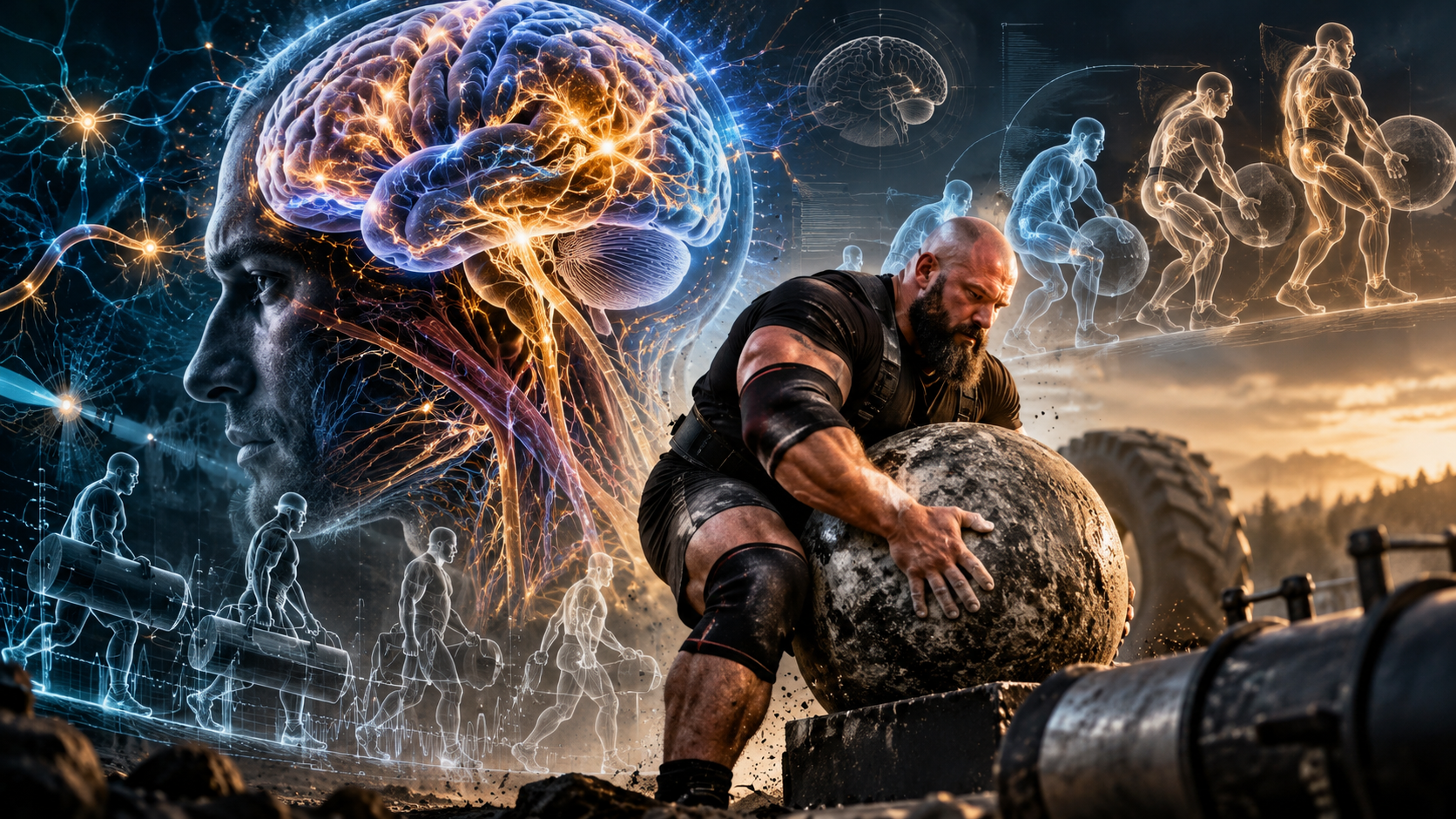
From raw strength to skill: the learning problem
An Atlas stone comes with no instructions for the nervous system. An athlete may possess sufficient strength, recognize the movement visually, and describe every phase verbally, yet a first attempt can remain awkward: the hands are poorly positioned, contact conditions change, the trunk responds late, and the stone follows an inefficient path. Practice can transform these successive corrections into a coherent action. The important question is not merely whether the muscles became stronger, but how perception, decision-making, anticipation, and execution became better coordinated. This episode examines the acquisition of a skill without confusing task-specific learning with a general increase in muscular capacity [1,2].
What does learning a movement actually mean?
In everyday language, learning often means repeating a movement until it works. Motor-control research makes a stricter distinction: performance is what can be observed in a particular attempt, whereas learning is a relatively persistent change in the capacity to perform a task, inferred from behavior. If an athlete presses a 110-kilogram log today after a thorough warm-up, that result alone does not tell us how much technique has improved. Better recovery, chalk, timely coaching, or motivation may explain the improvement. A genuinely acquired skill should reappear at a later assessment, without the same prompts and, within reasonable limits, in modified conditions. This distinction does not diminish competition success; it prevents a remarkable day from being mistaken for proof of permanent neural reorganization. Immediate performance can be measured through time, errors, success rate, or trajectory consistency. Learning is usually assessed through retention after a delay, and sometimes transfer to related tasks. In strongman those criteria must respect the actual event: a cleaner Atlas stone load one week later may provide stronger evidence of technical control than an isolated personal best under ideal conditions. Nevertheless, no simple assessment fully separates learning from strength, fitness, fatigue, or recovery. A 2024 scoping review emphasized that many sports skill studies use very short retention intervals and do not include transfer tests at all [1,3].
Classical descriptions commonly identify cognitive, associative, and relatively autonomous phases. During the first, the athlete discovers the goal and makes frequent errors; during the second, coordination becomes more reliable; during the third, execution may demand less conscious deliberation. These are teaching heuristics, not sharply bounded anatomical compartments. An experienced deadlifter can still be a novice at cleaning a log, highly effective under a yoke, and awkward with an unusually large stone on the same day. Expertise belongs to a task and a context, not to every movement a person might attempt. Automaticity does not mean complete inattention either: skilled athletes still monitor space, platform distance, and implement behavior. Improvement is also non-linear. A new cue about elbow placement may temporarily slow the lift while eventually enabling a more consistent movement. If a coach judges only the first session, a useful adjustment may be abandoned prematurely. Conversely, a very stable movement rehearsed under one condition may prove brittle when stone diameter, surface friction, or loading height changes. Contemporary accounts treat learning as an interaction among action selection, sensory prediction, skill sequencing, and explicit knowledge rather than a single ladder everyone climbs at the same rate [1,2].
A new strongman event is a control problem containing a goal, constraints, and several possible solutions. To load a stone, the athlete must move its center of mass upward, maintain appropriate contact, and manage balance; there need not be one ideal joint configuration for every human body. Limb lengths, hip mobility, stone diameter, platform height, and surface material alter the practical solution. During early practice the athlete explores mismatches between intended action and actual implement behavior. A failure may occur before maximal force is generated, when the starting posture is chosen; it may occur when transferring the object to the lap; or it may emerge during the final extension. Useful analysis therefore separates strategy, which action should be selected, from execution, how the chosen action can be produced at the right time. Prescribing ten more identical repetitions without identifying the limiting phase may simply automate an unhelpful response. Yet errors are not automatically pathological: ordinary movement variability supplies information about the task, and some unsuccessful attempts reveal the limits of an emerging strategy. Coaching must discriminate exploration from repetitions that expose the athlete to unnecessary loading risk. This distinction is especially important in strength events, where the physical consequences of a technical error can exceed those of a laboratory experiment [2,4].
Movement unfolds under incomplete sensory information. Visual, tactile, and proprioceptive signals have different delays and uncertainty; none supplies a perfect description of the body. The nervous system therefore combines incoming sensation with anticipation. During a lift, the athlete does not simply wait for the stone to move before deciding when to accelerate. Predicted consequences of motor commands help guide action, and the predictions can be revised when the actual response differs. Forward internal models are an influential explanation for this process, especially in sensorimotor adaptation experiments. They should not be imagined as complete software programs housed within a single brain structure. A model is a scientific account of how relations among commands, body mechanics, and environmental conditions are used in control. Distinguishing outcome error, the stone did not reach the platform, from sensory prediction error, the object rotated unexpectedly, matters. Outcome error describes failure to attain the goal; prediction error can recalibrate an estimate even during an otherwise successful attempt. A challenging successful lift can therefore provide useful information if the athlete recognizes how changing contact conditions required an adjustment. Research supports prediction and continual recalibration but cannot establish one definitive neural algorithm for every strongman implement [2,5].
Consider two attempts with the same stone and platform. In the first, the athlete positions the hands too high and feels the implement slip as the initial pull begins, compensating with greater trunk flexion. Before the next attempt, hand placement changes and the athlete anticipates the moment of separation from the ground, guiding the stone into the lap without the abrupt correction previously observed. It would be tempting to call this 'muscle memory.' The phrase is convenient but incomplete: muscles do not store technical instructions in the psychological sense, while the observed improvement concerns a distributed perception-and-control system. The athlete has used contact feedback to modify a future decision. If the second attempt succeeds only because a coach repeats precisely timed instructions, independent control has not yet been demonstrated. If the athlete reproduces the improved action several days later without those prompts, the learning hypothesis becomes more persuasive. This is an explanatory example, not a report of an experiment or evidence that one grip pattern suits every athlete. In applied assessment, mass, fatigue, and task demands should remain reasonably comparable. Video can document the grip, first pull, lap, and final extension, but two-dimensional images do not directly quantify muscle forces or neuronal activity [3,4].
Brain networks, plasticity, and the role of attention
Skill acquisition is sometimes described as if it occurred inside one special brain 'center,' yet lifting depends on interacting networks with partly overlapping functions. The cerebellum contributes to timing, sensory integration, and adjustment to prediction errors. Basal ganglia participate in selecting and updating actions in relation to outcomes and reinforcement. Motor, premotor, somatosensory, and parietal cortices contribute to planning, execution, body representation, and the use of object-related information. These are functional summaries, not exclusive assignments suggesting that one structure corrects, another decides, and a third executes. Networks exchange information in both directions, and their contributions vary with context and experience. When a stone rotates unexpectedly, the response cannot be reduced to the activation of one neural node. When the athlete chooses a new grip strategy on the next attempt, evaluation of the previous outcome matters as well. Controlled studies in humans and animals support interactions among these systems, but translating a laboratory activation pattern directly into a coaching command for strongman would exceed the available evidence. Training prescriptions should therefore be framed around observable skills rather than slogans promising to 'activate the cerebellum in five repetitions.' Recent reviews emphasize parallel learning mechanisms and warn against explaining complex expertise through a single neural structure [1,6].
Error-based adaptation, reinforcement learning, and use-dependent change describe related but distinguishable processes. When a log travels farther from the body than expected, the discrepancy between predicted and actual motion may alter subsequent motor commands. When an athlete discovers that one strategy produces faster, more successful repetitions and deliberately favors it, the outcome influences action selection. When a movement configuration is repeatedly practiced, execution preferences may also change without elaborate verbal instruction. In real training these processes overlap and cannot be neatly separated by observing a video. Not every repeated exercise constitutes a pure adaptation experiment, and adaptation to an artificial disturbance is not equivalent to expertise in a competition event. Basic research gains experimental control by simplifying the task; strongman adds substantial loads, mobility demands, friction, risk, and fatigue. Its practitioners should translate findings into working hypotheses. A large change in weight between attempts may modify both force prediction and movement strategy, but no scientifically established percentage guarantees optimal learning for every implement. A coach needs to monitor what the athlete actually does rather than invoke a general neurochemical mechanism as proof that a method must work [1,2,6].
Neural plasticity is the capacity of the nervous system to change its function, and sometimes structure, in response to experience. Motor learning may involve changes in synaptic efficacy, excitability, connectivity, and tissue properties, although no single marker describes the entire skill. Neuroimaging studies have reported gray- and white-matter changes during practice of controlled motor tasks, but sample sizes and task-specific methods limit generalization. A 2024 imaging investigation documented alterations associated with training a computer-based motor game; those observations cannot be converted into precise claims about the brain of an athlete loading a 180-kilogram stone. Terms such as LTP, LTD, dopamine, and BDNF refer to processes investigated scientifically, not instruments for measuring how much technique has been learned in the gym. Increased movement speed with the same implement is an observable mechanical result. Claiming that it proves one specific molecular pathway would be unjustified. Resistance training additionally changes peripheral and central systems at the same time: performance reflects muscular capacity, tolerance of effort, prediction, and coordination. Responsible explanation therefore maintains two complementary levels, plausible neurobiological mechanisms supported by research and practical behavioral indicators assessed reproducibly. The presence of a known biological mechanism does not establish the effectiveness of a particular untested coaching intervention [6,7].
During the first days of learning, athletes may consciously use instructions such as 'keep the stone close,' 'establish contact,' 'push against the floor,' or 'find the loading shelf.' Such cues help when they simplify relevant decisions or correct a specific obstacle. The same lift can become less fluid, however, if the athlete tries to monitor ten joints at once. Attention has limited capacity, and its target matters. Some research reports advantages for directing attention toward intended effects in the environment rather than toward body segments, but the issue is not settled. A favorable meta-analysis of external focus was challenged by a Bayesian reanalysis that identified publication bias and markedly smaller adjusted average effects. It would therefore be unsound to claim that one verbal formula works universally or that mentioning a body part inevitably harms learning. For a novice beginning a hazardous lift, an internal cue about trunk organization may be justified. In an already familiar phase, a simple external intention may prove more practical. These choices must be judged by actual movement, retention, independence from coaching, and the ability to respond to changed demands. The debate provides a useful example of why strongman coaching should acknowledge scientific disagreement rather than turn a contested finding into dogma [8,9].
Observing a demonstration is different from performing a movement. Video can reveal the sequence of operations, approximate elbow height, distance from the implement, and significant contact events. It cannot directly deliver the sensation of pressure, surface friction, or effort associated with an individual athlete's body proportions. Demonstration is therefore a starting point, not a photograph of compulsory technique. For a novice learning the log clean, a slow demonstration from an informative angle may make the phases intelligible. For an experienced lifter, comparing two attempts may expose the point at which velocity is lost. A coach can ask the athlete to explain the objective of each phase before large loads are introduced. Explicit understanding helps create observable criteria and reduce ambiguity, but learning is not finished once a person can recite instructions. Nor is there good reason to assume that passive viewing and mental rehearsal reproduce every benefit of physical practice under substantial loading. They may complement execution when circumstances require, with their usefulness depending on the task and athlete. Separating demonstration, explanation, and firsthand experience also establishes a boundary: the specific evidence for observation and mental representation deserves a dedicated treatment later in the series rather than being presumed here [1,3].
Structured practice: repetition, variation, feedback, and recovery
A set is not automatically a unit of learning. Five repetitions may be informative when the athlete has a precise objective, retains enough energy for control, and observes the consequence of a meaningful adjustment. Another five may simply reinforce an improvised strategy under exhaustion. When teaching a new technique, training volume should be distinguished from the informational value of practice. A coach can select one element, such as the transition of an Atlas stone onto the lap, and compare two or three attempts with adequate rest. When mass, diameter, platform height, footwear, and coaching instructions all change together, identifying the cause of progress becomes difficult. Excessive standardization, however, can make movement effective only in the practiced setting. A pragmatic progression is to reduce unnecessary variation while identifying a useful control solution and later reintroduce differences relevant to competition. This is not presented as a universally validated strongman protocol, because direct randomized trials are scarce. It is a methodological approach informed by variable control and broader evidence on retention and transfer. Highly experienced athletes may manage more complexity early, whereas a beginner may first need to understand the order of actions. In either case, the quality of exploration depends on the task and on the physical consequences of mistakes [1,3].
Blocked practice repeats one movement variant consecutively, while interleaved or random schedules alternate variants or tasks. In laboratory research, greater contextual interference may impair performance during practice yet improve subsequent retention or transfer. Two syntheses published in 2024 report overall advantages for increased interference on selected outcomes, while also highlighting substantial heterogeneity and weaker certainty in applied sporting contexts. Therefore, an athlete switching from a log to an axle and then a giant dumbbell should not assume that alternating events is always superior to structured practice. If safe starting positions remain unfamiliar, frequent switching may add confusion and fatigue. When the movement is reasonably stable, relevant variation can test flexible action selection. The useful question is what should remain constant and what actually varies in competition. Stone series may differ in diameter, load, and platform height; farmer's walks may differ in handle design, course distance, and turning requirements. Variable practice should represent such demands rather than turn every session into a random collection of exercises. Effects measured in laboratory tasks or sports without extreme loads cannot be translated into numerical prescriptions for handling 150-kilogram stones [10,11].
Feedback comes from two broad sources. Intrinsic information includes sensory consequences such as palm pressure, body position, contact with the loading surface, and implement sound. Augmented information comes from a coach, video, stopwatch, or sensor. Two common forms are knowledge of results, 'you completed 20 meters in 12 seconds,' and knowledge of performance, 'your rhythm deteriorated on the third step.' Both can help, but constant explanations can leave athletes dependent on external corrections. One practical hypothesis is to intervene promptly when an error creates risk, while sometimes allowing short periods for self-evaluation after less consequential mistakes. That is a conditional coaching strategy, not a universal neurophysiological law. Asking an athlete what they felt and what they would change reveals whether independent error-detection criteria are developing. When video suggests something different from the subjective experience, comparing the two may help calibrate perception. Video is not complete ground truth, particularly when forces and contact details remain invisible. In competition, when instructions are limited and pressure is high, independent correction may matter more than the quantity of feedback received during training. A later episode will examine feedback frequency and timing in greater experimental detail [1,2].
Fatigue creates a common confusion between capacity and technique. Near the end of a session, a stone may be harder to stabilize on the lap not because the motor representation has permanently deteriorated but because available force, temporary coordination, or vigilance has changed. Conversely, a technically clean repetition at 60 percent of capacity does not prove that the same strategy remains appropriate near the limit. A skill-acquisition protocol should identify which trials are designed to promote learning and which are designed to test tolerance to fatigue. Those aims can overlap, but they are not identical. With a novel high-risk skill, practice under severe fatigue that repeatedly generates errors may offer a poor balance between useful information and physical cost. There is not enough evidence to establish one universal RPE threshold or repetition frequency for all events. Decisions should consider implement complexity, athlete history, available spotters, and the reversibility of error. A biomechanical observation that repetition time changes across a set cannot by itself establish a neural mechanism, especially when load and fatigue both vary. When evaluating technique, effort conditions belong in the record alongside timing and success [4,12].
Training without sufficient recovery is not the same as productive intensive repetition. Motor performance can continue to change between sessions through processes of consolidation, in which a learned solution becomes more stable or accessible after initial practice. Sleep research suggests that some sequential tasks improve in accuracy or stability after sleep, but effects depend on task, age, and experimental design. A 2024 study found improvements in generalized accuracy relative to comparable waking intervals, without an equivalent speed benefit. It would be inappropriate to conclude that a fixed number of sleep hours guarantees a predictable percentage improvement in Atlas stone performance. Nonetheless, testing only immediately after practice neglects important timescales. Repeating a comparable assessment several days later can establish whether the solution remains available without continual prompting. Among strength athletes, the same interval also supports tissue recovery and metabolic restoration, either of which can influence the next performance test independently of motor memory. Sleep duration, training volume, and recovery status are thus important contextual variables rather than direct evidence about changes in synapses [13,14].
Individualization and assessment on real implements
In strongman, body geometry and implement geometry place genuine constraints on motor options. Two similarly strong athletes may display different hip and knee angles at the beginning of an Atlas stone pull without either automatically possessing inferior technique. A biomechanical study involving 20 experienced strongman athletes and progressively heavier stones described five phases and observed kinematic differences among participants and across repetitions. That matters because an event often presented as a single gesture can instead be analyzed as a sequence. Yet 20 participants cannot establish a universal norm, and descriptive motion analysis cannot demonstrate that copying one trajectory is best for every physique. Technical adaptation must reflect the athlete's anatomy, the properties of the stone, and the target height. Video may help compare repetitions within the same athlete, but apparent joint angles can change when camera position changes. For more reliable assessment, viewpoint, distance, and loading conditions should be held reasonably consistent. Comparing different bodies by visual symmetry alone, for example by insisting that everyone must display exactly the same knee angle, overlooks meaningful individual constraints. The relevant questions are whether the solution serves the task, can be reproduced, and avoids unnecessary exposure to risk [4].
A learning objective should become an observable criterion. 'Improve technique' is vague; 'keep the stone close during the first pull without losing the grip in three of four comparable attempts' can be assessed. For a log clean, one might observe the transition into the rack, the apparent separation between implement and trunk, or timing consistency between movement phases. For a yoke walk, the first five meters can be distinguished from later intervals, with total time, stops, and control recorded separately. The indicator depends on the problem being solved. Faster completion does not alone prove better technique if the athlete radically changes strategy or accepts excessive mechanical cost. Meaningful assessment combines competitive output with a few technical indicators chosen in advance. Ideally, the athlete completes a baseline task, practices over a defined period, and repeats the assessment without the detailed prompts used during instruction. A related but altered task, such as a stone with a different diameter, may later probe transfer. Without specialized equipment, modest but consistent measurement is more useful than elaborate visualizations built from incompatible observations [3,12].
We must also distinguish adapting technique to a changed load from learning an entirely new strategy under that load. With a light stone, the athlete may accelerate hip extension and spend little time stabilizing in the lap. With a challenging stone, stabilization may take longer and the path may differ without indicating that the athlete has regressed. Load and coordination do not necessarily relate linearly. Some patterns observed at low loads may not survive intact near competition intensity; meanwhile, continually using maximal implements can reduce opportunities for safe exploration. An effective learning environment should be sufficiently similar to the event to remain relevant yet manageable enough to preserve control. Specific loading percentages need justification and individualization, not arbitrary extrapolation from studies of finger movements or cursor tracking. If an athlete reproduces technique across three sessions but struggles when the implement changes moderately, that reveals a relatively specific skill, not a complete absence of learning. Stability and flexibility are different properties. A learned movement can be reliable within a narrow setting, while practical expertise requires gradual expansion of the conditions under which the athlete can still act effectively [1,4].
In strength sport, safety cannot be separated from learning. An athlete practicing heavy log cleans alone may discover much about implement inertia through failure, but some failed attempts expose the wrists, spine, or shoulders to avoidable situations. Error-based learning does not require deliberately provoking extreme failures. Difficulty can be increased through controlled changes in implement properties, rhythm, or precision demands while maintaining appropriate safety arrangements and a reserve of control. A theory about plasticity must never replace ordinary evaluation of pain or injury. New pain, loss of control, or other alarming symptoms justify stopping the attempt and seeking appropriate clinical assessment when needed. Increasing both load and volume in the same week may modify risk and obscure the interpretation of feedback. Skill acquisition research does not justify abandoning load progression or ignoring injury history. Reliable technique neither guarantees immunity from injury nor constitutes a single 'perfect' posture identifiable by unaided vision. The defensible objective is an effective, adaptable action performed under managed risk with explicit reasons for terminating a session [3,4].
Consider a hypothetical microcycle for an athlete experienced in general strength training but unfamiliar with moving an Atlas stone from the lap onto a platform. In the first session, after preparation, the coach selects a manageable mass, fixes the platform height, and defines success as controlling the stone without obvious slipping or major repositioning. Several attempts are filmed and the athlete describes where the difficulty was felt. The next session retains comparable conditions, introduces one strategic adjustment, and compares execution with the baseline. A third session checks whether the adjustment can be reproduced without the same immediate explanation. Following an appropriate delay, a retention assessment repeats the original task; a different stone diameter or adjusted platform can later probe flexibility under controlled conditions. This example is not a validated experimental protocol and does not claim universal superiority. It shows how 'did I improve?' can be broken into distinct questions: did success improve, did unnecessary corrections decrease, was the solution retained, and could it be adapted? The answers need not agree. An athlete can gain speed without gaining stability or develop consistency before setting a personal record. Serious research and responsible coaching begin by recognizing these distinctions [1,3].
Transfer, evidence limits, and conclusions
The learning curve rarely follows a perfectly smooth path. An early change in starting position can produce a striking improvement, followed by weeks in which times and errors fluctuate. A plateau does not automatically mean the nervous system has stopped adapting. The athlete may have encountered a temporary strength limit, the chosen performance measure may no longer be sensitive, or a new technical goal may introduce short-term costs before improving execution. Familiarization with testing is another complication: repeating the same test reduces uncertainty but does not guarantee an improvement that transfers to competition. Useful evaluation therefore combines a standardized assessment with observation in relevant conditions. For a novice, fewer hand repositionings and better control of transitions may matter more than lifting more weight. For an expert, small reductions in time or variability under comparable conditions may have competitive importance. Not every small difference is meaningful, however. Handheld timing, camera placement, and day-to-day variation introduce measurement noise. With too few observations, the distinction between normal variation and stable improvement remains uncertain. A consistent measurement process is more valuable than the apparent precision of one numerical result [1,3].
Reproducing one solution is not the same as transferring it. An athlete may load a familiar stone rapidly and still hesitate when faced with a larger, smoother stone or a higher platform. Transfer depends on shared functional demands rather than superficial resemblance. A powerful deadlift may provide useful extension capacity but cannot replace regulation of grip and object trajectory during a stone lift. Likewise, an excellent log press does not guarantee an efficient clean of an implement with a different diameter. Coaches can construct a simple task comparison: which variables remain comparable, including object position, force direction, phase transitions, available time, or sensory information, and which change? Transfer should then be tested rather than assumed. This is why a delayed assessment using a modified implement answers a different question from performance at the end of a coaching session. Current sports research does not provide precise answers for every combination of practice conditions and transfer destinations. Claiming that skill must migrate from one implement to another would overstate the evidence. It is more defensible to observe whether the athlete recognizes common functional features and can adjust action to the altered constraints [1,3,11].
A central coaching problem is distinguishing neural change from muscular adaptation. Early improvements during resistance training may reflect task learning, familiarity with effort, changes in neuromuscular recruitment, and several other adaptations that cannot be partitioned precisely using one gym test. More muscle mass is not the same as improving the order of movement phases, and faster yoke walking does not on its own prove hypertrophy of any specific muscle. The processes are complementary and can support each other. Force capacity sets important boundaries on available solutions, while efficient control helps an athlete use that capacity. When performance rises rapidly in a new event, a scientifically careful description is that the result is compatible with familiarization and learning. Assigning a precise percentage of improvement to 'the nervous system' without appropriate measurements is unwarranted. Even sophisticated models of plasticity do not turn one person's competition result into a molecular diagnosis. What a club can measure relatively well includes consistency, reliability over time, success with a modified task, and the subjective or mechanical cost of execution. Such explanatory restraint does not diminish neuroscience. It makes the science more useful by keeping evidence, inference, and coaching choices distinct [1,6,12].
Three levels of certainty should remain separate. First are general mechanisms supported by research: practice, prediction, feedback, and distributed neural networks participate in motor learning. Second are sport-specific empirical descriptions, such as phase-by-phase motion analysis of stones or loaded carries, which characterize what happens without identifying every cause. Third are coaching interventions inferred from the first two levels, such as one particular repetition schedule or loading progression. These interventions may be plausible without having been directly tested against alternatives in randomized strongman programs. Confusing the levels produces claims such as 'because the cerebellum uses errors, athletes must frequently fail lifts,' or 'because variation helped in the laboratory, every session should change implements.' Both ignore physical cost and contextual specificity. The 2024 scoping review of sports skill-acquisition interventions highlighted small samples, a focus on novice participants, and inconsistent measurements. The responsible interpretation is not that nothing is known, but that we know enough to formulate sensible hypotheses while lacking evidence to treat every hypothesis as a universal rule. Skilled coaching matters precisely because scientific principles must be matched to real people and real tasks [3,4].
The first conclusion of this series is straightforward: the brain does not merely accelerate an already programmed movement. Through experience, the integrated perception–action system becomes more capable of selecting and executing appropriate solutions. This process cannot be reduced to 'muscle memory,' a rigid three-stage ladder, or one brain-imaging marker. Learning is demonstrated when an athlete gains reproducible control, identifies relevant errors, and can retrieve the practiced solution after a delay and sometimes under changed conditions. In strongman, that means technical training should be evaluated according to implement phases and constraints, using sufficiently representative tasks, intelligible feedback, and managed risk. Today's successful repetition may mark the beginning of a skill, but retention and adaptability tell us more about its depth. The next episode moves closer to the point of contact between athlete and object. It asks how vision, palm pressure, balance information, and active movement form a continual regulatory loop. We will see why two equally massive objects can require radically different decisions and coordination patterns, and why perception is not simply what occurs before a lift, but part of lifting itself [1,2,5].
References and verifiable sources
[1] Krakauer JW, Hadjiosif AM, Xu J, Wong AL, Haith AM. Motor Learning. Comprehensive Physiology. 2019;9:613–663. DOI: 10.1002/cphy.c170043. https://pubmed.ncbi.nlm.nih.gov/30873583/
[2] Shadmehr R, Smith MA, Krakauer JW. Error Correction, Sensory Prediction, and Adaptation in Motor Control. Annual Review of Neuroscience. 2010;33:89–108. DOI: 10.1146/annurev-neuro-060909-153135. https://pubmed.ncbi.nlm.nih.gov/20367317/
[3] Choo L, Novak A, Impellizzeri FM, Porter C, Fransen J. Skill acquisition interventions for the learning of sports-related skills: A scoping review of randomised controlled trials. Psychology of Sport and Exercise. 2024;72:102615. DOI: 10.1016/j.psychsport.2024.102615. https://pubmed.ncbi.nlm.nih.gov/38401870/
[4] The biomechanical characteristics of the strongman atlas stone lift. Peer-reviewed research, 2021. Full text: https://pmc.ncbi.nlm.nih.gov/articles/PMC8418215/
[5] Johansson RS, Flanagan JR. Coding and use of tactile signals from the fingertips in object manipulation tasks. Nature Reviews Neuroscience. 2009;10:345–359. DOI: 10.1038/nrn2621. https://www.nature.com/articles/nrn2621
[6] Biochemical Pathways of Neuroplasticity in Sport Skill Acquisition: From Neuroscience to Coaching Practice. Brain Sciences. 2026;16(7):694. DOI: 10.3390/brainsci16070694. https://pmc.ncbi.nlm.nih.gov/articles/PMC13406859/
[7] Temporal dynamics of white and gray matter plasticity during motor skill acquisition: a comparative diffusion tensor imaging and multiparametric mapping analysis. Cerebral Cortex. 2024. DOI: 10.1093/cercor/bhae344. https://academic.oup.com/cercor/article/34/8/bhae344/7745825
[8] Favre-Bulle E, Nyfeler S, Schorderet C, et al. The effectiveness of different attentional foci on the acquisition of sport-specific motor skills in healthy adults: a systematic review with network meta-analysis. PeerJ. 2024;12:e17799. DOI: 10.7717/peerj.17799. https://pubmed.ncbi.nlm.nih.gov/39119107/
[9] Reporting bias, not external focus: A robust Bayesian meta-analysis and systematic review of the external focus of attention literature. Psychological Bulletin. 2024. DOI: 10.1037/bul0000451. https://pubmed.ncbi.nlm.nih.gov/39480294/
[10] High contextual interference improves retention in motor learning: systematic review and meta-analysis. 2024. https://pubmed.ncbi.nlm.nih.gov/38987617/
[11] The effect of contextual interference on transfer in motor learning: a systematic review and meta-analysis. 2024. https://pubmed.ncbi.nlm.nih.gov/39205981/
[12] The Biomechanics and Applications of Strongman Exercises: a Systematic Review. Sports Medicine Open. 2019. https://pmc.ncbi.nlm.nih.gov/articles/PMC6901656/
[13] Sleep improves accuracy, but not speed, of generalized motor learning in young and older adults and in individuals with Parkinson’s disease. Frontiers in Behavioral Neuroscience. 2024. DOI: 10.3389/fnbeh.2024.1466696. https://pubmed.ncbi.nlm.nih.gov/39390986/
[14] Roshchupkina L, et al. Motor learning- and consolidation-related resting state fast and slow brain dynamics across wake and sleep. Scientific Reports. 2024;14:7531. https://www.nature.com/articles/s41598-024-58123-6
More From The Journal
Training Science
THE BRAIN LEARNS TO LIFT: THE SCIENCE OF MOTOR SKILL ACQUISITION IN STRONGMAN | Episode 2: Perception–Action Coupling in Strongman Implement Handling
Vision, touch, proprioception, and action: how implement geometry, inertia, friction, and motion reshape coordination in strongman.
Training Science
TRANSFER OF STRENGTH: WHAT CAN STRONGMAN LEARN FROM OTHER SPORTS? | Episode 10: Interdisciplinary Synthesis, Method Selection and Validation of Competition Performance
Evidence-based synthesis of transfer from other sports to strongman: biomechanical criteria, individual diagnosis, programming, testing and limits of the evidence.