
Training
The Failure Point - Where Does a Strongman's Performance Stop? Episode I: Why Do You Get Stronger but Not More Performant?
September 2, 2026

The Failure Point - Where Does a Strongman's Performance Stop?
There is a point in a Strongman's career when the numbers in the gym keep rising, but competition performance no longer follows the same direction. The deadlift increases. The squat increases. The press gets heavier. Muscle mass may increase. Personal records can continue to appear. Yet Farmer's Walk times remain almost unchanged, deadlift repetitions do not improve, and loading a stone or sandbag does not become faster.
This is the starting point of The Failure Point series. It is not a series about the moment when an athlete can no longer lift a weight. It is about the moment when a physical capacity stops being converted into competitive performance.
The question is especially relevant in Strongman because the events are complex and biomechanical research is still limited. A systematic review identified only 11 relevant articles and biomechanical data for eight Strongman exercises, with many studies using small samples and simplified methods. In other words, the sport demands more than can be reduced to a single 1RM. [1,2]
1. Strength is not the same thing as performance
Maximal strength is the capacity to produce a very high level of force under a defined condition. Strongman performance is the result of using that force in a concrete situation: an object must be lifted, accelerated, carried, stabilized, loaded or repeated within a time limit.
The distinction may sound subtle, but it changes almost everything. An athlete can increase deadlift 1RM without improving the speed at which lockout is reached. Squat strength can increase without better Yoke Walk performance. The arms and back can become stronger without an Atlas Stone reaching the platform faster. Strength is a resource. Performance is the way that resource is converted into an outcome.
Strongman research supports this distinction. Higher-performing Farmer's Walk athletes are characterized by gait variables such as stride length and stride rate and reduced ground contact time, while faster Tire Flip performance is associated with a shorter second-pull phase. Having a larger engine is not enough if the transmission to the event does not improve. [1]
2. The Strongman paradox: more strength, the same result
Imagine two athletes who can both deadlift 350 kg. The first has a 350 kg deadlift and can perform the early repetitions of an event quickly, maintain position and manage breathing. The second has the same 1RM, but after several repetitions velocity drops sharply, the trunk becomes less stable and grip becomes limiting. In a repetition event, they are not equivalent.
Likewise, two athletes can have the same maximal strength but completely different capacities to produce force rapidly. Rate of force development describes how quickly force can rise after contraction begins. Research indicates that RFD is strongly influenced by rapid neuromuscular activation and can improve through heavy resistance and explosive training. [3,4]
In Strongman, the difference may appear within the first few hundred milliseconds of a movement. If the implement is not accelerated quickly enough, an athlete may possess enough total force to complete the repetition but lose time on every repetition. In a 60-second event, repeated fractions of a second become meaningful differences in placing.
3. Strength without speed can become unused strength
The force-velocity relationship helps explain why an increase in maximal strength does not automatically produce better explosive performance. A muscle can produce very high force when movement is slow, but a Strongman often needs to produce enough force within a very short time window.
This does not make maximal strength irrelevant. It remains one of the foundations of power. A recent 2026 review argues that maximal strength remains an important predictor of mechanical power and that long-term power development should combine maximal strength development with ballistic and speed-oriented work. [5] The problem arises when the athlete keeps investing almost exclusively in the component that is already sufficiently developed.
The practical question therefore changes from 'How strong am I?' to 'How much of the strength I possess can I convert into useful movement within the time available in the event?'
4. Power is the bridge between strength and performance
Mechanical power is the product of force and velocity. In a sport such as Strongman, this relationship is essential because many events do not merely require overcoming resistance, but accelerating it.
An athlete may have enough strength to lift a 150 kg stone, but if the stone is lifted slowly, total event time may be poor. Another athlete may have slightly lower maximal strength but accelerate the object more efficiently and achieve a better result. This is one of the differences between being strong and being a high-performing Strongman.
Power should not, however, become a new absolute target. Recent research also points out that estimating mechanical power in complex multijoint exercises has methodological limitations and that the optimal load depends on the sport-specific task and the individual's force-velocity profile. [5] In Strongman, power has to be interpreted in the context of the event, not as an isolated number.
5. Specificity is where strength begins to become performance
A 400 kg deadlift develops extraordinary capacity. But if the event uses a higher starting position, repetitions for 60 seconds, a different grip or a specialty frame, transfer is incomplete. The same logic appears throughout Strongman.
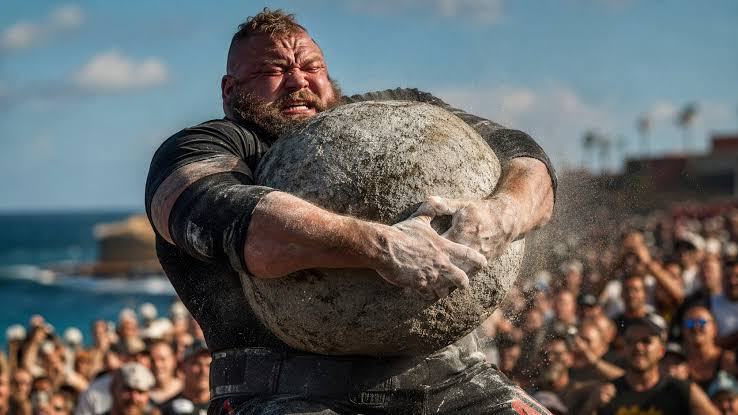
Farmer's Walk requires grip strength, stability, locomotion and center-of-mass control. Yoke Walk adds axial loading and the need to move a large system rapidly. Atlas Stone requires manipulating an object without handles through a specific lifting, lap and extension sequence. Log Lift changes hand position and implement geometry. Strongman tests not only muscular capacity, but the ability to apply that capacity to a specific mechanical problem. [1]
This is one of the most common points of stagnation: the athlete becomes better at the exercises that build general qualities, but does not become better at the task that decides the placing.
6. Fatigue can hide progress
An athlete can be stronger and more fatigued at the same time. There is no contradiction. Adaptation is the result of the training stimulus, but observed performance on a given day also depends on recovery, stress, sleep, nutrition, accumulated load and neuromuscular fatigue.
Recent research on proximity to failure indicates that sets taken very close to failure produce greater acute fatigue, larger reductions in biomechanical performance and greater metabolic and perceptual responses. [6,7] This does not mean failure training is inherently bad. It means it has a cost, and that cost must be weighed against the benefit being pursued.
In Strongman, the problem is amplified by high implement volume. An athlete may accumulate fatigue from deadlifts, carries, stones, presses and medleys and then interpret the resulting performance drop as a lack of progress. Sometimes strength is not missing. Freshness is.
7. Why more can produce less
Once an athlete becomes advanced, the problem is not necessarily finding a larger stimulus. It may become stimulus dosing. More heavy sets, more implements and more repetitions taken to failure can increase fatigue faster than they increase performance capacity.
A meta-analysis of velocity loss shows that as velocity declines within a set, repetitions, lactate and perceived effort increase, while jump performance, sprint performance and velocity against a fixed load tend to decrease. Chronically, larger velocity losses have been associated with greater hypertrophy but poorer outcomes for some measures of velocity and explosive performance. [8]
For a Strongman, this may mean that the same method that produces muscle mass and tolerance to effort can become poorly matched to a period where the goal is speed, expression of strength or competition performance.
8. Interference between qualities: when you train everything and maximize nothing
Strongman is a hybrid sport. Maximal strength, power, local muscular endurance, metabolic tolerance, grip, technique and recovery capacity all matter. This is precisely why programming becomes more complex as the athlete improves.
Concurrent-training literature indicates that simultaneous development of strength and endurance can produce interference under some conditions, particularly for lower-body strength and power. In a meta-analysis of 59 studies and 1,346 participants, effects varied with sex and training status, while highly trained athletes were underrepresented. [9,10]
This does not mean that every combination of strength and conditioning reduces performance. It means that when all qualities are pushed hard at the same time, recovery becomes a limited resource. A Strongman does not have an infinite adaptation reservoir.
9. Muscle mass: when another kilogram is not automatically an advantage
Increasing muscle mass can increase strength potential, but Strongman is not a contest of body mass. An additional kilogram can help if it contributes useful force, but it can become neutral or even costly if it reduces mobility, speed, locomotion efficiency or cardiovascular economy.
In events such as Farmer's Walk or Yoke Walk, the athlete must move their own body as well as the implement. In a medley, every kilogram that does not contribute sufficiently to force production becomes additional system mass that must be accelerated and transported. Body mass therefore needs to be evaluated through performance, not appearance.
10. Technique can become the limiting factor after strength is sufficient
Early in development, strength is often the obvious limitation. Later, technique can become the hidden limiter. An athlete may have the capacity to lift the object but lose time through a slow grip, poor positioning, unnecessary steps, inefficient repositioning or a trajectory that does not favor the implement's center of mass.
Strongman research provides clear examples. Superior Farmer's Walk performance is associated with combinations of stride length and stride rate, reduced contact time and other gait characteristics. In Tire Flip, a faster second pull is associated with better performance. These findings show that performance can be gained by improving how strength is used, not only by increasing strength itself. [1]
11. Performance psychology: physical capacity is not automatically expressed
A Strongman must produce force in a context where anticipation, controlled aggression, pacing, breathing and decision-making can influence execution. Recent research in strength athletes indicates that psyching-up strategies can influence deadlift performance, suggesting that expression of physical capacity is also affected by psychological state before an attempt. [11]
This does not mean mindset can replace strength. It means performance is an interaction between capacity and access to that capacity. An athlete can be physiologically capable of a performance that is not fully expressed because of poor strategy, hesitation, an incorrect pace or a flawed interpretation of effort.
12. How do you identify the point where strength stops producing performance?
The first step is to separate capacity indicators from performance indicators. 1RM, muscle mass and maximal isometric force tell you something about potential. Time over 20 m, repetitions completed, first-versus-last repetition velocity, time to lockout, loading time and distance covered tell you more about how that potential is expressed in an event.
The second step is to look for discrepancies. If deadlift rises by 10% but a deadlift-for-reps event does not improve, the problem may be repeated-force capacity, pacing, grip or fatigue tolerance. If squat rises but Yoke Walk stalls, the limiting factor may be technique, bracing, gait or specific transfer. If Atlas Stone load increases but loading time does not fall, power and technique may be needed rather than another maximal-strength block.
This is the point where programming has to change from asking 'What can I build?' to asking 'What is missing from the chain that produces the result?'
13. What does a Strongman look like after moving beyond simple strength accumulation?
An advanced athlete does not try to maximize every quality every week. The goal is to maintain sufficient levels of the non-limiting qualities while placing emphasis on the quality that currently limits the result.
During a strength block, the focus may be heavy loading and stable technique. During a power-development block, velocity and reduced unnecessary fatigue may matter more. Near competition, specificity, pacing and the ability to reproduce the exact event demands can become more important than another gym record.
Velocity-based training research suggests that velocity-loss zones can help control fatigue and preserve neuromuscular quality, although there is no universal perfect threshold for every athlete or exercise. [8,12] In Strongman, control should be tied to the event and the purpose of the training block.
14. The Failure Point: where does stagnation actually begin?
Stagnation does not necessarily begin when you can no longer add weight. It may begin when you keep increasing a quality that is no longer the primary limiter of performance.
If maximal strength is already sufficient for an event, another 20 kg on the bar may have less competitive value than a few percent improvement in velocity, technique, efficiency or fatigue tolerance. At that point, the problem is no longer how much strength you possess, but how effectively you can turn it into a result.
This is the real Failure Point of the first episode: the boundary between capacity and performance. A Strongman does not become more performant simply because he becomes stronger. He becomes more performant when strength, speed, power, technique, fatigue resistance, strategy and specificity begin to function as one system.
Conclusion
Strength remains the foundation of Strongman, but a foundation is not the building. At beginner and intermediate levels, increasing strength often produces large performance gains. As the athlete advances, the relationship becomes less linear. Every additional kilogram of force must find a path into the event.
When that path is blocked by speed, technique, fatigue, specificity, grip, mobility, coordination or strategy, the athlete can continue to become stronger without becoming more performant. It is not a paradox. It is the consequence of performance being a system rather than a single variable.
Scientific bibliography
1. Hindle BR, Lorimer A, Winwood P, Keogh JWL. The Biomechanics and Applications of Strongman Exercises: a Systematic Review. Sports Medicine - Open. 2019;5:49. doi:10.1186/s40798-019-0222-z. PMID:31820223.
2. Hindle BR, Lorimer A, Winwood P, Keogh JWL. A systematic review of the biomechanical research methods used in strongman studies. Sports Biomechanics. 2020;19(1):90-119. doi:10.1080/14763141.2019.1598480. PMID:31132028.
3. Maffiuletti NA, Aagaard P, Blazevich AJ, Folland J, Tillin N, Duchateau J. Rate of force development: physiological and methodological considerations. European Journal of Applied Physiology. 2016;116:1091-1116. PMID:26941023.
4. Grgic J, Schoenfeld BJ, Davies TB, Lazinica B, Krieger JW, Pedisic Z. Effect of resistance training movement pattern and velocity on isometric muscular rate of force development: a systematic review with meta-analysis and meta-regression. Sports Medicine. 2020. PMID:32034703.
5. Puschkasch-Möck S, Haff GG, Behringer M, Wirth K. Is Mechanical Power a Valid and Relevant Parameter to Control Resistance Training? Journal of Strength and Conditioning Research. 2026;40(3):356-365. PMID:41678794.
6. Varela-Olalla D, del Campo-Vecino J, Balsalobre-Fernández C. Influence of Proximity to Failure, Relative Intensity, and Volume on Voluntary Performance and Fatigue Symptoms After Resistance Training: A Systematic Review. Journal of Strength and Conditioning Research. 2025;39(9):e1129-e1168. doi:10.1519/JSC.0000000000005194. PMID:40644670.
7. Refalo MC, Helms ER, Trexler ET, Hamilton DL, Fyfe JJ. Influence of resistance training proximity-to-failure on skeletal muscle hypertrophy: a systematic review with meta-analysis. Sports Medicine. 2023.
8. Weakley JJS et al. The Acute and Chronic Effects of Implementing Velocity Loss Thresholds During Resistance Training: A Systematic Review, Meta-Analysis, and Critical Evaluation of the Literature. Sports Medicine. 2022. PMID:36178578597.
9. Schumann M, Feuerbacher JF, Sünkeler M, et al. Compatibility of Concurrent Aerobic and Strength Training for Skeletal Muscle Size and Function: An Updated Systematic Review and Meta-Analysis. Sports Medicine. 2022.
10. Petré H, Hemmingsson E, Rosdahl H, Psilander N. Development of maximal dynamic strength during concurrent resistance and endurance training in untrained, moderately trained, and trained individuals: a systematic review and meta-analysis. Sports Medicine. 2021. PMID:33866658.
11. Cusimano K, Moran J, Tod D, Freeman P. The Effects of Psyching-Up on Deadlift Performance in Competitive Strongmen, Strongwomen, and Powerlifters. Journal of Strength and Conditioning Research. 2026;40(5):576-584. doi:10.1519/JSC.0000000000005361. PMID:41628393.
12. Grgic J, Schoenfeld BJ, et al. Velocity-Based Resistance Training on 1-RM, Jump and Sprint Performance: A Systematic Review of Clinical Trials. 2022. PMID:35050973.
More From The Journal

Training
The Science of Strongman Training - Episode X: Competition Programming
How to build a complete Strongman competition preparation block: calendar, events, volume, intensity, specificity, simulations, autoregulation, tapering and fatigue management.
Training
The Science of Strongman Training - Episode IX: Peaking
Peaking in Strongman: how to turn months of training into maximal competition performance by reducing fatigue, preserving adaptations and managing specificity.