
Pharmacology
Testosterone and Its Derivatives - Episode 8: Methyltestosterone
September 7, 2026
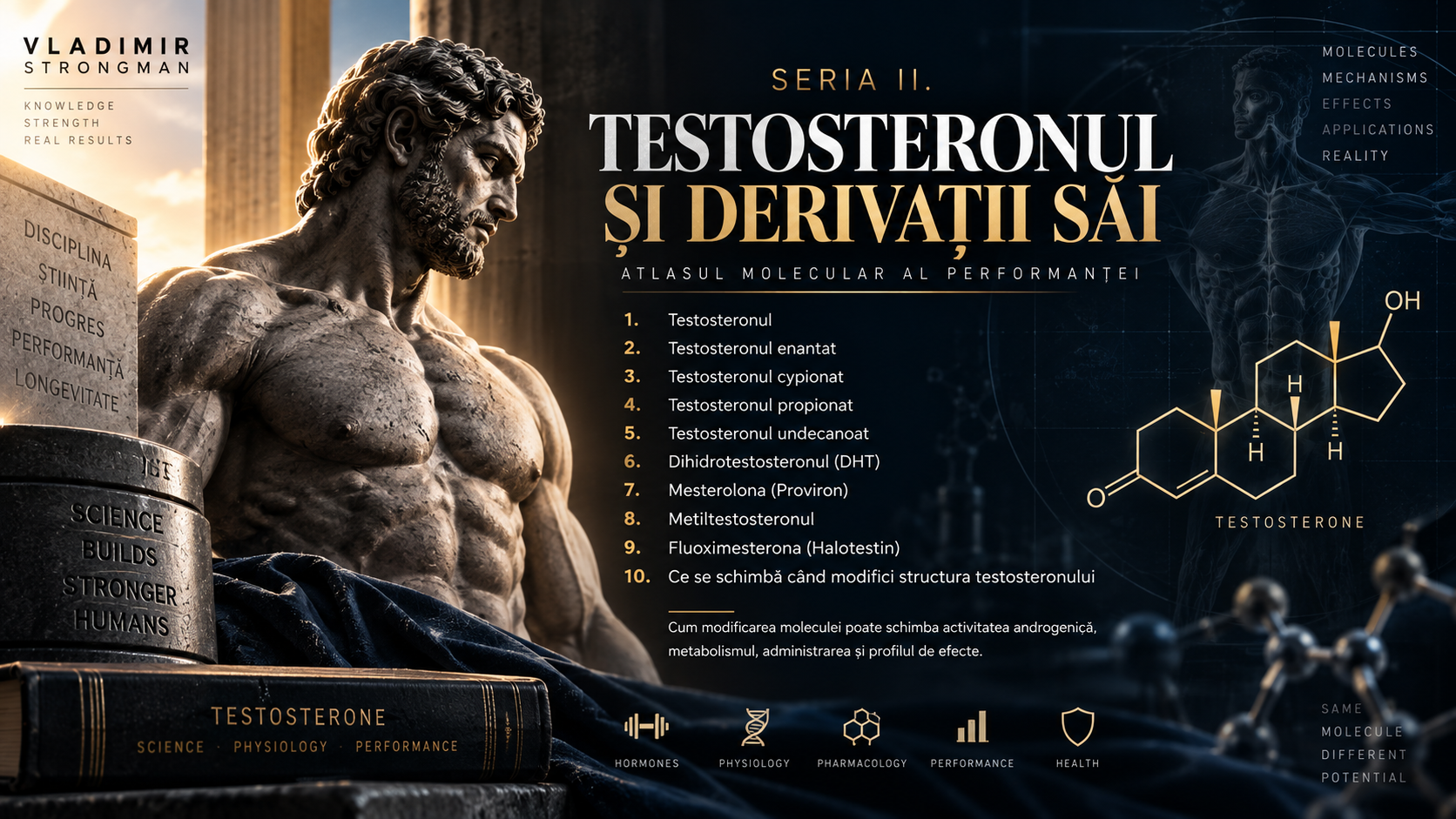
1. Why methyltestosterone matters
Methyltestosterone is one of the most useful molecules for understanding how a small chemical modification can radically change the way an androgen behaves in the body. At first glance, the name tells us almost everything: it is testosterone with an extra methyl group. But that methyl group, placed at the 17-alpha position, changes the pharmacological story considerably.
For readers interested in sport, the obvious question is why an oral testosterone derivative exists when testosterone itself can be given through other routes. The answer involves hepatic metabolism, molecular stability, and trade-offs created by the structural modification. Methyltestosterone is a classic example in which solving a pharmacokinetic problem creates other biological costs.
2. What is methyltestosterone?
Methyltestosterone is a synthetic androgen structurally derived from testosterone. Its molecular formula is C20H30O2 and its molecular weight is about 302.5 g/mol. Chemically, it can be viewed as testosterone modified by adding a methyl group at carbon 17-alpha.
That difference is small on paper but important biologically. The molecule retains the steroid nucleus and the ability to activate the androgen receptor, yet becomes more resistant to some processes that would otherwise limit testosterone activity after oral administration. PubChem describes methyltestosterone as a testosterone-related steroid bearing a methyl group at the 17-alpha position.
3. The key lesson: the 17-alpha position
The 17-alpha position is one of the best-known regions of the steroid structure in androgen pharmacology. Adding a methyl group there reduces oxidative hepatic metabolism enough for some molecules to remain active after oral administration. Endotext describes 17-alpha alkylation as a structural strategy used to obtain oral bioactivity.
This introduces an important concept: bioavailability. It is not enough for a drug to enter the intestine. It must also survive the biological filters that may transform or remove it before useful amounts reach systemic circulation.
4. What is first-pass metabolism?
After oral administration, a substance is absorbed from the gastrointestinal tract and reaches the liver through the portal circulation. The liver acts as a huge biochemical processing plant and can modify many molecules before they circulate through the rest of the body.
This is first-pass metabolism. For testosterone, hepatic degradation greatly limits the effectiveness of ordinary oral administration. Methyltestosterone is one historical solution: the 17-alpha-methyl group increases resistance to first-pass metabolism and permits oral activity.
5. The same solution creates a new problem
This is one of the major lessons of pharmacology. A chemical modification rarely produces only one effect. If you make a molecule more resistant in one context, you may also change how it is recognized, transported, or processed elsewhere.
For 17-alpha-alkylated androgens, the advantage of oral activity comes with a more important hepatic risk than is typical of unalkylated testosterone given through other routes. Endotext and official prescribing information describe cholestasis, jaundice, and, with prolonged high-dose exposure, severe hepatic complications including peliosis hepatis and hepatic neoplasms.
6. Methyltestosterone is not simply oral testosterone
It is tempting to say methyltestosterone is simply testosterone put into an oral form. Pharmacologically, that is too simple. The molecule has a modified structure and therefore its own behavior.
Still, its active steroid framework remains closely related to testosterone. It can interact with the androgen receptor and produce systemic androgenic effects. The major difference is not that the receptor sees a completely different species, but that the body encounters a molecule altered in its stability and metabolism.
7. The androgen receptor: the shared pathway
The androgen receptor, or AR, is the protein that converts an androgen signal into a cellular response. When an androgen binds the receptor, the complex can influence gene expression and, as a result, cell function.
In this sense, methyltestosterone belongs to the same functional family as testosterone: it is an androgen receptor agonist. Its effects do not occur because it has a secret new receptor, but because it can activate the same fundamental androgen-signaling system.
8. Androgenic does not mean only muscular
The word androgen is often reduced in fitness culture to muscle mass. Biologically, the field is much broader. Androgens affect sexual characteristics, reproductive function, erythropoiesis, bone, skin, hair follicles, and many metabolic processes.
That is why any serious discussion of methyltestosterone must move beyond the idea of getting bigger. An androgen changes a broad signaling system, and benefits pursued in one tissue can coexist with unwanted effects in others.
9. What about aromatization?
Unlike DHT-derived compounds, methyltestosterone retains the basic testosterone framework involved in the aromatization pathway. It therefore should not be confused with an androgen that is structurally unable to aromatize.
This makes its relationship with estradiol relevant. Depending on tissue and exposure, androgen can participate in estrogen formation. The simple lesson is that the word oral tells us nothing by itself about aromatization. Molecular structure and the enzymes encountered by the steroid are what matter.
10. Why the liver is central to the discussion
The liver has two roles at once: it metabolizes the molecule and it is part of the biological system in which certain structural modifications create adverse effects. With methyltestosterone, the adaptation that helps the molecule survive first-pass metabolism also contributes to the hepatic concerns associated with 17-alpha-alkylated androgens.
Official methyltestosterone information warns about cholestatic hepatitis and jaundice and notes that prolonged high-dose exposure has been associated with peliosis hepatis and hepatic neoplasms. This does not mean every person who uses the drug will develop liver injury, but it does mean the risk is important enough to be a central part of the molecule's pharmacology.
11. Cholestasis, explained simply
Bile is produced by the liver and must move through the biliary system. Cholestasis occurs when bile formation, secretion, or flow is impaired. When that process is disturbed, substances such as bilirubin can accumulate.
One clinical sign can be jaundice, meaning yellowing of the skin and sclera. This illustrates a key distinction: hepatic toxicity from 17-alpha-alkylated androgens is not merely a forum myth. It is a documented phenomenon in clinical literature and official prescribing information.
12. Peliosis hepatis
Peliosis hepatis is a rare condition in which blood-filled cavities develop within the liver. It is one of the severe complications historically associated with 17-alpha-alkylated androgens.
It should not be presented as a routine effect, but neither should it be trivialized. Official labeling considers this complication potentially life-threatening. That is why feeling well is not enough to exclude biological problems.
13. Lipids: another side of the molecule
17-alpha-alkylated oral androgens can alter lipid metabolism. Official methyltestosterone information lists increased serum cholesterol among reported adverse reactions.
For a strength athlete, this may sound less dramatic than improved performance. From a cardiovascular physiology perspective, however, the lipid profile matters far more than how a training session feels. A metabolic marker should not be ignored simply because it causes no immediate symptoms.
14. Why HDL and LDL matter
HDL and LDL are part of the system that transports cholesterol through the body. Simplified, LDL is involved in delivering cholesterol to tissues and becomes relevant to atherosclerotic risk in unfavorable concentrations and contexts, while HDL participates in reverse cholesterol transport.
Modified androgens can influence these pathways. Pharmacology therefore does not end at the androgen receptor. A molecule can be active in muscle and, at the same time, alter hepatic processes that affect cardiovascular risk.
15. Methyltestosterone and the hormone axis
Like other exogenous androgens, methyltestosterone can contribute to negative feedback within the hypothalamic-pituitary-gonadal axis. When the body senses sufficient androgenic signaling, secretion of GnRH, LH, and FSH may decrease.
A useful analogy is a thermostat. If the system senses enough signal, it can reduce its own production. This helps explain suppression of endogenous testosterone production and impairment of spermatogenesis in some settings.
16. Why spermatogenesis can be affected
Sperm production depends on coordinated function of the hypothalamic-pituitary-gonadal axis. When gonadotropins are suppressed by feedback, testicular stimulation can fall.
Official methyltestosterone information lists oligospermia at high exposure among possible adverse effects. The mechanism matters more than memorizing the list: an exogenous androgen can reduce the signal the testes need to maintain normal spermatogenesis.
17. What about gynecomastia?
Gynecomastia is the development of glandular breast tissue in males. It can occur when the balance between androgenic and estrogenic stimulation in relevant tissues changes.
Because methyltestosterone can retain the capacity for aromatization, it should not be described accurately as an androgen with no estrogenic relationship. The clinical response depends on hormone levels, tissues, metabolism, and individual susceptibility.
18. Methyltestosterone is not DHT
A common mistake is to group it with DHT derivatives simply because it contains a modification that changes metabolism. Methyltestosterone is a 17-alpha-alkylated testosterone derivative, not a direct DHT analog like mesterolone.
This matters because testosterone and DHT follow different metabolic pathways. Methyltestosterone belongs conceptually with the testosterone story, not as an 'oral DHT'.
19. What does 17-alpha-alkylated mean?
The term describes a specific chemical modification: a hydrocarbon substituent is introduced at the 17-alpha position of the steroid structure. This can increase resistance to hepatic degradation and therefore increase oral activity.
The same strategy appears in other androgenic compounds such as oxandrolone, oxymetholone, and stanozolol. Sharing a structural feature does not make the molecules identical. The full molecular structure determines each one's pharmacological profile.
20. Why oral does not automatically mean more convenient biologically
Oral administration has an obvious technical advantage: it avoids an injection. But ease of administration is not synonymous with a gentler biological profile.
With methyltestosterone, oral activity is achieved through a structural modification that comes with hepatic and metabolic costs. Good pharmacology does not ask only how a drug is administered. It also asks what biological price the body pays for that route to work.
21. Pharmacokinetics versus pharmacodynamics
Pharmacokinetics asks what the body does to the molecule: absorption, distribution, metabolism, and elimination. Pharmacodynamics asks what the molecule does to the body: receptor interaction, signaling, and biological effect.
Methyltestosterone is a useful example because it separates the two concepts. The 17-alpha modification primarily changes pharmacokinetics by increasing resistance to first-pass metabolism. The end result is pharmacodynamic because more active androgen can reach systemic tissues and the androgen receptor.
22. Why the liver is not merely a filter
In everyday language we say the liver 'cleans' the blood. Biologically, it is much more complex. The liver chemically modifies molecules, controls metabolic fluxes, synthesizes proteins, and regulates important parts of lipid and hormone metabolism.
When a molecule is designed to survive hepatic degradation, you are not simply changing its blood concentration. You may also change how that molecule interacts with the wider hepatic system. This contributes to the complexity of 17-alpha-alkylated androgens.
23. Androgenic effects on skin and hair
Androgens influence skin and hair follicles. Methyltestosterone prescribing information lists acne, hirsutism, and male-pattern hair loss among reported adverse reactions.
These effects again show that the androgen receptor is not a 'muscle receptor.' Different tissues respond differently to increased androgenic signaling.
24. Muscle: why this molecule attracts interest
As an androgen, methyltestosterone can activate pathways that support muscle tissue maintenance and adaptation. But simply saying 'it is anabolic' tells us little.
Muscle responds through a combination of receptor-dependent signaling, protein synthesis, energy availability, and training response. The muscular benefit must also be considered alongside effects on the liver, lipids, blood pressure, and endocrine axis. A molecule does not become 'good for the body' simply because it can support an anabolic process.
25. Methyltestosterone in modern medicine
Methyltestosterone has been used in certain androgen-related clinical settings, and prescribing documentation includes historical use in contexts of androgen deficiency and other conditions. Modern use is limited by better-characterized alternatives and, especially, the safety profile of 17-alpha-alkylated androgens.
Endotext emphasizes that 17-alpha-alkylated androgens, including methyltestosterone, are not appropriate for long-term androgen replacement when safer alternatives exist.
26. Why it should not be compared simplistically with injectable testosterone
A fair comparison separates the molecule from the route of administration. Injectable testosterone can provide systemic exposure without the same first-pass hepatic problem. Methyltestosterone is specifically designed to resist that first-pass process.
Therefore, two products that activate the same receptor can have very different risk profiles. Route of administration changes pharmacokinetics, and pharmacokinetics changes tissue exposure.
27. Why laboratory tests may tell a different story from how you feel
An athlete may notice changes in energy, libido, or body composition without knowing what is happening to liver enzymes, bilirubin, or the lipid profile. Some metabolic effects remain clinically silent, especially early on.
That is why an androgen should not be evaluated only by asking 'how do I feel?' In medicine, symptoms, clinical examination, and laboratory markers complement one another.
28. Methyltestosterone and strength sports
In strongman and other strength sports, there is a strong temptation to judge a compound only by its effects on strength and muscle mass. Scientifically, that is incomplete.
An androgenic profile can interact with recovery, erythropoiesis, body mass, water retention, and training adaptation. The same profile can also alter lipids, liver function, and the reproductive axis. Performance is an outcome, not the whole system.
29. Why water retention can complicate interpretation
Body weight is not the same thing as muscle mass. Androgens can influence sodium and water retention, and methyltestosterone labeling includes retention of sodium, chloride, water, and other electrolytes among reported effects.
In sport, a rapid change in body weight should not automatically be interpreted as hypertrophy. To understand what changed, water, glycogen, contractile tissue, and fat mass have to be considered separately.
30. What methyltestosterone does not do
It is not a universal upgrade of testosterone. It does not eliminate endocrine feedback. It does not protect the liver. It does not turn oral administration into a biologically safe option. It does not guarantee strength, muscle gain, or recovery without biological trade-offs.
It also should not be assumed that a chemical change that improves one property makes the entire molecule better. Greater resistance to hepatic metabolism does not mean better in every other respect.
31. What methyltestosterone teaches us about drug design
A drug is rarely a perfect solution. It is better understood as a compromise designed around a biological problem. With methyltestosterone, the problem was oral activity. The solution was 17-alkylation. The trade-off was a less favorable hepatic and metabolic profile.
That is a central idea in modern pharmacology: change the structure, change the properties. When the properties change, the relationship with the body changes as well.
32. Why molecules in the same class can behave differently
Methyltestosterone, oxandrolone, oxymetholone, and stanozolol share the 17-alpha-alkylated feature, but they are not equivalent. Additional changes to the steroid scaffold influence receptor affinity, metabolism, aromatization, interactions with binding proteins, and duration of action.
That is why saying 'all oral steroids are the same' is as wrong as claiming every molecule is completely unrelated to its structural family.
33. The 'oral equals easier' myth
Oral administration is technically simpler. It does not automatically mean biologically gentler. In methyltestosterone, the same adaptation that permits oral activity is tied to the hepatic metabolic concern.
This is an excellent example of why route of administration and safety profile must be evaluated separately.
34. Status as a drug with abuse potential
Methyltestosterone is classified in the United States as a Schedule III controlled substance. In educational terms, that matters because the molecule is treated legally and medically as a drug with abuse potential, not as an ordinary supplement.
Legal classification differs by country, and regulation should not be confused with pharmacology. They are separate questions: what the molecule does and how it is regulated.
35. What readers should remember about the liver
First, 17-alpha methylation helps methyltestosterone remain orally active. Second, the same structural class is associated with a more important hepatic risk. Third, liver injury can include clinical symptoms as well as laboratory abnormalities.
You do not need to memorize every liver disorder. The useful principle is the structural relationship: a modification that solves a bioavailability problem can create a safety trade-off.
36. What readers should remember about muscle
Methyltestosterone is an androgen, so it can activate the androgen receptor and support anabolic and androgenic responses. But the muscle effect cannot be separated from the rest of the body.
An athlete is not only muscle. The athlete is also liver, cardiovascular system, endocrine axis, lipid metabolism, blood system, and nervous system. Responsible pharmacology looks at all of these compartments.
37. The chemical lesson
If the entire episode had to be reduced to one idea, it would be this: one methyl group can change the route a molecule takes through the body. The 17-alpha position is important enough to turn an androgen that is poorly useful orally into an orally active drug.
But the change is not free. When you design a drug, you gain one property and may lose another. Pharmacology is the study of that trade.
38. Conclusion
Methyltestosterone is one of the clearest examples of molecular engineering in androgen pharmacology. Starting from testosterone, adding a methyl group at the 17-alpha position increases resistance to first-pass metabolism and makes oral activity possible. In exchange, the molecule becomes part of the 17-alpha-alkylated androgen class, which carries more significant hepatic and metabolic concerns.
For the general reader, the message should not be 'oral is good' or 'oral is bad'. The correct message is more interesting: molecular structure determines what the body does with a drug, and the route of administration can profoundly change exposure and risk.
Within this series, methyltestosterone is the bridge between steroid chemistry and pharmacokinetics. The next layer is to understand how other structural modifications can generate derivatives with very different profiles.
Selected sources
Handelsman DJ. Androgen Physiology, Pharmacology, Use and Misuse. Endotext, NCBI Bookshelf.
DailyMed. METHITEST (methyltestosterone) tablets, official prescribing information and warnings.
PubChem. Methyltestosterone, CID 6010, structure and molecular data.
More From The Journal

Training
The Science of Strongman Training - Episode X: Competition Programming
How to build a complete Strongman competition preparation block: calendar, events, volume, intensity, specificity, simulations, autoregulation, tapering and fatigue management.

Training
The Science of Strongman Training - Episode IX: Peaking
Peaking in Strongman: how to turn months of training into maximal competition performance by reducing fatigue, preserving adaptations and managing specificity.