
Pharmacology
Testosterone and Its Derivatives - Episode 7: Mesterolone (Proviron)
September 7, 2026
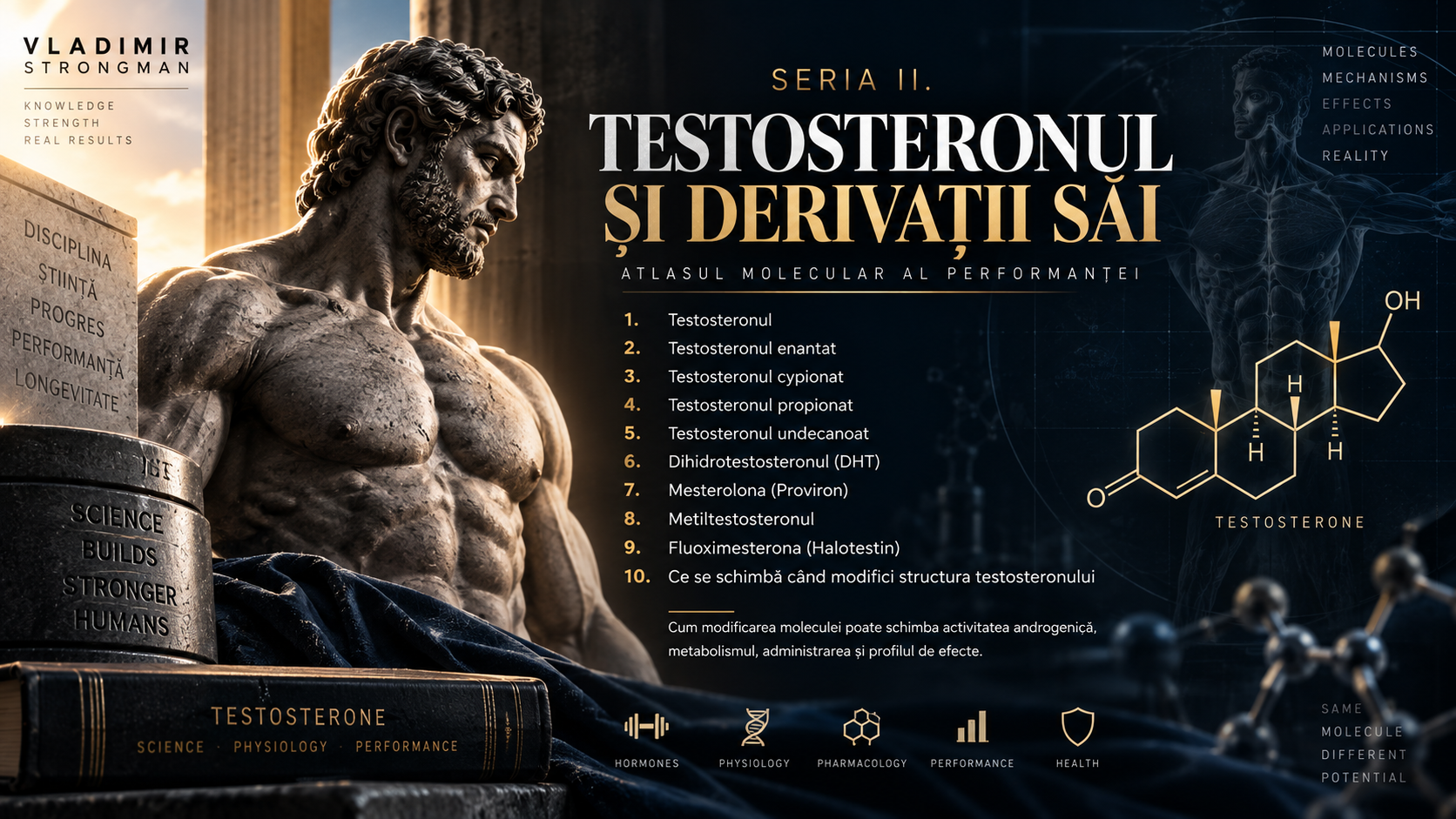
1. Why is mesterolone the next step?
After studying testosterone, its esters, and then DHT, the next logical step is a molecule from the same structural family that changes several key properties. Mesterolone, known by the trade name Proviron, is a synthetic DHT analog and shows how a structural modification can change metabolism and the pharmacologic profile of an androgen.
Mesterolone is not esterified testosterone. It is not simply DHT either. It is a synthetic molecule related to DHT, modified by a methyl group at position 1. This modification contributes to oral activity and resistance to aromatization.
2. What is mesterolone?
Mesterolone is a synthetic steroidal androgen and a structural derivative of dihydrotestosterone. Its chemical name is 17-beta-hydroxy-1-alpha-methyl-5-alpha-androstan-3-one. Proviron is a trade name associated with mesterolone.
NCBI classifies mesterolone as a synthetic steroid with androgenic and anabolic activity and describes it as an orally active DHT analog.
3. What does DHT analog mean?
An analog is a molecule designed to retain important features of another molecule while changing selected properties. When we say mesterolone is a DHT analog, we mean that it retains the DHT-like steroid framework while adding a structural change that alters pharmacologic behavior.
Its relationship to DHT helps explain why mesterolone is not a substrate for aromatase and why it does not depend on 5-alpha-reductase to become an active DHT-like androgen.
4. What is the 1-methyl modification?
Mesterolone contains a methyl group at position 1 of the steroid nucleus. Position 1 is part of the molecular scaffold where a small chemical change can alter enzymatic metabolism of an androgen.
In mesterolone, the 1-methyl modification contributes to its distinctive properties. The molecule remains sufficiently DHT-like for androgenic activity while following metabolic pathways that differ from those of DHT itself.
5. Why can it be administered orally?
Many oral androgenic molecules are modified at the 17-alpha position to resist hepatic metabolism, and this strategy can increase hepatotoxicity. Mesterolone follows a different structural strategy. It is a 1-methyl DHT derivative and can be orally active without the classic 17-alpha-alkyl modification used by many oral androgens.
This is one of the important lessons of the molecule: oral activity does not require the same chemical modification for every steroid.
6. What does non-aromatizable mean?
Aromatase is the enzyme that converts androgens such as testosterone into estrogens, especially estradiol. Mesterolone is a 5-alpha-reduced androgen and is not an aromatase substrate in the same way testosterone is.
Therefore, mesterolone is not converted to estradiol through aromatization. This is a fundamental difference from testosterone, which can function both as an androgen and as a precursor for estradiol.
7. Why does the lack of aromatization matter?
The lack of aromatization separates two effects that are often mixed in androgen discussions. An androgen can activate the androgen receptor, while testosterone can also create estrogenic signaling through estradiol. Mesterolone does not provide the same route to estradiol.
This does not mean mesterolone has no systemic effects. It means its hormonal profile does not reproduce the estrogenic component generated by aromatization of testosterone.
8. Which receptor does mesterolone activate?
Mesterolone acts through the androgen receptor. It does not need a special Proviron receptor. As a steroidal androgen, mesterolone binds the androgen receptor and can alter expression of androgen-dependent genes.
This brings us back to the lesson from the DHT episode: molecular identity and receptor signaling are different levels of analysis. Mesterolone is a distinct molecule, but it uses the same main androgen-signaling pathway.
9. Is mesterolone more androgenic than testosterone?
There is no scientifically sound universal ranking that answers this in every tissue and context. Mesterolone has androgenic activity and is a DHT analog, but the biological effect depends on tissue, concentration, receptor, metabolism and duration of exposure.
In pharmacology, it is more useful to describe a molecule's properties than to label it simply as 'stronger' or 'weaker'.
10. Why is mesterolone not the same as DHT?
DHT is 5-alpha-dihydrotestosterone, the natural 5-alpha-reduced metabolite of testosterone. Mesterolone is a synthetic molecule structurally related to DHT, but with a 1-methyl group that changes its properties.
That apparently small difference is enough to change pharmacologic behavior. Mesterolone is not produced by simply reducing testosterone in the body and should not be treated as DHT administered directly.
11. What happens with 5-alpha-reductase?
DHT is produced from testosterone by 5-alpha-reductase. Mesterolone is already 5-alpha-reduced, so it does not need that conversion to exist in its androgenic form.
Endotext emphasizes this feature: mesterolone is a DHT analog that does not undergo further androgen amplification by 5-alpha reduction.
12. Why is this property important?
Because it shows the difference between a precursor and an already 5-alpha-reduced androgen. Testosterone can be converted locally into DHT depending on the tissue. Mesterolone enters the body with this part of its androgenic architecture already established.
Its activity therefore does not depend on the local activity of 5-alpha-reductase to generate a DHT-like product.
13. Mesterolone and SHBG
Mesterolone has affinity for sex-hormone transport proteins and is known to interact with SHBG. SHBG, or sex hormone-binding globulin, is a plasma protein that transports and regulates the availability of several androgens and estrogens.
Interaction with SHBG can modify the distribution of circulating androgens, but it should not be interpreted as proof that mesterolone 'releases testosterone' or automatically converts every bound testosterone molecule into free testosterone.
14. What does free androgen mean?
Free androgen refers to the fraction that is not bound to plasma proteins. For testosterone, some is tightly bound to SHBG and another fraction is more loosely bound to albumin.
When another molecule interacts with SHBG, the binding equilibrium can change. But the relationship between SHBG and free testosterone is dynamic and should be treated quantitatively, not reduced to the slogan that 'mesterolone raises free testosterone'.
15. Mesterolone and endogenous testosterone
As an exogenous androgen, mesterolone can participate in negative feedback on the hypothalamic-pituitary-gonadal axis. The endocrine system does not classify feedback by trade name. Receptors and endocrine centers respond to the available androgenic signal.
Therefore, the idea that a compound 'does not suppress' because it does not aromatize is incorrect. Aromatization and gonadal feedback are separate processes.
16. Can mesterolone raise estradiol?
Mesterolone is not converted to estradiol by aromatase. It therefore does not directly increase estradiol through that pathway.
However, the absence of aromatization of one molecule does not mean that an individual's estradiol is independent of all other sources or that the endocrine system remains unchanged.
17. Why is mesterolone pharmacologically interesting?
Because it is an elegant example of androgen design. Starting from a DHT-like architecture, chemists retained the androgenic steroid nucleus, added a 1-methyl group, and obtained an orally active, non-aromatizable androgen.
Not every structural modification is intended to increase muscle mass. Sometimes the objective is to change metabolism, duration, route of administration or the pattern of effects.
18. How is mesterolone different from a testosterone ester?
A testosterone ester primarily changes pharmacokinetics by attaching a fatty-acid chain and then releasing testosterone after hydrolysis. Mesterolone is a distinct androgenic molecule, not a chemical reservoir for testosterone.
This is a fundamental distinction in the series: enanthate, cypionate and propionate are esterified forms of testosterone, whereas mesterolone is a DHT-related structural analog with its own pharmacology.
19. What happens to the liver?
Endotext notes that mesterolone is an oral androgen that does not belong to the 17-alpha-alkylated class typically associated with the hepatotoxicity of many oral androgens. This is an important chemical distinction.
However, 'not 17-alpha-alkylated' should not become 'cannot have hepatic effects'. Any androgen requires consideration of its own safety profile, interactions and clinical context.
20. Why should Proviron not be considered a liver protector?
The fact that mesterolone is not a 17-alpha-alkylated oral androgen in the same way as some other compounds does not mean that it protects the liver from other substances.
Pharmacology does not work by automatically neutralizing the toxicity of another compound. Two molecules can have different safety profiles without one becoming an antidote for the other.
21. Mesterolone and muscle mass
Mesterolone has androgenic activity and is classified as having androgenic and anabolic activity, but it is not considered a first-line oral agent for increasing muscle mass. Endotext notes suboptimal efficacy at standard doses and the need for repeated administration for clinical effect.
This is an important lesson for athletes: an active androgen receptor does not automatically mean impressive skeletal-muscle hypertrophy. Muscle adaptation is the result of multiple mechanisms, not one pharmacologic label.
22. Why does DHT-like not automatically mean more anabolic?
DHT is a potent androgen, but receptor potency alone cannot predict muscle mass. Tissues differ in enzymes, coregulators, receptor abundance, metabolism and cellular responses.
Mesterolone demonstrates exactly this principle. It retains a DHT-like architecture, but its clinical and pharmacologic profile is not a copy of every effect of DHT or testosterone.
23. Mesterolone and the prostate
Because mesterolone is androgenic and structurally related to DHT, it can act in androgen-responsive tissues. The prostate is one of the organs in which androgen signaling is important.
This is another demonstration that lack of aromatization does not mean lack of all androgenic effects. An androgen can influence tissue without becoming an estrogen.
24. Mesterolone and hair
Hair-bearing tissues are androgen sensitive, and a DHT-like compound can contribute to androgenic phenotypes in genetically susceptible people. For that reason, effects on scalp hair should be considered separately from discussions of muscle mass.
This reinforces a central idea of the series: the same androgen receptor can produce very different outcomes in different tissues.
25. Why can mesterolone be called oral DHT only in quotation marks?
The comparison is useful for explaining its structural family, but misleading if it implies that the two molecules are identical. DHT is an endogenous hormone, while mesterolone is a synthetic 1-methyl analog.
A more accurate statement is: mesterolone is an orally active DHT analog with its own pharmacology.
26. What happens to metabolism in muscle?
DHT and related 5-alpha-reduced androgens can be transformed by local enzymes, and androgen metabolism in muscle can limit the duration of signaling. Biochemical literature describes a role for 3-alpha-hydroxysteroid dehydrogenases in inactivating some 5-alpha-reduced androgens.
This is one reason receptor activity measured in an experimental system cannot automatically predict duration or intensity of effects in human skeletal muscle.
27. Mesterolone and the difference between pharmacokinetics and pharmacodynamics
Pharmacokinetics describes what the body does to the molecule: absorption, distribution, metabolism and elimination. Pharmacodynamics describes what the molecule does to the body: receptor binding and the cellular changes generated by the androgenic signal.
Mesterolone is an example in which a structural change affects both levels. The 1-methyl group contributes to its metabolic behavior, while the DHT-like structure preserves androgenic activity.
28. Mesterolone and hormone testing
A testosterone test does not directly measure the pharmacologic effect of mesterolone. A synthetic androgen can produce androgen-receptor signaling without increasing endogenous testosterone.
In addition, if an exogenous androgen suppresses the gonadal axis, endogenous testosterone may fall. Therefore, interpretation of a single testosterone result can be deeply misleading.
29. What does this mean for Strongman?
For a strongman, mesterolone is most useful as an example of structural pharmacology. It shows how a small molecular modification can remove aromatization, change metabolism and preserve androgenic activity.
The lesson is not that Proviron is a universal shortcut for strength or mass. Athletic performance involves the nervous system, muscle, connective tissue, energy, sleep, nutrition and many other variables.
30. Mesterolone and the idea of hardening
In sports culture, mesterolone is often associated with a 'harder' or 'drier' appearance. Those descriptions are contextual observations, not fundamental pharmacologic properties demonstrated by one unique mechanism.
Changes in appearance can be influenced by water retention, body fat, hormonal balance and many other variables. A gym-culture term should not be turned into a molecular definition.
31. What does mesterolone NOT do?
It is not aromatized to estradiol. It is not a testosterone ester that releases testosterone. It does not depend on 5-alpha-reductase to become an active androgen. And it is not a perfect pharmacologic substitute for testosterone or DHT.
These differences are more useful than any simple ranking of 'better steroids'.
32. What does it do instead?
Mesterolone provides an orally active synthetic androgen, structurally related to DHT, capable of activating the androgen receptor and resistant to aromatization. Its properties arise from the 1-methyl structure and its own metabolism.
It is exactly the kind of molecule that demonstrates that pharmacology is not a contest of 'how strong'. It is the study of relationships among structure, metabolism, receptor and tissue.
33. Why is mesterolone not standard testosterone replacement therapy?
Endotext notes several reasons: its pharmacology is less well defined, standard-dose efficacy is suboptimal, and repeated administration is needed for clinical effect. Modern testosterone replacement aims for predictable and monitorable testosterone exposure.
This shows the difference between a pharmacologically interesting molecule and a molecule suited to long-term testosterone replacement.
34. Mesterolone and anti-doping
Mesterolone is an androgenic-anabolic agent and should be distinguished from the medical status of a product. In competitive sport, a substance's status is also determined by anti-doping rules, not simply by whether it can be prescribed in a medical setting.
For athletes, the general rule is simple: a medical use does not automatically mean a substance is permitted in competition.
35. The chemical lesson of mesterolone
Mesterolone is an example of how chemists can modify an androgen starting from the DHT structure. One structural change, the 1-methyl group, contributes to a different metabolic profile and oral activity.
In this series, this is a crucial point: derivatives are not designed only to 'do more'. They are designed to change specific properties.
36. The biological lesson
DHT showed us that an androgen can be generated locally from testosterone. Mesterolone shows what happens when we build a synthetic analog that resembles DHT and administer it as a distinct molecule.
The result is an androgen with its own signaling, without aromatization, without a need for 5-alpha-reduction, and with a distinct metabolic profile.
37. What should a strongman remember?
Mesterolone should not be understood through nicknames, forums or rankings. It should be understood through chemistry. It is a 1-methyl DHT analog, orally active, androgenic and non-aromatizable.
Once you understand that sentence, you have the key to the difference among testosterone, DHT and mesterolone: three related molecules, but three distinct pharmacologic paths.
38. Conclusion
Mesterolone, or Proviron, is a synthetic DHT derivative that demonstrates how much a structural modification can change androgen behavior. The 1-methyl group contributes to oral activity and a distinct metabolic profile, while the DHT-like structure preserves androgenic activity.
Mesterolone is not aromatized and does not need 5-alpha-reductase to become an active androgen. It is not, however, 'pure DHT' and should not be treated as a perfect substitute for testosterone. Its pharmacology is its own, and effects depend on tissue, receptor, metabolism, exposure and context.
For our series, mesterolone is exactly the example we needed: once testosterone and DHT are understood, we can see how chemistry takes one of these androgenic architectures and turns it into a new molecule with a new profile.
Selected sources
Handelsman DJ. Androgen Physiology, Pharmacology, Use and Misuse. Endotext, NCBI Bookshelf.
NCBI MeSH. Mesterolone. Entry terms include Proviron and Vistimon.
PubChem. Mesterolone, CID 15020. Molecular formula C20H32O2.
Pihlajamaa P, Sahu B, Jänne OA. Determinants of Receptor- and Tissue-Specific Actions in Androgen Signaling. Endocrine Reviews. 2015;36(4):357-384.
More From The Journal

Training
The Science of Strongman Training - Episode X: Competition Programming
How to build a complete Strongman competition preparation block: calendar, events, volume, intensity, specificity, simulations, autoregulation, tapering and fatigue management.

Training
The Science of Strongman Training - Episode IX: Peaking
Peaking in Strongman: how to turn months of training into maximal competition performance by reducing fatigue, preserving adaptations and managing specificity.