
Pharmacology
Testosterone and Its Derivatives - Episode 2: Testosterone Enanthate
September 7, 2026
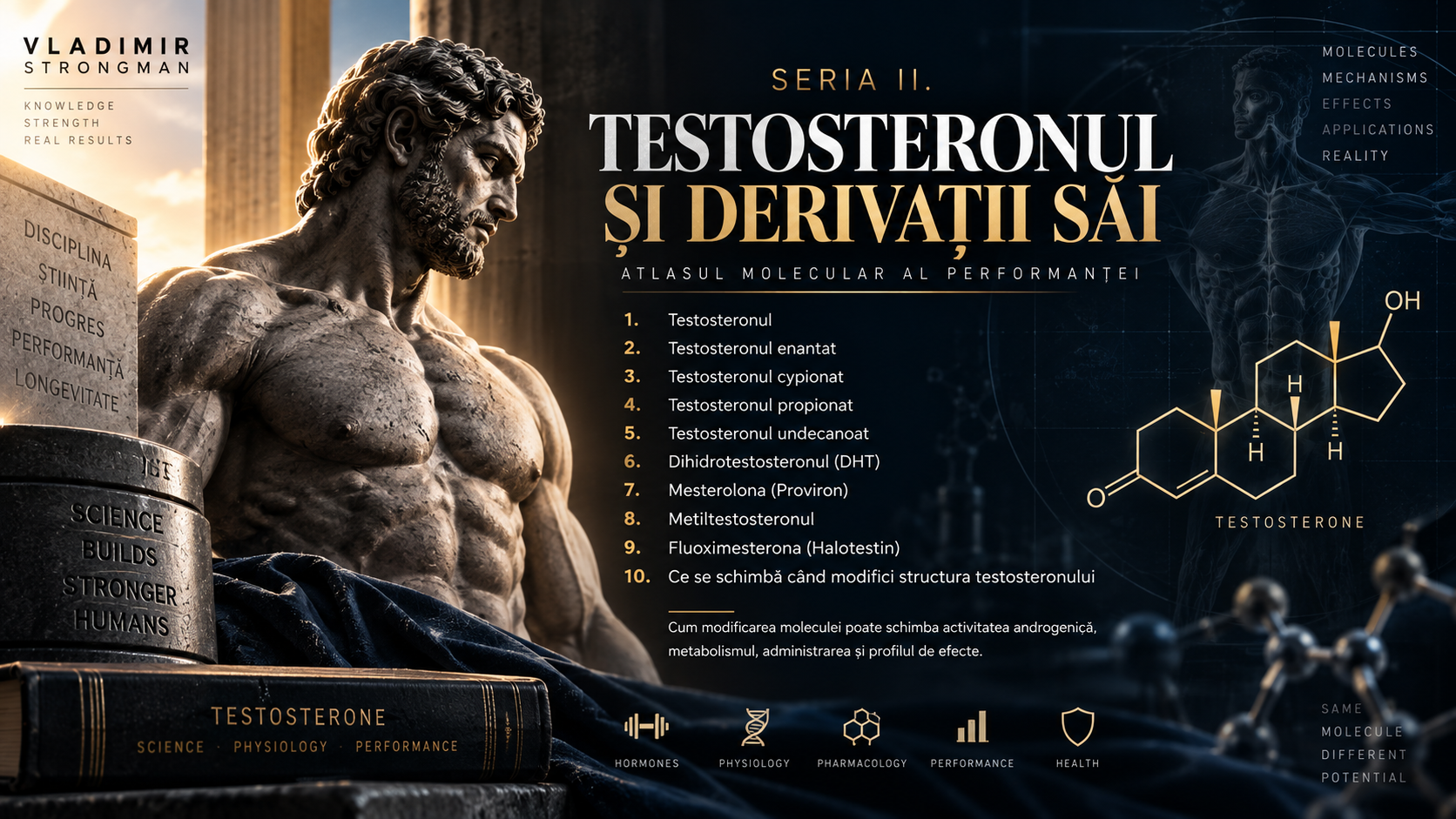
1. Why does testosterone enanthate exist?
Testosterone is the reference hormone of this series, but free testosterone is not a very practical form for achieving prolonged injectable exposure. The free molecule is cleared and metabolized relatively quickly, and an administration strategy based on it would produce a short-lived exposure. Pharmacology addressed this problem with a temporary chemical modification: esterification. Testosterone enanthate keeps the testosterone core but adds an ester that mainly changes the molecule’s physicochemical properties and the rate at which available testosterone reaches the circulation. Endotext describes testosterone esters as prodrug-like forms designed to create a local depot and slow release.
2. What does “enanthate” mean?
“Enanthate” refers to the ester attached to the testosterone molecule. An ester is a chemical group formed when an alcohol and a carboxylic acid react to create an ester bond. In testosterone enanthate, this modification is made at testosterone’s 17-beta-hydroxyl group. In simple terms, testosterone receives a temporary chemical “tail.” This tail makes the molecule more lipophilic, meaning it interacts more readily with fatty and oily environments, and that property contributes to slow release from an oil-based depot preparation. The molecular formula of testosterone enanthate is C26H40O3 and its molecular weight is approximately 400.59 g/mol, according to the FDA label for a testosterone enanthate product.
3. What is an ester, and why does it matter if it is “temporary”?
When we say the ester is temporary, we mean that the chemical bond can be broken by enzymes called esterases. Esterases hydrolyze, meaning they split, ester bonds with the help of water. The result is free testosterone and the acid-derived part of the ester. So the body does not have to turn enanthate into an entirely new hormone. It removes the delivery modification and releases testosterone, which can then act at the androgen receptor.
4. Testosterone enanthate is not a different androgen
This is one of the most important ideas in the episode. Testosterone enanthate is not, in essence, a hormone with a different target receptor. It is an ester of testosterone. The biologically active component responsible for androgenic effects is the testosterone released after ester hydrolysis. Therefore, when testosterone enanthate is compared with testosterone itself, the main difference is pharmacokinetic: how the hormone is delivered, how quickly it is released, and how long exposure can be maintained.
5. What is pharmacokinetics?
Pharmacokinetics is the branch of pharmacology that studies what the body does to a substance. The classic concepts are absorption, distribution, metabolism, and elimination. You can think of them as a molecule’s route: how it enters the body, where it goes, how it is transformed, and how it leaves. For testosterone enanthate, this route is strongly influenced by the fact that the administered form is an ester in an oil-based vehicle.
6. What is a “depot”?
In pharmacology, a depot is a local reservoir of a substance from which the drug is released gradually. With an oil-based injectable formulation of testosterone enanthate, the ester remains near the injection site and forms a depot from which it moves slowly into the surrounding extracellular fluid. Endotext explains that the rate of this release depends on the ester’s physicochemical properties and its partitioning between the oil phase and the surrounding aqueous phase.
7. What does lipophilic mean?
Lipophilic literally means “fat-loving.” A lipophilic substance has greater affinity for lipid environments than for pure water. Esterification increases testosterone’s lipophilic character. In an oil-based formulation, that property favors retention in the oil phase and contributes to slow release from the depot.
8. Why does an oil-based formulation change absorption speed?
Absorption means movement of the substance from the place where it was administered into the circulation. An esterified testosterone dissolved in oil does not behave like the same amount of free testosterone already present in an aqueous compartment. The ester must gradually leave the oil phase, enter extracellular fluid, and then be hydrolyzed to release testosterone. This sequence creates a rate-limiting step and is often described as depot-controlled absorption.
9. What is hydrolysis?
Hydrolysis is a chemical reaction in which a bond is broken with the help of water. For testosterone enanthate, ester hydrolysis is the step that removes the enanthate group and releases free testosterone. Esterase enzymes in the body make this reaction efficient, so once the ester leaves the depot, it can be converted relatively rapidly into biologically available testosterone.
10. What happens after testosterone is released?
After release, testosterone enters the circulation and follows the same biological pathways described in Episode 1. It binds plasma proteins to varying degrees, reaches tissues, can activate the androgen receptor, and can be locally metabolized. In certain tissues it can be converted to DHT by 5-alpha-reductase, and in others aromatized to estradiol. The ester mainly changes delivery, not the identity of the final androgenic signal.
11. What is half-life?
Half-life is the time required for a measured quantity, usually a drug concentration, to decline to about one-half under a given pharmacokinetic model and context. It is useful for understanding the rate of decline, but it should not be treated as a perfect countdown to complete disappearance. With injectable esters, the observed profile reflects both release from the depot and distribution and elimination after testosterone has been released. Endotext emphasizes that the duration of ester action is linked to delayed release from the depot.
12. Why should half-life not be confused with duration of effect?
The concepts are related but not identical. Half-life is a pharmacokinetic property defined within a particular model and context. The duration of a clinical or biological effect depends on the concentration needed to produce that effect, the tissue involved, sensitivity, and other factors. With a depot preparation, what is measured in blood is the result of ongoing release, so depot kinetics can matter more than simple disappearance from blood.
13. What are Cmax, Tmax, and AUC?
Cmax is the highest observed concentration after administration. Tmax is the time needed to reach that peak. AUC, or area under the curve, is a measure of total exposure over a defined period. These concepts matter because two formulations can contain the same active hormone but create very different concentration-time profiles. A depot can delay the peak and extend exposure.
14. Why does the ester mainly change the shape of the curve?
Imagine blood concentration as a curve. With rapid entry, the curve can rise quickly and then fall. With a depot ester, entry is slower and spread over time. The curve therefore changes shape: absorption can become the rate-limiting phase, and testosterone appearance can be stretched over time. Endotext describes this logic for injectable testosterone esters.
15. What is bioavailability?
Bioavailability is the fraction of an administered substance that reaches systemic circulation in a form capable of producing effects. With parenteral administration, the main issue is not passage through the gastrointestinal tract and first-pass liver metabolism, but release from the administration site. With a depot formulation, systemic availability can be high while the rate of appearance in blood is controlled by the formulation and ester properties.
16. What is the “first-pass hepatic effect”?
The first-pass hepatic effect is metabolism that can occur when an orally administered substance is absorbed from the intestine and reaches the liver through the portal vein before entering systemic circulation. An intramuscular or subcutaneous injection does not follow the same route. That is one reason injectable testosterone formulations can avoid the loss associated with first-pass metabolism.
17. Why does ester side-chain length matter?
Testosterone esters have different side chains. The length and structure of that chain change the molecule’s physicochemical properties, especially hydrophobicity and partitioning between oil and aqueous environments. In broad terms, a longer side chain can favor slower release. Endotext describes testosterone enanthate, with a seven-carbon ester side chain, as having a longer duration than testosterone propionate, which has a shorter ester side chain.
18. Enanthate versus free testosterone
The difference can be summarized this way: free testosterone is the active hormonal molecule, while testosterone enanthate is an esterified form used to modify release. Once the ester is hydrolyzed, what remains is testosterone. Enanthate should therefore not be imagined as a completely new androgen, but as pharmacological packaging of testosterone that changes the pace of delivery.
19. Enanthate versus propionate
Propionate and enanthate are both testosterone esters, but their ester side chains differ. In general, propionate has a shorter duration, while enanthate lasts longer. This does not mean that testosterone released from a longer ester becomes “more anabolic.” The main difference is the rate and duration of exposure, not a change in the identity of the hormone.
20. Enanthate versus cypionate
Testosterone cypionate is another long-acting testosterone ester. Endotext notes that testosterone cypionate and enanthate have similar pharmacokinetic profiles and can be considered pharmacologically close in androgen replacement contexts. Real differences between products also depend on formulation, vehicle, route of administration, and individual patient characteristics.
21. What is subcutaneous and what is intramuscular?
Intramuscular means the substance is administered into muscle tissue. Subcutaneous means it is administered into the tissue immediately beneath the skin. These are not just different locations: they can change absorption speed and tolerability. Some testosterone enanthate products are formulated for subcutaneous administration, while classic oil-based forms have long been used intramuscularly. The exact route should be taken from the individual product labeling, not assumed from the ester name.
22. Why can the same ester have different profiles across products?
Because the ester is not the whole product. Concentration, vehicle volume, oil type, route, injection site, and overall formulation also matter. Even when the esterified molecule is the same, the pharmaceutical product can create a different absorption profile. The FDA, for example, describes testosterone enanthate products formulated in sesame oil for subcutaneous administration, while other products use different vehicles and routes.
23. What is pharmacodynamics?
Pharmacodynamics is the other half of the story: what the substance does to the body. If pharmacokinetics follows the molecule’s journey, pharmacodynamics follows the effect produced by the concentration that reaches the target. For testosterone released from enanthate, pharmacodynamics includes androgen-receptor activation and the downstream biological consequences that follow receptor activation.
24. What does “downstream” mean?
“Downstream” refers to processes that occur after an initial molecular event. At the androgen receptor, a ligand binds the receptor and then a series of events can alter transcription of genes and cellular function. These later events are downstream consequences of the initial signal.
25. What happens to the hormonal axis?
When testosterone is administered exogenously, the body can interpret it as a sufficient androgenic signal and reduce stimulation of the hypothalamic-pituitary-gonadal axis through negative feedback. GnRH, LH, and FSH can fall, and endogenous testicular testosterone production and the stimulation needed for spermatogenesis can be reduced. This is a general principle of exogenous androgens, not a unique property of enanthate.
26. What is negative feedback?
Negative feedback is a control mechanism in which an output reduces the signal that produced it. In the endocrine axis, increased androgen signaling can tell the hypothalamus and pituitary that sufficient signal is present, reducing GnRH, LH, and FSH. It is an autoregulatory principle, somewhat like a thermostat reducing its command after a set temperature has been reached, although endocrine biology is much more complex than the analogy.
27. Why do peaks and troughs occur after an injection?
A depot formulation does not necessarily produce a perfectly flat concentration. It changes the rate of testosterone entry into blood, but it does not turn the curve into a straight line. After administration there can be a rise followed by a decline as the depot is depleted and testosterone is metabolized. The exact profile depends on formulation, route, and individual factors. Experimental data show that testosterone enanthate can produce a relatively rapid rise followed by progressive decline, illustrating the dynamic nature of a depot preparation.
28. What are accumulation and steady state?
Accumulation occurs when another administration is given before the previous exposure has disappeared completely. Steady state is the condition reached after repeated administration and sufficient time in which average exposure becomes relatively stable from one interval to the next. It does not mean blood concentration becomes perfectly flat. It means the repeating pattern of peaks and troughs settles into a relatively stable regime.
29. Why is saying “enanthate stays in the body for weeks” imprecise?
The ester can create prolonged release, but the presence of the ester and the persistence of an effect are not the same concept. Some ester is released and hydrolyzed, and the testosterone released is then distributed and metabolized. The exact time also depends on what is being measured: the ester itself, serum testosterone, a metabolite, or a biological effect. Absolute statements about “how many days it stays in the body” should therefore be treated cautiously.
30. Why does the ester name not tell you everything about the effect?
Enanthate tells us something important about molecular properties and release behavior, but it does not by itself define the entire pharmacological profile. Formulation, resulting exposure, tissues, local metabolism, individual sensitivity, and physiological context all matter. A single pharmacokinetic parameter should therefore not be turned into a general claim about “potency” or “effects.”
31. What is a prodrug?
A prodrug is an administered form that is converted in the body into an active form. For testosterone esters, the concept is useful because the ester is used to improve delivery properties, while hydrolysis releases testosterone. The term does not mean the administered molecule is “inactive in every sense”; it means the administered form is designed to generate the active form through a metabolic transformation.
32. Why is enanthate important for understanding all testosterone esters?
Because it offers a clear example of the separation between molecule and formulation. Testosterone remains the hormonal base. The ester mainly changes solubility, partitioning, and release. When we reach cypionate, propionate, undecanoate, and other forms, they can be compared systematically: what chemical group was added, how hydrophobic the molecule became, how it is formulated, how quickly it is released, and what exposure profile results.
33. Testosterone enanthate in medicine
Testosterone enanthate is used in androgen therapy for selected patients, depending on the diagnosis and specific product. In testosterone replacement for hypogonadism, the goal is to restore an appropriate physiological exposure, not intentionally create supraphysiological concentrations. Endocrine Society guidance recommends diagnosis based on compatible symptoms and consistently low testosterone values confirmed appropriately, followed by treatment monitoring and risk assessment.
34. Testosterone enanthate in sport
In sport, the same pharmaceutical form may be used outside medical indications, and the context is very different. Exogenous androgen exposure can affect muscle mass, erythropoiesis, lipids, reproductive function, and other systems, and competitions governed by anti-doping organizations may prohibit exogenous testosterone. For an educational article, the key distinction is between pharmacology and a recommendation to use it: explaining the mechanism is not a recommendation for administration.
35. What do hydrophobic and lipophilic mean, and why do these terms appear so often?
Hydrophobic describes a tendency to avoid water. In pharmacology, hydrophobicity can influence solubility, distribution, and movement between different environments. For a testosterone ester injected in an oil vehicle, this property contributes to depot behavior. There is no simple rule that “more hydrophobic means better”; the whole formulation and physiology matter.
36. What changes and what does not with esterification?
The main changes are physicochemical properties and pharmacokinetics: lipophilicity, partitioning into the vehicle, release rate, and the concentration-time profile. What does not change is the principal androgenic target, the androgen receptor, or the fact that testosterone can be converted to DHT and estradiol after release. In other words, the ester changes “how it gets there” more than “what the final biological signal is.”
37. What should a strongman remember?
Testosterone enanthate is esterified testosterone, not a completely different steroid. The ester is a chemically reversible modification removed by hydrolysis. In an oil-based depot preparation, slow release from the vehicle largely controls how testosterone appears in blood. Terms such as lipophilic, hydrolysis, depot, Cmax, Tmax, AUC, half-life, pharmacokinetics, and pharmacodynamics describe different pieces of the same puzzle. Understanding them makes it much easier to understand why enanthate lasts longer than shorter testosterone esters.
38. Conclusion
Testosterone enanthate is an almost perfect example of applied pharmacology: the same underlying hormone can be chemically packaged to change how it is delivered to the body. The enanthate ester increases lipophilicity, favors depot formation in oil-based formulations, and permits gradual release. After hydrolysis, free testosterone enters the physiology described in Episode 1. The true difference is not a new hormone, but a new exposure curve. That curve will be one of the key tools for comparing every testosterone formulation in this series.
Selected sources
Handelsman DJ. Androgen Physiology, Pharmacology, Use and Misuse. Endotext.
U.S. Food and Drug Administration. XYOSTED (testosterone enanthate) prescribing information.
PubMed. Pharmacokinetics and pharmacodynamics of testosterone enanthate and dihydrotestosterone enanthate in non-human primates.
PubMed. Comparative pharmacokinetics of testosterone enanthate and testosterone cyclohexanecarboxylate as assessed by serum and salivary testosterone levels in normal men.
More From The Journal

Training
The Science of Strongman Training - Episode X: Competition Programming
How to build a complete Strongman competition preparation block: calendar, events, volume, intensity, specificity, simulations, autoregulation, tapering and fatigue management.

Training
The Science of Strongman Training - Episode IX: Peaking
Peaking in Strongman: how to turn months of training into maximal competition performance by reducing fatigue, preserving adaptations and managing specificity.