
Pharmacology
Testosterone and Its Derivatives - Episode 1: Testosterone
September 7, 2026
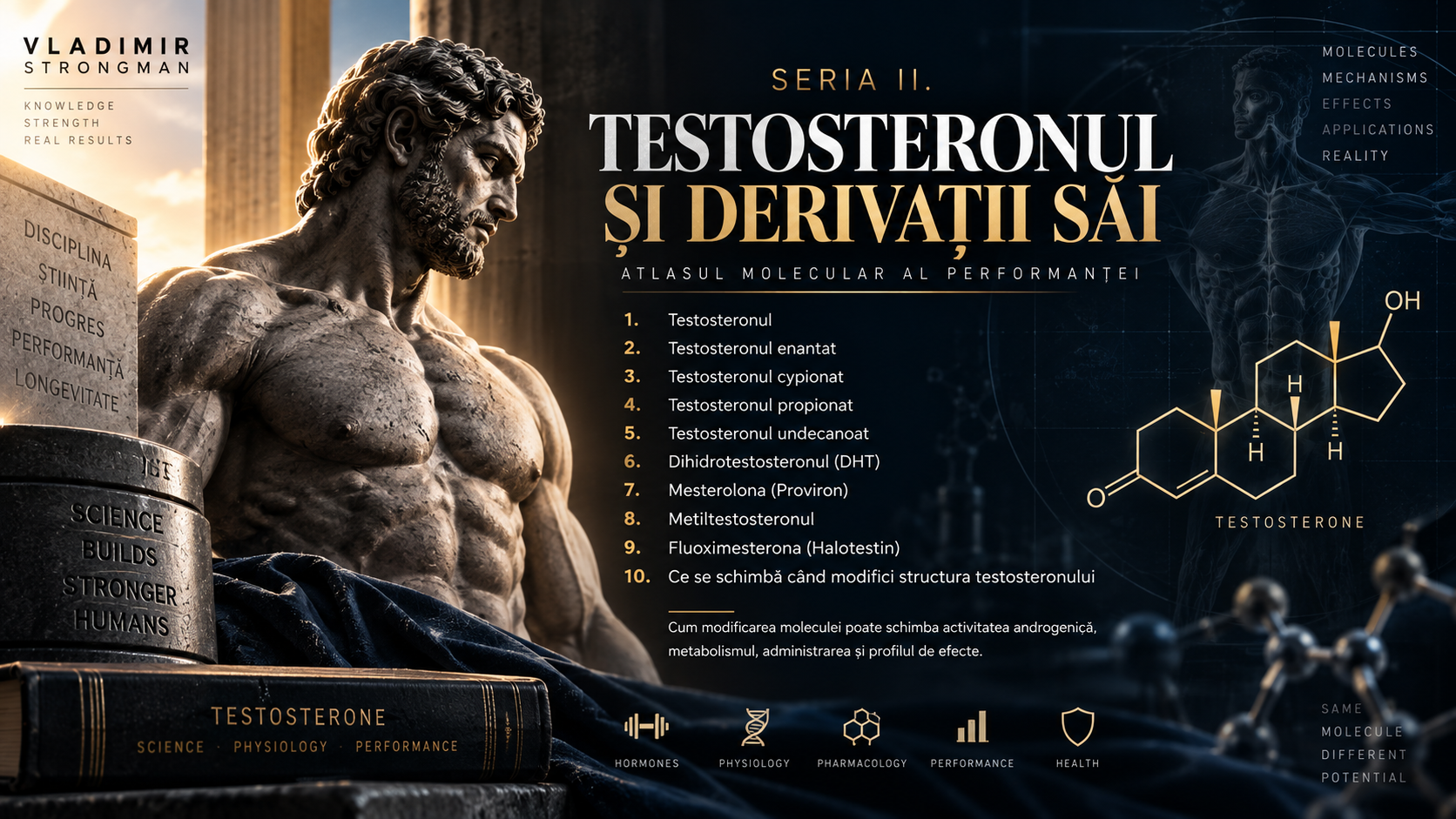
1. Why we start with testosterone
Any serious discussion of androgens and testosterone derivatives begins with the original molecule. Testosterone is not merely a hormone associated with muscle mass or sexual function. It is a central steroid of androgen physiology, produced mainly by Leydig cells and integrated into a network linking the hypothalamus, pituitary, testis, target tissues, and local metabolism. Understanding it provides the “alphabet” needed to read the molecules that come later in this series.
2. What testosterone is
Testosterone is a steroid androgen hormone. It has a four-ring steroid nucleus and is synthesized from cholesterol through a sequence of enzymatic reactions. In male physiology, it is the major circulating androgen, but its biological action is not defined by blood concentration alone: an important part of the signal is determined locally inside tissues.
3. Where it is produced
In adult men, most testosterone is produced by Leydig cells in the testes. Production is stimulated by luteinizing hormone, LH. The pituitary releases LH as part of the hypothalamic-pituitary-gonadal axis, and LH binds its receptor on Leydig cells to stimulate steroidogenesis. Endotext describes this pathway as a central component of physiological testosterone production.
4. Cholesterol is the starting material
Steroidogenesis starts with cholesterol. In the steroidogenic cell, cholesterol is transported to the mitochondrion, where enzymes initiate its conversion into androgenic precursors. A sequence of steps then occurs across mitochondrial and endoplasmic-reticulum compartments, and testosterone emerges as a major androgenic product. Physiological testosterone therefore reflects both chemistry and endocrine control: the molecular structure is the result of a specific enzymatic pathway.
5. LH is the key regulator of testicular production
LH acts through a G-protein-coupled receptor on Leydig cells. The resulting intracellular signaling supports cholesterol transport and steroidogenesis. This explains why endogenous testosterone production is not random: it is part of a regulated endocrine control circuit.
6. The hypothalamus-pituitary-testis axis
Upstream, the hypothalamus releases GnRH in pulses. GnRH stimulates the pituitary to release LH and FSH. LH primarily controls Leydig-cell steroidogenesis, whereas FSH acts on Sertoli cells and participates in spermatogenesis. Testosterone and its metabolites then contribute to negative feedback on the axis, limiting androgen production when the signal is sufficient.
7. Testosterone is not just a “blood level”
A laboratory measurement captures circulating testosterone, but that is only one layer of the system. Testosterone circulates with different degrees of protein binding, reaches tissues in variable amounts, and can be transformed locally into other steroids. Therefore, the same serum value does not guarantee an identical tissue response.
8. Total testosterone and free testosterone
A substantial portion of circulating testosterone is bound to proteins, especially SHBG and albumin. The free fraction is small, and the relationship between total testosterone, free testosterone, and binding proteins helps interpret androgen exposure. In practice, hypogonadism is diagnosed using compatible symptoms and consistently low testosterone confirmed with appropriate testing, not by a single subjective impression or isolated result.
9. Where testosterone acts
The androgen receptor is expressed in many tissues, not only reproductive organs. Muscle, bone, skin, the nervous system, and other tissues can respond to androgens. Receptor abundance and tissue sensitivity vary, contributing to the complex profile of testosterone effects.
10. The androgen receptor
Testosterone can cross the cell membrane and bind the intracellular androgen receptor. The hormone-receptor complex influences gene expression through transcriptional regulation. The androgen receptor is a nuclear receptor belonging to the broader steroid-receptor family that also includes estrogen, progesterone, glucocorticoid, and other steroid hormone receptor.
11. But the receptor is not the whole story
Androgen signaling includes pre-receptor, receptor, and post-receptor levels. Before receptor activation, the molecule can be metabolized. After activation, the response depends on chromatin, transcription factors, cofactors, and cellular metabolic state. This architecture helps explain why testosterone can produce different effects in different tissues.
12. Testosterone can be converted to DHT
In certain tissues, 5-alpha-reductase enzymes convert testosterone into dihydrotestosterone, DHT. DHT has higher affinity for the androgen receptor and can amplify androgen signaling locally. This conversion is especially relevant in tissues with substantial 5-alpha-reductase expression, including certain urogenital tissues and hair follicles.
13. Testosterone can also be converted to estradiol
A second major pathway is aromatization. Aromatase can convert testosterone into estradiol. Testosterone therefore also contributes indirectly to estrogen signaling. In physiology, this matters for bone, reproductive function, metabolism, and other processes. Testosterone is more than an androgen-receptor ligand: it is also a precursor for a biologically active estrogenic signal.
14. One hormone, multiple biological pathways
The pathway can be simplified as testosterone acting directly through the androgen receptor, testosterone → DHT through 5-alpha-reductase, and testosterone → estradiol through aromatase. This map explains why testosterone effects cannot be reduced to a single function and why changing local metabolism can change the biological phenotype.
15. Testosterone and muscle mass
Androgens contribute to the maintenance and development of muscle tissue through effects on protein synthesis, satellite cells, differentiation, and other cellular processes. Testosterone does not act in isolation: the muscular response also depends on training, energy intake, protein availability, sleep, and overall physiological state. Endotext describes androgen actions as including both reproductive and anabolic effects in somatic tissues.
16. Testosterone and bone
Androgens contribute to bone health, and some effects of testosterone are also mediated through aromatization to estradiol. This is another example of how one steroid hormone can influence physiology through more than one pathway, including local conversion.
17. Testosterone and erythropoiesis
Testosterone stimulates red blood cell production. Rising hemoglobin and hematocrit are important physiological effects, but during treatment or pharmacological exposure they require medical monitoring because an excessive rise in hematocrit can become clinically problematic. The Endocrine Society includes hematocrit monitoring among important elements of testosterone theraphy.
18. Testosterone and sexual function
Androgens are involved in the development and maintenance of male sexual characteristics, libido, and reproductive function. At the same time, exogenous testosterone is not equivalent to endogenous testosterone: an external source can suppress LH and FSH and reduce the testicular stimulation required for normal sperm production.
19. Exogenous testosterone changes the hormonal axis
When the body receives androgen from an external source, negative feedback can reduce GnRH, LH, and FSH. As a result, endogenous testosterone production and support for spermatogenesis can fall. This is one of the most important differences between natural physiology and exogenous testosterone exposure.
20. Testosterone is not synonymous with performance
In sport, testosterone is often associated with strength and muscle mass, but performance is multifactorial. Technique, body mass, neuromuscular preparation, energy availability, recovery, and psychology all contribute to outcomes. Testosterone is an important physiological component, not a universal explanation for every performance difference.
21. Physiological does not mean “effect-free”
There is a fundamental difference between restoring physiological testosterone exposure in a person with deficiency and creating androgen exposure well above physiological levels. In hypogonadism, the aim of therapy is to correct deficiency within appropriate medical care, not to turn testosterone into a supraphysiological stimulant. The Endocrine Society recommends diagnosis based on compatible symptoms and confirmed low values, together with monitoring and risk assessment.
22. Why testosterone is the reference molecule
Testosterone derivatives are best understood by comparing them with the parent molecule. A structural modification can change metabolism, duration, receptor affinity, conversion into metabolites, or tissue distribution. Without understanding testosterone, it is easy to see every derivative as an isolated compound and miss the common mechanism underneath.
23. Testosterone structure becomes the template for derivatives
Chemical changes to the testosterone scaffold can alter bioavailability, metabolic stability, receptor interaction, and the relationship with enzymes such as aromatase or 5-alpha-reductase. Some modifications are used to extend duration, others to change metabolic behavior, and others to change administration characteristics. In every case, the original molecule remains the reference point.
24. What “androgenic” and “anabolic” mean for testosterone
Testosterone has androgenic effects associated with male sexual development and function and anabolic effects associated with tissues such as muscle and bone. These are not two different substances, but components of the same biological profile. Later derivatives modify, in different ways, the balance among these effects, pharmacokinetics, or metabolism.
25. Why testosterone can act differently in different people
The response depends on biological age, baseline androgen status, SHBG, receptor context, metabolic enzymes, body composition, metabolic state, and training and recovery context. Two people with the same serum concentration can have different responses, and two people with the same exogenous exposure are not guaranteed to be biologically identical.
26. Testosterone as pharmacology’s zero point
Throughout this series, each derivative can be compared with this reference molecule: what changed structurally, what changed pharmacokinetically, which metabolites appear, what happens to aromatization and 5-alpha reduction, and how the biological profile changes. This is the right way to understand differences among derivatives without relying on simplistic rankings.
27. What to remember
Testosterone is the major circulating androgen of male physiology and a central node in a complex endocrine network. It is produced mainly by Leydig cells under LH control, acts through the androgen receptor, and can be converted locally into DHT or estradiol. Its effects include reproductive and anabolic functions, but responses depend on tissue and context. Understanding testosterone is the foundation for understanding all of its derivatives.
28. Conclusion
Testosterone is more than “the male hormone.” It is a reference steroid molecule linking steroidogenesis, endocrine control, the androgen receptor, local metabolism, and the function of multiple tissues. That is why, when analyzing a derivative, the first question should not be how “powerful” it is, but what changed relative to testosterone. That question will anchor the entire series.
Selected sources
Handelsman DJ. Androgen Physiology, Pharmacology, Use and Misuse. Endotext.
Endotext. Androgen Physiology: Receptor and Metabolic Disorders.
Endotext. Endocrinology of the Testis and Spermatogenesis.
Endocrine Society. Testosterone Therapy for Hypogonadism Guideline Resources.
Endocrine Society. Statement on Testosterone Replacement Therapy, July 16, 2026.
More From The Journal

Training
The Science of Strongman Training - Episode X: Competition Programming
How to build a complete Strongman competition preparation block: calendar, events, volume, intensity, specificity, simulations, autoregulation, tapering and fatigue management.

Training
The Science of Strongman Training - Episode IX: Peaking
Peaking in Strongman: how to turn months of training into maximal competition performance by reducing fatigue, preserving adaptations and managing specificity.