
Pharmacology
Testosterone and Its Derivatives - Episode 6: Dihydrotestosterone (DHT)
September 7, 2026
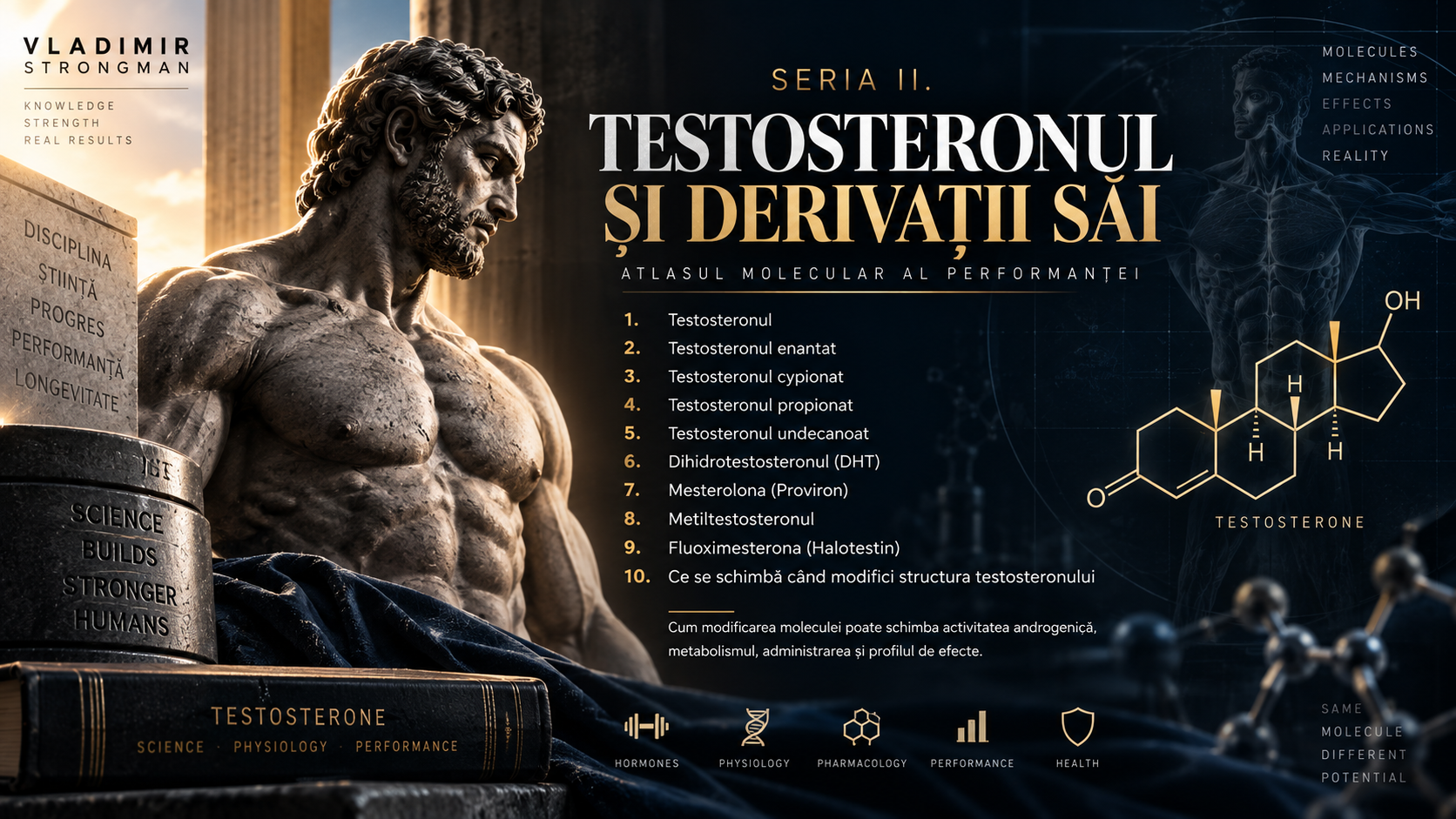
1. Why is DHT the next step after testosterone?
In the previous episodes we followed testosterone from its esterified form to the free hormone. The next step is to see what happens after testosterone reaches specific tissues. This is where dihydrotestosterone, or DHT, becomes important as one of the major natural androgens in the body.
DHT is not simply 'stronger testosterone'. It is a metabolite of testosterone produced by the enzyme 5-alpha-reductase, and its importance depends on tissue, enzyme expression, and androgen receptor biology.
2. What is dihydrotestosterone?
Dihydrotestosterone, abbreviated DHT, is an androgen derived from testosterone. Chemically, conversion involves reduction of a double bond in testosterone, a reaction catalyzed by 5-alpha-reductase.
DHT binds to the same androgen receptor as testosterone, but the interaction is tighter and, in experimental systems, can generate stronger receptor activation. This difference helps explain why DHT can amplify androgenic signaling in particular tissues.
3. What is 5-alpha-reductase?
5-alpha-reductase is a family of enzymes that converts testosterone to DHT. Humans have two principal isoenzymes encoded by different genes and expressed in different proportions across tissues.
Type 2 is strongly expressed in the prostate and some genital tissues, while type 1 is expressed in several organs including skin, liver, and brain. This tissue distribution is essential for understanding why DHT effects differ between organs.
4. Where is DHT produced?
DHT is formed in tissues that express 5-alpha-reductase. The prostate, skin, hair follicles, and certain regions of the nervous system are examples where local conversion of testosterone can contribute to androgen signaling.
This matters because a large part of DHT biology can be intracrine, meaning produced and used locally in the same tissue. Serum DHT therefore does not automatically represent total tissue DHT or tissue androgen activity.
5. What does intracrine mean?
Intracrine means that a steroid hormone or metabolite is produced within a tissue and acts locally, without needing to circulate in high concentrations to exert its effect.
In androgen physiology, this concept is fundamental. A tissue can receive testosterone from the circulation, locally convert it to DHT, and then use DHT to activate the androgen receptor. The final tissue signal cannot be inferred from a serum result alone.
6. Why does DHT bind the androgen receptor more strongly?
The androgen receptor is a nuclear receptor that functions as a transcription factor. When an androgen binds, the receptor-ligand complex can alter expression of genes controlling cellular function.
DHT has higher affinity for the androgen receptor than testosterone, and its dissociation from the receptor is slower. In transactivation models, DHT produces more potent receptor activation, but higher affinity does not mean every physiological effect is automatically greater in every tissue.
7. Does higher affinity automatically mean a bigger effect?
No. Affinity is only one part of the equation. Biological effect also depends on ligand concentration, receptor abundance, available co-regulators, tissue enzymes, and the cellular pathways downstream of receptor activation.
This is why DHT should be described as a potent, context-dependent androgenic signal, not as a universal unit of 'anabolic strength' that applies equally to every tissue.
8. What is androgenic amplification?
Conversion of testosterone to DHT is often described as androgenic amplification. The idea is that a tissue can transform a circulating androgen, testosterone, into a ligand that activates the androgen receptor more efficiently.
Endotext estimates that about 4% of circulating testosterone is converted to DHT, but this should not be treated as a fixed ratio for every tissue or every individual. Local conversion can be far more important than the overall blood percentage.
9. Is DHT only a circulating hormone?
No. DHT can circulate in blood, but a large part of its biological relevance comes from local production in target tissues. This is one reason serum DHT is not a perfect surrogate for tissue androgen activity.
Clinical literature indicates that intracellular androgen concentrations in androgen-sensitive tissues can be relatively independent of circulating concentrations. A blood test is therefore one piece of the puzzle, not the whole picture.
10. What role does DHT play in genital development?
During male fetal development, DHT is essential for development of the external genitalia. Testosterone and DHT have different roles, and local conversion of testosterone to DHT amplifies the androgenic signal required for these developmental processes.
This is demonstrated clearly by congenital type 2 5-alpha-reductase deficiency, in which external genital development is impaired during fetal life while some other androgen-dependent processes are less affected.
11. What role does DHT play at puberty?
At puberty, DHT contributes to development of several male secondary sexual characteristics and maturation of androgen-dependent tissues. The prostate, skin, and hair follicles respond differently to androgens, and local testosterone conversion is important for this tissue-specific pattern.
At the same time, many pubertal effects do not depend exclusively on DHT. Testosterone remains a major androgen and can act directly through the androgen receptor in many tissues.
12. DHT and the prostate
The prostate expresses 5-alpha-reductase and produces DHT locally. DHT binds the androgen receptor and contributes to prostate development and maintenance.
The same pathway is involved in benign prostatic hyperplasia, which is why 5-alpha-reductase inhibitors such as finasteride and dutasteride reduce DHT production in prostatic tissue and can reduce prostate volume.
13. DHT and body hair
Hair follicles respond to androgens in a region-dependent manner. In some areas, androgen signaling promotes transformation of fine hairs into thicker terminal hairs, while in genetically susceptible scalp follicles, androgen signaling can contribute to miniaturization.
This is one of the clearest demonstrations of tissue specificity: the same hormone can stimulate hair growth in one region and contribute to hair loss in another because follicle biology, receptor context, co-regulators, and the local environment differ.
14. DHT and acne
Androgens influence sebaceous glands, and DHT is a potent androgen in skin. Androgen receptor activation can increase sebaceous activity and contribute to an environment favorable to acne in susceptible individuals.
Acne, however, is not a simple readout of 'how much DHT you have'. Genetics, receptor sensitivity, sebaceous gland activity, and local inflammation all matter.
15. DHT and muscle mass
This is where many myths appear. DHT is a potent androgen at the receptor, but that does not mean it is the main driver of skeletal muscle hypertrophy in adults. Skeletal muscle is a tissue where testosterone can act directly, and clinical and physiological data do not support the simple idea that 'DHT is the testosterone for muscle growth'.
DHT can influence androgen-dependent processes, but the relationship among androgens, receptors, protein synthesis, satellite cells, and training adaptation is much more complex.
16. DHT and bone
Androgens participate in bone physiology, but testosterone also has an important role through conversion to estradiol. DHT cannot be aromatized to estradiol, making it biologically different from testosterone in some aspects of bone metabolism.
This is another good example of the series' central rule: an androgen that is more potent at the receptor is not automatically the dominant hormone for every physiological function.
17. Can DHT be converted to estradiol?
Not by classical aromatase. DHT has already undergone 5-alpha reduction and does not have the structural arrangement needed for aromatization to estradiol. Therefore, DHT and testosterone are not biologically interchangeable.
Testosterone is both an androgen receptor ligand and a precursor to estradiol. DHT is primarily an androgen and does not provide the same estrogenic pathway.
18. What happens when 5-alpha-reductase is inhibited?
Inhibition of 5-alpha-reductase lowers conversion of testosterone to DHT. Finasteride primarily inhibits type 2, while dutasteride inhibits both type 1 and type 2.
The consequences are tissue dependent. DHT production in the prostate falls substantially, and some androgen-dependent effects, including miniaturization of genetically susceptible scalp follicles, can be reduced. Circulating testosterone does not disappear and continues to act through the androgen receptor and through aromatization.
19. Why doesn't finasteride 'block testosterone'?
Finasteride does not block the androgen receptor and does not stop testosterone production. It reduces the activity of an enzyme that converts testosterone into DHT.
That distinction is essential: inhibiting a metabolite pathway is not the same thing as blocking the precursor hormone.
20. What happens after exogenous testosterone is given?
When exogenous testosterone increases androgen availability in circulation, tissues expressing 5-alpha-reductase can produce more DHT. A testosterone ester can therefore indirectly change DHT exposure without DHT itself being administered.
The magnitude of the change depends on tissue, enzyme expression, testosterone concentration, and individual biology. There is no universal rule such as 'x testosterone produces y DHT' that applies to everyone.
21. Why can DHT rise after oral testosterone undecanoate?
With oral testosterone undecanoate, the pharmacokinetic pathway involving lipid absorption and lymphatic transport can produce a distinctive profile of testosterone and its metabolites. Studies have reported increases in DHT that cannot be explained simply by assuming a fixed testosterone-to-DHT ratio.
It is an excellent example of why the nominal amount of testosterone does not by itself tell us which metabolites will be generated or in what proportion.
22. Circulating DHT versus tissue DHT
Serum concentration measures DHT that has reached the blood. It does not fully capture DHT produced locally in a tissue. For many androgenic actions, the cellular microenvironment is what matters.
Therefore, a 'normal' serum DHT value does not exclude important local production in a tissue with high 5-alpha-reductase activity, while an elevated serum value does not prove proportionally elevated tissue activity in every organ.
23. DHT and the androgen receptor
After DHT binds, the androgen receptor undergoes conformational changes and participates in regulation of gene transcription. The androgen-receptor complex interacts with androgen response elements and nuclear co-regulators.
This is not a simple on-off reaction. Receptor abundance, co-regulator composition, and the cell's genetic program influence the final response.
24. Why does the same receptor produce different effects in different tissues?
Because the androgen receptor does not work alone. Each tissue has its own set of transcription factors, co-activators, co-repressors, steroidogenic enzymes, and genetic programs.
Therefore, androgen receptor activation in prostate does not produce the same molecular result as activation in muscle, skin, or brain. Tissue context is part of the ligand-response system.
25. DHT and gene expression
DHT changes expression of androgen-responsive genes through the androgen receptor. This can alter protein production, cellular differentiation, and tissue-specific functions.
The effect depends on time and exposure. Repeated or chronic activation of the same pathway can produce responses different from a brief stimulus, especially when receptors and co-regulators adapt.
26. Is DHT necessarily 'good' or 'bad'?
No. DHT is a physiological hormone. It has essential roles in sexual development and tissue function, while the same androgen pathway can contribute to disease processes in certain contexts, including benign prostatic hyperplasia and androgenetic alopecia.
In biology, 'good' and 'bad' are often too crude for hormones that have normal functions and context-dependent consequences.
27. What does 5-alpha-reductase deficiency mean?
Congenital type 2 5-alpha-reductase deficiency results from variants in the SRD5A2 gene. The result is reduced DHT production in tissues that depend strongly on this pathway, especially during fetal development.
Observing affected individuals has helped medicine distinguish testosterone-dependent from DHT-dependent effects. It is one of the strongest natural human examples for studying the role of a hormone metabolite.
28. What should a strongman remember?
For a strength athlete, the most important lesson is not to confuse DHT with a simple marker of 'aggressiveness' or androgenic 'power'. DHT is a potent testosterone metabolite, produced especially locally in tissues that express 5-alpha-reductase.
When exogenous testosterone rises, its metabolites can rise as well, including DHT. But the effects on scalp, skin, prostate, muscle, and other tissues are not identical and cannot be predicted from a single serum result.
29. Conclusion
Dihydrotestosterone is a central component of androgen physiology. Testosterone can be converted locally to DHT by 5-alpha-reductase, and DHT binds the androgen receptor with higher affinity and can amplify androgenic signaling in specific tissues.
But the deeper lesson is more subtle: DHT is not 'better testosterone'. It is a metabolite with its own biology, strongly dependent on tissue. Prostate, skin, hair follicles, brain, muscle, and bone do not respond identically because they differ in enzymes, receptors, co-regulators, and genetic programs.
That logic lets the series go one step further: other structural modifications of testosterone can change receptor interaction, metabolism, and effect profiles without making all of these substances interchangeable.
Selected sources
McEwan IJ, Brinkmann AO. Androgen Physiology: Receptor and Metabolic Disorders. Endotext, NCBI Bookshelf.
Handelsman DJ. Androgen Physiology, Pharmacology, Use and Misuse. Endotext, NCBI Bookshelf.
Wilson JD. Role of dihydrotestosterone in androgen action. Prostate Supplement. 1996. PMID 8630237.
Marchetti PM, Barth JH. Clinical biochemistry of dihydrotestosterone. Annals of Clinical Biochemistry. PMID 23431485.
Dihydrotestosterone: Biochemistry, Physiology, and Clinical Implications of Elevated Blood Levels. PMID 28472278.
More From The Journal

Training
The Science of Strongman Training - Episode X: Competition Programming
How to build a complete Strongman competition preparation block: calendar, events, volume, intensity, specificity, simulations, autoregulation, tapering and fatigue management.

Training
The Science of Strongman Training - Episode IX: Peaking
Peaking in Strongman: how to turn months of training into maximal competition performance by reducing fatigue, preserving adaptations and managing specificity.