
Pharmacology
Series: Performance-Enhancing Substances That Do Not Directly Build Muscle - Episode 9: Oxygenation and Repeated Effort
September 8, 2026
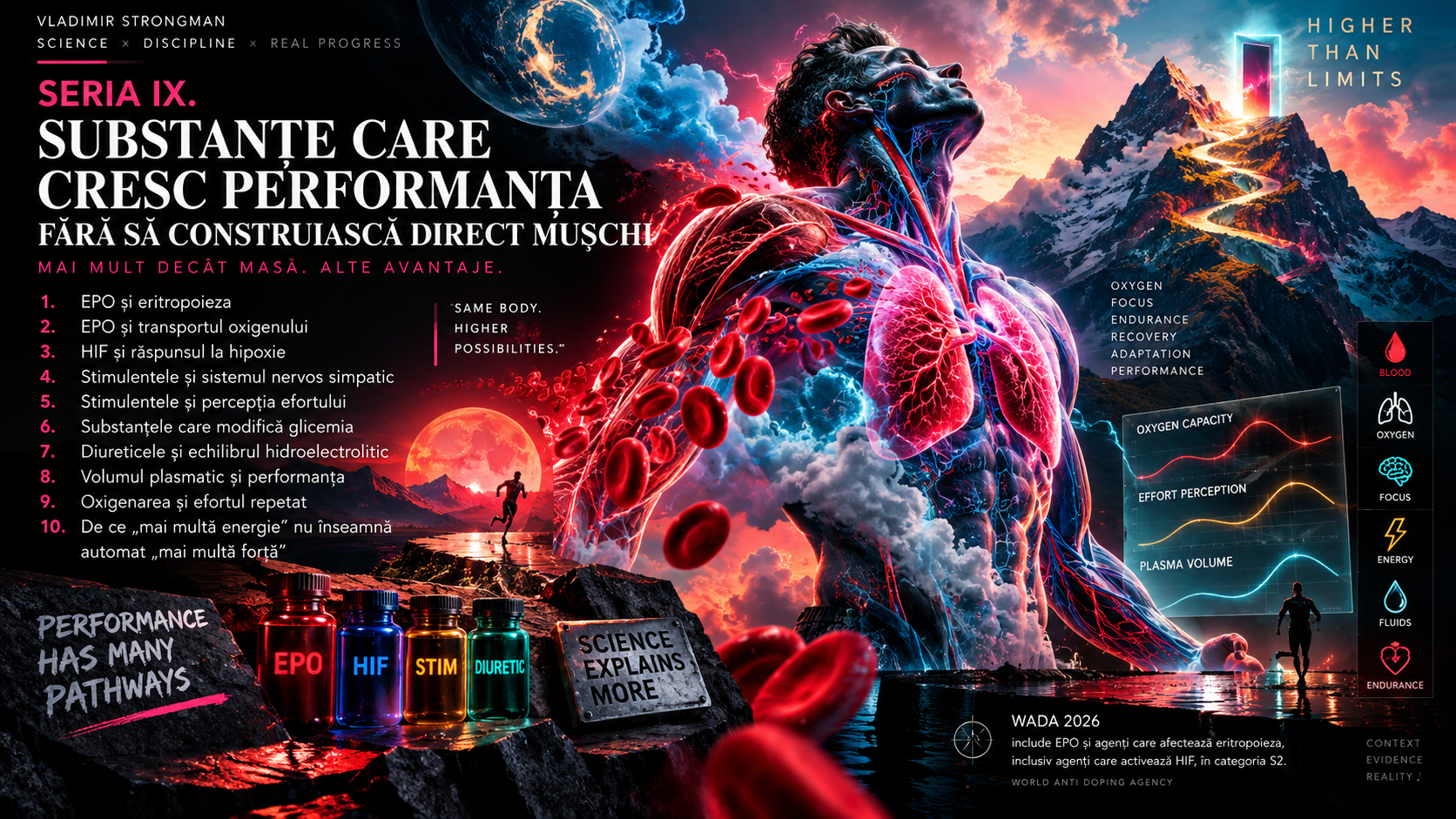
In previous episodes we followed oxygen from erythropoiesis and haemoglobin to plasma volume and circulation. Episode 9 shifts the question from 'how much oxygen can blood carry?' to 'how well can the body use that oxygen when effort must be repeated?'. For a Strongman athlete, this is the difference between one successful lift and remaining functional after four or five events.
Oxygenation is not a single number. It depends on ventilation, pulmonary gas exchange, haemoglobin saturation, haemoglobin concentration, cardiac output, blood-flow distribution and the muscle's ability to extract and use oxygen. Any link can become limiting, and repeated effort makes those limitations accumulate.
This article explains physiology, training adaptation and risk rather than protocols for artificially manipulating oxygen transport. Blood-doping methods and substances that artificially enhance oxygen transport are tightly regulated and can carry serious cardiovascular risks.
1. Oxygenation means more than breathing
Getting air into the lungs is only the first step. Oxygen must move from the alveoli into blood, bind to haemoglobin, be pumped toward working muscle and then diffuse to the mitochondria. Repeated performance depends on the entire chain, not on one isolated stage.
2. Alveolar ventilation
Alveolar ventilation describes the fresh air that actually reaches the alveoli and participates in gas exchange. During intense exercise, breathing rate and depth rise rapidly. If ventilation cannot keep up with carbon-dioxide production and metabolic demand, breathlessness may become limiting before the muscle is completely exhausted.
3. Oxygen diffusion through the lungs
Oxygen crosses the alveolar-capillary membrane according to partial-pressure gradients and the available exchange surface. In a healthy adult this stage usually has substantial reserve, but altitude, pulmonary disease or extremely intense exercise can reduce the safety margin.
4. Haemoglobin saturation
Saturation indicates what proportion of haemoglobin is carrying oxygen. At sea level, a healthy athlete usually maintains high values at rest. Good saturation does not guarantee performance, however, if haemoglobin is low, cardiac output is inadequate or muscle cannot use oxygen efficiently.
5. Haemoglobin is the main carrier
Most oxygen in blood is bound to haemoglobin. Oxygen dissolved directly in plasma represents only a small fraction. Total haemoglobin mass therefore matters more for carrying capacity than plasma alone, although plasma volume strongly influences the circulation that delivers it.
6. Arterial oxygen content
Arterial oxygen content depends mainly on haemoglobin concentration and haemoglobin saturation. Two people may show the same pulse-oximeter saturation yet have very different oxygen-carrying capacities if one has substantially less haemoglobin.
7. Cardiac output determines how much blood reaches muscle
Even perfectly oxygenated blood is useless if it does not reach tissue quickly enough. Cardiac output, the product of heart rate and stroke volume, determines how much blood can be moved each minute. This is where the previous episode on plasma volume connects directly with oxygenation.
8. Oxygen delivery is content multiplied by flow
Physiologically, oxygen delivery depends on how much oxygen arterial blood contains and how much blood the heart pumps. Increasing one component does not automatically improve performance if the other component becomes limiting.
9. Muscle must extract oxygen
Oxygen arriving in capillaries must be extracted by tissue. The arterial-venous oxygen difference reflects how much oxygen the muscle has taken up. Training can improve this capacity through capillary, mitochondrial and enzymatic adaptations.
10. The Fick principle
Oxygen consumption can be understood through the Fick principle: cardiac output multiplied by the arterial-venous oxygen difference. The message is simple: aerobic performance depends both on the pump and on the tissues' ability to extract oxygen.
11. VO2 is not the same thing as strength
A high VO2 max does not automatically produce a heavier deadlift. Maximal strength depends primarily on muscle mass, architecture, technique and neural drive. Aerobic capacity still influences how quickly an athlete recovers between sets, attempts and events.
12. Very short maximal effort is largely anaerobic
The first seconds of a maximal lift are supported mainly by stored ATP and the phosphagen system. Oxygen does not instantly produce the energy for a one-repetition maximum, but it becomes crucial immediately afterward for restoring energy systems.
13. Phosphocreatine recovery
Phosphocreatine resynthesis after intense exercise is strongly dependent on oxidative metabolism. Better oxygen delivery and utilization can therefore support more efficient restoration of phosphocreatine between efforts. This is one reason conditioning matters even in a strength sport.
14. Rest between efforts is metabolically active
When an athlete sits down after an event, the body is not switched off. The heart, lungs, liver and muscle continue working to restore high-energy phosphates, pH, temperature and fluid distribution. Recovery is an active process that consumes oxygen.
15. EPOC: oxygen consumption stays elevated
After intense exercise, oxygen consumption remains above resting level for a period. This excess post-exercise oxygen consumption reflects several recovery processes, from phosphocreatine restoration to thermoregulation and cardiovascular normalization.
16. Lactate is not useless waste
Lactate can be transported and used as an energy substrate by other muscle fibres, the heart and other tissues. Its disappearance from blood is not simply the washing out of acid. Lactate metabolism is closely tied to oxidative capacity.
17. Acidosis and the burning sensation
Intense exercise produces rapid changes in hydrogen ions, inorganic phosphate and other metabolites. Burning and performance loss cannot be blamed on one molecule alone. Good oxygenation supports recovery, but it does not completely erase local fatigue.
18. Mitochondria are the main site of oxidative metabolism
Mitochondria turn energy from carbohydrate and fat into ATP through oxygen-dependent processes. Conditioning can increase mitochondrial density and function, improving the muscle's ability to recover between intense efforts.
19. Capillarization
A richer functional capillary network around muscle fibres reduces diffusion distance and facilitates exchange of oxygen, nutrients and metabolites. A Strongman athlete does not pursue capillarization like a marathon runner, but efficient microcirculation can still help between events.
20. Myoglobin
Myoglobin binds oxygen inside the muscle fibre and helps move it toward mitochondria. Its systemic role is smaller than haemoglobin's, but it remains part of the local oxygen-transport chain.
21. Muscle fibres do not use oxygen identically
Type I fibres are more oxidative and fatigue resistant, whereas fast fibres produce more force but fatigue sooner. Strongman performance depends heavily on fast fibres, yet recovery between contractions and events benefits from oxidative infrastructure across the muscle.
22. Strong contraction can compress blood vessels
During a maximal contraction, intramuscular pressure can compress small vessels and temporarily reduce blood flow. Local oxygenation may therefore fall even when arterial blood is perfectly oxygenated.
23. Reperfusion after the load is released
When contraction ends and intramuscular pressure falls, blood flow rises again. This reperfusion delivers oxygen and helps process or redistribute metabolites. Time between repetitions and events therefore has real physiological value.
24. The Valsalva manoeuvre temporarily changes circulation
Valsalva helps stiffen the trunk during heavy lifting, but it also changes intrathoracic pressure, venous return and arterial pressure. Oxygenation does not disappear, yet blood flow and perfusion are altered during the effort.
25. Breathing after an event is part of recovery
Rapid breathing after a medley is not simply panic or poor conditioning. It reflects high carbon-dioxide production, acid-base disturbance, heat and the metabolic cost of recovery. How quickly breathing settles gives clues about how expensive the event was.
26. Repetition changes what becomes limiting
In the first event, maximal strength may be the main limit. By the fourth, the same muscle is still present, but oxygen delivery, temperature, hydration and phosphocreatine restoration may become decisive. Repeated performance is a systems problem, not just a muscle problem.
27. Repeated-sprint ability and Strongman
Research on repeated high-intensity efforts shows that oxidative metabolism contributes progressively more as efforts are repeated. Strongman events are not classic sprints, but the principle is similar: aerobic contribution becomes increasingly important during recovery and successive bouts.
28. Incomplete recovery changes the next event
If phosphocreatine, pH, temperature and circulating volume have not recovered sufficiently, the next effort begins from a worse physiological baseline. Motivation may be high while the energy systems are still in debt.
29. Long breaks and short breaks create different contests
A contest with thirty minutes between events stresses the body differently from one with only five to ten minutes. The shorter the recovery window, the more oxidative recovery and cardiovascular regulation matter.
30. Yoke Walk
The Yoke combines enormous axial tension, rapid steps and major cardiovascular demand. The event may last tens of seconds and leave heart rate and ventilation very high. Better oxygenation does not make the implement lighter, but it can shorten the physiological road back toward readiness.
31. Farmers Walk
Farmers challenges grip, trunk, legs and locomotion. Strong forearm contractions restrict local flow while the body must support movement and stabilization at the same time. Cardiovascular recovery becomes especially important in medleys or repeated runs.
32. Truck Pull
Truck Pull recruits a very large muscle mass and rapidly drives ventilation and cardiac output upward. The effort may be short, but its metabolic cost can be enormous. After the finish, oxygen becomes one of the central currencies of recovery.
33. Loading Medley
A loading medley alternates lifting, fast movement and manipulation of several objects. The limiting factor can migrate from strength to ventilation to the legs and back to technique. Weak aerobic infrastructure can turn the final object into a wall.
34. Atlas Stones
A stone series combines flexion, extension, brief breath holding, chest compression and repeated force production. Early stones may be limited mainly by strength, while the last ones depend increasingly on the ability to reproduce force under fatigue and heavy breathing.
35. Log for reps
Each repetition in a log-for-reps event is explosive, but the complete set becomes a mixed-energy problem. Phosphocreatine falls, glycolysis rises and oxidative metabolism contributes progressively more to recovery between repetitions.
36. Deadlift for reps
Deadlift for repetitions produces a severe combination of muscular tension, Valsalva and metabolic demand. Oxygenation does not replace strength, but it can influence recovery between repetitions and how quickly bar speed deteriorates.
37. Holds and local ischaemia
During Hercules Hold or Farmers Hold, sustained contraction can compress vessels and reduce local perfusion. Forearms may therefore fail while the heart and lungs still have reserve. Systemic oxygenation has limits when local mechanics temporarily close the tap.
38. Heat raises the cost of oxygen delivery
In the heat, more cardiac output must be directed toward the skin for cooling. Working muscle and thermoregulation compete for the same circulation. If plasma volume falls, that competition becomes harsher.
39. Dehydration reduces circulatory reserve
Dehydration can reduce stroke volume and raise heart rate at the same workload. Oxygen saturation may remain normal while maintaining effective blood delivery to muscle becomes more difficult.
40. Altitude lowers inspired oxygen pressure
At altitude, the percentage of oxygen in air remains roughly the same, but barometric pressure falls. Inspired oxygen partial pressure is therefore lower, making haemoglobin loading more difficult. Repeated efforts may suffer even if a single maximal-strength attempt changes less.
41. Acclimatization to altitude
Altitude exposure triggers ventilatory, hormonal and haematological responses. Adaptation is not immediate and cannot be reduced to EPO alone. Plasma volume, ventilation and acid-base balance also change.
42. Iron deficiency can limit transport
Iron is required for haemoglobin synthesis and for many oxidative enzymes. Deficiency can impair performance even before severe anaemia develops. Ferritin and related markers need clinical interpretation, particularly when inflammation is present.
43. Anaemia and repeated effort
Low haemoglobin reduces oxygen-carrying capacity. An athlete may preserve part of maximal strength yet fatigue faster and recover more slowly between efforts. Unusual breathlessness and declining exercise tolerance deserve investigation.
44. Excess viscosity can become counterproductive
More red cells can increase carrying capacity, but they also increase blood viscosity. If haematocrit becomes excessive, the heart must pump thicker blood and thrombotic risk can rise. Physiology does not reward one direction indefinitely.
45. EPO does not solve every link
Increasing erythropoiesis can change oxygen transport, but it does not automatically fix poor conditioning, ventilation, dehydration or energy recovery. A single intervention must therefore be separated from the function of the whole system.
46. HIF coordinates the hypoxic response
HIF factors regulate genes involved in erythropoiesis, angiogenesis and metabolism. They show that the body's response to low oxygen is a coordinated programme rather than a single hormone. Adaptation to hypoxia is a network.
47. Inhaled supplemental oxygen
Supplemental oxygen can increase inspired oxygen pressure, but in healthy athletes at sea level haemoglobin is already close to fully saturated. Effects on performance or recovery may therefore be limited and context dependent. It does not replace conditioning.
48. WADA status of inhaled oxygen
The 2026 WADA Prohibited List bans methods that artificially enhance oxygen uptake, transport or delivery, but explicitly excludes supplemental oxygen by inhalation from section M1.2. That exception does not mean every oxygen-manipulation method is permitted.
49. Blood doping is a different category
Reintroduction of blood or red-cell products to enhance performance is a prohibited method. It directly changes red-cell mass and can increase viscosity, cardiovascular strain and thrombotic risk.
50. Products that artificially alter oxygen transport
WADA M1.2 includes methods and products that artificially enhance oxygen uptake, transport or delivery, including certain haemoglobin substitutes. The fact that a technology can carry oxygen does not make it safe or legal in sport.
51. Carbon monoxide and haemoglobin
Carbon monoxide binds haemoglobin with very high affinity and reduces the blood's capacity to transport oxygen. Exposure can cause headache, dizziness, confusion and, at high levels, severe injury. It is not a conditioning shortcut.
52. Smoking and oxygenation
Cigarette smoke exposes the body to carbon monoxide and other substances that impair cardiovascular and respiratory function. For an athlete, this can reduce oxygenation reserve and make recovery harder even when raw strength does not disappear immediately.
53. Sleep and nocturnal breathing
Poor-quality sleep and sleep-related breathing disorders can affect recovery, blood pressure and metabolic control. In very large athletes, severe snoring and witnessed breathing pauses deserve medical assessment because nighttime oxygenation is part of recovery.
54. Respiratory infections reduce reserve
A respiratory infection can increase the work of breathing and reduce exercise tolerance. Returning too quickly to maximal effort when fever, chest pain or unusual breathlessness are present is a safety issue, not a test of willpower.
55. Pulse oximetry has limits
A pulse oximeter estimates peripheral oxygen saturation but can be affected by motion, poor peripheral perfusion, temperature and sensor quality. A normal reading says nothing directly about haemoglobin level, cardiac output or conditioning.
56. Heart-rate recovery
The fall in heart rate after exercise provides information about autonomic and cardiovascular recovery. It is not a direct measure of oxygenation, but it can help describe how expensive an event was and how recovered the athlete may be before the next one.
57. Aerobic conditioning for Strongman
Useful conditioning for Strongman does not need to copy distance-running training. The goal is a heart that can deliver blood efficiently, faster recovery between efforts and better tolerance of workload without sacrificing strength qualities.
58. Specificity still matters
Cycling, incline walking, sled work, circuits and submaximal event practice create different stresses. The best conditioning develops cardiovascular capacity without excessively interfering with recovery, technical work and strength development.
59. Warning signs
Disproportionate breathlessness, chest pain, cyanosis, fainting, confusion, persistent palpitations or an unexplained fall in resting oxygen saturation require medical assessment. Treating them as simple lack of conditioning can be dangerous.
60. Conclusion: oxygen determines how quickly you can come back
Oxygen does not perform a maximal lift by itself, but it supports the recovery that makes the next lift, sprint and event possible. In Strongman, the difference between being strong and remaining strong until the end often depends on whether oxygen-delivery and oxygen-utilization systems can keep pace with repeated effort.
In practice, good oxygenation often becomes visible through what does not happen: heart rate does not remain excessively elevated between events, breathing settles faster, the athlete can eat and drink, and technique does not collapse late in the day. These advantages are not dramatic in one photograph, but they become obvious over a long contest.
Another important point is that a pulse oximeter does not measure performance. It estimates peripheral haemoglobin saturation, but it does not tell you how much haemoglobin is present, how much blood the heart pumps or how much oxygen muscle extracts. A perfect-looking number can coexist with poor exercise capacity.
Strength sports often tempt athletes to treat aerobic and anaerobic metabolism as completely separate. In reality they operate together. An effort can be predominantly anaerobic while immediate recovery depends heavily on oxidative metabolism. This alternation explains why well-dosed conditioning can help a very strong athlete.
For Strongman, the most useful model is not 'becoming good at cardio' but 'restoring the systems that let me express strength more quickly'. Seen this way, conditioning does not compete with strength. It protects strength later in training and later in competition.
The series therefore reaches a central idea: performance can improve without directly building muscle because muscle depends on infrastructure. Red cells, plasma, lungs, heart, blood vessels, mitochondria and the nervous system form a network. Strength is the engine, but the network determines how long the engine remains useful.
Sources and recommended reading
1. Guyton and Hall. Textbook of Medical Physiology. Chapters on ventilation, gas exchange, oxygen transport, cardiac output and cardiovascular control.
2. McArdle WD, Katch FI, Katch VL. Exercise Physiology. Energy systems, oxygen transport, recovery and exercise performance.
3. Powers SK, Howley ET. Exercise Physiology: Theory and Application to Fitness and Performance. Oxygen transport and training adaptations.
4. Poole DC, Jones AM. Reviews on oxygen-uptake kinetics and metabolic transitions during exercise.
5. Bogdanis GC and colleagues. Classic research on phosphocreatine recovery and repeated high-intensity exercise performance.
6. Brooks GA. The lactate shuttle. Research on lactate use as an energy substrate and its relationship with oxidative metabolism.
7. Joyner MJ, Casey DP. Reviews on exercise blood flow, oxygen delivery, muscle perfusion and cardiovascular regulation.
8. Sawka MN and colleagues. Guidance and research on hydration, thermoregulation and cardiovascular function during exercise.
9. World Anti-Doping Agency. The 2026 Prohibited List. Section M1 on manipulation of blood and artificial enhancement of oxygen uptake, transport or delivery.
10. Sports-medicine literature on anaemia, iron deficiency, altitude, pulse oximetry and assessment of breathlessness in athletes.
Editorial note: this material is educational and explains the physiology of oxygenation and repeated effort. It is not a recommendation for blood doping, EPO use, haemoglobin manipulation, carbon-monoxide exposure or other methods of artificially enhancing oxygen transport. Chest pain, fainting, unusual breathlessness or unexplained low oxygen saturation require medical assessment.
More From The Journal

Training
The Science of Strongman Training - Episode X: Competition Programming
How to build a complete Strongman competition preparation block: calendar, events, volume, intensity, specificity, simulations, autoregulation, tapering and fatigue management.

Training
The Science of Strongman Training - Episode IX: Peaking
Peaking in Strongman: how to turn months of training into maximal competition performance by reducing fatigue, preserving adaptations and managing specificity.