
Pharmacology
Series: Performance-Enhancing Substances That Do Not Directly Build Muscle - Episode 2: EPO and Oxygen Transport
September 8, 2026
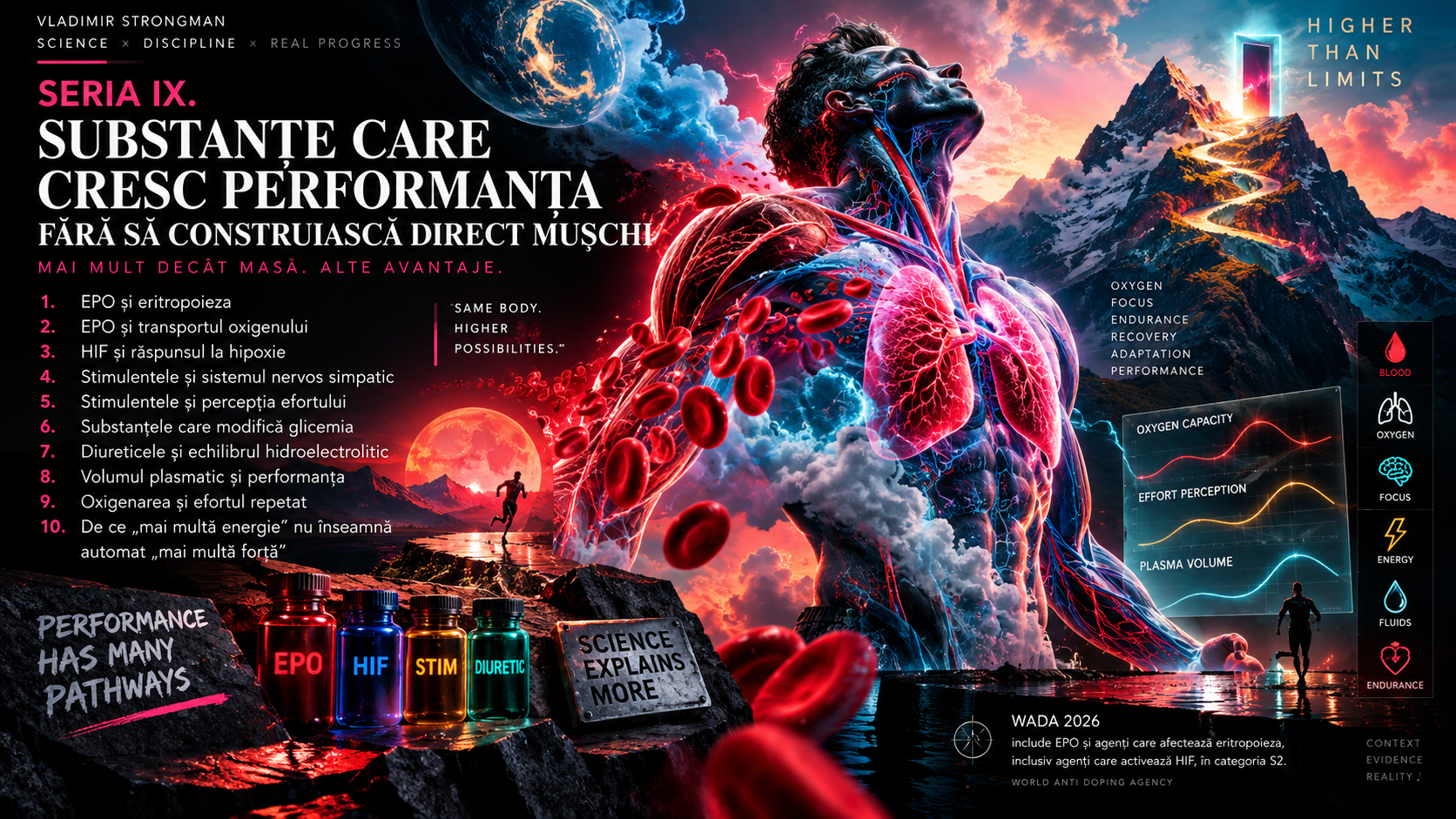
In the previous episode we followed how the body produces red blood cells and why erythropoietin, or EPO, has a central role in that process. Now we go one step further. Having more red blood cells is not enough by itself. They must pick up oxygen in the lungs, carry it through the circulation and release it where tissues need it. This is where the real story of oxygen transport begins and where the link between EPO and performance becomes easier to understand.
For the average reader, the phrase “oxygen transport” may sound abstract. In reality it describes one of the body's most concrete jobs: you breathe air in, oxygen enters the blood, most of it binds to hemoglobin, the heart sends that blood toward organs and muscles, and cells use oxygen to produce energy. Any weak link in this route can limit exercise. EPO acts mainly on one part of the chain by increasing red-cell mass, but the consequences can affect the entire system.
The goal of this episode is not to turn the reader into a physiologist. We will focus on the ideas that matter for understanding why blood that can carry more oxygen may help certain forms of exercise, why the benefit is not identical in every sport, and why the same change that may look attractive for performance can also increase cardiovascular strain. In sport, context decides almost everything.
1. Oxygen is the invisible fuel behind sustained effort
Muscle can produce energy without oxygen for short periods, but those pathways are limited and fatigue appears quickly. For continued effort, repeated sets and recovery between hard efforts, oxygen becomes essential. It allows mitochondria to extract much more usable energy from carbohydrates and fats than anaerobic pathways can provide alone. This is why the ability to deliver oxygen to muscle affects not only running or cycling but also the way a strength athlete recovers between sets, events and demanding training bouts.
2. The journey begins in the lungs
When we inhale, air travels to the alveoli, tiny structures where oxygen can cross into the blood. This transfer depends on ventilation, lung surface area, the pressure difference for oxygen and the quality of the membrane between air and blood. In a healthy person the lungs are usually very efficient. The limiting issue is not always how much oxygen enters the chest, but how much oxygen the blood can pick up and carry onward. That is where hemoglobin becomes the central character.
3. Hemoglobin is the main vehicle for oxygen
Only a small amount of oxygen travels freely dissolved in plasma. Most is carried bound to hemoglobin, the protein inside red blood cells. Each hemoglobin molecule can bind oxygen in the lungs and later release it to tissues. For that reason, when total hemoglobin mass rises, the theoretical oxygen-carrying capacity of the blood also rises. EPO does not carry oxygen itself. Its role is closer to increasing the number of transport vehicles available for the journey.
4. More red blood cells do not mean more oxygen in the air
A common misunderstanding is that EPO somehow brings more oxygen into the body. The air does not suddenly contain a higher percentage of oxygen, and the lungs are not breathing a different atmosphere. What can change is the blood's capacity to collect and transport the oxygen that is already available. Think of the same amount of cargo with a larger fleet of trucks. If the roads and engine work well, transport capacity may rise. If another link is limiting, the advantage may be smaller than expected.
5. Oxygen saturation and total oxygen content are not the same thing
A pulse oximeter estimates hemoglobin saturation, meaning the percentage of oxygen-binding sites that are occupied. Two people can both show 97 or 98 percent saturation while having very different amounts of hemoglobin. The person with more hemoglobin may carry more total oxygen even though the saturation percentage is identical. Saturation therefore does not tell the whole story. It describes how full the vehicles are, not how many vehicles are traveling through the bloodstream.
6. Hematocrit is a snapshot of blood composition
Hematocrit roughly represents the proportion of blood volume occupied by red blood cells. It is useful but must be interpreted carefully. Dehydration can raise hematocrit by reducing plasma volume without the body suddenly producing more red cells. Conversely, plasma-volume expansion can make the percentage appear lower. This is why hematocrit, hemoglobin, hydration and clinical context should be viewed together, especially in athletes who sweat heavily or change body weight quickly.
7. EPO changes transport capacity through erythropoiesis
The basic role of EPO is to signal the bone marrow to support the production and maturation of cells in the red-blood-cell lineage. As red-cell mass and hemoglobin mass rise, each unit of blood can potentially carry more oxygen. The process is not instantaneous and depends on iron availability, marrow health, kidney function and many other factors. EPO is a signal, not the raw material from which hemoglobin is built.
8. Iron is essential for functional hemoglobin
Hemoglobin requires iron in order to bind oxygen. If iron stores are inadequate, the body cannot efficiently build functional hemoglobin no matter how strong the erythropoietic signal is. This is why iron-deficiency anemia can markedly reduce exercise tolerance. In medicine, iron status, ferritin and related markers are evaluated because red-cell production is a construction process that needs materials, not only hormonal instructions.
9. The heart is the pump that makes the system useful
Even blood rich in hemoglobin is useless if it is not circulated. The heart must deliver blood to tissues through cardiac output, the volume pumped each minute. During exercise, cardiac output rises as heart rate increases and, up to a point, as the amount of blood ejected with each beat increases. Oxygen transport is therefore a cooperative product of lungs, blood and heart. None of these components can replace the others.
10. Arterial oxygen content matters more than many people realize
When blood leaves the lungs, the amount of oxygen it carries depends largely on hemoglobin concentration and how well that hemoglobin is saturated. Physiologists describe this as arterial oxygen content. You do not need to memorize the formula to understand the principle: if there is more functional hemoglobin and it is well oxygenated, each liter of blood can carry more oxygen toward tissues. This is one reason total hemoglobin mass is relevant to endurance performance.
11. Muscle still has to extract oxygen from the blood
Transport does not end when blood reaches the muscle. Oxygen must cross from capillaries into tissue and then into cells. Muscles trained for aerobic work can develop better capillary networks and greater mitochondrial capacity, which helps them extract and use oxygen. This explains why simply increasing hemoglobin cannot replace training. A larger fleet of trucks is less useful if the destination has poor roads, slow unloading and limited machinery to use the delivered cargo.
12. VO2max reflects the whole chain
VO2max describes the maximum amount of oxygen the body can use per minute, often expressed relative to body mass. It is not simply a lung test and it is not simply a blood test. It reflects ventilation, pulmonary exchange, cardiac output, hemoglobin, peripheral circulation and the muscle's ability to use oxygen. Increasing hemoglobin mass can raise the transport ceiling, but the final value depends on the entire system and on the athlete's training status.
13. EPO can affect performance without directly enlarging muscle fibers
This is exactly the theme of this series. EPO is not primarily discussed as a direct hypertrophy agent in the way androgens are. The performance advantage associated with increased erythropoiesis comes mainly from improving oxygen transport. An athlete may be able to sustain high aerobic work more effectively, tolerate a greater total workload and recover faster between efforts that heavily challenge the cardiovascular system. The muscle does not automatically become larger, but the conditions under which it performs can change.
14. The benefit is greatest when oxygen delivery is a real limitation
In endurance sports, where effort lasts minutes or hours, oxygen transport is a major limitation. In a very short sprint or a single maximal lift, most of the immediate energy comes from anaerobic systems. That does not make oxygen irrelevant to strength athletes. It simply makes the effect more indirect: recovery between sets, maintenance of work capacity, tolerance of consecutive events and the ability to recover between demanding training sessions.
15. One maximal lift and an entire competition are different problems
A maximal deadlift lasting a few seconds is not limited mainly by oxygen transport. A competition with six events, warm-ups, walking, heat, nerves and sometimes short recovery periods is a different story. Final performance depends on the ability to repeat hard work. An athlete can be extraordinarily strong in one attempt and still lose ground over the course of the day if cardiovascular capacity and recovery between events cannot support the total workload.
16. Oxygen matters most during recovery between efforts
After a hard effort, the body has to restore phosphocreatine, manage metabolic by-products, rebalance ions and prepare muscle for another intense contraction. A large part of this recovery depends on aerobic metabolism. This is why a strong oxygen-transport system can matter even in sports where individual efforts are short. Oxygen does not lift the implement for the athlete, but it helps create the conditions for the next attempt to be more effective.
17. Phosphocreatine recovery depends heavily on aerobic metabolism
The phosphagen system supplies energy extremely quickly during maximal efforts, but its stores are small. After a heavy set or sprint, phosphocreatine must be rebuilt. That process is supported by oxygen availability and mitochondrial function. So even if the lift itself was mainly anaerobic, recovery for the next lift is strongly tied to aerobic metabolism. This is one reason cardiovascular conditioning can help a strength athlete without turning the athlete into an endurance specialist.
18. Lactate is not simply waste that must be removed
People often say that oxygen “clears lactic acid.” The reality is more interesting. Lactate can be reused as fuel by other muscle fibers, the heart and the liver. A well-developed aerobic system helps the body handle lactate flux and continue working. Better oxygen transport may support that process, but lactate is not an enemy that simply disappears when more oxygen arrives. Metabolism is a recycling network, not a waste pipe.
19. Cardiac output and hemoglobin must work together
The total amount of oxygen delivered to tissues each minute depends on how much oxygen each liter of blood carries and how many liters the heart pumps. If hemoglobin rises, each liter may carry more oxygen. But if blood becomes more viscous, the heart may have to work harder to maintain flow. The advantage is therefore not unlimited. The body constantly balances carrying capacity, plasma volume, vascular resistance and cardiac workload.
20. Viscosity is the hidden cost of highly concentrated blood
As the proportion of red blood cells rises, blood can become more viscous. Think of the difference between pushing water and a thicker fluid through the same network of pipes. The heart and vessels need more pressure to maintain flow. This is one reason excessive hematocrit can become dangerous. More hemoglobin may improve oxygen-carrying capacity up to a point, but beyond that point the cardiovascular cost can become increasingly important.
21. Plasma volume changes the interpretation completely
Blood is not just red cells. Plasma is the liquid component and is crucial for circulating volume, thermoregulation and blood-pressure stability. A well-trained athlete can have a large plasma volume, which may dilute hematocrit without meaning total hemoglobin mass is low. Dehydration can do the opposite and concentrate the blood. One isolated number therefore cannot describe the entire oxygen-transport system.
22. Dehydration can turn an advantage into a risk
On a hot competition day, a very large athlete can lose substantial amounts of water through sweat. As plasma volume falls, blood becomes more concentrated and the heart has to preserve circulation under more difficult conditions. If red-cell mass is already high, viscosity may increase further. Hydration therefore matters directly when discussing hematocrit and oxygen transport. The same number of red blood cells can behave very differently depending on the fluid environment in which they circulate.
23. Heat creates competition for blood flow
During exercise in the heat, blood has two major jobs at once: deliver oxygen to working muscles and carry heat toward the skin for cooling. Skin vessels dilate, sweating rises and plasma volume can fall. For a 120-, 140- or 160-kilogram athlete, this demand can be enormous. Greater oxygen-carrying capacity does not cancel the problem of thermoregulation. Sometimes the real limitation becomes the cardiovascular system's ability to support both muscle work and body cooling.
24. Altitude shows naturally what the body tries to do through EPO
At altitude, oxygen pressure falls. The body detects this hypoxic environment and increases signals that stimulate EPO production. Over time, hematological adaptations may improve oxygen transport. This natural response is one of the clearest demonstrations of EPO's physiological role. However, altitude adaptation also includes changes in ventilation, circulation and cellular metabolism. It is not only a red-cell story, and people differ greatly in how they respond.
25. Hypoxia does not automatically mean better performance
Exposure to less oxygen is a stress. At first, performance can decline, sleep may worsen, heart rate may rise and high-intensity training can become harder. Adaptations take time and are not identical in every athlete. This helps correct a common thinking error: the fact that an adaptation may eventually become useful does not mean the stimulus that creates it is comfortable or free of cost. Every adaptation demands resources and physiological work.
26. Lung diffusion can become limiting during extreme exercise
In most healthy people the lungs have a large reserve. In highly trained athletes, however, blood can move through pulmonary capillaries so quickly that the time available for full oxygen loading becomes shorter. In some situations, arterial saturation can fall during very intense exercise. If the lung side of the chain becomes limiting, simply adding more hemoglobin does not solve everything. Oxygen transport is a chain, and performance cannot outrun its weakest link indefinitely.
27. Capillaries are the small roads that deliver oxygen to muscle fibers
Large arteries move blood quickly, but exchange with tissue occurs in microscopic capillaries that run close to muscle fibers. Aerobic training can increase capillary density, creating more opportunities for oxygen to move from blood into muscle. Conditioning therefore changes not only the heart but the local infrastructure of the muscle. EPO may increase the amount of oxygen carried, while training can improve the roads that deliver it to the destination.
28. Myoglobin takes over inside muscle
Once oxygen leaves the blood, part of its movement within the muscle fiber is supported by myoglobin, an oxygen-binding protein in muscle tissue. Myoglobin is not hemoglobin and does not circulate in the bloodstream, but it helps store and shuttle oxygen locally. This step shows how many levels the system has. From alveolus to hemoglobin, from heart to capillary and then from myoglobin to mitochondria, performance depends on coordination across many structures.
29. Mitochondria are where oxygen becomes usable energy
Oxygen delivered to muscle has value only if mitochondria can use it effectively. These structures produce ATP through oxidative phosphorylation and sit at the center of aerobic metabolism. Resistance training does not produce exactly the same mitochondrial adaptation as endurance training, and athletes vary greatly in this area. Two people with similar blood values can therefore have very different aerobic capacities. Blood delivers the resource, but the cellular engine determines how well it is used.
30. More oxygen transport does not create unlimited ATP
The body is not a factory where doubling one pipeline automatically doubles final production. If mitochondria, enzymes, capillaries, cardiac output or energy substrates become limiting, improving oxygen transport gives progressively smaller returns. This is a central principle of performance physiology: adaptations are interdependent. One variable can raise a ceiling, but it cannot erase every other biological limit in the system.
31. Strongman is a strength sport with a huge metabolic component
Strongman is not simply a powerlifting single repeated several times during the day. A yoke, farmers walk, medley, truck pull or stone series may last many seconds and drive heart rate extremely high. The competition also includes several of these efforts in one day. For a very heavy athlete, the energetic cost of moving body mass plus implements is enormous. Oxygen transport and cardiovascular conditioning can therefore influence total competition performance even though maximal strength remains central.
32. Loaded carries challenge the heart more than they appear to
During yoke or farmers walk, the legs, trunk, shoulder girdle and grip work at the same time. Powerful contractions can temporarily compress vessels inside the muscles, while blood pressure rises to preserve flow. Once the implement is dropped, circulation changes quickly again. This combination of compression, reperfusion and whole-body effort explains why an athlete can be gasping after only 20 or 40 meters. The problem is not the distance itself but the intensity of the work.
33. Truck pull can become an almost maximal cardiovascular test
A truck pull over 20 or 25 meters may look short, yet the athlete works almost continuously with the legs, trunk and arms for 30, 40 or even 60 seconds. Ventilation rises dramatically, heart rate climbs and oxygen demand increases quickly. In the final part of the event, success no longer depends only on raw strength. It also depends on maintaining energy production in a body that is already severely fatigued. Conditioning and oxygen transport become very visible here.
34. Medleys punish athletes who cannot recover while moving
In a medley, the athlete moves from one implement to another without a true rest. A sandbag may be followed by farmers, a sled or a loading object. Energy-system demands change continuously, and aerobic capacity supports partial recovery even while the event is still happening. An athlete with slightly less maximal strength can sometimes beat a stronger competitor by preserving speed and coordination to the finish. Oxygen transport does not create technique, but it can help prevent technique from collapsing under fatigue.
35. The break between events is a period of intense physiological work
When an athlete sits down after a hard event, the body is not resting in the everyday sense of the word. The heart continues pumping, breathing remains elevated, phosphocreatine is being restored, body temperature must fall, fluids are redistributed and the nervous system needs to regain control. A strong oxygen-transport system can support these processes. Conditioning therefore matters not only when the athlete is moving, but also during the minutes when the athlete appears to be doing nothing.
36. Faster recovery does not mean complete recovery
Even excellent oxygen transport cannot instantly repair tissue damage, fully restore glycogen in a few minutes or erase neural fatigue. It is important not to confuse one component of recovery with the entire process. An athlete may regain normal breathing and heart rate quickly yet remain limited by pain, heat, low carbohydrate availability, muscle trauma or central fatigue. Performance is a puzzle in which oxygen is an important piece, not the whole picture.
37. Body mass changes the oxygen cost of movement
A 150-kilogram athlete uses energy simply to move the body before the implement is even considered. In many Strongman events, large body mass is mechanically useful, but it also carries a cardiovascular price. The heart must perfuse a larger body, ventilation may be more difficult and heat dissipation is often less efficient. Oxygen transport and aerobic capacity therefore have surprisingly practical importance for very heavy strength athletes.
38. A modest relative VO2max can hide a large absolute oxygen consumption
VO2max is often reported as milliliters of oxygen per kilogram per minute. In a very heavy athlete, this relative value may look modest even when the body is consuming a large absolute amount of oxygen. A 70-kilogram endurance athlete and a 150-kilogram Strongman therefore should not be interpreted mechanically by the same number. In Strongman, absolute aerobic capacity, tolerance of repeated work and recovery between events may be more useful than comparison with standards designed for lighter endurance athletes.
39. Blood pressure becomes part of the equation
Greater red-cell mass does not exist in isolation. If an athlete already has elevated blood pressure, high body mass, sleep apnea, dehydration or other cardiovascular stressors, additional viscosity can add further strain. During very heavy lifting, blood pressure can rise dramatically for a few seconds even in healthy people. The idea that a higher hematological number is automatically better for performance ignores the cost that the circulation may have to pay.
40. Sleep apnea can change hematology without administered EPO
People with obstructive sleep apnea can experience repeated drops in oxygen during the night. The body may respond to hypoxia with signals that influence erythropoiesis. In very large athletes, severe snoring and sleep apnea matter not only for sleep quality but also for cardiovascular health and laboratory interpretation. A high hematocrit by itself does not prove EPO use. Medicine looks for possible causes before drawing conclusions.
41. Smoking can increase the drive for red-cell production
Cigarette smoke exposes the body to carbon monoxide, which binds strongly to hemoglobin and reduces its oxygen-carrying function. The body can respond by increasing red-cell mass. Paradoxically, a higher hematocrit does not necessarily mean better oxygen transport because part of the hemoglobin may be occupied by carbon monoxide. This is another reason hematological numbers must always be interpreted in context.
42. Androgens can also influence erythropoiesis
Androgens, including testosterone, can increase hemoglobin and hematocrit through several mechanisms involving red-cell production and iron regulation. This matters in strength sports, where androgen exposure and elevated hematological values may occur in the same context. A high hematocrit should therefore not automatically be attributed to EPO. At the same time, multiple factors that raise red-cell mass can combine and increase viscosity and cardiovascular strain.
43. The kidney is the sensor, but it does not control performance alone
The kidneys detect changes in oxygen availability and are the main source of EPO in adults. But the fact that the signal starts in the kidney does not mean the kidney decides performance by itself. Bone marrow must respond, iron must be available, lungs must oxygenate blood, the heart must pump it and muscle must use the oxygen. Performance emerges only at the end of the entire cascade.
44. Anemia shows what happens when oxygen transport falls
A person with anemia may become exhausted during tasks that were previously easy, with higher heart rate, faster breathing and a clear reduction in exercise tolerance. The reason is simple: each liter of blood carries less oxygen, so the body tries to compensate by increasing cardiac output. This clinical situation demonstrates the relationship between hemoglobin and performance from the opposite direction. Restoring a low value to normal, however, is very different from trying to push normal physiology beyond its usual range.
45. Correcting a deficiency and overloading the system are not the same thing
In medicine, treating anemia or using an erythropoiesis-stimulating agent for a specific indication aims to correct a problem, not to create supraphysiological athletic performance. This distinction matters. Moving from hemoglobin that is too low to an appropriate level can dramatically restore exercise capacity. It does not follow that continuously driving hemoglobin and hematocrit higher produces unlimited benefit. Physiology usually has an optimal zone, not an infinite staircase.
46. Thrombotic risk rises when blood becomes harder to move
More viscous blood can be harder to move, especially when combined with dehydration, elevated blood pressure, prolonged immobility, smoking or other cardiovascular problems. In some circumstances the risk of clot formation may rise. A clot can block a deep vein, travel to the lungs or contribute to serious arterial events. These risks explain why pharmacologically manipulating erythropoiesis cannot be reduced to the simple equation of more oxygen equals more performance.
47. The heart pays for every increase in circulatory resistance
If blood encounters greater resistance to flow, the heart must generate pressure to maintain circulation. In a large athlete who already experiences dramatic blood-pressure spikes during heavy lifting, this is not trivial. Short-term strain and long-term risk depend on the athlete's complete profile: resting blood pressure, sleep, body mass, kidney function, smoking, genetics and other substances. No single laboratory value tells the whole cardiovascular story.
48. More hemoglobin creates a trade-off between delivery and flow
Increasing hemoglobin improves the amount of oxygen each unit of blood can carry, but excessive cellular concentration can make flow more difficult. The relationship between hematocrit and performance is therefore not a line that rises forever. There is a biological trade-off between how much oxygen blood can carry and how easily that blood can be pumped through vessels. Healthy physiology keeps these variables within a range where overall function remains efficient.
49. Hemoglobin is not the only laboratory value that matters
A complete blood count can provide information about hemoglobin, hematocrit, red-cell count and red-cell indices. Depending on context, a clinician may also assess ferritin, iron status, transferrin saturation, kidney function and other markers. The important point is that interpretation does not come from one number. A value that looks attractive for performance may reflect dehydration, functional iron problems or another medical issue. Laboratory results are tools for understanding, not a scoreboard.
50. Ferritin cannot be interpreted alone
Ferritin generally reflects iron stores, but it is also an acute-phase protein that can rise during inflammation. An athlete may show altered values after hard training, illness or other physiological stress. Clinicians therefore view ferritin together with hemoglobin, circulating iron, transferrin-related markers, inflammation and the person's history. Iron is central to the EPO story, but the shortcut “higher ferritin equals better oxygen transport” is just as misleading as “higher hematocrit equals better performance.”
51. A pulse oximeter does not measure total hemoglobin
A pulse oximeter can show a normal saturation while a person is anemic. It estimates the percentage of available hemoglobin that is carrying oxygen, not the total amount of hemoglobin in the bloodstream. If the fleet is small but almost every vehicle is loaded, the percentage can look excellent even though total transport capacity is reduced. This distinction matters because oxygen saturation is often mistaken for a complete measure of oxygen delivery.
52. Heart rate is a response, not a verdict
When oxygen delivery is inadequate, the heart can compensate by increasing rate. But a high exercise heart rate does not automatically prove a hematological problem. It may reflect intensity, heat, dehydration, anxiety, poor conditioning or stimulant use. Likewise, a relatively low heart rate does not guarantee that every part of the oxygen-transport system is perfect. Heart rate is one piece of information about effort, not a complete test of oxygen delivery.
53. Training can improve oxygen delivery without pharmacology
Well-planned aerobic training can increase plasma volume, stroke volume, capillary density, mitochondrial content and the ability to use oxygen. These adaptations are not identical to increasing red-cell mass, but they can dramatically improve how the entire system functions. For a Strongman athlete, short and intelligently placed conditioning work can reduce the feeling of being completely out of breath between sets and improve tolerance of medleys without turning the program into long-distance running.
54. Conditioning should not destroy strength recovery
A strength athlete does not need the training volume of a professional cyclist. The goal is enough aerobic capacity to support training and competition without adding fatigue that interferes with strength development. Options can include incline walking, cycling, light sled work, controlled intervals or event-specific circuits. The principle is simple: the cardiovascular system should be trained enough that it is not a brake, but not so much that it consumes the recovery resources required for the primary goal.
55. More oxygen cannot compensate for poor technique
An athlete can have excellent cardiovascular capacity and still waste enormous amounts of energy through inefficient yoke steps, poor farmers positioning or a badly coordinated truck pull. Technique reduces the cost of each unit of work. Oxygen transport influences how long that work can be sustained, but it does not repair biomechanics. Sometimes the biggest performance boost comes from spending less energy on the same task rather than trying to create or transport more energy.
56. More oxygen cannot compensate for low carbohydrate availability
Oxygen is essential for aerobic metabolism, but muscle still needs fuel. During high-intensity work, carbohydrates are especially important because they can support rapid rates of energy production. If glycogen is severely depleted, strong oxygen transport does not solve the whole problem. The body needs both air and fuel. This again shows why performance cannot be explained by a single substance or one laboratory marker.
57. More oxygen cannot compensate for poor sleep
Poor sleep affects perceived effort, coordination, autonomic regulation, glucose metabolism and recovery. An exhausted athlete may have blood capable of carrying plenty of oxygen yet perform badly because the nervous system and motor decisions are compromised. Sleep apnea can also introduce repeated episodes of hypoxia and cardiovascular stress. In heavy strength athletes, who may be more prone to sleep-disordered breathing, sleep belongs directly in the discussion about oxygen and performance.
58. In anti-doping, EPO is prohibited because it can artificially alter this link
Erythropoietin and erythropoiesis-stimulating agents are prohibited in regulated sport because they can artificially increase oxygen-carrying capacity and alter performance. Anti-doping programs use laboratory methods and longitudinal hematological information to identify abnormal patterns. The purpose here is to explain physiology, not to describe ways of avoiding detection. Medical treatment and anti-doping rules are separate issues and both require appropriate professional oversight.
59. The main lesson: oxygen transport is a network, not one number
Oxygen transport depends on ventilation, lungs, hemoglobin, blood volume, the heart, vessels, capillaries, myoglobin and mitochondria. EPO acts mainly on red-cell production, which can modify one of the most important links in that network. Final performance, however, appears only when all parts cooperate. Two people with the same hemoglobin can perform very differently, and the same person can perform differently depending on temperature, hydration, sleep and training status.
60. Conclusion: EPO can change transport, not the rules of the whole organism
EPO can increase red-cell mass and therefore the blood's oxygen-carrying capacity. This mechanism explains why performance effects can be meaningful without directly increasing muscle mass. The benefit depends on the sport, cardiovascular condition and every other link in the oxygen chain. In Strongman, oxygen transport matters especially during longer events, repeated efforts and recovery between them. Beyond a certain point, however, increasingly concentrated blood can bring costs and risks that change the equation completely.
Sources and recommended reading
1. Guyton AC, Hall JE. Textbook of Medical Physiology. Chapters on red blood cells, oxygen transport and circulatory control.
2. Boron WF, Boulpaep EL. Medical Physiology. Sections on gas exchange, hemoglobin and cardiovascular transport.
3. Lundby C, Robach P. Does altitude training increase exercise performance in elite athletes? Experimental Physiology.
4. Schmidt W, Prommer N. Impact of alterations in total hemoglobin mass on VO2max. Exercise and Sport Sciences Reviews.
5. Joyner MJ, Coyle EF. Endurance exercise performance: the physiology of champions. Journal of Physiology.
6. Sawka MN et al. Exercise and fluid replacement. American College of Sports Medicine position stand.
7. Mairbäurl H. Red blood cells in sports: effects of exercise and training on oxygen supply by red blood cells. Frontiers in Physiology.
8. World Anti-Doping Agency. Prohibited List and Athlete Biological Passport resources.
9. American Society of Hematology. Educational resources on anemia, erythrocytosis and complete blood count interpretation.
10. American College of Sports Medicine. Resources on exercise physiology, VO2 and cardiovascular adaptation to training.
Editorial note: this material is educational and does not constitute medical advice, an administration protocol or a guide to doping. Erythropoietin and erythropoiesis-stimulating agents have specific medical indications and can cause severe cardiovascular and thrombotic complications when used inappropriately. In sport governed by the WADA Code, EPO and erythropoiesis-stimulating agents are prohibited.
More From The Journal

Training
The Science of Strongman Training - Episode X: Competition Programming
How to build a complete Strongman competition preparation block: calendar, events, volume, intensity, specificity, simulations, autoregulation, tapering and fatigue management.

Training
The Science of Strongman Training - Episode IX: Peaking
Peaking in Strongman: how to turn months of training into maximal competition performance by reducing fatigue, preserving adaptations and managing specificity.