
Pharmacology
Series: Performance-Enhancing Substances That Do Not Directly Build Muscle - Episode 10: Why More Energy Does Not Necessarily Mean More Strength
September 8, 2026
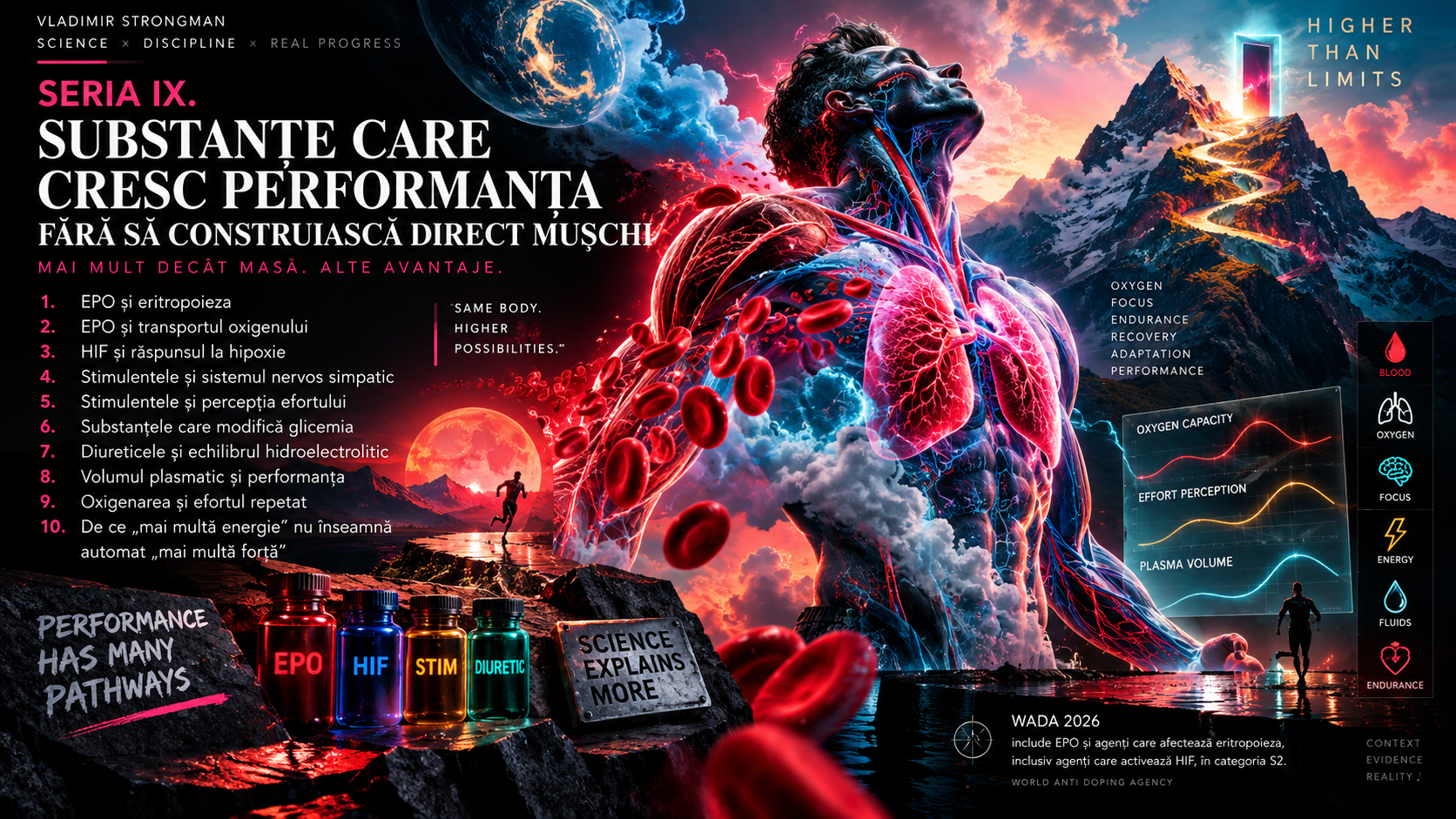
The final episode of the series starts from a common confusion: if the body has more energy available, it should automatically produce more strength. In reality, energy is only one of the conditions required for force production. A muscle may have enough ATP, glycogen and glucose while performance is still limited by the nervous system, technique, tendons, muscle architecture or fatigue.
In Strongman, the distinction is obvious. An athlete can be well fed, highly stimulated and feel full of energy, yet fail to lift more if high-threshold motor units are not recruited efficiently, the movement is unstable or passive tissues cannot tolerate the tension. Strength is not the fuel in the tank; it is the result produced by the entire transmission system.
This episode explains why ATP, carbohydrates, stimulants and the subjective feeling of energy can support performance without guaranteeing an increase in maximal strength. The goal is physiological and educational: to separate what enables effort from what actually produces force.
1. Energy and force are different concepts
Energy is the capacity to perform work, whereas force describes the mechanical interaction that accelerates, decelerates or holds an object against resistance. You can have enough energy to continue an activity without being able to generate greater maximal force.
2. ATP is the immediate currency
Muscle contraction uses ATP for actin-myosin cycling and ion pumps. Without ATP there is no contraction. But the presence of ATP does not tell us how many cross-bridges are activated at once, how large the muscle is or how effective the neural signal may be.
3. Stored ATP is limited
Muscle stores only a small amount of free ATP, enough for very few seconds of intense activity. The body therefore has to resynthesize it continuously through phosphocreatine, glycolysis and oxidative metabolism. Maximal power depends on how quickly energy can be supplied, not simply on total calories stored in the body.
4. Phosphocreatine supports brief explosions
The phosphagen system can resynthesize ATP very rapidly and is essential for brief maximal efforts. Yet more phosphocreatine cannot instantly turn a small muscle into one capable of producing the force of a much larger muscle.
5. Glycogen is fuel, not contractility
Muscle glycogen supports intense and repeated work. Low stores can reduce training volume and quality, but very high stores do not automatically increase the number of contractile fibers or the neural capacity for recruitment.
6. Blood glucose is not equivalent to strength
Maintaining blood glucose supports the brain and muscle during prolonged effort, but higher glucose does not instantly produce more force. Maximal strength depends primarily on neuromuscular and mechanical characteristics.
7. Total calories influence long-term adaptation
Adequate energy intake can support recovery, protein synthesis and body mass. Over time these effects can contribute to greater strength. This is accumulated adaptation, however, not the instant conversion of a large meal into kilograms on the bar.
8. The nervous system starts the contraction
Muscle does not decide by itself when or how strongly to contract. Commands arrive through the nervous system. Motor-unit recruitment, discharge rate and coordination strongly influence the force that is produced.
9. Motor-unit recruitment
High force requires recruitment of high-threshold motor units, often associated with fast fibers. Having sufficient energy does not automatically force the nervous system to recruit more motor units.
10. Discharge rate matters
A motor unit can produce more tension when neural impulses arrive at a higher frequency, within physiological limits. This is a neural mechanism rather than a simple energy mechanism. The muscle can have fuel and still receive an insufficiently strong command.
11. Synchronization and coordination
Useful force depends on how multiple muscle groups work together. A deadlift or log press is a mechanical orchestra. More fuel does not by itself correct a poor technical sequence.
12. Intermuscular coordination
Agonists, synergists and stabilizers have to activate at the right time. If stabilization is poor, part of the force produced never reaches the implement efficiently.
13. Antagonists can brake the movement
Antagonist co-contraction can stabilize a joint, but excessive co-contraction reduces net force in the desired direction. Energy availability does not automatically remove this neural brake.
14. Neural inhibition has a protective role
The nervous system uses protective mechanisms that can limit force in certain conditions. Pain, instability or perceived threat can reduce output even when the muscle has enough energy.
15. Stimulants can change perception, not structure
Stimulants can increase alertness, motivation and effort tolerance while reducing perceived fatigue. These effects may improve performance in some contexts, but they do not instantly create more myofibrils, thicker tendons or better technique.
16. Feeling energetic can be misleading
An athlete may feel extremely alert and aggressive without the neuromuscular system becoming stronger. Sometimes the subjective feeling of power rises more than objective performance.
17. Arousal has an optimal zone
Psychophysiological activation can support performance up to a point. Too little activation means insufficient intensity, but too much can disrupt technique, breathing, decision-making and fine control.
18. Adrenaline does not replace training
Catecholamines can increase heart rate, energy availability and activation. They may help an athlete express existing capacity but cannot instantly build mechanical capacities that do not exist.
19. Muscle mass sets part of the ceiling
Physiological cross-sectional area is closely related to a muscle's force-producing capacity. A larger muscle generally has the potential for more active actin-myosin cross-bridges.
20. Muscle quality matters
Two people with the same muscle mass can have different strength because of architecture, fiber composition, coordination and experience. Total energy availability does not describe these differences.
21. Pennation angle
The arrangement of muscle fascicles influences how much contractile tissue can be packed into a volume and the direction in which force is transmitted. This structural detail does not change acutely through higher energy availability.
22. Fascicle length influences velocity
Longer fascicles can favor shortening velocity, while overall architecture influences the force-velocity relationship. Again, these are structural properties rather than the amount of immediate fuel.
23. Tendons transmit force
Muscle generates tension, but the tendon transmits it to bone. If the tendon cannot tolerate the load or is painful, the nervous system may reduce output. More energy does not instantly repair a compromised structure.
24. Tendon stiffness
A certain amount of tendon stiffness supports efficient force transmission. Adaptation develops through training and time. A high-energy state cannot rapidly modify the mechanical properties of a tendon.
25. Body levers matter
Segment lengths, tendon insertion points and joint positions change mechanical advantage. An athlete can have excellent energy availability and still be disadvantaged in a particular event by geometry.
26. Technique converts internal force into external result
Muscular force has to be applied through an efficient path. Lost positions in the deadlift, log or yoke can consume energy without producing useful external work.
27. More effort does not automatically mean more force
An athlete can invest more mental and metabolic effort in an inefficient execution. It feels like pulling harder, but the bar does not move better. External output is what ultimately matters.
28. Strength and power are not the same
Mechanical power combines force and velocity. An intervention that improves speed or fatigue resistance can increase power in a task without necessarily increasing maximal isometric force.
29. The force-velocity relationship
Muscle produces different force depending on contraction velocity. With very heavy loads, velocity is low. Greater available energy does not fundamentally rewrite this relationship within minutes.
30. The length-tension relationship
Muscle produces different tension at different lengths. Joint position can place fibers in a more or less favorable region. Energy cannot correct a mechanically disadvantageous position.
31. Peripheral fatigue
After intense effort, calcium handling, phosphate, pH and membrane excitability all change. These changes can reduce force even while the body still has calories and glucose available.
32. Central fatigue
The central nervous system may reduce voluntary drive to muscle. Motivation and stimulation can modify this state to some degree, but they cannot always eliminate it. Sometimes the limit is not energy shortage but neural availability to use the muscle.
33. Pain reduces output
Pain changes motor recruitment and movement strategy. An athlete can have excellent glycogen and stimulation, but a painful joint may impose a powerful neural brake.
34. Sleep changes the capacity to express strength
Insufficient sleep can affect alertness, coordination, mood and recovery. Caffeine may reduce sleepiness, but it does not fully reproduce the biological effects of good sleep.
35. Muscle temperature
An appropriate warm-up can improve enzyme activity, nerve conduction and tissue elasticity. Too cold or too hot can reduce performance. Available energy still has to be expressed by a body operating in a functional temperature range.
36. Dehydration can reduce performance without lowering glycogen
An athlete can have excellent carbohydrate stores and still perform poorly if plasma volume falls, body temperature rises and heart rate becomes excessive. Chemical energy does not solve every transport problem.
37. Oxygenation matters more for recovery than for one maximal rep
A single maximal repetition depends heavily on anaerobic systems, but phosphocreatine restoration and preparation for the next attempt rely strongly on oxidative metabolism. Greater energy availability often helps more with maintaining repeated performance than increasing one-repetition strength.
38. Energy stores and recovery time
If the rest period is too short, energy systems do not fully recover even when substrate is available. It is not only the amount of fuel that matters but how quickly it can be converted and reused.
39. Enzymes have speed limits
Metabolism is controlled by enzymes, transporters and gradients. Having more substrate does not increase reaction speed indefinitely. At some point another link becomes limiting.
40. More glucose does not mean infinite oxidation
Glucose transport, phosphorylation and entry into metabolic pathways have limits. Extra substrate cannot force muscle to make ATP faster than enzymes and energy demand allow.
41. More caffeine does not mean unlimited effect
Stimulant effects tend to plateau and may be accompanied by tremor, anxiety, increased heart rate or reduced precision. Beyond a point, more stimulation can reduce execution quality.
42. Motivation can reveal existing strength
An intense competitive state can help an athlete express more of the capacity already present. This is different from building new capacity. Competition can open the tap, but it does not enlarge the structural reservoir.
43. Placebo can modify performance
Expectations can influence perceived effort, confidence and sometimes output. This demonstrates how powerful the brain is in expressing performance, but it does not turn placebo into a builder of contractile tissue.
44. Strength is movement-specific
An athlete can be extremely strong in the deadlift and only moderate in the log press. General energy availability is the same, but coordination, levers and experience are event-specific. Strength does not transfer perfectly between movements.
45. Strength is angle-specific
Force-producing capacity differs across joint angles. A sticking point can remain limiting even when the athlete feels energetic.
46. Isometric and dynamic strength differ
The ability to hold a static position and the ability to accelerate a load share mechanisms but are not identical. An athlete can excel at holds without having the same advantage in dynamic events.
47. Yoke: energy does not correct instability
In the Yoke Walk, an athlete can have excellent energy availability and still lose time if steps are too long, the trunk oscillates or the frame begins to sway. Stability and technique determine how much strength becomes forward movement.
48. Farmers: grip can be the limit
The legs and cardiovascular system may have enough energy, but the event ends if the fingers can no longer hold the handle. The limit here is local and mechanical rather than a lack of whole-body fuel.
49. Log press: technique can beat energy
An inefficient clean or poor rack position wastes energy before the press. The athlete may be highly stimulated, but if the log path is wrong, energy is mechanically lost.
50. Deadlift: the starting position sets the equation
In the deadlift, hip position, lat tension and bar path strongly influence the result. More energy does not fully compensate for a position that creates unfavorable lever arms.
51. Atlas Stones: strength must be applied through technique
With stones, the floor pick, lap and final extension require different sequences. A highly energized athlete can still lose the event if arm, trunk and hip positioning are poor.
52. Truck Pull: traction is limited by several systems
Truck Pull requires force, traction, body angle, rhythm, ventilation and metabolic tolerance. More energy may help sustain rhythm but cannot completely compensate for poor technique or insufficient traction.
53. The medley exposes the difference between energy and strength
In a medley, energy availability affects how long you can continue, but each implement has its own technical and mechanical demands. You may have fuel and still lose seconds on transitions or on an implement that requires a specific quality.
54. Maximal strength is a skill
Expressing very high force is a trainable skill. The nervous system learns recruitment, coordination and stabilization. Energy is necessary for training, but specific practice builds the skill.
55. Strength is built slowly
Hypertrophy, tendon adaptation, technique and neural coordination develop over weeks, months and years. No acute energy intervention can compress all of these adaptations into an hour.
56. More energy can increase training volume
This is where the real advantage appears. Good energy availability can allow more high-quality sets, better recovery and greater consistency. Over time, that workload can create the adaptations that increase strength.
57. More energy can preserve strength late in competition
In a long contest, carbohydrates, hydration and conditioning can help an athlete lose less performance from event to event. This is not necessarily an increase in maximal strength but a better preservation of existing strength.
58. Preserving performance can look like gaining strength
If an athlete completes the same weight in the fifth event that was previously missed, it may look like greater strength. Sometimes the explanation is simply arriving at that moment less fatigued rather than having a higher maximal ceiling.
59. Objective performance is the useful signal
Feeling energetic, pumped, aggressive or having a high heart rate is not synonymous with strength. Weight lifted, bar velocity, event time and technical quality are more useful indicators of the real effect.
60. Conclusion: energy enables, the system produces
Energy is indispensable, but it is not synonymous with strength. ATP enables contraction, glycogen supports work, stimulation can raise activation and oxygenation accelerates recovery. Force emerges when the nervous system, muscle, tendon, joints and technique convert all of these resources into efficient mechanical action.
The central idea of the entire series is that performance is not a single variable. Some interventions increase fuel availability, others alter perceived effort, circulation, oxygenation or hydration. All can influence results without directly building muscle and without necessarily raising the ceiling of maximal strength.
In Strongman, the difference between being stronger and being better able to use your strength is essential. An athlete can improve greatly through conditioning, technique, hydration and strategy even if isolated maximal strength changes little. Competition rewards strength available at the right moment, not only the gym record.
More energy is most useful when it removes a real limitation. If the athlete is hypoglycemic, dehydrated or exhausted by workload, restoring resources can make a major difference. If the limit is technique, tendon capacity or neural recruitment, the same energy strategy has much less effect.
This is also why more can become counterproductive. Too much stimulation can disturb technical precision, too much food before exertion can cause discomfort, too much water can create imbalance and too much training volume can impair recovery. Performance comes from appropriate regulation, not maximizing every variable independently.
The series therefore ends with a simple rule: the engine needs fuel, but fuel alone does not build the engine, transmission and chassis. In the human body, strength is the output of an integrated biological machine. Energy powers it; training and structure determine its limits.
Sources and recommended reading
1. Guyton and Hall. Textbook of Medical Physiology. Chapters on muscle contraction, energy metabolism, the nervous system and motor control.
2. McArdle WD, Katch FI, Katch VL. Exercise Physiology. Energy systems, fatigue, glycogen and neuromuscular performance.
3. Enoka RM. Neuromechanics of Human Movement. Motor-unit recruitment, force control and neuromuscular fatigue.
4. Zatsiorsky VM, Kraemer WJ. Science and Practice of Strength Training. Mechanical and neural principles of strength development.
5. Haff GG, Triplett NT, eds. Essentials of Strength Training and Conditioning. NSCA. Strength, power, energy systems and training design.
6. Fitts RH. Work on the cross-bridge cycle and peripheral mechanisms of skeletal-muscle fatigue.
7. Gandevia SC. Spinal and supraspinal factors in human muscle fatigue. Classic work on central fatigue and voluntary activation.
8. Cormie P, McGuigan MR, Newton RU. Developing maximal neuromuscular power. Reviews on strength, velocity and power.
9. Burke LM and colleagues. Sports-nutrition literature on carbohydrates, energy availability and repeated-effort performance.
10. Exercise-physiology and biomechanics literature on force-velocity, length-tension relationships, muscle architecture and tendon force transmission.
Editorial note: this material is educational. It is not a recommendation to use stimulants, manipulate blood glucose, use medications or apply other pharmacological interventions to enhance performance. Strength and exercise tolerance should be developed through individualized training, nutrition and recovery.
More From The Journal

Training
The Science of Strongman Training - Episode X: Competition Programming
How to build a complete Strongman competition preparation block: calendar, events, volume, intensity, specificity, simulations, autoregulation, tapering and fatigue management.

Training
The Science of Strongman Training - Episode IX: Peaking
Peaking in Strongman: how to turn months of training into maximal competition performance by reducing fatigue, preserving adaptations and managing specificity.