
Training
Strongman and the Limits of the Human Body - Episode IV: How Much Can the Human Spine Withstand?
September 5, 2026
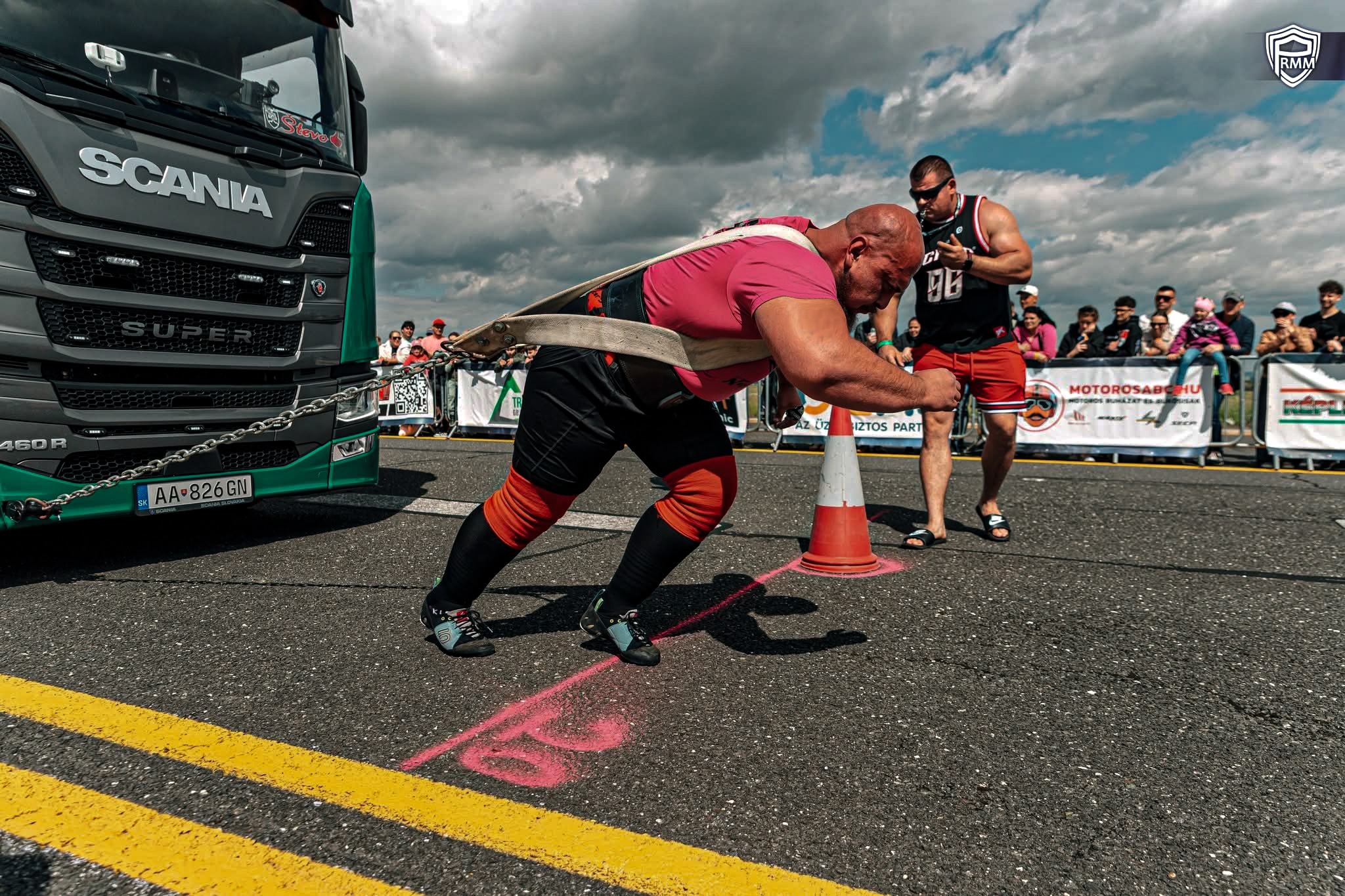
Strongman and the Limits of the Human Body - Episode IV: How Much Can the Human Spine Withstand?
Of all human structures, the spine is one of the most misunderstood when strength is discussed. In the gym, the question often appears: “How many kilograms can the spine support?” It sounds simple, but biomechanically it is almost impossible to answer with one number. The spine does not receive only the weight on the bar. It receives a combination of external load, body mass, muscle forces, trunk position, movement acceleration, load distance from the body and shear forces.
In Strongman, the problem becomes even more interesting. A yoke walk can place a very large load directly above the body. A deadlift creates large lumbar moments. A Farmer’s Walk combines axial loading with walking, stabilization and repeated positional changes. Fatigue can also turn a well-controlled movement into a biomechanically different one.
The correct question is therefore not “how many kilograms can the spine support?” but “what combination of compression, shear, torsion, bending and duration can a particular athlete tolerate in a particular position and task?” That is the starting point of Episode IV.
1. The spine is not one single structure
The spine is a system made of vertebrae, intervertebral discs, joints, ligaments, muscles and connective tissues. Each component contributes to transmitting and controlling force.
When you lift a load, force is not simply distributed vertically through the vertebrae. Trunk muscles produce substantial forces to stabilize the spine, and these forces increase internal loading. This is why a relatively moderate external load can generate much larger internal spinal forces.
2. What does “withstand” mean?
“Withstand” can mean different things. A spine may tolerate a load for one repetition but not the same load for hundreds of repetitions. It may tolerate compression in a stable position but not the same combination of compression and shear when the trunk is flexed and the load is far from the body.
Duration, repetition and fatigue are part of the problem. Instantaneous mechanical capacity is not the same as repeated-work capacity.
3. Compression: the force that presses the spine
Compression is one of the best-known forms of spinal loading. It acts along the spinal axis and occurs during lifting, squatting, loaded walking and many other activities.
Compression is not automatically synonymous with injury. A healthy spine is designed to tolerate loading. Problems arise when magnitude, direction, duration and frequency exceed an individual’s capacity to adapt or are combined with other demanding loads.
4. Shear: the force that wants segments to translate
Shear acts differently from compression. Rather than mainly pressing along the spinal axis, it tends to translate one segment relative to another.
During tasks with a forward-inclined trunk, shear forces can become important. Therefore, measuring compression alone does not fully describe spinal loading.
5. Bending moment: the problem of leverage
The position of the load matters as much as the load itself. If an implement moves farther from the lumbar spine, the lever arm increases and the extensor muscles must produce a larger moment to maintain trunk position.
This is one of the central ideas in lifting biomechanics: two objects with the same mass can produce very different spinal demands if one is held close to the body and the other farther away.
6. Why 100 kg does not mean 100 kg to the spine
If 100 kg is held close to the body, the external moment may be relatively smaller. If the same load is held much farther away, the moment increases. In addition, the body itself has mass, and the muscles must counterbalance segment positions.
Biomechanical lifting models show exactly this: posture and lever arm can substantially alter lumbar loading even when the external object mass remains constant.
7. Back muscles can increase internal loading
It may seem paradoxical, but the muscles that protect and stabilize the spine also contribute to the internal forces the spine must withstand. To maintain trunk position, the spinal extensors generate force, and that force creates compressive components.
This does not mean muscle is “bad.” Co-contraction and stabilization are essential for control. It simply means internal loading is different from the external weight visible on the bar.
8. The spine needs stability, not immobility
A healthy spine should not be treated as a rigid rod. It is a mobile structure that must allow movement while controlling movement under load.
In Strongman, the technical goal is not to eliminate every spinal movement, but to maintain control of the segments in a configuration where forces can be managed.
9. How strong is the lumbar spine?
Experimental and biomechanical studies have reported highly variable values for the structural capacity of lumbar segments. A classic model based on experimental literature reported a mean ultimate compressive strength of approximately 4.4 kN for lumbar segments, with substantial variation between specimens. This cannot be converted into a universal “safe limit” for a living human and should not be compared directly with kilograms on a bar.
The reason is simple: an isolated cadaveric segment is not a living Strongman. The body contains muscles, pressure, ligaments, discs, adaptations and load-sharing mechanisms that substantially alter system behavior.
10. The spine can tolerate surprisingly high loads
An experimental study of the follower-load mechanism showed that a lumbar spine could tolerate approximately 1,200 N of compressive loading without damage or instability under experimental conditions in which the load path followed the curvature of the spine. The study is important because it shows that not only force magnitude matters, but also its path through the system.
This idea is fundamental to Strongman: the same force can have different mechanical effects depending on direction, alignment and control.
11. The deadlift: one of the largest loading examples
The deadlift is an excellent example of the difference between external weight and spinal loading. In one biomechanical modeling study, deadlifting produced mean peak values at L5 of approximately 8.0 kN axial compression and 1.9 kN shear, with substantial variation between participants.
These numbers are not universal limits and do not mean every kilogram on the bar creates the same spinal load. They show how large internal forces can become when an athlete lifts a heavy load in a specific biomechanical configuration.
12. Why Strongman can push the problem further
Strongman uses less standardized implements, unusual positions and very large loads. An atlas stone, keg, yoke or bulky object changes the center of mass and lever arm.
The system has to produce force while controlling a load that does not always behave like a rigid, symmetrical bar.
13. Yoke Walk: the load that sits on you
Yoke Walk is one of the most relevant events for this episode. Available research is limited, but one biomechanical study examined three experienced strongmen with an average body mass of approximately 117 kg who carried a yoke of approximately 177 kg over 8 meters.
The authors observed high spinal compression and attributed an important part of it to the large absolute yoke load and the trunk-muscle co-contraction required to stabilize the spine. It is a striking example of the difference between external and internal loading.
14. Why the yoke is not simply a heavy squat
During a yoke walk, the athlete must carry the load while walking. Every step generates oscillations, accelerations and small changes in the center of mass. The trunk must stabilize the frame without completely blocking movement.
The spinal problem is therefore simultaneously static and dynamic: a large continuous load is combined with repeated perturbations.
15. Farmer’s Walk: compression plus walking
In Farmer’s Walk, the load is held at the sides while the body moves. Strongman literature indicates that Farmer’s Walk and Yoke Walk produce substantial muscular and spinal demands, including muscular compression and anterior/posterior spinal loading.
Walking also continuously changes force distribution. The spine must remain stable enough to transfer force between the legs and implement while remaining mobile enough to permit locomotion.
16. Torsion: the spine does not work only forward and backward
Strongman can also introduce rotational components. Carrying studies have reported differences in lumbar rotation between Farmer’s Walk, Yoke Walk and suitcase carry. Asymmetric loading can add demands on rotational control.
This is another reason why “maximum compression” is not enough to describe mechanical risk. A structure can be loaded in several ways at the same time.
17. Speed changes loading
Load mass is not the only factor. Classic lifting studies showed that movement speed can alter lumbar moments. Faster lifts increased peak extensor moment substantially in one biomechanical experiment.
This does not mean slow is always safe and fast is always dangerous. It means acceleration and inertia belong in the equation.
18. An unstable object changes the game
An unstable load may require additional co-contraction for control. Research comparing stable and unstable lifting conditions has found greater lumbar compressive loads in the unstable condition under specific experimental circumstances.
In Strongman, this idea is relevant to sandbags, kegs and implements that change shape or position during movement.
19. Lumbar posture: neutral is not a magic number
The concept of a neutral back is useful technically, but it should not become an absolute rule. The human spine can move under load. What matters is control, force distribution and the athlete’s capacity to tolerate the task.
A study comparing different lumbar postures during lifting showed that lordotic and kyphotic positions alter muscle activation and segmental forces differently. The important result is not that one posture is “perfect,” but that posture changes mechanics.
20. Fatigue is a mechanical factor
As fatigue accumulates, the ability to maintain the same position and coordination can decline. If the trunk begins to move differently, lever arms and force distribution can change.
In a Strongman competition, this is amplified by event order. A spine that handles a load very well early in the day may receive a different mechanical demand after the legs, grip and trunk musculature have accumulated fatigue.
21. A strong spine is not an invulnerable spine
Training can increase muscular capacity and tolerance to loading, but it does not turn tissue into an indestructible material. Adaptation is real, but it has limits.
Moreover, tissues do not all adapt at the same rate. Muscle can become stronger faster than some passive tissues change. This is one reason progression and volume management matter.
22. Is there an absolute limit?
Yes, in a biological sense there are structural limits. But there is no single number that applies to all humans and all situations. Capacity depends on anatomy, age, sex, body mass, training, geometry, bone density, disc condition, technique and loading history.
More importantly, the limit for one repetition is not the same as the limit for repeated sets or a competition event.
23. Why we cannot say “the spine can handle X kg”
Because the bar does not transmit a fixed value directly to the spine. Internal loading results from interaction among load, posture, muscles, acceleration and geometry.
A 300 kg deadlift does not mean L5-S1 receives 300 kg. It may experience a much larger internal force. At the same time, two athletes lifting the same external weight may experience different internal loads.
24. The spine and intervertebral discs
Intervertebral discs contribute to load distribution and permit segmental motion. They are not simple passive “shock absorbers.” They are complex biological structures influenced by hydration, pressure, geometry and loading.
During repeated loading, phenomena such as viscoelastic creep and time-dependent recovery become relevant. A structure that appears stable during one repetition may respond differently after hundreds of loading cycles.
25. The spine and ligaments
Ligaments contribute to stability and limit certain motions. During lifting, some load can be carried by passive structures while muscle actively controls movement.
In Strongman, technical training cannot eliminate passive-tissue contribution, but it can help keep loading within a range the athlete can control and recover from.
26. Why a Strongman can tolerate more than an untrained person
A trained athlete develops neuromuscular, muscular, skeletal and technical adaptations that allow management of much larger loads. It is not simply that the muscles are stronger. The entire system becomes better organized.
However, this capacity should not be confused with invulnerability. A Strongman can generate enormous forces because the system can manage them, but repeated exposure can still accumulate cost.
27. Strongman versus occupational limits
Occupational lifting and ergonomics literature often uses loading thresholds intended to reduce injury risk in general or working populations. These thresholds cannot be mechanically transferred to an elite strength athlete.
A trained Strongman may exceed workplace loading levels by a large margin without automatically sustaining injury. That does not mean repeated high loading is risk-free.
28. When strength becomes the problem
Force itself is not the enemy. Problems arise when demand exceeds capacity or when the loading dose is no longer compatible with recovery.
An athlete may tolerate an extraordinary load on a well-prepared day and be more vulnerable to the same load after excessive volume, insufficient sleep, accumulated fatigue or degraded technique.
29. The spine’s Failure Point
The Failure Point should not be imagined as a cinematic moment when the spine “breaks” at one exact weight. In practice, the limit may be a combination of loss of control, altered technique, pain, fatigue or exceeding the tolerance of a tissue.
The most important functional limit often appears before catastrophic structural failure: the athlete can no longer reproduce the position and force required to control the load.
30. Pain is not a spinal dynamometer
Pain and mechanical loading are not perfectly synchronized. High loads can occur without pain, while pain can occur under relatively low loads. Pain is a complex biological phenomenon, not a direct reading of kilograms on the spine.
Therefore, absence of pain does not prove that any load is safe, and pain does not allow direct calculation of a dangerous weight.
31. How can a Strongman protect the spine?
By developing trunk strength, technical skill, progressive loading, volume control, fatigue management and intelligent load selection. None makes the spine invulnerable, but all can increase the system’s capacity to manage stress.
Exercise variation can also distribute stress across different movement patterns and prevent one structure from receiving the same dose of stress continuously.
32. What does a well-prepared spine look like?
Not a spine that never moves or experiences stress, but a spine integrated into a system capable of producing and controlling force. A well-prepared trunk can stabilize the pelvis and rib cage, transfer force between limbs and maintain control under load.
33. How much can an elite Strongman’s spine withstand?
There is no scientifically validated universal number. Strongman studies and biomechanical models nevertheless show that elite athletes can expose the spine to very large internal loads, sometimes several kilonewtons, without that automatically meaning injury.
In an experimentally studied yoke walk, large athletes carried a yoke of approximately 177 kg. In deadlift modeling, lumbar compression near 8 kN at L5 was estimated under certain conditions. These findings demonstrate system capacity, but they do not define a maximum.
34. The biggest mistake: confusing weight with loading
A Strongman should not think only in kilograms on the bar. He should think in forces, moments, positions, repetitions and fatigue.
200 kg held in a controlled position and 200 kg lifted with the implement far from the body are not the same problem. 200 kg for one repetition and 200 kg for 20 repetitions are not the same dose. And 200 kg in a fresh training session and 200 kg after four events do not represent the same functional spine.
35. Conclusion: the spine has more than one limit
How much can the human spine withstand? The scientific answer is: it depends on how it is loaded. The spine can tolerate impressive forces, and Strongman demonstrates that capacity spectacularly. But there is no universal kilogram value representing the human limit.
The limit emerges from the interaction of compression, shear, torsion, bending moment, load position, musculature, technique, speed, fatigue and exposure duration. Near the Failure Point, the question is no longer simply how strong the spine is, but how well the entire system can control force.
A Strongman does not win because he has an indestructible spine. He wins because the entire system, from the legs to the trunk and into the implement, can produce, transmit and control enormous forces. True performance begins exactly where force must be managed, not merely produced.
Selected references
1. Keogh JWL, Winwood PW. The Biomechanics and Applications of Strongman Exercises: a Systematic Review. Sports Medicine - Open. 2019;5:38. DOI: 10.1186/s40798-019-0222-z.
2. Hindle BR, Lorimer AV, Winwood PW, Brimm D, Keogh JWL. The Biomechanical Characteristics of the Strongman Yoke Walk. Frontiers in Sports and Active Living. 2021;3:670297. DOI: 10.3389/fspor.2021.670297.
3. Dolan P, Earley M, Adams MA. Bending and compressive stresses acting on the lumbar spine during lifting activities. Journal of Biomechanics. 1994;27(10):1237-1248. DOI: 10.1016/0021-9290(94)90277-1.
4. Jäger M, Luttmann A. Biomechanical analysis and assessment of lumbar stress during load lifting using a dynamic 19-segment human model. International Journal of Industrial Ergonomics. 1989;4:1-15.
5. Dreischarf M et al. Estimation of loads on human lumbar spine: A review of in vivo and computational model studies. Journal of Biomechanics. 2016;49(6):833-845.
6. McGill SM, Norman RW, Cholewicki J. A biomechanically based evaluation of lumbar spinal loads. Ergonomics. 1996;39(1):85-101.
7. McGill SM, Marshall LW. Kinematic and kinetic analysis of the spine during lifting. Relevant biomechanical literature on spinal loading and trunk stabilization.
8. Callaghan JP, McGill SM. Intervertebral disc loading during the deadlift. Relevant biomechanical research on lumbar loading during lifting.
9. Shirazi-Adl A, et al. A follower load increases the load-carrying capacity of the lumbar spine in compression. Spine. 1999;24(18):1803-1810.
10. Low Back Biomechanics during Repetitive Deadlifts: A Narrative Review. PubMed PMID: 34875981.
11. The mechanical loading of the spine in physical activities. PubMed PMID: 37166549.
More From The Journal

Training
The Science of Strongman Training - Episode X: Competition Programming
How to build a complete Strongman competition preparation block: calendar, events, volume, intensity, specificity, simulations, autoregulation, tapering and fatigue management.
Training
The Science of Strongman Training - Episode IX: Peaking
Peaking in Strongman: how to turn months of training into maximal competition performance by reducing fatigue, preserving adaptations and managing specificity.