
Training
Strongman and the Limits of the Human Body - Episode III: What Is the Limit of Grip Strength?
September 4, 2026
Strongman and the Limits of the Human Body - Episode III: What Is the Limit of Grip Strength?
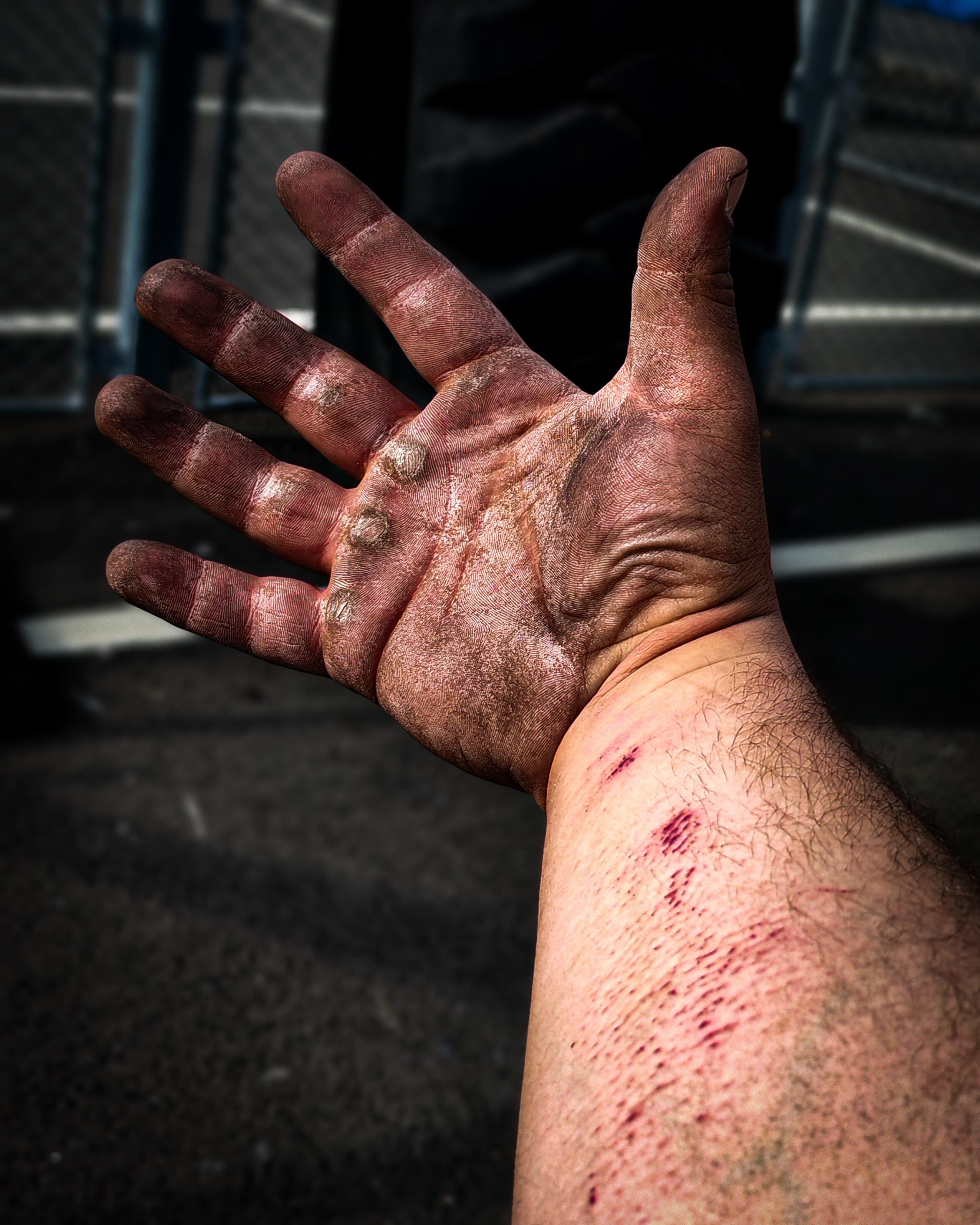
In Strongman, there is a fascinating moment when an athlete may have legs capable of moving an enormous mass, a trunk strong enough to stabilize it, and yet lose the event because the hand can no longer maintain the connection with the implement. Grip is the gateway through which whole-body force reaches the load. When that gateway closes, the rest of the system no longer matters.
Grip is not one quality. It includes maximal hand force, isometric holding capacity, fatigue resistance, finger control, skin tolerance, wrist stability and the ability to transmit force through a particular joint position. In a Farmer’s Walk, Hercules Hold, Axle Deadlift or thick-handle event, the limiting factor may appear in a different place.
This episode starts with a simple question: how strong can the human hand be? Science gives a more interesting answer than a single number. Maximal strength is only a snapshot. Real performance is the entire film: how much force you can produce, how long you can maintain it, how quickly fatigue develops and how well the hand stays connected to the whole kinetic chain.
1. Grip is not simply squeezing strength
In everyday language we say “good grip” or “my grip failed.” Biomechanically, those expressions hide several capacities. Squeezing force is only one of them. An athlete may have impressive dynamometer strength and still be poor at holding a heavy load for 20 or 30 seconds.
Strongman performance depends on matching grip type to event demands. Crush grip, support grip, thick-handle grip and pinch grip place different demands on the hand and upper limb.
2. Maximal strength: how much can the hand squeeze?
Maximal hand strength is influenced by hand size, forearm characteristics, handle geometry, wrist position, training status and individual anatomy. A dynamometer provides a useful measurement, but it cannot reproduce every condition of a Strongman event.
There is therefore no universal grip value that defines “enough.” A very high dynamometer score can coexist with modest Farmer’s Walk performance if the athlete cannot turn maximal strength into sustained support under load.
3. Crush grip, support grip and pinch grip
Crush grip describes the ability to squeeze an object between the fingers and palm. It is relevant to many tasks, but it does not fully describe the ability to support a bar or handle that is trying to pull the hand open.
Support grip is closer to the demand of Farmer’s Walk and deadlifting: the hand must resist a force that tends to open the fingers. Pinch grip emphasizes the thumb and fingers. Strongman athletes therefore need a grip profile that matches the profile of their events.
4. The fingers are the final link
When a bar begins to slip, the hand does not fail as a single block. Finger force decreases, position changes and the fingers gradually lose mechanical advantage. In some grips, the fingers are literally the final point of contact.
This helps explain why finger flexor strength and the ability to maintain finger flexion can become decisive with thick objects, Axle bars or unusual handles.
5. The wrist is the foundation of grip
The hand does not produce force in isolation. The wrist must provide a position in which the flexor and extensor musculature can operate effectively. Changing wrist angle can alter grip mechanics.
In a heavy event, the wrist must resist not only the gripping force but also the moment created by the implement. If wrist position collapses, available force can become harder to use.
6. The forearm: the hidden engine of grip
The finger flexors and forearm musculature are major producers of gripping force. In Strongman, however, the forearm has to work for both strength and endurance.
When contraction is intense and sustained, local blood flow and metabolic factors contribute to fatigue. The problem therefore becomes not only how much force exists, but how much remains available after several seconds or repeated efforts.
7. Grip fatigues differently from a large muscle group
A meta-analysis of static contraction endurance showed systematic differences in time to fatigue between body regions, with hand and grip among the regions that can become relatively fatigue-sensitive depending on intensity. We cannot transfer a single fatigue curve directly to Strongman, but the principle matters.
As the percentage of maximal force used to hold an object increases, the available holding window generally becomes shorter. This is why the same load may be manageable for a short hold and impossible over a longer distance.
8. Maximal grip strength and grip endurance are different
An athlete may produce 100% of his current capacity in a very brief contraction, but cannot sustain 100% of that force for long. This is one of the key differences between maximal testing and event performance.
For a carry, what matters is the reserve between the force required to hold the implement and the athlete’s maximal grip force. A larger reserve provides more room for fatigue.
9. Farmer’s Walk: where grip becomes time
In Farmer’s Walk, the load continuously pulls the hands downward. Every step is a small perturbation, and grip must maintain contact while the body is moving.
Strongman biomechanics research indicates that Farmer’s Walk performance is associated with gait parameters such as stride length, stride rate and ground-contact time. Grip does not operate independently from these factors. It has to survive the entire movement strategy.
10. Hercules Hold: the pure test of holding capacity
Hercules Hold removes some of the complexity of walking and exposes the ability to sustain force. The arms are pulled laterally while the hands must resist a continuous force.
The limit may be grip, but it may also involve the shoulder, scapular position, trunk and tolerance to sustained isometric contraction. The event demonstrates why grip cannot be treated as an isolated property of the fingers.
11. Axle: when handle thickness changes the game
A thick handle can reduce the ability to close the fingers around the object and alter pressure distribution. Therefore, the same mass can create a different grip demand depending on handle diameter.
Experimental grip studies show that handle geometry can influence maximal force. For Strongman, this means equipment specificity matters enormously.
12. Why a thick handle can feel twice as heavy
As diameter increases, the fingers cannot close around the object in the same configuration. Contact, joint angles and moment arms change. You have not added kilograms, but you have changed the mechanical problem.
This is one reason an athlete may dominate a standard bar and encounter an unexpected limit on an Axle or another thick-grip implement.
13. Hook grip, mixed grip and other strategies
The way the fingers wrap around a bar can change grip security. Depending on the event and rules, athletes may use different strategies to prevent the hand from opening.
Every strategy also changes local loading. Grip should therefore be analyzed not only by “how hard do I squeeze?” but by how force is distributed through the fingers, palm and joints.
14. Skin can become the limit before muscle
In Strongman, grip capacity is not purely neuromuscular. Palm skin, calluses, sweat and friction between hand and handle can determine how secure contact remains.
An athlete may have enough muscular strength for the implement but lose contact because of a wet surface, torn callus or a position that creates excessive slip. The practical limit is always the limit of the whole system.
15. Sweat and friction
The contact between skin and implement is mechanical. If effective friction decreases, the hand must create a different configuration to maintain the load. During a heavy hold, a small loss of security can matter enormously.
This is why Strongman preparation also includes hand management: chalk, skin care, equipment choice and adaptation to competition conditions.
16. Grip and the nervous system
Force is not produced by muscle alone. The nervous system recruits motor units, coordinates contraction and adjusts force output according to sensory feedback.
With a heavy and unstable implement, sensory control becomes important. The hand has to detect small positional changes and respond without losing contact. Grip is therefore also a motor-control problem.
17. Why grip can fail suddenly
Sometimes the feeling is that the hand is holding securely and then, almost without warning, the implement starts to slip. This does not mean force disappeared instantly. The reserve may have become so small that a small change in position or friction pushed the system beyond its limit.
At that point grip can enter positive feedback: slipping changes finger position, the new position reduces mechanical advantage, and reduced advantage accelerates slipping.
18. The grip limit is not always maximal force
A maximal test asks, “how much force can you produce right now?” A Strongman event may ask, “how much force can you maintain while walking, breathing, stabilizing the trunk and controlling the implement?” These are different questions.
Grip assessment for Strongman should therefore include both maximal measurements and event-specific holding or carrying protocols.
19. How long can grip last?
There is no universal duration. Endurance depends on relative contraction intensity, grip type, joint position, blood flow, training status and fatigue state.
Research on static contractions shows a clear relationship between relative intensity and time to exhaustion. As intensity approaches maximal force, the holding window becomes shorter. In Strongman, this helps explain why a small increase in load can create a huge change in holding time.
20. Why 5 kg can completely change an event
Adding 5 kg does not necessarily mean only 5 kg more difficulty. If the athlete was already close to the holding limit, those kilograms can turn a submaximal contraction into one very close to maximal.
This is why some grip events behave nonlinearly. Near the Failure Point, small increases in load can produce disproportionate reductions in holding time.
21. Grip and Farmer’s Walk: what fails first?
In Farmer’s Walk, it is impossible to say in advance that grip will be the limiting factor. An athlete may have extraordinary grip but be limited by legs, trunk, breathing or pace.
But when the load becomes sufficiently heavy and the distance sufficiently long, grip can become the first system to lose its ability to maintain the implement. At that point lower-body strength can no longer be converted into movement.
22. Grip in Yoke Walk is a different problem
Yoke Walk can place less direct demand on the hands than Farmer’s Walk because the frame is supported on the body. That does not make grip irrelevant. The hands and arms help control the frame, while whole-system stability remains essential.
This difference shows how specific grip really is. An athlete can be exceptional at Farmer’s Walk and not have the same advantage in an event where more of the load is transferred to the shoulders and trunk.
23. Grip with unconventional implements
Sandbags, kegs, stones and objects without handles do not provide a perfect hand geometry. Often the athlete combines finger flexion with compressing the object between the arms and trunk.
In these events, grip becomes more a skill of contact and control than a simple squeezing force. Object shape can completely change the strategy.
24. Grip and finger length
Hand dimensions influence how the fingers wrap around an implement. A larger hand may have advantages with certain bars or thick objects, but this does not automatically guarantee stronger grip.
In Strongman, anthropometry matters because events use different object geometries. Mechanical advantage appears only when body dimensions match the task.
25. Grip and body mass
Absolute grip strength is only part of the equation. Strength relative to body mass can provide useful context, especially when comparing athletes of very different sizes.
In Strongman, where body mass is often high and implements are extremely heavy, absolute strength remains crucial. Yet athletes with similar body mass can have very different grip capacities.
26. Central versus local fatigue
When an athlete says “my grip died,” the problem may be predominantly local in the hand and forearm, or it may be influenced by general fatigue accumulated during an event or competition.
That is why grip should be evaluated in context. A test performed fresh does not necessarily reproduce the grip available after deadlifts, yoke, stones or other events that have already stressed the whole system.
27. Grip after a heavy event
In competition, event order can completely change grip limits. A fresh hand and a fatigued hand are not the same instrument.
Programming should therefore include the ability to produce grip under fatigue. It is not enough to have an exceptional first-event grip if the third event asks for the same quality after substantial accumulated fatigue.
28. Grip can be trained, but specificity matters
Grip training can improve strength and endurance, but adaptation depends on the stimulus. Heavy holds, carries, axle work, thick-handle work, pinch work and finger exercises do not necessarily create the same adaptation.
For Strongman, the most valuable stimulus is often the one that reproduces the force profile required by competition. If the event demands support grip on a thick handle, a completely different test may have limited transfer.
29. Why grip should not always be trained to failure
Grip is already stressed by deadlifts, rows, carries, stones, pulls and many other exercises. If every session adds repeated forearm failure, recovery can become the limiting problem.
The goal is not to destroy the hands. It is to increase system capacity without compromising the main training. A stronger grip that reduces deadlift quality or harms the next session may not be a real performance gain.
30. When grip becomes an injury factor
Fatigue can alter wrist, elbow and shoulder position. If the hand can no longer maintain the implement in its usual position, the body may introduce compensations to preserve contact.
This does not mean every weak grip causes injury. It means that loss of control changes mechanics. With a very heavy implement, a small positional change can have large consequences throughout the kinetic chain.
31. What is the real grip limit?
It is not a fixed kilogram value and not a single dynamometer number. The real grip limit is the load at which the hand can no longer maintain the contact required for that specific task under those specific conditions.
If the object is held for two seconds, the limit may be one value. If it must be held for 30 seconds, the limit changes. If it must be carried 30 meters, it changes again. If the athlete arrives after three previous events, the limit may be different once more.
32. Failure Point: when the hand can no longer transmit force
The grip Failure Point appears when available force, friction, grip geometry and fatigue resistance are no longer sufficient to maintain contact. It may look like slipping, progressive finger opening, wrist-position loss or complete failure.
Importantly, Failure Point does not necessarily equal total muscular exhaustion. Sometimes the system loses a useful mechanical configuration before all relevant muscle fibers are incapable of contraction.
33. How should a Strongman grip be measured?
A useful profile should include maximal force, isometric holding, fatigue response and event-specific testing. A dynamometer is useful, but it cannot be the only measurement.
Ideally, testing should reproduce handle diameter, body position, duration and loading pattern from competition. The closer the test is to the real problem, the more meaningful the interpretation.
34. There is no perfect grip
There is only the grip that is appropriate for a specific task. An athlete may have enormous crush strength and still be limited in pinch. He may be exceptional at Farmer’s Walk and not have the same advantage in Hercules Hold. He may have powerful fingers but vulnerable skin.
In Strongman, performance appears when the athlete’s grip profile matches the event profile. That is more valuable than one impressive number.
35. Conclusion: the grip limit is the limit of connection
What is the limit of grip strength? There is no universal number. Grip has different limits for maximal force, holding, carrying, thick handles, pinch, unstable objects and repeated efforts. In Strongman, the hand is the point where whole-body force must enter the implement.
When grip is strong enough, the legs, hips and trunk can turn force into movement. When grip fails, the entire chain stops. The real question is therefore not “how hard can the hand squeeze?” but “how much force can the hand transmit and maintain under the real conditions of the event?” That is where the science of grip truly begins.
Selected references
1. Keogh JWL, Winwood PW. The Biomechanics and Applications of Strongman Exercises: a Systematic Review. Sports Medicine - Open. 2019;5:38. DOI: 10.1186/s40798-019-0222-z.
2. Winwood PW, Hume PA, Cronin JB, Keogh JWL. Retrospective injury epidemiology of strongman athletes. Journal of Strength and Conditioning Research. 2014;28(1):28-42. DOI: 10.1519/JSC.0b013e3182986c0c.
3. Frey Law LA, Avin KG. Endurance time is joint-specific: a modelling and meta-analysis investigation. Ergonomics. 2010;53(2):166-177. DOI: 10.1080/00140130903389068.
4. Massy-Westropp NM, Gill TK, Taylor AW, Bohannon RW, Hill CL. Hand Grip Strength: age and gender stratified normative data in a population-based study. BMC Research Notes. 2011;4:127. DOI: 10.1186/1756-0500-4-127.
5. Bohannon RW. Grip strength: an indispensable biomarker for older adults. Clinical Interventions in Aging. 2019;14:1681-1691. DOI: 10.2147/CIA.S194543.
6. Stephens JA, Taylor A. Fatigue of maintained voluntary muscle contraction in man. Journal of Physiology. 1972;220(1):1-18. DOI: 10.1113/jphysiol.1972.sp009691.
7. Hindle BR, Lorimer AV, Winwood PW, Brimm D, Keogh JWL. The Biomechanical Characteristics of the Strongman Yoke Walk. Frontiers in Sports and Active Living. 2021;3:670297. DOI: 10.3389/fspor.2021.670297.
8. Hand Grip Force-Time Curve Indicators Evaluated by Dynamometer: A Systematic Review. 2024. PubMed PMID: 38931305.
9. Static and Dynamic Handgrip Strength Endurance: Test-Retest Reproducibility. PubMed PMID: 28259282.
10. Influence of muscle blood flow on fatigue during intermittent human hand-grip exercise and recovery. PubMed PMID: 9248662.
More From The Journal
Training
The Science of Strongman Training - Episode X: Competition Programming
How to build a complete Strongman competition preparation block: calendar, events, volume, intensity, specificity, simulations, autoregulation, tapering and fatigue management.
Training
The Science of Strongman Training - Episode IX: Peaking
Peaking in Strongman: how to turn months of training into maximal competition performance by reducing fatigue, preserving adaptations and managing specificity.