
Training
Strongman and the Limits of the Human Body - Episode II: How Much Weight Can the Human Body Carry?
September 3, 2026
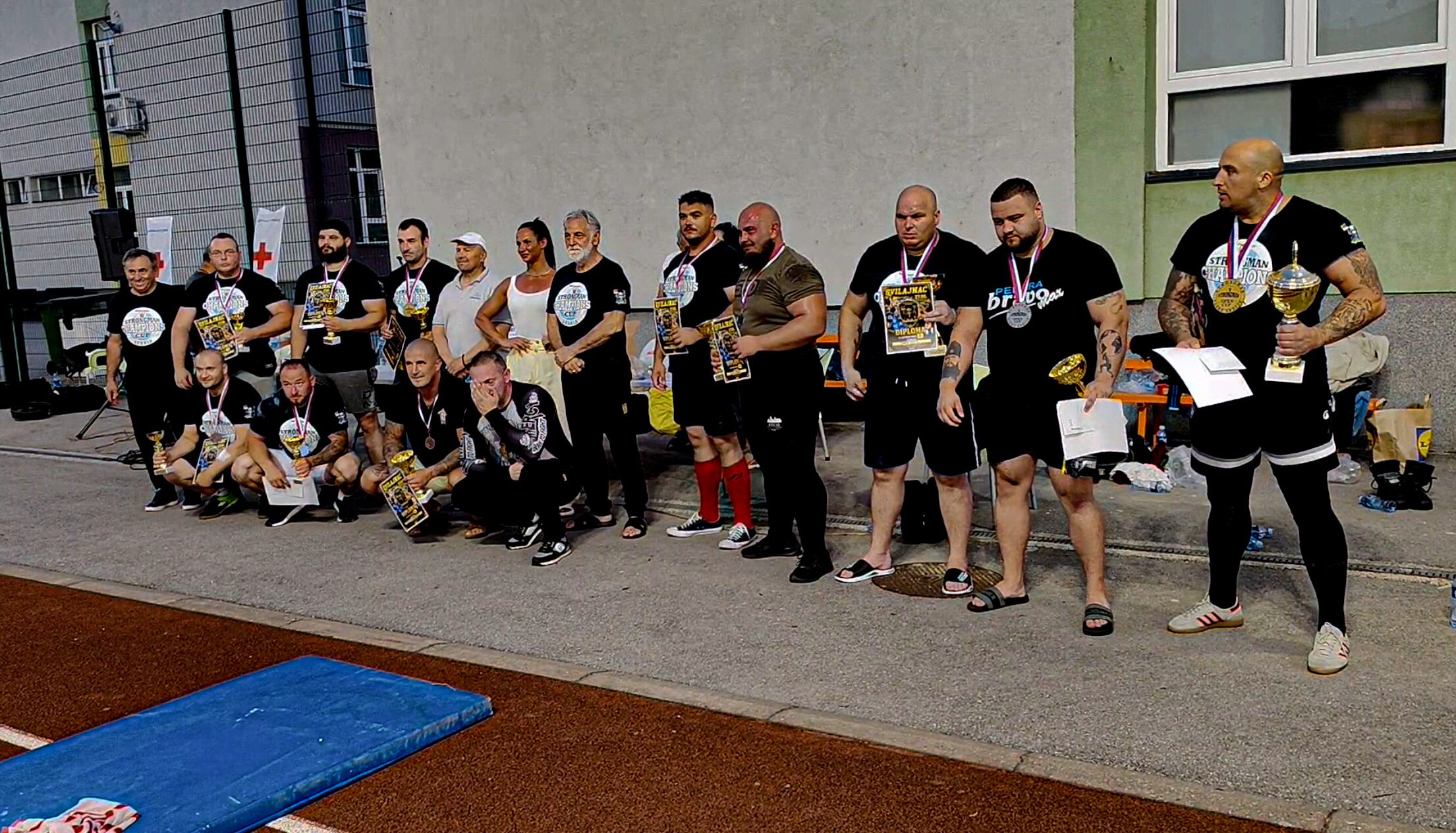
Strongman and the Limits of the Human Body - Episode II: How Much Weight Can the Human Body Carry?
Lifting a weight and carrying it are two different problems. During a lift, the athlete must generate enough force to detach the object from the ground and move it through a defined trajectory. During a carry, the body must repeatedly produce force, maintain balance, stabilize the trunk and pelvis, control every step and preserve grip while the center of mass is continuously moving.
Strongman makes this distinction spectacularly visible. Farmer’s Walk, Yoke Walk, Sandbag Carry, Keg Carry and Conan’s Wheel test not only how strong an athlete is, but how effectively strength can be converted into controlled locomotion under load. Biomechanical research shows that Strongman carries alter gait, ground-reaction forces, trunk loading and step strategy. At the same time, the literature remains limited for some events, especially Yoke Walk and very heavy forms of load carriage.
1. Carrying is not simply lifting while walking
When an object is lifted and held still, the musculoskeletal system can organize a relatively stable configuration. Once walking begins, that configuration disappears. Every step moves the center of mass, changes the base of support and requires the body to produce vertical, propulsive and stabilizing forces at the same time.
Load carriage is therefore better understood as a combination of strength, balance, coordination, local muscular endurance and tolerance to loading. An athlete may be able to lift an enormous weight from the floor and still perform less effectively in a carry if grip, trunk control or gait becomes the limiting factor.
2. What does “how much can you carry” actually mean?
There is no single answer because load mass, distance, speed, load position, walking surface, effort duration and stops all matter. A person may carry an extremely heavy load for a few meters while the same load becomes impossible after several dozen meters.
In Strongman, performance is usually defined by the heaviest load carried over a set distance, the longest distance carried with a given load, or the time required to complete the distance. The “limit” is therefore always tied to a task and a condition.
3. The body becomes part of the load-carriage system
During a carry, the athlete’s body mass and the external load form a combined system. Once the load is lifted, the system’s center of mass changes. The heavier the object or the farther it sits from the body axis, the greater the stabilization demands.
This is why two people carrying the same external weight can experience different mechanical demands. Body proportions, load position, limb lengths and technique all change the mechanics of the complete system.
4. The center of mass is one of the main characters
The body constantly manages the relationship between its center of mass and its base of support. During walking, that base is small and changes with every step. Adding a heavy load changes both the inertia and the location of the combined center of mass.
A good Yoke Walk or Farmer’s Walk is therefore more than a display of strength. It is a continuous negotiation with balance. The athlete must keep the load controlled while maintaining enough speed to move efficiently.
5. Farmer’s Walk: the brutal laboratory of load carriage
Farmer’s Walk is one of the clearest forms of bilateral loaded carriage. The load is held at the sides, the hands must maintain the handles, and the legs must produce steps fast enough to convert strength into efficient locomotion.
Biomechanical analyses indicate that higher-performing athletes tend to show shorter ground-contact times and favorable combinations of stride length and stride rate while maintaining velocity. Muscle mass and total system force have also been associated with Farmer’s Walk performance.
6. The load must not only be held, but controlled
A load that moves relative to the body creates an additional problem. If the implements swing, the athlete must continuously correct their trajectory. These corrections cost energy and can alter trunk position.
In competition, efficient technique reduces unnecessary motion. It is not enough to be able to hold the load. It must be held in a configuration that allows fast, repeatable walking.
7. Yoke Walk changes the problem
Yoke Walk distributes the load differently from Farmer’s Walk. The frame rests across the shoulder region, and the athlete must control a large mass that can amplify vertical and lateral oscillations. Trunk and hip demands become enormous.
Research on the Yoke Walk shows that the movement should be understood through loaded gait and load-carriage mechanics. Evidence suggests that load position and trunk control are critical, while quantitative literature remains much smaller than the literature on Farmer’s Walk.
8. Why can a Yoke feel unstable even to a very strong athlete?
Maximal strength does not eliminate instability. An athlete may produce enormous force in a controlled position and still struggle when the frame moves in several directions simultaneously.
Yoke performance rewards the ability to control oscillation, maintain trunk rigidity and turn each step into a propulsive impulse. Part of the skill is preventing the implement from dictating the athlete’s gait.
9. Sandbag Carry and the deformable object problem
A sandbag does not behave like a barbell. Its shape changes, its center of mass can shift, and the amount of contact with the body depends on technique. This increases the demand for control and makes carriage more position-dependent.
The athlete must find a position that reduces the moment arm and keeps the object close to the body. As the bag drops, demands on the arms, trunk and hips can increase.
10. Keg Carry: when the center of mass becomes unpredictable
A keg can be held in several ways, and its contents or shape can alter its stability. Carrying becomes a combination of strength and anticipation of object movement.
This is one of the major differences between Strongman and traditional lifting. The implement is not merely a weight. It is an imperfect mechanical partner, and the athlete must adapt to it.
11. Conan’s Wheel: carrying becomes continuous resistance
Conan’s Wheel combines load support with walking and rotation around an axis. The athlete cannot simply place the load into a comfortable position. The torque must be maintained while movement continues.
As distance increases, the problem shifts from maximal strength toward the ability to sustain force under fatigue. This is where the difference between “I can lift it” and “I can carry it without failing” becomes obvious.
12. Grip can stop legs capable of moving hundreds of kilograms
In Farmer’s Walk, grip is the interface between the body and the implement. If the hands cannot maintain the handles, force produced by the legs and hips cannot reach the object.
This illustrates an important performance principle: global capacity is often constrained by the weakest relevant link. Sometimes the athlete does not need more general strength. The limiting link needs to be raised.
13. The forearm does not work alone
Grip during carrying involves the hand and forearm musculature, but also wrist, elbow and shoulder position. As carrying time increases, local fatigue appears and the ability to sustain force can decline.
During a maximal carry, grip may be the immediate limiter. During a longer carry, the same grip demand can become a metabolic and neuromuscular problem. Distance changes the nature of the limitation.
14. The trunk is the transmission column of carrying
The legs produce force against the ground while the load is held by the hands or supported on the body. Between those points sits the trunk. If it loses the required stiffness, some movement becomes unwanted deformation.
Biomechanical studies have found substantial spinal-muscle demands during Farmer’s Walk and Yoke Walk. This helps explain why heavy carries can fatigue the trunk even when breathing still feels manageable.
15. The spine does not have to be held motionless at all costs
Spinal stability does not mean the absence of all movement. It means controlling movement relative to the task. Excessive rigidity can waste energy, while uncontrolled loss of position can increase demands on particular tissues.
In Strongman, the practical goal is a position stable enough for force transmission but dynamic enough to permit walking. The body must be rigid where needed and mobile where necessary.
16. How gait changes under load
Load carriage changes gait parameters. Loaded-carriage research commonly reports changes in stride length and stride rate, with effects becoming more pronounced as load increases. In Farmer’s Walk, high-level performance depends on maintaining an efficient combination of stride length, stride rate and ground-contact time.
This adaptation is not random. The body searches for a strategy that keeps the center of mass controllable while producing enough propulsion without unnecessary cost.
17. Ground-reaction forces increase
When carrying a load, the body must push harder against the ground to support and accelerate the combined mass. Farmer’s Walk research has reported increased vertical and horizontal ground-reaction-force components compared with unloaded walking.
This means every step becomes a small repetition of force. Over a long event, hundreds of such repetitions turn an apparently simple task into a systemic demand.
18. Speed and load compete for the same system
The heavier the load, the harder it is to accelerate and stabilize the system. The faster the athlete walks, the greater the need to produce and control force in a shorter time.
A competition carry is therefore not simply a test of brute strength. It is a compromise among load, speed, stability and energy cost. The athlete who finds the best compromise can win without being the strongest in an isolated test.
19. Distance completely changes the limit
Over a few meters, maximal capacity may dominate. As distance increases, peripheral fatigue, grip failure, metabolic strain and technical degradation appear. Therefore the maximum carryable load is not a constant.
An athlete may have extraordinary capacity for 10 meters and a very different capacity for 50 or 100 meters. The same body has multiple limits, each linked to duration and task demands.
20. Fatigue changes biomechanics before it stops the athlete
An important point is that fatigue does not begin only when the athlete stops. Movement strategy can change beforehand. Steps may become shorter, trunk oscillation may increase and ground-contact time may change.
In competition, this degradation can create a secondary effect. A less efficient position can increase the cost of every step, accelerating fatigue and creating a feedback loop.
21. Breathing becomes part of carrying
Heavy carrying stresses both the musculature and the cardiorespiratory system. Trunk bracing, grip maintenance and walking under load can constrain breathing mechanics. As duration increases, ventilatory demand becomes increasingly relevant.
A skilled athlete does not simply breathe more. He must find a strategy that preserves enough trunk stability without turning every step into a struggle against his own breathing mechanics.
22. The heart does not know it is “just a carry”
Carrying a heavy load recruits substantial muscle mass. Legs, trunk, shoulders and forearms work simultaneously. Cardiovascular demand can therefore become considerable, especially as speed and distance increase.
This explains why a carry can produce disproportionate exhaustion relative to its short duration. It is not only a strength event. It is a task in which multiple systems are challenged at the same time.
23. How much can a person carry relative to body mass?
There is no universal rule such as “a human can carry X times body weight.” Capacity depends on load position, distance, surface, technique and training status. In load-carriage research, relatively modest loads can already alter gait, while Strongman operates at a far more extreme end of the spectrum.
Some Strongman carries can involve loads clearly exceeding the athlete’s body mass. But the fact that a load can be moved for a few meters does not mean it can be carried efficiently over long distances. The body-mass-to-load ratio is only the beginning of the analysis.
24. Why a very large athlete may have advantages
Body mass can contribute to force production, stability and the ability to control large implements. In some events, a larger body may provide mechanical advantages and a more stable base.
But body mass is also a load. A heavier body has to accelerate its own mass on every step. Size can therefore help one part of the problem while increasing another cost.
25. Relative strength still matters
Relative strength describes force capacity in relation to body mass. During carrying, it can influence how efficiently an athlete accelerates the total system and how much of that system consists of his own body.
Strongman often rewards absolute strength, but carrying efficiency is not completely independent of relative strength. The ideal athlete for a given event is one who can produce enough force for the load without paying unnecessary cost through body mass.
26. The walking surface can change the result
Traction, stiffness and surface regularity influence how efficiently force can be transmitted. On a slippery surface, some of the athlete’s force-producing capacity cannot be converted into propulsion without loss of stability.
In competition, the surface becomes part of the task. The athlete has to produce force in a real environment rather than an idealized mechanical system. Experience on different surfaces therefore has both technical and tactical value.
27. Grip, trunk and legs do not fatigue at the same time
A carry can fail when a single component reaches its limit. Sometimes the hands fail first. Sometimes the trunk can no longer maintain position. In other situations, the legs retain enough strength but cannot maintain the required walking rhythm.
This decoupling explains why “the weight destroyed me” is an incomplete analysis. The better question is: which component reached its Failure Point first?
28. Heavy carrying is also a coordination problem
Every step must be synchronized with the position of the implement. If the step occurs too early, too late or with the wrong amplitude, the center of mass can oscillate and energy cost increases.
Experienced athletes can look economical not because they are using little effort, but because they waste less effort on unnecessary motion. Coordination is the mechanism that converts raw strength into efficient carriage.
29. Why awkward objects can be heavier than they look
Mass is only one variable. A 120 kg object with a good handle and predictable center of mass may be easier to carry than a lighter object that shifts, deforms or prevents a favorable position.
Strongman deliberately exploits this difference. Implements are designed to force the athlete to solve a mechanical problem rather than simply produce a large force number.
30. When the load becomes too heavy for walking
There is a point at which the athlete can no longer maintain the required combination of stability, propulsion and control. He may be able to lift the object from the floor but cannot initiate a step. Or he may take a few steps, but velocity falls so far that carriage becomes impractical.
This is essential: the limit for lifting is different from the limit for carrying. A carry load must not only be liftable, but movable.
31. What happens when technique begins to degrade?
As fatigue rises, the athlete may lose rhythm, allow the implement to drift away from the body or begin using compensatory movements. These changes can increase energy cost and the load on particular tissues.
A maximal carry does not necessarily end when the muscle is completely incapable. Sometimes it ends when technique is no longer efficient enough to continue. Performance therefore has a technical limit as well.
32. When the body begins protecting the system
Pain, perceived threat and fatigue can modify force production and coordination. The nervous system is not merely a cable carrying commands. It participates in regulating effort and adapting motor behavior.
During an extreme carry, protective behavior may appear before structural failure. The athlete slows down, changes position or stops. That does not necessarily mean weakness. It may mean the system has recognized that the demand has exceeded its current safe or efficient capacity.
33. Can a human carry more than he can lift?
It depends on how the task is defined. If the external load is already positioned in a way that allows movement, the result can differ from a floor lift. If the object is supported by a frame or rests across the shoulders, the load distribution changes the mechanics completely.
There is no universal rule saying that carrying must be harder or easier than lifting. They are different tasks and should be compared under the same configuration, distance and conditions.
34. Failure Point: how much can the body carry?
The Failure Point of load carriage appears when the combined demand of load, distance and speed exceeds the capacity of the limiting link. It is not necessarily the instant the athlete drops the object. It may occur when velocity collapses, technique degrades or stability becomes insufficient.
A Strongman should therefore not chase only heavier loads. He must build a system capable of carrying the load under the real conditions of the event: grip, trunk, hips, legs, breathing, balance and rhythm. The limit moves when the entire system adapts.
35. Conclusion: the human does not carry a weight, he carries a system
How much weight can the human body carry? There is no universal number. Capacity depends on the object, distance, speed, load position, surface, technique, body mass, strength, grip, trunk capacity, cardiorespiratory fitness and fatigue. A load that is possible for five meters may be impossible for fifty.
Strongman exposes this reality in extreme form. Farmer’s Walk demonstrates the interaction between grip and gait. Yoke Walk shows how important stability becomes under enormous load. Sandbag and keg introduce object unpredictability. Conan’s Wheel turns support into continuous endurance. In every case, the limit is not merely how much force a muscle can produce. It is how much the whole organism can produce, transmit, control and repeat without the system failing.
Selected references
1. Keogh JWL, Winwood PW. The Biomechanics and Applications of Strongman Exercises: a Systematic Review. Sports Medicine - Open. 2019;5:38. DOI: 10.1186/s40798-019-0222-z.
2. Hindle BR, Lorimer AV, Winwood PW, Brimm D, Keogh JWL. The Biomechanical Characteristics of the Strongman Yoke Walk. Frontiers in Sports and Active Living. 2021;3:670297. DOI: 10.3389/fspor.2021.670297.
3. Yang F, et al. Effects of anterior load carriage on gait parameters: a systematic review with meta-analysis. Applied Ergonomics. 2021;94:103587. DOI: 10.1016/j.apergo.2021.103587.
4. Applied Ergonomics. A systematic review of physiological and biomechanical differences between males and females in response to load carriage during walking activities. 2024;114:104123. DOI: 10.1016/j.apergo.2023.104123.
5. Winwood PW, Hume PA, Cronin JB, Keogh JWL. Retrospective injury epidemiology of strongman athletes. Journal of Strength and Conditioning Research. 2014;28(1):28-42. DOI: 10.1519/JSC.0b013e3182986c0c.
More From The Journal

Training
The Science of Strongman Training - Episode X: Competition Programming
How to build a complete Strongman competition preparation block: calendar, events, volume, intensity, specificity, simulations, autoregulation, tapering and fatigue management.
Training
The Science of Strongman Training - Episode IX: Peaking
Peaking in Strongman: how to turn months of training into maximal competition performance by reducing fatigue, preserving adaptations and managing specificity.