
Training
Strongman and the Limits of the Human Body - Episode I: How Much Force Can a Human Produce?
September 3, 2026

Strongman and the Limits of the Human Body - Episode I: How Much Force Can a Human Produce?
The question sounds simple: how strong can a human being become? In reality, it is one of the hardest questions we can ask about human performance. Force is not a single property of muscle and cannot be reduced to the number written on a plate. It is the output of a system in which muscle produces tension, the nervous system activates the musculature, tendons transmit force, joints convert it into mechanical moments, and body geometry determines how efficiently that force reaches the object.
For Strongman, the question becomes even more interesting. The athlete does not merely have to produce force in a laboratory or during an isolated contraction. He must produce it in awkward positions, with unstable implements, limited grip, under fatigue and sometimes across a sequence of events that continuously changes the conditions. Modern research on human muscle specific tension shows that muscle has an intrinsic force-producing capacity per unit cross-sectional area, but estimating it in humans is complex and values depend on methodology. A 2024 systematic review proposed approximately 26.8 N/cm² as a more robust estimate of human muscle specific tension.
1. What does force actually mean?
In biomechanics, force is an interaction capable of changing the motion of a body. In sport, however, we use the word for several different things. We can talk about muscular force, external force, isometric force, maximal force, relative strength or the ability to produce force within a certain time. A 400 kg deadlift and an isometric push against a fixed object are both expressions of force, but they are not the same physiological or mechanical problem.For a Strongman, useful force is force that can be transmitted to the implement under the conditions of the event. Performance therefore depends not only on how much tension a muscle can produce, but on how much force can be coordinated, transmitted and maintained during real movement.
2. How much force can a muscle produce?
A muscle's force capacity is related to its architecture and particularly to physiological cross-sectional area. The more contractile fibers contribute to force production, the greater the potential force capacity. This is one reason hypertrophy can increase strength, although the relationship is not perfectly linear.Classic reviews show that the relationship between muscle area and force is complex and influenced by training status. Modern specific-tension research confirms that measuring force per unit area in humans is difficult because activation, moment arms, tendon compliance and muscle geometry all matter.
3. Force begins in the nervous system
Muscle does not contract by itself. The nervous system determines which motor units are recruited, how frequently they fire and how they are coordinated. During maximal contraction, force can increase through recruitment of additional motor units and through changes in discharge rate.This is one reason an athlete can become substantially stronger before changes in muscle size alone explain the improvement. Strength training develops not only contractile tissue but also the nervous system's ability to use that tissue.
4. How much muscle force can humans voluntarily access?
The phrase “using 100% of your strength” is popular rather than scientific. Maximal voluntary force is the result of neural and muscular activation in a particular context. There is no universal percentage describing how much of some hypothetical absolute force every human can access.Recent reviews of maximal voluntary contraction emphasize cortical and spinal excitability, descending drive and inhibition as important contributors to strength expression. The measured limit is therefore not simply the limit of the muscle, but the limit of the whole system under that condition.
5. Strength is not the same as muscle mass
Two athletes with similar muscle mass can have very different strength. Muscle architecture, fiber characteristics, fascicle length, pennation, intermuscular coordination, technique and specific experience all affect how muscle mass becomes force.In Strongman, this becomes obvious when a highly muscular athlete cannot reproduce the performance of a competitor with similar mass. Muscle provides potential. The system determines how much of that potential becomes performance.
6. Muscle cross-sectional area is only the beginning
Physiological cross-sectional area estimates how many contractile elements can contribute to force, but fiber orientation matters. Pennate muscles can pack more fibers into a given volume, while longer fibers provide advantages for shortening and velocity. The body constantly balances force, speed and range of motion.There is therefore no single ideal muscle architecture for every Strongman event. The athlete needs high force, but also the ability to accelerate, move and control an implement.
7. Specific tension: how strong is muscle per square centimeter?
Specific tension is force relative to muscle cross-sectional area. The concept is important because, at least theoretically, it separates contractile quality from simple muscle size. The problem is that in humans we cannot directly measure every required component with equal precision.The 2024 systematic review screened 1,506 papers and identified 30 relevant studies, finding substantial variation among published estimates and proposing 26.8 N/cm² as a more robust value for use. This variation shows why absolute numerical claims about human muscle must be treated cautiously.
8. Muscle produces tension, but tendon transmits it
Muscular force must be transmitted to the skeleton. The muscle-tendon junction, tendon and bone insertion form essential links in the chain. A structure capable of producing force is not useful if that force cannot be transmitted efficiently.In Strongman this is fundamental. When you pull an axle, lift a stone or carry farmer's handles, there is no isolated “muscle force” separate from the rest of the body. There is force transmitted through a chain of tissues that must remain sufficiently rigid and stable to transmit the load.
9. The tendon is not simply a rope
Tendons have elastic and viscoelastic properties. They can store and return energy and influence the relationship between muscle-fiber shortening and movement of the bones. Tendon adaptation is also not identical to muscle adaptation.This creates an important issue for a very strong athlete: contractile capacity can increase faster than the tolerance of certain passive structures. Strength therefore has to be developed together with the ability to transmit it.
10. The joint converts force into moment
Force applied at a certain distance from a joint axis produces a moment. The moment arm can dramatically change muscular demand even when external load stays the same. This is why joint position can turn an apparently manageable load into a very demanding one.In a deadlift, for example, the distance between the bar and the hip and knee joints affects joint moments. You are not simply lifting a weight. You are lifting it within a particular geometry.
11. Leverage explains part of the difference between people
Femur length, torso length, arm length and joint positions alter the mechanics of an event. An athlete may have an advantage in deadlift and a disadvantage in another movement without having fundamentally different musculature.This is one reason Strongman can favor varied body types. There is no single perfect anthropometry for every event.
12. Force depends on joint angle
A muscle's ability to produce force changes with muscle length and joint position. The length-tension relationship and changes in moment arm mean that the same musculature can be more effective in some positions and less effective in others.This is why an athlete can have a very strong point in a movement and a weak point elsewhere. When a Strongman misses a weight a few centimeters before lockout, the issue is not necessarily a general lack of strength. It may be a local mechanical limitation.
13. Isometric force can be enormous
During an isometric contraction, muscle produces tension without substantial change in overall system length. In certain positions, humans can produce very high forces, and isometric tests allow precise measurement of components of neuromuscular capacity.But high isometric force does not automatically guarantee dynamic performance. Movement also requires velocity, coordination, changes in muscle length and positional control.
14. Maximal force is not the same as power
Force describes the capacity to produce tension, while power also incorporates how quickly mechanical work is performed. An athlete can be extraordinarily strong without being the most explosive. In Strongman both qualities may matter, but their relative importance changes from event to event.A loading event requires not only lifting the implement but accelerating and moving it efficiently. A maximal deadlift requires a different combination. A fast yoke requires another.
15. Rate of force development
Rate of force development describes how quickly force rises after contraction begins. It becomes critical when the time available to apply force is short. An athlete can have enormous maximal strength but gain less from it in an event if he cannot express enough of that force quickly.In Strongman, this distinction appears during the first moments of an implement lift, acceleration of a sled or initiation of a yoke carry.
16. Why the deadlift is a perfect example
The deadlift combines force production at the hip and knee with trunk stabilization and transmission through the upper limbs to the bar. Biomechanical research shows that it contains important dynamic and isometric components.Under stable conditions, participants can produce more force than under unstable conditions, emphasizing how important it is to transmit force to an external support. For Strongman, stability is not a detail. It is part of performance.
17. How much force can an elite Strongman produce?
There is no single universal number. We can, however, observe how far an extreme athlete can go in controlled tests. A recent study of a world champion Strongman and deadlift champion reported gross and net peak forces of 9,171 N and 7,480 N respectively during an isometric mid-thigh pull, as well as 9,866 W of peak countermovement-jump power, all exceptionally high values compared with previously published data.These numbers are impressive, but they should not be confused with “the total force of a human.” They are outputs from a specific test and biomechanical configuration.
18. External force is not the same as internal muscular force
When an athlete lifts 400 kg, the external load does not mean every muscle produces 400 kg-force. Multiple muscle groups contribute, while internal forces in tendons and joints can be much larger than the externally observed force.This distinction is essential. A 400 kg barbell is an external outcome. The musculoskeletal system must generate and transmit a much more complex set of forces and moments to make that bar move.
19. Why the implement changes everything
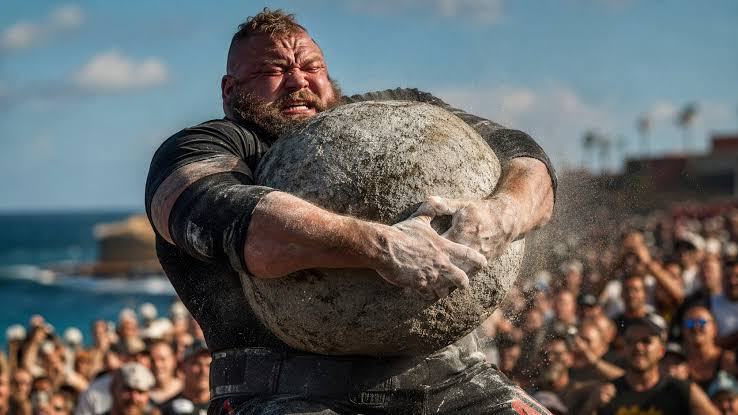
A barbell has relatively predictable geometry. A stone does not. A sandbag deforms, a keg can shift its center of mass, an axle changes grip demands and a yoke adds stabilization requirements. The implement becomes part of the biomechanical problem.This is why a huge deadlift does not automatically make an athlete a champion stone lifter. Force must be transferred in a form compatible with the implement and event demands. Strongman biomechanics research emphasizes this specificity and the complexity of measuring these exercises.
20. Grip can become the limit of the entire system
You can have legs and hips capable of enormous force, but if the hand cannot maintain the implement, that force never reaches the object. Farmer's walk and deadlift are obvious examples of grip limiting global performance.In that situation, you may not need more general strength. You need to increase the limiting link or use a technical strategy that redistributes demand.
21. The trunk is the bridge between the legs and the implement
Force produced against the ground must be transmitted through the pelvis and trunk to the upper limbs. If trunk position is lost, some force is dissipated into unwanted movement and demand on certain tissues can increase.Strongman core strength is therefore not simply “strong abs.” It is the ability to maintain a configuration that allows force transmission under load.
22. Fatigue changes the force limit
The maximal force available after a heavy set or after several events is not the same as the force available when fresh. Peripheral fatigue, neural changes, metabolite accumulation and altered motor control can reduce the ability to produce and coordinate force.In competition, this is decisive. A Strongman must know not only what he can lift on a perfect day, but how much force he can still produce after the body has already paid the cost of previous events.
23. Force also depends on contraction history
Muscle does not respond identically at the same length if it has previously been shortened or stretched while active. Force depression and force enhancement demonstrate that the mechanical history of a contraction can alter subsequent force.For Strongman, this means movement sequence and starting position can influence performance. It is not only how strong the muscle is, but what mechanical state it is in before it has to produce force.
24. Pain can become a limit before strength does
Pain can alter motor behavior. Even if tissue could mechanically produce a certain force, the nervous system may change recruitment and movement strategy when it detects threat or nociception.This is one of the differences between “I can do it” and “my system allows me to do it under these conditions.” For an athlete, repeatedly ignoring that distinction can turn a manageable problem into a much more expensive one.
25. Fear can change force expression
Anticipation of pain or injury can change technique, speed and load distribution. An athlete may unconsciously reduce range of motion or adopt a protective strategy.In Strongman, where implements are heavy and positions can be unusual, confidence in the movement becomes part of force expression. That does not mean fear should be ignored. It means it should be understood and managed.
26. Absolute versus relative strength
Absolute strength is the ability to produce a given amount of force regardless of body mass. Relative strength relates performance to body mass. In Strongman, absolute force is highly important, but relative strength can explain why a lighter athlete is exceptionally efficient for his size.This distinction also explains why simple comparisons between athletes from very different body-mass profiles can be misleading.
27. Anthropometry can create mechanical advantages
Arm length, torso proportion, circumferences, pelvic width and joint positions can influence performance. Strongman research has found relationships among anthropometry, maximal strength and performance in several events, confirming that the sport is not simply a contest of muscle mass.Long arms may be advantageous in one event. A particular torso structure may favor another position. Performance is an interaction between body and implement.
28. Why records keep rising
The observed limit is not necessarily the absolute biological limit. Records rise through genetic selection, specialization, training methodology, nutrition, recovery, technique, experience and competition. Each generation can find better ways to convert biological capacity into performance.At the same time, progress cannot continue at the same rate forever. As performance approaches physiological and mechanical limits, gains become smaller and more expensive.
29. Modern Strongman pushes the system toward its limits
An elite Strongman represents a rare combination of body mass, strength, work capacity, coordination and experience. Research on a world champion demonstrates how different the muscle morphology of such an athlete can be from untrained populations.But extreme performance has a problem: as force-producing capacity rises, it becomes increasingly important that the structures transmitting and tolerating that force keep pace.
30. The limit can be muscular, neural or mechanical
In a failed attempt, the limitation may be muscle, neural activation, grip, trunk stiffness, joint position or implement mechanics. Therefore, “I did not have enough strength” is often too simple an explanation.Good analysis asks: which link could no longer meet the demand? That question is much more useful for training design.
31. Can humans produce unlimited force?
No. Limits arise from the amount of contractile tissue, neural activation, body geometry, tissue properties, metabolism, temperature, fatigue and musculoskeletal integrity.But there is no single number representing “the human limit.” There are different limits for different contraction types, positions, velocities and loads. A record is the demonstrated limit in a particular configuration, not a universal constant of the species.
32. What happens when force exceeds tissue capacity?
One of the system's links can fail. Muscle may be injured, tendon may be overloaded, joints may experience very high moments and bone can become the limiting structure under extreme conditions.Strongman injury epidemiology shows that muscle and tendon injuries, as well as lower-back and shoulder problems, are relevant. In a study of 213 athletes, 82% reported an injury during a one-year period.
33. The Strongman paradox: become stronger without becoming more fragile
The goal is not simply to produce as much force as possible. The goal is to increase system capacity at a rate that muscle, tendon, joints, technique and recovery can support.Strength without structural capacity becomes vulnerability. Strength without technique becomes waste. Strength without recovery becomes debt. And strength without strategy can become an obstacle to long-term performance.
34. Failure Point: where does strength end and the body's limit begin?
The Failure Point is not a line drawn in one place. It is the point at which event demand exceeds the capacity of the limiting link. On one day it may be grip. On another it may be fatigue. In one attempt it may be hip mechanics, while in another it may be activation capacity or tissue tolerance.The real skill of a Strongman is not to ignore this limit but to move it progressively through adaptation. Become stronger without destroying the system that produces strength. Turn today's limitation into tomorrow's capacity.
35. Conclusion: humans do not have a single limit
How much force can a human produce? The correct answer is: it depends on what we call force, on position, velocity, implement, fatigue state, neural activation, muscle mass and architecture, and the integrity of the whole system. Muscle produces tension, the nervous system commands it, tendon transmits it, the joint converts it into a moment, and biomechanics determines how much becomes useful movement.Strongman is one of the clearest demonstrations of this reality. When we watch a person lift hundreds of kilograms, we see only the external outcome. Inside, millions of processes are coordinated simultaneously. The human limit is not one number. It is a moving frontier between what the organism can produce, what it can transmit and what it can tolerate.
Selected references
1. Persad LS, et al. Specific tension of human muscle in vivo: a systematic review. J Appl Physiol. 2024;137(4):945-962. DOI: 10.1152/japplphysiol.00296.2024.
2. Jones EJ, Bishop P, Woods A, Green JM. Cross-sectional area and muscular strength: a brief review. Sports Med. 2008;38(12):987-994. DOI: 10.2165/00007256-200838120-00003.
3. Maganaris CN, Baltzopoulos V, Ball D, Sargeant AJ. In vivo specific tension of human skeletal muscle. J Appl Physiol. 2001;90(3):865-872. DOI: 10.1152/jappl.2001.90.3.865.
4. Enoka RM. The determinants of skeletal muscle force and power: their adaptability with changes in activity pattern. J Biomech. 1992.
5. Martin ML, Travouillon KJ, Fleming PA, Warburton NM. Review of the methods used for calculating physiological cross-sectional area. J Morphol. 2020. DOI: 10.1002/jmor.21139.
6. Winwood PW, Keogh JWL, Harris NK. Interrelationships between strength, anthropometrics, and strongman performance in novice strongman athletes. J Strength Cond Res. 2012;26(2):513-522. DOI: 10.1519/JSC.0b013e318220db1a.
7. Keogh JWL, Winwood PW. The Biomechanics and Applications of Strongman Exercises: a Systematic Review. Sports Med. 2019. DOI: 10.1007/s40279-019-01169-1.
8. Winwood PW, Hume PA, Cronin JB, Keogh JWL. Retrospective injury epidemiology of strongman athletes. J Strength Cond Res. 2014;28(1):28-42. DOI: 10.1519/JSC.0b013e3182986c0c.
9. Nuzzo JL, et al. Muscle and tendon morphology of a world strongman and deadlift champion. Eur J Appl Physiol. 2024.
10. Enhancing human strength via neural modulation: mechanisms of maximal voluntary contraction and translational interventions. Front Physiol. 2025. DOI: 10.3389/fphys.2025.1695665.
More From The Journal

Training
The Science of Strongman Training - Episode X: Competition Programming
How to build a complete Strongman competition preparation block: calendar, events, volume, intensity, specificity, simulations, autoregulation, tapering and fatigue management.
Training
The Science of Strongman Training - Episode IX: Peaking
Peaking in Strongman: how to turn months of training into maximal competition performance by reducing fatigue, preserving adaptations and managing specificity.