
Training Science
Series: STRONGMAN DATA LAB: HOW WE MEASURE AND ANALYSE PERFORMANCE - Episode 8: Video Analysis and Identification of Technical Errors
October 15, 2026
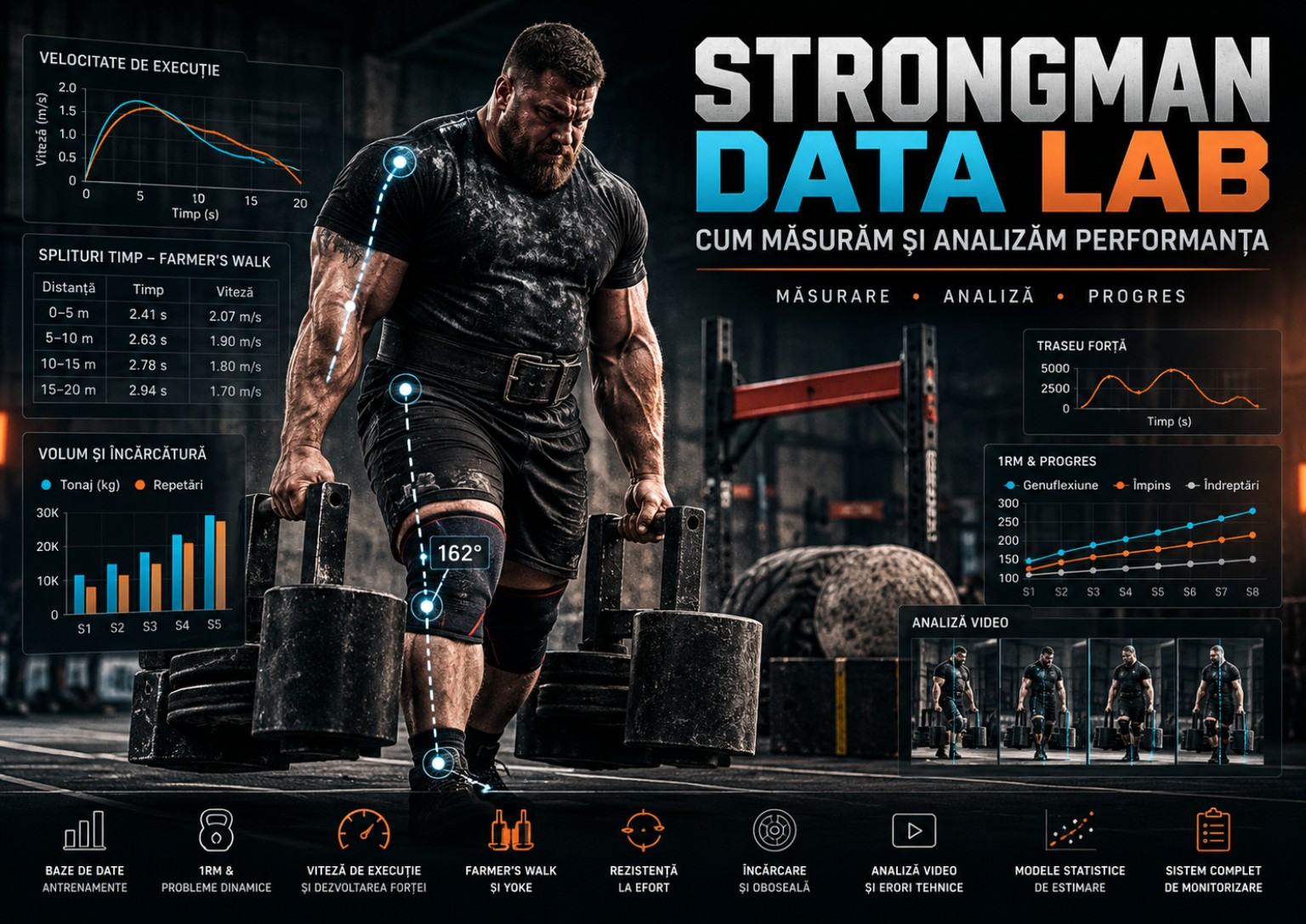
A fifteen-second video can change how a strongman understands a training session. Yoke sway halfway through a course, a Log repetition losing time between clean and press, or a Deadlift bar drifting away from the body may become apparent on replay. Yet observing movement does not automatically reveal its cause. Camera angle can exaggerate deviation, lens geometry can distort apparent position, and a poorly chosen frame can suggest a joint angle that was never present in the assumed plane. Between «that looks wrong» and «we can demonstrate that changing it improves performance» lies the discipline of video analysis.
This eighth episode of STRONGMAN DATA LAB: HOW WE MEASURE AND ANALYSE PERFORMANCE continues the development of a practical assessment system. Earlier episodes established measurable outcomes, databases, relationships with 1RM, execution velocity, Farmer’s and Yoke timing, repetitive events and training-load monitoring. Here we examine the images that provide context for those numbers: movement recording, camera placement, temporal synchronisation, coordinate estimation, technical-error recognition and testing coaching hypotheses.
The approach remains scientifically grounded while being practical for gyms where a tripod and smartphone are easier to obtain than a motion-capture laboratory. We will distinguish qualitative observation, calibrated two-dimensional kinematics and validated three-dimensional analysis. Each has a different capacity to support claims. Neither ordinary video nor automated pose estimation directly measures joint forces or tissue loading.
Athletes and numerical scenarios in this article are hypothetical teaching examples unless explicitly described as published findings. The cited literature includes strongman biomechanics and evidence about camera-based measurement validity and reliability. Each section asks what can be observed, how reliably it can be quantified, which explanations are plausible and how a proposed intervention could be tested. Video becomes an auditable source of information, not an oracle that reveals every hidden mechanism.
1. From a gym video to biomechanical analysis
Athletes commonly film lifts to check validity, share results or identify obvious loss of control. Those are legitimate purposes, but biomechanical analysis requires additional discipline. We need to specify the observed event, tracked object, spatial references, time scale and conditions of comparison. Without these definitions, a useful coaching impression can become an unjustified claim about mechanisms underlying performance.
Three operational levels are helpful. The first is qualitative observation: «the Yoke frame visibly oscillates», «the athlete regrips an Axle» or «the Log moves out of rack position». The second involves simple measurement: clean duration, lockout time or pixel displacement of a tracked landmark. The third requires calibration and error assessment to estimate comparable positions or angles. These levels should not be used interchangeably or expected to answer identical questions.
A systematic review of biomechanics methods in strongman found that simplified two-dimensional techniques were common, reflecting the difficulty of advanced field measurement [2]. That does not invalidate ordinary video. Rather, it makes transparent reporting essential. A lateral recording may show a prolonged pickup, yet cannot directly quantify spinal-disc pressure simply because the back is visible.
For a coach, the best analysis begins with a narrow, answerable question. «Where did we lose two seconds compared with the previous run?» is more testable than «Why am I not strong enough?». Video should make the first question verifiable and connect the answer to a practical adjustment in technique, pacing or test conditions.
2. What an image reveals and what it cannot
A camera records light projected onto a sensor. Frames can show apparent positions, displacements and event sequences. With timing references and calibration, some velocities and angles may be estimated. Muscular forces, joint moments, intra-abdominal pressure, neural activation and tissue tolerance do not appear directly in those pixels. Some quantities can be estimated through more elaborate models requiring additional inputs, each with its own uncertainty.
Consider an athlete visibly leaning forward while lifting an Atlas Stone. The image does not establish that the lumbar spine is overloaded or that the posture is pathological. Mechanical conclusions would require knowledge of object trajectory, external forces, body segmentation and other quantities. Qualitative review can identify a movement worth investigating, but it is not a clinical diagnosis. Anthropometry and experience also mean efficient techniques will not look identical across athletes.
The reverse problem also exists: an apparently smooth movement is not necessarily efficient. A Deadlift can look technically tidy yet waste considerable time in preparation. A Log can follow an attractive overhead path while losing seconds during repositioning before the clean. Competitive result, timing and validity still matter. The visual elegance of a movement is not a performance unit.
Use language proportionate to the evidence. «From the lateral view, the bar appears to move forward after leaving the floor» is justified without full calibration. «The bar moved eleven centimetres away from the athlete’s centre of mass» requires a much stronger measurement protocol. Responsible analysis makes the distinction explicit.
3. Camera placement should follow the question
A lateral view is often useful for observing forward-back and vertical movement of an implement. In Deadlift it may reveal the sequence from lift-off to lockout; in Log it can show cleaning and overhead drive. But the actual side selected matters, and the full relevant motion must remain visible. When feet or implement leave the frame, measurements become incomplete.
Front or rear views can reveal apparent lateral movement and asymmetry. They are useful in Farmer’s and Yoke, where sway and off-line corrections may cost time. Yet knee or trunk angles estimated from the front are not equivalent to sagittal-plane measurements obtained laterally. An oblique camera mixes projection planes and can create misleading interpretations.
For Log Overhead Press, two fixed cameras may be preferable: lateral for implement trajectory and frontal for lockout and lateral control. Synchronising views links events, but two ordinary videos do not automatically create three-dimensional motion capture. That requires appropriate geometry, calibration and validation. Placing two clips beside each other is not a 3D biomechanical reconstruction.
Decide camera locations before the attempt instead of selecting an angle after observing an unfavourable result. For longitudinal comparison, preserve camera height, distance and orientation where feasible. Perspective changes can make an unchanged movement pattern appear altered. Reproducible camera placement is part of a reproducible testing protocol.
4. Frame rate, resolution and measured time
Frame rate, commonly expressed as frames per second (fps), determines nominal intervals between available images. At 30 fps, adjacent frames are about 33.3 milliseconds apart; at 60 fps, roughly 16.7 ms; and at 120 fps, approximately 8.3 ms. These numbers describe sampling, not guaranteed accuracy. Motion blur, compression, inadequate lighting and subjective event selection can make actual uncertainty considerably larger.
If lockout can only be localised between adjacent frames, timing uncertainty arises from sampling. Measuring an interval also involves identifying both its beginning and end. Reporting 7.428 seconds as though millisecond precision were established is misleading if the video has 30 fps and ambiguous landmarks. Software may display many decimal places, but reported precision should reflect the actual method.
Spatial resolution interacts with frame rate. Phones may reduce image resolution to capture higher frame rates or digitally stabilise footage by cropping. If the implement occupies very few pixels, tracking may be unreliable even at 240 fps. A clear 60-fps recording can sometimes answer a coaching question better than very fast but dark and noisy footage.
Record actual file timing characteristics and check whether frame rate is constant. Some devices record variable frame intervals, and software assuming uniformly spaced frames can introduce errors. For important analysis, use actual timestamps where available rather than trusting only the camera setting selected before recording.
5. Exposure time and motion blur
The time during which a sensor accumulates light affects clarity during rapid movement. Longer exposure can create blurred edges that make it difficult to identify a plate boundary, hand position or precise lockout moment. Higher frame rate does not eliminate blur when individual frames remain unclear. Lighting is consequently a measurement concern rather than merely an aesthetic one.
Consider a hypothetical Log moving rapidly through its final centimetres towards lockout. If the implement and arms are blurred, analysts may disagree about the first frame showing acceptable extension. Adequate, safe lighting and a stable camera reduce ambiguity. Extremely bright lights that distract the athlete are not required; the aim is visibility without interference or hazard.
Digital stabilisation introduces another complication. Some software shifts the image to compensate for camera movement. Tracking an implement within stabilised footage can therefore require extra care because the apparent reference system has been altered. A fixed tripod provides a more stable physical reference and often avoids correction algorithms affecting apparent trajectories. Handheld footage remains useful for broad technical review but is less suitable for some spatial measurements.
Reports should acknowledge when image quality prevents reliable phase estimation. «The precise lockout time could not be measured because of blur» is more professional than filling a table with a precise-looking but fragile value. Missing data reflect limits of observation, not necessarily a failure of the overall training analysis.
6. Perspective, parallax and pixel geometry
A lens projects three-dimensional space into a two-dimensional image. Points at different depths can show different pixel displacements even if their real movement is similar. An implement moving closer to the camera can appear to shift sideways or grow in size. This is particularly important in strongman, where large objects and multiplanar movements are common.
Estimating centimetres requires an appropriate scale reference in the plane of movement. Using an object closer to the camera than the tracked bar can bias pixel-to-centimetre conversion. Wide-angle lenses may also distort geometry near image edges. A tape measure placed arbitrarily in a corner does not guarantee calibration throughout the image.
For basic 2D work, place a fixed camera approximately perpendicular to the dominant motion plane and position an object of known dimensions near that plane. Clearly state that the result is a two-dimensional estimate susceptible to out-of-plane movement. When an athlete rotates or the implement sways towards the lens, the simple calibration may become inappropriate. Not every pixel displacement represents the corresponding real-world distance.
When the question only concerns phase duration, spatial calibration may not be necessary. Choosing a measurement matched to the available equipment avoids unnecessary complexity. A stable video clock can answer «How long did the clean take?» without pretending to reconstruct the Log’s full three-dimensional trajectory.
7. Two-dimensional calibration: from pixels to centimetres
Calibration establishes a relationship between image coordinates and a physical reference. The simplest version uses a visible object of known length in the relevant movement plane. If a one-metre reference occupies 500 pixels, the local scale is five pixels per centimetre. A tracked displacement of 150 pixels then corresponds to approximately thirty centimetres only if the object stays in the same plane and geometric distortion is negligible. The arithmetic is simple; defending those assumptions is the difficult part.
For a laterally filmed Log, a known implement dimension might serve as a scale, but the dimension must be correctly oriented relative to the camera. Rotation or movement towards the lens changes apparent size and makes the scale unstable. A fixed reference near the movement region often works better than one moving with the implement. Even that arrangement remains approximate if the dominant movement plane changes.
More elaborate procedures can use multiple calibration points and lens-distortion correction. Every transformation should be documented: selected landmarks, their physical placement and the geometric model used. An app displaying a ruler over the image does not prove perspective error has disappeared. Accuracy should be checked against an independent known distance that was not used to build the calibration.
For longitudinal assessment, retain the same camera position and calibration where possible. Changing zoom or image resolution requires recalculating the scale. Pixel-to-centimetre conversion from an older video cannot simply be reused. Well-executed 2D analysis can provide useful planar trajectories, but only within clearly stated limits.
8. Anatomical landmarks: where should tracking points be placed?
Angle analysis requires clearly defined anatomical landmarks. A 2D estimate of knee flexion, for example, may use projected hip, knee and ankle reference points, but locating these under clothing or by silhouette alone can be difficult. In strongman, knees may be hidden by a Yoke frame, forearms by a Log and the trunk by a large loading object. Occlusion directly limits measurement reliability.
Visible marks on clothing or equipment can sometimes help, provided their use is safe and practical. They do not automatically coincide with the true joint centre. Skin and clothing move relative to bone, and a line drawn through visible points estimates the projected segment rather than perfect anatomical kinematics. Rotation away from the camera plane introduces further error.
During Deadlift, tracking a visible barbell landmark may be more reliable than identifying partly hidden joints. It may also answer the coaching question more directly. If trunk inclination is the focus, use one explicit operational definition of the tracked line and apply it consistently. Changing landmarks between repetitions because one happens to be more visible can manufacture apparent improvement.
A club protocol can illustrate landmarks with a reference image. When a point cannot be seen, mark the observation missing or approximate. Do not reconstruct a hidden joint purely from intuition to make the table complete. Data quality depends partly on whether another trained observer can repeat the same landmark selection.
9. Synchronising video with official timing and other devices
In competition, official timing may begin with a referee’s command, an audible signal or another rule-defined event. Recording can start earlier, so file time zero is not competition time zero. The analyst must identify a shared reference. For repetitive events this may be the start signal; for Yoke it might be the first visible movement, but only when the analysis is explicitly movement-start based.
Two phones can have different clock settings and variable recording delays. A clap visible and audible in both recordings, a safely produced flash or another common event may help relative synchronisation. Video-audio offsets and variable frame timing still need consideration. Two clips that appear synchronised in an editing timeline are not automatically aligned within milliseconds.
When bar-velocity sensors and video are used together, they also need a common temporal definition. Sensor peak velocity may occur at a different instant from the frame selected by an analyst as concentric onset. Without alignment, the relationship between position and velocity can be misinterpreted.
If a suitable shared landmark is unavailable, report timings relative to events identifiable within each recording and avoid pretending different systems are absolutely aligned. An honest independent video analysis can be more useful than an unverified «data fusion» model.
10. Segmenting movement: phases must be defined before counting
Complete strongman movements contain multiple stages, but their boundaries are not always visually obvious. Log may be divided into pickup, lap, clean, rack, dip, drive, lockout and lowering. Deadlift can include setup, bar separation, knee passage, completion and return. Atlas Stones may include pickup, lap, extension and loading. Two analysts using different definitions of «clean duration» will not produce directly comparable times.
Definitions should use identifiable visual events. For example, clean onset may be defined as the first frame in which the Log leaves contact with the thighs, and completion as the first stable rack position. This is one practical convention, not an international standard. An athlete may use a fluid technique that makes boundaries somewhat arbitrary. The chosen rules must therefore be disclosed.
For each phase, calculate duration and its share of the total cycle. If a hypothetical twelve-second repetition contains a 4.5-second clean, cleaning represents 37.5% of elapsed time. This does not establish that it is «too slow». A controlled transition may support a more reliable final press. The meaningful outcome remains the whole successful, safe repetition.
Phase analysis becomes particularly useful when total performance deteriorates. Instead of saying «the Log is slower», we may show that clean duration has increased while overhead drive remains similar. This narrows training hypotheses without providing an automatic diagnosis of the underlying physical cause.
11. Discrete event timing and frame-selection error
Frame-by-frame review feels precise, but events can be gradual or ambiguous. Saying that a bar «left the floor» requires an operational definition: the first visible gap between plate and surface, or the first sustained upward movement of the implement. These can produce different timestamps. With a flexible bar, the hands and centre shaft may move before the plates separate from the ground.
For lockout, a mechanical position may be reached before the referee accepts the repetition. Overhead events may require stable control and a command. The first geometrically extended frame and the official validation timestamp are therefore different measurements. A Log or Dumbbell athlete may briefly achieve extension before repositioning and receiving the down signal. Both events may be worth tracking, but their meanings differ.
Repeat the annotation without consulting earlier values to estimate within-observer consistency. If the same evaluator selects timestamps differing by several frames, reported precision should be reduced. At 30 fps, disagreement by three frames is already around one-tenth of a second, which could be the entire performance difference being investigated. Extra decimal places offer no remedy.
When error is too large relative to the relevant change, improve recording or choose a coarser question. A two-second pause may be reliably detectable even when a 0.04-second lockout improvement is not. Matching measurement capability to decision needs is more important than apparent technical sophistication.
12. Implement trajectory versus movement efficiency
A visually straight bar path is often presented as a universal ideal, but the relationship between trajectory and efficiency depends on exercise, anthropometry and technique. During Deadlift, certain changes in position may reflect necessary mechanics. During Log pressing, an intentional path may avoid the face before moving into a stable overhead position. Not every curve on video is a technical mistake.
Track an approximate implement-centre landmark frame by frame to construct image coordinates. In calibrated 2D analysis, these may be converted into planar distances. Apparent lateral deviation can nevertheless arise from implement rotation or movement away from the recording plane. Tracking data must be read together with camera geometry.
Efficiency cannot be calculated from path length alone. A shorter Log path does not guarantee easier pressing, since acceleration, stability and alignment may differ. In Farmer’s, visible handle sway may reflect interaction with steps rather than a single correctable flaw. A proposed trajectory adjustment should be assessed through complete performance and validation, not merely through the attractiveness of its plotted line.
A responsible report might say «the final repetition shows greater anterior displacement in the lateral video» and recommend testing a technical change. It should not claim «this increased lumbar loading by eighteen percent» without appropriate biomechanical modelling. The boundary between kinematics and dynamics belongs in every interpretation.
13. Deadlift: identifying where movement changes
Deadlift video can be divided into setup, plate separation, knee passage and completion. If an athlete starts with the hips at one height but raises them before the bar leaves the floor, record the sequence. This does not automatically prove an error or injury risk. Some movement is part of the individual athlete’s pre-tension strategy. Its relevance depends on consistency, performance and comparison under similar loads.
A fixed lateral view can support tracking bar position relative to chosen athlete landmarks. Quantification requires calibration and a defined tracked point. With a flexible bar, the shaft at the grip and the sleeve near the plates may follow temporarily different paths. Ignoring the implement’s elastic behaviour can cause analysts to label a legitimate loading sequence as delayed bar separation or inefficient setup.
In a hypothetical comparison at unchanged load, time from visible initial tension to plate separation rises from 0.8 to 1.3 seconds. We cannot automatically conclude that the athlete became weaker. Starting posture, tensioning method or event-timestamp selection may have changed. Examine the remaining lift, perceived effort and normal test variability before deciding whether the difference matters.
A technical adjustment that shortens separation time but increases failed lockouts is not automatically beneficial. Recommendations should be tested through complete, valid and controlled lifts at comparable loads. Video identifies potential interventions rather than revealing one universally optimal Deadlift form.
14. Trunk inclination and the error of diagnosing from a single line
Online analysis often draws a line along the back and compares its angle with vertical. This can describe apparent inclination in two-dimensional projection, but does not directly reveal segment-by-segment spinal curvature or internal force distribution. If the camera is not perpendicular to the sagittal plane, the angle may be distorted. Clothing, soft tissues and muscular size make anatomical landmark identification more difficult.
An athlete with a longer torso may use a different posture from someone with different segment proportions while both lift effectively. Declaring one angle «wrong» without context ignores loading, anatomy and intended technique. There is a difference between an unusual but controlled position and an abrupt loss of position under load. Video may suggest that distinction, but is not enough to diagnose injury.
A practical report can track whether visible trunk position changes from early to late repetitions and whether that coincides with velocity, perceived effort or failed attempts. Greater apparent trunk flexion late in the set does not automatically establish «erector muscle fatigue». Bar positioning, altered strategy and load difficulty may also contribute.
The priority is identifying changes relevant to performance and control. When pain or other symptoms occur, video is not a diagnostic tool and must not be used to authorise heavy lifting. Technical analysis and clinical assessment are different processes, though they may inform each other appropriately.
15. Deadlift repetitions: what actually deteriorates?
During Deadlift for Reps, a set may become slower because each lift takes longer, between-repetition pauses increase or invalid attempts consume time. Episode Six examined these distinctions in temporal terms; video adds movement description. Measure the concentric phase of each attempt, then the interval from bar return to the next attempt, using consistent observable landmarks.
Imagine six hypothetical lifts at unchanged loading, with concentric times of 2.2, 2.3, 2.4, 2.7, 3.1 and 3.5 seconds. Movement time increases, but we cannot automatically partition the effect into physiological fatigue and changed technique. If video also shows greater forward bar displacement, reduced efficiency becomes a hypothesis worth testing. If visible positioning is similar, other explanations deserve examination.
Dead-stop repetitions require a defined stationary period on the floor. Touch-and-go changes the cycle, while bar flex and rebound can affect durations. Record which version and rule was used. Combining these into a single velocity-loss curve without labelling differences creates the false impression of a stable fatigue measurement.
Coaching value comes from identifying a testable intervention: consistent rests, more repeatable positioning, load adjustment or targeted phase practice. Repeat the assessment under similar conditions. A more aesthetically pleasing line on the screen, without better valid performance or control, is not sufficient proof of technical progress.
16. Log Lift: separate pickup, clean and press analysis
Log Lift demonstrates why the global result cannot explain the movement. One athlete may lose time lifting onto the thighs, another during the transition into rack, another between dip and drive. A clear lateral video may allow phase identification if the implement does not completely obscure the relevant landmarks. A frontal view can complement assessment of stability and lockout but does not replace lateral trajectory information.
One operational sequence could mark: implement leaves the floor; reaches lap; rotation into rack begins; settles at the chest; dip starts; implement leaves rack; overhead extension is achieved; referee validation occurs. These landmarks are not universal for every technique but organise observation. Durations between them show where time is spent, not which muscle «failed».
In a hypothetical example, clean duration increases from 3.4 to 5.8 seconds between the first and sixth repetition, while overhead drive stays close to two seconds. The dominant observed slowing occurs before pressing. Clean technique and pacing become plausible targets for review, but this does not establish inadequate lumbar strength or prove shoulders are free from fatigue.
Competition rules must be explicit. Mandatory clean on every repetition differs fundamentally from repeated presses after a single clean. If monitoring is intended to predict competition performance, the test should reproduce the relevant demand. Video strengthens specificity; it does not replace judging standards.
17. Overhead lockout: valid position versus optical appearance
Lockout matters in Log, Axle and Giant Dumbbell. Camera projection can create misleading impressions: from an oblique angle, an elbow may seem extended when it is not; another view may conceal the joint completely. One frame shows a position, not necessarily the stable control required for acceptance. Time to extension may differ from time to the referee’s down signal.
Useful descriptive categories include clearly stable extension, extension with corrections, insufficient visibility and officially rejected attempt. Angular quantification needs explicit landmarks and error assessment. We should not invent one universal elbow-angle threshold across different overhead events when official rules and available video evidence differ.
In a hypothetical trial, the athlete reaches extended position after two seconds but takes another 1.2 seconds to stabilise the Log before receiving the command. Focusing only on pressing velocity would miss that time. Reducing stabilisation duration could be beneficial if control and validity are preserved. A fast but unstable finish does not represent complete progress.
Video can support judging education but should not unilaterally rewrite competition outcomes. The official result follows the applicable rules. In training, footage helps athletes understand rejected efforts and practise consistent standards. The goal is more accepted repetitions, not selecting favourable frames to declare questionable attempts valid.
18. Axle and Giant Dumbbell: grip and asymmetry beyond one camera angle
Axle changes grip requirements through diameter and rotational behaviour compared with standard Olympic bars. Video can reveal grip changes, hand repositioning and difficulties transitioning into rack. However, a frontal view cannot fully describe sagittal movement, while a side view can conceal the farther hand. Two angles may help analyse transitions if they can be reliably synchronised.
Giant Dumbbell introduces unilateral loading, and athletes may adopt different strategies depending on the arm used. Apparent lateral trunk lean may reflect balance, implement positioning or compensation. It should not automatically be labelled pathological. If the event permits alternating arms, tag each repetition with the side used to preserve comparison quality.
A recording may show time losses during the dumbbell clean rather than overhead extension. Identify clean onset, rack, dip, overhead position and referee signal using declared landmarks. If the implement hides an event, do not fabricate its timestamp. Explicit uncertainty allows rigorous work even with relatively simple equipment.
Technical changes should first be tested under loads compatible with safe control before being used with extreme competition weights. Faster execution accompanied by repeated instability may be undesirable. Video can locate time losses without removing the responsibility to perform safely.
19. Farmer’s Walk: understanding loaded gait from the rear
Farmer’s Walk involves two independently moving implements that can oscillate relative to the athlete. Fixed rear video helps reveal deviation from the course centreline and corrective steps. Lateral footage may show apparent stride length and handle movement along the travel direction, but complete three-axis sway analysis requires a more elaborate methodology. Ordinary video must not be described as direct measurement of ground-reaction forces.
Keogh and colleagues’ preliminary Farmer’s gait analysis [3] demonstrated the value of studying this particular form of loaded walking. It did not establish a single ideal stride rate for every athlete or load. Speed, step pattern and handle control depend on mass, body proportions and course phase. Analysis must retain those conditions rather than applying one normative template.
Imagine the same athlete completing the first ten metres in similar time on two runs, then losing 1.4 seconds in the last ten metres of the second. Video shows the right handle rotating in the palm and steps shortening. Grip difficulty may have contributed to slowing, but the exact contribution is not known. Testing handle positioning, implement control or specific grip endurance could help investigate the explanation.
Record loading per hand, corridor width, surface, course length and stopping rules. Oblique video can make one implement appear farther away than the other. Before calling that asymmetry, confirm camera alignment. A technical conclusion should rest on more than a perspective illusion.
20. Yoke Walk: sway and corrective steps
Yoke can oscillate laterally and forward-back as an athlete accelerates, brakes or corrects direction. Rear footage may reveal movement relative to the course centreline, while lateral footage can show longitudinal rocking. Hindle and colleagues’ 2021 Yoke study observed nineteen strongman athletes and analysed five-metre intervals [4]. These data support phase-based description but do not establish a universal acceptable sway threshold.
A club protocol might use descriptive categories: stable travel, moderate controlled sway, repeated lateral corrections and stopping related to instability. For quantitative investigation, track a visible frame landmark with a fixed, suitably aligned camera. But a frame corner may follow a different path from the total system’s centre of mass. Name the actual measured variable «displacement of the Yoke landmark», not «athlete centre-of-mass oscillation».
In a hypothetical twenty-metre trial at 340 kg, finishing time falls from 20.1 to 19.0 seconds. The first trial contains two large lateral corrections after ten metres, while the second contains fewer. Better sway management may contribute, but pickup, pace and fatigue may also have changed. One comparison does not establish causation.
Training may test a more controlled start or more consistent positioning beneath the frame at manageable loads. Evaluate the intervention through finishing time, split times and safety. A faster run that repeatedly approaches loss of control is not necessarily a suitable model for everyday training.
21. Truck Pull and Sled Pull: trunk angle in traction context
Truck Pull performance depends on vehicle configuration, friction, surface, ropes or harnesses and competition rules. Video can show athlete positioning, step rhythm and periods when the vehicle starts or stops moving. Trunk inclination does not independently determine traction force, however, and an extremely forward-leaning posture is not automatically superior. Interpretation requires vehicle movement and foot-ground interaction context.
During Sled Pull, a visible landmark on the sled can support displacement estimation. When the course is flat, camera alignment is appropriate and scale is calibrated, interval mean speed may be estimated. During Truck Pull, a wheel can help identify movement onset, but converting wheel pixels into exact vehicle displacement requires proper perspective handling. The image does not directly reveal the rolling resistance overcome by the athlete.
In a hypothetical case, the competitor covers the opening five metres of Truck Pull more slowly than in a previous session but travels at similar speed later. Initial vehicle acceleration may be the issue, but differences in vehicle setup, surface or strategy could explain it. Video localises the time loss without proving that leg strength is the limiting factor.
For comparison, retain the vehicle identity and configuration alongside course, slope and traction equipment. A change in tyres or rope position can alter resistance. Technical explanations ignoring the object being moved risk attributing environmental differences to the athlete.
22. Atlas Stones: large objects conceal important landmarks
Atlas Stones pose particular challenges because the stone can obscure the athlete’s trunk, hips and hands. Lateral video may show separation, lap position, extension and loading; frontal video can show apparent symmetry. Neither automatically reveals the three-dimensional positions of hidden joints. When a pose-estimation algorithm guesses landmarks concealed by the stone, its numerical confidence may not reflect physical validity.
The strongman biomechanics review identifies gaps in evidence for several events, including Atlas Stones [1]. There is no universally validated optimal technique model for every sphere diameter, platform height and athlete morphology. Club-level analysis can still identify time-consuming phases and changes in strategy. The information is valuable when matched to the exact task.
Imagine a hypothetical athlete loading the same 120 kg stone onto the same platform in 9.0 seconds and, after technical practice, 7.8 seconds. Video shows a shorter lap pause without an obvious change in separation duration. A portion of improvement appears to occur during the transition to extension. This does not establish reduced lumbar loading or a precise percentage of energy saved.
Film only when the platform and surrounding area are safe and assistants cannot be struck. A camera positioned too close to loading may itself become an obstacle. Safety takes priority over perfect viewing geometry; a measurement that cannot be obtained safely should be abandoned or replaced by a simpler observation.
23. Sandbag, Keg and Loading Medley: transitions between objects
Loading medleys combine approach, pickup, carrying, positioning, loading and returning. A fixed camera may capture major events but miss some phases when objects are spread over a large course. Two cameras can sometimes help: one covering pickup and travel, another observing the platform, synchronised using a common event. Their placement must not interfere with athletes or assistants.
A delay at a heavy object may reflect strength limitations, inefficient positioning, unstable grip or deliberate pacing. Video can separate time to pickup from travel and loading time and compare these phases across similar attempts. If most delay occurs at the platform, loading technique becomes a coaching question. If the athlete moves slowly with the object, a different problem may be involved.
In a hypothetical three-sandbag medley, objects are completed at seconds 13, 32 and 56. Intervals of 13, 19 and 24 seconds could easily be mislabelled progressive fatigue. Yet object masses, shapes and return distances may differ. Video analysis must distinguish each object and configuration rather than manufacturing an «endurance index» from those three intervals alone.
An intervention may improve positioning near the platform or reduce unnecessary movement during returns. It should be tested on the same course under unchanged rules. A faster motion that fails to satisfy loading validity does not produce official progress. Video provides timing context while competition rules define success.
24. Tire Flip: phases of rotation and where seconds disappear
A Tire Flip combines initial lifting, movement towards the balance point and final pushing or rotation. Hindle and colleagues’ systematic review summarised research identifying the duration of a secondary pulling phase as an important discriminator of faster and slower performances in the studied configurations [1]. It does not establish that this phase dominates every tyre and athlete. Mass, diameter, stiffness and surface conditions can all change technique.
From lateral footage, we can define lift onset, passage through a chosen orientation and onset of final rotation. If an athlete loses time transitioning from pull to push, more economical hand repositioning may be worth testing. But when the tyre’s geometry conceals landmarks, measured phase durations carry substantial uncertainty.
In a hypothetical comparison, two flips take 6.8 and 5.9 seconds. The faster attempt appears to have a shorter transition between lifting and pushing. Without timing every phase, we cannot assign the entire gain to that transition. Repeated attempts with the same tyre can strengthen a provisional explanation.
Footage must be captured from outside the possible falling and rolling zone. Large tyres may fall unexpectedly or occupy more space than the camera preview suggests. Do not place observers or tripods in the flipping direction to obtain a better angle. The method must adapt to safety requirements.
25. Automatic pose estimation and the limits of markerless algorithms
Markerless systems estimate body landmarks from images without physical markers. They are attractive because a phone may produce a skeletal overlay and joint-angle graphs without laboratory equipment. Yet an algorithm can be wrong when body segments are hidden, the athlete rotates or the pose differs from its training data. Strongman contains many such conditions: large implements, belts, bars and unusual loading patterns.
A 2025 systematic review of computer-vision gait analysis reported promising results for some spatiotemporal variables but lower accuracy for certain joint estimates and limited reliability evidence [7]. Another review of markerless lower-limb and trunk analysis found substantial differences across systems, tasks and joints [8]. Neither establishes that a commercial app is automatically accurate while an athlete lifts a 160 kg Atlas Stone.
Imagine a hypothetical pose-estimation tool placing a knee landmark behind a Log even though the joint is completely hidden. Displaying a knee angle of 76.4 degrees does not repair the fact that the reference location has been inferred from an occluded region. The analyst must inspect the source image and decide whether the result can be validated. A calculated number is not necessarily a directly observed measurement.
In practice, manually review problematic segments, retain quality-confidence fields when available and flag occlusions. Software performing well during unloaded walking should not automatically be assumed to work under Yoke. Transfer to unusual strongman tasks requires testing, ideally against a stronger reference method.
26. OpenPose, OpenCap and accessible movement analysis
Pose-estimation systems can reduce the time needed for manual tracking. Tools such as OpenPose and OpenCap illustrate the growing accessibility of video-based biomechanics, while research has evaluated related methods in gait, squatting and functional movements [7, 8, 9]. Performance differs among joints and tasks. Strong correlation with a criterion system does not guarantee exact agreement in every frame.
In Yoke, the frame can hide the pelvis or limbs, making algorithms infer a posture rather than measure a visible landmark. In Log, the cylinder conceals parts of the arms and trunk; Farmer’s implements also create occlusions. A model validated for an unobstructed Squat should not be assumed accurate across the strongman event catalogue. Testing must reflect the actual environment.
A genuine benefit is automating repetitive tasks: identifying candidate events, comparing sequences and generating movement histories. However, every angular or velocity estimate requires a method label and quality check. Camera changes, lighting and clothing can influence algorithm performance. Numerical outputs should not be treated as clinical measurements merely because the interface looks scientific.
For STRONGMAN DATA LAB, markerless tools are appropriate for exploration and for indicators shown to be adequately reliable under the specific protocol. They should not independently declare a joint dangerously loaded or authorise painful training. Performance measurement and medical diagnosis remain distinct.
27. Kinovea and manual annotation: software cannot replace a protocol
Video-analysis software can provide angle tools, point tracking and frame-by-frame playback. Kinovea is one example used in research and coaching. Recent studies have examined the validity of particular functions for defined tasks such as jumping [10]. Findings apply to the evaluated procedures rather than establishing identical accuracy for every feature and exercise. A software brand does not confer universal measurement validity.
In practice, one may import lateral Deadlift footage, select a visible bar landmark and compare trajectories across repetitions. With suitable scale calibration, planar mean velocity can be estimated, but calibration and tracking errors propagate into the result. Automated tracking may lose the landmark when the bar is obscured, and inferred positions should be checked rather than accepted uncritically.
A sound protocol records file source, actual frame timing, resolution, camera geometry, tracked landmarks, calibration and treatment of ambiguous frames. These details may seem administrative, but without them longitudinal comparisons can become unreliable. Where manual tracking is used, a second independent pass or another observer can help estimate consistency.
Complex proprietary software is not required to begin. A player offering individual-frame inspection, a spreadsheet and clear definitions can answer many questions about movement phases and timing. Tools become valuable when they improve accuracy or efficiency, not simply because they offer numerous features.
28. Between-rater reliability: does the same clip lead to the same result?
If two coaches review a recording and select different lift-off frames, the measure is not yet stable. Disagreement may arise from unclear definitions, inadequate footage or differences in observer training. Before using the variable for an important decision, assess repeatability. With rapid movements, disagreement by a few frames can reverse conclusions about changes of tenths of a second.
A simple assessment has two observers independently annotate ten repetitions. Calculate the absolute difference between their timestamps and compare it with the changes you want to detect. If disagreements are commonly 0.15 seconds, a reported improvement of 0.05 seconds is not adequately supported. Measurement uncertainty is larger than the supposed effect, regardless of how appealing the graph appears.
Technical categories also require common criteria. If one observer labels every lateral movement «sway» but another reserves the term for major loss of control, agreement will be poor. A small library of agreed example clips can improve consistency. The aim is not unnecessarily complicated terminology but operational rules that produce similar decisions between observers.
High reliability does not by itself guarantee validity: two observers can consistently measure the wrong thing. Yet without reliability, longitudinal comparisons are weak. First verify repeatability, then ask whether the metric truly represents the sporting question.
29. Validity: are we measuring what we think we are?
An application may track a Yoke corner perfectly and produce a smooth displacement curve. Does that curve actually describe the performance variable of interest? If the question is athlete speed, frame-corner movement may be affected by sway. If the question is clean duration, the chosen onset and completion events must match the intended phase. Validity is not guaranteed simply because the calculation itself is mathematically correct.
Where possible, compare a measurement with an appropriate criterion method. Video event times might be compared with electronic timing when both define the same start and finish. Automatically estimated joint angles may be compared with a more accurate motion-capture system under the relevant task. Correlation alone does not establish absolute agreement, while systematic differences may matter [11].
Imagine two apps reporting mean Log velocity of 0.65 and 0.72 m/s for one repetition. Do not select the more convenient value. Review landmarks, time intervals, scale and filtering. The systems might measure different phases rather than contradicting each other mathematically. A rigorous report makes such definitional differences explicit.
Before adding a variable to a dashboard, ask what coaching decision it could improve. An uncertain angle estimate that never changes a decision may be unnecessary. Clear video evidence of invalid repetitions can sometimes offer more practical value than sophisticated but unvalidated joint-angle analysis.
30. Measurement error and the smallest detectable change
Every instrument varies, and video analysis is no exception. Error may arise from recording, calibration, landmark selection and processing. To conclude that clean duration improved by 0.2 seconds, we need to know whether the method can resolve such a change beyond ordinary variation. Atkinson and Nevill presented statistical approaches to measurement error in sports variables [12]. The practical lesson is not to treat every numeric difference as genuine progress.
In a hypothetical assessment, two analysts measure Log phases across ten clips and typical disagreement is around 0.12 seconds. An apparent improvement of 0.08 seconds is not strong evidence of a real change. A repeated improvement of 0.9 seconds would be much more compelling, provided apparatus and protocol remain comparable. Even large differences deserve context checks.
Standard error of measurement, coefficient of variation and minimal detectable change are defined statistical quantities that require appropriate estimation. They should not be invented from two attempts and presented as precise percentages. In a club setting, repeated standardised observations may provide an initial practical sense of variability before more formal analysis is available.
When precision is insufficient, choose more robust outcomes. Detecting a three-degree hip-angle change may be difficult, while identifying a two-second lap pause may be straightforward. Selecting variables appropriate to the method reduces administrative burden and false conclusions.
31. Before-and-after video comparison: testing technical changes
Two side-by-side clips can make a technical correction look impressive, but demonstrating an effect requires more than editing. Loading, course, camera, effort level and validity rules must be sufficiently comparable. If one video shows a 300 kg Yoke and another 260 kg, smoother movement at the lighter load does not independently prove the superiority of a new technique. External demands have changed.
A simple approach uses several appropriately submaximal attempts with unchanged load and course, separated sufficiently to preserve recovery. The analyst should decide in advance which outcome matters: pickup duration, number of corrective steps or transition time. Selecting a metric only after seeing which one improved risks overstating the intervention’s apparent effect. Raw trials, including those less flattering to the proposed technique, must remain in the record.
Imagine three hypothetical pre-intervention Yoke times of 19.5, 19.8 and 19.6 seconds at 300 kg, followed by 18.7, 18.9 and 18.6 seconds under comparable conditions. The pattern is promising, but timing error and environmental stability still need checking. If all later runs also show fewer corrections, the technical explanation gains practical support. Familiarisation and trial order remain alternative causes.
The new video should not be considered better merely because movement appears «cleaner». The relevant outcome is complete valid performance under adequate control. If a change reduces a visual deviation but lengthens overall time or creates discomfort, it may not represent useful progress. Coaches should be able to state what the correction targets and how they will evaluate its consequences.
For greater confidence, repeat a similar comparison in another session or under a second carefully selected load. A one-day difference may reflect ordinary variability. Replication does not eliminate every explanation, but it strengthens the case that the observed result is not a single unusual trial. The aim is a small practical experiment, not a manufactured demonstration of a predetermined conclusion.
32. Case study: faster Farmer’s through a revised start
Imagine an athlete losing time in the opening five metres of Farmer’s Walk. Video shows a very large first step after pickup, followed by two corrections to stabilise the handles. The coach proposes more controlled opening steps without declaring that «short steps are always best». The narrow hypothesis is that reduced early swing will save time in the opening section and produce a steadier later run.
Assessment uses unchanged loading, for example 120 kg per hand, over the same twenty-metre course, with comparable camera placement and adequate rest. Three hypothetical opening splits before the adjustment are 5.3, 5.5 and 5.2 seconds. After the change they are 4.9, 5.0 and 4.8. The pattern is repeated rather than resting on one isolated record. Whole-course time still needs examination.
Suppose average finishing time falls from 18.0 to 17.4 seconds while footage shows fewer corrections and more consistent handle control. A defensible conclusion is that the new strategy is associated with faster, steadier performance under this protocol. We should not claim grip strength increased because that was not directly measured and the intervention primarily concerned motor strategy.
Competition may involve different loads and handle textures, changing the effect. Before treating the correction as permanent, test it gradually under conditions closer to the contest without unnecessary repeated maximal exposure. The data support an informed decision, not a universal guarantee.
The coach should retain a record of the unsuccessful attempts as well. If one new-start trial produces a dropped implement, that matters when balancing pace against control. A video selected for social media may show only the fastest effort, while a training dataset should preserve the range of performance. Selection bias can make an unreliable strategy appear better than it is.
33. Case study: shorter Log clean with unchanged press phase
Consider an athlete completing six Log repetitions at 100 kg. Initial video shows progressively slower cleans while the interval from drive onset to full arm extension remains fairly stable. The coach suspects that time is being lost during repositioning from lap to rack and introduces a technical-practice period. Phase-level footage allows the hypothesis to be tested without assuming maximal strength has increased.
In hypothetical data, mean clean duration over the final three repetitions falls from 5.0 to 4.1 seconds after several weeks. Press duration remains close to 2.0 seconds, and valid count increases from six to seven within the official seventy-five-second window. These results are compatible with improved transitions and time economy, but cannot establish that the chosen accessory drill is the sole cause. Greater familiarity with the implement may also matter.
All attempts, including failures, should be analysed. Faster cleaning that produces an unstable rack could lead to more invalid overhead efforts. Therefore phase duration must be reported alongside the official count and control criteria. A short highlight clip should not erase unsuccessful trials from the dataset.
In an article or public report, the correct phrasing is that «this hypothetical case shows shorter cleans coinciding with one additional accepted repetition». It would be misleading to claim that all strongman athletes will gain one or two lifts through the same correction. Transfer depends on load, technical history and the actual limiting factor.
A further question concerns whether improvement persists at heavier contest loads. An athlete might clean 100 kg more efficiently but still struggle when implement size or loading increases. A cautious progression of comparable tests can assess this without turning each training session into a maximal competition simulation.
34. Case study: interpreting late-course Yoke instability
Imagine a 360 kg Yoke over twenty metres. The athlete starts efficiently and covers the opening ten metres relatively quickly, but lateral corrective steps and frame sway appear in the last five metres. Rear video identifies the onset of instability, while lateral footage can help examine forward-back rhythm. The observed problem is localised in time, making it more useful than a vague statement that «technique is bad».
The analyst can count corrections and time the final five-metre section. In a hypothetical dataset, one attempt shows four visible corrections and a final split of 6.2 seconds. A second, using a more controlled opening, shows two corrections and a final split of 5.4 seconds. These two runs do not prove that fewer corrections caused the entire time difference. Even with comparable conditions, trial variability and familiarisation may contribute.
An intervention might target the distribution of acceleration, position beneath the frame or opening cadence at manageable loads. Video helps verify whether the target movement actually changes. Increasing load aggressively to «force stability» is not the required response. Near-loss of control with a very heavy frame can threaten the athlete and surrounding people.
If the improvement persists across several sessions, it supports continued use of the strategy. If finishing times remain unchanged despite visibly reduced sway, reconsider whether that variable is truly performance-limiting for this athlete. An aesthetically better movement pattern is not automatically a faster one.
Technical coding should also distinguish mild rhythmic oscillation from genuinely disruptive corrections. Otherwise analysts may overcount harmless movement. Clear examples and consistent coding rules make the result more reliable and more useful when tracking a long training block.
35. Case study: the Atlas Stone lap pause
Repeated Atlas Stone loading can be divided into separation, settling into lap, extension and loading. Imagine an athlete with strong initial pickup but a long delay repositioning before extension. Lateral footage may reveal the pause even though the stone obscures the hands and hips. Use a simple operational definition: time from an established lap position to the first continuous extension movement.
In a hypothetical scenario, this pause decreases from 2.5 to 1.6 seconds after technical practice. Overall loading time decreases from 9.4 to 8.5 seconds and the repetition remains valid. The temporal association is compatible with improvement through a quicker transition, but does not demonstrate lower spinal loading or a measurable reduction in energy expenditure. Those internal quantities are not observed directly.
When several different stones are used, diameter, texture and platform height are essential. Longer time with a heavier or larger stone is not evidence of deterioration by itself. Compare sufficiently similar tasks and document changes of implement. In a loading medley, each stone may need its own technical and temporal profile.
Transition practice should use appropriate loads rather than rushing to force a stone beyond current ability. If speed improves while grip or control deteriorates, the intervention is not yet robust. Safe and valid loading is the goal, not the shortest possible video clip.
Athlete perception may provide additional context. A transition can become quicker while feeling more difficult, perhaps because less pause is available before extension. That does not automatically disqualify the change, but it should be monitored across sessions. Efficient event practice balances time, perceived cost, technique and recovery.
36. Case study: Tire Flip and the secondary transition
Consider an athlete using the same tyre for repeated flips, with video showing a long delay between initial lifting and final pushing. The literature synthesised on Tire Flip suggests this region of the movement can matter for performance differences under some conditions [1]. The coaching hypothesis is that hand and body repositioning consumes excess time, rather than simply inadequate force during the opening pull.
Define phases that are actually visible. Across three hypothetical flips, transition times are 2.1, 2.3 and 2.0 seconds. After technical work, the corresponding times become 1.6, 1.5 and 1.7 seconds, with lower total durations. The example shows a repeated difference, but normal timing error and tyre identity still need verification. Changing to a tyre with different diameter would weaken the comparison.
Starting the final push earlier is not automatically superior if it causes loss of tyre control. Assess valid completion and the surrounding safety zone. Do not encourage hurried repositioning where a heavy tyre may fall unpredictably towards the athlete. Performance timing is useful only when execution remains adequately controlled.
A published comparison should state its phase definitions and timing method. Sophisticated tracking is not required to demonstrate that one transition became shorter. Comparable footage, visible events and cautious interpretation are sufficient for many practical questions.
There is also value in retaining trials where the intervention fails. If the revised technique produces two fast flips and one unsuccessful effort, the variability should be part of the evaluation. An approach that is occasionally spectacular but often unreliable may be less useful in competition than a slightly slower strategy that consistently satisfies the event rules.
37. Coding technical errors without vague labels
Terms such as «unstable», «too slow» and «wrong» may help informal conversation but are insufficient for a longitudinal dataset. To compare movement months later, we need operational definitions of technical events. For Log, categories might include unsuccessful clean, unstable rack, interrupted press and rejected lockout. For Yoke, corrective steps, stops and loss of control may be relevant. Farmer’s might use drops, regrips and course deviation. Categories must match the actual rules and coaching question.
Definitions need examples. A lateral correction might be defined as a step predominantly taken to recover direction or stability rather than every slightly diagonal foot placement. Such classification can involve evaluator judgment, which should be examined for consistency. If two observers cannot reproducibly distinguish normal walking adjustments from corrections, the variable is not robust enough for high-stakes comparison. Simplify the categories until agreement becomes adequate.
Not every deviation requires correction. Athletes may adopt different efficient strategies due to body proportions or implement characteristics. A movement is not automatically an error merely because it differs from a textbook demonstration. To label a pattern an error in a useful coaching sense, there should be a defensible argument that it affects validity, safety or performance under the specific task.
Keep neutral observations separate from proposed explanations. «Two frame stops» is more directly observable than «the athlete lacks core stability». The former records events; the latter proposes a mechanism that may be wrong. A database that preserves both fields makes subsequent reassessment possible without erasing the original evidence.
A practical coding guide should also distinguish absence of an event from inability to see it. If the camera does not show the athlete’s far hand, that is not evidence that no regrip occurred. Mark the observation «not visible». Confusing missing information with a zero count is a frequent source of apparently clean but misleading datasets.
38. A two-camera protocol for an ordinary gym
Two fixed smartphones can improve visual coverage of many exercises without requiring a laboratory. One view can show the primary movement plane, while the other captures lateral control or criteria for a valid repetition. Both cameras must remain outside the athlete’s movement and potential failure zones, without obstructing assistants or officials. Before recording, check that the complete event stays in view, including overhead movement.
Use consistent recording settings across comparable sessions or document changes. A visible or audible shared event can assist synchronisation before the attempt. If one camera records with variable timing, matching a single event at the start may not guarantee accurate alignment throughout a long sequence; check another event near the end when appropriate. Do not promise finer time resolution than the protocol demonstrates.
In a hypothetical Log assessment, lateral video shows clean duration while frontal video helps clarify lockout. This does not authorise automatic calculation of three-dimensional shoulder angles. Multicamera reconstruction requires calibration, suitable geometry and validation. The immediate benefit is reduced occlusion and better descriptive assessment, which may already answer the coaching question.
With only one phone, select the view that best answers the primary question and accept the blind spots. Moving the camera during an attempt to «find the ideal angle» increases instability and may create a hazard. One carefully positioned fixed view often provides better comparison data than visually dramatic but inconsistent handheld footage.
The protocol should specify a practical naming convention so both videos can be linked to the same attempt. Camera position, time of recording, relevant settings and whether any software stabilisation was applied belong in the metadata. These small steps prevent confusion later when several sessions contain visually similar attempts.
39. Video database structure: the file is not the entire result
A useful archive links each video to athlete, session, event, implement, load and test conditions. Every file needs a stable identifier and metadata describing frame timing, resolution, camera location and processing transformations. Analysis then creates event timestamps, phases, technical categories and calculated indicators. A clip with no explanation of its conditions loses much of its value for longitudinal comparison.
Three linked tables may be sufficient. The first stores the attempt, the second its associated videos and the third annotations with timestamp, evaluator and definition version. One attempt can therefore have frontal and lateral recordings but only one official score. If an annotation is corrected, the revision and source are retained. This logic can be implemented in a spreadsheet with stable IDs rather than requiring an expensive database server.
A hypothetical record might read «event_07; Yoke; 320 kg; twenty metres; asphalt; rear camera; sixty fps; official time 18.7 seconds». Annotations can include pickup, each five-metre crossing and visible corrections. When a timestamp cannot be determined, mark it not measured rather than zero. An invalid attempt retains that status even if video shows an interesting movement pattern.
Rules also need preservation. When a competition standard changes, existing images may be reconsidered for new analytical questions, but historical official results should not be silently rewritten. A well-structured system separates source material, official outcomes and revisable interpretation.
For teams, a short data dictionary describing every column can prevent gradual inconsistency. If «pickup» means first visible movement in one month but implement clearance in the next, the database may appear complete while becoming scientifically incoherent. Clear field definitions are as important as the choice of software.
40. Privacy, consent and rights relating to training video
Gym recordings may show more than the athlete being analysed: other participants, private conversations, displayed telephone numbers or clues about location. Collection and sharing must account for consent and applicable rules. A clip authorised for internal coaching is not automatically authorised for public publication. Attendance at an event does not imply unlimited permission to reuse every captured image.
A team should define who may access recordings, how long they are retained and whether they may be processed by automated services. Uploading to cloud software may involve additional data-processing conditions. There is little justification for collecting unnecessary personal information or storing every recording indefinitely. Retention should be proportionate to the sporting purpose.
Public research and publication involving identifiable athletes require additional ethical care. Consent to recording, private technical analysis and internet publication may be separate permissions. If someone allows analysis but not public display, appropriate aggregate findings or de-identified diagrams may sometimes be used where permitted. Superficial blurring should not automatically be assumed to eliminate identification risk.
Strongman training video can be enormously useful, but credibility depends on respecting filmed individuals. An interesting result is not a reason to publish without suitable rights. Methodological and ethical standards belong to the same professional process.
Athletes should also know whether their videos may be used to train or improve computer-vision systems. Permission for ordinary coaching feedback does not automatically imply agreement to unrelated model training. Transparent consent reduces the risk of hidden secondary uses and improves trust in the monitoring programme.
41. Identifying movement issues without making medical diagnoses
If an athlete moves asymmetrically, video may offer a reason to review technique, loading and context. It cannot independently establish an injury, nerve disorder or specific mobility problem. Some asymmetries are ordinary characteristics of an individual technique, others follow implement shape and others may warrant specialist assessment. Cameras do not replace medical history and clinical examination.
During Deadlift, apparent lateral bar drift can have multiple explanations: hand placement, uneven equipment loading, body contact or projection geometry. It would be unjustified to conclude that a specific muscle is «inactive» from this observation alone. That would require different evidence. A cautious technical experiment, such as adjusting grip under manageable loading, may be more appropriate for understanding the pattern.
Acute pain, dizziness, neurological symptoms or loss of implement control require stopping and obtaining suitable assessment. A pose-estimation app marking a joint red cannot certify that a lift is medically safe or unsafe. Performance-analysis technologies do not automatically have diagnostic capability, and they should not be used as substitutes for trained health professionals.
A proportionate statement is «there is a change of position that deserves technical review with the athlete». That identifies something observable without claiming access to hidden mechanisms. If the change persists or accompanies symptoms, technical planning should be coordinated with appropriate medical care.
Coaches should distinguish warning signs from normal variation in technique. The absence of a neat textbook position is not itself a diagnosis. Conversely, an apparently ideal angle does not prove safety. Clinical risk depends on more than the shape of one frame and must not be simplified into a colour-coded screenshot.
42. A ten-minute video-review routine
A coach can use an efficient procedure without turning every repetition into a research project. First clarify the question that motivated recording. Then note load, implement and rules, select the appropriate view and identify the main events. Over the next few minutes, measure two or three relevant intervals and observe one technical pattern. Finally, formulate a testable hypothesis for the next session. The process should produce a decision rather than a decorative report.
Suppose an athlete describes Log as «slow». The analyst separates clean, rack pause and press rather than tracking dozens of uncertain joint angles. Video shows the rack pause increasing from one second to three between early and late repetitions. The coaching question becomes whether altered pacing can reduce this delay without increasing invalid attempts. This is a modest but potentially useful insight.
Next check recording quality. Were relevant landmarks visible? Did the camera move? Were start and end events defined consistently? If not, the observation should not become a confident numerical conclusion. Retain a descriptive note and improve the setup for future filming. A session can still produce methodological progress when the first recording proves insufficient.
Finally, communicate two things: the direct observation and the proposed experiment. Avoid overwhelming the athlete with long lists of possible faults and speculative explanations about invisible muscles. Focused feedback is easier to apply and verify than ten simultaneous corrections.
The routine should also include a brief follow-up. During the next comparable session, check whether the targeted feature actually changed and whether overall valid performance improved. Without that second step, even an accurate video diagnosis may have limited coaching value. The benefit lies in closing the loop from observation to action and back to measurement.
43. Ten frequent errors in strongman video analysis
The first mistake is filming from different angles and later comparing projected trajectories as though perspective were identical. The second is treating playback speed as actual movement speed: slowing a clip to half-speed changes presentation, not biomechanics. The third is converting pixels into physical distances without calibration. The fourth is selecting hidden landmarks and treating software guesses as directly observed measurements. The fifth is reporting excessive decimal precision relative to image quality.
The sixth mistake is analysing only successful attempts and discarding failures. The seventh is confusing official referee acceptance with reaching a geometric position. The eighth is changing a phase definition halfway through a training block. The ninth is interpreting a visible angle or implement trajectory as direct measurement of joint forces. The tenth is claiming a technical change caused performance improvement simply because two videos look different. Every one of these errors can produce an attractive graph accompanied by a weak conclusion.
Solutions are often straightforward: fixed tripod, recorded viewing angle, visible landmarks, phase definitions established before analysis and retention of all attempts. When evidence is insufficient for a strong claim, reduce the claim. If a joint angle cannot be measured, phase duration may still be available. If two cameras cannot be synchronised reliably, analyse their footage independently rather than claiming a precision that was never verified.
Every review should distinguish describing, measuring and explaining. Description can be accurate without causal explanation. Measurement requires an operational definition and understood uncertainty. Explanation needs comparisons, plausible alternatives and testing. Confusing these levels is the main reason ordinary video is so often overinterpreted.
A practical final check is to ask whether another coach could repeat the analysis from the stored recording and method. If the answer is no, the conclusion may rely too heavily on personal impression. That does not make the feedback worthless, but it should be presented as a coaching observation rather than a demonstrated quantitative finding. Transparency about that distinction makes later correction and improvement possible.
44. A four-week video protocol for technical development
Week one establishes a baseline. Choose one event, such as submaximal Log Clean and Press, and fix the camera, event landmarks and validity criteria. Film several comparable attempts, record primary phase times and identify one or two repeatable issues. Avoid simultaneously trying to change stance, clean, breathing, rack and press, because multiple interventions make their individual effects difficult to interpret.
In week two, introduce one modest technical modification without aggressively increasing loading. Record whether the targeted phase changes and whether unintended effects occur elsewhere. Shortening the clean is useful only when rack control remains adequate and the overall lift satisfies competition standards. If discomfort appears or execution becomes unstable, reconsider the approach.
Week three repeats the protocol under comparable conditions with sufficient recovery. Look for consistency rather than a single personal record. Several attempts showing similar changes are more informative than one edited highlight. Highly variable results may indicate the need for further familiarisation or a more reliable measurement landmark. The assessment procedure should remain proportionate to the benefit of its information.
In week four, examine whether the revised technique improves the full event and remains effective at a relevant load within the programme. The report should cover official outcome, movement phases and measurement uncertainty. If the adjustment does not help, revisit the original hypothesis instead of defending it. A video-coaching block succeeds by creating a testable decision process, not by filling a folder with clips.
The protocol is illustrative, not a universal four-week prescription. An athlete preparing for immediate competition may need a different schedule from someone developing technique in the off-season. Likewise, a correction that changes quickly may not need an entire month, while complex movement skills may take much longer. The principle is controlled observation and follow-up rather than rigid adherence to a calendar.
45. Video as communication between athlete and coach
Video analysis has a relational dimension. An athlete may feel that time is being lost during the press, while the clip shows a long pause beforehand. A coach may notice unusual positioning that the athlete explains as a deliberate response to a particular implement. Discussing both perspectives improves interpretation. Video should support collaboration rather than serve as proof that one person «does not understand movement».
Good feedback identifies an observable event and proposes an experiment. Instead of saying «your technique is poor», say «approximately two seconds are spent between lap and rack; we will test a different transition at the same load». Instead of «you lack stability», say «three corrections appear after ten metres; we will see whether a more controlled start reduces them». Neutral wording makes observations clearer and proposed adjustments testable.
Equally important is what should not be judged. A training video does not justify criticism of body appearance or speculation about medical conditions from posture alone. Feedback should stay relevant to the sporting task and respect the athlete’s consent. Athletes who understand that review is not a trial of personal worth may be more willing to disclose difficulties and explore possible improvements.
Within a team, a carefully permissioned library of labelled example clips can help standardise coaches’ vocabulary. Each example should identify what is directly visible and what remains uncertain. This turns occasional informal comments into a shared learning method without pretending that every visible deviation has one explanation.
Communication should also include positive evidence. If a technical feature is stable while another deteriorates, point out the component that is working. That helps preserve successful movement while targeting the actual limitation. Overcorrecting an already effective phase can create unnecessary variability and make a simple intervention needlessly complicated.
46. What belongs in a scientific video-analysis report?
A report begins with the question, event and athlete characteristics relevant to the task, without collecting unnecessary personal information. It then describes apparatus, loading, rules, camera geometry, frame rate, resolution and calibration. Phase and landmark definitions, missing-data handling and reliability procedures follow. Another reader should be able to understand and, where permitted, reproduce the analysis from the reported method.
Present direct observations first: phase durations, valid attempts, technical categories and changes between sessions. Then distinguish possible interpretations and their limitations. If a 0.6-second improvement is reported, explain measurement confidence. If analysis is qualitative, do not invent precision to make it appear quantitative. A limited but accurately reported observation is preferable to an elaborate unsupported explanation.
Graphs need units, descriptive titles and clear conditions. Pixel trajectories cannot be labelled centimetres unless calibrated, and apparent image velocity should not be called centre-of-mass speed without justification. Examples must indicate whether numbers come from real measurements, constructed teaching scenarios or cited studies. Scientific communication depends on traceability from each claim to its actual source.
A report should also describe what it did not measure. Perhaps ground-reaction forces, intra-abdominal pressure and three-dimensional joint moments were unavailable. Stating those omissions does not weaken the legitimate value of measured timing or planar kinematics. It prevents readers from assuming that precise-looking graphs represent a complete mechanical model.
End with a conclusion proportionate to the evidence and a suggestion for the next verification step. The report should not imitate a medical diagnosis or transform a single attempt into a universal law. Its quality depends on whether another analyst can understand the decisions, definitions and uncertainty involved.
47. Future research: from gym video to validated models
Video research in strongman has substantial opportunities because many events remain incompletely characterised. Existing reviews document both the use of simplified two-dimensional methods and evidence gaps for several implements [1, 2]. Future work could compare phase timing with actual competition outcomes, assess annotation reliability across camera angles and test markerless algorithms under large objects. Accuracy during unloaded walking does not establish performance during Yoke or Farmer’s.
Standardised filming protocols for Log, Atlas Stones and Tire Flip would be especially useful, with visible landmarks and openly described coding rules. If several clubs adopt comparable methods, researchers could examine between-athlete variation more credibly. Standardisation should not eliminate meaningful differences in competition rules or apparatus. A useful model incorporates context rather than merely collecting stopwatch figures.
Studies should report method failures as well as successes: moments when pose estimation loses landmarks, camera angles producing unreliable calibration and disagreements between observers. Research that publishes only clips where algorithms worked perfectly may exaggerate field usefulness. In strongman, difficult and imperfect attempts can be the most relevant to coaches, so excluding them can create a serious practical blind spot.
Longitudinal designs may investigate whether measurable technical changes transfer to performance weeks later, rather than only whether a clip looks different after coaching. They should consider load, training phase, previous attempts and individual morphology. Randomising or counterbalancing intervention order, when feasible, could help separate learning from the effect of a particular cue. Not every club can perform such research, but clear descriptions can make even small studies more informative.
Eventually, a STRONGMAN DATA LAB might connect video, timing, loading and competition results in one platform. Its value would still depend on individual indicator validation, data protection and evidence that the outputs improve decisions. Greater computational capacity does not transform an uncertain estimate into biomechanical truth.
48. Conclusion: video becomes scientific when its limits are known
Video analysis helps us examine movement beyond the final competition score. It can reveal where a Log clean becomes slower, when Yoke sway begins, how Farmer’s pacing changes and which phase of a tyre flip consumes time. Yet the distinction between seeing, measuring and explaining must remain intact. Cameras reveal projected positions and observable events, not clinical diagnoses or direct measurement of every force within the body.
A practical system defines its question before recording, positions equipment safely, specifies landmarks and tests whether measurements can be repeated. Results are compared only when apparatus, rules and viewpoint are sufficiently similar. Proposed corrections must be evaluated through valid, controlled performance. Visually attractive movement is not automatically more efficient, and a single successful clip is not evidence that a new strategy will be reliable in competition.
Markerless tools and analysis software offer promising possibilities, but accuracy depends on task and system. Large implement occlusion and multiplanar movement make strongman particularly challenging. The correct response is not to reject technology but to define its appropriate role. A carefully used video stopwatch may be extremely valuable even without reconstructing the entire body in three dimensions.
For athletes who train without access to specialised laboratories, this is encouraging. Reliable observation does not always require expensive instrumentation. A fixed camera, visible landmarks, consistent rules and an honest diary can reveal changes in movement that are meaningful for technique and pacing. The essential investment is methodological discipline, not merely hardware.
The next episode examines statistical models for estimating performance: trends, prediction intervals, repeated-trial comparisons and the limitations of algorithms fitted to small datasets. We will move from measuring movement to the more difficult task of forecasting outcomes, preserving the same guiding rule: no number deserves more confidence than the method and data that produced it.
Scientific bibliography
[1] Hindle, B. R., Lorimer, A., Winwood, P., & Keogh, J. W. L. (2019). The Biomechanics and Applications of Strongman Exercises: A Systematic Review. Sports Medicine - Open, 5, 49. https://doi.org/10.1186/s40798-019-0222-z
[2] Hindle, B. R., Lorimer, A., Winwood, P., & Keogh, J. W. L. (2020). A systematic review of the biomechanical research methods used in strongman studies. Sports Biomechanics, 19(1), 90–119. https://doi.org/10.1080/14763141.2019.1598480
[3] Keogh, J. W. L., Kattan, A., Logan, S., Bensley, J., Muller, C., & Powell, L. (2014). A Preliminary Kinematic Gait Analysis of a Strongman Event: The Farmers Walk. Sports, 2(1), 24–33. https://doi.org/10.3390/sports2010024
[4] Hindle, B. R., Lorimer, A., Winwood, P., Brimm, D., & Keogh, J. W. L. (2021). The Biomechanical Characteristics of the Strongman Yoke Walk. Frontiers in Sports and Active Living, 3, 670297. https://doi.org/10.3389/fspor.2021.670297
[5] Winwood, P. W., Cronin, J. B., Brown, S. R., & Keogh, J. W. L. (2014). A Biomechanical Analysis of the Farmers Walk, and Comparison with the Deadlift and Unloaded Walk. International Journal of Sports Science & Coaching, 9(5), 1127–1143. https://doi.org/10.1260/1747-9541.9.5.1127
[6] Colyer, S. L., Evans, M., Cosker, D. P., & Salo, A. I. T. (2018). A Review of the Evolution of Vision-Based Motion Analysis and the Integration of Advanced Computer Vision Methods Towards Developing a Markerless System. Sports Medicine - Open, 4, 24. https://doi.org/10.1186/s40798-018-0139-y
[7] Cheng, X., Jiao, Y., Meiring, R. M., Sheng, B., & Zhang, Y. (2025). Reliability and validity of current computer vision based motion capture systems in gait analysis: A systematic review. Gait & Posture, 120, 150–160. https://doi.org/10.1016/j.gaitpost.2025.04.016
[8] Yoma, M., Llurda-Almuzara, L., Herrington, L., & Jones, R. (2025). Reliability and validity of lower extremity and trunk kinematics measured with markerless motion capture during sports-related and functional tasks: A systematic review. Journal of Sports Sciences, 43(17), 1703–1730. https://doi.org/10.1080/02640414.2025.2518359
[9] Can OpenCap deliver valid and reliable kinematic data for motion analysis? A systematic review and three-level meta-analysis. (2026). https://pmc.ncbi.nlm.nih.gov/articles/PMC12954493/
[10] From Laboratory to Field: Concurrent Validity of Kinovea’s Linear Kinematics Tracking Tool for Semi-Automated Countermovement Jump Analysis. (2026). Sensors, 26(1), 24. https://doi.org/10.3390/s26010024
[11] Bland, J. M., & Altman, D. G. (1986). Statistical Methods for Assessing Agreement Between Two Methods of Clinical Measurement. The Lancet, 327(8476), 307–310. https://doi.org/10.1016/S0140-6736(86)90837-8
[12] Atkinson, G., & Nevill, A. M. (1998). Statistical Methods for Assessing Measurement Error (Reliability) in Variables Relevant to Sports Medicine. Sports Medicine, 26(4), 217–238. https://doi.org/10.2165/00007256-199826040-00002
More From The Journal

Training
The Science of Strongman Training - Episode X: Competition Programming
How to build a complete Strongman competition preparation block: calendar, events, volume, intensity, specificity, simulations, autoregulation, tapering and fatigue management.

Training
The Science of Strongman Training - Episode IX: Peaking
Peaking in Strongman: how to turn months of training into maximal competition performance by reducing fatigue, preserving adaptations and managing specificity.