
Training Science
Series: STRONGMAN DATA LAB: HOW WE MEASURE AND ANALYSE PERFORMANCE - Episode 7: Monitoring Training Load and Fatigue
October 15, 2026
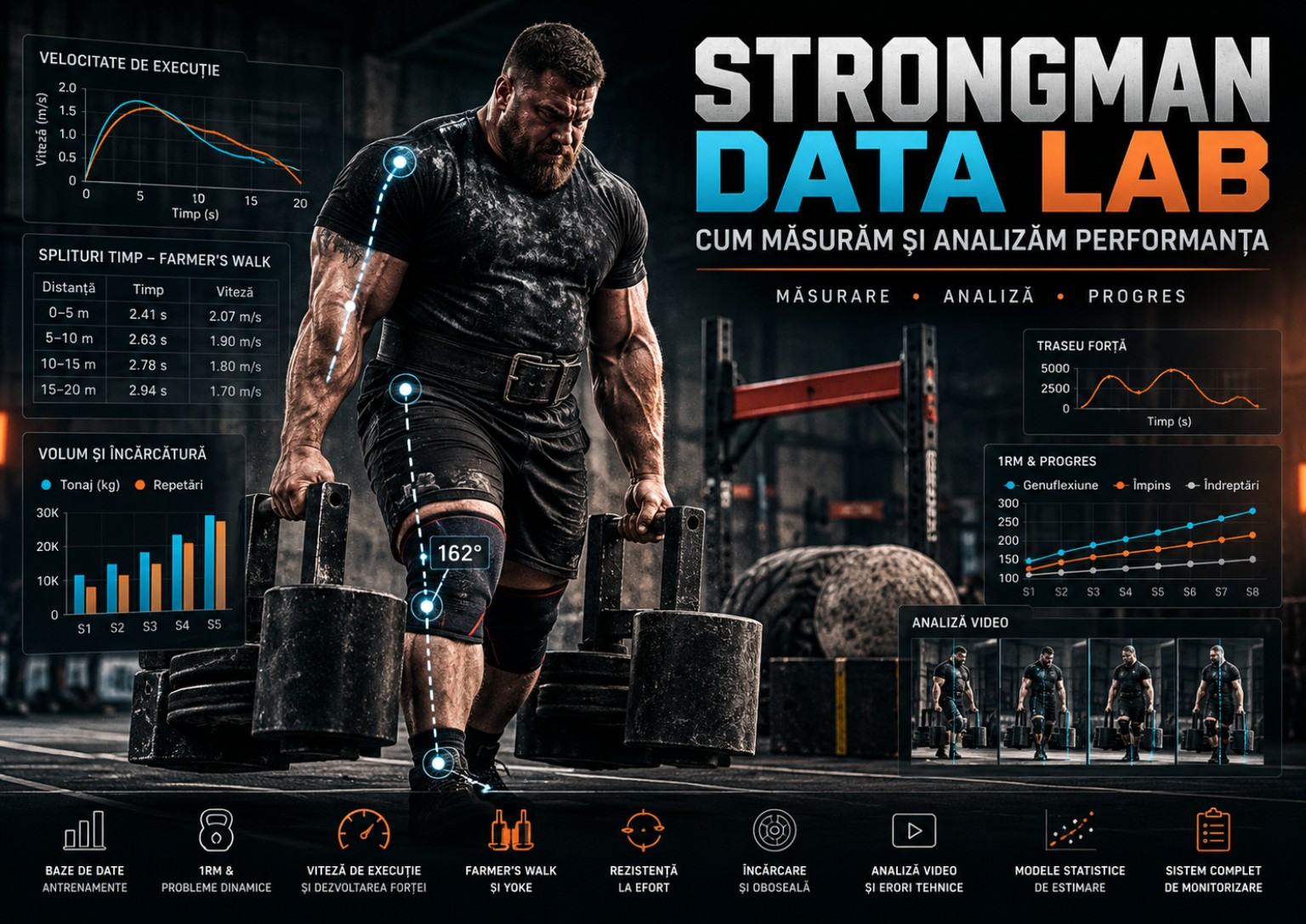
A strongman can record seven repetitions of Deadlift at 200 kg, five successful Log presses at 110 kg and a twenty-metre Yoke run under 360 kg. The numbers matter, but they do not reveal everything each session cost or what capacity remains for tomorrow. One workout may look productive while creating fatigue that compromises the next three; another may involve lighter weights but considerable volume and short rests. How do we separate the stimulus required for adaptation from fatigue that begins to obstruct the goal?
During the first six STRONGMAN DATA LAB episodes, we developed an approach to measurable outcomes, database design, relationships with 1RM, movement velocity, Farmer’s and Yoke split times and repeated-event performance. Episode Seven expands the observation from individual attempts to the training week. We will explore external and internal training load, volume, intensity, session RPE, subjective well-being, reference tests, longitudinal changes and the limitations of popular monitoring indices. The aim is to train hard enough for adaptation while preserving the capacity to repeat productive work.
Sports-monitoring research does not provide a universal fatigue detector, and strongman adds distinctive challenges. Identical tonnage may come from Squat or Atlas Stones even though the mechanical demands differ. A contest can combine heavy pulling, overhead loading, carries and object manipulation within one afternoon. Observations must therefore be distinguished from explanations, and applications of findings from other sports must be clearly labelled. A consensus statement on athlete training-load monitoring supports context-appropriate, multidimensional assessment [1].
All numerical athlete examples in this episode are hypothetical teaching scenarios, not measurements of identifiable competitors. Published studies are discussed with reference to their actual populations and outcomes. By the end, readers should be able to design a useful register in a spreadsheet or simple application, interpret a deteriorating reference-test result and recognise when the data are insufficient for a confident conclusion.
1. What is training load in strongman?
Training load describes the work prescribed and performed during preparation, but it is not synonymous with the total mass of plates used. Strongman sessions may involve conventional strength sets, loaded locomotion, platform loading and variable recovery periods. These tasks have different movement geometry, durations and force patterns. Reducing them all to «kilograms lifted» confuses manipulated mass with the complex demands of training.
Two complementary categories are useful. External load describes what the athlete actually performed: mass, repetitions, distance, duration, attempts and exercise configuration. Internal load describes the athlete's response, for example through perceived exertion, heart rate when appropriate and subjective well-being. Bourdon and colleagues’ consensus [1] treats these as complementary perspectives rather than measurements that can simply replace one another.
A Farmer’s session of three twenty-metre runs at 140 kg per hand can be described through per-hand loading, distance, each finishing time, drops and rest intervals. For Squat, sets, repetitions and load are more natural. This asymmetry is an advantage rather than a defect: different tasks need different measurement descriptions. Only after retaining the event-level information should we attempt more general weekly comparisons.
The right question is not «What is the one load number?» but «What observations are necessary to understand prescription, response and outcome?» A few precisely defined variables often outperform an invented average combining Squat tonnage and Truck Pull metres. Meaningful analysis begins by respecting the physical task.
2. External load: what was performed rather than simply programmed
Programming records intention; monitoring should preserve the actual work. Suppose a plan calls for five sets of five Deadlifts at 180 kg but the athlete completes four sets of four. Prescribed and performed loads now differ, and both should remain available. The first describes coaching intent, the second the observed exposure. Overwriting either one destroys an opportunity to examine why the adjustment occurred.
For conventional lifting, volume can be approximated by sets, repetitions and sometimes tonnage, calculated as the sum of load multiplied by repetitions. Dynamic events also require distance, time and counts of valid and failed attempts. Knowing that a Yoke frame weighs 360 kg does not tell us whether the athlete carried it five or twenty metres, or whether it was put down twice.
Actual implement mass must be distinguished from nominal advertised loading. Two Yoke frames may distribute identical total masses differently, while Farmer’s can be logged per hand or in total. Apparatus identifiers and units are essential. Without them, an apparent volume increase can arise entirely from a change in recording convention.
Equal external work does not produce an identical response in every athlete or session. The same sets completed after a recovery day may feel substantially different after multiple demanding sessions. External load describes the task, not the entire physiological response. Its interpretation improves when combined with perceived effort, readiness and later performance.
3. Internal load: individual responses to the same challenge
Two athletes might complete the same Farmer’s course with the same handles and loading yet experience very different difficulty. One may have considerable strength reserve and excellent implement control, while another is close to grip failure. External tasks are comparable, but the internal responses differ. Treating equal weights as equal fatigue would discard exactly the information we want monitoring to capture.
Session RPE, set-specific difficulty and brief well-being reports describe different aspects of response. They should not be conflated. The hardest repetition is not equivalent to the whole-session experience, while mood, heat, technical familiarity and recovery can alter perception. These measures are useful signals but do not provide direct diagnosis of individual physiological mechanisms.
Halson emphasised selecting markers relevant to the monitoring objective, identifying meaningful change and communicating results simply [2]. Internal-response data can explain why a previously manageable prescription has become unexpectedly difficult. On another occasion, perceived exertion may remain stable despite a slower reference performance. Such disagreement should lead to investigation rather than deletion of whichever value appears inconvenient.
Heart rate alone cannot describe the mechanical cost of a maximal Deadlift or local grip stress during Farmer’s. A measurement may be physiologically accurate yet insufficient for the sporting question. We therefore retain task-specific external metrics alongside athlete report and observable performance.
4. Volume: sets, repetitions, tonnage and misleading comparisons
Volume can refer to working sets, repetitions, tonnage, travel distance or time under load. Appropriate definitions depend on the task. Five sets of five Squats at 160 kg produce 4,000 kg of external tonnage if all twenty-five repetitions are completed. Carrying two 120 kg Farmer’s implements over twenty metres gives a mass-distance product of 4,800 kg·m. That product is not a direct measure of mechanical work, because relevant force vectors and displacements have not been measured.
Comparing 4,000 kg of Squat tonnage with 4,800 kg·m of carrying is dimensionally and biomechanically inappropriate. The units differ and the demands are distinct. An overall strongman «volume score» can be constructed, but its weighting needs justification and validation before it guides decisions. In a practical gym, separate volume series for exercise families are often more transparent.
A hypothetical week might include thirty-five Squat repetitions, twenty-four Deadlifts, six Log attempts and one hundred metres of loaded Yoke travel. Compare each category with previous weeks rather than forcing them into an impossible grand sum. Where hypertrophy is a priority, hard working sets by movement pattern or muscle group may be more informative than gross tonnage.
Higher volume does not automatically mean greater progress. Additional sets that impair technique, consume recovery or interfere with weekend events may have limited marginal value. Monitoring should examine both the accumulated work and the athlete’s response to it.
5. Intensity: percentage of 1RM, exertion and implement specificity
In conventional resistance training, intensity can be expressed as a percentage of a clearly defined exercise-specific 1RM. In strongman, the term is more ambiguous. A 360 kg Yoke does not have a fixed relationship with Squat 1RM, and Log mass cannot simply be expressed as a percentage of Strict Press 1RM. Each movement has different range, coordination and apparatus demands.
For Squat and Deadlift, recent valid maxima may support percentage-based programming. Specific events may use a load relative to the heaviest reliably completed event variation, but even that requires standardised conditions. A Yoke maximum for five metres may differ materially from a maximum over twenty metres. Reporting one as the other creates false precision.
RPE and repetitions in reserve add information about difficulty without replacing external loading. A 110 kg Log feeling like RPE 7 one week and RPE 9 the next could indicate changes in readiness, technique or environment. We should not immediately conclude that maximal strength declined. Repeated observation and the rest of the session matter.
An applied system can label technical, volume-oriented and near-competition loading categories separately. If every difficult set is recorded simply as «heavy», we cannot identify which part of the programme is becoming more demanding. Define intensity meaningfully within each exercise family, and avoid careless conversions between different implements.
6. Frequency, density and rest between efforts
Weeks with similar volume and intensity can create different demands if frequency and density differ. Five moderate sessions distributed through a week may not have the same impact as three very long sessions. Similarly, six Log attempts with generous rest differ from six compressed into a short period. Density describes how much work is concentrated in time; rest is part of the dose.
Imagine four Farmer’s runs at identical loading. During one week, the athlete rests ten minutes between runs; during another, only three. Total distance and mass remain unchanged, while perceived difficulty and late-run performance may vary. Without recording rest, the change could be attributed to athletic capacity when it actually follows a different testing protocol.
For a timed repetition event, density may be expressed as accepted repetitions per minute within a standardised window. For general gym work, work and rest durations can be logged separately. A universal equation is unnecessary. Use the quantity that informs the declared training question.
Spacing between training days matters too. Heavy weekend events followed by demanding Deadlift on Monday create a different context from Deadlift on Wednesday after recovery. Monitoring should therefore record not only what was done but also when it occurred and in what sequence.
7. Session RPE: a simple view of an entire workout
Session rating of perceived exertion, commonly associated with Foster and colleagues [3], is one way to describe internal load. The athlete rates the difficulty of a whole session on a predefined scale; the score may then be multiplied by session duration in minutes. A hundred-minute session rated RPE 7 produces 700 arbitrary units (AU). That number does not represent energy expenditure, tonnes lifted or a measured percentage of fatigue. It is an index derived from time and perception.
Collection timing matters. Asking directly after a maximal attempt may disproportionately reflect the final effort, while asking much later introduces recall effects. A protocol should specify the scale, its anchors and the time when the question is asked. Switching between different scales without documentation makes longitudinal comparison unreliable.
Strongman creates an additional challenge: a three-hour event session may contain equipment setup, long waits, assistance to others and short periods of intense work. Multiplying RPE by every minute spent in the gym can overstate active exposure relative to a short demanding workout. Whether warm-up, equipment preparation and waiting are included must be explicit and consistent. No convention is perfect, but an undefined convention cannot support meaningful comparison.
Session RPE may help identify an unusually difficult training week. It does not describe tissue-specific mechanical stress and cannot make a Yoke session equivalent to a Squat session merely because both score 700 AU. Keep external task data alongside the internal-load index instead of allowing one calculation to replace the actual exercise record.
8. A worked example of weekly internal training load
Imagine five sessions: ninety minutes at RPE 6, one hundred at RPE 8, eighty at RPE 6, seventy-five at RPE 7 and one hundred fifty at RPE 8. Their products are 540, 800, 480, 525 and 1,200 AU, summing to 3,545 AU. This permits comparison with other weeks when the same duration rules and perceived-exertion scale are used. It does not directly quantify how much mechanical work or force was produced.
If the next week totals 3,900 AU, the change is approximately ten percent. This does not establish a ten-percent increase in injury risk or muscular fatigue. The index may have increased through longer sessions, greater perceived difficulty or both. The coach should inspect the contributing sessions and changes in performance before deciding whether action is needed.
Competition weekends deserve special treatment. Waiting between events, repeated warm-ups and psychological demands create a pattern unlike an ordinary gym session. A global competition RPE may be recorded but should be identified separately. Five events during one afternoon should not automatically be treated as five identical training sessions.
Weekly charts become more informative when they reveal daily distribution. Two weeks with the same total may contain very different clusters of demanding and moderate work, and these schedules can produce different responses. The total is a useful summary, not a complete causal explanation.
9. Training monotony and distribution of stress
Sports-monitoring literature sometimes describes daily-load uniformity through an index comparing average daily load with its variability, commonly termed training monotony. Similar daily values can produce a high ratio, while more variable days can produce a lower value. However, interpretation depends on how rest days, missing values and training exposure are defined. It should not be turned into a traffic light that diagnoses overtraining automatically.
Two weeks with identical totals of 3,000 AU can look very different: one includes three heavy days and four easy or rest days; the other distributes load evenly. An index may capture that contrast, but it does not prove that either schedule is inherently safer or more effective. Strongman event sessions may be concentrated at weekends because equipment is available then, rather than because of an ideal biological arrangement.
A mathematical limitation appears when daily-load variability is very small. Dividing the mean by a standard deviation approaching zero can generate an extreme value without proportionately extreme physiology. Short observation windows and inconsistent treatment of rest days further distort interpretation. Always inspect the raw daily values before trusting a derived metric.
For practical coaching, a simple display of daily load, rest opportunities and reference performance may be more useful than monotony. When a competitor feels depleted after two demanding sessions, examine the actual exercise content and responses instead of assuming a single statistical ratio has located the cause.
10. Fatigue is multidimensional, not one biological number
Fatigue can refer to a temporary reduction in force-producing ability, increased perceived difficulty or altered coordination. These phenomena overlap but are not equivalent. During Yoke, a slow split may follow corrective steps; during Log, clean duration may increase even as pressing speed remains stable. Calling every deterioration «neuromuscular fatigue» is not sufficiently specific.
Halson emphasised the complex responses to training load and the need for task-relevant markers [2]. A slow repetition can also reflect altered technique, changed range of motion, new equipment or sensor variability. If an athlete reports feeling tired while reference performance remains stable, retain both observations rather than declaring one automatically false.
Normal short-term fluctuation must be distinguished from persistent deterioration. A poor day after major exertion does not establish maladaptation. Prolonged impairment in performance, recovery or well-being deserves systematic review and, when symptoms warrant, medical evaluation. A stopwatch or sports application cannot diagnose underlying disease.
A good system does not seek a magical fatigue detector. It examines convergence among performance, recent training exposure, athlete perception and context. Sometimes the evidence remains ambiguous. That uncertainty should be communicated rather than hidden behind a coloured readiness score suggesting more knowledge than the observations justify.
11. Functional overreaching and the danger of overinterpretation
A joint ECSS–ACSM consensus discusses distinctions among functional overreaching, non-functional overreaching and overtraining syndrome [5]. Demanding training may temporarily suppress performance, with improvement after recovery. This interpretation is often retrospective. On the first day of fatigue, we cannot know with confidence that it will lead to beneficial adaptation.
Non-functional overreaching involves a more persistent decrement without the intended benefit, while overtraining syndrome requires broader assessment and exclusion of other medical or nutritional explanations. No one simple test reliably diagnoses these situations. Tonnage, an isolated heart-rate-variability value and a ratio of two training weeks are not independent diagnostic tools.
In strongman, high-volume accumulation blocks can be intentional. Temporarily slower Farmer’s runs may be compatible with planned fatigue, but persistent pain, new symptoms and failure to recover should not be dismissed because the spreadsheet labels the week «heavy». Health context takes priority over confirming the original training plan.
The coach should compare actual responses with expectations and remain willing to modify the programme. Not every week must produce a record, but productive training cannot depend on systematically ignoring deteriorating health or an athlete’s inability to recover.
12. Daily readiness versus long-term adaptation
Readiness describes an athlete’s relative state on a given day, not their entire strength potential. A competitor may have a stable long-term 1RM but move more slowly after a demanding session. Conversely, one excellent day does not prove durable adaptation. Monitoring must distinguish acute fluctuations from long-term development.
A short reference test can be integrated into warm-up, perhaps a fixed-load Squat repetition or technically standardised submaximal Log attempt. But each test has measurement variability and imposes some fatigue. If obtaining a readiness score requires repeated very heavy attempts, the measurement becomes costly and may influence the state being assessed.
When a reference result declines, examine session RPE, sleep, recent training exposure and technical changes. Recovery of the metric after rest supports the possibility of a temporary state fluctuation. Persistent deterioration warrants further investigation rather than automatic labelling as «overtrained». Health-related issues must be assessed on their own merits.
Across months, repeated event results under comparable conditions describe adaptation better than a single readiness score. Plotting a fixed-load performance marker alongside weekly load can generate useful hypotheses, but temporal association does not establish causality. The aim is to connect day-to-day observation with longer-term programme decisions.
13. Subjective monitoring: questions that can outperform another sensor
A daily questionnaire should be short enough to encourage honest and consistent completion. Sleep quality, energy, general muscular soreness, stress and willingness to train can be tracked with stable response anchors. There is little value in creating twenty items if only three or four influence decisions. Subjective monitoring works best as a structured conversation with the athlete rather than an administrative form completed automatically.
Saw, Main and Gastin reviewed fifty-six studies using both subjective and objective monitoring measures [4]. They reported that subjective measures generally reflected training-load responses with greater sensitivity and consistency than many commonly used objective measures. This does not make self-report infallible. It means the athlete’s experience deserves serious consideration rather than being dismissed as noise beside device outputs.
Imagine an athlete reporting low energy, poor sleep and unusually difficult sessions across four days. Even if a moderate Squat reference test remains stable, there is reason to review programming, recovery and other contextual changes. Those reports do not diagnose overtraining or disease. They do reveal movement away from the athlete’s typical state and may justify a focused discussion.
Privacy and proportionality matter. A coach does not require unrestricted knowledge of an athlete’s personal life to ask whether sleep and energy support safe training. Collect information relevant to the sporting purpose and explain its use. Psychological monitoring should not be turned into improvised clinical assessment.
14. Sleep: context rather than a universal explanation
Sleep can influence recovery, performance and perception of effort, but the relationship between one night and one training result varies. Performing well after short sleep does not establish that sleep is unimportant; performing poorly after eight hours does not demonstrate disease. Monitoring seeks repeated patterns rather than turning every night into a verdict about the athlete’s capacity.
An applied record can include approximate bedtime, waking time, estimated duration and a simple quality rating. Consumer devices may provide estimates of sleep stages, but their algorithms are not equivalent to clinical polysomnography. They may help identify trends while retaining individual errors. Values from different devices or changed software should not be assumed interchangeable.
Consider two hypothetical weeks with similar training volume. During the second, the athlete sleeps less and perceives event sessions as harder. Poor sleep is a plausible contributor, but work stress, nutrition, scheduling and exercise order may also matter. Responsible interpretation preserves alternative explanations rather than assigning the entire difference to one variable.
Persistent insufficient sleep alongside deteriorating recovery and performance should prompt a review of scheduling and recovery practices. Important symptoms or sustained sleep problems may require professional assessment. A chart of hours slept can inform that conversation, but does not provide a diagnosis by itself.
15. Muscle soreness, discomfort and the limits of a numerical score
Delayed-onset muscle soreness after unfamiliar exertion may occur without a discrete injury. However, sharp, localised or worsening pain should not be merged into a generic fatigue score that authorises heavy training. Monitoring can distinguish general stiffness from localised pain and preserve a brief note of location and onset. Clinical evaluation remains appropriate when symptoms warrant it.
One athlete may report diffuse thigh soreness after Squat while completing a submaximal Log session normally. Another may have shoulder discomfort altering every overhead press. Identical «5 out of 10» ratings would conceal different problems. Scores should be accompanied by relevant context without pretending that a number establishes the cause.
Pain can also change movement mechanics, confounding velocity interpretation. A slower Deadlift may reflect avoidance of a painful position rather than a general decline in force-producing ability. Deliberately altered range of motion makes comparison with previous tests less valid. Safety and health should take priority over maintaining a visually uninterrupted performance dataset.
An intelligent monitoring system flags new, unusual or control-limiting symptoms separately instead of absorbing them into an average readiness score. Algorithms should not independently authorise heavy loads when warning signs are present.
16. Heart rate and HRV: useful signals with clear limits
Resting heart rate and heart-rate variability (HRV) can reflect aspects of autonomic regulation under standardised conditions. They are also influenced by sleep, hydration, illness, psychological stress, temperature, medication and measurement procedure. An unusual reading does not identify its cause. Cardiovascular metrics also do not directly describe local mechanical stress on the back, elbows or grip during heavy strongman work.
If HRV is used, choose a sufficiently reliable device and a stable procedure: comparable times of day, similar measurement conditions and interpretation relative to the athlete’s history. Absolute values should not be used to rank recovery between different athletes. A one-day change may be noise, while a persistent pattern deserves investigation alongside symptoms and performance.
Suppose an athlete’s HRV remains lower than their typical range for several days, but perceived well-being and reference performance remain normal. There is no basis for automatically cancelling every session. Conversely, normal HRV does not make acute pain or serious symptoms safe to ignore. The signal complements the broader picture without replacing it.
A club without HRV equipment has not necessarily lost the most important information. A well-kept load diary, brief questionnaire and consistent reference tests may already support useful decisions. Add technology only when there is a practical question it can answer with adequate validity.
17. Fixed-load movement velocity as a readiness test
Episode Four examined execution velocity as an indicator of performance. One possible readiness application is repeating an exercise at a standardised load and technique, then comparing velocity with the athlete’s history. If a competitor normally moves 150 kg in Squat at a mean velocity of 0.58 m/s but records 0.48 m/s one day, that change deserves attention. It does not independently diagnose systemic fatigue or disease.
The procedure needs stable warm-up, range of motion, intention to accelerate and device placement. Deeper Squat execution or differently attached sensors can change velocity without any change in physiological capacity. Research on velocity loss provides insights within specific exercises [9], but using velocity as a strongman readiness marker requires context-appropriate validation.
Imagine a hypothetical series of 0.58, 0.57, 0.56, 0.49 and 0.55 m/s under comparable conditions. One unusually low result should not be treated as irreversible decline, especially if it rebounds. Review sleep, session RPE and recent training on that date. If changes exceed known measurement variability and appear across several tests, lower readiness becomes a more plausible interpretation.
Daily maximal testing is not necessary. A monitoring test should consume little recovery capacity. If checking readiness requires numerous heavy attempts, the assessment may deplete the resource it is supposed to protect.
18. Farmer’s and Yoke timing as event-specific reference markers
A standardised submaximal carry on an unchanged course can provide an applied indicator of dynamic performance. If a competitor usually completes a twenty-metre Farmer’s run at 100 kg per hand in about fifteen seconds, but one session takes eighteen seconds, that is a noticeable difference. Fatigue is one possibility, alongside altered surface, apparatus, pickup duration or pacing. Interpretation requires video and context.
In Yoke, sway and corrective steps can strongly influence elapsed time. A reference test may therefore retain total time plus technical observations. Slowing concentrated in the final section suggests a different question from difficulty getting the frame off the floor. Neither result automatically establishes «central nervous system fatigue», a phrase often used without adequate operational definition.
Testing should fit normal warm-up or event preparation when it is safe and relevant. Frequent added maximal runs merely to populate a chart are not desirable. A moderate carry may reveal substantial changes without proving that it precisely predicts performance under competition loads.
Across months, preserve results for the same combination of athlete, implement, surface, distance and starting criterion. When conditions change, give the test a new label. Monitoring gains value through comparability, not through constant novelty in the assessment.
19. Monitoring maximal strength without frequent maximal attempts
Maximal strength is central to strongman, but testing it directly too frequently can add fatigue without sufficient benefit. Submaximal reference sets, cautiously interpreted estimated 1RM values and controlled top sets can help track trends if the method stays consistent. None perfectly reproduces an official maximal attempt. Monitoring is intended to observe development, not to transform every week into a competition.
For example, an athlete may complete three Deadlift repetitions at 200 kg with RPE 7 one week and repeat the load a month later with RPE 6 and more consistent technique. These observations are compatible with improvement, but an RPE-derived estimated maximum contains uncertainty. Changes in straps, range of motion or bar type weaken comparability. Report the direct observation first, then offer possible interpretations.
Planned maximal testing can make sense at certain stages when an athlete’s condition and programme allow it. It should not become the primary daily readiness signal. A failed maximal attempt may reflect warm-up strategy, technical execution or poor load selection rather than an isolated change in muscle capacity. Interpreting it requires context and distinction between attempted and valid performance.
For longitudinal comparison, favour safe reference loads that the athlete can complete with limited technical variation. Monitoring should not become a major training stressor in its own right. When submaximal observations adequately inform the next session, an added maximal test is unlikely to provide proportional benefit.
20. Event-specific registers: Yoke, Farmer’s, Log and Sandbag
Strongman requires event-specific descriptions. For Yoke, record total mass, frame height, distance, time and drops. For Farmer’s, preserve per-hand mass, handle characteristics, travel distance and the crossing definition. Log records need implement mass, repetition and attempt count, clean and press rules and, when relevant, cycle times. Sandbags require platform height, object characteristics and carry distance.
These fields are not decorative. A 320 kg Yoke over twenty metres in eighteen seconds cannot be compared directly with 340 kg over fifteen metres in seventeen seconds. Farmer’s on asphalt may not be equivalent to Farmer’s on rubber flooring. Repeated Log pressing after a single clean differs from a format requiring a new clean each time.
A systematic review of strongman biomechanics documents the variety of movement characteristics and limits of extrapolation from conventional lifting [8]. Load monitoring must respect the same specificity. What is easiest to count is not necessarily what deserves comparison. Transition duration may sometimes matter more than loading, while technical validity may determine the entire competitive outcome.
A practical database may use separate tables for conventional lifting, carries and loading medleys. They can share session and date identifiers without being forced into one universal measurement unit. This allows the coach to examine weekly structure alongside performance trends for individual events.
21. Surfaces, implements and environmental conditions as confounders
Seemingly minor equipment changes can mimic fatigue. A stiffer Deadlift bar, differently sized Log, less stable Yoke frame or altered Farmer’s handle texture changes the task. If equipment changes while session RPE rises, we cannot immediately attribute the difference to worse readiness. Comparability of apparatus and execution standards must first be checked.
Carries are affected by surface, slope, temperature and turning requirements. A twenty-metre run on smooth flooring is not equivalent to one on uneven gravel. There is no universal equation that converts times between surfaces with perfect accuracy. More reliable monitoring preserves the course identifier and analyses genuinely different environments separately.
In hot weather, a familiar volume session may feel much harder. That does not automatically mean the athlete’s underlying adaptations have deteriorated. Environmental context is worth recording when it plausibly changes results, although dozens of irrelevant measurements are unnecessary. A simple note about unusual heat may be sufficient in an exploratory training log.
Equipment changes can be essential to contest preparation and should not be avoided merely to protect a clean graph. Instead, create a new test condition and record the change date. Good data practices follow the evolving programme without confusing environmental variation with physiological adaptation.
22. Work, travel and stress outside the gym
Athletes experience demands beyond formal training. Professional schedules, travel, fragmented sleep and psychosocial stress can influence effort perception and readiness. This matters for strongman competitors balancing demanding jobs and competitions in other cities or countries. Two identical gym weeks may take place within very different life circumstances.
We do not need to quantify every personal experience. A brief general-stress rating or travel note may provide adequate context. If an athlete returns from overnight travel and feels depleted, a slower reference test could reflect that circumstance rather than loss of strength. The explanation remains a hypothesis and should not be elevated to diagnosis.
Coaches should avoid treating every poor performance day as evidence of weak commitment. Monitoring reveals contextual constraints, and programming can be adjusted without abandoning long-term goals. A lighter technical session may sometimes be appropriate when recovery and safety information support that decision.
Privacy remains essential. A training diary does not entitle coaches to unrestricted details of an athlete’s personal life. Collect only what is necessary for training and respect a person’s choice not to share private information. Monitoring should strengthen collaboration rather than become excessive supervision.
23. Competition is a distinct loading event
A strongman competition may combine multiple maximal efforts in one day, repeated warm-ups, variable waiting times and tactical pressure. Workload cannot be reduced to the number of events. Deadlift for Max, Yoke and Log for Reps create different demands despite each event being brief. Competition also changes the subjective experience of effort and uncertainty.
An event-day record can preserve loading, valid and failed attempts, active performance duration and approximate recovery periods for each discipline. An overall session-difficulty rating adds another view. There is no need to translate every exposure into an invented equivalent tonnage. The demands that shape subsequent readiness do not all share one natural unit.
An athlete competing on Saturday and returning to heavy gym work on Monday should consider the nature of the preceding efforts, not merely the existence of one calendar day without a competition. A day dominated by overhead attempts may affect later sessions differently from one dominated by carries, even when both include five events. Post-competition notes make these distinctions available to coaches.
There is no universal recovery duration after a competition. Athlete experience, loading, attempt count, travel and any problems encountered all matter. Monitoring helps adjust the next training block, but cannot guarantee complete recovery after a fixed number of hours.
24. Off-season, accumulation, intensification and taper: context changes interpretation
Off-season work may emphasise hypertrophy, technical improvement and recovery after a competitive season. Greater volume combined with lower relative loads does not indicate regression when that is the intended programme. During intensification, volume may fall as weights rise. During taper, total load can be reduced to improve the expression of performance. Weeks should not all be judged by the simplistic rule that greater tonnage is always better.
A reduced-load week may produce lower session RPE and faster reference movements. This can reflect reduced acute fatigue rather than a new structural adaptation developed within days. During accumulation, reference performance may temporarily decline even while training aims to build capacity that will emerge later. Results need interpretation relative to the intended training phase.
Imagine four weeks of gradually increasing Squat volume with a mild reduction in fixed-load repetition velocity. In week five, volume drops and velocity rebounds. This pattern is compatible with the planned loading-and-recovery sequence, although the chart cannot establish every causal link. If recovery fails to appear, the explanation needs reconsideration.
Every session record should therefore include its training-phase label. This simple metadata field prevents low-volume taper from being mistaken for poor commitment and anticipated fatigue from being labelled immediate programme failure. A number becomes meaningful when we know what the programme was trying to achieve at that point in the season.
25. Acute and chronic training load: two windows and several interpretations
Sports monitoring often distinguishes recent load from a more established baseline. One popular convention compares the current week with a mean of several previous weeks, commonly termed the acute:chronic workload ratio (ACWR). The idea appears intuitive: a current week very different from previous exposure signals a substantial change. However, window selection can be arbitrary, and the ratio has important conceptual and statistical limitations [6].
Imagine an athlete recording 2,500 AU this week against a mean of 2,000 AU during four preceding weeks. The ratio is 1.25, indicating recent load is 25% above that chosen baseline. It does not mean injury probability is 25%, risk increased by exactly 25%, or training should automatically stop. The quantity is an arithmetic comparison between two aggregates, not a validated individual causal prediction.
Some calculations include the acute week in the chronic denominator, creating mathematical coupling between numerator and denominator. Other issues include time-window selection, weighting methods, seasonal change and overinterpretation of thresholds. Impellizzeri and colleagues explicitly discussed fundamental conceptual and methodological problems with ACWR [6]. Accordingly, a supposed universal «safe zone» must not be presented as biological law.
Strongman compounds these difficulties because a weekly figure may mix exercises with very different demands and athletes have different histories. A session-RPE-based ratio may raise a useful question about sudden change, but cannot replace examination of actual exercises, symptoms and readiness. A large difference deserves context, not an automatic verdict.
26. Why one universal risk threshold promises too much
The relationship between sporting load and health problems cannot be reduced to a threshold applying to every athlete and training phase. The IOC consensus on training load and injury risk discussed exposure management, including competition congestion, travel and psychological load [7]. This does not establish one magic number for strongman. Risk depends on individual history, task characteristics and factors omitted by a weekly sum.
One athlete increasing from 500 to 800 AU has a large relative change, while another increasing from 4,000 to 4,300 AU has a smaller percentage change. These percentages alone cannot identify which athlete faces greater risk or which programme produces adaptation. Absolute loading, prior tolerance and exercise selection matter. Identical numerical ratios may conceal entirely different tasks.
Correlation and causation also require distinction. If injury counts rise following high-load weeks, confounding factors may be present. Athletes approaching competition may lift heavier, attempt unfamiliar equipment and alter recovery simultaneously. Without appropriate study design, one metric cannot be declared the cause. Individual extrapolation demands even greater caution.
In practice, recent load is a contextual signal. If an athlete sharply increases training volume while reporting deteriorating performance and poor recovery, a programme review is sensible. If evidence is incomplete, do not invent a causal explanation. Decisions should integrate multiple sources and take health-related warning signs seriously.
27. Rapid load changes: what actually changed?
A sudden increase can arise in several ways. The athlete may add a session, increase the working load without changing sets, or shorten rest so that more work is performed per unit time. These changes may lead to similar weekly session-RPE totals while creating different mechanical demands. Monitoring needs to identify the source of the change, not merely declare that the total increased by twenty percent.
In one hypothetical week, a competitor raises working Squat volume from twenty to thirty-five repetitions at comparable weights. In another week, volume remains twenty while intensity rises. Both may feel harder, but their volume and intensity distributions differ. The intended training phase should guide interpretation. Similar perceived difficulty does not guarantee identical recovery needs.
For loaded carries, increases may come from distance, mass, number of runs or reduced rest. Moving from two to five Yoke runs is not equivalent to adding twenty kilograms to one Yoke attempt. The structure of loading has changed. Event-specific data preserve that structure rather than reducing it to one arbitrary total.
A useful weekly review answers three questions: which exercise family changed, by how much and how did the athlete respond? Programme adjustments are better supported when an important loading change coincides with repeated signs of poor tolerance. In isolation, a derived ratio should not control the entire training plan.
28. Consecutive hard weeks: accumulation or inadequate recovery?
An accumulation block may contain several difficult weeks, and some fatigue can be anticipated. The concern begins when response exceeds what can be tolerated or when recovery fails after the planned reduction in training. No universal formula identifies that point. We can nevertheless track reference performance, subjective state and actual loading over time while retaining training-phase context.
Suppose four weeks of increasing Deadlift volume lead to gradually greater exertion despite broadly stable technique. If a recovery week is followed by a better reference result, the pattern is compatible with an effective loading-and-recovery sequence. If performance continues declining and symptoms emerge, the response should not be «add another hard week so supercompensation can occur». Programming and health context need reassessment.
The overtraining consensus warns about the difficulty of distinguishing overload states from only a few markers [5]. It would therefore be inappropriate to diagnose an athlete from the number of consecutive difficult weeks. Persistently poor performance may require assessment of recovery, health and other possible explanations.
A healthy monitoring culture permits changing the plan without presenting adjustment as failure. Reducing volume temporarily may protect the broader season objective. Data are valuable when they reveal a need to reconsider assumptions, not when they are used to defend the original schedule at all costs.
29. Tissue loading and the limits of tonnage
Tonnage describes externally manipulated mass in repetition exercises, but does not directly measure internal forces on a tendon or joint. A 100 kg Log and a 100 kg Bench Press can stress the shoulders and elbows differently. Two Deadlift variations with the same load can alter mechanical moments. Without dedicated biomechanical assessment, tonnage cannot be converted into a precise local injury-risk figure.
This matters when an athlete is monitoring a sensitive body region. Increasing overhead work may justify tracking sets and attempts involving comparable shoulder positions. However, «shoulder volume» remains a practical programming approximation, not a measurement of tissue stress. Symptoms and technique require individual consideration.
Imagine an athlete removing ten monthly Bench Press sets while adding many Log and Giant Dumbbell attempts. Bench tonnage falls, yet total overhead or pressing exposure may not. A fragmented diary could imply load reduction despite increased sport-specific demand. Coaches need a whole-programme view without pretending that different exercises are mechanically interchangeable.
No global workload score guarantees prediction of tendon injury. Monitoring may assist dose management and communication with appropriate professionals, but does not replace clinical assessment. Precision in kilogram counting should not be mistaken for precision in estimating biological consequences.
30. Monitoring by movement families
A practical strongman programme can use movement families: pulls from the floor, lower-body strength, overhead pressing, loaded locomotion, object handling and accessory work. These categories reveal overlapping exposures without claiming that each exercise within a family is identical. Conventional Deadlift and Sandbag Pickup share some demands but differ in implement geometry, grip and movement pattern.
Consider a hypothetical week with Monday overhead, Tuesday Squat, Wednesday Row, Thursday Push Press, Saturday Farmer’s and Yoke, and Sunday Log and Atlas. A superficial calendar view might treat each family as appearing once. In reality, overhead exposure occurs Monday, Thursday and Sunday, while leg extension and trunk stability recur across several events. Classification helps expose the overlap.
Count sets or attempts within families and report them alongside loading and perceived exertion. Do not add ten Bench sets and ten Yoke runs into one universal total of twenty «load units». Descriptive observations such as «three overhead exposures within six days» may support recovery decisions without requiring a dubious cross-exercise equation.
Movement-family labels are not medical diagnoses and do not automatically define a safe volume. Their purpose is to reveal weekly structure and prevent unintended accumulation of similar physical demands hidden behind apparently unrelated event names.
31. Hypothetical eight-week study: training load and Squat reference performance
Imagine an athlete tracking one standardised Squat repetition at 150 kg after an unchanged warm-up. Across eight weeks, hypothetical weekly session-RPE load totals are 2,600, 2,850, 3,100, 3,250, 2,100, 2,850, 3,050 and 2,300 AU. These are constructed teaching values, not data from a published study. They illustrate four accumulation weeks followed by lower exposure, two renewed demanding weeks and another decrease. The question is how to describe the relationship with performance rather than force a convenient fitted curve.
Suppose reference mean concentric velocities are 0.55, 0.54, 0.52, 0.50, 0.56, 0.55, 0.53 and 0.57 m/s. It would be tempting to say rising workload «caused» slowing and deload weeks «caused» faster movement. First verify sensor placement, range of motion and movement technique, and estimate whether changes exceed measurement variability. Eight points cannot isolate the relevant physiological mechanisms or provide a validated predictive model.
We may observe that reference performance declined during the first high-load period and recovered when exposure fell. This is compatible with changes in acute fatigue, but does not independently demonstrate increased maximal strength. That question requires additional comparable loads and specific outcomes over a longer period. Faster movement after a deload may reflect removal of fatigue rather than new structural adaptation.
The diary should also retain sleep, exercise RPE and major programme changes. If week four included two unusually demanding Yoke attempts while week eight did not, interpretation becomes more complex. A mature analysis distinguishes observed temporal relationships from proposed mechanisms and identifies what would need to be tested next.
32. Case study: changed exposure during a strongman weekend
Consider two hypothetical weekends using the same five events: Farmer’s, Yoke, Log, Sandbag and Atlas. The first has four twenty-metre Farmer’s runs, three Yoke runs, six Log attempts, four sandbag loads and eight Atlas attempts. The second uses comparable loads but only two Farmer’s runs, two Yoke runs, four Log attempts, three sandbag loads and four Atlas attempts because the athlete reports insufficient recovery after a demanding week. The event list is identical, but the actual exposures differ substantially.
If the first session lasts three hours at RPE 9, its session-RPE index is 1,620 AU. If the second lasts two hours at RPE 7, the value is 840 AU. The difference is large, but it does not directly measure injuries prevented or recovery gained. Reduced exposure could support better subsequent training, yet this effect must be evaluated through actual performance and well-being rather than assumed with certainty.
To compare Farmer’s times between the weekends, consider event order. A run performed first may differ from the same run completed after Log and Sandbag. Changing order makes the conditions less comparable. The log should retain each event’s place within the session and approximate recovery from preceding demanding work.
The example illustrates why reducing volume can be an informed decision without declaring the original plan fundamentally wrong. Recovery capacity and context vary. Monitoring should describe the athlete’s actual response, supporting continued development rather than enforcing a predetermined number of attempts regardless of consequences.
33. Case study: identical external load, different internal response
Two hypothetical athletes complete five sets of five Squats at 160 kg and three twenty-metre Farmer’s runs at 110 kg per hand. Their external tasks match if apparatus, movement standard and course remain consistent. The first rates the session RPE 6 and maintains familiar technical execution. The second reports RPE 9 and performs a much slower final carry with multiple corrective steps. Equal prescriptions have not produced equal observable responses.
The difference could reflect strength capacity, event-specific preparation, technical familiarity, accumulated fatigue or environmental circumstances. RPE alone cannot identify which explanation is correct. Nevertheless, the second athlete’s recent loading and movement quality deserve review before additional volume is prescribed. A temporary modification can be justified without a definitive physiological diagnosis.
Four weeks later, suppose the second athlete repeats the same task at RPE 7 with more stable carry times. This is an observable improvement in tolerance or efficiency at the reference load. We still cannot establish precisely how much arose from strength gain, learning or recovery. Complementary tests and repeated observations would be needed to distinguish their contributions.
This comparison shows why individualisation cannot be replaced by one nominally identical programme for everyone. Athletes respond differently to the same dose. Monitoring earns its value when it identifies those differences and supports proportionate adjustments, not when it reduces people to simplistic categories of «good» and «bad» athletes.
34. An unexpectedly poor day: a verification procedure before adjustment
When a competitor enters the gym and the first reference test is below normal, immediate load reduction may sometimes be sensible but is not always required. First check the measurement: same apparatus, same technical variation, same warm-up? Could a sensor or timing error be responsible? Non-comparable tests should not trigger a major programme change. Once the result appears valid, interpret it within the athlete’s context.
Next examine sleep, recent sessions, perceived effort and any pain or symptoms. If warning signs are present, safety and appropriate assessment take priority. If the athlete is otherwise well and the session is technical, adjusting loading to preserve movement quality may be suitable. If a maximal test is scheduled, the decision should be made cautiously using all available information, not an isolated velocity reading.
Imagine fixed-load Squat velocity falling from 0.56 to 0.49 m/s while exertion rises from a typical RPE 7 to RPE 9. If two controlled attempts confirm the pattern under comparable technique, reducing the day’s training demand may be reasonable. This does not mean the athlete has «lost 12.5% of strength». Velocity and maximal strength are related but not interchangeable measurements.
Record the decision and its observed consequence. Was volume reduced? Did technical execution remain sound? Did perceived effort improve? Across subsequent weeks, evaluate whether similar adjustments help. An autoregulation algorithm should be judged by practical results rather than followed ceremonially. If it overreacts to measurement noise, simplify the rule.
35. An unexpectedly good day: why loading need not rise automatically
A reference performance above normal may create an urge to add weight or attempts. However, an accumulation phase, recovery week or approaching contest can have objectives other than maximal testing. Faster fixed-load velocity could reflect favourable readiness, improved technique or ordinary variation. It is not a mandatory instruction to increase the session load.
Suppose an athlete plans controlled submaximal Strict Press sets and the first repetition moves much faster than usual. If technical quality is the objective, keeping the programme unchanged may be appropriate while retaining the positive observation. If the session explicitly uses calibrated velocity-based load adjustment, a prudent increase might fit the plan. The response depends on training phase and prior decisions.
One common mistake is turning every good day into an informal competition. This can make workload unpredictable and undermine recovery planning. Monitoring should help preserve a coherent progression process rather than reinforce weekly record chasing. Athletes progress through repeated training cycles, not only through their heaviest individual attempts on favourable days.
After the block, examine whether such «good» readings predicted better specific event performance. If not, the marker may still help describe daily readiness without reliably forecasting contest success. Its limited role can be useful and should not be exaggerated into a universal predictor.
36. Planning a deload: before and after monitoring
A deload may be scheduled in advance or adjusted according to the athlete’s response. Temporarily lower volume does not necessarily mean no meaningful stimulus, and moderate loading can preserve technical familiarity. There is no one universal formula specifying the required percentage reduction in tonnage or strongman attempts. The choice depends on training phase, fatigue and competition timing.
An applied protocol should first define the purpose: reduce accumulated stress while retaining useful technical exposure. Monitor whether perceived effort becomes more typical and reference tests return to their customary range. If well-being improves but performance does not rebound immediately, the deload should not automatically be deemed ineffective. Recovery and longer-term adaptation can follow different timescales.
A hypothetical modification might reduce Deadlift working repetitions from thirty to fifteen and Yoke runs from four to two while retaining manageable technical work. This illustrates adjustment across exercise families, not a universal prescription. Cutting one activity while leaving several others extremely demanding may produce less total relief than expected.
Evaluate the block over subsequent weeks rather than only the first excellent workout after reduced loading. If a particular deload approach repeatedly supports better recovery and consistent progress for that athlete, it gains practical support in that context. Such local success should not be generalized automatically to all strongman competitors.
37. When monitoring indicators disagree
An athlete may report poor sleep yet move the reference load faster than usual. Another may feel excellent but record a slower Yoke time. These discrepancies are not necessarily errors. The indicators describe different aspects of state and performance, each with measurement uncertainty. A mature system should not force all observations into one reassuring or alarming story. It should ask what each variable actually measures and whether the disagreement matters for the training decision.
Suppose session RPE increases while Log repetitions and Farmer’s time remain stable. The athlete may be achieving familiar performance at a higher perceived cost. This matters, but it does not prove inevitable progression towards failure. Check whether the pattern repeats and whether other recovery indicators change. If perceived difficulty soon returns to baseline, the difference may have been transient rather than a sign of persistent maladaptation.
Conversely, reference performance may decline while the athlete reports feeling well. Equipment changes, technical differences and ordinary measurement variability should be considered. If it is safe and useful, a low-cost reference test can be repeated, with video checked for comparability. It would be inappropriate to tell the athlete that their perception is necessarily wrong or that the sensor must always be correct. Both are partial sources of evidence.
Persistent contradictions should generate questions rather than an invented «consensus score». Health symptoms and major performance deterioration warrant greater caution. In their absence, training can sometimes proceed with prudent adjustments and observation. A useful indicator must be allowed to remain inconclusive when the evidence does not support a confident answer.
38. Building a warning system without magical thresholds
Many coaches appreciate dashboards that label an athlete green, amber or red. Such systems can simplify communication, but thresholds need transparent definitions and individual calibration. An arbitrary rule such as «readiness below 90% means red» can produce false alarms or overlook important problems. There is no universally validated single-number test that determines safe strongman training for every athlete.
A better starting point is to separate different kinds of flags. One category identifies non-comparable records: changed implements, altered course and missing landmarks. Another identifies performance changes larger than familiar test variation. A third concerns symptoms or technique that call for particular attention. These categories should not be confused. Sensor failure does not mean athlete fatigue, while acute pain should not be averaged into an otherwise positive readiness score.
Imagine Farmer’s times usually varying between 15.0 and 15.5 seconds under a fixed protocol, followed by a result of 18.2 seconds. The result deserves checking. Before reducing every planned load, confirm distance, surface, handle mass and timing method. If conditions match and the athlete also reports unusual difficulty, a programme adjustment may be reasonable. If the course was changed, the warning belongs to measurement comparability rather than physiology.
The best traffic-light system permits explanation and human judgement. Automated rules can direct coaching attention, but should not override technical assessment, health context or appropriate clinical advice. Responsible software communicates what triggered the alert and what uncertainty remains, rather than replacing a nuanced decision with a colour.
39. Meaningful change and measurement error
A different result is not necessarily meaningful progress. Improving Farmer’s from 18.10 to 18.05 seconds may represent less change than hand-timing error. A velocity device reporting a 0.01 m/s increase may have captured a real change or normal test variability. Atkinson and Nevill described approaches to measurement error in sports variables [11]. Without a sense of normal variation, coaches risk treating noise as adaptation.
We should distinguish observed change from the smallest change worth acting upon. The latter can depend on device error, typical athlete variability and competition demands. A tenth of a second may matter when podium positions are separated by tenths, but a poorly controlled timing procedure may not resolve it reliably. Competitive importance and measurement capability must be considered together.
A practical protocol might involve independently timing the same recordings or examining multiple comparable reference sessions. Sophisticated modelling is not always necessary, but coaches should understand the approximate magnitude of uncertainty. One test cannot precisely define all variation. Reporting ranges and context may be more appropriate than presenting every tiny difference as a percentage improvement.
Retain raw measurements rather than only «progress» labels. Better methods introduced later can allow interpretation to improve without destroying the original history. Responsible sports science includes the ability to acknowledge that some apparent differences were too small for the tools to establish confidently.
40. A minimum digital register: essential fields
A useful system can be built from a few linked tables covering athletes, sessions, exercises, attempts and daily status. A session record includes date, training purpose, duration, session RPE, phase of the programme and relevant notes. Exercise records include variation, apparatus, loading, sets and repetitions or travel distance. Daily-status records contain a small number of consistent questions. This structure permits analysis without forcing different events into one physical unit.
Each result should have an explicit status and provenance: directly measured, estimated, missing or technically invalid. Missing is not zero. If the athlete does not perform Yoke this week, do not enter a zero-second time that would resemble a world record. If a sensor fails, preserve the fact that training occurred while marking only the affected measurement as unavailable. Simple distinctions prevent major statistical errors.
One hypothetical entry is «Thursday; Push Press; 110 kg; ten singles; two-minute rests; global RPE 7; no major technical issues». Another is «Saturday; Yoke 320 kg; three twenty-metre runs; times 19.4, 20.1 and 20.8 seconds; six-minute rests». These records describe different physical tasks but can be connected by the athlete and calendar, allowing their combined training context to be examined.
Records should be accessible and auditable rather than trapped in a dashboard that hides source numbers. Retaining a correction history and written variable definitions is good practice. In a team environment, access permissions, privacy and data retention belong in the system design, not as afterthoughts. Only information necessary for legitimate coaching purposes should be collected.
41. Graphs that belong on a monitoring dashboard
A practical dashboard does not need dozens of charts. Weekly internal load, exposure by movement family, one fixed reference-performance metric and a relevant subjective-status measure may be enough. Every chart needs clear units and test conditions. Session RPE is expressed in arbitrary units, not «fatigue percentage». A Squat velocity series must identify the reference load and exercise variant. Labels are part of measurement validity.
Annotations should identify accumulation blocks, competitions, deload weeks and apparatus changes. A performance decrease following a technical modification does not necessarily prove loss of capacity. A sudden improvement following a change in course length does not prove physical adaptation. Visualisations should make comparison conditions clear enough for a reader who was not present at the sessions to understand the data.
Avoid dual axes adjusted arbitrarily to make curves appear correlated. Two unrelated variables can look closely connected when their scales are selected for visual effect. Separate plots or explicitly justified normalisation often make interpretation safer. Testing an actual statistical relationship requires examining error, alternative explanations and repeated observations rather than merely judging the shape of two lines.
Published reports should briefly explain what changed, whether it exceeds known variability and what cannot be inferred. A graph is valuable when it sharpens a question. If it only creates an impression of sophisticated monitoring without supporting a decision, it is probably too complex for the task.
42. Analysis without prediction models: the strength of simple comparisons
Advanced algorithms are not required for useful strongman monitoring. Comparing similar tests, estimating variability and connecting observations with the training calendar may provide enough information for programming decisions. If an athlete consistently records slower Yoke times after consecutive hard days and recovers when those sessions are spaced apart, the observation can inform a scheduling experiment. It does not prove causality, but creates a plausible, testable question.
Predictive models become attractive as databases expand, yet they must be evaluated on observations not used to create them. If software displays «readiness 82%», ask what that percentage represents, how the model was calibrated and how accurate it has been on new data. Without those answers, the output may be less useful than clear notes about sleep, perceived effort and reference velocity. Complexity is not equivalent to precision.
A dataset of twenty sessions may be too small for a model with ten inputs. Fitting too many relationships can reproduce sample-specific noise rather than stable principles. A simple comparison of several standardised recent sessions may perform better. Changing apparatus and competition rules further reduces the amount of genuinely comparable strongman data available for modelling.
Before adding a predictor, ask whether it changes decisions and whether the resulting decisions improve training or competition outcomes. When a complicated model provides no advantage over a clean training diary, simplification is justified. Monitoring should be a disciplined learning process, not a competition between algorithms.
43. A five-minute weekly review routine
At the end of a week, a coach should not have to read hundreds of spreadsheet rows to find what matters. Start by comparing performed training with the plan. Then review which movement families rose or fell in exposure. Next examine subjective well-being and a reference test that can be compared reasonably with history. Finally, formulate one or two questions for the following week. This process is more valuable than automatically generating a long report that contains no decisions.
Consider a hypothetical week in which Deadlift volume rises by five sets while loaded-carry exposure remains stable. Whole-session RPE increases by one unit in two workouts, while reference-load velocity remains unchanged. There is no basis for immediately diagnosing pathological overload. We can simply record that perceived demand increased while reference performance was maintained, then check whether the pattern persists.
In contrast, repeatedly declining reference performance combined with difficult recovery and actual loading beyond the plan offers stronger grounds for review. Causation remains uncertain, but the coach has practical reasons to discuss lower volume, changed session order or revised short-term objectives. If meaningful symptoms appear, ordinary training analysis must not substitute for appropriate medical evaluation.
Retain both the decision and the rationale. After two or three weeks, examine whether the intervention had its intended effect. A monitoring system that learns from its decisions is more useful than one that continuously issues warnings without ever checking what happened next. Every routine should therefore include some accountability for its own practical results.
44. A first-month strongman monitoring protocol
During the first week, define the variables. What counts as a working set? Which minutes are included in session duration? How are implement masses recorded? Choose a small set of response measures: session RPE, brief energy and sleep reports, and one low-cost performance reference. The aim is a reproducible process, not a dashboard full of metrics from day one.
During the second week, check collection quality. Have all sessions been recorded? Is the same RPE scale being used? Are reference-test apparatus and conditions stable? If an athlete routinely skips one field, the method may be too complicated or the collection time may be inconvenient. Simplify the procedure before drawing conclusions from a dataset with systematic missingness.
During weeks three and four, continue recording and examine initial variability. These observations can describe the process, but four weeks are generally insufficient for robust personal thresholds or causal models. Do not generate a numerical «optimal zone» simply because twenty sessions are available. The data may already reveal inaccurate apparatus labels, incompatible rest conditions or frequently overlapping hard sessions.
At the end of the first month, retain fields that support decisions and remove those that consume effort without generating useful information. Expand gradually, evaluating whether monitoring improves practice. A simple protocol maintained for months is usually more valuable than an exhaustive collection effort abandoned after one month because it became too demanding.
A useful next step is documenting each variable in a short data dictionary. Include its unit, timing method, validity rules and response procedure when information is missing. This makes the record understandable if a different coach or analyst later uses it, and prevents gradual drift in field meaning across the season.
45. The competition season and the cost of travel
When a season contains many contests, training cannot be interpreted separately from the competition calendar. An athlete may travel overnight, compete in several demanding events and return to professional obligations before recovering fully. Contest count, travel duration, available recovery days and event types deserve consideration. Frequent competition does not automatically create medical problems, but cumulative exposure should not be ignored.
A calendar can record each competition’s travel duration, events, actual attempts and overall difficulty. During the following week, it can show programme adjustments and reference-test changes. There is no need to invent an exact fatigue-unit equivalent for every kilometre travelled. Context remains valuable without artificial mathematical conversion.
Imagine two competitions scheduled within three weekends. A reduced-volume week between them may be planned to preserve competitive performance rather than evidence of insufficient development. If tonnage declines at the same time, it would be misleading to interpret the chart as regression. Competition labels and microcycle objectives are necessary to understand why loading changed.
The type of competition also matters. Repeated maximal overhead attempts may influence later overhead sessions differently from a contest dominated by carries, even if each contains the same number of events. Recording event composition adds information that competition count alone cannot supply. The choice of post-contest session should account for what the athlete actually performed.
Good monitoring helps coordinate travel, recovery and technical practice as well as selecting weights. Strongman takes place in real life, where logistics can limit preparation. A system ignoring that reality may produce elegant mathematical recommendations that athletes cannot reasonably implement.
46. Data cannot replace coaching judgement or athlete autonomy
A dashboard may identify patterns that are difficult to see by eye, but it does not know every circumstance of a workout. It may record slow Yoke time without knowing the floor was wet, or a high session RPE without capturing unusual professional stress. Coaches and athletes need to add context. Important decisions should not be delegated blindly to an algorithmic threshold, especially when very heavy implements create substantial consequences for poor execution.
The athlete is an active participant rather than merely a source of numbers. They may explain that performance was limited by grip, unfamiliar equipment or a deliberate pacing choice. Their perception is not automatically infallible, but neither should it be dismissed when a sensor displays a different picture. Informed autoregulation depends on combining data, experience and technical observation.
Poorly designed monitoring can become intrusive. It may collect constant information, produce alarms and pressure athletes to justify every fluctuation. Effective monitoring should be proportional, protect privacy and allow meaningful decisions rather than demands for surveillance. A readiness score that the athlete cannot understand is difficult to use responsibly.
Transparency can improve trust. If a coach recommends reducing volume, the athlete should understand whether the decision follows repeated performance deterioration, reported symptoms, an important workload change or a combination. The system should make the reasoning visible without pretending to provide certainty where none exists.
Ultimately, assess monitoring by decision quality and sustainable performance. Spectacular charts add little if technique deteriorates, the programme becomes impossible to follow or athletes avoid reporting problems because they fear being judged.
47. Research limitations: transfer from other sports to strongman
Much of the training-load literature comes from team sports, endurance events and conventional resistance training. Strongman-specific biomechanical research is growing, but direct evidence remains limited for universal relationships between every load index and performance in Yoke, Atlas, Log or Truck Pull [8]. Recommendations based on other disciplines should be identified as extrapolations requiring verification, rather than presented as findings directly established in strongman.
Even within-athlete research can be difficult. Implements, loads, competition rules and training phases change frequently. A study of ten athletes may identify valuable hypotheses but have limited power for personalised prediction. A model trained on one season may fail during another if the athlete develops or the events differ substantially. These factors increase the importance of carefully described test conditions.
Future research could examine movement-family exposure, different strongman session formats, subjective responses and reference-performance changes after contests. Longitudinal studies with documented rules, apparatus and measurement error would be particularly valuable. Competition outcomes should be reported alongside training indicators, instead of treating the indicator itself as the final objective.
Cross-sport knowledge is still useful when applied cautiously. The distinction between external and internal load, the value of subjective reporting and the need to quantify measurement error are broad methodological lessons. What must be tested is whether a particular metric improves decisions for the strongman task at hand.
We need not wait for perfect evidence to make thoughtful decisions. We can measure clearly defined tasks, test hypotheses modestly and communicate limitations. Applied sport science begins where numerical precision is no longer confused with certainty about causes.
48. Conclusion: the athlete must remain central to the system
Training load and fatigue cannot be reduced to one universal score. A strongman week can combine tonnage, loaded locomotion, timed repetition events and technical attempts. External load records what was performed; internal load describes aspects of the athlete’s response; reference tests provide evidence about performance; context explains why interpretation must remain cautious. None replaces all the others.
A functioning STRONGMAN DATA LAB should not collect every variable that technology makes available. It should select a small number of well-defined measures with genuine practical value. When an athlete improves, monitoring should help clarify the conditions in which that happened. When performance deteriorates, it should narrow unsupported assumptions and support responsible investigation without pretending to diagnose medical causes automatically.
The desired result is not a flawless dashboard but a more understandable programme. Athlete and coach should be able to explain why a load was chosen, why volume was reduced or why a technical session was preserved. Data become valuable when there is a clear path from observation to decision and then to evaluation of the outcome.
Measurement can also reveal that a programme is working despite short-term fluctuation. One slower reference lift during accumulation is not always failure; one unusually fast lift after rest is not always a permanent new strength level. Trends, repeated observations and the demands of the next competition matter more than isolated impressive numbers.
Episode Eight will turn from training logs and charts to video analysis and the identification of technical errors. We will examine how recordings can reveal implement paths, changes of posture and phases where time is lost, without pretending that an ordinary camera is equivalent to a fully calibrated biomechanics laboratory.
A further editorial principle matters for any website publishing these analyses: readers must be able to distinguish actual experimental evidence from constructed teaching examples. When presenting an eight-week session-RPE or Squat-velocity table, mark hypothetical numbers explicitly. A real study would need to identify participant numbers, collection procedures, measurement uncertainty, inclusion criteria and limitations. Without such details, a realistic graph can create the false impression that an experiment took place. Credible publishing begins with clarity about where every data point came from.
In coaching, the decisive criterion remains transfer: do the measurements improve preparation and competition performance? If repeatedly reducing volume before demanding events appears to support better reference performance, the approach deserves further investigation. If a readiness score has never changed a decision, its usefulness should be questioned. Technology should not be collected as proof of sophistication. It should reduce uncertainty surrounding practical choices.
Monitoring systems also need regular evaluation of their own effectiveness. At the end of a training block, ask which warnings were useful, how many proved misleading, and whether the athlete could provide information without excessive administrative burden. If the tool is demanding, simplify it. If tests are not comparable, improve the protocol. If interpretation fails to inform decisions, revise the questions. Applied science is a discipline of improving procedures, not merely increasing the volume of observations.
Coaches should resist another common temptation: using favourable results from one athlete as proof that the same decision is optimal for everyone. A particular deload or loading distribution may work repeatedly for one competitor and be unsuitable for another with different events, recovery capacity or training history. The appropriate conclusion is local and conditional until broader evidence supports generalisation. A small, transparent system can still produce valuable individual knowledge without claiming universal validity.
Data governance is part of this process. Athletes should understand what is recorded, who can see the information, and whether videos or well-being scores will be retained. A coach does not need unlimited access to private matters to identify training-load patterns. Information should be proportionate to its sporting purpose. The system should encourage honest reporting, not create pressure to conceal poor sleep or symptoms because a dashboard turns them into judgements about character.
When these principles are respected, a STRONGMAN DATA LAB can be simple enough for an independent athlete and rigorous enough for a coach working with several competitors. The same foundations apply in both settings: measure what can be defined, preserve context, assess uncertainty and evaluate actual consequences of training decisions. No single number replaces experience, but carefully structured evidence can make experience more useful.
Selected scientific bibliography
[1] Bourdon, P. C., Cardinale, M., Murray, A., et al. (2017). Monitoring Athlete Training Loads: Consensus Statement. International Journal of Sports Physiology and Performance, 12(Suppl 2), S2-161–S2-170. https://doi.org/10.1123/IJSPP.2017-0208
[2] Halson, S. L. (2014). Monitoring Training Load to Understand Fatigue in Athletes. Sports Medicine, 44(Suppl 2), 139–147. https://doi.org/10.1007/s40279-014-0253-z
[3] Foster, C., Florhaug, J. A., Franklin, J., et al. (2001). A New Approach to Monitoring Exercise Training. Journal of Strength and Conditioning Research, 15(1), 109–115. https://pubmed.ncbi.nlm.nih.gov/11708692/
[4] Saw, A. E., Main, L. C., & Gastin, P. B. (2016). Monitoring the Athlete Training Response: Subjective Self-Reported Measures Trump Commonly Used Objective Measures: A Systematic Review. British Journal of Sports Medicine, 50(5), 281–291. https://doi.org/10.1136/bjsports-2015-094758
[5] Meeusen, R., Duclos, M., Foster, C., et al. (2013). Prevention, Diagnosis and Treatment of the Overtraining Syndrome: Joint Consensus Statement of the ECSS and ACSM. European Journal of Sport Science, 13(1), 1–24. https://doi.org/10.1080/17461391.2012.730061
[6] Impellizzeri, F. M., Tenan, M. S., Kempton, T., Novak, A., & Coutts, A. J. (2020). Acute:Chronic Workload Ratio: Conceptual Issues and Fundamental Pitfalls. International Journal of Sports Physiology and Performance, 15(6), 907–913. https://doi.org/10.1123/ijspp.2019-0864
[7] Soligard, T., Schwellnus, M., Alonso, J. M., et al. (2016). How Much Is Too Much? (Part 1) International Olympic Committee Consensus Statement on Load in Sport and Risk of Injury. British Journal of Sports Medicine, 50(17), 1030–1041. https://doi.org/10.1136/bjsports-2016-096581
[8] Hindle, B. R., Lorimer, A., Winwood, P., & Keogh, J. W. L. (2019). The Biomechanics and Applications of Strongman Exercises: A Systematic Review. Sports Medicine - Open, 5, 49. https://doi.org/10.1186/s40798-019-0222-z
[9] Sánchez-Medina, L., & González-Badillo, J. J. (2011). Velocity Loss as an Indicator of Neuromuscular Fatigue During Resistance Training. Medicine & Science in Sports & Exercise, 43(9), 1725–1734. https://doi.org/10.1249/MSS.0b013e318213f880
[10] Pareja-Blanco, F., Rodríguez-Rosell, D., Sánchez-Medina, L., et al. (2017). Effects of Velocity Loss During Resistance Training on Athletic Performance, Strength Gains and Muscle Adaptations. Scandinavian Journal of Medicine & Science in Sports, 27(7), 724–735. https://doi.org/10.1111/sms.12678
[11] Atkinson, G., & Nevill, A. M. (1998). Statistical Methods for Assessing Measurement Error (Reliability) in Variables Relevant to Sports Medicine. Sports Medicine, 26(4), 217–238. https://doi.org/10.2165/00007256-199826040-00002
[12] Weakley, J., Mann, B., Banyard, H., McLaren, S., Scott, T., & Garcia-Ramos, A. (2021). Velocity-Based Training: From Theory to Application. Strength & Conditioning Journal, 43(2), 31–49. https://doi.org/10.1519/SSC.0000000000000560
More From The Journal

Training
The Science of Strongman Training - Episode X: Competition Programming
How to build a complete Strongman competition preparation block: calendar, events, volume, intensity, specificity, simulations, autoregulation, tapering and fatigue management.

Training
The Science of Strongman Training - Episode IX: Peaking
Peaking in Strongman: how to turn months of training into maximal competition performance by reducing fatigue, preserving adaptations and managing specificity.