
Training Science
Series: STRONGMAN DATA LAB: HOW WE MEASURE AND ANALYSE PERFORMANCE - Episode 6: Assessing Endurance in Repetitive Strongman Events
October 15, 2026
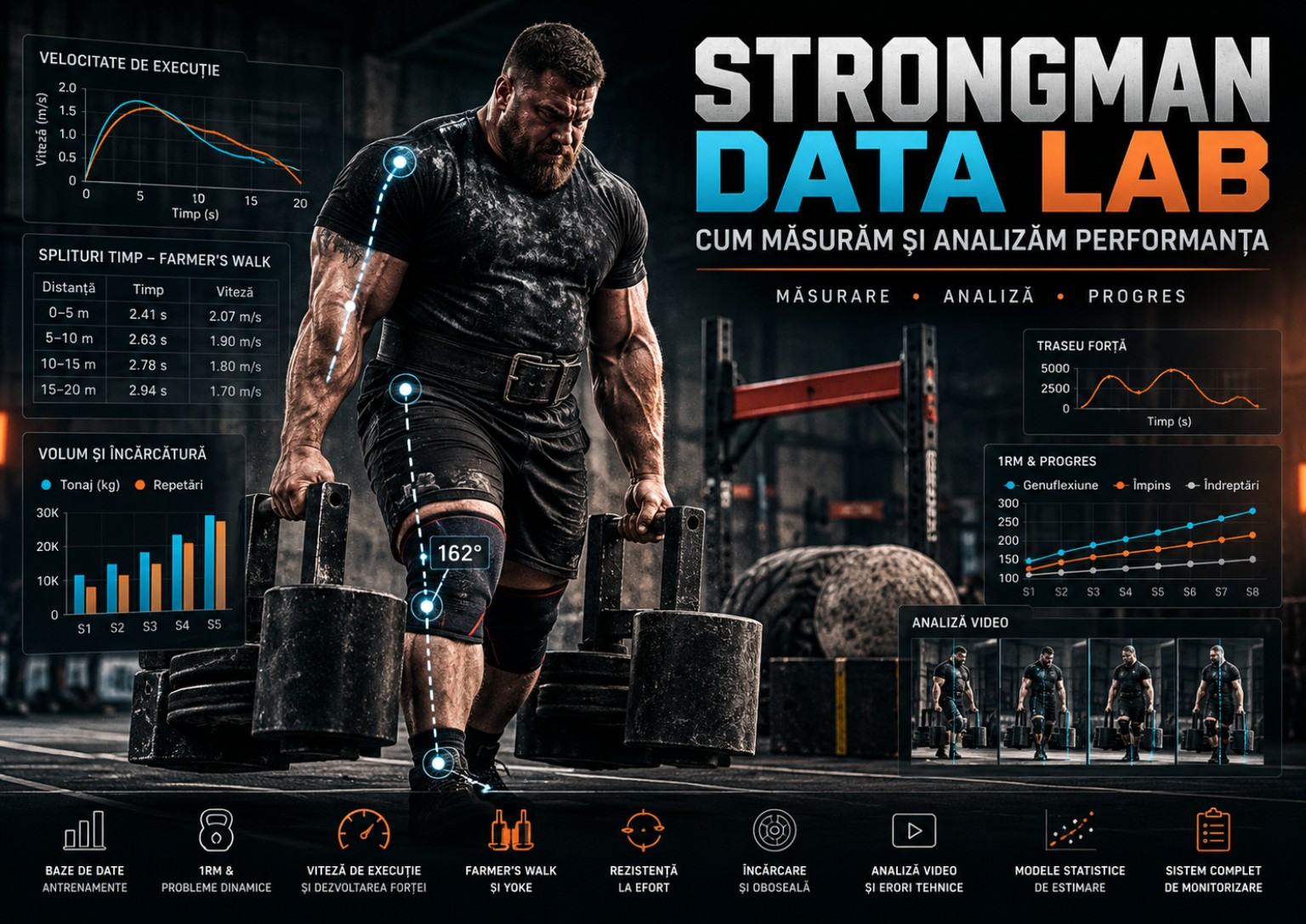
A strongman repetitions-for-time event may look straightforward to evaluate. The referee counts valid repetitions, time expires, and the athlete with the highest count wins. Yet two sets of eight Log Lift repetitions can conceal very different performances. One competitor might complete six lifts rapidly and spend the final quarter of a minute failing a seventh. Another may maintain a consistent pace, take brief planned pauses and finish with a repetition still potentially available. The official count matters; the structure of the attempt tells us more about how that result was produced.
The first five STRONGMAN DATA LAB episodes established measurement validity, database design, the limits of transferring 1RM to moving events, movement velocity and split-time analysis in Farmer’s Walk and Yoke. Episode Six focuses on event-specific endurance in repeated tasks: Deadlift for Reps, Log Lift for Reps, Axle, Viking Press, Dumbbell Press, Atlas Stones and repeated loading. Our central question is not simply how many repetitions an athlete completes, but what can be observed about pacing, performance decline, recovery pauses, technical efficiency and tolerance of sustained effort.
We will maintain the series’ evidence-informed approach without turning results from conventional resistance exercises into universal strongman laws. Studies of repetition-velocity loss, failure training, RPE and RIR, and autoregulation provide useful methodological guidance. However, repeated Log Clean and Press is not interchangeable with a conventional Bench Press set. It contains transitions, rules and technical demands of its own. Likewise, a competition Deadlift with full resets differs from touch-and-go training. Extrapolation must be identified and justified rather than hidden behind the phrase «science proves».
All numerical athlete examples are hypothetical and educational, except observations explicitly identified as published research findings. No invented results are attributed to identifiable competitors, and no prediction model is presented as validated without evidence. We aim to develop techniques coaches can apply with a stopwatch, smartphone, training log and optionally a bar-velocity device. A small set of well-defined variables that changes real decisions is preferable to hundreds of ambiguous measurements.
1. What is endurance in a repetitive strongman event?
«Endurance» is often treated as one general capacity. A Deadlift for Reps event actually demands repeated force production against a specified load under specific rules and a time constraint. Log for Reps also includes cleaning, positioning, pressing and a valid overhead lockout. Atlas Stones for Reps may require repeatedly handling a large, awkward sphere and transferring it onto a platform. Event-specific endurance means maintaining valid performance under the exact task demands, not an abstract ability separated from equipment and technique.
Maximal strength reserve and repeated-effort ability are related but different. A competitor with a 300 kg Deadlift 1RM may find 220 kg relatively manageable, but repetition count also depends on pacing, set characteristics, familiarity, stability and floor-contact rules. A competitor with a lower 1RM may perform well in certain repeated-effort conditions. Without relevant data, neither outcome is guaranteed. A maximal record cannot by itself predict the entire repetition sequence.
The primary result is the number of repetitions accepted before the time limit or another stopping rule. Secondary outcomes may include time to the first valid repetition, duration of each cycle, time spent resting, concentric velocity, number of failed attempts and the point when technique begins to degrade. Their usefulness depends on the coaching question. To understand why an athlete completes only six repetitions, timing distribution may be more informative than a generic estimate of aerobic capacity.
This definition creates an important limit: without a stable protocol, series are not comparable. Eight lifts at 180 kg with a full reset on the floor need not be equivalent to eight touch-and-go lifts. A Log event requiring a clean on every repetition differs from one allowing the implement to remain at chest level between presses. Evaluation therefore begins with competition rules rather than statistical formulas.
2. Official outcome versus observed mechanical performance
The referee records a discrete result: zero, one, two or more valid repetitions. That is the official outcome and should not be replaced by an approximate video count. Yet two series with the same total may have different temporal profiles. During a sixty-second event, athlete A could complete six valid lifts by second forty-two while athlete B achieves the sixth at second fifty-nine. Their official count could be equal even though B uses almost the entire time window and A has time for another attempt.
The situation can also be more complicated. An athlete finishing six repetitions rapidly may then waste time on a failed seventh, while a more conservative competitor might retain enough capacity for another valid attempt. The timestamp of the sixth lift does not independently establish that A had greater remaining capacity. We need perceived effort, failed attempts, technique quality and the actual circumstances of the set.
A useful system distinguishes three levels: observed event, computed quantity and interpretation. «The third repetition was accepted 21.6 seconds after the signal» is an observation. «The interval from the second to third valid lift was 8.2 seconds» is a calculation. «The athlete rested longer after the second lift» is an interpretation requiring video verification, because that interval might contain deliberate rest or a failed attempt.
Each attempt should therefore have an identifier, status and timestamp. Invalid attempts remain in the history because they help explain why equal official results may have different costs. Equally, a failed lockout must not be upgraded to a valid repetition merely because the implement reached an almost acceptable height. Competition scoring and kinematic observation remain distinct.
3. Why repetition count alone does not describe fatigue
A set may end because time expires, an athlete voluntarily stops, technique no longer satisfies the rules, grip fails or external circumstances interrupt the event. Only some of these situations imply reaching a limit close to concentric muscular failure. Five repetitions in a minute do not reveal whether a sixth would have been possible with ten more seconds, whether technical failure prevented it, or whether a referee rejected an attempt. Before calling the result «poor endurance», establish how the set ended.
Research on training to failure provides a relevant warning. A 2022 meta-analysis by Grgic and colleagues, including fifteen studies, found no clear overall advantage of resistance training to failure over non-failure training for gains in strength or muscle hypertrophy [4]. That conclusion concerns resistance-training programmes, not the optimal competitive strategy for every strongman repetition event. Taking all preparation sets to failure simply to imitate competition can add fatigue without assured superiority in event transfer.
Competition changes the balance of reward, risk and recovery. A final difficult attempt may sometimes be justified within the rules and safety requirements. In regular training, where exposures recur week after week, stopping before marked technical breakdown may provide useful stimulus with lower recovery cost. There is no methodological obligation to assess endurance only through absolute failure.
Record the reason for termination: time limit, concentric failure, invalid technique, voluntary decision, symptoms or equipment problem. If the reason is unknown, label it unknown. This field may be more useful than an elaborate composite score, because it prevents all low repetition counts from being interpreted as identical forms of fatigue.
4. Repetition duration and average set pace
The simplest temporal measure is complete cycle duration. In a sixty-second event, consider an athlete receiving valid repetitions at 7, 14, 21, 29, 37, 46, 54 and 60 seconds. Intervals from the signal or previous valid repetition are 7, 7, 7, 8, 8, 9, 8 and 6 seconds. This sequence reveals changes in time between validated results but does not separate active movement from rest. The final repetition may appear «faster» because pacing changed as the limit approached.
A simple average is elapsed time divided by repetition count, but the chosen elapsed time matters. If eight repetitions are completed by second forty-five within a sixty-second window, 60/8 = 7.5 seconds per repetition describes rate relative to the entire allocated window, while 45/8 = 5.625 seconds describes rate up to the last successful lift. Both are mathematically correct and answer different questions. Reporting must specify which duration is used.
In Log Lift, intervals between valid lockouts may include lowering, cleaning, repositioning, dipping, driving, lockout and rest. If the question concerns pressing endurance, movement phases need separating. If the question concerns competition performance, full cycle time is more appropriate. No single «repetition time» has a universal definition across strongman implements.
An applied protocol should record at least each validation timestamp and, where video permits, movement onset and the start of rest. Define these events in advance. Failed attempts between successful repetitions remain part of the interval, while the detailed event log allows them to be identified. Do not artificially smooth the timeline to manufacture a constant pace.
5. The true unit of analysis: repetition, cycle and set
«Repetition» may describe one simple movement, but many strongman repetitions are multi-stage cycles. Log Clean and Press has several phases, Atlas Stones may involve pickup, lap and loading, and Deadlift may begin from complete rest before every attempt. Analysis therefore needs a hierarchy: session, set or event, attempt, validated repetition and movement phase. This preserves the context of every observed action.
An athlete might complete a successful Log clean followed by an unsuccessful press. Recording only «zero repetitions» discards the successful phase and the time consumed. On another attempt, the clean itself may fail before reaching the chest. Both yield zero accepted repetitions yet differ in technical profile and effort cost. A well-designed system retains official outcome and observed sub-events.
In Deadlift, passing the knees is not equivalent to valid lockout. A lift can travel most of its range and still be rejected. An app counting vertical movements may add an extra repetition unless it incorporates the actual rules. Cameras and sensors provide evidence; they are not automatic replacements for officials.
Each hierarchical level supports different indicators. At repetition level, record speed and duration. At cycle level, analyse transitions. At set level, examine pace distribution and validated count. At weekly level, monitor progression and accumulated stress. Moving between these levels without explanation can turn a narrow observation into an unjustified claim about overall athletic capacity.
6. Repetition pacing: the strategy hidden inside the score
Pacing describes how successful efforts are distributed across available time. One athlete may start aggressively, completing four repetitions in the first twenty seconds, then slow considerably. Another may perform two or three repetitions in each third of the event. The final count might be identical, even though the first athlete accumulates substantial local fatigue while the second may miss an opportunity for an additional repetition. No strategy is universally optimal; loading, event duration, technique and rules all matter.
Distinguish active movement, transitions and deliberate pauses. In Log, the interval between lockouts may contain lowering, cleaning, repositioning, pressing and rest. Pausing in the rack is not complete physiological recovery because the athlete still supports a heavy implement. During Deadlift, resting with the bar on the floor differs from pausing while maintaining grip on the bar. Each task needs clear definitions before timing begins.
Consider a hypothetical 75-second Log event. Athlete A receives valid lifts at seconds 8, 17, 27, 39, 53 and 72. Athlete B succeeds at 10, 20, 31, 43, 56 and 70. Both complete six repetitions. B has a steadier late pace, but this does not prove that another repetition was available. We would need failed-attempt data, phase durations and perceived exertion. The interval between validated lifts is descriptive, not a direct physiological reserve measure.
Competition strategy can change if tied repetition counts are separated by the time of the final successful lift. An aggressive early pace might then have value even without an additional repetition. The database must preserve ranking rules alongside the physical observations. Otherwise, coaching could optimise a simplified event that does not correspond to the actual contest.
7. Pace decline: a useful formula and its limits
A descriptive slowing index can be written D = 100 × (late mean cycle time / early mean cycle time − 1). If the first three cycles take six seconds on average and the final three take eight, the index is 33.3%. This indicates that cycle duration increased by one-third, not that the athlete experienced «33.3% muscular fatigue». When cycle intervals contain rest, the index also reflects pacing decisions.
A failed attempt can produce a long interval between validated repetitions. Suppose the third valid lift occurs at second twenty, an attempted fourth fails at second twenty-eight and the next successful lift occurs at second forty-one. The twenty-one-second interval is not twenty-one seconds of rest. Preserve invalid attempts and actual pauses separately; do not relabel time between valid results as pure movement velocity.
An accessible alternative is counting repetitions within equal time windows. Four, three and one valid repetitions in consecutive twenty-second periods reveal a declining distribution. However, when few events fall into short windows, moving one completion across the boundary can change the result substantially. Raw timestamps should therefore be retained and used for precise comparisons.
Longer cycle duration can also be intentional. An athlete may pause before a final difficult effort to increase the likelihood of successful lockout. Elsewhere, the lift itself becomes slower because the load is increasingly difficult. Video can help distinguish active movement from rest, but still cannot measure internal fatigue directly. Accurate analysis requires more than a single decreasing line.
8. Velocity loss: a kinematic measure, not percentage exhaustion
Sánchez-Medina and González-Badillo examined relationships between velocity loss and mechanical and metabolic responses during Bench Press and Squat sets in resistance-trained men [2]. Their 2011 study established useful insights within those protocols; it did not provide an equation converting Log or competition Deadlift slowing into an exact percentage of physiological fatigue.
A common metric is VL% = 100 × (reference velocity − current velocity) / reference velocity. The reference must be specified in advance, perhaps the first or fastest technically valid repetition. If mean concentric velocity falls from 0.50 to 0.35 m/s, the calculated loss is 30%. This does not mean 30% of energy stores have been consumed, nor does it directly estimate failure probability. It describes a relative change between two kinematic measurements.
In Deadlift, bar bending, initial position and differences between dead-stop and touch-and-go repetitions can affect recording. In Log, pressing velocity may remain fairly constant while cleaning takes increasingly long. A device averaging clean, repositioning and pressing into one number could obscure the changing phase. More sensors cannot fix poorly defined measurement.
The useful question is whether velocity declines within the same movement phase across comparable repetitions. If it does, we examine method error, repetition validity and relevance to event success. Squat-derived thresholds should not automatically determine when Axle or Log sets end. Velocity is helpful when it informs a defensible sporting decision.
9. Velocity-loss thresholds and limits of transfer
Pareja-Blanco and colleagues compared Squat programmes using approximately 20% and 40% repetition-velocity-loss thresholds across eight weeks [3]. Twenty-two participants achieved similar Squat strength improvements. The lower-loss condition produced greater countermovement-jump improvements despite fewer repetitions, whereas the higher-loss condition was associated with greater hypertrophy in some measured muscle regions.
These findings do not make 20% a universal strongman stopping threshold, nor establish that 40% is required for hypertrophy. Exercise selection, experience, total work and programme objectives all constrain generalisation. A Log repetition involving a mandatory clean differs substantially from a conventional Squat. An athlete learning to maintain clean lockouts may need a different set design from one primarily pursuing muscular size.
Before competition, stopping criteria should consider technique, load and recovery. If repetitions remain fast but are no longer technically valid, a sensor cannot authorise continuing automatically. If velocity decreases under safe technique during a block explicitly developing tolerance of repeated efforts, some slowing may be anticipated. Data inform decisions but do not replace coaching responsibility.
10. RPE, RIR and the athlete’s subjective experience
RPE describes perceived effort; RIR estimates repetitions still possible before an explicitly defined limit. Zourdos and colleagues investigated an RIR-based RPE scale in squatters of different experience levels [5], while Helms and colleagues discussed its application to autoregulated resistance training [6]. These tools are not objective sensors: interpretation depends on athlete experience and the wording of the question. They can nevertheless complement mechanical observations.
For a conventional Bench Press set, asking how many additional repetitions might have been possible has a relatively clear meaning. In repeated Log work, the athlete may have enough capacity for another press but not another clean, or vice versa. Separate perceptions for clean and press may be recorded, although this must not be presented as an established validated scale for all strongman formats. Sometimes a short descriptive note is more informative than numerous numerical ratings.
A hypothetical note might read: «Log 100 kg, six valid repetitions in 75 seconds, final RPE 9, clean felt most limiting». If video also shows a progressive increase in clean duration with relatively steady pressing time, the observations converge. They still do not prove the precise physiological mechanism. If athlete and video assessments diverge, the disagreement deserves exploration rather than automatic dismissal.
Keep the administrative burden modest. Two or three consistent post-set questions often provide useful context. The value of subjective data lies in repeated collection and interpretation alongside outcomes, not in treating one athlete statement as an unquestionable causal explanation.
11. An invalid repetition is not synonymous with muscular failure
An attempt may be rejected because of inadequate force production or because the execution violates competition rules. In Log, full lockout, overhead control and referee signals can determine validity. In Deadlift, final position and lowering rules matter. An implement reaching almost the required height is not automatically a valid repetition; at the same time, a rejected lift does not necessarily demonstrate absolute concentric failure.
Imagine two Deadlift attempts. In the first, the bar stalls below final lockout. In the second, the bar reaches the required height but the effort is rejected for a technical rule violation. Both add zero to the official score, yet they suggest different coaching questions: lifting capacity versus familiarity with adjudication. A database recording both simply as «failure» loses meaningful information.
Use operational categories such as valid, technically invalid, mechanically unsuccessful, abandoned and unknown, adapted to the actual rules. If video cannot reveal the reason, do not invent one. Even one failed attempt may explain an unusually long interval between valid repetitions, so its timestamp should remain in the sequence.
Reducing invalid attempts can increase the official repetition count without any detectable change in mean velocity of successful repetitions. This is a real competitive improvement even if it cannot be attributed directly to increased maximal strength. Learning rules and improving technical economy are legitimate components of event-specific repeated performance.
12. Deadlift for Reps: what makes repetitions comparable
Deadlift for Reps appears easier to standardise than Log because the principal movement follows a relatively recognisable pattern. Strongman nevertheless uses standard bars, axles, frames, large wheels and different starting heights. Rules may require controlled lowering, complete floor contact, a referee command or simply returning the load before the next repetition. Straps may be permitted or restricted. Each combination creates a different task even when the displayed kilograms are identical.
A minimum protocol records actual mass, implement variation, starting height, range of motion, reset rules, time window and lockout standard. For each repetition, observe lift onset, validation and lowering where visible. If the bar settles between attempts, active lifting time can be separated from the interval before the next lift. This shows whether the overall decline comes from slower movement, longer pauses or both.
Consider a hypothetical sixty-second event at 220 kg with seven valid repetitions. Lockouts occur at seconds 5, 12, 19, 27, 36, 47 and 59. Successive intervals are 5, 7, 7, 8, 9, 11 and 12 seconds. The sequence reveals progressive slowing but does not identify the component responsible. If video shows each lift taking approximately four seconds while pauses become longer, the investigation shifts towards between-attempt recovery and pacing.
If lifts themselves become slower, mean concentric velocity can be compared, provided starting conditions remain similar. Different bar bending or shortened range of motion can create false impressions of improvement. An athlete may perform more repetitions through better pacing without moving each repetition faster. Competition outcome remains meaningful, but explaining it requires several variables.
13. Dead-stop versus touch-and-go: different tests
In dead-stop repetitions, the bar settles on the floor and the athlete starts each new effort after a defined pause, even if brief. Touch-and-go may involve a quicker transition and sometimes elastic effects from contact or bar flex. These differences can influence repetition duration and difficulty. Eight dead-stop repetitions are not automatically equivalent to eight touch-and-go lifts at the same load.
Define a complete reset clearly. Must the bar be motionless? Can the athlete preserve trunk tension? May straps remain tight? Is another referee signal required? If competition standards are stricter than training standards, gym repetition counts may overestimate what can be completed officially. This is a question of test validity, not athlete character.
Suppose an athlete completes ten touch-and-go repetitions at 200 kg in sixty seconds but only seven dead-stop repetitions under otherwise comparable conditions. It would be misleading to express this as «30% more endurance». The tasks differ, while count and capacity are not linearly related. Elastic behaviour, movement economy, setup time and other factors can contribute. Record and interpret them as separate tests.
For longitudinal tracking, select a primary version with stable technical criteria. If competition rules change, create a new condition in the database. Both formats can remain useful, but should not be joined into one uninterrupted performance trend. Apparent improvement might arise solely because floor-contact requirements changed.
14. Log Clean and Press: a cycle with several possible limits
During Log for Reps, cleaning and pressing may deteriorate at different rates. An athlete may repeatedly clean the cylinder to the chest without trouble but struggle progressively at overhead lockout. Another may maintain pressing speed while cleaning becomes increasingly difficult through repositioning and wasted movement. Total repetitions cannot distinguish these patterns without examining individual phases.
A complete cycle may be divided into pickup onto the thighs, clean to rack, preparation, overhead drive, stabilisation and lowering. This is a practical analytic framework rather than one universal competition standard. The phases depend on implement and rules. Precise beginning and ending landmarks are essential if repetition times are to be compared over weeks.
Imagine six hypothetical repetitions at 100 kg. Clean durations are 3.0, 3.2, 3.6, 4.3, 5.1 and 6.4 seconds, while pressing durations remain around 1.8 to 2.1 seconds. The main observed deterioration occurs during cleaning. A programme focused entirely on shoulder strength could miss the more immediate limitation. Yet longer cleaning alone does not prove weak back muscles; technique and transitions require review.
A format permitting repeated presses without a new clean is a different event. The limiting factors may then shift towards pressing capacity, stability and rest between lockouts. Both formats can be measured rigorously, but a six-repetition clean-every-time result should not be casually compared with eight presses from rack as though they represented the same ability.
15. Axle Clean and Press: implement diameter changes the task
Axle introduces grip and rotational characteristics that can alter repetition duration. Some events permit continental cleaning techniques; others restrict how the implement may reach the chest. Bar diameter, surface texture and rules about straps affect the demand. A set with an Axle is not automatically comparable to Log or a standard bar even when external mass is the same.
In an Axle for Reps event with mandatory cleaning, each cycle may become slower as the athlete loses efficiency moving into the rack. If video shows stable pressing time but increasingly lengthy grip repositioning, one plausible limitation emerges. If attempts fail mainly at overhead lockout, a different problem is suggested. Both can produce identical final scores, which is why invalid attempts and phase durations belong in the record.
Competition strategy may involve an economical clean method, but major technical changes should be practised before the contest rather than improvised under severe fatigue. The analysis identifies where time is spent and tests whether an intervention produces additional valid lifts. Squat research does not establish one ideal Axle transition duration; event-specific evidence is limited, so the actual rules must guide the protocol.
Record Axle type, diameter, permitted technique, complete mass and event duration. A subjective grip-difficulty note can be valuable but should not be misrepresented as an independently validated measure. If control deteriorates dangerously, the attempt ends regardless of the remaining clock time.
16. Viking Press: an apparently simple repeated movement
Viking Press uses a lever system; the mass of attached plates is not identical to the force experienced at the hands throughout the movement. Lever lengths, pivot location, athlete position and equipment design affect mechanical demand. Two apparatuses loaded with «100 kg» need not be equivalent, and their velocities should not be interpreted like a conventional vertically travelling bar.
For analysis, retain apparatus identity, nominal plate load, lever configuration, starting position and full-extension criterion. If leg drive is allowed or prohibited, the rule must be included. A small change in movement range can alter repetition count substantially. Automated video counting may accept invalid repetitions unless calibrated to the referee’s actual standard.
Imagine eighteen accepted repetitions in one sixty-second trial and twenty-one in another on the same apparatus. To interpret the change, examine repetition duration and rejected attempts. If newer repetitions have shorter range of motion, the apparent improvement may not be genuine. If validity is maintained and pace is more consistent, the increase is competitively meaningful even without proving whether muscle growth or coordination caused it.
Apparatus variability makes universal record comparison difficult. A Viking Press performance can be outstanding in one contest without creating a globally interchangeable kilogram benchmark. We should prioritise comparisons within identical configurations and provide enough descriptive detail when publishing results.
17. Giant Dumbbell for Reps: stability and changing arms
Giant Dumbbell has a large mass and centre-of-mass properties different from an ordinary gym dumbbell. The start, clean to shoulder, leg drive and lockout rules all affect performance. Where arm changes are permitted, note whether the athlete uses one arm or alternates. Those formats should not be silently combined into one identical testing condition.
Video can track time from initial movement to shoulder placement, overhead validation, lowering and repositioning. An athlete may have a powerful overhead drive yet lose substantial time stabilising the implement before every attempt. As loading rises, setup duration may dominate cycle time. When repetition intervals lengthen, we must know whether pressing itself slowed or preparation became less efficient.
Consider a hypothetical five-repetition performance with a 75 kg giant dumbbell. Valid lockouts occur at seconds 9, 20, 33, 47 and 65. The increasing intervals do not independently establish deltoid fatigue. The athlete may be spending more time finding a stable shoulder position. A coach could test technical transitions at submaximal loads before revising strength training.
Safety requires special attention. Unilateral efforts may involve trunk compensation or corrective steps. Faster execution should never be rewarded when it compromises a controlled lockout. A technically valid, stable result matters more than an impressive repetition interval obtained through unstable movement.
18. Atlas Stones and Tire Flip: repetitions unlike barbell lifts
Atlas Stones for Reps involves repeatedly lifting large spherical objects, sometimes with different diameters, surfaces and platform heights. Tire Flip requires rotating an object, repositioning hands and pushing through distinct movement phases. Hindle and colleagues’ 2019 systematic review describes the existing biomechanical strongman literature and identifies important evidence gaps [1]. We cannot use repetition count alone to isolate muscular strength or endurance from these complex tasks.
Atlas Stones cycles can be divided into pickup, lap, extension, loading and return. If a sequence uses several different stones, each has its own properties and may constitute a distinct workload. Rapid completion of an early stone followed by prolonged struggle on a later one does not reveal the precise limitation from total medley time alone. Repetition testing with one stone offers more direct comparability if platform height and resetting rules remain unchanged.
Tire Flip cycles can be separated into initial pull, secondary pull and final push or rotation. Published biomechanical work has found that durations of particular phases can distinguish faster and slower flips [1]. Exact thresholds should not be transferred between tyres of different geometry and stiffness. Per-flip timing and phase-level video provide useful information without claiming a complete mechanical model.
Constant rhythm is not automatically efficient technique. A repetition may become faster because the athlete shortens movement or violates judging standards. Retain validity, failed attempts and implement characteristics. Comparing repeated efforts is meaningful only when the task itself remains sufficiently stable.
19. Loading Medley: object count does not describe the whole event
A Loading Medley with sandbags of 70, 90 and 110 kg is not three identical repetitions; it is a sequence of different tasks. Each object requires pickup, transport, loading and return. Changing order, platform height or distance changes the demand. Endurance here means completing a specific sequence, not a pure repetitions-per-minute score. Three completed objects can conceal substantial delay at one heavy object or during transitions.
Record timing from start to the first pickup, transport, valid loading, return and subsequent completion events. In a hypothetical sixty-second medley, a competitor loads the first object at second twelve, the second at thirty-one and the third at fifty-five. The intervals of twelve, nineteen and twenty-four seconds do not solely represent progressive fatigue because the objects are also becoming heavier. Valid comparison requires the same order and configuration across sessions.
When total medley time improves, segmentation can reveal whether gains arise from carrying, loading or returning for the next object. Describing the entire change as «better endurance» would conceal distinct mechanisms. A quicker unladen return may improve performance without greater ability to lift the object itself.
With repeated use of the same bag, cycles are more directly comparable, but we still need to specify whether it is lowered to the ground, returned from the platform or reset by assistants. Such details can fundamentally alter cycle duration. A precise stopwatch cannot compensate for an imprecisely defined task.
20. Thirty-, sixty-, seventy-five- and ninety-second events
The official time limit changes how an athlete distributes effort. A thirty-second event may reward rapid completion of a smaller number of cycles; ninety seconds provides more opportunities to adjust pacing while also allowing greater fatigue accumulation. This does not imply one universal second when «aerobic metabolism takes over». Energy systems contribute concurrently, with changing proportions dependent on intensity, duration and rest structure.
In a hypothetical example, an athlete performs six moderate-load Log repetitions in thirty seconds and nine in seventy-five seconds. Timing and pauses may explain why the longer window does not yield proportionally more repetitions. Extrapolating six in thirty seconds to fifteen in seventy-five ignores fatigue, transitions and failed attempts. Measurement must cover the full event rather than just the opening cycles.
Testing two time windows at unchanged load might be informative across separate sessions, provided it fits training and safety constraints. Compare valid count, completion timestamps and perceived effort. Do not assume that the best athlete at thirty seconds will necessarily win over ninety. Event duration can change relative strengths between competitors.
Near competition, reproduce the official time limit. A sixty-second protocol and an arbitrary mathematical conversion are not an adequate substitute for a genuine seventy-five-second event. Once the window is defined, measure the task that will actually be contested.
21. Strength reserve and relative loading: why 1RM is insufficient
A load of 220 kg may represent different fractions of maximal capacity for two athletes, influencing repetition potential. Yet percentage of 1RM does not precisely predict repeated-event endurance. Relationships among load, possible repetitions and exertion vary across people and exercises. A 1RM from a standard bar is not automatically equivalent to maximal capacity with an axle, frame or altered starting height.
Suppose one athlete has a Deadlift 1RM of 280 kg and another 250 kg. At 200 kg, nominal relative intensities are about 71.4% and 80%, assuming both maxima are measured with equivalent technique and apparatus. The first competitor plausibly has more absolute force reserve, but the sixty-second outcome also depends on lift speed, rest, rules and event-specific tolerance. No reliable equation guarantees a particular repetition advantage from the 8.6-percentage-point difference.
A complete record includes absolute load, percentage of a relevant exercise-specific 1RM, valid repetition count and completion timestamps. If 1RM is estimated, the method and uncertainty must be noted. An outdated personal record may no longer describe present capacity. Seventy-five percent of a best lift from two years earlier is not necessarily seventy-five percent of today’s maximum.
Progress at a fixed load and progress at an increasing load are different questions. The first is a relatively direct comparison of performance on a standardised task. The second examines performance as external difficulty changes. Both can be useful, but should never be silently combined into one trend.
22. Local fatigue, coordination and technical limitation
«I became tired» can describe multiple problems. During Deadlift, an athlete may struggle with hip extension, grip or trunk stability. During Log, the shoulders may feel exhausted while repetition rate actually declines because cleaning takes longer. Atlas Stones may become harder chiefly because object manipulation and positioning deteriorate. Kinematic observations describe external behaviour; they do not directly isolate individual muscle contributions.
Responsible analysis separates athlete report from camera observations. If an athlete says «my shoulders failed» while pressing remains fast but cleaning slows, the experience deserves clarification. Perhaps maintaining rack position was exhausting even while the visible drive stayed efficient. The athlete’s report is not necessarily wrong; different sources describe different aspects. Combining them can improve coaching questions.
Consider a hypothetical Deadlift series with fairly stable active lifting times across the first five repetitions but increasingly long intervals before new attempts. The data do not establish whether the limitation is cardiovascular, psychological or muscular. They do show that concentric lifting duration has not changed very much. This narrows the investigation without resolving it.
Pain, dizziness and substantial loss of technical control change the priority from performance monitoring to safety. A repetition-time algorithm cannot distinguish normal fatigue from a medical problem with clinical certainty. Appropriate assessment remains outside the scope of sport-performance modelling.
23. Energy systems: useful context without magic formulas
Heavy repetitive work requires continual ATP resynthesis. Phosphagen processes, glycolysis and oxidative metabolism contribute simultaneously in changing proportions depending on instantaneous intensity, task duration and pauses. There is no fixed universal second when one system completely switches off and another assumes all work. An intermittent Log event may differ substantially from continuous exercise lasting the same overall time.
The fact that a set lasts seventy-five seconds does not identify exact lactate production or glycogen use. Such estimates would require specific research methods, and simple extrapolation is unreliable. We can still study when repetitions occur, how long pauses last and how perceived effort evolves. These observations are accessible without pretending to measure biochemistry from ordinary video.
One heavy repetition every ten seconds creates a different intermittent pattern from repeated attempts every four seconds. Pauses may permit partial recovery of relevant resources but also consume limited competition time. Faster attempts are not necessarily more efficient if they cause late failures. Compare valid outcomes instead of selecting strategy through an oversimplified metabolic story.
Developing event-specific endurance involves exposure to actual contest requirements without excluding general preparation. Yet the precise balance of load, duration and training volume must be individualised. Do not prescribe work intervals based on an assumed exclusive energy-system dominance at second thirty or sixty.
24. Breathing, stabilisation and pauses between attempts
Heavy lifts require postural control and breathing management. During Deadlift, the athlete restores positioning before each pull; during Log, breathing may be reorganised between clean and press or after lowering. Deliberate pauses can improve the quality of the next attempt while using competition time. Monitoring can show whether short pauses support more valid repetitions or merely create delays without observable benefit.
Video reveals pause duration but does not directly measure intra-abdominal pressure or respiratory gas exchange. Extended breath-holding should not be prescribed merely to reduce cycle times. Breathing strategy must remain compatible with task demands, technique and health. Dizziness, chest pain or unusual breathing difficulty call for ending the attempt and obtaining appropriate medical assessment.
Consider two hypothetical six-repetition sets at unchanged load. In the first, immediate repeated attempts lead to two failures. In the second, brief deliberate pauses allow six valid repetitions with no rejected attempts, while total duration remains similar. We may test whether pauses aided control, but cannot claim that breathing alone caused the improvement. Technique and familiarity may contribute.
Evaluate breathing and rest within the whole set. A method that makes the first repetition more comfortable but excessively delays later attempts may reduce the final score. Strongman pacing balances stability, safety and what the event rules actually reward.
25. Rest between sets and recovery between testing attempts
Rest duration belongs in the record whenever multiple sets are compared. Five minutes of recovery are not equivalent to two minutes, and a prolonged warm-up can change the response to the first attempt. If within-session endurance is being examined, standardised rests are important. Yet very heavy strongman sets may be too demanding for repeated maximal testing merely to obtain another data point.
One workable approach is a standardised reference set at an appropriate frequency, with additional observations drawn from normal training. If multiple trials are necessary on one day, use carefully chosen loading and sufficient recovery based on training goals and experience. Monitoring must not become a private maximal competition every week. Its cost in fatigue should be justified by useful information.
Between-set performance can be described through valid repetitions, their timestamps and perceived exertion. If the first set yields eight repetitions and the second six at unchanged load, performance has declined, but the cause is not isolated. Previous exercises, temperature, motivation and actual rest duration all matter. A structured system preserves these details rather than relying on memory.
Across weeks, avoid simultaneously changing load, event duration, rules and rest conditions whenever a clean comparison is intended. Some changes are unavoidable in real programming; those should be documented and comparisons interpreted cautiously.
26. A strongman microcycle with endurance monitoring but without excessive testing
Strongman programmes develop several qualities at once, so monitoring must not consume the resources needed for actual training. One reference assessment for Deadlift for Reps and another for Log for Reps can be integrated into programmed sessions instead of adding two separate maximal events each week. During a hypertrophy-oriented block, submaximal sets may provide useful observations. During contest preparation, assessment can gradually resemble actual loading, duration and rules.
Imagine a hypothetical microcycle with Deadlift on Tuesday and Log on Sunday. A standardised six-repetition Deadlift set can supply execution times and perceived effort without reaching failure. A manageable five-repetition Log set can be filmed laterally to analyse clean and press phases. Such observations support longitudinal comparisons at lower cost than repeated maximal competition simulations.
Closer to competition, a sixty- or seventy-five-second full-event assessment may be useful at a frequency determined by recovery and the broader programme. There is no universal calendar. After demanding Farmer’s, Yoke and sandbag work, testing maximal Log repetitions on the same day could add unreasonable fatigue. Monitoring must respect stimulus order and recovery demands.
An effective system does not automatically increase testing frequency simply because the data are interesting. It asks whether another attempt would change a decision. If a phase is already known to deteriorate with fatigue, the next session may test a technical intervention without reproducing the complete maximal protocol. Information quality and practical value should take priority over volume of measurements.
27. Hypothetical eight-week Deadlift for Reps case study
Consider an athlete preparing for 200 kg Deadlift for Reps over sixty seconds. Weekly valid counts are seven, seven, eight, eight, nine, eight, ten and ten. The trend suggests improvement but does not independently establish that maximal strength increased. The athlete may be lifting more efficiently, taking shorter pauses or tolerating the pacing demand better. To locate change, we need completion timestamps and stable testing conditions.
During the first assessment, seven valid lockouts might occur at seconds 6, 13, 21, 30, 40, 50 and 59. In the final assessment, ten might occur at 5, 10, 15, 21, 27, 34, 41, 48, 55 and 60. Mean intervals are shorter and more repetitions are completed without a failed attempt. The observations still do not reveal whether concentric movement is faster or pauses are shorter. Video or suitable velocity measurement can separate those phases.
High perceived effort at the end of both sets does not mean the later test was «easy». It may demonstrate greater capacity to produce valid work within the same time. Body-mass changes, previous training fatigue and differences in floor-contact technique should all be noted. Arbitrary correction factors must not be invented to make conditions appear identical.
The justified conclusion is that the athlete progressed from seven to ten accepted repetitions under the reported conditions. If the protocol remained stable and the difference clearly exceeds normal variability, the change is practically meaningful. The mechanism remains a hypothesis to be examined through movement times, pauses and complementary strength tests.
28. Case study: six Log repetitions under two pacing strategies
Consider another hypothetical event: 110 kg Log for seventy-five seconds. During the first attempt, the athlete completes six repetitions, racing through the first four and then requiring long pauses. At a later session, the athlete uses planned short breaks and still achieves six valid repetitions but with two fewer invalid attempts. Official performance may tie, while execution becomes more controlled.
Video can identify clean duration, pressing duration, rest after lowering and lockout timestamps. If pressing speed deteriorates in the first strategy but remains stable in the second, pacing may contribute to the difference. Trial order and growing familiarity remain alternative explanations. Ideally, strategies would be compared across more than one adequately recovered session.
Suppose inter-validation durations in one hypothetical trial are 8, 9, 10, 12, 16 and 18 seconds. Under the alternative, they are 10, 11, 11, 12, 14 and 15 seconds. Both sequences reach the sixth completion at second seventy-three, but distribute time differently. The second concentrates less elapsed time in the final cycles. That does not prove greater strength or less internal fatigue; it describes changed time management.
The coach may favour the strategy producing clean repetitions and leaving room for another attempt, subject to the ranking rules. If completion time determines the tiebreak after equal counts, a different approach may have tactical advantages. Two teaching examples are not sufficient grounds for declaring an «optimal pacing algorithm».
29. Case study: official repetitions improve without higher bar speed
A hypothetical athlete attempts Axle Clean and Press at 90 kg. The initial assessment records five accepted lifts and two rejected for incomplete lockout. After a technical training block, seven repetitions are accepted, while pressing-phase durations remain close to the original values. Possible improvements include final positioning, trunk coordination, implement control and familiarity with judging requirements. No numerical increase in maximal strength needs to be assumed.
This demonstrates the difference between physiological capacity and competitive efficiency. Conventional Bench Press or Strict Press tests may remain stable while official Axle performance improves. A system recording only load and bar velocity would miss the development. Validity and rejection-reason fields matter particularly in events with complex technical rules.
A testable hypothesis is that the athlete reduced failed attempts through improved overhead stabilisation. Subsequent sessions can examine whether this persists under contest loading and in later repetitions when exertion is high. Repeated success strengthens the practical explanation, although the entire improvement cannot be assigned numerically to one training exercise.
This information helps a coach avoid unnecessarily revising all strength work when the immediate problem was technical validity. It does not mean strength development is irrelevant. It means competitive performance has several components, and sometimes the greatest available improvement comes from reducing errors rather than adding weight to an accessory lift.
30. From observation to a testable intervention
Useful analysis requires a question, an indicator, a hypothesis and a subsequent check. If Log clean duration increases across later repetitions, a plausible hypothesis is that the athlete loses efficiency while repositioning the implement. A submaximal technical block with standardised transitions could be tested. After several weeks, repeat a comparable assessment to see whether cleaning time stabilises and accepted repetitions increase.
If long pauses dominate Deadlift time loss, two pacing strategies might be compared at unchanged loading in separate sessions. Automatically reducing rest to zero could create invalid repetitions or technical deterioration. Alongside the final count, compare rejected attempts and perceived exertion. An intervention succeeds when it improves the meaningful outcome rather than only a convenient secondary metric.
When pacing remains good until halfway through a minute then collapses, determine whether movement duration or between-attempt rest changed. These situations may need different responses. Interpretation also requires load difficulty, training history and day-to-day context. There is no one intervention corresponding to every slowing pattern.
Retain findings that challenge the hypothesis. If a new exercise improves pressing speed but Log repetition count stays unchanged, intended transfer has not been demonstrated. That is valuable information about specificity. A mature data lab accepts unsuccessful interventions and adjusts its model rather than selectively reporting only improvements.
31. A minimum log for repeated strongman events
A database needs athlete, session, event, implement variation, load, rules, time limit and accepted repetition count. At attempt level, retain timestamps, status and known reasons for rejection. Where feasible, store clean, pressing or concentric durations at phase level. Context includes RPE, rest between sets and relevant symptoms or technical changes.
Zero repetitions must not simultaneously mean «did not compete», «attempted and failed», «device malfunction» and «not measured». These situations require separate codes. Missing time is not zero seconds. One incorrect data-entry convention can produce absurd averages and distort prediction models. Analysis quality begins with field definitions.
A hypothetical entry might read «athlete A; conventional Deadlift; 200 kg; dead-stop; sixty-second window; eight valid repetitions; one invalid attempt; final RPE 9». A linked event table retains each valid lockout timestamp and the invalid attempt. This structure supports reconstruction of the official score and analysis of pacing. Charts can be recalculated without losing original observations.
Personal information and videos require responsible handling. Do not collect unnecessary medical data to produce a repetition chart or automatically distribute recordings containing bystanders. Access, storage and retention rules should match the purpose. Useful sports monitoring does not require unlimited surveillance.
32. Formulas, rates and checks in a spreadsheet
Mean repetition rate across the complete time allowance is r = 60 × n / T, expressed as repetitions per minute when T is in seconds. Eight repetitions during a seventy-five-second window give r = 6.4 per minute. If the eighth repetition was completed at second fifty-four, rate up to the final lockout is 60 × 8 / 54 ≈ 8.89 per minute. Do not confuse the two: one includes the entire official window and the other the elapsed period until the final success.
Each inter-validation interval is Δt_i = t_i − t_(i−1), with t_0 = 0 when the starting signal is the reference. Summing these intervals should reproduce the time of the final accepted repetition. This is a useful automatic check. Decreasing timestamps or physically impossible simultaneous lockouts require review, not arbitrary alteration without original footage.
For longitudinal changes, Δ% = 100 × (new − old) / old, provided the baseline is non-zero and tests are comparable. Increasing from six to eight repetitions is approximately +33.3% in accepted count. It does not demonstrate that maximal strength or metabolic endurance increased by 33.3%. Repetition count is discrete and may change abruptly when a completion falls just inside or outside the time limit.
A good file verifies that the official score equals the number of «valid» records, all timestamps fall within the allowed interval and loading units are consistent. A video clock offset should be resolved through the protocol, not by conveniently moving a borderline repetition. Data validation is part of validating the performance.
33. Graphs that reveal useful information
A timeline of valid lockouts shows when the athlete completed each repetition. Another chart may plot full cycle durations, while a third separates active movement and rest. These variables have different units and meanings, so combining them without labels is misleading. For Log Clean and Press, separate clean and press lines may identify phase-specific deterioration concealed by overall cycle time.
For longitudinal comparison, plot accepted repetitions at unchanged load and time limit against date. Annotate changes of rules, implements or timing method. An apparent improvement immediately after replacing dead-stop with touch-and-go should not be interpreted as pure muscular adaptation. A changed task needs a separately labelled series.
Group analysis can use distributions and means, but must preserve individual variation. One athlete may progress through faster repetitions, another through fewer rejected attempts and another through shorter rest. Compressing them into an opaque «endurance score» may reduce the usefulness of the information. In strongman, an individual profile often matters more than a small-group average.
Published graphs based on hypothetical values must be clearly labelled as such. Constructed examples are excellent teaching tools but do not become empirical evidence. Accurate presentation cannot replace honesty about the source of data.
34. Result reliability: when does one extra repetition represent genuine progress?
Repetition count is discrete: seven and eight differ by one unit, but that difference may mean different things across circumstances. If an athlete frequently finishes the seventh repetition at second fifty-eight and occasionally squeezes an eighth inside the time limit, results can be sensitive to timing, pacing and daily variation. Consistently completing ten repetitions after a training block is a more robust practical change. Comparing one old record with one new best attempt is not enough to characterise normal variability.
Reliability concerns reproducing observations under sufficiently similar conditions. A few reference sets separated by appropriate recovery may help estimate ordinary fluctuation. Yet consecutive attempts are not physiologically independent: the first may improve readiness, and later sets may suffer fatigue. Test design therefore needs consistent trial order, rest, familiarisation and microcycle timing. A standard deviation calculated from incompatible attempts is not an adequate estimate of method error.
Atkinson and Nevill discussed statistical approaches to measurement error in sport [8], while Bland and Altman explained why high correlation between methods is not equivalent to satisfactory absolute agreement [9]. These principles matter in a small gym. If two analysts count the same video and one accepts a borderline lockout that the other rejects, the disagreement must be resolved through explicit validity criteria, not by reporting 7.5 accepted repetitions. Accepted repetitions are discrete rule-defined events.
A responsible system can retain the official count and an independent video-review result. Disagreement does not authorise retroactively rewriting a competition score. Within a training diary, labels may be revised when evidence warrants it, while preserving a correction history. Real progress is not the most optimistic number but a change supported by comparable observations and transparent rules.
35. Between-rater variation and video annotation
Two analysts may disagree on repetition onset, full lockout and pause duration, especially when an implement obscures the joints or the camera is angled. An encoder may produce a displacement curve without knowing whether a referee would accept the movement. Clear operational definitions are therefore necessary before coding, and footage must show the relevant landmarks whenever possible.
During a calibration exercise, two observers may independently timestamp eight repetitions in the same recording. Their differences are then calculated in seconds. If most lockouts differ by less than 0.10 seconds but one differs by 0.60, examine why that event was ambiguous. Do not automatically erase it; the appropriate result may include greater uncertainty for that particular phase. Additional decimal places cannot repair ambiguity.
Recording at sixty or 120 frames per second may improve temporal resolution, but frame rate does not solve obstruction, perspective and compression. A side camera might miss an elbow lockout hidden by the Log; an additional view may help if safely positioned. When footage is inadequate, label a time approximate rather than claiming exact measurement. The analyst should not invent precision beyond what can be observed.
The aim of between-rater assessment is not to turn coaches into full-time statisticians. It is to discover which details can be monitored credibly. If repetition counts agree consistently but pressing-phase durations vary substantially between analysts, use the former for robust decisions and treat the latter as exploratory. Removing unreliable metrics can improve the monitoring system.
36. Systematic bias: consistent devices can still disagree
A hand timer may produce consistently delayed stopping times because of operator reaction. Video software may define movement onset differently from an encoder. Both tools can be repeatable while reporting non-interchangeable values. Strong correlation does not guarantee that absolute differences are small enough for coaching decisions [9]. This matters when trying to interpret gains of only a few tenths of a second.
Suppose an analyst identifies lockouts at 12.0, 19.3 and 27.1 seconds, while an application reports 12.2, 19.5 and 27.3. The constant 0.2-second difference might arise from different detection rules. Identical offsets can cancel when calculating intervals between events, but still affect time to first completion or final completion relative to the official start. Measurement error must be evaluated for the exact metric used.
If the athlete switches cameras or updates software, document the change. A different application may detect a different part of the same action despite using identical terminology. Over months, an artificial breakpoint can resemble progress. Historical data need not be discarded, but their non-equivalence should be acknowledged rather than silently hidden.
The most expensive tool is not necessarily the most useful. Fixed video and explicit criteria may be sufficient to count valid repetitions. Measuring very short movement phases might require specialised validated equipment. Choose a tool based on the acceptable error for the actual decision rather than its advertised precision.
37. Pacing and success probability: a decision problem
During the final seconds, an athlete may choose an immediate high-risk attempt or a brief pause followed by a more controlled effort. The correct choice depends on time remaining, load difficulty, previous attempts and rules. Without sufficient data, precise probabilities of success would be invented. We can nevertheless frame the situation as a choice between outcomes and investigate it through an athlete’s own history.
Imagine a competitor with twenty seconds remaining and six accepted repetitions. If new attempts typically take eight seconds, there may be time for one or perhaps two efforts, but a failed attempt can consume much of the remaining window. If previous sets show repeated failure after six repetitions, a short pause might be tactically sensible. We do not know whether it actually improves success probability without repeated comparison.
A statistical model might estimate attempt success by prior completed repetitions and rest duration, but it would require enough comparable attempts. Ten total training sets may contain very few late-stage attempts, making any fitted probabilities unstable. Descriptive patterns and planned training comparisons are preferable to a pseudo-precise «success calculator» based on sparse data.
Ranking rules change the value of possible decisions. If a tie at six repetitions is resolved by time of the sixth, earlier completion may matter. If every additional valid repetition changes placing, a difficult final attempt may be worthwhile within clear safety limits. Tactical modelling must always refer to the actual competition format.
38. Time to first repetition and the cost of setup
Initial seconds may be consumed by stance adjustment, pre-tension or a difficult clean. If successful lifts occur at seconds 12, 20, 28, 36, 44 and 52, the first interval is longer than subsequent ones. This may represent setup cost, not a sudden increase in strength or speed after the opening lift. Later repetitions may also begin from mechanically different positions depending on the rules.
In Log, the first repetition may require a complete pickup from the floor while subsequent repetitions can use a different lowering pattern if permitted. In Deadlift, initial strap arrangement and positioning may occur only once. Comparing the first inter-validation interval with later intervals therefore mixes structurally different cycles. It may be best to analyse the first repetition separately.
Define t_first as elapsed time from official start to first accepted completion. Track it alongside mean subsequent intervals. If setup training reduces t_first by two seconds while all later intervals remain constant, that creates additional contest time. It does not prove that another repetition is physiologically available. Time savings and increased maximal force are different improvements.
Setup adjustments should be tested at conservative loads while retaining full technical validity. Saving a second by rushing into an unstable position is not practical progress. A stable setup that saves time without compromising control can be competitively valuable even before any measurable change in strength.
39. Interpreting repeated equal scores
Eight repetitions across three assessments do not automatically indicate stagnation. The eighth may have been accepted at second fifty-nine during the first test and second forty-three in the last. The count remains the same but the athlete now has more time for another attempt. Rejected attempts may also have declined, or clean duration may have become more consistent. Partial progress may precede a discrete increase in the official score.
Conversely, reaching the eighth earlier does not guarantee the ninth. An athlete may complete eight by second forty-five and then repeatedly fail at the ninth because of load difficulty. Do not confuse available time with the physiological ability to complete another valid repetition. Additional observations, including failures, are needed.
An informative chart can display accepted count and time of last accepted lift as separate variables. If the count rises from seven to eight while completion takes longer, the athlete may have adopted a more patient pace. If the count remains eight while finishing time falls and perceived exertion is lower, further monitoring may be appropriate before making major programming changes.
Training context also matters. A hypertrophy block can deliver meaningful progress without immediate changes in a contest-specific test. Technical preparation may reduce rejected attempts before increasing count. The purpose of data is to clarify what changed rather than dismiss athlete experience when the official number stays constant.
40. Composite endurance scores: possible value and substantial risk
A coach may wish to combine repetition count, average pace, velocity loss and RPE into one score. These variables differ in units and meaning. Adding repetitions to seconds and metres per second is physically meaningless. Statistical standardisation and weighting are possible, but the weights embody assumptions: how much is one additional repetition worth compared with ten seconds saved? The answer follows competition rules and intended use.
A better practical presentation often keeps three or four core variables separate. Deadlift for Reps may be summarised by accepted count, last completion time, failures and pacing. Log can additionally show clean and press durations. These metrics point towards different interventions and remain interpretable without an arbitrary score out of one hundred.
If a composite score is genuinely needed for research, disclose its variables, transformations, weights, reference population and treatment of missing data. Then test whether it predicts competition outcomes or changes decisions better than the simple measures. A score fitted attractively to its own development dataset may fail at the next event. Overfitting is possible even with seemingly simple models.
The richness of strongman data lies in event specificity, not artificial uniformity. One Viking Press apparatus cannot be converted transparently into another Log challenge through an unexplained coefficient. Good methods preserve task-relevant information before attempting broad cross-event comparisons.
41. Training load monitoring and how session stress relates to event outcomes
A repetitive-event test never happens in isolation. Performance may depend on previous training volume, proximity to failure and recovery between sessions. Foster and colleagues described an approach using whole-session perceived exertion to track exercise training [7]. A club may record session RPE together with session duration, but their product is not an exact measure of mechanical stress in every tissue, nor should the number be presented as such.
If an athlete achieves seven repetitions during a demanding training week and nine after a reduced-volume period, the difference may reflect lasting adaptation and reduced acute fatigue. A graph ignoring microcycle structure may incorrectly treat both mechanisms as one direct increase in endurance. The record should note recent loading and the training-block objective. Such context does not allow every mechanism to be isolated statistically, but makes interpretation more responsible.
This is particularly important when athletes train conventional strength and strongman events simultaneously. A heavy Squat and Deadlift session may affect a subsequent loading test even when the implements are not identical. A competitor with high residual fatigue might still perform technically well but need longer pauses. Conversely, unfamiliar testing conditions may reduce repetitions despite adequate recovery. A monitoring system must avoid confidently attributing every discrepancy to the most familiar explanation.
Self-reported sleep, fatigue and general well-being can complement the mechanical record. Saw, Main and Gastin’s systematic review highlighted the value of subjective self-report for monitoring training responses [11]. These questions are not medical diagnostic tests, and sensitive information should be treated confidentially. They supply sporting context to a surprising result rather than offering a definitive physiological certificate.
42. Individual differences and limits of universal standards
Two strongman competitors with equal Deadlift 1RM values can perform differently in repeated efforts. Anthropometry, range of motion, technique, exposure to repetition events and event-specific conditioning may contribute. A universal rule defining exactly how many repetitions should be possible at «80% of 1RM» would be misleading. Load–repetition relationships vary across individuals and exercises; strongman additionally introduces substantial apparatus variation.
For individual development, comparing an athlete with their own carefully standardised results may be more useful than comparing them with a small-group average. Progressing from six to eight accepted repetitions under identical conditions is meaningful even if another competitor can perform ten. Opponent results may inform competitive targets but do not automatically explain an athlete’s own adaptation.
Experience also affects consistency. A novice may initially waste time because of unfamiliar setup and variable technical execution. A highly experienced athlete may already have economical movement and instead be limited by strength reserve or recovery. A similar official score can therefore hide very different development opportunities. The monitoring system should preserve technical and contextual information rather than forcing everyone into one expected pacing curve.
For multiple athletes, report relevant individual characteristics and distinguish between-person associations from within-person changes. A group-level relationship between 1RM and repetition count does not become an individual progression equation automatically. This distinction helps coaches avoid programming based on averages that conceal meaningful personal differences.
43. Predictive algorithms: when the dataset is too small
A model might try to predict repetition count from relative load, first-repetition velocity, perceived exertion and recent history. With only twelve sets, however, a model including many inputs is likely to fit details of those observations rather than produce reliable forecasts. Prediction error should be expressed in meaningful units, such as actual repetitions, instead of relying on an impressive correlation coefficient. Predicting eight repetitions with a typical error of three may be useless for a competition decision.
A simple rule, perhaps the mean of the last three truly comparable tests, may outperform a sophisticated algorithm trained on sparse data. To test a model, retain future attempts separately and assess whether it forecasts observations not used during construction. If external performance deteriorates, the extra complexity has not been justified. Reproducing historical data is not proof of predictive ability.
Even a well-supported model must respect changes of rules and apparatus. A model calibrated for touch-and-go Deadlift should not automatically be used for dead-stop, while a profile derived from Log at 90 kg does not necessarily predict performance at 140 kg. Different loading may bring new technical limitations and change pacing behaviour. Event specificity and measurement uncertainty can constrain predictive usefulness more than computational capability.
The proper output of a modest model might be a broad range, accompanied by uncertainty and a clear statement of test conditions. It should not claim exact future repetition counts or make safety decisions on the athlete’s behalf. Predictions support coaching discussions; they do not replace direct observation, technical judgment or the actual competition result.
44. Safety in repeated-effort assessments and stopping criteria
Deadlift for Reps, Log and Axle involve substantial loading and can produce progressive technical deterioration. Monitoring should not turn every session into a failure test. Loss of implement control, acute pain, dizziness, unusual cardiopulmonary symptoms or inability to meet technical requirements call for stopping and appropriate assessment. No graph justifies ignoring clear warning signs.
The International Olympic Committee consensus on training load and injury risk emphasised context and management of sporting exposure [10]. Velocity and repetition counts can provide complementary information, but neither constitutes a medical clearance test. An athlete may move a load quickly while experiencing a problem that needs attention; another may lift slowly without an injury. A kinematic threshold cannot diagnose health status.
Coaches should define stopping criteria in advance, position assistants safely and ensure implements cannot strike bystanders or measurement equipment. Cameras must never obstruct the lifting area. Fatigue-related control problems may be more serious when a heavy Log is overhead or when a dumbbell is being repositioned than during a familiar submaximal lift. Safety is specific to the task, not merely to a numerical percentage of estimated effort.
A successful performance assessment produces meaningful information without unjustified exposure to risk. It should help training remain sustainable across weeks and competition seasons. If a monitoring method repeatedly demands maximal efforts just to populate charts, its design should be reconsidered rather than defended as scientifically necessary.
45. A standardised assessment protocol for one repeated event
An applied protocol can begin by selecting one event, loading level and time window relevant to the competition goal. Before testing, specify the start rule, range of motion, validity criteria, permitted techniques, rest conditions and apparatus. Use a reasonably consistent warm-up and maintain comparable conditions in future assessments where possible. An attempt should be repeatable as a measurement, not merely difficult as an exercise.
Position video equipment to capture the start, the movement and relevant lockouts without interfering with safety. Record the official score, timestamps of accepted repetitions, invalid attempts and total time to last success. If phase-level analysis is technically possible, add its durations. If a phase cannot be observed reliably, keep it missing rather than inventing a complete record. After testing, collect a brief exertion rating and the athlete’s perception of the limiting component.
Before the next assessment, define what change would justify a decision. Examples could include one extra valid repetition, fewer failed attempts or more stable pacing at the same load. If the official count remains unchanged, check secondary indicators without automatically declaring stagnation. A monitoring routine that never influences practice may need to be simplified or removed.
For more rigorous comparison, retain the test’s raw footage and the written protocol, when permitted. If a future analyst reviews the attempt, they should be able to identify the exact same start signal, validation events and competition standards. The record should make sense without relying on the original coach’s memory. Reproducibility is the practical link between ordinary training notes and sports science.
46. Three coaching questions that the data should clarify
First, where is time being lost? Increasing rest duration is different from slowing concentric movement. In one case the athlete may need to test pacing or transitions; in the other, event-specific force production and technical efficiency may deserve closer examination. Neither interpretation follows automatically without video and the context of the load.
Second, why are repetitions invalid? Positioning, implement control, failure to complete a mechanical phase and rule violations can all reduce the official score. An analyst should identify which explanation is supported and which remains unknown. An incomplete lockout does not automatically mean weak shoulders, and a slow clean does not prove that the athlete lacks maximal back strength.
Third, does the improvement occur under the load, event duration and rules that actually matter? A better conventional Squat, Bench Press or submaximal Log set is valuable information, but only event-specific testing verifies a competitive gain. The relevant question is whether the intervention improves valid work under the actual task, without producing an unacceptable recovery or safety cost.
These answers rarely emerge from one number. Combine official result, event chronology, video, loading context and athlete perception. Where data are insufficient, formulate a hypothesis and improve the next test. A credible monitoring system gradually reduces unsupported assumptions rather than promising one universal explanation for every slow repetition.
47. The limits of direct strongman research
The research base on Squat, Bench Press and velocity-based resistance training is larger than direct evidence on Log or Atlas Stones repetition events performed against a clock. Hindle and colleagues’ systematic review describes both the existing biomechanical research and important gaps in strongman-specific knowledge [1]. Therefore, neither velocity-loss thresholds nor ideal pacing curves from conventional exercises should be presented as universally validated for strongman.
This shortage of evidence does not make monitoring useless. It makes transparency essential. Observations collected from one athlete remain primarily that athlete’s data, and models calibrated for one context need testing before broader use. Constructed numerical scenarios are clearly identified as hypothetical unless supported by a documented real dataset. A precise-looking figure without a verifiable source does not become scientific evidence.
Future research could compare different repetition-event durations, athletes with different experience levels and strategies involving planned rest. It could examine whether initial phase duration, velocity loss and subjective exertion predict validated repetitions in genuinely comparable strongman tasks. Such studies would need sufficient samples, carefully controlled apparatus and explicit definitions of failure and technical validity.
Until stronger evidence is available, coaches can follow a disciplined individual process: record meaningful variables, repeat comparable conditions, estimate variability and assess the consequences of programming changes. This produces useful applied knowledge without pretending to establish universal physiological laws. Editorial credibility and methodological accuracy are inseparable.
48. Conclusion and connection to the next episode
Assessment of repeated-event endurance begins with one simple outcome: the number of accepted repetitions. It becomes more informative when we examine how those repetitions are distributed across time. Cycle duration, movement phases, deliberate pauses, rejected attempts, velocity and perceived effort describe complementary aspects of performance. None is individually synonymous with fatigue, and none automatically identifies one physiological mechanism.
An athlete may gain an additional repetition through greater force capacity, improved technique, more effective pacing or fewer invalid attempts. These pathways can produce identical official score changes while requiring different training decisions. The purpose of performance analysis is to distinguish plausible explanations and turn them into specific, testable interventions.
The central STRONGMAN DATA LAB principle remains unchanged: define the measurement carefully, compare only sufficiently similar conditions and interpret results in proportion to their reliability. A simple stopwatch and clear video may sometimes reveal more than a poorly calibrated sensor. The athlete’s own experience is a source of information, but it should be examined alongside observable outcomes rather than accepted or dismissed automatically.
The next episode turns towards training-load and fatigue monitoring. Individual repetitions will be integrated into the broader picture of weekly volume, intensity, perceived effort, adaptation and recovery. This transition is important: knowing how a single set changes tells us relatively little unless we also understand what happened before it and how the athlete responds afterwards.
Selected scientific bibliography
[1] Hindle, B. R., Lorimer, A., Winwood, P., & Keogh, J. W. L. (2019). The Biomechanics and Applications of Strongman Exercises: a Systematic Review. Sports Medicine - Open, 5, 49. https://doi.org/10.1186/s40798-019-0222-z
[2] Sánchez-Medina, L., & González-Badillo, J. J. (2011). Velocity Loss as an Indicator of Neuromuscular Fatigue during Resistance Training. Medicine & Science in Sports & Exercise, 43(9), 1725–1734. https://doi.org/10.1249/MSS.0b013e318213f880
[3] Pareja-Blanco, F., Rodríguez-Rosell, D., Sánchez-Medina, L., et al. (2017). Effects of Velocity Loss during Resistance Training on Athletic Performance, Strength Gains and Muscle Adaptations. Scandinavian Journal of Medicine & Science in Sports, 27(7), 724–735. https://doi.org/10.1111/sms.12678
[4] Grgic, J., Schoenfeld, B. J., Orazem, J., & Sabol, F. (2022). Effects of Resistance Training Performed to Repetition Failure or Non-Failure on Muscular Strength and Hypertrophy: A Systematic Review and Meta-Analysis. Journal of Sport and Health Science, 11(2), 202–211. https://doi.org/10.1016/j.jshs.2021.01.007
[5] Zourdos, M. C., Klemp, A., Dolan, C., et al. (2016). Novel Resistance Training-Specific Rating of Perceived Exertion Scale Measuring Repetitions in Reserve. Journal of Strength and Conditioning Research, 30(1), 267–275. https://doi.org/10.1519/JSC.0000000000001049
[6] Helms, E. R., Cronin, J., Storey, A., & Zourdos, M. C. (2016). Application of the Repetitions in Reserve-Based Rating of Perceived Exertion Scale for Resistance Training. Strength & Conditioning Journal, 38(4), 42–49. https://doi.org/10.1519/SSC.0000000000000218
[7] Foster, C., Florhaug, J. A., Franklin, J., et al. (2001). A New Approach to Monitoring Exercise Training. Journal of Strength and Conditioning Research, 15(1), 109–115. https://pubmed.ncbi.nlm.nih.gov/11708692/
[8] Atkinson, G., & Nevill, A. M. (1998). Statistical Methods for Assessing Measurement Error (Reliability) in Variables Relevant to Sports Medicine. Sports Medicine, 26(4), 217–238. https://doi.org/10.2165/00007256-199826040-00002
[9] Bland, J. M., & Altman, D. G. (1986). Statistical Methods for Assessing Agreement Between Two Methods of Clinical Measurement. The Lancet, 327(8476), 307–310. https://doi.org/10.1016/S0140-6736(86)90837-8
[10] Soligard, T., Schwellnus, M., Alonso, J. M., et al. (2016). How Much Is Too Much? (Part 1) International Olympic Committee Consensus Statement on Load in Sport and Risk of Injury. British Journal of Sports Medicine, 50(17), 1030–1041. https://doi.org/10.1136/bjsports-2016-096581
[11] Saw, A. E., Main, L. C., & Gastin, P. B. (2016). Monitoring the Athlete Training Response: Subjective Self-Reported Measures Trump Commonly Used Objective Measures: A Systematic Review. British Journal of Sports Medicine, 50(5), 281–291. https://doi.org/10.1136/bjsports-2015-094758
[12] Weakley, J., Mann, B., Banyard, H., McLaren, S., Scott, T., & Garcia-Ramos, A. (2021). Velocity-Based Training: From Theory to Application. Strength & Conditioning Journal, 43(2), 31–49. https://doi.org/10.1519/SSC.0000000000000560
More From The Journal

Training
The Science of Strongman Training - Episode X: Competition Programming
How to build a complete Strongman competition preparation block: calendar, events, volume, intensity, specificity, simulations, autoregulation, tapering and fatigue management.

Training
The Science of Strongman Training - Episode IX: Peaking
Peaking in Strongman: how to turn months of training into maximal competition performance by reducing fatigue, preserving adaptations and managing specificity.