
Training
Strongman – The Hardest Strength Sport? The Science Behind the Most Complete Test of Strength
September 1, 2026
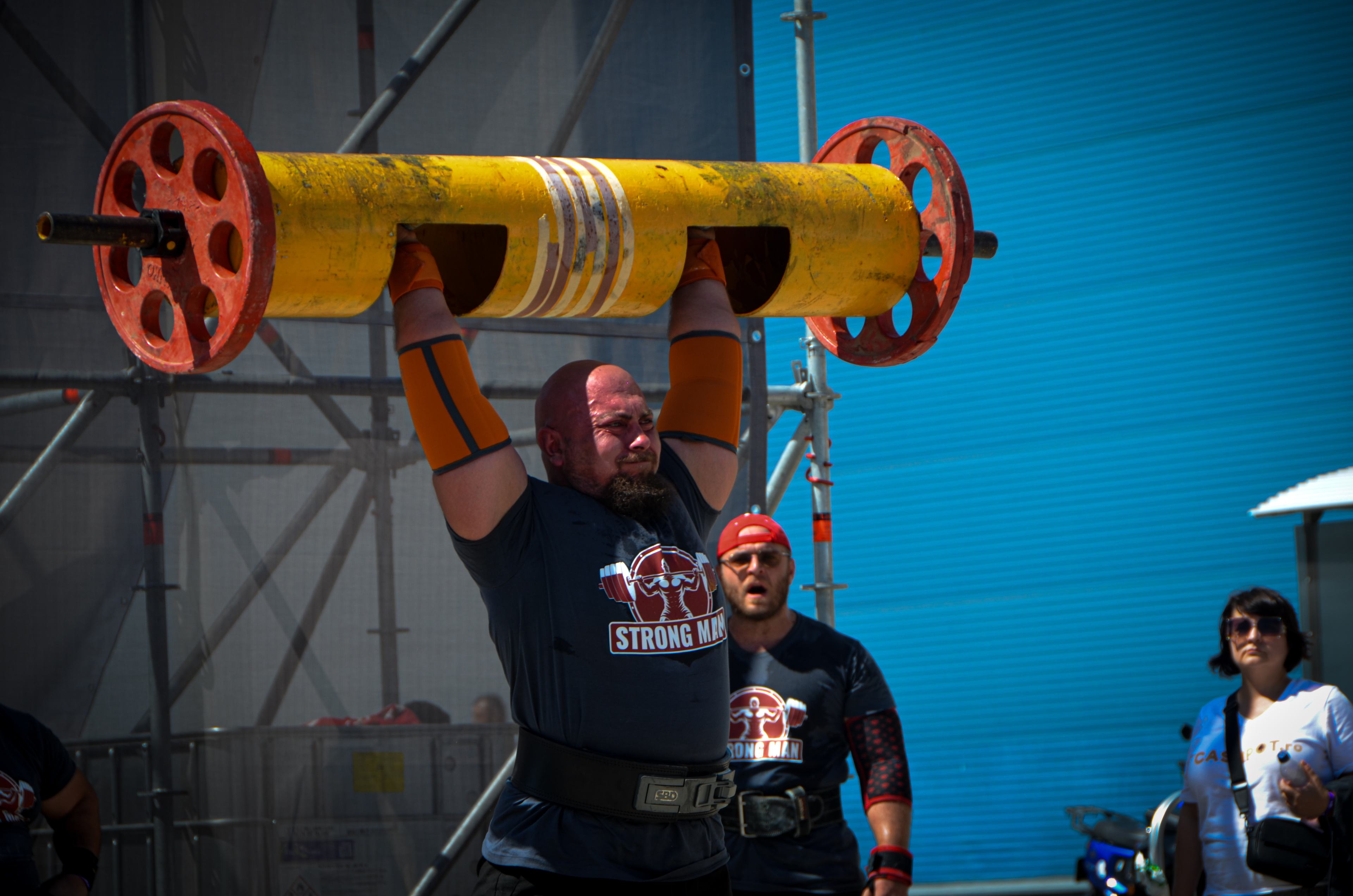
There are sports in which you must be extremely strong. There are sports in which you must be exceptionally explosive. There are sports in which you must repeat effort until the nervous system, musculature and willpower begin negotiating with one another. Strongman has a distinctive problem: it often asks for all of them, sometimes in the same competition and occasionally in the same event.
That is why the question “Is Strongman the hardest strength sport?” cannot be answered scientifically with a simple yes or no. There is no universal index of hardness and no experiment placing every strength sport on one scale. A more useful question is: how many physical qualities must a Strongman athlete express simultaneously to be competitive? From that perspective, the case for Strongman’s exceptional complexity is strong.
1. What does “hard” actually mean in strength sport?
Hard can mean many things. It can mean an enormous external load. It can mean a long event with rapidly accumulating fatigue. It can mean difficult technique, instability, psychological pressure, or a greater penalty when mechanics deteriorate. In a specialized strength sport, some of these variables are tightly controlled. In Strongman, they are frequently stacked on top of one another.
A powerlifter pursues maximum performance in the squat, bench press and deadlift under standardized conditions. An Olympic weightlifter pursues performance in the snatch and clean and jerk, two highly technical and explosive lifts. Strongman may ask for deadlift, overhead press, yoke, farmer’s walk, stones, sled, sandbag, tire flip or a medley in one competition. That does not make the other sports easy. It makes the Strongman performance profile unusually broad.
2. Maximal strength is the foundation, not the destination
Maximal strength remains the base. Without it, there is not enough reserve to move very heavy loads. But in Strongman, strength must transfer to tasks with different demands than a standard barbell. Research on competitor training practices shows that maximal-strength work is nearly universal, while many athletes also include power, hypertrophy and specific Strongman-event training.
This matters because performance is not simply a function of how much force you can produce in a familiar position. It also depends on how quickly you can produce it, how effectively you transmit it through the trunk, how long you can repeat the effort, and how well you preserve technique as fatigue changes the movement. Research on rate of force development shows that rapid force production depends strongly on early neuromuscular activation and can be influenced by both explosive and heavy-resistance training.
3. The object is not neutral: sometimes the object fights back
One essential difference is object geometry. An Olympic bar has relatively predictable geometry. An atlas stone is large, round and difficult to grip. A sandbag deforms and changes shape while you lift it. A keg has a different center of mass from a bar. A yoke can oscillate laterally and longitudinally. A farmer’s frame combines enormous vertical force with trunk control and locomotion.
A systematic review of Strongman biomechanics identified 11 relevant studies and showed that events can be considered as carrying, pulling and static-lifting tasks. The authors also highlighted limited biomechanical data for several events, including the yoke walk, unilateral load carriage, vehicle pull and atlas stone. In other words, the very features that make the sport interesting in practice also make it difficult to reproduce in a laboratory.
4. Yoke walk: when strength has to move
The yoke walk is one of the clearest demonstrations of the difference between being strong and being able to use strength. The athlete must support a very heavy frame across the shoulders, stabilize it, coordinate the steps and move quickly without losing control. In a biomechanical study of 19 Strongman athletes, the yoke walk was examined at realistic loads, and performance involved relationships between velocity, stride length, stride rate and hip and knee movement.
A fundamental principle appears here: strength is no longer a static number. It has to become locomotion. The body must function as a transmission system between the load and the ground. If the trunk collapses, the steps become chaotic, or the implement begins to oscillate, some of the available force is spent on stabilization and correction rather than forward movement.
5. Atlas stone: lifting an object that does not behave like a barbell
The atlas stone is almost a biomechanics lesson made physical. The athlete must grip a spherical object, pull it toward the body, lap it, then elevate it over a bar or onto a platform. Biomechanical research has divided the movement into distinct phases, from the initial grip and first pull through the lap, second pull and completion.
More importantly, research found that as a set progresses and stone mass increases, repetition duration and joint ranges can change. That demonstrates the importance of acute fatigue. You do not perform exactly the same movement on the first stone and the final stone. The body has to continuously adjust its strategy.
6. The trunk is not just “core”. It is the bridge between force and object
In Strongman, the trunk is stressed in ways that cannot be reduced to one exercise. Farmer’s walk, yoke, stones, keg, log and suitcase carry demand stabilization in different planes. A study comparing several Strongman events demonstrated substantial demands on the torso and lumbar spine, including large hip moments and the need for trunk musculature to support pelvic and spinal position.
This changes how strength should be viewed. Strong legs are not enough if the trunk cannot transmit force. Strong arms are not enough if grip and scapular position fail. Strongman requires integration: legs, hips, trunk, shoulder girdle and hands must work as one system.
7. Strength, power and strength endurance in the same sport
One of the strongest arguments for Strongman’s complexity is the combination of intensities. One event may require an almost maximal and very short effort. Another may demand continuous work for many seconds. Another may be a medley in which the athlete moves directly from one implement to another. The neuromuscular system therefore has to be capable of both maximal production and repeated production.
A physiological study comparing a Strongman circuit with traditional strength training used sled drag, farmer’s walk, dumbbell clean and press and tire flip in the Strongman condition. Both protocols increased lactate, heart rate and energy expenditure, showing that Strongman training can create substantial physiological stress and should not be reduced to the stereotype of simply lifting heavy objects with long rests.
8. Fatigue changes the problem: the same load, a different body
Fatigue is one reason Strongman can become brutal. If you have one maximal attempt, the main problem is producing the required force at that moment. In a medley, the problem is producing force after you have already produced force. Breathing is elevated, grip is tired, the trunk has been loaded, and coordination becomes more expensive.
Under fatigue, technique becomes a resource. Efficient movement conserves energy. Poor movement spends energy on stabilization and correction. Strongman therefore does not reward only raw strength. It rewards the ability to preserve useful strength throughout the event.
9. Grip: the link that can decide everything
In many events, grip is the real limiting factor. You can have enough back strength for a farmer’s walk, but if the hands cannot hold the implement, none of it matters. You can have enough leg strength for a carry, but if the object slips, force cannot be transferred. In stones, the hands must create an efficient contact position with a rounded surface. In axle or frame work, geometry changes the demand on the forearm and fingers.
This is another example of specificity. General strength is necessary, but strength must exist in the form demanded by the event. Strongman turns grip from a detail into a performance determinant.
10. When technique becomes more important precisely because the object is heavy
The Strongman paradox is that a heavier implement does not make technique less important. It makes it more important. When the object is heavy and awkward, small positional errors can have large consequences. If the stone moves too far from the body, the arms become a poor lever. If the yoke oscillates, energy is lost to correction. If the farmer’s walk becomes unstable, every step can cost more.
Biomechanical reviews highlight precisely the need to understand event-specific movement. The challenge is that many Strongman events are difficult to standardize and measure. That does not make technique less important. It means the research still has ground to cover.
11. Injury risk: hardness also has a price
Any serious discussion of Strongman’s demands must include injury. In a retrospective study of 213 athletes, 82% reported at least one injury during the period assessed. Frequently affected areas included the lower back, shoulder, biceps and knee, while muscle and tendon injuries were common.
It would be wrong to turn these findings into the simplistic statement that Strongman is absolutely dangerous. Weight-training sports generally show lower injury rates than many contact or team sports. However, a systematic review of weight-training sports reported Strongman injury rates around 4.5–6.1 injuries per 1,000 hours in the available studies, and the retrospective Strongman study found greater injury likelihood during implement training than traditional resistance training when exposure was considered.
12. The difference between pushing through pain and being a resilient athlete
This distinction matters. Mental toughness does not mean ignoring every signal from the body. Normal fatigue, effort discomfort and the feeling that you have reached your limit can be part of a hard event. Unusual pain, loss of technical control, acute symptoms or signs of injury are different.
A good athlete is not the person who continues regardless of context. It is the athlete who knows when to push and when to protect long-term capacity. In Strongman, that is not weakness. It is strategy. A season is not won in one training session, and a damaged body does not become stronger because you ignored the warning.
13. Strongman versus powerlifting: specialization versus transfer
Powerlifting is extraordinarily demanding precisely because of specialization. The three competition lifts allow deep technical optimization, and every kilogram matters. Recent powerlifting literature contains a much larger research base covering biomechanics, training, competition, nutrition and injury. Strongman has a smaller scientific literature, but it requires broader transfer between tasks.
If the question is who can produce the greatest force in a standardized movement, powerlifting has its own answer. If the question is who can apply force across a very broad range of external contexts, Strongman becomes extremely difficult to match.
14. Strongman versus weightlifting: explosive power versus variety
Olympic weightlifting contains some of the most explosive movements in sport. The snatch and clean and jerk demand timing, mobility, speed and rapid force production. Research on competitive weightlifting emphasizes the extremely high mechanical power outputs produced in these movements.
Strongman sometimes borrows Olympic-lifting movements but places them in a different ecosystem. The athlete may need explosive power for a log or axle, then loaded locomotion, then strength endurance. It is not necessarily “harder” in an absolute sense. It is less specialized.
15. Why competition becomes a test of resource management
In a Strongman competition you are not competing only against the load. You are competing against your own energy. If you start too hard in a speed event, you may pay for it in the next one. If you do not accelerate enough in a medley, you lose time. If you choose the wrong pace on a carry, you can reach the final section without grip.
Competition preparation therefore includes management. A study of 132 Strongman athletes found that most used warm-ups before events, while athletes also reported strategies concerning rest and preparation between events. Small decisions become important when they are repeated across five or six events in one day.
16. Psychology: when the weight becomes personal
There is a moment in Strongman when the implement stops being only an implement. It becomes a question. Can you move it? Can you move it now, after two events? Can you move it when the opponent has posted a strong result? Can you move it after missing the previous attempt?
Sport psychology describes mental toughness in relation to pressure management, emotional regulation, attention and adaptive responses to adversity. But resilience does not mean invulnerability. It means the ability to respond and adapt. For a Strongman, that can mean converting pressure into a concrete task: breathing, setup, first movement, rhythm and execution.
17. What does Strongman ultimately demand from the body?
It demands an unusually broad combination: maximal strength for heavy objects, power for fast movement, strength endurance for long events, grip for difficult implements, stability for unstable loads, coordination for locomotion and fatigue tolerance for repeated effort.
It also demands adaptability. Implements are not always identical. Rules change. Distances change. Heights change. Sometimes you encounter an object that looks nothing like anything in your gym. A Strongman athlete needs a foundation strong enough to solve the problem, not merely repeat a memorized movement.
18. What we cannot claim yet
Science needs to remain modest. The Strongman literature is still small compared with the literature on powerlifting, weightlifting and other sports. Many studies have small samples, retrospective methods or laboratory protocols that cannot fully reproduce competition. Biomechanical reviews have explicitly identified missing data for several events.
So we cannot say that Strongman has been experimentally proven to be “the hardest strength sport”. We can say that it has a very broad demand profile and that the available literature supports the complexity of its biomechanics, physiology and preparation.
19. The verdict: the hardest discipline or the most complete strength test?
If “hardest” means the greatest absolute load, the answer depends on the movement and athlete. If it means the most explosive, weightlifting has a powerful claim. If it means highly specialized maximal strength under standardized conditions, powerlifting is difficult to challenge.
But if difficulty is defined by the number of qualities that must be expressed in one competition, the variety of implements, the transfer of force into locomotion, trunk and grip demands, accumulated fatigue and the need to solve different motor problems, Strongman has one of the strongest cases in strength sport.
Perhaps that is the more accurate definition: Strongman is not necessarily “the hardest” because every event is harder than every event in another sport. It is hard because it asks you to be good at many forms of strength and to combine them when the body is already tired.
Conclusion: the weight is not the only opponent
A Strongman athlete does not fight only kilograms. He fights inertia, object geometry, time, fatigue, grip, stability, breathing, pressure and his own decisions. Raw strength opens the door, but technique, conditioning and control keep it open.
That is why Strongman can reasonably be viewed as one of the most complete tests of strength. Not because science has mathematically crowned it number one in difficulty, but because the athlete must turn strength into action in almost any form the competition can invent.
In the end, the weight does not become lighter. The athlete becomes more capable. And that is perhaps the essence of Strongman: not being strong in one direction, but building enough strength, control and endurance to solve the problem in front of you.
Sources and further reading
The Biomechanics and Applications of Strongman Exercises: a Systematic Review – PubMed / Sports Medicine - Open.
The Biomechanical Characteristics of the Strongman Yoke Walk – PubMed.
The Biomechanical Characteristics of the Strongman Atlas Stone Lift – PubMed / PeerJ.
Comparison of Different Strongman Events: Trunk Muscle Activation and Lumbar Spine Motion, Load, and Stiffness – PubMed.
Acute Physiological Responses to Strongman Training Compared to Traditional Strength Training – PubMed.
Retrospective Injury Epidemiology of Strongman Athletes – PubMed.
The Epidemiology of Injuries Across the Weight-Training Sports – PubMed.
The Strength and Conditioning Practices of Strongman Competitors – PubMed.
The Competition-Day Preparation Strategies of Strongman Athletes – PubMed.
More From The Journal

Training
The Science of Strongman Training - Episode X: Competition Programming
How to build a complete Strongman competition preparation block: calendar, events, volume, intensity, specificity, simulations, autoregulation, tapering and fatigue management.
Training
The Science of Strongman Training - Episode IX: Peaking
Peaking in Strongman: how to turn months of training into maximal competition performance by reducing fatigue, preserving adaptations and managing specificity.