
Training
The Science of Strongman - Episode VIII: The Deadlift in Strongman - Why Is It So Different From the Conventional Deadlift?
September 1, 2026
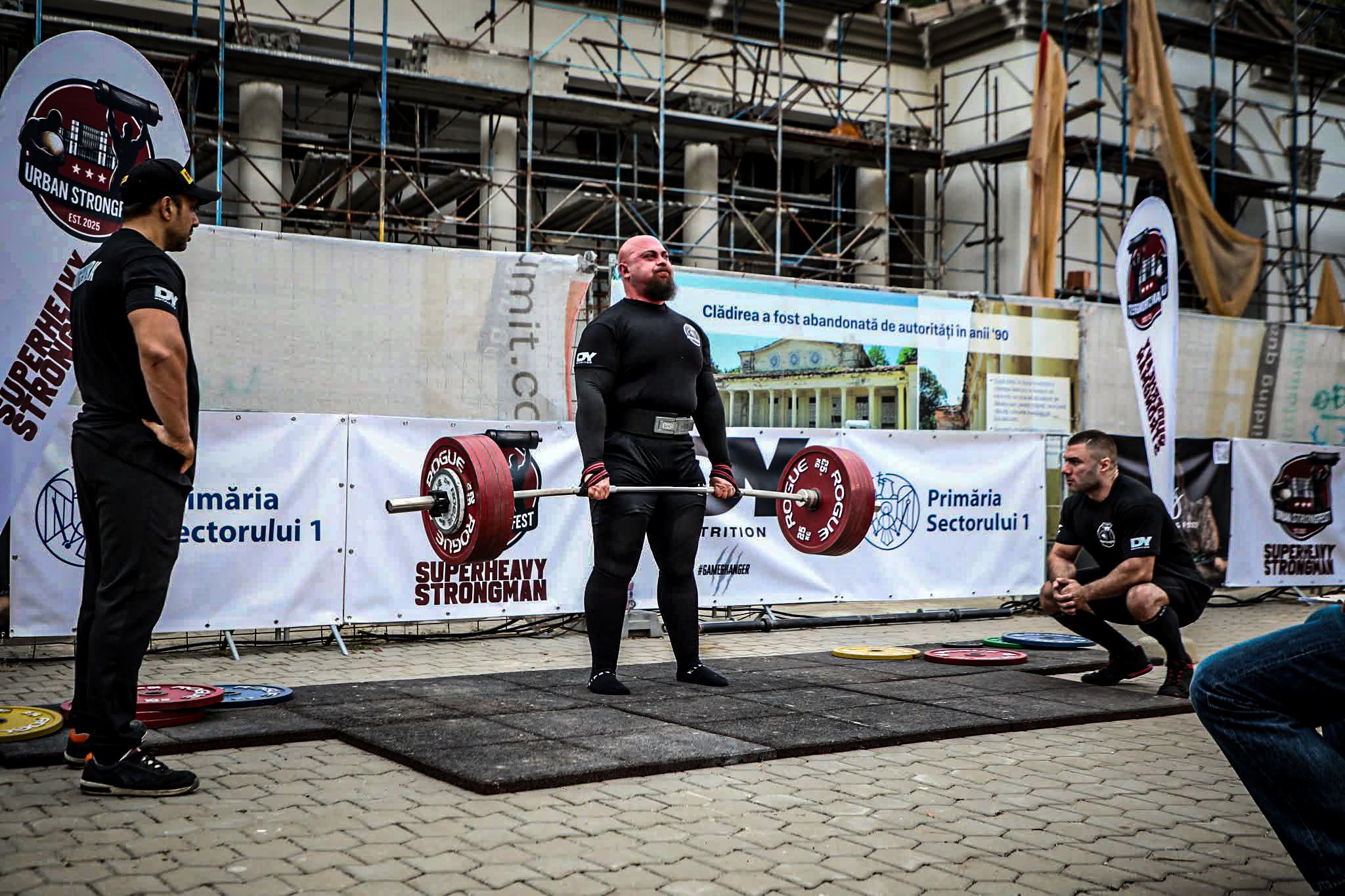
The Science of Strongman - Episode VIII: The Deadlift in Strongman - Why Is It So Different From the Conventional Deadlift?
The deadlift looks like the simplest strength event: the load is on the floor, the athlete grabs it, and stands up with it. In Strongman, however, this simple image hides one of the most demanding combinations of strength, positioning, stability, grip, and fatigue tolerance in the sport.
Biomechanical literature describes the deadlift as a foundational movement used in both strength training and powerlifting and Strongman competition. At the same time, Strongman-specific research remains limited, and the variety of events means that the same general movement pattern can have very different mechanical demands.
In competition, deadlifting may mean a 1RM, maximum repetitions in a fixed time, a bar at a modified height, an axle, a rack pull, or a variation in which the implement and starting position completely alter the mechanics. For a Strongman athlete, the right question is therefore not simply “how much can you pull?” but “how do you produce force under the exact conditions of the event?”
1. The Strongman Deadlift Is Not Just a Heavier Deadlift
In the conventional deadlift, the athlete lifts the bar from the floor through coordinated knee and hip extension, with contribution from the ankle and controlled trunk positioning. Biomechanical research describes the action as simultaneous extension of the hip and knee, finishing in an upright position.
Strongman takes this basic movement and changes the context. Change the bar height, implement diameter, grip, or repetition count, and you change the problem the athlete has to solve.
2. The First Problem: Breaking the Load From the Floor
The start of the deadlift is often where the athlete discovers whether the position is strong enough. In this phase, the knees and hips must produce force together, while the trunk must remain rigid enough for force to reach the implement.
If the bar starts too far from the body, the external moment around the hips and trunk can increase. If the hips start too high, the movement may become more dependent on hip extension. If the hips start too low for the athlete's anthropometry, the position may become inefficient. There is no universally perfect starting position, only a position that must match the athlete and implement.
3. Knees, Hips, and Back: One System, Not Three Separate Exercises
The deadlift is not simply a “back exercise” or a “leg exercise.” It is a movement in which knee and hip extension must be coordinated with spinal stabilization and pelvic control.
As the bar rises, the relative contribution of the joints changes. In the initial phase, knee position and trunk angle influence the mechanics. As the athlete passes the knees, hip extension becomes increasingly important for continuing the movement and completing the lockout.
4. Why Lockout Is So Important in Strongman
In many Strongman events, the weight may leave the floor relatively well and still stall near the top. The reason is straightforward: the deadlift contains several mechanical regions, and the demands on the hips, trunk, and grip change throughout the lift.
Lockout is the completion of hip and knee extension and stabilization of the load in an upright position. In competition, a repetition that does not reach a clear finishing position may not count, regardless of how difficult the first portion was.
5. Keeping the Bar Close: The Centimeters That Change Everything
One of the central mechanical principles of the deadlift is controlling the distance between the load and the body. The farther the load moves away, the greater the external moment on the joints that must stabilize it.
In Strongman, this principle can be harder to apply because the implement may be more voluminous or use specialized handles. Technique therefore has to adapt to the implement, but the principle remains: a position that allows the load to be controlled efficiently reduces unnecessary mechanical demands.
6. Starting Height Changes the Deadlift
A deadlift starting from the floor is not the same problem as a deadlift from an elevated position. Changing the starting point changes joint angles, range of motion, and the amount of work required in different phases.
In Strongman, this is a major variable. A raised-bar event can reduce the initial knee-demand and emphasize hip extension and lockout. A lower starting position can demand more force during the initial pull.
7. Axle Deadlift: When Grip Becomes Part of the Problem
An axle, because of its larger diameter, can change how the hand closes around the bar and increase grip difficulty. In an event requiring repeated lifts, the limiting factor may become not only hip-extension strength but the ability to keep the implement in the hands.
This is one reason an athlete can have a very strong conventional deadlift and still be less effective in a Strongman axle event. Grip specificity matters.
8. Grip: The Link That Can Stop a Very Strong Deadlift
The deadlift requires a direct mechanical link between the hands and the implement. If the grip fails, the force generated by the legs and hips can no longer be applied to the load.
In Strongman, the problem is amplified by repetitions, thick bars, unusual implements, and time-limited formats. Grip should therefore be viewed as a performance component, not a finishing detail.
9. The Deadlift and the Posterior Chain
The posterior chain is fundamental: the glutes contribute to hip extension, the hamstrings contribute to hip extension and knee control, and the spinal musculature plays a major role in maintaining trunk position. At the same time, the quadriceps make an important contribution to knee extension, especially during the initial phase.
This combination explains why the deadlift can transfer useful qualities to other Strongman events involving heavy object lifting or acceleration. However, transfer is not automatic: implement shape and event demands can substantially change the mechanics.
10. Bracing: Why the Trunk Must Stay Rigid
In a heavy deadlift, the athlete must create a stable bridge between the lower and upper body. Breathing, intra-abdominal pressure, and trunk musculature contribute to this stability.
Bracing does not mean the spine must be completely motionless in every situation. It means the athlete must control trunk position sufficiently to transmit force and keep the load under control.
11. Conventional, Sumo, and the Position That Fits the Athlete
In Strongman, deadlift style can depend on the rules, stance width, bar type, starting height, and anthropometry. Arm, femur, and torso length influence starting positions and moment arms.
There is no rule stating that one technique is universally superior. Technique should maximize force production under the exact conditions of the event while complying with the rules.
12. The Strongman Deadlift as a Speed Problem
In a 1RM, the objective is to produce enough force for a single repetition. In an AMRAP deadlift, however, speed becomes a strategic resource. Repetitions that are too slow consume more time and energy, while repetitions performed too aggressively can degrade position and accelerate fatigue.
The successful athlete learns to find a speed that preserves technique and minimizes the cost of each repetition.
13. Why Repetition Deadlifts Are Brutal
The first repetition and the tenth repetition are not the same problem. After each repetition, the musculature must produce force again while the cardiovascular and respiratory systems support the effort.
Fatigue can change starting position, bar speed, trunk rigidity, and grip capacity. When technique begins to deteriorate, the athlete may spend more energy to move the same load. A cycle develops: fatigue worsens mechanics, and less efficient mechanics accelerate fatigue.
14. The Deadlift as Both a Strength and Conditioning Event
In a time-limited format, the deadlift becomes a simultaneous test of maximal strength, local muscular endurance, anaerobic capacity, and pacing strategy. This combination is one of the characteristics that separates Strongman from traditional strength testing.
An athlete can have a higher 1RM than another athlete and still lose a repetition event if they cannot sustain the pace, recover between repetitions, or maintain grip.
15. Rack Pulls and Elevated-Position Variations
Elevated-start variations are useful for exposing specific portions of the movement, particularly lockout and hip extension. In Strongman, they may reproduce some events more closely when the competition bar does not start from the floor.
However, a partial variation does not completely replace specific deadlift work. If the competition problem is breaking the load from the floor, training must include sufficient work from that position. Specificity should follow the athlete's actual limitation.
16. Deadlift and Carryover to Other Strongman Events
The deadlift develops qualities useful for many events: hip extension, posterior-chain strength, trunk rigidity, and grip. Strongman literature identifies biomechanical similarities between the deadlift and phases of events such as the atlas stone lift and tire flip.
But carryover has limits. An excellent deadlift does not automatically guarantee excellent stone, farmer's walk, or vehicle-pull performance. Strongman tests combinations of qualities and implements, and transfer must be considered in relation to the movement.
17. Technique: What to Watch in a Competitive Deadlift
Good technical analysis does not begin by asking whether the back is “perfect.” It begins by asking whether the position allows efficient force production and transmission.
Important elements include:
• bar position relative to the body;
• hip position at the start;
• trunk angle;
• knee and hip extension sequence;
• maintenance of tension before lift-off;
• speed during the first portion of the lift;
• bar passage past the knees;
• lockout control;
• ability to reproduce the same technique under fatigue;
• grip and its impact on strategy.
18. Training: Maximal Strength, Speed, and Specificity
A Strongman program should not treat the deadlift as a single exercise. It is more useful to view it as a family of exposures: heavy deadlifting for strength, variations for weak points, speed work, and specific sessions using the competition implement.
If the event is a 1RM, the priority is maximal force production. If it is an AMRAP, technical efficiency, local endurance, grip, and pacing must also be developed. If the bar starts at an unusual height, that position must be trained.
19. Recovery and Volume Management
Heavy deadlifting can create substantial systemic stress. What matters is not only the load on the bar, but also total volume, proximity to failure, exposure frequency, and which other events are stressing the posterior chain during the same week.
In Strongman, deadlift may be preceded or followed by carries, stones, pulls, or other events requiring hip extension and trunk stabilization. Programming must account for this overlap.
20. Why the Deadlift Is One of the Purest Strongman Events
Because it reduces the problem to its essence: the implement is heavy, and the athlete must create enough force to lift it. But Strongman adds exactly the dose of controlled chaos that turns a simple movement into a complex test.
A thick bar changes the grip. A raised bar changes the angles. Repetitions change the physiology. Time changes strategy. An unusual implement changes the center of mass. And fatigue changes everything you planned on the first repetition.
Conclusion - The Deadlift Is More Than Hip Extension
The Strongman deadlift demonstrates how raw strength must be converted into performance. A strong posterior chain is not enough. The athlete must position the body, control the bar, maintain rigidity, preserve grip, and complete the lift under the exact conditions imposed by competition.
In a 1RM, every centimeter can determine whether the load moves. In an AMRAP, every second and every repetition can determine the ranking. In an axle or raised-height event, the implement itself becomes part of the biomechanics.
True deadlift strength is not simply the ability to lift a weight from the floor. It is the ability to produce force efficiently, repeatedly, and under control when the bar, the clock, and fatigue are all trying to destroy your mechanics.
References
Hindle, B. R., Lorimer, A., Winwood, P. W., & Keogh, J. W. L. (2019). The Biomechanics and Applications of Strongman Exercises: a Systematic Review. Sports Medicine - Open, 5, 49. doi:10.1186/s40798-019-0222-z.
Hindle, B. R., Lorimer, A., Winwood, P. W., & Keogh, J. W. L. (2020). A systematic review of the biomechanical research methods used in strongman studies. Sports Biomechanics, 19(1), 90-119. doi:10.1080/14763141.2019.1598480.
Anthropometric Predictors of Conventional Deadlift Kinematics and Kinetics: A Preliminary Study. Journal of Functional Morphology and Kinesiology.
Biomechanical research on the Strongman atlas stone lift and its relationship to traditional strength-training movements.
More From The Journal
Training
The Science of Strongman Training - Episode X: Competition Programming
How to build a complete Strongman competition preparation block: calendar, events, volume, intensity, specificity, simulations, autoregulation, tapering and fatigue management.
Training
The Science of Strongman Training - Episode IX: Peaking
Peaking in Strongman: how to turn months of training into maximal competition performance by reducing fatigue, preserving adaptations and managing specificity.