
Training
The Science of Strongman - Episode VII: Pressing Events - Why Is the Overhead Press So Difficult?
September 1, 2026
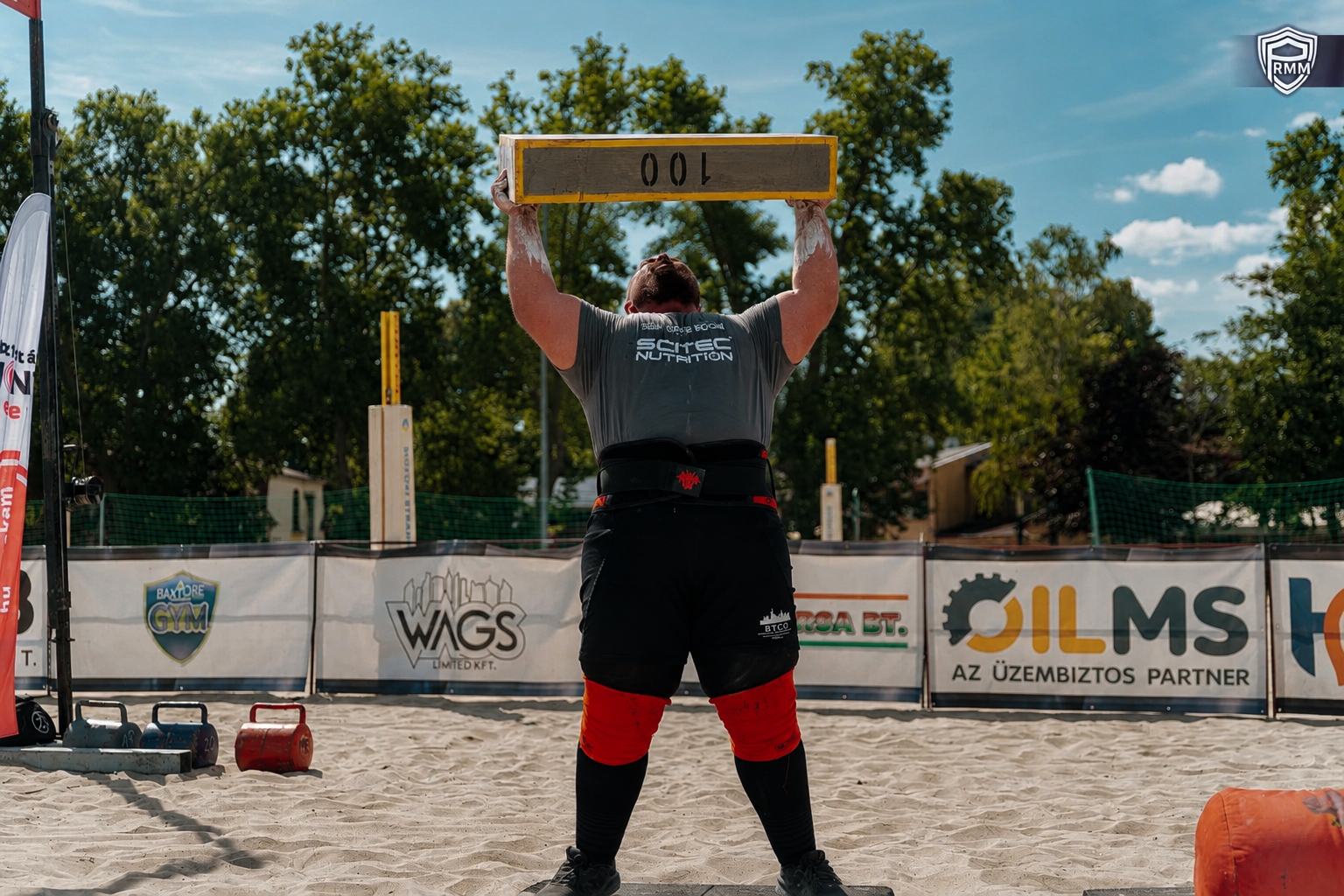
The Science of Strongman - Episode VII: Pressing Events - Why Is the Overhead Press So Difficult?
At first glance, the overhead press looks like one of the simplest movements in Strongman: take an implement from shoulder level and press it overhead. But its visual simplicity hides one of the most complex relationships between strength, balance, mobility, coordination, and stability in the sport.
In a pressing event, the athlete does not simply have to produce force. The athlete must create an efficient path for the implement, keep the body stable, coordinate the legs and trunk with the upper limbs, and manage an implement whose shape, center of mass, and handle position may differ substantially from those of a conventional barbell. Strongman biomechanics research shows that the log lift shares features with movements such as the clean and jerk and push press, while also presenting important mechanical differences, including different ranges of motion and force characteristics compared with a barbell.
The overhead press is therefore not simply a shoulder exercise. It is an event in which the entire body must transform force into a controlled vertical movement.
1. Why It Looks Simple and Why It Is Not
In a pressing exercise, the implement usually starts in a position supported by the shoulders, arms, and trunk. As the upward movement begins, the athlete must generate enough force to overcome the load and its inertia. At the same time, the body must remain stable enough for force to be transmitted in the intended direction.
The problem becomes even more obvious in Strongman because the implement is not always compact and symmetrical. A log has a large diameter and a neutral handle position that changes arm placement. An axle can place distinctive demands on the wrist and grip. A keg or unconventional implement can change mass distribution. Thus, the same label, “overhead press,” can conceal several different biomechanical problems.
2. The Press Starts Before the Implement Leaves the Shoulders
A common conceptual mistake is to look only at the part where the arms push. In Strongman, the starting position is already part of the press. If the implement is not positioned efficiently on the body, if the trunk is unstable, or if the elbows and wrists are poorly positioned, the athlete begins the movement with a mechanical disadvantage.
In the log press, for example, the clean phase and stabilization of the implement on the chest are important parts of the total movement. Research on the log lift has shown differences from the barbell clean and jerk, including greater knee flexion in certain phases and greater trunk and hip range of motion.
3. Leg Drive - When the Press Becomes a Whole-Body Movement
In the push press and many Strongman variations, the legs contribute to accelerating the implement. The athlete dips under control, changes direction rapidly, and uses lower-limb extension to transmit impulse to the implement. The arms then continue the movement and complete the lockout.
Leg drive does not make the shoulders irrelevant. It means the load is distributed across several segments. Studies comparing barbell and log push press mechanics have reported differences in dip depth, propulsive velocity, impulse, mean force, and power, with higher values for the barbell in some measurements. Implement shape and diameter can therefore alter how effectively an athlete can use leg-generated impulse.
4. Strict Press Versus Push Press - Two Different Problems
The strict press limits leg contribution and makes the shoulders, triceps, and trunk much more directly responsible for the lift. The push press allows substantial contribution from the lower limbs, increasing the potential to accelerate the implement.
In competition, this difference can completely change strategy. If the event is an AMRAP, the ability to use leg drive efficiently and conserve local energy can become crucial. If it is a strict strength test, the athlete cannot hide the same limitation through momentum.
5. Why the First Centimeters Can Be Brutal
In many overhead press variations, the implement must pass through an initial region in which the arms are not yet in a favorable mechanical position. This is where athletes often experience a sticking point. If acceleration is insufficient, the implement slows and becomes much harder to recover.
This region is not simply a muscular strength problem. Elbow position, trunk angle, implement path, shoulder mobility, and the ability to maintain tension all matter. A small change in position can alter moment arms and therefore the demand placed on the musculature.
6. The Shoulders - The Visible Engine, But Not the Only Engine
The deltoid contributes substantially to arm elevation, but overhead pressing involves a much larger system. The triceps are essential for elbow extension, scapular musculature contributes to control and positioning of the scapula, and the trunk must stabilize the base from which the arms press.
In a heavy press, the body must allow shoulder movement without losing control. This combination of mobility and stability is one of the defining features of pressing. Too little mobility can force compensation. Too little control can make the position unstable even when muscular strength is high.
7. The Triceps - The Final Barrier Before Lockout
As the elbow extends, the triceps becomes a critical contributor. In competitions where judging requires clear extension, the ability to finish the movement can determine the result after the hardest portion has already been overcome.
This creates an important distinction between moving the implement and completing the repetition. An athlete may have enough strength to pass the initial region but lose the repetition at lockout. In a pressing event, both phases must be developed.
8. The Trunk - The Platform That Must Not Collapse
When the implement becomes heavy, the body naturally searches for positions that allow the movement to continue. If trunk rigidity is lost, some of the force generated by the legs and upper limbs is dissipated through unwanted motion.
In Strongman, the implement can amplify this issue. A thick log can place its mass farther anteriorly than a conventional barbell. Biomechanical literature notes that the greater diameter of a log can position its center of mass farther in front of the athlete's center of mass and increase demands on the trunk and lumbar spine.
9. Center of Mass - The Implement Does Not Move Alone
For an implement to move efficiently overhead, the athlete must control the relationship between the implement's center of mass and the body's base of support. The more voluminous or difficult to keep close to the body the implement is, the greater the external moment on the trunk can become.
This explains why two implements with the same weight can feel radically different. Mass is only one variable. Shape, diameter, and center-of-mass location change the mechanical equation.
10. Implement Path - The Centimeters That Can Decide a Rep
An efficient press does not simply mean “up.” It means up along a path that allows the body and implement to remain in an efficient mechanical relationship. If the implement moves too far away from the body, external moment can increase and the demand on stabilizers may rise.
With a log, the large diameter and handle position alter the path compared with a barbell. Good technique therefore cannot be defined only by the final position. The entire journey of the implement must be considered.
11. Shoulder and Scapular Stability
The scapula must move and stabilize in a way compatible with overhead arm elevation. At the same time, the rotator cuff and surrounding shoulder musculature contribute to keeping the humeral head controlled within the joint.
In heavy pressing, stability does not mean immobility. A healthy shoulder must be able to move. The challenge is controlling that movement under load. An athlete may have enough pressing strength and still be limited by the ability to control shoulder position.
12. Why the Log Press Is Different From a Military Press
The log press combines several problems into one event: getting the implement up, positioning it on the chest, stabilizing it, performing the dip and drive, then extending the arms and completing the lockout. The neutral handles and large diameter change elbow and trunk positioning.
Biomechanical studies have found clear differences between log and barbell lifts during clean and press phases. In one comparison, the log lift showed greater trunk and hip range of motion, while the barbell allowed greater velocity and impulse in certain phases.
13. Axle Press, Keg Press, and Other Implements: Same Pattern, Different Problems
Strongman overhead pressing can use logs of different diameters, axles, kegs, dumbbells, Viking presses, or other implements. The literature highlights this variety, making it difficult to reduce pressing to a single standardized technique.
An axle can change grip and wrist demands. A keg can have a less predictable mass distribution. A Viking press changes the direction of resistance and the way the body can use leg drive. Specificity is therefore essential: the athlete must develop the capacity to produce force, but also the ability to produce that force against the implement that will appear in competition.
14. Breathing and Intra-Abdominal Pressure
A heavy press demands more than arm strength. It also demands the ability to maintain a rigid trunk. Breathing and bracing strategy influence this rigidity. The athlete must create sufficient pressure and control to transmit force while also managing the physiological cost of repeated efforts.
In a long pressing set, breathing strategy becomes even more important. A technique that is excellent for a maximal single is not necessarily the most efficient strategy for ten fast repetitions. The event dictates the trade-offs.
15. Fatigue: When Pressing Becomes a Metabolic Problem
As repetitions accumulate, the ability to produce force and velocity declines. The shoulders and triceps may become locally limited, but fatigue can also appear through loss of trunk rigidity, slower leg drive, and deteriorating coordination.
In an AMRAP event, the athlete must find the balance between speed and resource conservation. A repetition that is too slow may be extremely costly, while a repetition that is too fast can compromise the next position. Competitive pressing is therefore an energy-management problem as well as a strength problem.
16. Why Multiple Repetitions Are So Different From a Single
A heavy single demands high force production and coordination over a short interval. A multi-repetition set additionally requires the ability to recover between repetitions, maintain technique, and tolerate accumulating fatigue.
In Strongman, this can turn a seemingly simple event into a race against time. Two repetitions may feel relatively easy while the next five become progressively more expensive physiologically. Training should therefore reflect the competition format.
17. Pressing Training - From Strength to Specificity
A strong program should develop several levels. General strength can be built through overhead press, push press, and barbell variations. Specificity then increases through log, axle, Viking press, or the actual competition implement.
Not every session needs to be heavy. Some can emphasize speed, technique, and efficiency. Others can target maximal strength. Others can reproduce the competition format. This combination develops capacity without turning every training session into a test.
18. What Should Be Monitored Technically
In Strongman pressing, several questions are more useful than simply asking “how much did you lift?”:
• Can the athlete position the implement efficiently before the press?
• Can the trunk remain rigid during the dip and drive?
• Are the legs used to accelerate the implement rather than to lose position?
• Does the implement remain sufficiently close to the body's axis?
• Where is the sticking point?
• Is the limitation in the shoulders, triceps, trunk, grip, or technique?
• Can the same mechanics be reproduced under fatigue?
19. Recovery and Shoulder Health
Heavy pressing can create substantial stress across the shoulders, elbows, wrists, and trunk. Because many Strongman exercises already involve the upper body, total workload must be calculated rather than simply counting overhead press sets.
Recovery should include adequate time between heavy exposures, volume control, and gradual progression toward specific implements. Strongman literature also emphasizes that biomechanical research on the log lift and other events remains limited, so practical decisions must be adapted to the individual, technique, and competition demands.
20. Why Is the Overhead Press So Difficult?
Because it does not require one quality. It requires several systems to work simultaneously.
You need enough strength to accelerate the implement. You need enough mobility to bring it overhead. You need stability to control the joints. You need a trunk capable of transmitting force. You need technique to find an efficient path. You need leg drive when the event allows it. And you need to repeat all of this when fatigue begins removing your margin for error.
That is the difference between pressing a weight and pressing in Strongman. In the first case, the implement has to go up. In the second, the entire body has to construct a path through which the implement can go up.
Conclusion - Pressing Is Organized Strength
The overhead press is one of the clearest demonstrations of a central Strongman principle: strength does not exist in isolation. It must be organized, transmitted, and controlled. Strong shoulders cannot compensate for an unstable trunk. Strong triceps cannot fix a poor implement path. Strong legs do not help if leg drive is not synchronized with the implement.
In pressing events, the athlete becomes a complete system for a few seconds: the legs generate impulse, the hips and trunk transmit it, the shoulders and arms continue acceleration, and the hands and joints stabilize the implement until lockout. When all components synchronize, hundreds of kilograms can travel overhead. When one component fails, the load suddenly feels much heavier.
That is why the overhead press is difficult not because its shape is complicated, but because it is a simple movement that demands almost the entire body to function correctly at the same time.
References
Hindle, B. R., Lorimer, A., Winwood, P. W., & Keogh, J. W. L. (2019). The Biomechanics and Applications of Strongman Exercises: a Systematic Review. Sports Medicine - Open, 5, 49. doi:10.1186/s40798-019-0222-z.
Hindle, B. R., Lorimer, A., Winwood, P. W., & Keogh, J. W. L. (2020). A systematic review of the biomechanical research methods used in strongman studies. Sports Biomechanics, 19(1), 90-119. doi:10.1080/14763141.2019.1598480.
Winwood, P. W., Keogh, J. W. L., Harris, N. K., et al. (2019). Biomechanical comparisons of strongman log lift and traditional barbell lifts as discussed in the Strongman biomechanics literature.
Renals, R. L., et al. Research comparing push press biomechanics using a barbell and logs of different diameters, as summarized in the Strongman biomechanics systematic review.
More From The Journal

Training
The Science of Strongman Training - Episode X: Competition Programming
How to build a complete Strongman competition preparation block: calendar, events, volume, intensity, specificity, simulations, autoregulation, tapering and fatigue management.

Training
The Science of Strongman Training - Episode IX: Peaking
Peaking in Strongman: how to turn months of training into maximal competition performance by reducing fatigue, preserving adaptations and managing specificity.