
Training
The Science of Strongman - Episode V: The Neuromuscular System - How the Body Learns to Become Stronger
September 1, 2026
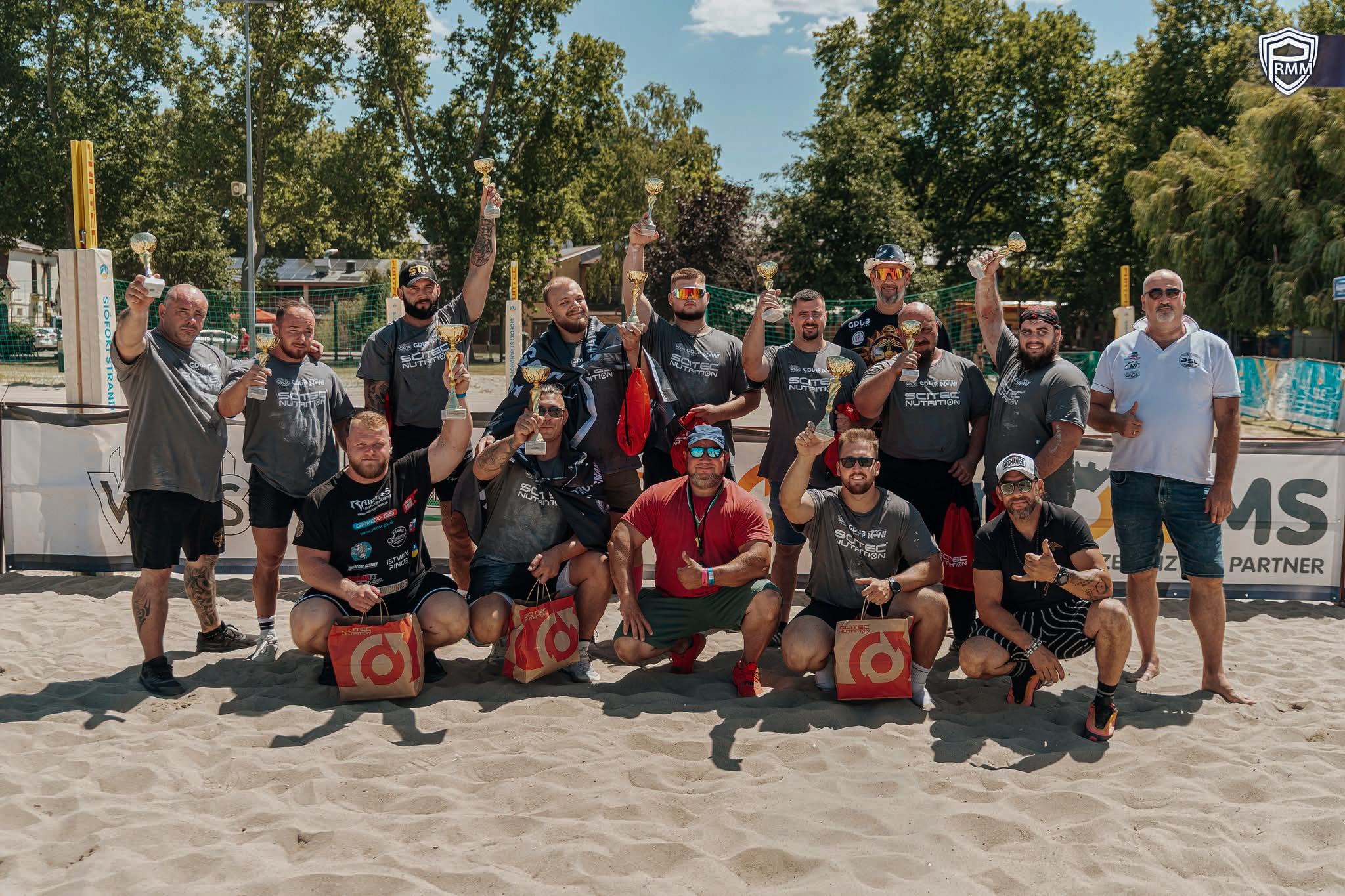
The Science of Strongman - Episode V: The Neuromuscular System - How the Body Learns to Become Stronger
In the first episodes of this series, we examined Strongman through strength, the distinctive demands of the sport, energy systems and biomechanics. All of these have one common foundation: the neuromuscular system. Without it, there is no maximal force, speed, stability, coordination, or ability to turn intention into actual movement.
When a Strongman says he has become stronger, that statement can describe several processes at once. Muscle can become larger and capable of producing more tension. The nervous system can become more efficient at recruiting and controlling motor units. Coordination between muscle groups can improve. Tendons and connective tissues can adapt. And the athlete can learn a more efficient technical strategy for a given implement. Modern resistance-training research describes this combination of neural, muscular and functional adaptations.
1. Strength Begins in the Nervous System, But It Does Not End There
A common old model of strength says that a strong muscle produces force and a larger muscle produces more force. Both contain an important truth, but neither is sufficient to explain Strongman performance. Muscle does not decide by itself when and how strongly to contract. The brain and spinal cord control muscular activation through motor neurons, and motor neurons control motor units. Through this system, the nervous system can rapidly change the amount and distribution of force produced.
During a very heavy lift, the problem is not merely having enough contractile tissue. The athlete must activate a large number of motor units and coordinate them in a way that produces useful force. Reviews of resistance-training adaptation show that strength gains during the early stages of training are strongly associated with neural adaptations, while hypertrophy contributes progressively more as training continues. The picture is not a rigid “nervous system first, muscle second” sequence. Both systems adapt in parallel, and their relative contribution depends on training experience, task and testing conditions.
For Strongman, this distinction is crucial. An athlete can have impressive muscle mass and still fail to convert it into maximal performance with an awkward implement. Conversely, an athlete with highly practiced technique can express remarkable force before morphological changes become dramatic. This is not magic or a hidden reserve of strength. It is the result of the neuromuscular system becoming more efficient at the task it practices.
One important mechanism is motor-unit recruitment. To produce more force, the nervous system can activate more motor units and alter the frequency at which they fire, known as rate coding. Synchronization and coordination of motor-unit discharge, together with changes in inhibitory mechanisms, can also contribute to force expression. Reviews of strength physiology emphasize that maximal performance is influenced by morphological and neural factors, including motor-unit recruitment, rate coding, synchronization and musculotendinous characteristics.
This is the difference between having force and being able to express force. A Strongman must express force within a short time window, sometimes from a mechanically disadvantaged position and almost always under conditions in which the implement is not perfectly standardized. The nervous system is therefore not simply a cable carrying a command to the muscle. It is a control center that learns how to select, dose and coordinate the available resources.
2. Motor Units, Velocity, and the Difference Between Maximal and Rapid Force
Modern Strongman does not demand one single neuromuscular quality. Some events resemble maximal-force tasks, others demand rapid force expression, while others combine force with locomotion and fatigue resistance. Lifting a very heavy implement from the floor and accelerating a yoke over several dozen meters are different problems, even though both are labeled “strength”.
Rate of force development becomes important when the available time to produce force is short. An athlete may have very high isometric force but still be limited in a dynamic event if he cannot develop enough force in the first moments of the movement. Recent research on motor-unit adaptations shows that neuromuscular responses are task-specific and that adaptations supporting maximal force are not identical to those supporting rapid force expression.
This specificity explains why a Strongman cannot build his entire performance profile through slow, very heavy lifts alone. Heavy loading is excellent for maximal strength, but Strongman implements must sometimes be accelerated, carried, turned, loaded over a barrier or moved rapidly from one point to another. The nervous system must learn not only to “switch on” many motor units but to use them at the right time.
Velocity is also not independent of strength. The force-velocity relationship shows that, under concentric conditions, the muscle's ability to produce force decreases as shortening velocity rises. In practice, an athlete needs both a high capacity for maximal force and the ability to produce enough force at the velocities relevant to the event. This is why a combination of heavy strength work, dynamic work and event-specific exposure is useful.
In a Farmer's Walk, for example, performance is not determined only by how much the athlete can hold. It depends on how efficiently force becomes steps, how well oscillations are controlled, how rapidly force can be produced at each ground contact and how much that ability declines across the event. In a tire flip, the timing of force application can be as important as its magnitude. In a log press, synchronization between legs, hips, trunk and arms can determine whether available force actually reaches the implement.
Neuromuscular adaptation should therefore not be understood as simply increasing the “power of the nervous system.” It is a functional reorganization of how the system produces and controls force. The more dynamic the event, the more important the speed, timing and precision of that force production become.
3. Hypertrophy: The Engine Gets Bigger, But That Is Not the Whole Story
If neural adaptations explain an important part of progress, hypertrophy remains one of the foundations of strength performance. Greater muscle cross-sectional area generally provides greater potential for force production. Resistance training stimulates structural changes in muscle fibers, and these changes interact with neural adaptations and adaptations of connective tissues.
But Strongman asks a more interesting question than “how big must the muscle be?” The question is what muscle mass is useful for the task and how much of that mass can be converted into specific force. Increased muscle volume without corresponding coordination and force transfer does not guarantee better performance. At the same time, a highly efficient nervous system needs sufficient contractile tissue to recruit.
The relationship between hypertrophy and strength is therefore cooperative. Muscle provides infrastructure. The nervous system determines how that infrastructure is used. Tendons and passive structures contribute to force transmission. Technique organizes the entire system. In an advanced Strongman, these components are so interconnected that separating them becomes more of a teaching exercise than a faithful description of performance.
Recent resistance-training syntheses show that training can improve strength, muscle mass, power and contraction velocity simultaneously, but different prescriptions favor different adaptations. Heavier loads tend to favor voluntary strength gains, while higher volumes are more important for hypertrophy. For power, moderate loads performed with fast intent can play an important role.
In Strongman, this explains why programming must avoid confusing “heavy training” with “complete training.” One training block may target muscle mass. Another may target maximal strength. Another may target rapid force expression. As competition approaches, specificity usually increases so that general adaptations are converted into performance on the actual events.
Another important point is that hypertrophy should not be judged only by appearance. Muscle growth is biologically complex, and muscle architecture, fascicle length, pennation angle and musculotendinous properties can influence how force is produced and transmitted. Two people with similar muscle circumference are not necessarily functionally equivalent.
4. The Body Learns the Movement, Not Just the Weight
This is one of the most important ideas in Strongman: adaptation is specific. The neuromuscular system does not simply learn to lift “500 kilograms.” It learns to lift a particular implement, from a particular position, with a particular technique, at a particular rhythm and under particular conditions.
If an athlete repeatedly performs a log press, the nervous system becomes more competent at organizing that movement. If he repeatedly performs a yoke walk, he learns to control an implement that moves around the body while the center of mass of the whole system changes with every step. If he repeatedly performs stone loading, he learns to create and maintain contact with an object without handles and with geometry different from a bar. This is motor learning applied to Strongman.
Modern research shows that motor-unit adaptations can be task-specific and that changing the exercise can change the nature of the adaptation. A program that improves one contraction or movement very effectively does not automatically transfer all benefits to every other movement. citeturn0search5
This is the principle of specificity. For general development, squats, deadlifts, presses and pulls are outstanding tools. For competition performance, however, exposure to the event's mechanical characteristics must also exist. Every training session does not need to become a competition simulation, but as competition approaches, the stimulus should increasingly resemble the demands the athlete must actually perform.
This also explains why a Strongman can be extremely strong in the gym and still be surprisingly slow in an event. He may possess enormous general capacity but may not yet have built the neuromuscular “map” required for that particular implement. This is not a mysterious lack of strength. It is a difference between general capacity and specific expression.
Technique is therefore not merely an aesthetic issue. A repeated technique becomes a motor strategy. With sufficient practice, the nervous system can reduce the conscious attention required for complex sequences and execute them more automatically. This becomes extremely valuable in medleys, where the athlete must make decisions and execute movements while already fatigued.
Strongman is therefore a sport in which the body does not learn only to become strong. It learns to be strong in a particular way.
5. Fatigue Changes the Neuromuscular System and Changes Performance
A Strongman does not compete in a laboratory. He competes after warm-up, equipment transport, waiting, previous events and sometimes several events that have already challenged the same muscle groups. The ability to produce force while fresh is therefore only part of the problem.
As fatigue accumulates, motor recruitment, contraction velocity, coordination and stabilization strategies can change. Sometimes the athlete can still produce high force but can no longer produce it at the same speed. In other cases, the main problem is technical: position degrades, the implement moves farther from the body, steps become shorter or less organized, and the mechanical cost of each repetition rises.
This interaction between fatigue and technique is important for programming. If an athlete trains only when perfectly fresh, he may learn a strategy that works brilliantly for the first repetitions but collapses in a medley. If every session is taken to exhaustion, however, technical quality and recovery capacity may suffer. The solution is intelligent dosing of fatigue and choosing when specificity should be practiced under pressure.
Available data also show that Strongman training can create substantial physiological stress. In a comparative study, a Strongman session including sled drag, farmer's walk, dumbbell clean and press and tire flip produced important physiological responses, comparable to a traditional strength session for several indicators.
Fatigue is not simply an enemy. It can also be an adaptation stimulus when introduced in the right amount and followed by adequate recovery. Problems arise when stress exceeds recovery capacity and begins to reduce performance, technical quality and readiness for subsequent sessions.
For Strongman, this means programming must consider not only external load but also the neuromuscular cost of training. Two sessions with the same total weight can produce very different demands if one consists of singles with long rest periods and the other is a continuous medley of carries, pulls and lifts.
6. Building a Neuromuscular System for Strongman
When all these mechanisms are combined, a Strongman training architecture emerges that is more complex than simply accumulating kilograms. The first component is a strength base. The athlete needs high general capacity for hip and knee extension, pushing, pulling, bracing and grip. The second is functional muscle mass sufficient to support force production. The third is velocity, the ability to express force within a short time. The fourth is event-specific coordination. The fifth is fatigue resistance and the ability to maintain performance when the system is already challenged.
There is no single recipe for all of these qualities. Resistance-training research shows that load, volume, velocity and frequency can influence adaptations differently. For maximal voluntary strength, high loads are especially effective. For hypertrophy, total volume becomes more important. For power, moderate loads and fast intent can play a relevant role.
In a well-designed Strongman program, these stimuli do not have to compete with one another all the time. They are organized. One period may emphasize mass and general strength. A later period may increase intensity and reduce volume to convert general capacity into maximal strength. As competition approaches, specificity can increase, with more event work, more speed under load and more combinations of events. This allows the neuromuscular system to build the foundation before being required to express it in its final competitive form.
Another principle is repetition quality. If the goal of a session is to improve a highly specific motor skill, repetitions need to be clean enough for the nervous system to learn the intended strategy. Excessive fatigue can turn practice into rehearsal of errors. Conversely, if the goal is fatigue tolerance and maintaining performance, a controlled amount of fatigue may be exactly the stimulus required.
This is where science meets coaching. Science tells us that adaptations are specific and that different training variables create different effects. The coach then has to decide when and how to combine those variables according to the athlete, calendar, level and events.
For an advanced Strongman, progress may become less spectacular on the scale and more visible in movement quality. A weight that once required hesitation becomes fluid. A yoke that used to oscillate becomes stable. A log that stalled during the transition moves overhead without losing rhythm. A farmer's walk that once consumed enormous effort becomes more economical. These changes are manifestations of neuromuscular and technical adaptation, even when they do not immediately appear as extra centimeters of arm circumference or additional body mass.
7. Conclusion - Strongman Does Not Simply Become Stronger; He Becomes More Competent at Using Strength
The neuromuscular system is where physical capacity becomes performance. Muscle can produce tension, but the nervous system determines how it is recruited. Motor units can be activated, but their coordination must match the task. Muscle mass can increase, but it must be integrated into a system capable of using it. Tendons can transmit force, but the body must create the conditions for that force to reach the implement.
For Strongman, the central lesson is that adaptation is not only about more. More muscle, more weight, more repetitions or more intensity are not automatically synonymous with more performance. Adaptation is also a problem of precision. The body must learn what to recruit, when to recruit it, how much force to produce and how to coordinate that force with the implement and movement.
Early strength gains can occur through rapid neural changes. Over time, hypertrophy and remodeling of the musculotendinous system become essential. As the athlete advances, however, simply increasing general capacity becomes insufficient. Specificity becomes increasingly important. The nervous system must learn the events, and the body must express force at the speed, position and conditions of actual competition.
That is why an elite Strongman is not merely a highly muscular and very strong person. He is a highly trained neuromuscular system capable of turning intention into force, force into movement and movement into result. The difference between a strong athlete and an athlete who dominates an event often appears exactly here: in the ability to use available resources with almost brutal precision.
Ultimately, the body does not merely learn to lift more. It learns to lift better. And when the nervous system, muscle, tendons, technique and experience work together, strength stops being only a physical characteristic. It becomes a skill.
References
Carroll, T. J., Riek, S., & Carson, R. G. (2001). Neural adaptations to resistance training: implications for movement control. Sports Medicine, 31(12), 829-846.
Schoenfeld, B. J., Grgic, J., Van Every, D. W., & Plotkin, D. L. (2021). Loading Recommendations for Muscle Strength, Hypertrophy, and Local Endurance: A Re-Examination of the Repetition Continuum. Sports.
Del Vecchio, A., Enoka, R. M., & Farina, D. (2024). Specificity of early motor unit adaptations with resistive exercise training. The Journal of Physiology, 602(12), 2679-2688.
Molina, A. M., et al. (2025). Resistance training-induced adaptations in the neuromuscular system: Physiological mechanisms and implications for human performance. The Journal of Physiology.
Suchomel, T. J., Nimphius, S., & Stone, M. H. (2016). The Importance of Muscular Strength: Training Considerations. Sports Medicine, 46, 1419-1449.
Harris, N. K., Woulfe, C. J., Wood, M. R., Dulson, D. K., Gluchowski, A. K., & Keogh, J. W. L. (2016). Acute Physiological Responses to Strongman Training Compared to Traditional Strength Training. Journal of Strength and Conditioning Research, 30(5), 1397-1408.
Grgic, J., Schoenfeld, B. J., et al. (2023). Resistance training prescription for muscle strength and hypertrophy in healthy adults: a systematic review and Bayesian network meta-analysis. British Journal of Sports Medicine.
Häkkinen, K. (1989). Neuromuscular and hormonal adaptations during strength and power training. A review. Journal of Sports Medicine and Physical Fitness.
More From The Journal

Training
The Science of Strongman Training - Episode X: Competition Programming
How to build a complete Strongman competition preparation block: calendar, events, volume, intensity, specificity, simulations, autoregulation, tapering and fatigue management.
Training
The Science of Strongman Training - Episode IX: Peaking
Peaking in Strongman: how to turn months of training into maximal competition performance by reducing fatigue, preserving adaptations and managing specificity.