
Training
The Science of Strongman - Episode IV: The Biomechanics of Strength - How a Strongman Moves Weight
September 1, 2026
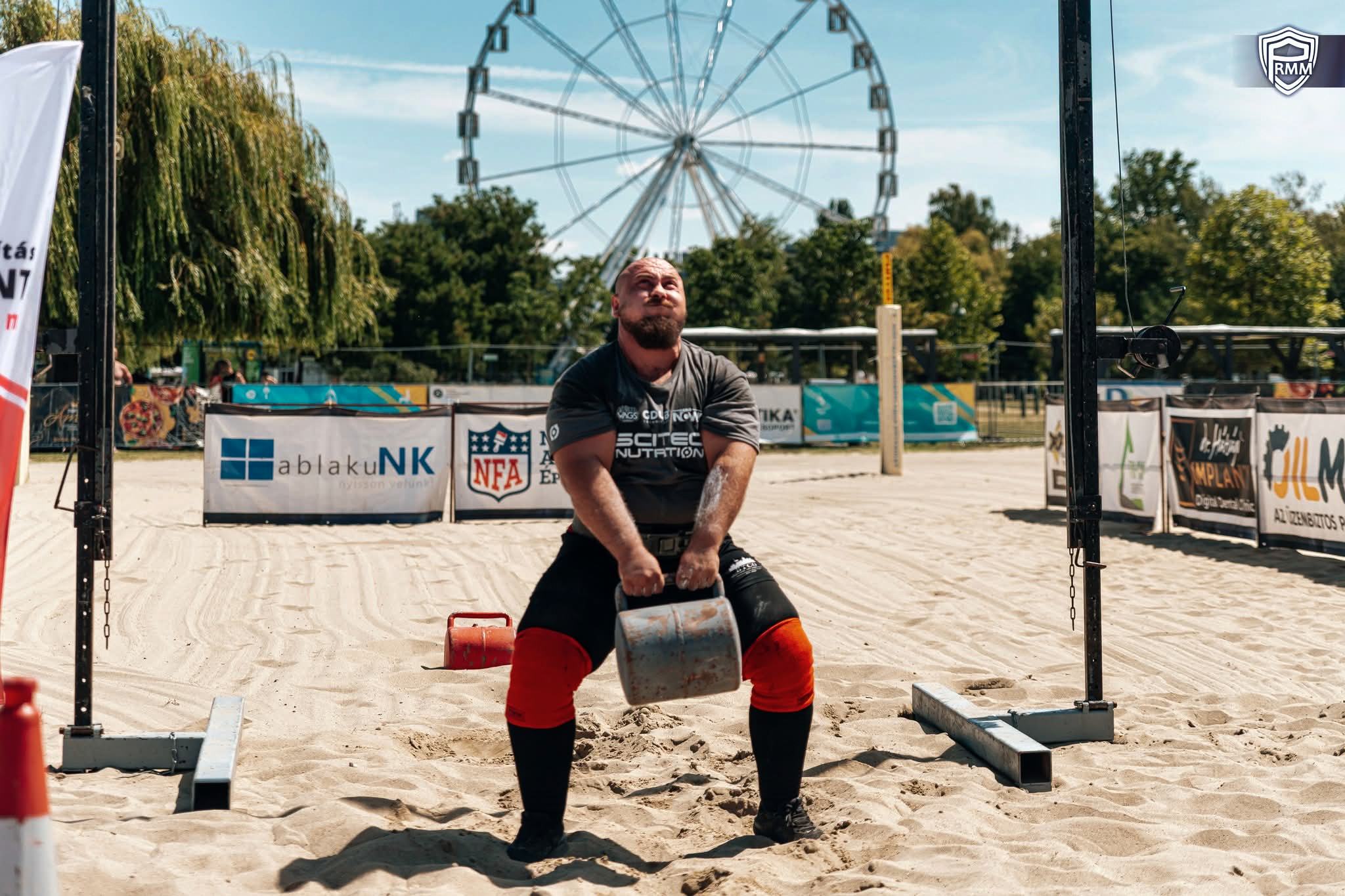
The Science of Strongman - Episode IV: The Biomechanics of Strength - How a Strongman Moves Weight
In Strongman, a weight is never just a weight. A log, Atlas stone, yoke, farmer's walk, keg, or sled does not create the same mechanical problem even when its mass is similar. The object's shape, center of mass, distance from the body, contact surface, freedom of movement, and the way the athlete can apply force completely change the equation.
This is where Strongman biomechanics begins. Performance is not simply the product of abstract muscular strength, but the interaction of force, position, leverage, acceleration, stability, and control. Biomechanical research shows that Strongman events challenge the body's linkage and stabilization system differently from traditional exercises, while carrying events can demand abilities distinct from static lifting.
1. Biomechanics Does Not Ask Only “How Strong Are You?”
The biomechanical question is more precise: where is force applied, in what direction, at what distance from a joint, at what speed, and with what stability? Two people can produce similar muscular force yet generate different joint moments if their positions differ.
In a sport where implements are often asymmetrical, bulky, or unstable, this difference becomes enormous. Technique is partly the art of organizing the body so external forces can be managed efficiently.
2. Force, Moment, and Leverage
A central concept is torque, or the moment of force. For a joint, the effect of a force depends not only on its magnitude but also on the moment arm, the perpendicular distance between the force's line of action and the joint center.
Practically, if an implement moves farther from the body, the same mass can create a much larger joint demand. That is why “keep the object close” is not merely a coaching cue. It is a mechanical strategy for reducing the moment arm. In Strongman, where implements can be large and difficult to control, a few centimeters can meaningfully alter loading.
3. Center of Mass - The Invisible Point That Changes Everything
The center of mass is the point at which the mass of a body can be considered concentrated for translational and rotational analysis. In a compact, symmetrical object, its location may be intuitive. In a large, deformable, or irregular object, its behavior is harder to predict.
A Strongman must learn not only the object's mass but also how that mass behaves. An Atlas stone does not sit on the body like a barbell. A sandbag can change shape. A keg can roll or shift in the arms. A yoke distributes mass around the athlete. The implement becomes part of the athlete's biomechanical system.
4. Base of Support and Balance
To produce and transfer force, the athlete needs a sufficiently stable base of support. Stance width, pressure distribution through the feet, and the position of the center of mass relative to the base influence balance and control.
In a static lift, the base may appear simple. In a carry, however, it becomes dynamic: every step shifts the center of mass and changes the points of contact with the ground. That is why loaded walking is not simply “deadlift plus walking.” It is a distinct locomotor problem.
5. The Trunk - The Link That Transfers Force
In many Strongman events, the trunk acts as a transfer link between the lower and upper limbs. If this link deforms excessively, some of the force produced by the hips and legs can be lost through unwanted motion.
Trunk stiffness does not mean maximal tension at all times. It means controlling motions that do not contribute to the intended task while allowing the joints that need to move to remain mobile enough to do so. Strongman research has documented high levels of trunk muscle co-contraction and loading, particularly during events such as the super yoke.
6. Super Yoke - A Laboratory for Stability
The yoke is an excellent example of applied biomechanics. The load is positioned around the body, and the athlete must move both body mass and implement mass. Every step produces acceleration and deceleration of the system, while the frame must be controlled so the implement does not oscillate excessively.
Biomechanical analyses have shown that the super yoke can generate very high spinal loads, partly because of implement mass and massive trunk co-contraction. This makes the yoke simultaneously a test of strength, stability, and dynamic control.
7. Farmer's Walk - When Strength Becomes Locomotion
The farmer's walk changes the problem completely. The athlete must not only produce force against the ground, but produce it repeatedly through a cycle of steps. Step length, step frequency, ground contact time, trunk position, and control of oscillations influence speed.
Biomechanical research indicates that higher-performing athletes in the farmer's walk have been characterized by greater stride length and stride rate and reduced ground contact time.
8. Stone Loading - Why Object Shape Matters
Lifting a stone is mechanically different from lifting a barbell. The contact surface is broad, the object's center of mass is not fixed to a bar, and the athlete must create and maintain contact while the object moves.
Biomechanical analyses of stone lifting demonstrate the importance of coordination between hip extensors and trunk extensors. The irregular shape of the stone can make an idealized neutral-spine posture impossible to maintain throughout the task, emphasizing the importance of control and technical strategy.
9. Log Press - The Implement Changes the Press
A log is not an oversized Olympic barbell. Its diameter, handles, center of mass, and position relative to the body change the mechanics of the press. The athlete must establish an efficient start position, transfer force from the legs and hips through the trunk, and control the implement vertically.
The implement can also constrain elbow and wrist positions, changing freedom of movement. This leads to a fundamental principle: Strongman technique cannot be mechanically copied from powerlifting or weightlifting. It must be adapted to the implement and the competition rules.
10. Tire Flip - Force Applied in the Right Direction
In a tire flip, the athlete must turn force produced against the ground into both rotation and translation of a large implement. Body position, contact point, and the timing of the transition in the pushing strategy are decisive.
Biomechanical studies have found differences between higher- and lower-performing athletes, including the duration of the second pull phase. This shows that performance depends not only on how much force is produced but also on how efficiently the timing of force application is organized.
11. Sled Pull - The Relationship Between Force and Traction
In a sled pull, the athlete must generate sufficient horizontal force to overcome resistance. The ability to maintain ground contact and direct force usefully becomes critical.
Strongman biomechanical research has associated better heavy sled pull performance with locomotor characteristics such as greater stride length and stride rate and shorter ground contact time.
12. Strength Is Not Enough Without Transfer
An athlete can possess enormous strength in certain movements and still be slower in a Strongman event. One possible reason is force transfer. If body segments are poorly coordinated, muscular force is not efficiently converted into implement displacement.
Transfer depends on sequencing. In a lift, the hip, knee, trunk, and upper limbs do not simply need to “work simultaneously” in the simplistic sense. They need to contribute when their contribution is mechanically useful.
13. Stiffness Versus Mobility
Strongman biomechanics requires a balance between stiffness and mobility. Stiffness helps transmit force and control the implement. Mobility allows the positions required to produce that force.
Too little mobility can force compensations. Too little stiffness can create energy leaks and instability. What matters is task-specific stiffness: the ability to resist unwanted movement while the desired movement continues.
14. Technique Changes With Fatigue
One of the most important aspects of competition biomechanics is that technique does not remain identical throughout an event. As fatigue rises, velocity decreases, stiffness can change, and stabilization strategies are modified.
Therefore, perfect technique in an isolated repetition is not necessarily optimal technique in a medley. The athlete needs technique robust enough to remain efficient when the neuromuscular and energetic systems are already challenged. Recent fatigue research shows that performance effects depend on protocol and task, supporting the need for more ecologically valid models of assessment.
15. Why Awkward Implements Are So Demanding
An awkward implement can increase difficulty without increasing mass. If the center of mass is far from the body, if the contact surface is unstable, or if the implement moves independently of the athlete, the system must produce more control.
This is one of the fundamental differences between Strongman and many traditional barbell exercises. A barbell provides a relatively predictable interface. A Strongman implement can become an unpredictable mechanical partner, and the athlete must control it through position and contact.
16. Biomechanics and Injury Risk
Biomechanics should not be used to automatically label a technique “safe” or “unsafe.” Mechanical loading is only one component of risk. Athlete history, volume, fatigue, recovery, progression, and competitive context also matter.
Nevertheless, understanding loading allows more intelligent programming. Strongman studies have shown that certain events can produce substantial trunk and spinal demands, while object shape can constrain positions that might be considered ideal in conventional exercises.
17. Specificity: Do You Have to Train the Exact Event?
Not always, but the more specific the objective, the more important exposure to the real mechanical characteristics becomes. The squat can build general strength. The deadlift can build extension strength. Neither completely reproduces the demands of a yoke walk, stone load, or farmer's walk.
Strongman literature emphasizes this diversity: carries, pulls, and lifts demand different abilities, while biomechanical research still has important gaps for events such as yoke walk, vehicle pull, Atlas stone, and log lift.
18. Why Good Technique Does Not Always Look the Same
Biomechanics does not provide one universal position. An athlete with long femurs, another with a long torso, and another with very long arms may use different strategies for the same task and still produce efficient mechanics.
Technique should therefore be evaluated relative to anatomy, implement, rules, and outcome. A position can look unusual and still be efficient. Conversely, a position that looks “perfect” can be poorly matched to the athlete's anthropometry or the implement.
19. From Mechanics to Programming
Understanding biomechanics can directly change training. If an athlete loses speed in a carry, the problem may be grip strength, but it may also be stride length, trunk control, implement position, or repeated-force capacity. If an athlete misses a stone load, the problem may be strength, but it may also be contact with the implement or extension sequencing.
Diagnosis should therefore precede the solution. Not every poor result is solved by adding weight to the bar. Sometimes the intervention is a change in position, velocity, range of motion, distance from the body, or contact strategy.
20. Conclusion - Strongman Is Strength Organized in Space
Strongman biomechanics can be summarized in one idea: force must be organized in space and time. It is not enough for the athlete to have muscles capable of producing force. The athlete must orient that force, transfer it through the kinetic chain, control the implement's center of mass, and remain stable while the implement moves.
The yoke shows the importance of stability. The farmer's walk shows that force must become locomotion. Stone loading demonstrates how strongly object shape changes lifting mechanics. The log press shows that the interface between athlete and implement can alter technique. Tire flip and sled pull show that force direction and timing matter as much as force magnitude.
Ultimately, a high-performing Strongman is not merely an athlete who produces large amounts of force. He is an athlete who can place that force exactly where it needs to go, exactly when it needs to go there. When force, leverage, stability, coordination, and the implement align, the weight starts moving. That is where the real biomechanics of Strongman becomes visible.
References
McGill, S. M., McDermott, A., & Fenwick, C. M. J. (2009). Comparison of different strongman events: trunk muscle activation and lumbar spine motion, load, and stiffness. Journal of Strength and Conditioning Research, 23(4), 1148-1161.
Winwood, P. W., Keogh, J. W. L., Harris, N. K., et al. (2019). The Biomechanics and Applications of Strongman Exercises: a Systematic Review. Sports Medicine - Open, 5, 60.
Hindle, B. R., Lorimer, A., Winwood, P. W., & Keogh, J. W. L. (2019). A systematic review of the biomechanical research methods used in strongman studies. Sports Biomechanics.
Woulfe, C., Harris, N., Keogh, J. W. L., & Wood, M. (2014). The physiology of strongman training. Strength and Conditioning Journal, 36(6), 84-95.
Harris, N. K., Woulfe, C. J., Wood, M. R., Dulson, D. K., Gluchowski, A. K., & Keogh, J. W. L. (2016). Acute Physiological Responses to Strongman Training Compared to Traditional Strength Training. Journal of Strength and Conditioning Research, 30(5), 1397-1408.
Gastin, P. B., & Suppiah, H. T. (2026). Anaerobic and Aerobic Energy System Contribution During Maximal Exercise: A Systematic Review. Sports Medicine, 56(7), 1723-1747.
More From The Journal

Training
The Science of Strongman Training - Episode X: Competition Programming
How to build a complete Strongman competition preparation block: calendar, events, volume, intensity, specificity, simulations, autoregulation, tapering and fatigue management.
Training
The Science of Strongman Training - Episode IX: Peaking
Peaking in Strongman: how to turn months of training into maximal competition performance by reducing fatigue, preserving adaptations and managing specificity.