
Training
The Science of Strongman Training - Episode VI: Overreaching and Overtraining
October 12, 2026
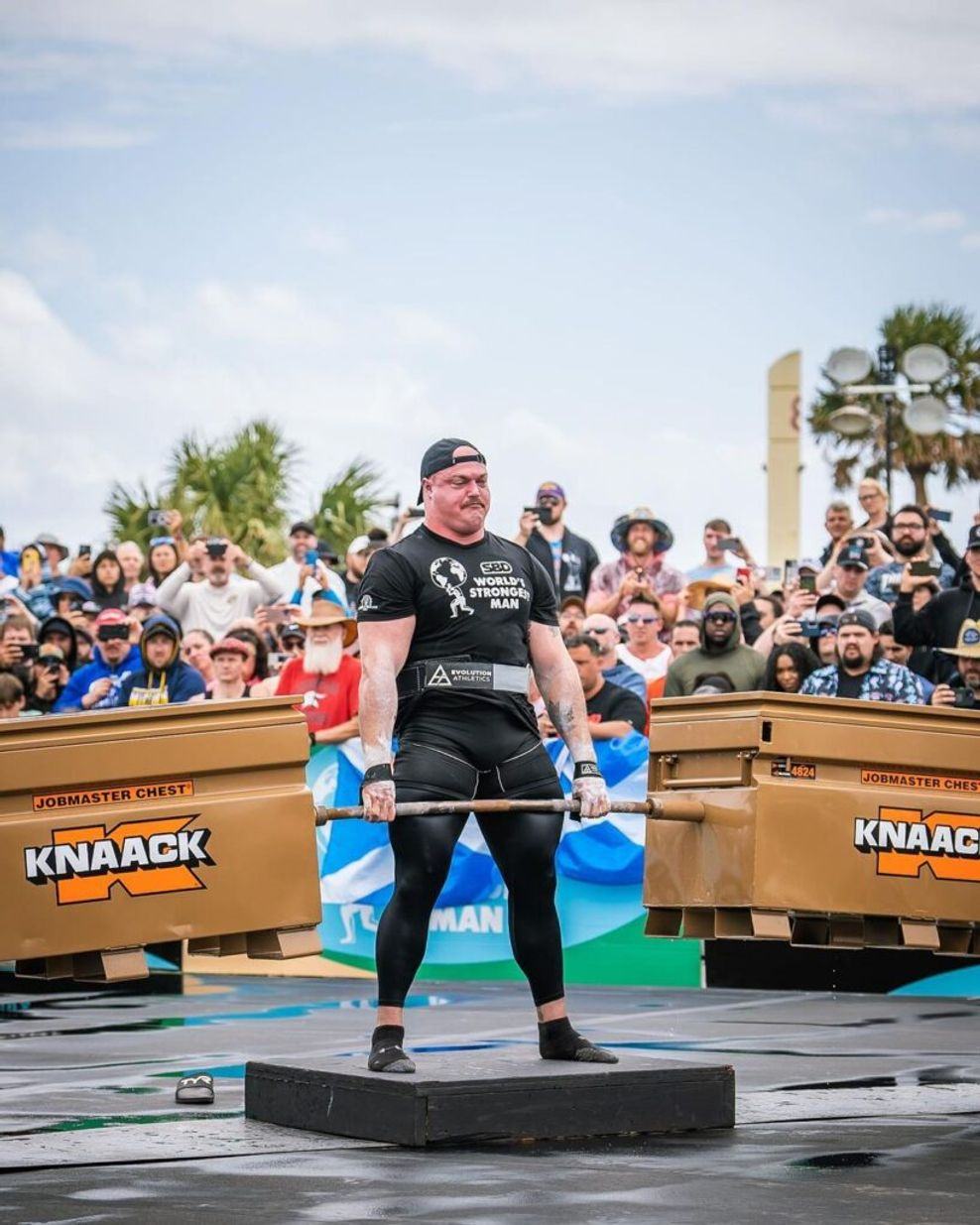
In Strongman, progress does not occur without stress. To become stronger, faster, more resilient to heavy implements and more technically efficient, the athlete must be exposed to a stimulus large enough to create a reason for adaptation. The problem begins when stress repeatedly exceeds the capacity to recover. At that point, the same tool that builds performance can begin to erode it.
This is where two frequently used terms are often applied without enough precision: overreaching and overtraining. They are not synonyms for one hard week, muscle soreness or a day when the bar feels unusually heavy. The literature distinguishes a temporary and sometimes intentional reduction in performance that may be followed by positive adaptation from a longer maladaptive state and, much more rarely, true overtraining syndrome.
For Strongman, this distinction matters. The sport combines maximal strength, power, carries, awkward implements, grip, axial loading, technique, conditioning and competitions in which several events are compressed into a short period. An athlete can accumulate muscular, neural, metabolic and psychological fatigue from sources that are not visible in a simple count of sets. Overreaching therefore has to be understood as a whole-system problem, not merely a muscle problem.
1. Overreaching does not automatically mean that you trained too much
Overreaching describes a period in which training load rises above the athlete’s usual level and performance may temporarily decline. In functional overreaching, that decline is relatively short and is followed by recovery and, in some contexts, improved performance. This strategy is not proven to be necessary for progress, but it can occur during deliberately demanding training phases.
This changes how fatigue should be interpreted. A temporary reduction in performance is not, by itself, evidence that the program has failed. If an athlete enters a difficult training block, performance falls for several days, and then returns to a higher level after stress is reduced, the response is compatible with functional adaptation. Context, duration and the response to recovery matter.
Non-functional overreaching is more problematic. High training load combined with insufficient recovery produces a longer performance decrement accompanied by fatigue, mood changes or other signs of maladaptation. The problem is no longer simply that the athlete is tired. The problem is that the fatigue is no longer producing the adaptive result for which the load was introduced.
In the literature on strength sports and resistance training, evidence for genuine overtraining syndrome is surprisingly limited. There is evidence for functional and non-functional overreaching, but diagnosis of overtraining syndrome is difficult and requires exclusion of other explanations for performance loss. This matters because the word overtrained is used in strength gyms far more often than the evidence can justify.
2. The three levels: functional overreaching, non-functional overreaching and overtraining syndrome
Functional overreaching can be understood as a state of increased training stress and temporarily depressed performance from which the athlete recovers within a relatively short period. In a well-designed Strongman program, this may occur after several high-volume weeks, after accumulating demanding event sessions or before a planned reduction in training stress. The term functional does not mean that suffering is automatically beneficial. The benefit has to be judged by what happens after recovery.
Non-functional overreaching is more concerning. Performance remains depressed for longer and recovery becomes more difficult. Sleep disruption, persistent fatigue, low motivation, mood disturbance and reduced tolerance to training may appear. In this state, automatically adding more work is not a champion mentality. It is ignoring biological feedback.
Overtraining syndrome is a much more serious and less common condition. The ECSS and ACSM consensus emphasizes prolonged maladaptation and the need to exclude other causes such as infection, low energy availability, insufficient carbohydrate or protein intake, iron deficiency and medical conditions. There is no single blood test or hormonal value that universally confirms the syndrome.
The practical message is simple: do not diagnose overtraining after one bad session. Look for a pattern. One poor day is noise. One difficult week may be normal fatigue. Persistent performance decline combined with changes in sleep, mood, appetite, motivation and tolerance to exercise deserves investigation.
3. Why Strongman has a distinctive fatigue profile
A Strongman program cannot be evaluated by tonnage alone. Two weeks with the same number of kilograms can have completely different costs. Heavy deadlift creates a different demand from Yoke Walk. Farmer’s Walk adds grip and locomotion. Stones combine flexion, extension, object contact and acceleration. Medleys compress several qualities into one sequence. A session can be short in duration and still be highly costly.
Fatigue also comes from more than training. Competition, travel, physical work, poor sleep, psychological stress, insufficient energy intake and changes in routine can alter the balance between stress and recovery. The athlete can perform exactly the same session in two consecutive weeks and receive two different biological doses because recovery status is different.
This is central to Strongman: external load is not identical to internal load. Three hundred kilograms on a bar is an external load. The cost that load creates depends on experience, technique, sleep, nutrition, stress, recent exposure and current fatigue. Programming has to consider both sides.
4. When a hard week becomes a problem
A hard microcycle is not problematic simply because it is hard. The problem appears when the next sessions are programmed as if the athlete had recovered even though the available information says otherwise. If performance falls, technique degrades, RPE rises at the same loads, sleep worsens and pain persists, automatically continuing volume can turn manageable fatigue into maladaptation.
One particularly important mechanism is monotony. If every day is hard, every event is specific, every set is close to failure and training stress rarely changes, the athlete loses the space in which the body can absorb the load. Strongman does not require maximum effort every day. It requires enough stress on the right days and enough recovery between them.
Another issue is repeated failure training. Training to failure can have a place in certain exercises and contexts, but frequent maximal efforts in complex or highly demanding Strongman movements can raise fatigue cost without a proportional benefit. The more technical and systemically demanding the exercise, the more carefully the stimulus-to-fatigue relationship should be considered.
5. The signals that matter: performance, RPE, sleep, mood and pain
No single marker is sufficient to identify overtraining syndrome. Scientific consensus emphasizes the difficulty of diagnosis and the fact that hormonal, biochemical, immune, psychological and performance markers do not provide a universal answer on their own. Monitoring therefore needs to combine several sources of information.
Performance is probably the most useful practical signal. If an athlete repeatedly sees lower performance at the same load and under similar conditions while RPE rises, the situation deserves investigation. Do not track only absolute numbers. Movement speed, number of high-quality repetitions, technical consistency and the ability to reproduce performance after normal rest also matter.
Sleep and mood are equally important. Difficulty falling asleep, frequent waking, non-restorative sleep, irritability, low motivation or reduced interest in training do not prove overtraining, but combined with declining performance they can form a pattern of under-recovery. Daily monitoring should be simple and repeatable, not a collection of dozens of numbers that nobody uses.
Persistent pain should also be separated from ordinary muscle fatigue. In Strongman, grip, biceps, lumbar tissues, shoulders, knees and tendons can receive repeated loading. If pain changes technique, limits range of motion or persists from session to session, it should not be solved with more willpower. Training load should be reviewed and medical assessment considered when appropriate.
6. Planned overreaching: it can be used, but it should not be romanticized
The idea of deliberately pushing above the habitual training level has a logical basis. A loading phase can create accumulated fatigue, and a subsequent reduction in stress can allow previously developed capacity to be expressed. In sports science, this is often discussed within the fitness-fatigue continuum. However, the research does not establish that athletes must deliberately enter a deep overreached state to make progress.
For Strongman, this distinction matters because the cost of a loading phase can be high. If the goal is work capacity, volume can rise. If the goal is tolerance to consecutive events, density can rise. If the goal is maximal strength, intensity can rise. But there is no requirement to maximize volume, intensity, frequency, specificity and density simultaneously.
In other words, intelligent overreaching means controlling the dose, not glorifying suffering. If the athlete cannot explain which variable was increased, why it was increased and when it will be reduced, the strategy is not clearly defined. It is accumulation.
7. Why true overtraining is rarer than people think
In strength sports, it is tempting to label every difficult period as overtraining. The literature suggests otherwise. Evidence for genuine overtraining syndrome in resistance training and strength sports is limited. A scoping review of 47 papers found evidence for functional and non-functional overreaching but very limited evidence that allowed a clear conclusion that true overtraining syndrome had occurred in these populations.
This does not mean strength athletes cannot reach a serious state of under-recovery. It means the terminology should be disciplined. An athlete can be exhausted, perform poorly and require a substantial reduction in training stress without meeting the clinical concept of overtraining syndrome.
That precision is useful. If everything is called overtraining, we lose the ability to distinguish normal accumulated fatigue, a programming problem, insufficient energy intake, sleep disruption, injury, infection or a genuine clinical state. Good diagnosis begins by not confusing the labels.
8. Deloading: the brake that allows the engine to continue
Deloading is one strategy used to reduce accumulated training stress. A 2023 international consensus for strength and physique sports defines deloading as a period of reduced training stress intended to mitigate physiological and psychological fatigue, promote recovery and enhance preparedness for subsequent training.
There is no single universal recipe. Volume can be reduced through fewer sets or repetitions, intensity can be adjusted and exercise selection can change. In Strongman, it may be more useful to reduce high-cost exposures rather than remove movement entirely. A technical, lighter version of an event can remain while the maximal attempt is removed.
Deloading should not be viewed as punishment for getting tired. It is a programming component. If a period of high stress is planned, the period of reduced stress should be intentional as well. An athlete does not lose meaningful strength simply because volume is reduced for several days. Reducing fatigue can allow existing strength to be expressed more effectively.
9. Strongman: what should be reduced first when recovery deteriorates?
The answer is not always stop everything. If performance is affected, identify the dominant cost. Sometimes the problem is total volume. Sometimes intensity. Sometimes excessive frequency of specific work. An athlete may tolerate squat and bench well but be crushed by two heavy Stones and Yoke sessions placed too close together.
In practice, the first variable to reduce is often unnecessary or repetitive volume. Keep the essential stimulus and remove work that adds fatigue without a clear contribution to the goal. Then adjust intensity, failure exposure, event count and frequency of heavy exposures as needed. The objective is not to make training easy. It is to make cost proportional to benefit.
Before competition, this logic becomes even more important. You do not need to prove that you can survive a brutal session seven days before the contest. You need to arrive on competition day able to produce force, technique and speed without residual fatigue stealing performance.
10. Nutrition and energy: when the problem looks like training but is not
One of the most important lessons from overtraining literature is that performance decline should not automatically be blamed on training. The ECSS and ACSM consensus recommends excluding factors such as negative energy balance and insufficient carbohydrate or protein intake, together with medical causes.
For Strongman, this is highly relevant. A very large athlete has a high energy demand, and heavy implement sessions can consume substantial resources. If training volume increases while food intake remains unchanged, the problem may not be that the volume is impossible. The problem may be that recovery resources did not increase with the training demand.
The same principle applies to hydration and carbohydrate availability during high-volume phases. On days with several events, energy availability can directly affect execution quality. An athlete who loses speed and technical control may need less training stress, but the nutrition and recovery system should also be examined.
11. Sleep and life stress are part of the program
The body does not neatly separate gym stress from the rest of life. Recovery and performance consensus emphasizes that the stress-recovery balance includes training, competition and demands outside sport. For a Strongman who works, travels or has family responsibilities, total stress can be much higher than what appears in the training log.
A normal training week can therefore become very difficult when sleep decreases, psychological stress rises and nutrition becomes chaotic. During such periods, temporary adjustment of training can be the mature solution. Not because the athlete is weak, but because adaptation is constrained by available resources.
Sleep should be treated as a programming variable. If three consecutive nights are poor, there is no requirement to cancel all training. But reducing a maximal attempt, preserving technique and reassessing over the following days can be reasonable. A rigid program is not superior to one that responds to biological reality.
12. Monitoring: turning sensations into information
Monitoring does not need to be complicated. A practical system can track sleep duration and quality, energy, mood, pain, motivation and session RPE. Weekly, the athlete can review performance on a few benchmark lifts and the trend in training load.
The key is to look for change from the athlete’s own normal level. There is no universal RPE value that proves an athlete is overtrained. If a load that was normally RPE 7 repeatedly becomes RPE 9 while speed declines and sleep worsens, that is more informative than one isolated measurement.
A useful log can also include context: travel, competitions, physical work, psychological stress, dietary changes and unusually demanding sessions. These data help distinguish a local training response from a systemic problem. Monitoring becomes useful only when it changes decisions.
13. What do you do when several negative signals appear?
First, do not panic and do not automatically add more passive recovery without understanding the cause. Review the context. Did volume increase? Intensity? Specific event frequency? Did sleep decrease? Did body mass drop intentionally? Was there illness? A competition? Travel?
Second, reduce cost. Remove accessory work, reduce event count, avoid failure and keep selected technical exposures. If performance stabilizes and symptoms improve, you have learned something useful about current training tolerance.
Third, escalate assessment if the problem persists. Prolonged performance decline, systemic symptoms, major mood changes or medical concerns should not be managed solely through programming. Appropriate medical evaluation may be required to exclude other causes.
14. What does programming that reduces maladaptation look like?
The first principle is alternation. Not every day needs to be hard and not every event needs to be trained at the same intensity. A week can contain heavy exposures, moderate sessions, technical work and recovery-oriented sessions. This variation distributes stress.
The second principle is progressing one major variable at a time. If volume rises, intensity does not automatically need to rise at the same time. If a new high-cost event is introduced, another stimulus can temporarily be reduced. This keeps the program readable.
The third principle is preserving reserves. Not every set needs to reach the limit. Not every week needs a record. An elite athlete needs the ability to repeat performance, not merely produce one memorable session.
The fourth principle is planning reductions in stress. Deloading can be scheduled after demanding periods, around competitions or when monitoring indicates excessive accumulation. Current coaching consensus does not support one universal deload frequency. The need is individual and depends on training stress and athlete response.
15. Overreaching in Strongman: an example of logic, not a universal recipe
Imagine an athlete entering a six-week accumulation phase. During the first two weeks, general volume increases. During the next two, specific volume rises through carries and loading. In week five, heavier loading and denser sessions are introduced. In week six, volume drops while selected intensity is maintained and fatigue is allowed to fall.
In this model, the hard week is not isolated from the rest of the program. It has a function and an exit point. If the athlete continues increasing weights in week seven simply because he feels compelled to prove he is tougher than in week six, the mechanism changes. It is no longer controlled accumulation. It is accumulation without an exit.
This is one of the most important Strongman principles: a hard phase needs a limit. If there is no point at which stress decreases, you have not created a controlled overreaching phase. You have created a new normal of fatigue.
16. Conclusion: you do not need to be permanently exhausted to be progressing
Overreaching and overtraining are different concepts and should be treated differently. Functional overreaching may involve a short performance decline followed by recovery and adaptation. Non-functional overreaching occurs when the imbalance between training and recovery produces a longer performance decline and signs of maladaptation. Overtraining syndrome is much rarer, difficult to diagnose and should only be considered after other causes have been excluded.
In Strongman, accumulation risk is real because the sport combines very high loads with technical, locomotor and metabolic demands. But the solution is not permanently training less. The solution is controlling the relationship between stimulus and recovery. Sometimes you push. Sometimes you reduce. Performance emerges from intelligent alternation between the two.
A successful Strongman is not the athlete who tolerates the most fatigue. It is the athlete who can create enough stress to adapt, recognize when the cost becomes excessive and recover before fatigue turns into maladaptation. Strength is not built through continuous destruction. It is built through sufficient stress, sufficient recovery and repeating that cycle for long enough.
Bibliography and sources
1. Meeusen R, Duclos M, Foster C, et al. Prevention, diagnosis and treatment of the overtraining syndrome: Joint consensus statement of the European College of Sport Science and the American College of Sports Medicine. Medicine & Science in Sports & Exercise. 2013;45(1):186-205. DOI: 10.1249/MSS.0b013e318279a10a.
2. Weakley J, Halson SL, Mujika I, et al. Overreaching and overtraining in strength sports and resistance training: A scoping review. Journal of Sports Sciences. 2020;38(16):1897-1912. DOI: 10.1080/02640414.2020.1763077.
3. Bell L, Strafford BW, Coleman M, Androulakis-Korakakis P, Nolan D. Integrating Deloading into Strength and Physique Sports Training Programmes: An International Delphi Consensus Approach. Sports Medicine - Open. 2023;9:87. DOI: 10.1186/s40798-023-00633-0.
4. Kellmann M, Bertollo M, Bosquet L, et al. Recovery and Performance in Sport: Consensus Statement. International Journal of Sports Physiology and Performance. 2018;13(2):240-245. PMID: 29345524.
5. Soligard T, Schwellnus M, Alonso JM, et al. How much is too much? International Olympic Committee consensus statement on load in sport and risk of illness. British Journal of Sports Medicine. 2016.
6. McGuigan H, Hassmén P, Rosic N, Stevens CJ. Training monitoring methods used in the field by coaches and practitioners: A systematic review. International Journal of Sports Science & Coaching. 2020;15(3). DOI: 10.1177/1747954120913172.
7. Winwood PW, Keogh JWL, Harris NK. The strength and conditioning practices of strongman competitors. Journal of Strength and Conditioning Research. 2011;25(11):3118-3128. DOI: 10.1519/JSC.0b013e318212daea.
8. Winwood PW, Hume PA, Cronin JB, Keogh JWL. Retrospective injury epidemiology of strongman athletes. Journal of Strength and Conditioning Research. 2014.
9. Hindle BR, Lorimer AV, Winwood PW, Keogh JWL. The biomechanics and applications of Strongman exercises: a systematic review. Sports Medicine - Open. 2019;5:49. DOI: 10.1186/s40798-019-0222-z.
More From The Journal

Training
The Science of Strongman Training - Episode X: Competition Programming
How to build a complete Strongman competition preparation block: calendar, events, volume, intensity, specificity, simulations, autoregulation, tapering and fatigue management.

Training
The Science of Strongman Training - Episode IX: Peaking
Peaking in Strongman: how to turn months of training into maximal competition performance by reducing fatigue, preserving adaptations and managing specificity.