
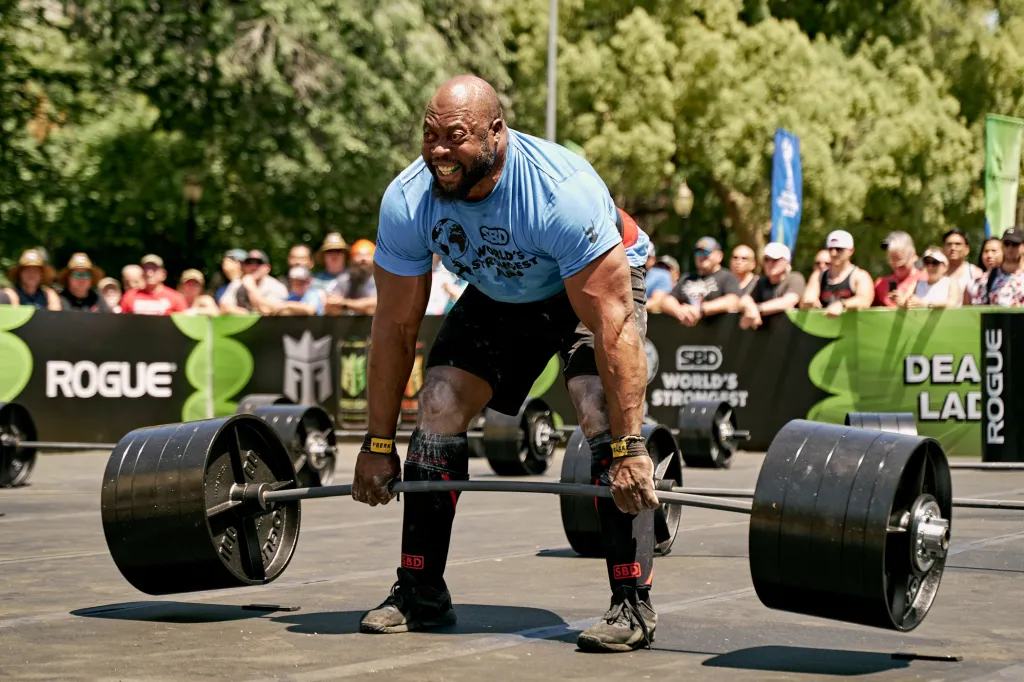
Frequency is one of those training variables that looks simple in theory and becomes complicated as soon as the sport is Strongman. At first glance, frequency means the number of training sessions completed in a week. In reality, a Strongman athlete has a frequency for squats, deadlifts, pressing, grip, Yoke, Farmer’s Walk, Stones, conditioning, technical practice and, more importantly, a frequency of exposure to different types of stress. That distinction changes how the microcycle should be built.
General resistance-training literature indicates that when total volume is equated, frequency has a much smaller effect on hypertrophy than is sometimes assumed. Meta-analyses have generally found similar hypertrophy outcomes when the same volume is distributed across different numbers of days. For strength, some analyses identify benefits of higher frequency, but these tend to disappear or become smaller when volume is equated. More recent evidence suggests that frequency may have an independent relationship with strength gains, with diminishing returns. The practical conclusion is not that frequency does not matter, but that its main value is often the ability to organize the training dose more effectively.
1. Frequency is not the number of days. It is the distribution of the stimulus
A Strongman program should separate at least three concepts: total training frequency, frequency of a quality, and frequency of an event. You can have four training days and only one heavy deadlift exposure, two pressing exposures and three indirect grip exposures. If you only count training days, you lose information that matters for adaptation. Frequency should therefore be viewed as an exposure matrix, not simply a number in the corner of the program.
This approach is essential because Strongman stimuli overlap. A heavy Yoke is not just a leg event. It involves the trunk, spinal musculature, shoulder girdle, stability and locomotion under load. Farmer’s Walk stresses grip, but also gait, trunk control and force production while the center of mass is disturbed. Atlas Stones involve hip and knee extension, trunk mechanics, arm positioning and object control. If these exposures are placed too close together, the true frequency of stress applied to the same structures can be much higher than the written program suggests.
Good frequency therefore does not mean squeezing in as many training days as possible. It means creating enough exposures to maintain stimulus and practice while leaving enough space for the athlete to convert those exposures into adaptation. Frequency is essentially a problem of temporal stress distribution.
2. The relationship between frequency and volume: the same dose, a different architecture
Imagine 20 productive lower-body sets in one week. They can be concentrated into two days, divided across three, or distributed across four. If effective volume and intensity are comparable, there is no guarantee that four days will produce more hypertrophy than two. Frequency syntheses support this idea: when volume is equated, hypertrophy differences become small or disappear. Frequency therefore becomes an organizational tool.
But organization is not a minor detail. Two days with ten sets each can produce substantial fatigue within a session. Dividing the work across three or four exposures may preserve repetition quality, reduce technical degradation and allow each session to begin with better neuromuscular availability. In Strongman, this advantage is amplified because technical quality has direct competitive value. Performing more high-quality repetitions may be more useful than performing the same number of repetitions after fatigue has altered the movement.
Frequency can therefore control the size of each dose. If 24 Log repetitions are required in a week, they can be programmed as 4 × 6, 3 × 8 or 2 × 12. These configurations are not physiologically identical in a technical event. The first may favor quality and velocity, while the last may create more local and technical fatigue within each session. The appropriate configuration depends on the goal, athlete level and season phase.
The recent meta-regression by Pelland and colleagues, including 67 studies and 2,058 participants, found a clear relationship between increasing volume and strength and hypertrophy adaptations, with diminishing returns. For frequency, the effect on hypertrophy was compatible with negligible effects, whereas strength showed a positive relationship, again with diminishing returns. This is highly relevant to Strongman: frequency can be valuable not because more days automatically build more muscle, but because they allow better distribution of work and more high-quality exposures to specific movements.
3. Frequency for strength: neural practice, specificity and exposure quality
Maximal strength is not only a property of muscle mass. It depends on intermuscular coordination, motor-unit recruitment, rate of force development, exercise technique and the ability to produce force in specific positions. Frequency can therefore become particularly useful when the goal is to improve a complex movement. Repeating a movement often enough can improve familiarity and technical efficiency without making every exposure maximal.
In Strongman, this is obvious with Log Lift, Axle Press, Farmer’s Walk and Yoke. An athlete may have one heavy exposure, one technical exposure and one speed exposure in the same week without having three maximal sessions. Frequency is therefore connected to intensity distribution. A competition event can appear multiple times, but each exposure can have a different function: development, technique, speed, fatigue tolerance or competition specificity.
This is different from the simplistic idea that an exercise should be repeated frequently simply because it is important. Each exposure needs a purpose. If an athlete performs Log four times per week and all four sessions are heavy, frequency stops being an organizational tool and becomes multiplication of stress. If two exposures are moderate and one is heavy, frequency can increase practice without proportionally multiplying recovery cost.
4. Strongman event frequency: how often should you lift the object you want to master?
Specificity creates a particular problem in Strongman. An event may differ so much from classical exercises that transfer from the gym is incomplete. Squat strength can contribute to Yoke, but it does not replace walking with a Yoke. Deadlift strength can contribute to Farmer’s Walk, but it does not replace controlling the implements during locomotion. Hip-extension strength can contribute to Stones, but it does not replace lap, extension and loading technique.
Biomechanical research on Strongman events shows that these events have specific demands. Yoke Walk changes gait parameters with load and speed. Atlas Stone lifting contains distinct phases, with mechanics influenced by load and fatigue. Farmer’s Walk combines force production with locomotion and control of an external load. Therefore, practice frequency should be based on how much specific adaptation is needed and how costly each exposure is.
A high-mechanical-cost event may require low frequency but strategic practice. A very heavy Yoke, for example, may appear once per week or less often in certain phases, while gait, posture and rhythm can be practiced with lighter loads. Conversely, a lower-cost technical exercise may tolerate more frequent exposures. Frequency should therefore be determined by the benefit-to-cost ratio of the exposure, not by a universal rule.
5. Frequency and recovery: the question is not whether you can repeat, but whether you can repeat and adapt
An athlete can repeat a session before every sign of fatigue has disappeared. That does not automatically mean frequency is too high. Recovery is not a switch that instantly moves from “fatigued” to “recovered.” It is a dynamic process in which different systems recover at different rates. Metabolic recovery, the nervous system, muscle, tendons, joints and psychological readiness may all follow different timelines.
In Strongman, this matters enormously. An athlete may feel that the legs are ready while grip is still fatigued. He may have good squat performance but reduced tolerance to Yoke. He may execute a heavy deadlift but not be ready for a Stone session that heavily challenges finger flexors, biceps, trunk and hips. Recovery must therefore be analyzed by systems and stress types rather than as one global state.
Excessive frequency occurs when a new exposure is introduced before the body can absorb the previous exposure. The signal may be reduced performance, higher RPE at the same load, lower velocity, technical deterioration or accumulation of pain. None of these signs alone diagnoses overtraining, but together they may indicate that current frequency exceeds recovery capacity.
6. Frequency across the season: not every week should look the same
Frequency should change with the objective. During an accumulation phase, frequency can distribute higher volume and help build muscle mass and work capacity. During intensification, the number of exposures may remain relatively stable while the proportion of heavy sessions increases. Near competition, frequency can be maintained to preserve movement familiarity while volume and cost of each exposure are reduced.
This is an important distinction between frequency and volume. You can reduce volume without eliminating frequency. An athlete may perform two Log exposures in the week before competition with far fewer repetitions. He may perform a short Yoke exposure for coordination and rhythm without turning the session into a capacity test. Frequency can therefore maintain specificity even when volume is being reduced.
Across a long season, frequency can also function as a risk-management tool. If the same structure is exposed to high loads three times per week for months, cumulative cost may become important. Alternating heavy, moderate and technical exposures can maintain practice without every contact with the event having the same mechanical aggressiveness.
7. How to build Strongman frequency: from a program to a monitoring system
An advanced program starts by defining priorities, not by choosing the number of days. First identify the events and qualities that need development. Then establish realistic weekly volume. Next choose the frequency that distributes this volume with the best combination of quality, specificity and recovery. Only then should the concrete weekly calendar be built.
A conceptual model may contain four main days: a lower-body and deadlift-dominant day, a pressing and Log technique day, a carry and grip event day, and a mixed Stones, loading and conditioning day. Depending on the athlete, short additional exposures for technique or speed may be included. The exact number of days is less important than how overlapping stresses are distributed.
For an advanced athlete, frequency can be considered at several levels. Macro frequency is the number of sessions per week. Meso frequency is the number of exposures to a quality within a week or microcycle. Specific frequency is the number of exposures to an event. Technical frequency is the number of contacts with a movement at a low enough intensity to permit practice without a large recovery cost. This last category is particularly useful in Strongman.
Monitoring can include performance at standardized loads, RPE, repetition velocity when available, event distance and time, technical quality and the next-day response. If higher frequency creates more exposures but every exposure becomes slower, harder and technically less stable, its benefit needs to be reassessed. Frequency is useful only if it improves the system, not if it merely fills the calendar.
8. Conclusion: optimal frequency is the frequency you can sustain and convert into performance
There is no universal Strongman frequency. There are frequencies appropriate to different goals, training levels and events. General evidence does not support the idea that simply increasing training days automatically produces more hypertrophy, while strength effects appear to be related largely to the ability to distribute volume and increase high-quality exposures. Strongman-specific literature adds a decisive element: events have their own biomechanical demands, and the cost of an exposure can be much greater than the number of sets suggests.
For Strongman, frequency is best understood as the architecture of time between stimuli. Too little and you lose practice, specificity and sometimes exposure quality. Too much and there is insufficient space for adaptation. Optimal frequency is the zone in which each exposure contributes to the next rather than sabotaging it. That is the difference between a program that merely fills the week and a program that builds an athlete.
Bibliography and sources
1. Schoenfeld BJ, Grgic J, Krieger J. How many times per week should a muscle be trained to maximize muscle hypertrophy? Journal of Sports Sciences. 2019;37(11):1286-1295. DOI: 10.1080/02640414.2018.1555906.
2. Schoenfeld BJ, Ogborn D, Krieger JW. Effects of Resistance Training Frequency on Measures of Muscle Hypertrophy: A Systematic Review and Meta-Analysis. Sports Medicine. 2016;46:1689-1697. DOI: 10.1007/s40279-016-0543-8.
3. Grgic J et al. Effect of Resistance Training Frequency on Gains in Muscular Strength: A Systematic Review and Meta-Analysis. Sports Medicine. 2018. PMID: 29470825.
4. Ralston GW et al. Weekly Training Frequency Effects on Strength Gain: A Meta-Analysis. Sports Medicine - Open. 2018. PMID: 30076500.
5. Pelland CJ et al. The Resistance Training Dose Response: Meta-Regressions Exploring the Effects of Weekly Volume and Frequency on Muscle Hypertrophy and Strength Gains. Sports Medicine. 2026;56(2):481-505. DOI: 10.1007/s40279-025-02344-w.
6. Winwood PW, Keogh JWL, Harris NK. The strength and conditioning practices of strongman competitors. Journal of Strength and Conditioning Research. 2011;25(11):3118-3128. DOI: 10.1519/JSC.0b013e318212daea.
7. Hindle BR, Lorimer AV, Winwood PW, Keogh JWL. The Biomechanics and Applications of Strongman Exercises: a Systematic Review. Sports Medicine - Open. 2019;5:49. DOI: 10.1186/s40798-019-0222-z.
8. Hindle BR et al. The Biomechanical Characteristics of the Strongman Yoke Walk. 2021. PMID: 33981993.
9. Hindle BR et al. The biomechanical characteristics of the strongman atlas stone lift. PeerJ. 2021;9:e12066. DOI: 10.7717/peerj.12066.
10. American College of Sports Medicine. Resistance Training Prescription for Muscle Function, Hypertrophy, and Physical Performance in Healthy Adults: An Overview of Reviews. 2026. PMID: 41843416.
More From The Journal

Training
The Science of Strongman Training - Episode X: Competition Programming
How to build a complete Strongman competition preparation block: calendar, events, volume, intensity, specificity, simulations, autoregulation, tapering and fatigue management.

Training
The Science of Strongman Training - Episode IX: Peaking
Peaking in Strongman: how to turn months of training into maximal competition performance by reducing fatigue, preserving adaptations and managing specificity.